Shipping Hand Sanitizer During the COVID-19 Public Health Emergency
Introduction:
As of this writing (04.06.20) the expanding COVID-19 pandemic in the U.S. has made the regulations pertaining to the transportation of hand sanitizer of special interest. If you are involved in the transport of this hazardous material (HazMat), then you must comply with the Hazardous Materials Regulations (HMR) of the Pipeline and Hazardous Materials Safety Administration within the U.S. Department of Transportation (USDOT/PHMSA).
Photo by Martin Sanchez on Unsplash
The purpose of this article is to identify and explain the applicable regulations of USDOT/PHMSA for the classification, packaging, hazard communication, and transport of Hand Sanitizer within the U.S.
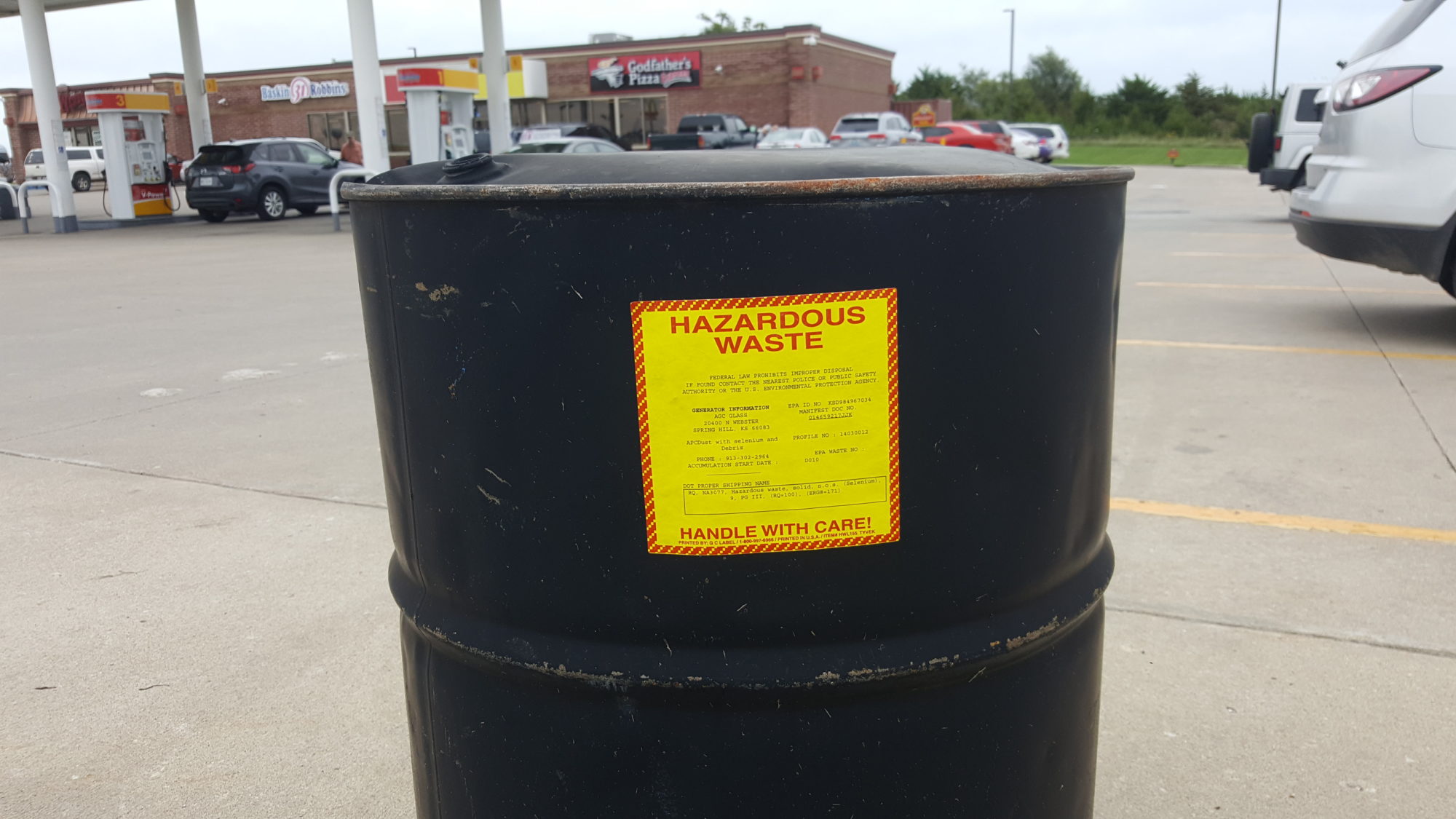
FAQ: How does USDOT/PHMSA classify a hazardous waste?
Hazardous waste is defined at 49 CFR 171.8 of the Hazardous Materials Regulations (HMR) of USDOT/PHMSA as follows:
Hazardous waste, for the purposes of this chapter, means any material that is subject to the Hazardous Waste Manifest Requirements of the U.S. Environmental Protection Agency specified in 40 CFR part 262.
Contact me with any questions you may have about the generation, identification, management, and disposal of hazardous waste
So, to understand USDOT/PHMSA’s definition of a hazardous waste we must refer to the regulations of the USEPA. The regulations of the USEPA at 40 CFR 262, subpart B describe the Manifest Requirements applicable to Small and Large Quantity Generators. This means only the following hazardous waste generator categories are subject to the requirements of 40 CFR 262, subpart B for the uniform hazardous waste manifest:
Large quantity generator of hazardous waste (LQG)
Small quantity generator of hazardous waste (SQG)
Not included in these regulations, i.e., not subject to the Hazardous Waste Manifest Requirements of the USEPA at 40 CFR 262, subpart B, is the following hazardous waste generator category:
Very small quantity generator of hazardous waste (VSQG). Formerly known as the conditionally exempt small quantity generator of hazardous waste (CESQG).
The factors for determination of hazardous waste generator categories are summarized below:
Large quantity generator:
Generate ≥1,000 kg (2,200 lb) of hazardous waste in calendar month.
Or…
Generate >1 kg (2.2 lb) acute hazardous waste or >100 kg (220 lb) acute hazardous waste spill residue in a calendar month.
Small quantity generator:
Generate >100 kg (220 lb) but <1,000 kg (2,200 lb) of hazardous waste in calendar month.
And…
Generate ≤1 kg (2.2 lb) acute hazardous waste and ≤100 kg (220 lb) acute hazardous waste spill residue in a calendar month.
Very small quantity generator:
Generate ≤100 kg (220 lb) hazardous waste in calendar month.
And…
Generate ≤1 kg (2.2 lb) acute hazardous waste and ≤100 kg (220 lb) acute hazardous waste spill residue in a calendar month.
Q: My state mandates the use of the uniform hazardous waste manifest for non-RCRA hazardous waste (California) / special waste (Illinois) / non-hazardous industrial solid waste (Texas) / liquid industrial by-product (Michigan), does that mean it is also a hazardous waste per USDOT/PHMSA?
A: No. The definition of hazardous waste in the HMR references the requirement to use the uniform hazardous waste manifest (40 CFR part 262). It is not impacted by the regulations of a state. How a state chooses to manage waste under its RCRA authorization does not affect USDOT/PHMSA’s definition of hazardous waste.
Q: My state doesn’t recognize the VSQG category (California) / has an additional generator category (Kansas SQG). How does that affect USDOT/PHMSA’s classification of hazardous waste?
A: It doesn’t. Just like the previous Q&A, the regulations of a state do not affect the USDOT/PHMSA definition / classification of hazardous waste.
FAQ: What is a special permit?
A special permit is defined at 49 CFR 171.8 of the Hazardous Materials Regulations (HMR) of USDOT/PHMSA as follows:
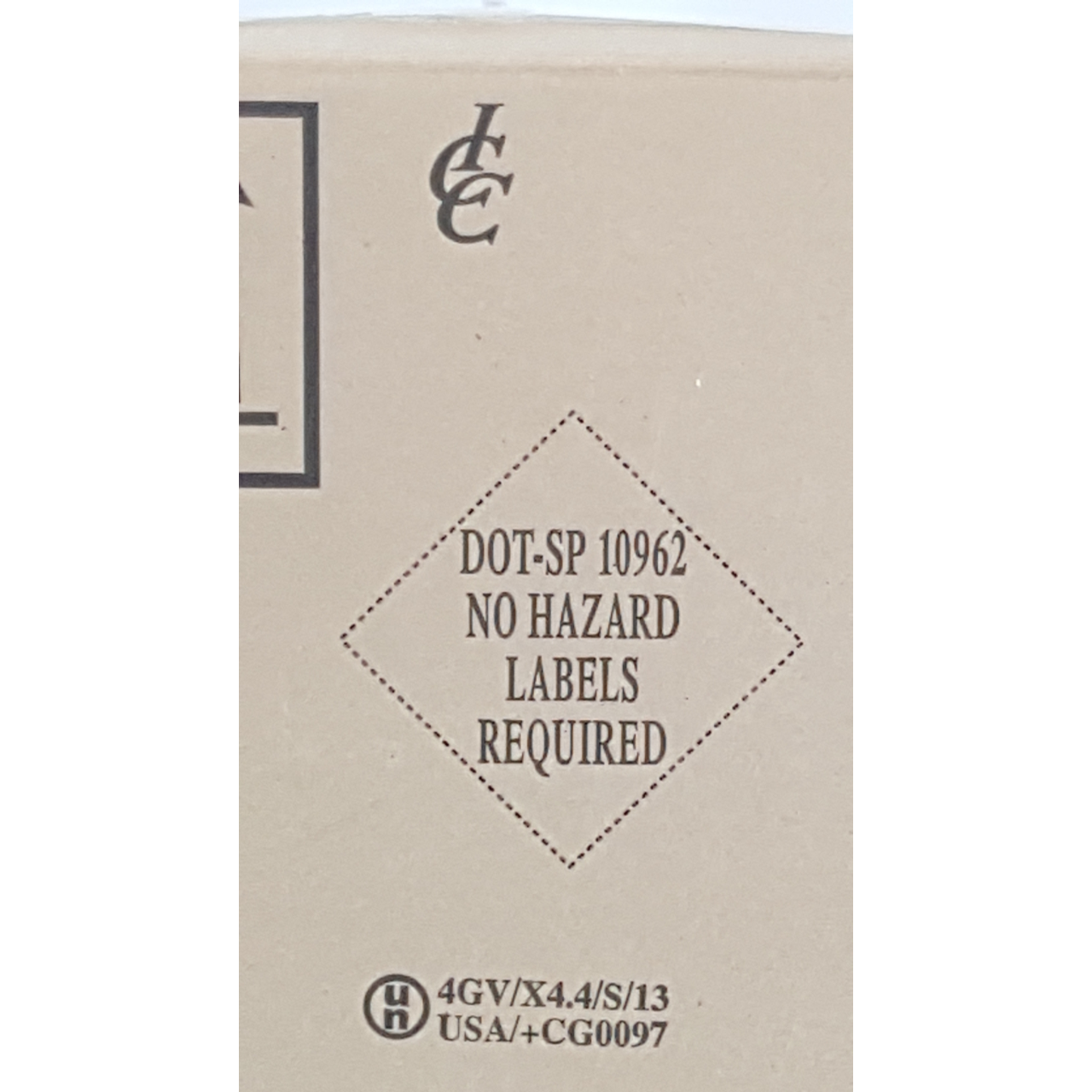
Special permit means a document issued by the Associate Administrator, the Associate Administrator’s designee, or as otherwise prescribed in the HMR, under the authority of 49 U.S.C. 5117 permitting a person to perform a function that is not otherwise permitted under subchapter A or C of this chapter, or other regulations issued under 49 U.S.C. 5101 et seq. (e.g., Federal Motor Carrier Safety routing requirements).
In a nutshell: A special permit may be issued by USDOT/PHMSA to allow a person (e.g., shipper, carrier, or receiving facility) involved in the transportation of a hazardous material (HazMat) to perform a function that is not allowed by the HMR.
Special permits – once known as exemptions – may be granted to an applicant for an emergency situation or when a safe alternative to the HMR can be demonstrated by the applicant.
A person seeking a special permit has two options:
Apply for a new special permit specific to its operations.
Persons seeking a special permit must submit an application to USDOT/PHMSA. The application must meet the requirements of 49 CFR 107, Subpart B and include evidence that the special permit will achieve the same safety level of the HMR or is consistent with the public interest (i.e., the benefit to the public of the special permit outweighs the risk, such as in an emergency). USDOT/PHMSA’s review of your application will include an evaluation of your compliance history.
If the special permit is granted, compliance with its conditions are the responsibility of the applicant; this includes training HazMat Employees on its conditions. Special permits have an expiration date, a person wishing to continue use of a special permit must submit a new application prior to its expiration date.
Contact me with any questions you may have about the transportation of hazardous materials by air, highway, vessel, or rail
A carrier transporting a HazMat under a shipper’s special permit or a shipper offering a HazMat for transport by a carrier using a special permit need not be a party to the special permit if it does not re-package the HazMat.
USDOT/PHMSA Temporary Relief From Recurrent HazMat Employee Training During COVID-19 Public Health Emergency
The Bullet:
Due to the COVID-19 public health emergency, PHMSA decided to temporarily halt enforcement actions against shippers and carriers that are unable to comply with training requirements included in the Hazardous Materials Regulations (HMR). The notice is limited to recurrent training requirements and does not apply to all other HMR obligations or applicable laws for hazardous materials shippers and carriers (aka: hazardous materials employers or HazMat Employers.
For additional information on PHMSA operations during this public health emergency, please contact phmsapublicaffairs@dot.gov
Who:
Notice signed by: William S. Schoonover / Associate Administrator for Hazardous Materials Safety/ Pipeline and Hazardous Materials Safety Administration
Enforcement discretion will be exercised by the following which regulate every mode of HazMat transportation (air, highway, rail, & vessel):
Federal Aviation Administration (FAA)
Federal Motor Carrier Safety Administration (FMCSA)
Federal Railroad Administration (FRA)
PHMSA
United States Coast Guard (USCG)
Contact me with any questions you may have about the transportation of hazardous materials by air, highway, vessel, or rail
PHMSA gives notice that it will not take enforcement action against any HazMat Employer who is unable to provide recurrent training consistent with HMR training requirements.
This notice is limited to the recurrent training requirements found in 49 CFR 172. 704(c)(2). HazMat Employers must comply with all other obligations under the HMR and other applicable laws.
Note: this enforcement discretion applies solely to the requirement to provide recurrent HazMat Employee training at least once every three years pursuant to §172.407(c)(2). It does not apply to the responsibility of the HazMat Employer to provide initial HazMat Employee training within 90 days of personnel performing a regulated function and to provide for direct supervision of untrained personnel during the 90 day period. The regulations for initial HazMat Employee training are at 172.704(c)(1).
PHMSA understands that many HazMat Employers may be experiencing difficulty in either obtaining or providing recurrent training as required by the Hazardous Materials Regulations (HMR, 49 CFR Parts 171-180) due to the COVID-19 outbreak.
How:
As the agency with the authority to create and enforce regulations for the transportation in commerce of hazardous materials, USDOT/PHMSA has also the authority to create an enforcement discretion such as this one.
A little something more:
PHMSA reminds HazMat Employers that the HMR does not require training to be provided in a traditional classroom setting or through on-the-job training. Any method of training delivery, including web based, self-paced computer instruction, remotely delivered classroom instruction, on-the-job training, or some combination of those methods that cover the required elements in 49 CFR 172 Subpart H are acceptable. PHMSA encourages the utilization of any of these training methods to provide HazMat Employees with appropriate recurrent training even if testing is not possible.
Interested in a Webinar that covers this topic, and more!
The notice twice refers to “recurrent training” and makes no mention of initial training. Further, the first sentence of the last paragraph reads,
This notice is limited to the recurrent training requirements found in 49 CFR 172. 704(c)(2).
That statement excludes the requirements of 49 CFR 172.704(c)(1) for the HazMat Employer to provide initial training within 90 days of a HazMat Employee performing a regulated function and to ensure the HazMat Employee performs any regulated functions under the direct supervision of a trained and knowledgeable HazMat Employee.
USDOT/PHMSA Assistance to Public During COVID-19
During the COVID-19 Pandemic and the public health emergency it has caused, the Pipeline and Hazardous Materials Safety Administration within the U.S. Department of Transportation (USDOT/PHMSA) has issued a notice of the assistance it is providing to pipeline operators and hazardous materials stakeholders until the emergency declaration is lifted. The documents describing that assistance are identified below. (more…)
Q&A: Why does my truck display placards for Division 2.2 Non-Flammable Gas and not Oxygen?
Question:
Hello,
I am employed with (working to become a contract driver soon) with a company that services nursing homes with oxygen cylinders. They provide various sizes of cylinders and also provide filling of liquid oxygen for reservoirs on-site. I carry well over 1001 lbs. on my route.
My question is, why is my truck placarded non-flammable gas 2 ?????
and not oxygen 2?????
I can’t get a straight answer from my management and was curious if you could help. Also, is there training you provide online that would help me?
Thanks,
My reply:
Thank you for contacting me. Please see below.
Oxygen as a compressed gas meets the criteria for a Division 2.2 Non-Flammable Non-Poisonous Compressed Gas.
The Division 2.2 placard must be displayed if the vehicle carries 454 kg or more (≥1,001 lb) of HazMat.
Per 49 CFR 172.504(f)(7) the oxygen placard may be used in place of the Division 2.2 placard. So, it is an option to display the Oxygen placard instead of the Division 2.2 Non-Flammable Gas placard.
I hope this answers your question.
Contact me with any questions you may have about the transportation of hazardous materials by air, highway, vessel, or rail
Thank you. That’s what I thought but just wanted to make sure.
I wasn’t done (I have so much to share!):
You’re welcome!
You may wish to read this article I wrote indicating when it is necessary to display the identification number on a transport vehicle if it contains a large quantity of a single HazMat: Vehicle Marking Requirements for Single HazMat.
That spurred another question (06.20.18):
I read the other article you sent and it did clear up when to use numbered placards on a straight forward shipment. Other scenarios would also be helpful.
What if you picked up a shipment carrying 11,000 lbs each of two different chemicals from one shipper? Total 22,000 lbs?
Same scenario but you picked them up from two separate shippers?
Another: Picked up 11,000 lbs of one chemical and 4,000 lbs of another chemical? One shipper and then two shippers?
Scenario 1: “What if you picked up a shipment carrying 11,000 lbs each of two different chemicals from one shipper? Total 22,000 lbs?”
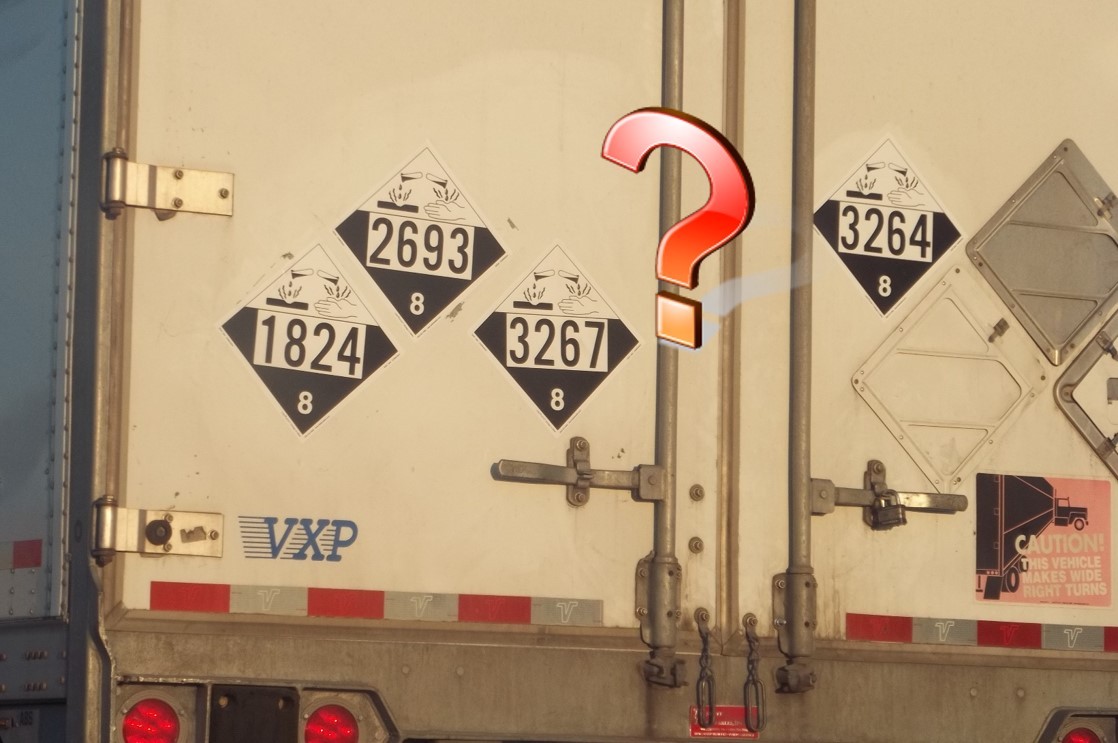
Answer: In this scenario you must display the applicable placards for each HazMat unless one of the placarding exceptions at 49 CFR 172.504(f) apply. If both HazMat are in a non-bulk packaging you must not display the identification number. If either of the HazMat are in a bulk packaging you must display its identification number on or near the placard.
Scenario 2: “Same scenario but you picked them up from two separate shippers?”
In this scenario the vehicle would display the applicable placard and identification number for the first shipment (assuming all of the other conditions of 49 CFR 172.301(a)(3) are met). When the second shipment is picked up the placard for the second HazMat must be displayed, but not its identification number. The identification number and placard from the first shipment would continue to be displayed (this is based on a conversation with the HazMat InfoLine. It is not clear from the regulations. I could not find a letter of interpretation to confirm).
Scenario 3: “Picked up 11,000 lbs of one chemical and 4,000 lbs of another chemical? One shipper and then two shippers?”
If both HazMat picked up from one shipper then Scenario 1 from above will apply.
If picked up from two separate shippers then Scenario 2 will apply.
I hope this helps. Please don’t hesitate to contact me with any other questions.
Contact me with any questions you may have about the transportation of hazardous materials by air, highway, vessel, or rail
I frequently receive questions about placarding vehicles. As you can see from this Q&A, there are many scenarios to consider and each may require a different display of placards. If you are a carrier of HazMat, make certain you display the correct placards. If you are a shipper of HazMat (i.e., you offer the HazMat to a carrier for transport), make certain you offer the correct placards to the driver.
As a shipper or a carrier, make certain all of your employees with a direct affect on the safe transport of HazMat receive initial and triennial HazMat Employee training.
Q&A: Do I placard for a Class 3 Flammable in bulk packaging and 500 lbs of a Class 8 Corrosive in non-bulk?
A follow-up question from a occasional contact (06.13.18):
Daniel, Hope all is doing well.
I have another question that has been bothering me as well. Hoping you can share some guidance.
Say I have a shipment of UN1993 BULK(ONE TOTE BIN)
I also have a shipment of Corrosive UN1806 non-bulk weighing 500lbs.
No other hazmat on board. How would this trailer be placarded?
I, myself would say a bulk UN1993 placard and a corrosive placard.
I have had other safety officials advise that the bulk shipment is not included on the aggregate gross weight once its placarded.
I have an answer and it is not what I initially anticipated (I’m glad I did additional research of 49 CFR 172.504(c)). Please see below.
When determining the placarding requirements for a vehicle there are three criteria to consider (other exceptions are available but not applicable to this scenario):
Is it any quantity, any packaging of a HazMat identified in Table 1 at §172.504(e)? If so, placard for hazard class.
Is it any single or multiple HazMat of an aggregate gross weight of 454 kg (1,001 lbs) or more ? If so, placard for each hazard class.
The above criteria are considered independently. Therefore, the weight of a Table 2 HazMat in a bulk packaging (which requires display of the placard for its hazard class according to #2 of the above) is not counted toward the aggregate gross weight threshold indicated in #3. Similarly, the weight of a Table 1 HazMat (placards required according to #1 of the above) is not counted toward the aggregate gross weight threshold of #3.
Separate from the regulations for the display of placards are those that require the display of the identification number on transport vehicles and freight containers. A vehicle transporting a bulk packaging (e.g., an intermediate bulk container or tote bin), must display the HazMat’s identification number unless the number is visible on the packaging during transport.
In your scenario the vehicle must display the Class 3 placard with the identification number (1993) – because it is in a bulk packaging – but not the Class 8 placard – because it’s gross aggregate weight (not counting the Class 3 tote) is <454 kg (1,001 lbs). Of, course, the driver has the option to display the Class 8 placard if they so choose.
This letter of interpretation from USDOT/PHMSA almost exactly represents your scenario: LOI 02-0043.
I hope this helps. Please don’t hesitate to contact me with any other questions.
Contact me with any questions you may have about the transportation of hazardous materials by air, highway, vessel, or rail
The regulations for the display of placards on a vehicle can be simple, but can become more complex when the hazardous materials transported and the types of packagings used increase. Make certain your placards are correct and are displayed properly.
FAQ: What are the Table 1 and Table 2 placarding tables?
Found at 49 CFR 172.504(e) of the USDOT/PHMSA Hazardous Materials Regulations (HMR), the placarding tables (Table 1 and Table 2) identify a distinction made by USDOT/PHMSA between the “really nasty” hazardous materials of Table 1 and the “routine” HazMat of Table 2. A HazMat’s location on one of the two tables will play a significant role in determining which – if any – placards are required to be displayed on the vehicle transporting it. The Table 1 and Table 2 placarding tables are also referenced in the following regulations of the HMR:
The applicability of the empty packaging (with residue) exception at §173.29(c).
So, what are the Table 1 and Table 2 placarding tables of 49 CFR 172.504(e)?
Table 1:
Net quantity per package Passenger aircraft
Net quantity per package Cargo Aircraft Only
Lithium metal cells and batteries
Forbidden
2,5 kg
Table 2:
Hazardous Waste Code
Hazardous Waste
(Solvent Name)
Hazard Code
F001
Tetrachloroethylene
(T)
Trichloroethylene
(T)
Methylene chloride
(T)
1,1,1-Trichloroethane
(T)
Carbon tetrachloride
(T)
Chlorinated fluorocarbons
(T)
F002
Tetrachloroethylene
(T)
Methylene chloride
(T)
Trichloroethylene
(T)
1,1,1-Trichloroethane
(T)
Chlorobenzene
(T)
1,1,2-Trichloro-1,2,2-trifluoroethane
(T)
Ortho-dichlorobenzene
(T)
Trichlorofluoromethane
(T)
1,1,2-Trichloroethane
(T)
F003
Xylene
(T)
Acetone
(T)
Ethyl acetate
(T)
Ethyl benzene
(T)
Ethyl ether
(T)
Methyl isobutyl ketone
(T)
n-butyl alcohol
(T)
Cyclohexanone
(T)
Methanol
(T)
F004
Cresols & cresylic acid
(T)
Nitrobenzene
(T)
F005
Toluene
(T)
Methyl ethyl ketone
(T)
Carbon disulfide
(T)
Isobutanol
(T)
Pyridine
(T)
Benzene
(T)
2-Ethoxyethanol
(T)
2-Nitropropane
(T)
Reuse of Hazardous Materials Packaging
Introduction:
In my experience most shippers of a hazardous material (HazMat) will use a packaging only once. After that initial use the packaging is either disposed of, recycled, or sent for reconditioning. All of these options are subject to USEPA, USDOT/PHMSA, and possibly state regulations. Many HazMat shippers are unaware of the allowance to reuse a packaging for the transport in commerce of a hazardous material; perhaps many times. This allowance of the Hazardous Materials Regulations (HMR) of USDOT/PHMSA will not only result in less waste generation but will also save you money.
The purpose of this article is to identify and explain the USDOT/PHMSA regulations at 49 CFR 173.28(a,b, & e) for the reuse of a packaging for the transport of a hazardous material.
Scope and Applicability:
The scope and applicability of these regulations are limited to the following:
Transport must be “in commerce”. i.e., by or for a business or government agency engaged in commercial activity.
Packaging must be used for the transport of a hazardous material (HazMat). Non-HazMat are not subject to these regulations.
Non-bulk packaging only. Bulk packagings may be reused but are subject to different regulations dependent on their packaging type. The reuse of bulk packagings will not be considered in this article.
MADE IN THE USA: “The reuse provisions only apply to UN performance-oriented or specification packagings manufactured and filled in the United States.” (01-0270)
Not limited to original user: “There is no limitation on who may reuse a packaging for the transportation of hazardous materials. The person who reuses the packaging does not have to be the original user.” (99-0125)
Contact me with any questions you may have about the transportation of hazardous materials by air, highway, vessel, or rail
§173.28(c) addresses the requirements for the reconditioning of non-bulk packagings. The reconditioning of non-bulk packagings will not be addressed in this article.
§173.28(d) addresses the remanufacture of non-bulk packagings. The remanufacture of a non-bulk packaging will not be addressed in this article.
The reuse of a packaging for a Division 6.2 Infectious Substance is described in §173.28(f) and will not be addressed in this article.
Before reuse each packaging – even a non-reusable container – must be inspected. The purpose of the inspection is to ensure that all packagings and receptacles to be reused are in a condition that complies with all of the requirements of the HMR; this includes closure devices and cushioning materials. This requires compliance with the HMR’s general packaging requirements:
§173.24 – General requirements for packagings and packages
§173.24(a)(2) indicates the regulations apply to both new packagings and packagings to be reused.
§173.24a – Additional general requirements for non-bulk packagings and packages
But that’s not all. The inspection must also determine the non-bulk packaging to be reused is capable of passing all performance tests represented by the packaging markings (11-0085). These are found at §178, subpart M.
A packaging may not be reused under any of the following conditions:
Contains a residue that is incompatible with the HazMat it is to be refilled. Note: This does not mean free from anyresidue. Just free from any incompatibleresidue.
Has been ruptured.
Displays evidence of other damage which reduces its structural integrity. Note: The key term here is, “…reduces its structural integrity.” The person reusing the packaging must determine if damage – if any is observed – is sufficient to reduce the packagings structural integrity.
A non-bulk packaging that shows evidence of a reduction in integrity may not be reused unless it is reconditioned per §173.28(c).
Q: What is the definition of “other damage”? Does the shipper have the authority to determine when “other damage” has occurred to one of its packagings?
A: The HMR do not provide a definition for “other damage” beyond that provided in §173.28(a), i.e., “damage which reduces [the packagings’] structural integrity.” The shipper is responsible for identifying packaging deficiencies that may reduce the packagings structural integrity. (o4-0101)
That may seem like a lot. But really, the general conditions for reuse of a packaging aren’t any different than the responsibilities of the shipper prior to the first use of a non-bulk packaging.
Conditions for Reuse of Specific Packaging Types:
Packagings made of paper (other than fiberboard), plastic film, or textile:
Per §173.28(b)(3), packagings made of the following materials may not be reused:
Paper (other than fiberboard).
Plastic film.
Textile
Packagings made of fiberboard (box or drum) may be reused. A challenge specific to this type of packaging is damage that may be caused by removal of tape used for closure. Tears to the facing / laminate of the fiberboard may result in a reduction in structural integrity of the packaging which will render the packaging unfit for reuse. For this type of packaging, cutting the tape, leaving it attached to the packaging, and then taping over the old tape may be a better option than removing the old tape entirely. (04-0101, 06-0019)
Contact me with any questions you may have about the generation, identification, management, and disposal of hazardous waste
Previously used non-bulk packaging reused for the shipment of hazardous waste:
§173.28(b)(6) allows a previously used non-bulk packaging to be reused for the shipment of hazardous waste, not subject to the regulations of §173.28 if done in compliance with §173.12(c).
The definition of the term at §171.8 refers back to §173.28:
NRC (non-reusable container) means a packaging (container) whose reuse is restricted in accordance with the provisions of §173.28 of this subchapter.
Per §173.28(e) a packaging marked as NRC according to the DOT specification or UN standard requirements of 49 CFR part 178 may only be reused for the transport of a HazMat that does not require a DOT specification or UN standard packaging.
Q: What is an example of a HazMat that does not require a DOT specification or UN standard packaging?
A: Any hazardous material subject to one of the following packaging exceptions:
Limited quantity
Small quantity
Excepted quantity
De Minimis
Lithium battery subject to §173.185(c)
And other exceptions in the HMR…
This means, however, that a packaging marked as NRC according to the DOT specification or UN standard requirements of 49 CFR part 178 may not be used for the transport in commerce of a hazardous material unless it is subject to one of the above-referenced packaging exceptions. If used, the packaging still must meet the general conditions for reuse identified earlier in this article (11-0085).
The inclusion of text, “…a packaging marked as NRC according to the DOT specification or UN standard requirements of 49 CFR part 178…” (emphasis added) may seem unnecessary until you learn that a packaging might be marked with “NRC” for an entirely different reason than its reuse: i.e., it is a packaging approved by the Nuclear Regulatory Commission (NRC). §172.203(d)(7) and §173.471 refer to the display of “NRC” as a packaging mark because it is approved by the Nuclear Regulatory Commission.
Prior to 1991, the letters “STC” (single trip container) and “NRC” (nonreusable container) were used as markings on certain, now obsolete, DOT specification non-bulk packagings that restricted the use of those packagings. Currently, the only packaging required to have an NRC marking is the DOT 39 cylinder at §178.65(i).
Q: What options for reuse do I have for a packaging marked by the manufacturer as NRC according to the DOT specification or UN standard requirements of 49 CFR Part 178?
A: Not much. The packaging may only be used for a hazardous material that does not require DOT specification or UN standard packaging, a non-hazardous material, or the shipper may request a special permit from USDOT/PHMSA that allows for its reuse.
Plastic inner receptacles of composite packagings:
Plastic inner receptacles of composite packagings must have a minimum thickness of 1.0 mm (0.039 inch).
Metal and plastic drums and jerricans used as single packagings or the outer packagings of composite packagings:
First of all, let’s make sure we’re clear on the type of packagings subject to this regulation at §173.28(b)(4). Two types of packagings are identified, both are defined at §171.8:
“Single packaging means a non-bulk packaging other than a combination packaging.” Single packagings subject to this regulation include:
Steel drum (1A1 or 1A2)
Aluminum drum (1B1 or 1B2)
Metal drum (1N1 or 1N2)
Steel jerrican (3A1 or 3A2)
Aluminum jerrican (3B1 or 3B2)
Plastic drum (1H1 or 1H2)
Plastic jerrican (3H1 or 3H2)
“Composite packaging means a packaging consisting of an outer packaging and an inner receptacle, so constructed that the inner receptacle and the outer packaging form an integral packaging. Once assembled it remains thereafter an integrated single unit; it is filled, stored, shipped and emptied as such.” Though composite packagings are many, only the following are subject to this regulation:
Plastic receptacle within a protective steel drum (6HA1)
Plastic receptacle within a protective aluminum drum (6HB1)
Plastic receptacle within a protective plastic drum (6HH1)
Glass, porcelain, or stoneware receptacles within a protective steel drum (6PA1)
Glass, porcelain, or stoneware receptacles within a protective aluminum drum (6PB1)
These regulations do not apply to any of the above packagings if they are the outer packaging of a combination packaging (14-0136).
To be authorized for reuse, the above packagings must be marked in a permanent manner (e.g., embossed) as follows:
The nominal thickness of the packaging material in mm for metal packagings.
The minimum thickness of the packaging material in mm for plastic packagings.
For a full description of the required marking refer to §178.503(a)(9).
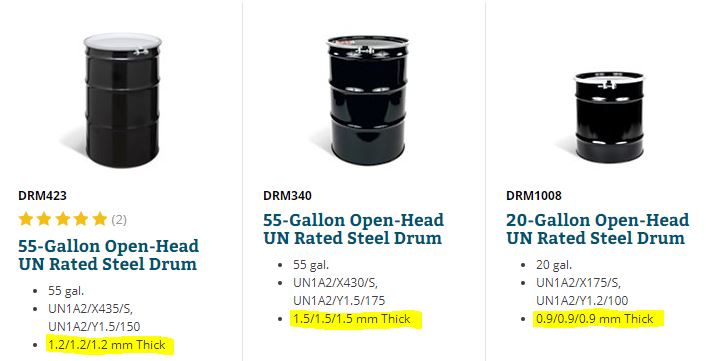
Each of these steel drums meet the minimum thickness requirements for their size
But we’re not done. To be eligible for reuse the packaging must conform to the following minimum thickness criteria (an exception to these criteria for packagings manufactured before January 1, 1997 is identified after the table):
Net quantity per package Passenger aircraft
Net quantity per package Cargo Aircraft Only
Lithium ion cells and batteries
Forbidden
10 kg
1 Metal drums or jerricans manufactured and marked before January 1, 1997 with a minimum thickness of 0.82 mm body and 1.09 mm heads may be reused. Those packagings manufactured and marked after January 1, 1997 and intended for reuse must be constructed with a minimum thickness of 0.82 mm body and 1.11 mm heads.
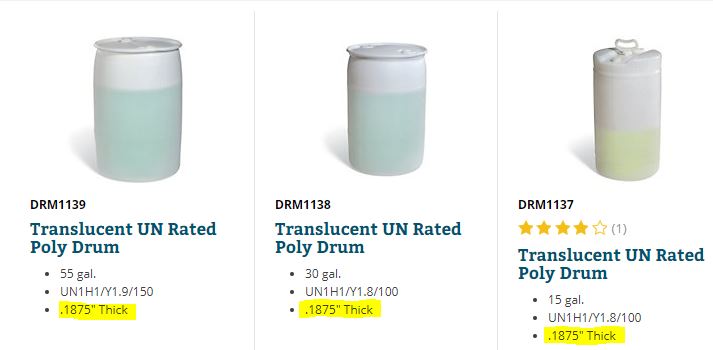
Each of these packagings meet the nominal requirements for their size
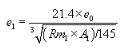
Stainless steel drums and jerricans are not subject to the requirements of the above table. They must conform to a minimum wall thickness as determined by the following equivalence formula:
FORMULA FOR METRIC UNITS
FORMULA FOR U.S. STANDARD UNITS
Symbols in the above formulas have the following values:
e1 = required equivalent wall thickness of the metal to be used (in mm or, for U.S. Standard units, use inches).
e0 = required minimum wall thickness for the reference steel (in mm or, for U.S. Standard units, use inches).
Rm1 = guaranteed minimum tensile strength of the metal to be used (in N/mm2 or for U.S. Standard units, use psi).
A1 = guaranteed minimum elongation (as a percentage) of the metal to be used on fracture under tensile stress (see paragraph (c)(1) of this section).
How important is this requirement? Well, §173.28(a) includes as a general condition that a packaging not meeting the minimum thickness requirements may not be reused or reconditioned for reuse.
Q: Does that mean I must measure the minimum / nominal thickness of this packaging type before each reuse?
A: No. What you must do is ensure the packaging is permanently marked with its minimum / nominal thickness and that the marked thickness meets the minimum thickness criteria either of the table or the equivalence formula, as applicable.
Q: If a packaging was not marked by the manufacturer with the minimum / nominal thickness at the time of manufacture, may it be marked at a later date by the reuser or reconditioner of the packaging?
A: Yes. A packaging not marked at the time of manufacture with the minimum / nominal thickness may be permanently marked at a later date by the reuser or reconditioner provided the integrity of the packaging is not degraded and the packaging was initially intended to be reused. (00-0227)
If you like this article, please share it using any of the social media platforms identified at the bottom of this article.
You’ll look real smart recommending my articles!
Packagings subject to the leakproofness test with air:
§173.28(b)(2) specifies the requirements for the leakproofness test prescribed at §178.604 for certain packagings to be reused. §173.28(b)(7) identifies conditions where a packaging subject to the leakproofness test may not be required to be tested.
Before we go any further, what packagings are subject to the leakproofness test with air prescribed in §178.604? Quite simply: all packagings intended to contain liquids, except that:
The inner receptacle of a composite packaging may be tested without the outer packaging if the test results are not affected.
The test is not required for inner packagings of combination packagings.
The leakproofness test is not required for any packaging intended for the transport of solid HazMat.
Q: Is the leakproofness test required for packagings intended for reconditioning or remanufacture?
A: Yes, though not clearly stated in §173.28(c) for reconditioning or §173.28(d) for remanufacture. The determination is made as follows:
§173.28(c)(3) requires a reconditioned packaging to be marked as indicated at §178.503(c) & (d). Per §178.503(c)(1)(v), every reconditioned packaging that passed a leakproofness test must be marked with an “L”.
§173.28(d) states a remanufacturer of a packaging is subject to the requirements of part 178 as a manufacturer. A packaging manufacturer must ensure each packaging is capable of passing the prescribed tests, which includes the leakproofness test at §178.604.
§173.28(b)(2) requires the following for packagings subject to the leakproofness test prior to reuse:
48 kPa (7.0 psig) for Packing Group I. Note: this is higher than the minimum air pressure required at §178.604(e)(1) for Packing Group I.
20 kPa (3.0 psig) for Packing Group II. Note: this is the same as §178.604(e)(2) for Packing Group II.
20 kPa (3.0 psig) for Packing Group III. Note: this is the same as §178.604(e)(3) for Packing Group III.
The packaging that is retested without failure per above must then be marked:
With the letter “L”.
Name and address or symbol of the person conducting the test.
Last two digits of the year the test was conducted.
Symbols, if used must be registered with the Associate Administrator (aka: USDOT/PHMSA).
However, §173.28(b)(7) allows for the reuse of a packaging without the leakproofness test if the packaging complies with the following:
Reuse of a packaging subject to the leakproofness test without performing the leakproofness test:
A packaging subject to the leakproofness test at §173.28(b)(2) may be authorized for reuse without performing the leakproofness test if the packaging complies with all of the following requirements of §173.28(b)(7):
Is otherwise authorized for use according to the requirements of §173.28.
Is refilled with a HazMat compatible with the previous contents. Note: this does not require the same HazMat, merely one that is compatible with what was in the packaging previously.
Is refilled and offered for transport by the original filler. Note: this does not specify who performs the transport, merely who fills and “offers for transport” (aka: the shipper).
Is transported in a transport vehicle or freight container under the exclusive use of the refiller of the packaging.
“Exclusive use” means that the transport vehicle does not contain any material offered by anyone other than the filler of the packaging (04-0111).
Is constructed of one of the following:
Stainless steel, monel, or nickel with a thickness not less than 1 1/2 times the minimum thickness prescribed in §173.28(b)(4), (see above in this article).
Plastic, if it is not refilled for reuse more than five (5) years from its date of manufacture. The month and year of a plastic packaging’s manufacture is marked on the packaging pursuant to §178.503(a)(6).
Another material or thickness when approved under the conditions established by the Associate Administrator (aka: USDOT/PHMSA) for reuse without retesting.
Q: Does this mean that a plastic packaging has a five year limit on its use for the transport of a HazMat?
A: No. A plastic packaging may continue to be reused pursuant to §173.28 even after five (5) years. However, after five (5) years from its date of manufacture it is no longer eligible for this exception and must be leakproofness tested before reuse.
Don’t confuse this limit for the reuse of plastic packaging under §173.28 with a similar but more restrictive limit on the use of plastic packagings in the dangerous goods regulations of the International Air Transport Association (IATA) and the International Maritime Organization (IMO). Under their regulations (5.0.2.1.5 for IATA and 4.1.1.15 for IMO) a plastic packaging may not be used or reused more than five (5) years after its date of manufacture. USDOT/PHMSA has no such limitation (17-0031).
Whew! After all that you might be thinking the reuse of a HazMat packaging is not worth the trouble of compliance, but hold on. Let’s summarize the requirements:
Perform an inspection of the packaging to ensure in good condition for reuse.
No incompatible residue.
If the packaging is designed for liquid HazMat, perform the leakproofness test. No leakproofness test for solid HazMat.
The leakproofness test may not be required if the packaging is refilled and shipped by the original filler, is transported in a vehicle under the exclusive use of the refiller, and the packaging is made of stainless steel, monel, or nickel of the prescribed thickness or plastic and not more than five (5) years old.
And…
Metal and plastic drums and jerricans used as single packagings or the outer packaging of composite packagings must be permanently marked to indicate they meet the minimum thickness requirements.
And remember, “There is no limitation on who may reuse a packaging for the transportation of hazardous materials. The person who reuses the packaging does not have to be the original user.” (99-0125)