PO Box 1232 Freeport, IL 61032

A Different Kind Of Training

A Different Kind Of Training

A Different Kind Of Training

Q&A: Are my alcohol wipes subject to USDOT Regulations?

A question asked on December 09, 2020:

Hello,

I found your article The Classification of Alcohol Wipes, and was hoping you could clarify for me:

We currently have these classified as a class 4.1 packing class II. We have been requiring our driver to placard when this item is over 1000 lbs.

I think I am reading your article correctly, that since these are in sealed packages, AND there is no free liquid, it is not regulated by the DOT. Is that correct? If so, there may be very little free liquid in the package, would that change it?

One more thing, does the size of the sealed roll change anything?

I greatly appreciate your help on this.

Thanks,

Daniels Training Services, Inc.

815.821.1550

Info@DanielsTraining.com

https://danielstraining.com/

My reply the same day:

Thank you for contacting me. Please see below.

  • If your product is classified as UN 3175, Solids containing flammable liquid, n.o.s., 4.1, II and meets the conditions of the special provision 47 it is not subject to USDOT regulations for its transportation within the U.S. No placards or any other hazard communication required.
  • Special provision 47 requires:
    • Small inner packagings consisting of sealed packets and articles.
    • Sealed packets or articles contain less than 10 mL of a Class 3 Flammable Liquid, e.g., ethanol, isopropanol, in Packing Group II or III.
    • Class 3 Flammable Liquid is absorbed onto a solid material (i.e., the wipe).
    • No free liquid in the packet.
  • Free liquid in the packet – even “very little” – does not meet the conditions of the special provision which requires: “…no free liquid”
  • The special provision does not limit the size of the inner packaging, only the amount of liquid it contains (10 mL).

I hope this helps. Please contact me with any other questions.

Like this article?

Subscribe to my Monthly Newsletter

No marketing emails!

Conclusion:

A good example where a shipper of a hazardous material is complying with the USDOT/PHMSA Hazardous Materials Regulations (HMR), but is doing more than is required. Compliance is necessary, but if an exception to full regulation is available – as is the case here – then the shipper may be able to save significant amounts of money by taking advantage of that exception. Don’t miss out on the exceptions to the HMR available to you! Contact me with questions.

Q&A: Is an emergency response telephone number required?

A question received October 16, 2020:

Hello, my name is <<Name>> at <<Company>> in <<City, State>> a freight forwarder.

I found an article regarding CANUTEC you wrote, and I am writing this email because I need your help.

We have several hazmat import containers that containing butane steel cartridges, and SM Line, ocean carrier requested “24hrs emergency contact” on the IMO/Multimodal DG Form in one of the four companies below for inland rail transportation.

Chemtrec, Infortace, Chemtel, Canutec

We have handled the exact same cargo for 3~4years with other carriers, but never had like this problem.

I don’t know what to do, so please let me know if there is any way you can help me.

HAZMAT INFO:

  • UN 1075
  • PETROLEUM GASES, LIQUEFIED
  • CLASS 2.1, F-D, S-U
  • 54,120 STELL CYLINDERS IN 4,510 FIBERBOARD BOXES

Thank you!

My reply that same day:

Thank you for contacting me. I can assist you. Please see below.

  • The Hazardous Materials Regulations of the USDOT/PHMSA require the shipper (the person who “offers” a hazardous material for transportation) to provide the following to the carrier:
    • Emergency response information for the HazMat in transportation. (More on this below).
    • Emergency response phone number that will reach a person who is knowledgeable about the HazMat in transportation and has knowledge of the emergency response procedures.
  • The following is required of the emergency phone number:
    • Displayed clearly on shipping paper.
    • Will be answered by a person (not a machine) 24/7 whenever the HazMat is in transportation.
      As noted above, person must be knowledgeable about the HazMat and about emergency response.

Or…

    • If not knowledgeable, has immediate contact with a person who is.
  • The emergency phone number may be either of the following:
    • One of the commercial services indicated in your email (you must pay them a fee and provide them with information about your HazMat).
    • Some other person (e.g., an employee) if they can meet the requirements for knowledge and availability.
  • This is not a new regulation. It is possible you did not have this issue in the past because the carrier provided the emergency phone number or it was overlooked.
  • Please read:

I hope this helps. Please contact me with any other questions.

Contact me with any questions you may have about the transportation of hazardous materials by air, highway, vessel, or rail

International and Domestic

Daniels Training Services, Inc.

815.821.1550

Info@DanielsTraining.com

https://danielstraining.com/

That seemed to be all he needed to know:

Thank you for your help 🙂 I should learn a lot about Hazmat things.

Conclusion:

It’s not uncommon for a shipper of HazMat to be unfamiliar with all of their regulatory responsibilities. The Hazardous Materials Regulations of USDOT/PHMSA can be difficult to read and understand. This person was wise enough to ask for help. I’m glad I was able to help them.

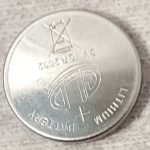
lithium metal button cell battery installed in equipment

Q&A: How do I mail a product containing a lithium metal button cell battery?

A question received September 23, 2020:

Hi Daniel,

I just stumbled across your website and specifically this article: March 6, 2019: USDOT Changes Regulations for Transport of Lithium Batteries

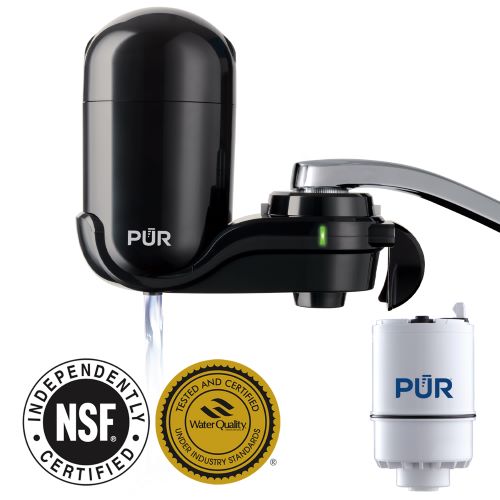
I am trying to mail a water filter like the one in the image I attached.lithium metal button cell battery installed in equipment

When it showed up to me it had some of the UN stickers and said “forbidden for transport by air or vessel”. It does have some type of battery in it to monitor when the filter life is up.

My question is, do I need to provide one of the UN stickers on the attached image to mail it with USPS? I’m just confused if the stickers are only required for mailing batteries themselves, or if the stickers are required when there is just a battery inside the unit.

Thank you!

My reply that same day:

I will try to answer your question. Please see below.

  • To give a complete answer the size and type of the lithium cell or battery must be known.
  • However, based on the image I will presume the following:
    • It is a cell and not a battery due to its presumed size and function in the equipment. Specifically, it is a button cell.
    • It is, as you indicate, contained in the equipment it is meant to power when in it is in transportation.
    • It is a lithium metal cell and not lithium ion since it is unlikely to be rechargeable as lithium ion batteries usually are.
    • It is a “smaller” lithium metal cell. That is, it has a lithium content of no more than 1 gram if a cell and no more than 2 grams if a battery.
  • The equipment and battery must be packed securely in a good outer packaging.
  • It is not subject to any other USDOT regulations for transport within the U.S. as long as my above presumptions are correct. There is no requirement for any marks or labels on the package.
  • If the battery is packed by itself more stringent regulations apply.
  • Please refer to U.S. Postal Service (USPS) regulations.

I hope this helps. Please contact me with any other questions.

His reply the next day (09.24.21):

Lithium metal button cell batteryThank you very much for your quick reply. I have a second one of these that I cracked open to find the battery. It is a button battery about the size of a nickel, so this would NOT require any markings on the package? And for the one I will be mailing the battery will be inside the unit just as it was from the manufacturer.

What would be a normal consumer product that would require the markings when shipping? Something like an iPhone?

Thank you for the USPS website reference!!

That same day I had an answer:

Please see below.

The transportation of lithium batteries (all batteries) is very complicated. Please be advised that I am providing only general guidance.

  • If you are shipping the batteries as part of a business you are subject to more strict penalties.
  • In general:
    • “Smaller” lithium cells or batteries (those typically used in consumer devices) are subject to less regulation.
    • Lithium cells or batteries packed and shipped in the equipment they are meant to power are subject to less regulation.
    • A button cell battery contained in the equipment it is meant to power is subject to very little regulation other than safe packaging.
    • The battery in an iphone – and most other consumer items – is smaller and therefore subject to little regulation. However, it is still subject to more regulation than a button cell contained in the equipment it is meant to power.
    • The requirement for the lithium battery mark depends on the number of factors:
      • All “smaller” lithium cells or batteries packed alone or with – but not in – the equipment they are meant to power require the display of the lithium battery mark.
      • The lithium battery mark is never required for “smaller” button cells or batteries contained in equipment (your situation).
      • For other “smaller” lithium cells or batteries contained in equipment, e.g., an iPhone, the lithium battery mark must be displayed if any of the following is true:
        • More than 4 cells in a package or more than 2 packages in a consignment.
        • More than 2 batteries in a package or more than 2 packages in a consignment.
    • The mark forbidding all air and vessel transport or forbidding just passenger aircraft depends on more complicated review of regulations. Regardless, it does not apply to your situation.

Please contact me with any other questions.

The questioner wanted clarification for their specific situation:

Thank you!

So since I am just mailing one unit, with a button cell battery contained inside the equipment, I should not include any markings on the package is what I am concluding from your bullet points, correct?

My reply:

Based on the information provided, that is correct.

He was grateful:

Thank you for your time!

Conclusion:

The USDOT/PHMSA Hazardous Materials Regulations (HMR) regarding the transportation of lithium batteries of any size and any configuration are very complicated. Any time I’m asked a question I make certain to go back to the most current edition of the HMR to confirm my answer. Don’t rely on hearsay or outdated regulations! Make sure you get it right.

Q&A: How do I transport empty DOT 406 bulk fuel cargo tanks from Europe to U.S.?

A question from a soldier in the U.S. Army on July 20, 202o:

CLASSIFICATION: UNCLASSIFIED

Hello Daniels Training Services, INC. Team,

I read through your internet article USDOT Requirements for Shipments of Empty Packagings. Thanks for posting it.

I have a couple of questions on behalf of the US Army Europe.

Situation: We have DOT 406 Bulk Fuel Cargo Tanks that must be returned to numerous Army bases across the USA from Europe. The tanks have contained fuel and have been completely drained (including pipes, pumps and removal filtering systems) according to the manufacturers technical manuals. There may be “Crevice” residue fuel trapped in pipe connection seals that is undrainable. We will use military vessels to get them back from Europe to the nearest port in the USA. The tanks will have onward shipping by commercial trucks to their final destinations in the USA. We find no examples or provisions in the 49 CFR 171-173 that define “Cleaning/Purging” certificates or statements. We want to make sure that the “Cleaning/Purging” certificate statement we prepare here in Europe is acceptable for commercial carriers in the USA to authorize them to carry these Bulk Fuel Cargo tanks as a Non-Hazardous Material shipment.

Question 1. What resource document tells me the “SHIPPER” is responsible to know the exact provisions (standards) of what is meant by sufficiently cleaned of residue and purged of Flammable Liquid Vapors” for the below fuel types?

Question 2. Must tanks be cleaned with liquid substance?

Question 3. Or is “Draining all liquids & ventilating vapors below LEL levels to satisfy both terms, “Sufficiently Cleaned of Residue and Purged of Flammable Liquid Vapors” even if the temporary LEL of 0.00%(V) id recorded?

Bulk Packaging TypeCapacityHazMat LabelMarkingPlacard
Intermediate Bulk Container (IBC)All
(Option 1)
No labels.
172.400(a)(2)
Identification number on all four sides.
No regulation explicitly allows for the display of the ID# on 4 sides of an IBC w/ a capacity of <3,785 L but it is not forbidden.
Placard on all four sides.
172.504(a)
All
(Option 2)
No labels.
172.400(a)(2)
Identification number on two opposing sides if capacity of bulk packaging is less than 3,785 L.
172.302(a)(2).
Bulk packaging with a capacity of 3,785 L or more must display the identification number on all four sides and therefore may not take advantage of this exception since per 172.332, the identification number must be displayed on or near the placard.
172.302(a)(1)
Placard on two opposite sides.
172.514(c)(4)
1.8 m3 or more.HazMat label on two opposite sides.
172.406(e)(6)
Identification number and proper shipping name as if for a non-bulk packaging per 172.301(a)(1).
172.514(c)(4)
Identification number as if for a non-bulk packaging per 172.301(a)(1).
172.336(d) and 15-0120
No placards.
172.514(c)(4)
Less than 1.8 m3.Label one side.
172.406(e)(6)
Identification number and proper shipping name as if for a non-bulk packaging per 172.301(a)(1).
172.514(c)(4) and 15-0120
Identification number as if for a non-bulk packaging per 172.301(a)(1).
172.336(d)
No placards.
172.514(c)(4)
Large PackagingAll
(Option 1)
No labels.
172.400(a)(2)
Identification number on all four sides.
No regulation explicitly allows for the display of the ID# on 4 sides of a large packaging w/ a capacity of <3,785 L but it is not forbidden.
Placard on all four sides.
172.504(a)
All
(Option 2)
No labels.
172.400(a)(2)
Identification number on two opposing sides if capacity of bulk packaging is less than 3,785 L.
172.302(a)(2).
Bulk packaging with a capacity of 3,785 L or more must display the identification number on all four sides and therefore may not take advantage of this exception since per 172.332, the identification number must be displayed on or near the placard.
172.302(a)(1)
Placard on two opposite sides.
172.514(c)(4)
1.8 m3 or more.HazMat label on two opposite sides.
172.406(e)(1)
Identification number as if for a non-bulk packaging per 172.301(a)(1).
172.336(d) and 15-0120
No placards.
172.514(c)(5)
Less than 1.8 m3.Label one side.
172.406(e)(1)
Identification number as if for a non-bulk packaging per 172.301(a)(1).
172.336(d) and 15-0120
No placards.
172.514(c)(5)
Bulk Packaging other than portable tank, cargo tank, or tank car, e.g. bulk bag or boxAllNo labels.
172.400(a)(2)
Identification number on all four sides.
No regulation explicitly allows for the display of the ID# on 4 sides of a bulk packaging w/ a capacity of <3,785 L but it is not forbidden.
Placard on all four sides.
172.504(a)
18 m3 or more.No labels.
172.400(a)(2)
Identification number on all four sides.
172.302(a)(1)
Placard on all four sides.
172.514(c)(3)
1.8 m3 or more and less than 18 m3.
(Option 1)
Label on two opposite sides.
172.406(e)(1)
Identification number as if for a non-bulk packaging per 172.301(a)(1).
172.336(d) and 15-0120
No placards.
172.514(c)(3)
1.8 m3 or more and less than 18 m3.
(Option 2)
No labels.
172.400(a)(2)
Identification number on two opposing sides if capacity of bulk packaging is less than 3,785 L.
172.302(a)(2).
Bulk packaging with a capacity of 3,785 L or more must display the identification number on all four sides and therefore may not take advantage of this exception since per 172.332, the identification number must be displayed on or near the placard.
172.302(a)(1)
Placard on two opposite sides.
172.514(c)(3)
Less than 1.8 m3.Label one side.
172.406(e)(1)
Identification number as if for a non-bulk packaging per 172.301(a)(1).
172.336(d) and 15-0120
No placards.
172.514(c)(3)

As you can see above, all these fuels have different Lower/Upper Explosion Limits.

Question 4. Would you recommend that we set the standard with a LEL of 0.00% (V)?

Purpose of your efforts will help us establish a template certificate “Drain/Clean/Purge” statement for Fuel Cargi Tanks shipping for Soldiers returning from missions in support of the US Army in Europe.

Thank you in advance for any assistance you may provide us.

Interested in a Webinar that covers this topic, and more!

My Webinar Training Schedule

My reply that same day:

I will review and reply.

He was able to wait:

Mr. Stoehr,

Thank you, standing-by.

My final answer 06.21.20:

Please see below. My answers – like the article you referred to earlier – are derived from the Hazardous Materials Regulations (HMR) of the Pipeline and Hazardous Materials Safety Administration within the US Department of Transportation (USDOT/PHMSA). The transportation in commerce of a hazardous material to, from, or through, the U.S. is subject to the HMR.

Question 1:

  • There is no clear regulatory citation on this specific point in the HMR.
  • 49 CFR 171.8 identifies the person who offers or offeror of a hazardous material (aka: the shipper) as a person who performs or is responsible for performing a pre-transportation function (described at §171.1(b)) or makes the HazMat available to the carrier.
  • The shipper is responsible for compliance with §173.29 Empty packagings as it is with the remainder of part 173.
  • The shipper must determine if the consignment is a HazMat and if so, what type and then communicate that information to the carrier. This requires the shipper to determine if a packaging, “Is sufficiently cleaned of residue and purged of vapors to remove any potential hazard”, or “Is refilled with a material which is not hazardous to such an extent that any residue remaining in the packaging no longer poses a hazard;”
  • In sum: There are no examples or provisions in the HMR for  cleaning or purging certificates or statements.

Question 2:

  • This is easier. No.
  • 49 CFR 173.29(b)(2)(ii) requires the packaging to be, “…sufficiently cleaned of residue and purged of vapors to remove any potential hazard;” it does not prescribe how to do this.

Question 3:

  • The HMR do not reference the LEL or UEL.
  • It is up to you as the shipper to ensure compliance with §173.29. The HMR does not indicate how you do this.

Question 4:

  • I do not recommend you set the standard with a LEL of 0.00%(V) since that is not indicated as a standard at §173.29.
  • Instead, I recommend you ensure compliance with the conditions of §173.29.

Purpose:

I think it a good idea to draft a “certificate of drain/clean/purge” though one is not required by the HMR. In my experience, most carriers wish to see one if they suspect the presence of HazMat.

I hope this helps. Please contact me with any other questions.

Contact me with any questions you may have about the generation, identification, management, and disposal of hazardous waste

Daniels Training Services, Inc.

815.821.1550

Info@DanielsTraining.com

https://danielstraining.com/

Conclusion:

That was the last I heard from him. I hope the project went well. This is a common question among shippers of hazardous materials: How do I ensure the packaging is empty per 49 CFR 173.29? What certification is required? The answer is this: It is up to the shipper to determine if a packaging is in compliance with the requirements of 49 CFR 173.29 and then to offer it for transportation accordingly.

Q&A: Must I renew the DOT specification (UN Standard) on packagings I have in stock?

A question from a recurring customer on 09.04.20:

We received the below note from our packaging supplier in regard to testing. We supply a hazardous material for transportation and ship using these boxes. Has there been any changes that you know off that would help us decide if the testing is necessary?

MESSAGE FROM PACKAGING SUPPLIER:

Good morning and hope all is well. The UN Certification on your 6 X 32 OZ UN SHIPPER is set to expire in November. If you plan to renew this UN certification, please ship the below test components to <<city, state>> to my ATTN at your earliest convenience. When received, the test regimen will be scheduled. Current lead time for testing is 8-10 weeks. Also, please issue a purchase order for this re-test to orders@<<company>>.com. Cost per UN Test is $1895.00.

  • 6 X 32 OZ UN SHIPPER
  • 13 Complete Cartons: Item # 30060/30060P
  • 78 32-OZ Brown HDPE BR Bottles: Item # 20205
  • 78 28/400 White Child Resistant Screw Caps: Item # 2C205
  • Closure Tape (Customer Provided): ULINE S-3267 2” Poly Tape

If you have any questions, please let me know.

By the way we have a large inventory of boxes and bottles that were certified when we bought them.

Interested in site specific training at your site that covers this topic, and more!

Ask me about my Onsite Training

I thought I could help but I required more information:

I can assist you. I require more information. Please see below.

  • An image of the packaging would be helpful.
  • What is the DOT specification / UN standard? It should be displayed on the side of the packaging.
  • What is the hazardous material to be packed and shipped in this packaging?

Thank you and please advise.

It took him a few days to reply with the information I requested (09.08.20):

Here is the info you asked for, thanks in advance.


He also provided a safety data sheet (SDS) for the product that confirmed it was a HazMat.

My reply that same day:

Please see below.

  • The packaging in the image is marked to indicate it is designed, manufactured, and tested to indicate it meets a UN standard.
  • The packaging met this UN standard as of its manufacture in 2018.
  • It is authorized for use within the the U.S. and is acceptable for transportation of hazardous materials wherever the UN standard is accepted (most of the world).
  • Any recertification of the packaging design is done by the packaging manufacturer or their agent.
  • There is no need to renew a UN certification on packagings that have already been manufactured.

In short:

  • The packagings you have in inventory marked as the above are fine for use.
  • There is no life-span on the use of this type of packaging. i.e., you could sit on these for 10 years and they would still be acceptable for use unless the UN standard for packagings changes in that time. Note: some plastic packagings have a five year lifespan under the international regulations and also within the U.S. if they are reused.
  • I don’t know what the packaging supplier is referring to.

I hope this helps. Please contact me with any other questions.

He was grateful:

Thanks Daniel as usual you are a big help.

Contact me with any questions you may have about the transportation of hazardous materials by air, highway, vessel, or rail

International and Domestic

Daniels Training Services, Inc.

815.821.1550

Info@DanielsTraining.com

https://danielstraining.com/

Conclusion:

I don’t know the entire story – I never spoke with the packaging supplier – but I am confused by what they seemed to be requesting. I wish to think that the supplier of a HazMat packaging would know the regulations well enough not to make a costly mistake like this, but I think this one did. Make certain you are aware of your responsibilities under the Hazardous Materials Regulations (HMR) of the Pipeline and Hazardous Materials Safety Administration within the US Department of Transportation (USDOT/PHMSA).

Q&A: May I transport an empty cargo tank when I don’t have the HazMat endorsement on my CDL?

A question, September 16, 2020:

Subject: placards

Message Body:
Sir:    If i pick up a propane truck (26,000 lb) with a new tank on it from the factory and it has the sticky placards on it can i cover them up to transport the truck to the destination?   I have a tank endorsement but no hazmat.  thank you.

My reply that same day:

As long as the cargo tank does not contain any HazMat at all. Not even the residue of the HazMat. Not even vapors. If you open the cargo tank and smell nothing but that fresh factory smell, then yes, you must cover up or remove the placards during transportation.

If any residue of the HazMat remains – even just vapors – then transport must be as fully-regulated, including the HazMat Endorsement on the CDL.

I hope this helps.

Please read:

Please contact me with any other questions.

Like this article?

Subscribe to my Monthly Newsletter

No marketing emails!

He had one more question for me (09.21.20):

I have one more question for you if you don’t mind. Can a state superseded any hazmat laws? If so would you have any idea what the fine would be?Also would the drivers license would be impacted if he violates any hazmat laws? Thanks again for your help.

I had another reply:

Good questions. See below.

  • The Hazardous Materials Regulations for HazMat transportation (including placards) are Federal. They are created by the Pipeline and Hazardous Materials Safety Administration within the US Department of Transportation (USDOT/PHMSA). States may not change them in any way, though a state may enforce the Federal regulations and issue state fines.
  • The commercial driver’s license (CDL) is issued by the state with both Federal and state requirements. Federal authority is under the Federal Motor Carrier Safety Administration within the USDOT (USDOT/FMCSA).
  • I don’t think – I am not entirely sure – violation of HazMat regulations will result in loss of CDL unless the violation is viewed to be criminal. The regulations of the FMCSA identify the ways a driver can lose their CDL and none of them are HazMat violations.

Other subjects related to HazMat and the CDL:

Daniels Training Services, Inc.

815.821.1550

Info@DanielsTraining.com

https://danielstraining.com/

That seemed to do it:

Thank you for the clarification.

Q&A: What labels & marks are required for a lithium metal button cell battery contained in equipment?

A question from someone unknown to me on September 23, 2020:

Hi Daniel,

I just stumbled across your website and specifically this article: https://danielstraining.com/march-6-2019-usdot-changes-regulations-for-transport-of-lithium-batteries/

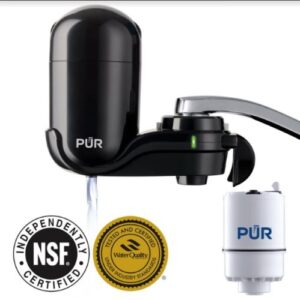
I am trying to mail a water filter like the one in the image I attached.

Pur water filter with lithium battery

When it showed up to me it had some of the UN stickers and said “forbidden for transport by air or vessel”. It does have some type of battery in it to monitor when the filter life is up.

My question is, do I need to provide one of the UN stickers on the attached image to mail it with USPS? I’m just confused if the stickers are only required for mailing batteries themselves, or if the stickers are required when there is just a battery inside the unit.

Thank you!

Daniels Training Services, Inc.

815.821.1550

Info@DanielsTraining.com

https://danielstraining.com/

My reply the same day:

I will try to answer your question. Please see below.

To give a complete answer the size and type of the battery must be known. However, based on the image I will presume the following:

  • It is a cell and not a battery. A lithium cell is a single encased eletrochemical unit with one positive and one negative electrode. A lithium battery is two or more cells electrically connected together and fitted with devices for use.
  • It is a “button cell”. Defined in the IATA Lithium Battery Guidance Document for 2021 as a round small cell or battery with an overall height that is less than the diameter.
  • It is a lithium metal type cell and not lithium ion. Lithium metal cells/batteries are non-rechargeable whereas lithium ion (Li-ion) cells/batteries are re-chargeable and typically used in consumer electronics.
  • Its lithium metal content is no more than 1 g. A cell of this size is subject to a packaging exception as a smaller lithium cell/battery.

If the above presumptions are true, the requirements for its transportation in commerce can be summarized as follows:

  • The equipment with cell inside must be packed securely in an outer packaging.
  • Outer packaging must be of suitable material and adequate strength.
  • The equipment must be secured against movement within the package.
  • The equipment must be packed to prevent accidental activation.
  • It is not necessary to display any package marks or labels on the outer package.
  • If the battery is packed by itself or with – but not in – the equipment it is meant to power more stringent regulations apply.
  • You may find more helpful information in this other article I wrote: Classification of Lithium Batteries for Transportation in Commerce.
  • Since you indicate you will be mailing by USPS, I suggest you refer to USPS regulations.

Also…

  • I don’t know why the package would display a mark or label indicating it is forbidden for transport by air or vessel. If my above presumptions are correct this package is not forbidden for transport by either mode.

I hope this helps. Please contact me with any other questions.

Interested in a Webinar that covers this topic, and more!

My Webinar Training Schedule

He had more information and more questions (09.24.20):

Thank you very much for your quick reply. I have a second one of these that I cracked open to find the battery. It is a button battery about the size of a nickel, so this would NOT require any markings on the package? And for the one I will be mailing the battery will be inside the unit just as it was from the manufacturer.
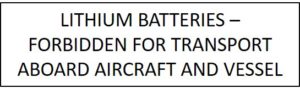
What would be a normal consumer product that would require the markings when shipping? Something like an iPhone?

Thank you for the USPS website reference!!

I had more answers:

The transportation of lithium batteries (all batteries) is very complicated. Please be advised that I am providing only general guidance. If you are shipping the batteries as part of a business you are subject to more strict penalties.

In general:

  • Smaller lithium batteries (those typically used in consumer devices) are subject to less regulation. This includes both lithium ion and lithium metal. My article: Classification of Lithium Batteries for Transportation in Commerce includes a table displaying the lithium content thresholds between “smaller” lithium cells/batteries and fully-regulated cells/batteries.
  • A lithium cell or battery packed alone is subject to the most stringent regulations.
  • A lithium cell or battery packed and shipped in the equipment it is meant to power is subject to less regulation.
  • A button cell battery contained in the equipment it is meant to power is subject to very little regulation other than safe packaging.
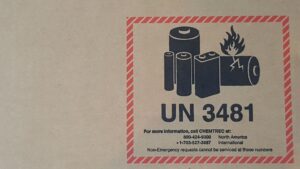
  • The battery in an iPhone – and most other consumer items – will likely be lithium ion and will also likely have a Watt-hour (Wh) rating below the threshold for a “smaller” cell/battery and therefore subject to less regulation. The only package mark or label it might require is the lithium battery mark.

UN3481 Lithium Battery Mark

  • I wrote “might” regarding the display of the lithium battery mark because the requirements for its display depends on several factors:
    • The size of lithium cell/battery.
    • Whether the cell/battery is packed alone, with the equipment it is meant to power, or in the equipment it is meant to power.
    • The number of cells or batteries in the package and the number of packages in the consignment. e.g., if you ship more than two battery packages in a consignment, all packages must display the lithium battery mark.

Please contact me with any other questions.

He needed some additional clarification:

So since I am just mailing one unit, with a button cell battery contained inside the equipment, I should not include any markings on the package is what I am concluding from your bullet points, correct?

My reply:

Based on the information provided, that is correct.

He was grateful:

Thank you for your time!

Like this article?

Subscribe to my Monthly Newsletter

No marketing emails!

Conclusion:

If the above exchange doesn’t make this clear, let me clearly write it now: the transportation of lithium cells and batteries is very complex and is only going to become more so. By the time you read this article the regulations may have already become more stringent. Be sure to do your research into the applicable regulations before you prepare, package, and offer for transport a lithium cell or battery.

Q&A: Does a bulk packaging require the display of the HazMat’s identification number on the vehicle?

A question from a shipper or carrier of HazMat (07.31.20):

I am hauling NA 1993 combustible liquid pg3 (2-methyoxymethylethoxy propanol) in a tote of 350 gallons. Its total weight is 2329lbs. This is the only hazmat on the truck.

*bulk haz. Mat placard accordingly*

Do I need to put UN number on the truck? Could you help me when is to put un number onto placards? Your help would really be appreciated.

Thanks

If you like this article, please share it using any of the social media platforms identified at the bottom of this article.

My reply that same day:

I will try to answer your question below.

  • You indicate your HazMat is a Class 3 Combustible Liquid.
  • I understand the HazMat is contained and transported in a bulk packaging (i.e., has a capacity of more than 119 gallons).
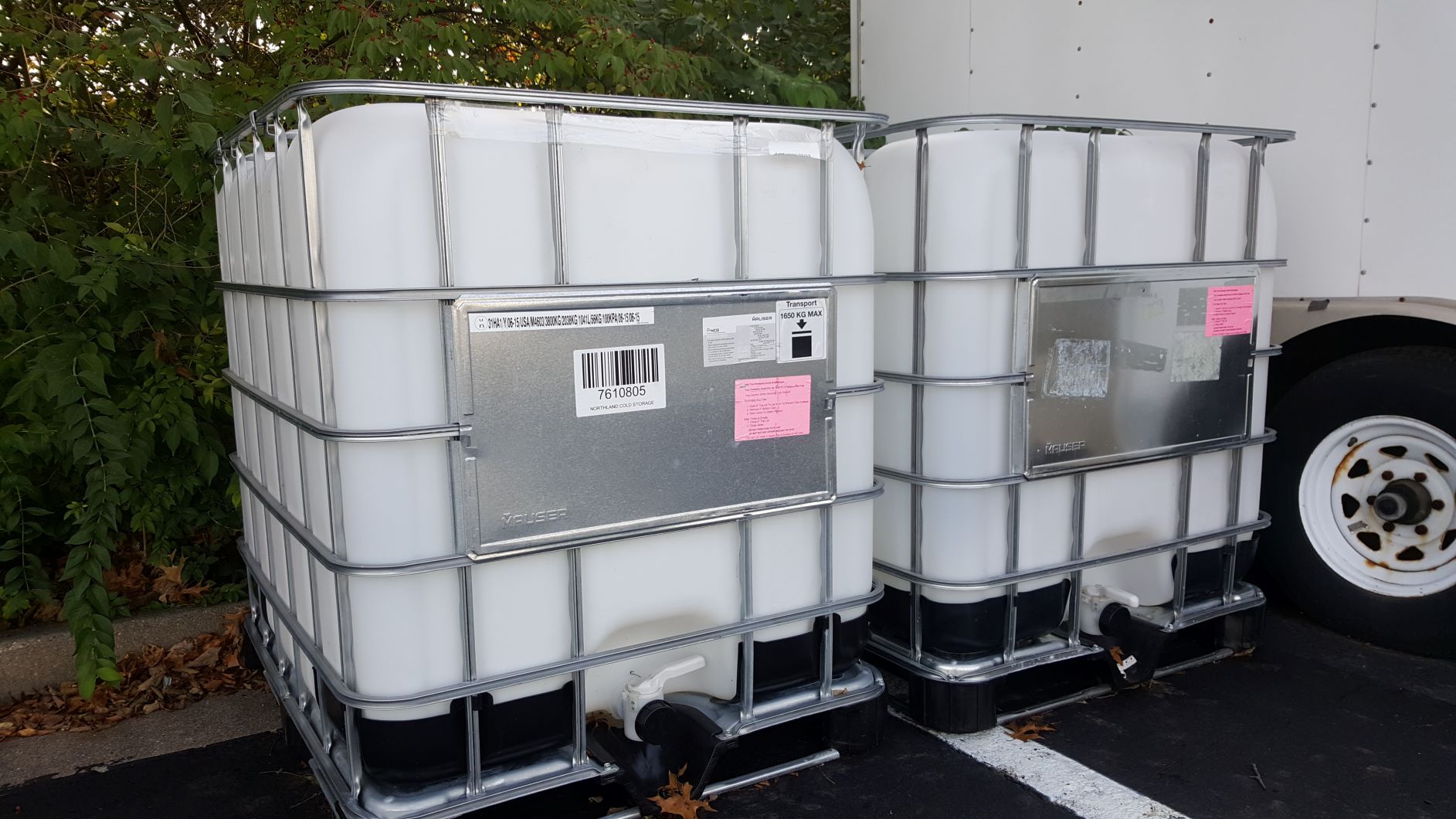
  • More specifically, the packaging is a tote, which I presume to be an intermediate bulk container (IBC).
  • The HazMat Regulations for the display of labels, marks, and placards on an IBC are complex. Read: HazMat Labels, Markings, and Placards on an Intermediate Bulk Container
  • A vehicle transporting a bulk packaging of a HazMat must display both of the following on all four sides of the vehicle or freight container:
    • The placard (in this case the Class 3 Combustible Liquid).
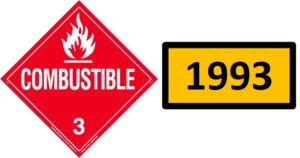
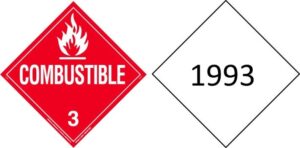
    • The identification number (in this case NA1993). It is displayed solely as “1993” it is not necessary to include the “NA”.
  • The identification number can be displayed in any one of three ways:
    • On the placard. (The white in the bottom of the placard is an option and is not required.)

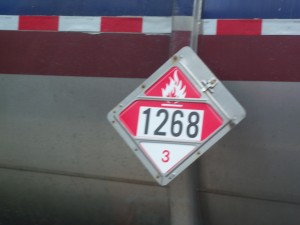
Hazardous materials placard with identification number


    • On an orange panel near the placard.


    • On a white square-on-point near the placard.

NA1993 Mark with Plcard

I hope this helps. Please contact me with any other questions.

He wanted some more information:

Thank you for the information. Could you please tell me more when to include UN number. I always have same issue number of times.

Thanks in advance.

Like this article?

Subscribe to my Monthly Newsletter

No marketing emails!

I had the information:

Sure:

Any time you have a hazardous material in a bulk packaging (>119 gallons), the identification number must be displayed on all four sides of the vehicle.

Also, the identification number must be displayed on a vehicle if it contains a large amount of a single HazMat in a non-bulk packaging. Read: Vehicle Marking Requirements for Large Quantities of a Single Hazardous Materials in Non-Bulk Packagings

Contact me with any questions you may have about the transportation of hazardous materials by air, highway, vessel, or rail

International and Domestic

Daniels Training Services, Inc.

815.821.1550

Info@DanielsTraining.com

https://danielstraining.com/

That seemed to do it!

Thanks a lot.

Conclusion:

The Hazardous Materials Regulations of USDOT/PHMSA are a challenge for both shippers and carriers of HazMat. If you have a question, contact me. If you need HazMat Employee training, contact me!

Q&A: Will “Proprietary Ingredient 1” suffice as a technical name in the shipping description?

A question from a former customer June 18, 2020:

It’s been awhile, but I asked you a few questions in the past when I was working at <<Company>>. New job, new adventures.

I know I have come across this before, and I can’t remember the answer.

The following was copied into the email:

I have run into something I have never come across before so I am tapping you both to see if I can get some assistance.

We have a new item that one of our facilities is going to bring on-site that I am setting up in our system. The manufacturer SDS has some weird information in the shipping description that I wanted to get an expert opinion on.

The manufacturer lists the DOT classification as follows:

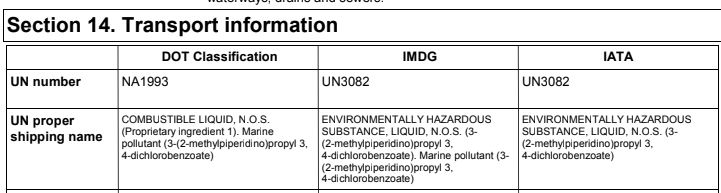
NA1993, Combustible Liquid, N.O.S. (Proprietary Ingredient 1). Marine pollutant (3-(2-methylpiperidno)propyl 3, 4-dichlorobenzoate).

Is it acceptable to ship a product with a generic shipping name and have it listed as a “Proprietary ingredient?” It seems odd to me when I think about an emergency response perspective.

Any insight is appreciated as I am at a loss here!

Section 14 SDS Combustible Liquid Marine Pollutant

My reply that same day:

Thank you for contacting me. Please see below.

  • Per 49 CFR 172.101(b)(4), a hazardous material with a ‘G’ in column 1 of the hazardous materials table requires the display of at least one of the technical names of the HazMat with the proper shipping name as a mark on the package and on the shipping paper.

Hazardous Materials Table entry for Combustible Liquid

  • “Technical name” is defined at 49 CFR 171.8:

Technical name means a recognized chemical name or microbiological name currently used in scientific and technical handbooks, journals, and texts. Generic descriptions are authorized for use as technical names provided they readily identify the general chemical group, or microbiological group. Examples of acceptable generic chemical descriptions are organic phosphate compounds, petroleum aliphatic hydrocarbons and tertiary amines. For proficiency testing only, generic microbiological descriptions such as bacteria, mycobacteria, fungus, and viral samples may be used. Except for names which appear in subpart B of part 172 of this subchapter, trade names may not be used as technical names.

  • In sum, a technical name is…
    • A recognized chemical name or microbiological name.
    • Generic descriptions are authorized only if they readily identify the general chemical or microbiological group. Acceptable generic chemical descriptions as technical names are:
      • Organic phosphate compounds
      • Petroleum aliphatic hydrocarbons
      • Tertiary amines
    • Trade names may not be used as technical names unless they are listed as a proper shipping name or shipping description in column B of the Hazardous Materials Table.
  • (Proprietary Ingredient 1) does not fulfill this requirement. It must be replaced with a technical name.
  • However, pursuant to 49 CFR 172.203(l) the HazMat is also described as a marine pollutant. This additional description includes the name of the marine pollutant in parenthesis after the words “Marine Pollutant”. It is possible that the inclusion of the name of the marine pollutant may suffice to also meet the requirement to include the technical name of the HazMat if it meets the requirements for a technical name described above. If the name of the marine pollutant is also used as the technical name of the HazMat, the text “(Proprietary Ingredient 1)” should be removed.

Further:

  • The requirement to include the technical name of a HazMat as an additional description to the shipping description is at 49 CFR 172.203(k).
  • The requirement to include the technical name of the HazMat as a mark on the package is at 49 CFR 172.301(b).

Daniels Training Services, Inc.

815.821.1550

Info@DanielsTraining.com

https://danielstraining.com/

I hope this helps. Please contact me with any other questions.

Intermediate bulk containers

Q&A: Can I use a UN Standard IBC for my non-HazMat?

An email I received 10.21.20:

Hello, Our company would like to know if the IBCs that are intended to be filled with non hazardous material need to be retested every 2.5 years. Does the DOT require this regardless of Hazardous / non hazardous material in the IBC?

Thank you,

My reply October 22, 2020:

Thank you for contacting me. Please see below.

  • An IBC (intermediate bulk container) used for the transportation of a hazardous material (HazMat) must be designed, manufactured, tested, and marked to indicate it meets a packaging specification of the USDOT/PHMSA.
  • The United Nations Performance Oriented Standard (aka: UN Standard) is one of several packaging specifications accepted for use within the U.S. by USDOT/PHMSA.
  • An IBC that meets the UN Standard must display the UN Standard mark as specified at 49 CFR 178.703. This mark must be visible in transportation.

Specification Packaging Marking on an IBC

  • In order to continue in service, IBCs must be retested and inspected as follows:
    • Leakproofness testing every 2.5 years if it is designed to retain liquids.
    • An external visual inspection every 2.5 years to ensure it continues to meet the requirements of the UN Standard.
    • An internal inspection every 5 years to ensure it continues to meet the requirements of the UN Standard.
  • UN Standard packaging is not required for non-HazMat.

However…

  • If a UN Standard packaging is used for a non-HazMat, the packaging is subject to all of the requirements of the UN Standard including the retest and reinspection.
  • Therefore, if you use a UN Standard packaging for the transportation of a non-HazMat the IBC must continue to be retested every 2.5 years – and more as indicated above – in order to retain its UN Standard. It is a violation to use a packaging marked to indicate it meets the UN Standard when it does not.

Solution:

  • Use IBCs that do not display the UN Standard mark for transport of non-HazMat.
  • If UN Standard mark is visible, then obliterate, remove, or securely cover prior to transport of non-HazMat.

I hope this helps. Please contact me with any other questions.

He required clarification:

So, as long as the UN marking is off the tote, it can be shipped?

Interested in a Webinar that covers this topic, and more!

My Webinar Training Schedule

My confirmation:

Yup.

Conclusion:

Sometimes the USDOT/PHMSA Hazardous Materials Regulations can be tricky; sometimes they don’t make any sense. “Why does it matter if the material in transport is non-HazMat?” My HazMat Employee training can help you to make sense of it all.

Search Website