The Hazardous Materials Regulations (HMR) of the USDOT/PHMSA require most packagings used for the transport in commerce of a hazardous material (HazMat) to meet a DOT specification or a UN standard. Some HazMat are subject to a packaging exception and others – though fully regulated – are allowed to be transported in other forms of specification packaging, e.g., a packaging in compliance with a special permit; these do not require DOT specification or UN standard packaging.
Most shipments of HazMat, however, will require a DOT specification or UN standard packaging. Those that are non-bulk packagings must be manufactured to a standard identified in 49 CFR 178, subpart L and be able to pass certain tests specified in §178, subpart M. One of those required tests is the leakproofness test. (more…)
Quick Take: Alternatives to the Leakproofness Test Method
The Hazardous Materials Regulations (HMR) of USDOT/PHMSA require certain packagings (mostly single and composite packagings intended for the transport of liquid hazardous materials) to undergo a leakproofness test prior to use or reuse.
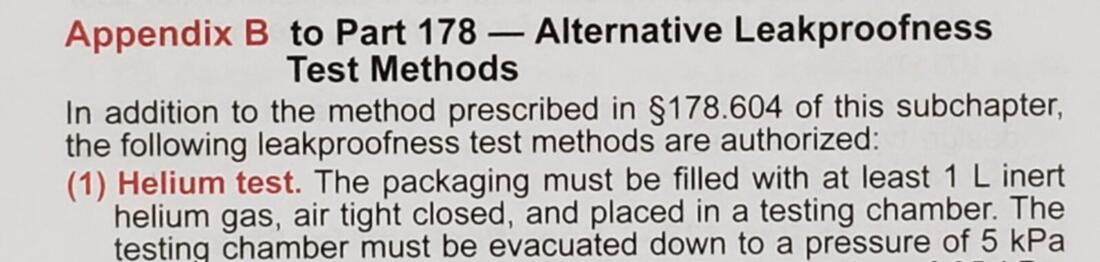
The requirements for the leakproofness test are found at 49 CFR 178.604. §178.604(d) identifies the test method to use. It also reads, “Other methods, at least equally effective, may be used in accordance with appendix B of this part.” So, in addition to the method prescribed in §178.6o4, the leakproofness test methods of appendix B to part 178 are authorized.
What follows is a list of the alternative leakproofness test methods of Appendix B to Part 178. For a more complete description, refer to the regulation.
Helium test
Pressure differential test
Solution over seams
Solution over partial seams test
Contact me with any questions you may have about the transportation of hazardous materials by air, highway, vessel, or rail
Q&A: My truck has Corrosive, Combustible Liquid, and Class 9 Miscellaneous. What placards are required?
A question from a recent customer (June 06, 2018):
Daniel,
Hope this finds you well. I am the warehouse manager at <<Company>>. I was wondering if you can clear something up for us. When placarding trucks if we have multiple hazard classes shipping and it is over 1000# we have to placard all the hazard classes correct? If you look at the attachment I believe we should’ve placarded both class 8 & 9. (A shipping paper was attached showing a consignment of more than 2,500 lb of various Class 8 Corrosive Materials, more than 3,000 lbs of a Class 9 Miscellaneous, 220 lb of a Class 3 Combustible Liquid, and some non-hazardous materials). I have some that believe if one class is over the 1000# that is what gets placarded. Would you be kind enough to help clear this confusion.
Contact me with any questions you may have about the transportation of hazardous materials by air, highway, vessel, or rail
49 CFR 172.504(a) indicates it is necessary to display placards on a vehicle containing any amount of a hazardous material except in the following conditions:
A hazardous material identified in Table 2 of the placarding tables at §172.504(e), in a non-bulk packaging, if the total amount of HazMat in the vehicle is less than 454 kg (1,001 lb).
Since neither the Class 9 Miscellaneous nor the Class 3 Combustible Liquid in a non-bulk packaging are required to display placards, their respective weight is not counted toward the placarding threshold.
This letter of interpretation from USDOT/PHMSA (97-0099) is too old to be available as a link from their website. However, it indicates that Class 9 Miscellaneous HazMat is not counted toward the placarding threshold: “Only materials that are covered by Table 2 and that require placarding are included in the aggregate gross weight.” Though not stated directly, this would apply to Class 3 Combustible Liquids in a non-bulk packaging as well.
If the weight of the Class 8 Corrosive is 454 kg (1,001 lbs) or more, then it is necessary to display the Class 8 Corrosive placard on the vehicle.
Display of the Class 9 Miscellaneous and the Class 3 Combustible Liquid placards on the vehicle are optional – at the discretion of the driver – but not required.
I hope this helps.
Please contact me with any other questions.
If you like this article, please share it using any of the social media platforms identified at the bottom of this article.
You’ll look real smart recommending my articles!
And that did it!
This absolutely helps. Thank you for this info.
Q&A: I’m picking up Class 8 Corrosive and Class 9 Miscellaneous (Marine Pollutants). What placards do I need?
Sent May 05, 2018, all in uppercase so I knew he was serious.
TUESDAY I HAVE TO PICK UP 9,000 LBS OF CLASS 8 MATERIALS IN 200 BOXES ON 10 PALLETS PLUS 50 BAGS ON 2 PALLETS AT 1500 LBS OF CLASS 9 MARINE POLLUTANT MATERIALS.
DO I NEED A CORROSIVE PLACARDS WITH THE UN NUMBER ON THEM AND MARINE POLLUTANT PLACARDS FOR MY TRAILER?
I REFUSED THIS LOAD FRIDAY FOR THE LEAKING OF ONE BAG OF THE MARINE POLLUTANTS AND NO HAZMAT DOCUMENTS FOR THE CLASS 8 BOXES.
However, it is not necessary to display the HazMat’s identification number (UN NUMBER) on the placard because both of the following are true for this consignment:
The HazMat is not in a bulk packaging. If in a bulk packaging it would be necessary to display the identification number on the vehicle.
FYI: though it has the same dimensions and visibility requirements as a placard, the identification of a marine pollutant is a mark, not a placard.
You were correct to reject the original consignment due to damaged packaging and lack of hazardous material shipping paper. Per 49 CFR 177.801:
No person may accept for transportation or transport by motor vehicle a forbidden material or hazardous material that is not prepared in accordance with the requirements of this subchapter.
I hope this helps. Please don’t hesitate to contact me with any other questions.
That must have done it because I didn’t hear from him after that.
Contact me the next time your USDOT Training is due to expire.
Q&A: How do I classify a Class 3 Combustible Liquid for both international and domestic transport?
This e-mail was sent from a contact form on Daniels Training Services (https://danielstraining.com) on December 05, 2019
Hello,
I am trying to name a chemical for transport. It has a flashpoint of 81 C. It is not a US DOT marine pollutant, but it is an IMDG marine pollutant. We ship in both bulk and non-bulk packaging, both domestically and internationally. I believe the US DOT name would be NA1993, combustible liquids, n.o.s. (name), 3, III -is that correct?
I am having a hard time with the IATA and IMDG name. Would those still be the NA1993? I know that NA1993 isn’t recognized internationally, so I am little confused as how this should be named. Any help you can provide with the naming would be greatly appreciated!!
Thank you for contacting me. I apologize for my delay. I will review and reply. Please advise on the below.
What is the chemical? Do you have an SDS?
What makes it an IMDG marine pollutant?
What is the expected capacity of the packaging: <5 L / 5 kg? <119 gallons? >119 gallons?
Does transport begin or end in the U.S.?
Thank you and please advise.
Answer:
Hello Daniel,
Thanks for taking the time to help me with this!!
The product is a blend of basic epoxy resin (casRn 25085-99-8) and Oxirane, 2-(butoxymethyl)- (casRn 2426-08-6); flash point 81 °C
No, we do not have a SDS. We are trying to make one and the SDS author asked me to assist in the naming.
It is IMDG marine pollutant because it meets the UN model regulation criteria for classification as a Chronic Aquatic Toxicity Cat 2.
When we make a SDS, we include the names for each package type and mode of transport. We ship 1L to 20L/5 gallon samples, 55 gallon drums, and 275 gallon totes
1L to 5 gallon samples ship by ground or air both domestically and internationally
55 gallon drums and 275 gallon totes ship by ground domestically and by vessel internationally
Transport begins in the US
Thanks,
Interested in site specific training at your site that covers this topic, and more!
It was after Christmas, (12.27.19) but I got him an answer:
I will try to answer you questions. Please see below.
Based on the flash point it is a Class 3 Combustible Liquid per USDOT regulations.
A material with a flash point higher than 60 degrees C is not subject to international regulations (IATA or IMO).
Based on your information it is not a marine pollutant per USDOT regulation but is a marine pollutant per international regulations.
A combustible liquid is not subject to USDOT regulation if transported by highway or rail within the U.S. and in a non-bulk packaging (and other conditions).
A non-bulk packaging of this material is not subject to USDOT regulations within the U.S. In a bulk packaging it is a Class 3 Combustible Liquid. NA1993, combustible liquids, n.o.s. (name), 3, III may be the proper shipping description if a more specific name is not available. There may be other shipping names that are more descriptive of the HazMat.
The material is subject to international regulation as a marine pollutant unless subject to the marine pollutant exception (packaging of less than 5 L or 5 Kg).
USDOT regulations allow a non-HazMat to be classified as a marine pollutant within the U.S. if subject to international regulation as a marine pollutant.
Also:
Section 14 of the SDS is not required to be completed within the U.S.
My suggestion:
Classify as marine pollutant for all transport.
Classify as Class 3 Combustible Liquid only when in bulk packaging within the U.S. All other transport is non-HazMat.
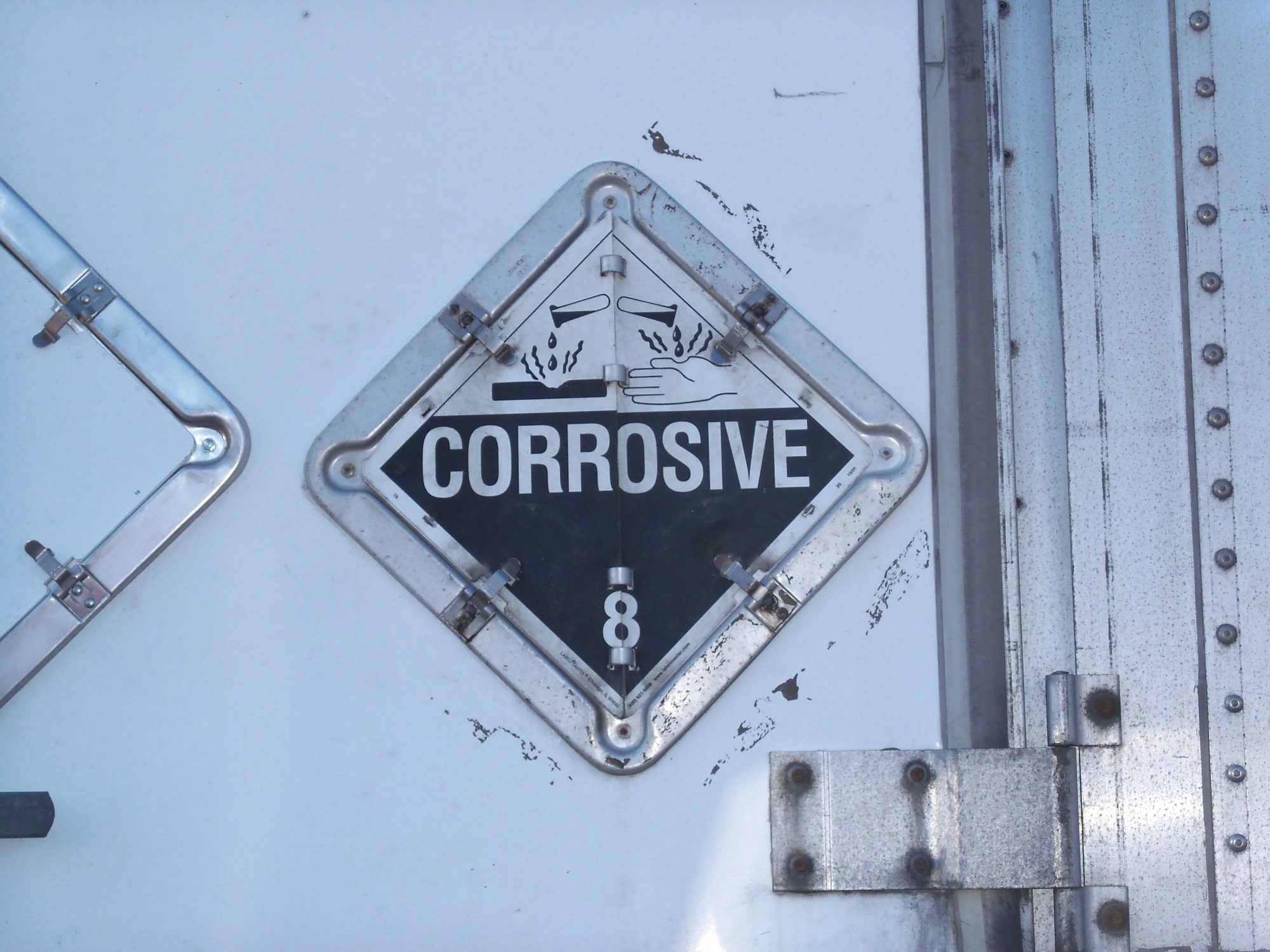
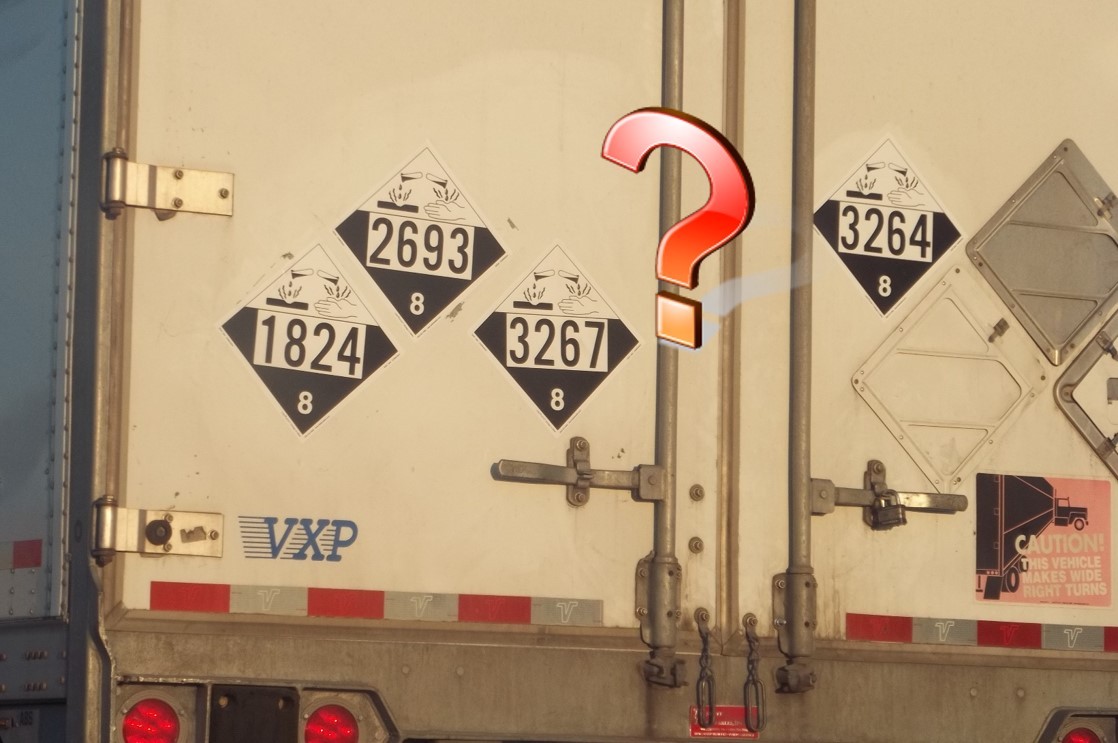
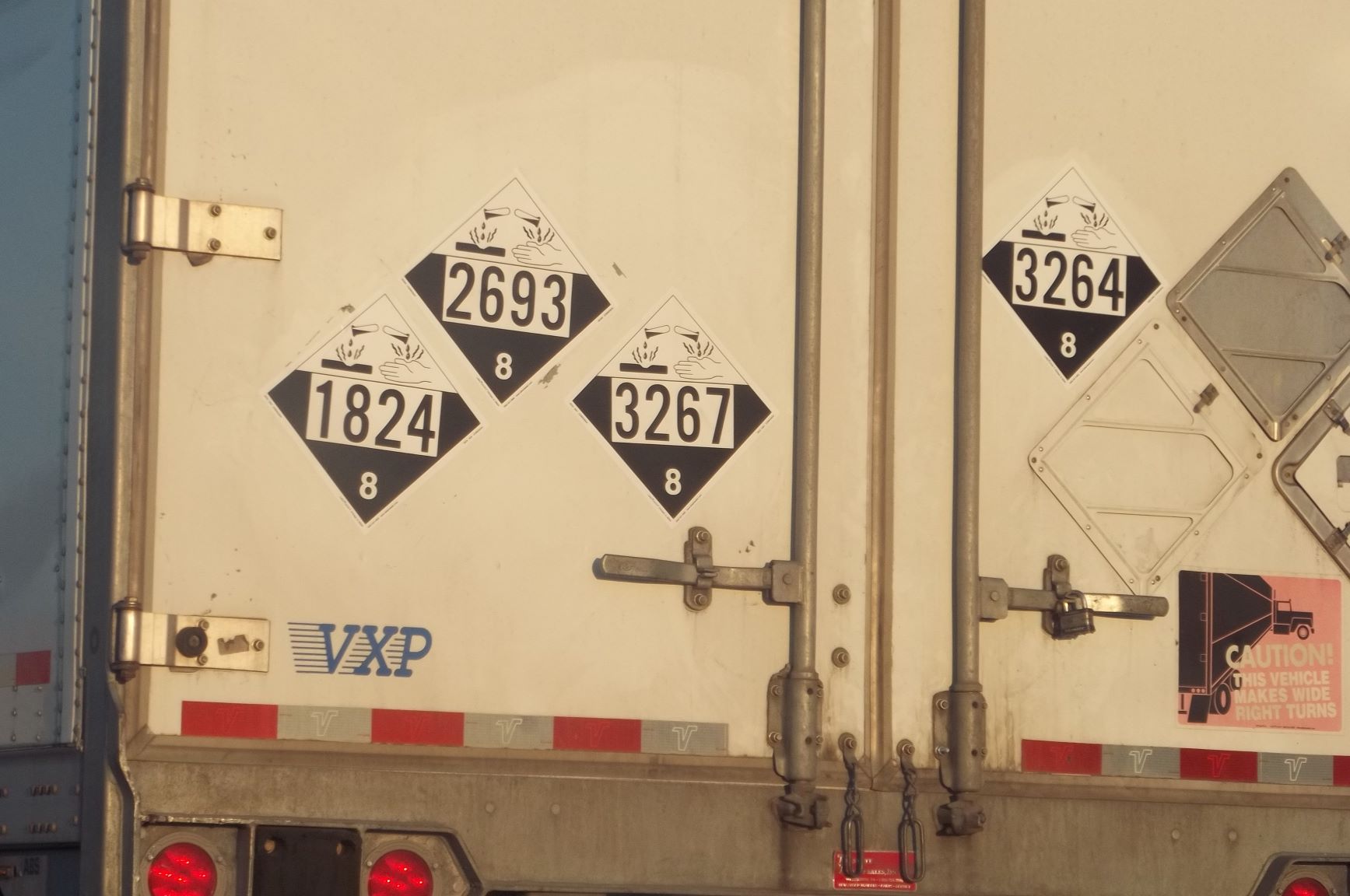
Two separate Class 8 Corrosive placards must be displayed on all four sides of the vehicle.
The identification number 3264 is not required to be displayed on a Class 8 placard since the HazMat is not in a bulk packaging and it is not the sole HazMat in the vehicle.
The identification number 1760 is required on a Class 8 placard since the HazMat is in a bulk packaging.
If no bulk items then one Class 8 Corrosive placard per side with no identification number would suffice.
I hope this helps.
Please contact me with any other questions.
It took awhile, but on May 23rd he still had questions:
There are at least four separate bulk packagings on this vehicle.
Thanks for the answer but I’m still confused. (when must an identification number not be included on a hazardous material placard) it says “the solution is to display each applicable identification number in one of the following manners”. “on separate placards of the same hazard class”. In your response you say the identification number isn’t “required” for 3264. Wouldn’t it be prohibited to put the 3264 number on the placard since it is not bulk and does not cover the entire load? Can I use a placard with the 3264 and one with 1760 or MUST I use a plain corrosive 8 placard with a 1760 placard?
I tried to clarify:
I will try to clarify.
Vehicle must display two Class 8 Corrosive placards on all four sides.
One of the placards on each side must display the identification number 1760. It represents the Class 8 Corrosive in a bulk packaging.
The other Class 8 placard must not display an identification number. It’s purpose is to represent the non-bulk quantity of Class 8 Corrosive (UN2364).
Please contact me if you have any other questions.
The requirements for display of placards on a vehicle can be complicated. Having to also display the HazMat’s identification number on or near the placard can complicate things further. Whether you transport a HazMat (carrier) or offer for transport (shipper) you must determine what placards and/or identification numbers are required to be displayed on the vehicle and then either offer them to the driver (responsibility of the shipper) or display them properly on the vehicle (responsibility of the carrier).
Q&A: May I include the ERG# with the IATA shipping description?
A question. May 11, 2018:
Mr. Stoehr,
My name is <<Redacted>>, and let me start by telling you that I have been enjoying your blogs and various compliance articles for years now. I stumbled across your page years ago searching for some RCRA info and I’ve had it bookmarked ever since. I’ve never taken one of your classes, but your articles are some of the best I’ve ever seen. You have a real talent for writing, and you make complex regulatory content very digestible. Thank you for all that you do.
I have a question for you, and before I ask it, I’ll understand if you can’t just answer it outright. If there’s a fee involved, I’m more than happy to pay it. Your knowledge and time are worth money.
Now on to my question:
I had a customer recently ask if there are any DOT rules that prohibit putting the ERG# in the full DOT shipping name, and I told him that based on my understanding, the rules in 49 CFR 172.202 don’t prevent you from including additional information (like the ERG number), as long as it appears after the USDOT Description in its proper sequence. I was discussing this with a colleague of mine and he told me that he thought IATA regulations actually require the ERG in the shipping name. I don’t have a copy of the IATA rules, but I’d like to have this assertion confirmed (just for my own academic curiosity). I don’t work in the IATA sphere at all, but I’d like to at least get that question put to bed.
Thanks for your time and let me know if this is something you can answer.
Me: *BLUSH* and a reply on May 14, 2018:
I have an answer for you.
There is nothing in the IATA Dangerous Goods Regulations that mandates the inclusion of the ERG # with the shipping description on the Shipper’s Declaration for Dangerous Goods.
As a matter of fact, none of the emergency information required by USDOT/PHMSA is required by IATA. However, per USDOT state variation USG-12, the emergency phone number and emergency information is required for any shipment of HazMat transported from, to, or through the U.S.
FYI: State (i.e., a country like Brazil or China) and operator variations are included in Section 2 of the IATA Dangerous Goods Regulations. These variations must be complied with and are subject to enforcement by USDOT just like the rest of the Dangerous Goods Regulations.
IATA does allow for additional information in the description (like emergency information) if it does not detract from the communication of the hazard.
I hope this helps.
Please contact me with any other questions.
Contact me with any questions you may have about the transportation of hazardous materials by air, highway, vessel, or rail
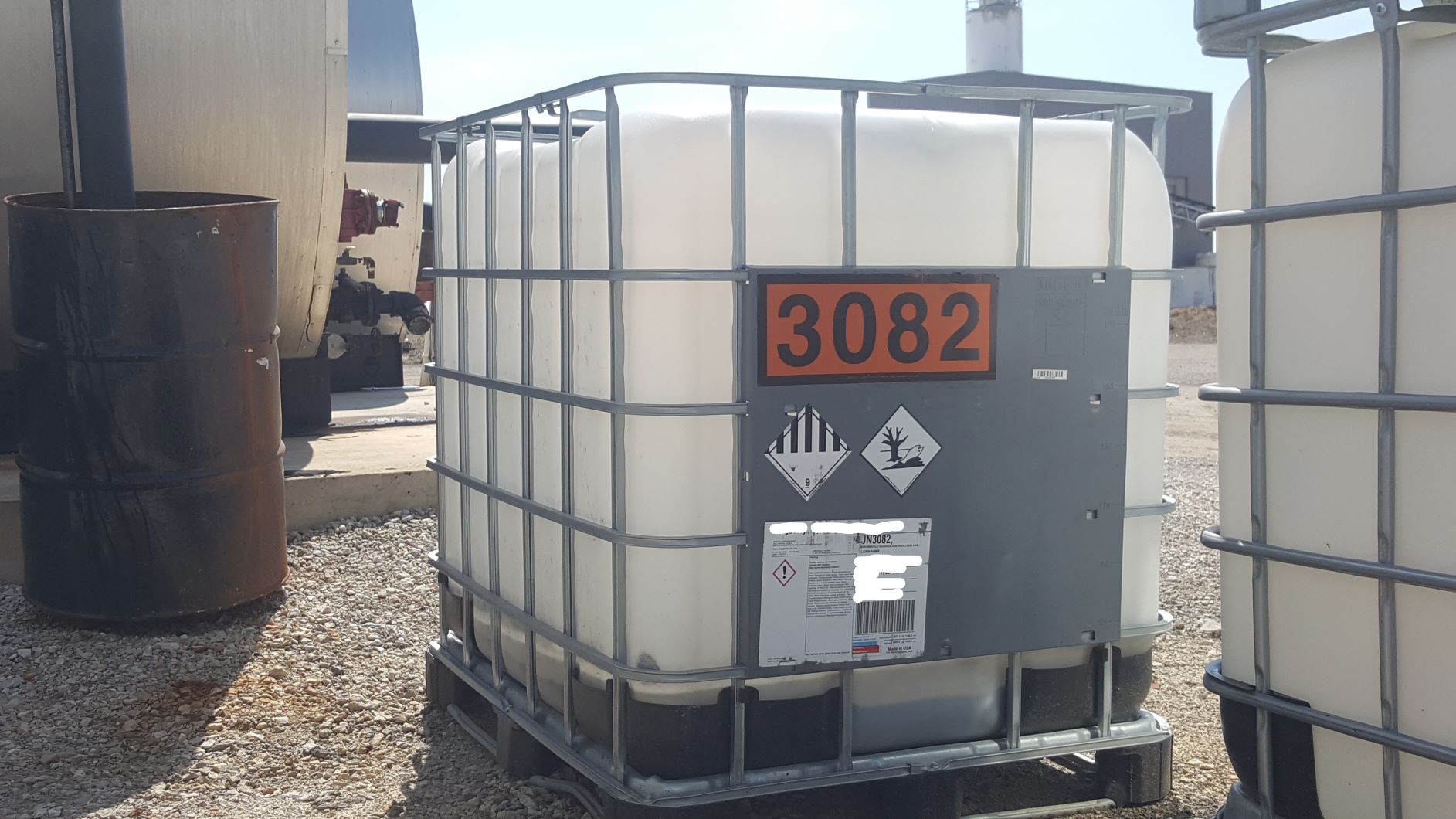
We have a product in totes (Product Name part A, ###A) which is a DOT HazMat class 9 (UN: NA3082, PG III, liquid) with an RQ of 11,111 lbs. In Section 14 of the SDS it states: “When in individual containers of less than the Product RQ, this material ships as non-regulated” – I’m not sure what this means. The product is shipped in totes/IBC (each approx. 3300 lbs – 330 gal) with about 4-6 per load.
My question is: does a semi truck trailer need to be placarded (class 9) when shipping about 4-6 totes (total max ~22,000 lbs; in bulk and >1,001 lbs)? According to your USDOT/PHMSA HazMat Employee training webinar I recently attended, placarding is required for any materials from Table 2 in bulk package (>119 gal) or >1,001 lbs. Also, on page 3 of the DOT Chart 16 (handout) it states for CLASS 9: “(Placarding) Not required for domestic transportation”.
Could you clarify this? No need to elaborate much, I’m just looking for the quick answer. The confusing part is the SDS statement…. and Chart 16.
Thank you very much!!
Contact me with any questions you may have about the transportation of hazardous materials by air, highway, vessel, or rail
I am not aware of any hazardous substance with a reportable quantity (RQ) of 11,111 lbs. I believe the max RQ is 5,000 lbs.
It would be helpful to know the constituent in the product that is a hazardous substance. Can you provide an SDS for the product?
I won’t know for certain without seeing the SDS but I am confident the statement in section 14 is indicating that the material is not regulated as a HazMat unless it is a RQ of a hazardous substance.
If I knew the name of the HazMat and its concentration in the solution, I could determine if an RQ of a hazardous substance is present.
I think a quick review of the SDS would indicate if a hazmat or not.
He was able to provide additional information:
Class 9 Miscellaneous placard
Here is page 1 and page 10 of the SDS. Sorry for the poor quality of the image.
Thanks again!
Note from Daniels Training Services: I did not include the images but below is the relevant content.
Text from section 14 SDS reads: “Additional Transportation Information: When in individual containers of less than the product RQ, this materials ships as non-regulated.”
The hazardous substance component of the product was 4,4′-diphenylmethane Diisocyanate (MDI). It has a RQ of 5,000 lb.
The information provided did not identify the concentration of MDI in the product.
Please see below. My response is based on the information provided.
Do not rely on section 14 of this SDS. In this SDS it contains several errors. Unfortunately, this is not uncommon in my experience.
The product is only a hazardous substance if at a concentration of 10% or more in the solution and has a mass of 5,000 lbs (454 kg) or more in a single container. This is not possible in a single IBC of 3,300 lbs.
It does not appear to be a HazMat for any other reason that I can determine. However, it may contain other HazMat I am not aware from the information provided.
No need to placard trucks transporting this material then. Thanks for the clarification.
My final answer with a suggestion:
No, however, I do think this deserves more research. In my experience at least one of the two parts of a resin system are a HazMat.
Conclusion:
But that was the last I heard from him on that topic.
Q&A: Is DOT registration required for a SQG?
Question (April 13, 2018):
Hi Daniel,
I had a quick question about the DOT Registration requirement (Subpart G).
If a SQG of HW ships their waste (e.g. 3 drums >1001 lbs -needs placard) with Safety Kleen, the SQG needs to be registered?
Thanks
My answer that same day:
In the situation you describe, registration will be required. The hazardous waste generator status of the shipper is not a factor when determining if registration with PHMSA is necessary.
So that was easy. Please see below for some information on things left unsaid in that brief Q&A.
The customer asked about “DOT” but I answered as “PHMSA”; what gives? The Pipeline and Hazardous Material Safety Administration (PHMSA) is one of thirteen (13) administrations within the U.S. Department of Transportation (DOT). PHMSA is responsible for ensuring the safe and secure movement of hazardous materials by all modes of transportation: highway, rail, vessel, aircraft. It therefore has overlapping authority with other administrations and bureaus within the DOT such as: Federal Aviation Administration (FAA), Federal Railroad Administration (FRA), Federal Motor Carrier Safety Administration (FMCSA), and others. Its authority may also overlap with the US Coast Guard. Note: while the Coast Guard is no longer a part of the DOT, it operates under a memorandum of understanding to enforce DOT regulations for transportation by vessel. In casual conversation it’s OK to refer to USDOT regulations but if we’re trying to be precise we must use PHMSA or USDOT/PHMSA.
SQG? This is a small quantity generator of hazardous waste. A SQG generates more than 100 kg (220 lb) per month of hazardous waste but must not generate more than 1,000 kg (2,200 lb) per month. Under USEPA’s hazardous waste regulations a SQG is subject to a moderate level of regulation, between that of a large quantity generator (LQG) and the very small quantity generator (VSQG).
Not sure of your hazardous waste generator status?
If you are a generator of a hazardous waste subject to USEPA and state regulations you are likely also to be a shipper of hazardous materials (USEPA hazardous waste is one type of hazardous material) subject to USDOT/PHMSA regulations for its off-site transportation.
Q&A: Which are required to be displayed on IBCs: placards or labels?
A question from a repeat customer on June 8, 2017. (I’m frequently contacted by customers in the interim between their periodic training to answer questions).
Hi Dan,
I hope this finds you doing well.
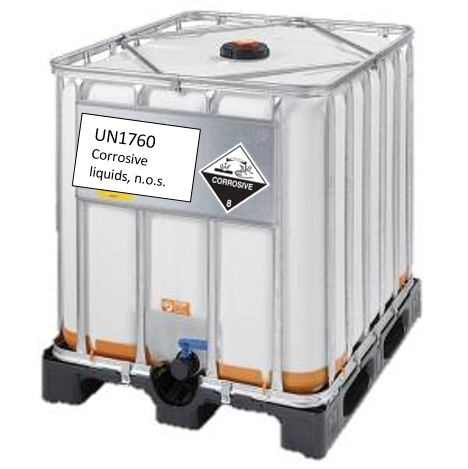
During the training session back in April, there was a question raised about “do we need to apply a placard to IBCs or can we use the 4” x 4” labels”. I cannot remember what the answer to this question was.
We ship a number of IBCs of class 8 material not only domestically but also via ocean and today we place a class 8 placard on opposing sides of the IBC. Is this required or can we use the smaller 4” x 4” class 8 label?
Thanks for the help.
Best regards,
Contact me with any questions you may have about the transportation of hazardous materials by air, highway, vessel, or rail
I can answer part of your question now. The other part will take more time and research. Please see below.
For transportation within the U.S. according to the regulations of PHMSA, there are several options for the marking, labeling, and/or placarding of an IBC. One option available is to mark and label the IBC in the same manner as a non-bulk packaging. This means a single HazMat label (4″ x 4″) near the proper shipping name and the identification number (ID number at least 12 mm high). This article I wrote explains the available options, including the above: How to Mark, Label, and/or Placard an IBC of HazMat.
The requirements for hazard communication on an IBC per the regulations of the IMO are not immediately known to me. I will need to research the answer and reply.
I hope this helps.
He was grateful, but I wasn’t done!
Thanks Dan!!
It took me until the next day to research the Dangerous Goods Code of the International Maritime Organization (IMDG Code):
I now have an answer to the second part of your question. Please see below.
Per the IMDG Code, an IBC of more than 450 L (119 gal) must be marked on two opposing sides (5.2.1.4) and must be labeled on two opposing sides (5.2.2.1.7).
This differs from the domestic regulations of PHMSA which has many options but includes an option to label and mark on only one side.
I hope this helps. Please contact me with any other questions.
His reply the same day (06.09.17):
Hi Daniel,
Thanks for this information. The last part of our question relates to the size. Today we place a placard on each side of the tote but we are wondering if we can use a 4” x 4” label instead. This would be easier and less costly.
Thanks again.
I wished to clarify the information:
In both instances (domestic and international) a 250 mm x 250 mm (approximately 4″ x 4″) HazMat label is acceptable.
Wow! Look at all those exclamation marks! I think I helped him to save his company a lot of money!
Thanks!!!!!!
Interested in site specific training at your site that covers this topic, and more!
This exchange illustrates several important points about the applicable regulations and my services:
The transportation of hazardous materials is subject to a variety of regulations based on its mode – aircraft, vessel, rail, or highway – and its destination – domestic or international.