PO Box 1232 Freeport, IL 61032

A Different Kind Of Training

A Different Kind Of Training

A Different Kind Of Training

A Question About Transportation of Liquid Lead Acid Batteries

A question from a reader of my Newsletter on July 22, 2015:

Is there a certain height maximum that wet batteries UN2794 can be loaded for highway transportation? I believe there is and I am looking for the specific information. If so can you tell me specifically where I can find this information. I just finished reading your article from November 13 2014 for Packaging Wet Batteries for Transportation and did not see anything regarding loading height limits.

Thank You
My reply the very next day (7.23.15):

Thank you for contacting me.  The answer to any question about packaging for batteries, wet, filled with acid can be found in 49 CFR 173.159 (referenced from column 8 of the Hazardous Materials Table).

173.159(d)(1) includes the only reference to packaging height that I can find in the HMR.  It reads in part:  “Electric storage batteries are firmly secured to skids or pallets capable of withstanding the shocks normally incident to transportation are authorized for transportation by rail, highway, or vessel. The height of the completed unit must not exceed 11⁄2 times the width of the skid or pallet. …”
173.159(e) contains a very good exception from most of the HMR when transporting solely batteries (i.e. no other HazMat on the vehicle) by highway or rail.
I hope this helps.  Please don’t hesitate to contact me with any other questions.
Thanks again for contacting me.
Dan

Contact me with any questions you may have about the transportation of hazardous materials by air, highway, vessel, or rail

International and Domestic

Daniels Training Services

815.821.1550

Info@DanielsTraining.com

https://danielstraining.com/

A Question About Speculative Accumulation Under the 2015 Definition of Solid Waste Rule

A question I received August 9, 2015 (A Sunday!) from a reader of my monthly newsletter:

Hello – I enjoyed reading your article on the new RCRA DSW rule.  In your opinion, would the new labeling requirement in 40 CFR 261.1(c)(8) be applicable to areas accumulating –
1) Recyclable materials with precious metals to be reclaimed managed 261.6 & 266?
or
2) scrap metal that is not excluded under 261.4(a) but managed 261.6?

I appreciate any thoughts you may have.

Thank You

My reply on the following Monday (I don’t work Sundays):

That is a good question.  Give me a day or two to research a response and I will get back to you.

 Thank you for contacting me.
Dan

Like this article?

Subscribe to my Monthly Newsletter

No marketing emails!

And my reply just two days later (August 12, 2015):
Thank for the compliment and your confidence in my ability.  I believe I have an answer for you.
The 2015 DSW revised the description of the Speculative Accumulation Provision at 40 CFR 261.1(c)(8) to include a requirement to label the storage area where a material is being accumulated prior to recycling.  This, and other new requirements, apply to all persons subject to the Speculative Accumulation provision.
Therefore, it is necessary to determine if the two exclusions you refer to (Scrap Metal & Precious Metals Reclamation) require compliance with the Speculative Accumulation Provision.  Answer:
I hope this helps.
Please don’t hesitate to contact me with any other questions.
Dan
Another happy customer!:
Great- thank you for the quick response.

Contact me with any questions you may have about the generation, identification, management, and disposal of hazardous waste

Daniels Training Services

815.821.1550

Info@DanielsTraining.com

https://danielstraining.com/

40 CFR 261.4(a)(27) The New Remanufacturing Exclusion for Spent Solvents

The New Notification Requirement if Recycling Hazardous Secondary Materials Under the EPA Regulations of the 2015 Definition of Solid Waste Final Rule

The 2015 Definition of Solid Waste Final Rule, which became effective at the Federal level on July 13, 2015, both added new and revised existing exclusions from regulation as a solid waste for hazardous secondary materials that are recycled by reclamation.  A generator of the hazardous secondary material taking advantage of the exclusions – and you should if you can – will be required to submit a notification to the EPA or their state.  The purpose of this article is to identify and explain the requirement to submit a notification per 40 CFR 260.42 for recycling by reclamation of a hazardous secondary material under the regulations codified under the 2015 Definition of Solid Waste final rule. (more…)

Requirements of the Remanufacturing Plan of 40 CFR 261.4(a)(27)

The new Remanufacturing Exclusion for certain spent solvents generated by – and destined for future use in – specified industry sectors requires the generator of the spent solvents and the remanufacturer to jointly develop and maintain a remanufacturing plan. The purpose of this article is to identify and explain the requirements of this new EPA regulation codified by the 2015 Definition of Solid Waste Rule. (more…)

Packing Instructions for Paint, Paint-Related Material, Adhesives, Ink, and Resins

49 CFR 173.173 contains the packing instructions for paint, paint-related material, adhesives, ink, and resins.  If you intend to offer for transportation, i.e. ship, or transport in commerce any of the above – either as a product or a waste – you must be familiar with the packing instructions of §173.173 and the exception from some of the Hazardous Material Regulations it offers. (more…)

NY DEC Announces Second Arrest in Schenectady Illegal Dumping Case

The Bullet:

Police made a second arrest in the illegal dumping of approximately 125 gallons of waste oil in the city of Schenectady, NY following the public’s assistance in identifying the suspect.

Logo of the New York State Department of Environmental ConservationWho:

New York Department of Environmental Conservation (NY DEC).

Joseph Alleyne, of Schenectady, known locally as “Green Eyes,” on Wolf Rd. in Colonie, NY.

58-year-old Linwood Gholson, of Schenectady, NY.

What:

Linwood Gholson and Joseph Alleyne were arrested separately for dumping waste oil into a storm drain.

Alleyne is facing charges that include felony level endangering public health, safety and the environment under the New York State’s Environmental Conservation Law.

Linwood Gholson was charged with felony release to the environment and aggravated unlicensed operation of a motor vehicle and operating a motor vehicle with a suspended registration.

When:

July 10, 2015:  Arrest of Linwood Gholson.

July 24, 2015:  Arrest of Joseph Alleyne.

July 29, 2015:  Announcement by NY DEC.

Where:

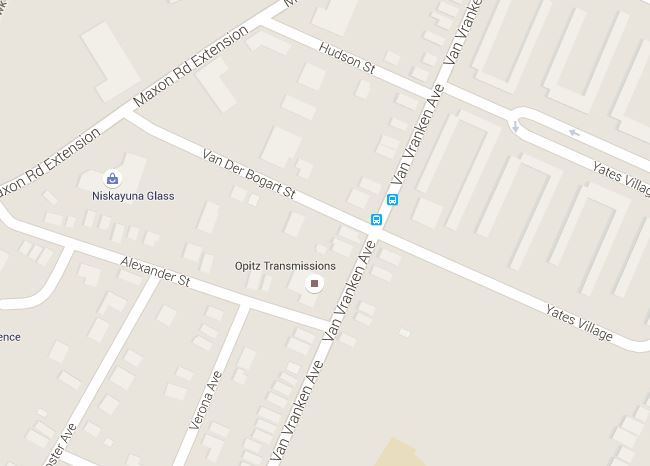
Map of Van Der Bogart Street in Schenectady, NYThe oil was dumped into a storm drain on Van Bogart St. (Van Der Bogart Street) in Schenectady, NY.

 Why:

DEC Regional Director Goertz said,

DEC will not tolerate illegal dumping of any kind and we appreciate the public’s assistance in this case.

How:

The New York State Department of Environmental Conservation (NY DEC) is authorized by the Environmental Protection Agency (EPA) to administer the hazardous waste program in New York state.  This includes enforcing state environmental regulations that must be at least as strict as those of the EPA.  If NY DEC did not administer its program in a manner at least as stringent and as broad as the Federal program it would run the risk of losing its authorization.

Read:  Authorization of State Hazardous Waste Programs Under RCRA

Local news coverage resulted in multiple tips which led to the arrest of Joseph Alleyne.

Thanks to leads from the public, DEC Environmental Conservation Officers and their partners in local law enforcement identified, located and arrested the suspect.

Summary:

Activities such as this used to be common, even acceptable.  But no more.  Too many people are aware of the damage done to the environment by illegal disposal activities to allow such behavior to go unnoticed or unreported.  In this case, the public provided information to make the second arrest possible.

No one wants their name or their company’s name tarnished in this way.  Make certain that everyone at your company knows the regulations of NY DEC and EPA for the management of wastes, and those of the US Department of Transportation for the transportation of hazardous materials.  In any situation, training for your HazMat Employees and Hazardous Waste Personnel will be a benefit to you and your employees.

Daniels Training Services

815.821.1550

Info@DanielsTraining.com

https://danielstraining.com/

Contact me if you have any questions about your regulatory compliance.

North Slope Borough Settles With EPA for Hazardous Waste Violations

The Bullet:

The U.S. Environmental Protection Agency and the North Slope Borough, Alaska have reached a settlement that resolves alleged violations of hazardous waste requirements under the Resource Conservation and Recovery Act.

North Slope Borough Settles With EPA for Hazardous Waste Violations

Who:

The North Slope Borough – the equivalent of most other state’s “county” – in the U.S. state of Alaska.

USEPA Region 10 with its headquarters in Seattle, WA.

USEPA contact: Judy Smith, 503-326-6994, smith.judy@epa.gov

What:

USEPA alleges the following violations by the North Slope Borough:

  • Failure to complete the hazardous waste determination on at least five separate wastestreams.
  • Stored more than 45,000 pounds of hazardous waste for greater than 90 days without the required permit.

EPA and the North Slope Borough have signed a Consent Agreement and Final Order.  As part of this agreement, the North Slope Borough will pay a $445,336 penalty.

The drums and containers of hazardous waste have been removed from the site.

When:

Violations occurred from 2012 – 2014

Announced by USEPA July 30, 2015

Where:

North Slope Borough is located largely in the North Slope region of Alaska.  The subject hazardous waste was generated at the South Pad facility located on Nunavaaq Street in Barrow, Alaska.

Why:

Ed Kowalski, Director of EPA Region 10’s Office of Compliance and Enforcement:

Performing timely and accurate hazardous waste determinations is a keystone of the RCRA program.  Waste must be evaluated by the generator so that it can be safely managed and to prevent releases that endanger human health and the environment.

Obtaining a RCRA permit prior to operating a storage facility is a critical requirement of the RCRA program. The permitting process insures that hazardous waste storage facilities are operated to prevent harm to the environment or human health. Circumventing that process can lead to dangerously poor waste management.

How:

Since Alaska lacks an authorized hazardous waste program, the Federal hazardous waste regulations apply in that state as they do in Iowa and Puerto Rico.

A Borough, just like a county, city, state, or even Federal government or division of government is subject to the hazardous waste regulations of the Resource Conservation and Recovery Act and to the fines or penalties that may be imposed if violations of the regulations are found or alleged.

Summary:

A huge penalty – not a fine – was paid by this relatively small local government.  I can only imagine that this represented a significant hit to their budget, perhaps for years to come.  Though lack of Hazardous Waste Personnel Training was not cited as an issue here, I can’t help but believe that good training – my training – would have identified these issues and given the administrators of the North Slope Borough the information and the tools they would need to fix the problem.

Daniels Training Services

815.821.1550

Info@DanielsTraining.com

https://danielstraining.com/

Please don’t hesitate to contact me, whatever your question, regarding the cradle-to-grave management of hazardous waste.  I’ll travel anywhere in the country to provide Onsite Training or we can make it easy with a Webinar.


Summary of Proposed Rule from USEPA: The Hazardous Waste Generators Improvement Rule

Announcements from regulatory agencies of the US Government in the Federal Register can have a significant impact on your business.  Therefore it’s important for you to continuously monitor Federal Register publications for announcements applicable to your operations.  I can help you to do this.

Sometimes an announcement in the Federal Register calls for a more thorough explanation than what is conveyed by the headline; that is the point of this article.  Here I will briefly summarize, and provide access to more information, on a specific Federal Register announcement:  the Hazardous Waste Generator Improvements Rule

What agency is making the announcement?

The United States Environmental Protection Agency (USEPA)

Daniels Training Services

815.821.1550

Info@DanielsTraining.com

https://danielstraining.com/

When was this announced in the Federal Register?

The proposed Hazardous Waste Generator Improvements Rule was signed by the EPA Administrator on August 31, 2015.  It was published in the Federal Register on September 25, 2015.

Any other dates I need to know?

Comments on this proposed rule must be received by November 24, 2015.  The submittal requirements for comments are included in the Federal Register.

Due to requests from the regulated community, EPA is extending the deadline for the comment period by 30 days to December 24, 2015.  The notice of this extension was published in the Federal Register on November 5, 2015.

What type of action is this?

This is a proposed rule, meaning the issuing Agency is proposing a new rule or a revision to an existing rule.  This is not a final rule, nor may it ever be one.  Comments submitted by interested parties may delay, change, or eliminate this proposed rule.

What regulations may be impacted?

40 CFR Parts 260, 261, 262, 263, 264, 265, 268, 270, 273, and 279.  In short, pretty much every regulation pertaining to a generator of hazardous waste.  This is big.  Whatever form this proposed rule takes when it becomes a final rule – and don’t hold your breath – it will have a significant impact on all hazardous waste generators.  Especially Large Quantity Generators (LQGs) and Small Quantity Generators (SQGs).

How is the announcement identified in the Federal Register?

Hazardous Waste Generator Improvements Pages 57917 – 58012 [FR DOC # 2015-23166]

I don’t have all day.  Can you sum it up for me and I’ll determine if I need to read the whole thing?

USEPA is proposing to revise the hazardous waste generator regulations under the Resource Conservation and Recovery Act (RCRA).  Proposed revisions and improvements include:

  • Revise certain components of the hazardous waste generator regulatory program, primarily 40 CFR 261.5 (related to CESQGs) and 40 CFR part 262 (related to SQGs and LQGs). This will require close observation by the regulated community since these revisions may be small but significant and will be interspersed throughout all of the hazardous waste generator regulations.
  • Address gaps in the regulations. This may result in an expansion in the scope of these regulations into activities that are currently not regulated.
  • Provide greater flexibility for hazardous waste generators to manage their hazardous waste in a cost-effective and protective manner. This is good for hazardous waste generators but may be opposed by persons outside the regulated community.
  • Reorganize the hazardous waste generator regulations to make them more user-friendly and thus improve their usability by the regulated community. This is good for hazardous waste generators but it will also make the regulations more accessible for citizen watch dog groups.
  • Make technical corrections and conforming changes to address inadvertent errors, remove obsolete references to programs that no longer exist (like the National Environmental Performance Track), and improve the readability of the regulations. Readability is a good thing but it’s also a two way street.  The regulations will be more readable to a wider audience, both within and without the regulated community.

Other highlights of the proposed rule:

  • A voluntary program will allow for the consolidation of waste from a Conditionally Exempt Small Quantity Generator (CESQG) by LQGs under the same ownership.  I submitted a comment (my first!) on this aspect of the proposed rule.  My comment was a proposal to expand this program to include the consolidation of waste from a CESQG by a Small Quantity Generator (SQG) under the same ownership.  You can review my comments by going to Regulations.gov and searching for my Comment Tracking Number (1jz-8m6t-jw6v).  Decide if you wish to comment on this or any other aspect of this Proposed Rule.  It’s really easy!
  • A voluntary program will allow generators to temporarily change generator status (i.e. SQG to LQG or CESQG to SQG or LQG) episodically.
  • Allow LQGs to accumulate reactive or ignitable hazardous waste within 50’ of their property line if granted a waiver from their local fire department.
  • Clarify the hazardous waste generator status determination for a facility that generates both acute and non-acute hazardous waste.
  • Replace the term Conditionally Exempt Small Quantity Generator (CESQG) with Very Small Quantity Generator (VSQG).
  • Revise container closure regulations found in 40 CFR 262.34(a)(1) for LQGs.
  • Move all of the generator regulations – including those for CESQGs now found in 40 CFR 261.5 – into 40 CFR part 262.
  • Agency is also proposing changes to parts 260, 263, 264, 265, 268, 270, 273, and 279 mostly to maintain consistency with the proposed changes in part 262.
  • Revise the definition of small quantity generator in 40 CFR 260.10 as well as add definitions for:
    • Large quantity generator
    • Conditionally exempt small quantity generator (and change to very small quantity generator)
    • Central accumulation area.
  • Revise the regulations for labeling and marking of containers, tanks, drip pads, and containment buildings used for the accumulation of hazardous waste.
  • Add a provision that hazardous waste generators are prohibited from disposing liquid hazardous waste in landfills.
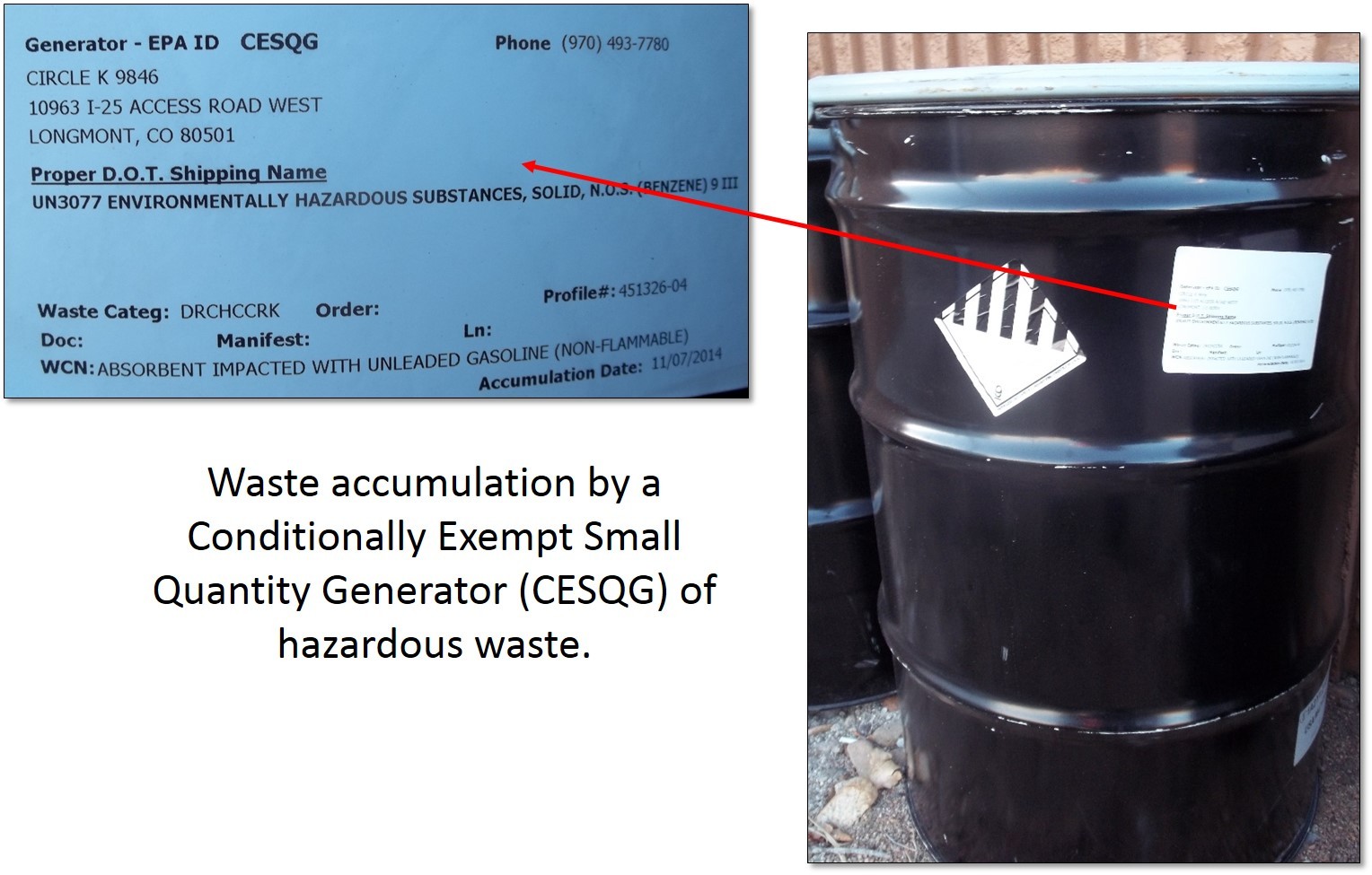
Container of hazardous waste generated by a CESQG
Summary:

This represents a substantial change to the USEPA hazardous waste regulations.  I suspect this will generate a lot of comments from interested parties.  USEPA’s schedule for implementation of the Final Rule is unknown but I suspect – given the nature of the proposed rule – that it will take some time for everyone to have their say and for the Agency to respond with further revisions.  It could take years or it might all be over in a few months and we’ll have new rules – at the Federal level – for hazardous waste generators.  Since some of these rules are less strict than the existing, states with an authorized hazardous waste program will have the option of whether or not they wish to adopt them.

Where can I look for more information?

You may read the Federal Register publication itself here:  PDF | Text | More

Or subscribe to my monthly newsletter.  I’ll be writing articles on this as information becomes available and as I have time to write.

Like this article?

Subscribe to my Monthly Newsletter

No marketing emails!

USEPA has created a website with more information about the proposed rule:  Proposed Rule: Hazardous Waste Generator Improvements

If you have any specific questions about this new proposed rule or require training to ensure you are in compliance with both Federal and State regulations, please contact me.

Daniels Training Services

815.821.1550

Info@DanielsTraining.com

https://danielstraining.com/


FOR FURTHER INFORMATION CONTACT: Jim O’Leary, U.S. Environmental Protection Agency, Office of Resource Conservation and Recovery, (MC: 5304P), 1200 Pennsylvania Ave. NW., Washington, DC 20460, (703) 308–8827, (oleary.jim@epa.gov) or Kathy Lett, U.S. Environmental Protection Agency, Office of Resource Conservation and Recovery, (MC: 5304P), 1200 Pennsylvania Ave. NW., Washington, DC 20460, (703) 605–0761, (lett.kathy@ epa.gov).

A Brief Summary of USDOT’s Hazardous Material Regulations

On October 2, 2015 I had the opportunity to speak for 50 minutes or so at the MRA Safety Conference in Moline, IL.  I was tasked with summarizing the Hazardous Materials Regulations of the USDOT and the applicable regulations to be addressed in Driver Training.  After it was all over I sat down, made a few minor adjustments and created a narrated presentation using Office Mix.  All you have to do is sit back and watch!

When it’s over, please don’t hesitate to contact me with any questions you may have about the transportation of hazardous materials or the management of hazardous waste.

Daniels Training Services

815.821.1550

Info@DanielsTraining.com

https://danielstraining.com/

Search Website