The Requirements of 40 CFR 262.16(b)(8)(vi) Arrangements with Local Authorities for Small Quantity Generator of Hazardous Waste
Federal regulations of the U.S. Environmental Protection Agency (USEPA) require a small quantity generator of hazardous waste (SQG) to maintain equipment and processes to prevent a hazardous waste emergency and to respond to it if one occurs. The regulations are found in the following SQG conditions for exemption:
40 CFR 262.16(b)(8) Preparedness and prevention
40 CFR 262.16(b)(9) Emergency procedures
This article is the sixth in a series that closely examines and explains these regulations.
In the previous article in this series I addressed the requirements of 40 CFR 262.16(b)(8)(v) Required Aisle Space for a Small Quantity Generator
The purpose of this article: 40 CFR 262.16(b)(8)(vi) Arrangements with local authorities. (more…)
Q&A: How do I determine the characteristic of toxicity for a liquid waste?
A question May 04, 2018:
can tclp 20 x rule be used for liquid waste or is it only for solid?
My reply May 08, 2018:
Thank you for contacting me. I will try to answer your question below.
Neither TCLP (Toxicity Characteristic Leachate Procedure) nor the “Rule of 20” may be used on a liquid waste for the purpose of determining the characteristic of toxicity.
The point of TCLP analysis is to extract a leachate from a representative solid sample of waste and determine the concentration of specified toxins in the liquid.
Regulated toxins are identified by USEPA in Table 1 of 40 CFR 261.24(b). They include:
Arsenic (D004)
Lead (D008)
2,4-D (D016)
Lindane (D013)
Silver (D011)
Toxaphene (D015)
2,4,6-Trichlorophenol (D042)
More…
Interested in site specific training at your site that covers this topic, and more!
The “Rule of 20” (I believe this is what the questioner meant by “20 x rule”) is a less expensive option than TCLP for analysis to determine a characteristic of toxicity for a solid. The procedure for using the Rule of 20 on a solid sample is briefly summarized as follows:
Analyze to determine the total concentration of regulated toxin(s) in the sample.
The total results are then divided by 20 to determine the Maximum Theoretical Leachate Concentration (MTLC).
The MTLC is compared to the regulatory threshold of the toxin(s) at §261.24.
If the MTLC does not equal or exceed the regulatory thresholds, then the sample cannot exhibit the characteristic of Toxicity.
A liquid sample of a waste is analyzed directly for the total concentration of toxins. The total results are compared directly to the regulatory thresholds to determine if it exhibits the characteristic of Toxicity.
Analysis of a sample to determine the characteristic of Toxicity is just one step in the responsibility of a hazardous waste generator to conduct a hazardous waste determination. Using the Rule of 20 can save you a lot of money in lab costs. Contact me to determine if there are any other methods available to you to save money and ensure compliance.
Q&A: What is the proper shipping description for a limited quantity of HazMat by vessel?
Question (May 02, 2018):
I have had no official training, but I have been brokering Hazardous shipment(s) for approx 25 years.
I wanted to make sure that the BOL I prepared is correct.
UN 3208 Metallic Substance, Water-Reactive NOS (Magnesium, Class 4.3, PG II, Limited Quantity, F-G, S-N
Emergency Phone ###-###-####
My reply that same day:
Please see below.
Overall, the shipping description appears correct. Please see below for further guidance.
Note: Since you represent a trucking company within the U.S., I presume at least part of the transport to be by U.S. highway. Also, though not indicated in your question, I presume this consignment is to be transported by vessel according to the International Maritime Organization Dangerous Goods Code (IMDG Code). I’ll indicate how I came to this second conclusion while answering your question.
The sequence to the basic description is correct.
UN/ID number: UN3208
Proper shipping name: METALLIC SUBSTANCE, WATER-REACTIVE, N.O.S. The proper shipping name is displayed in uppercase letters in the IMDG Code. It is acceptable to be displayed in lowercase letters.
Hazard class: Class 4.3. Class 4.3 is Dangerous When Wet. Note: Class 4.3 is how it is identified in the IMDG Code. The USDOT/PHMSA Hazardous Materials Regulations refers to it as Division 4.3.
Packing Group: PG II. PG II is the medium / moderate level of danger for a hazardous material / dangerous good.
An additional description of the hazardous material / dangerous good is required as well:
Since this is a generic proper shipping name, at least one technical name of a constituent of the hazardous material / dangerous good must be included with the shipping description. The technical name must be contained within parenthesis (brackets). You indicate “Magnesium” but do not have it contained within parenthesis.
“Limited Quantity” or “Ltd Qty” is to be included as an additional description if the hazardous material / dangerous good is to offered for transport by vessel or air subject to the limited quantity exception. Both the IMDG Code and the USDOT/PHMSA Hazardous Materials Regulations have similar requirements for packaging and hazard communication of a limited quantity. Note: A shipping paper is not required for the transport of a limited quantity by highway or rail within the U.S., but is required for transport by vessel. I therefore again presume that this consignment is to be transported by vessel per the IMDG Code.
Subject to the IMDG Code, it may be a limited quantity only if the net quantity of dangerous good in a single packaging is no more than 500 grams and if the gross package weight does not exceed 30 kg.
“F-G, S-N” are the relevant emergency schedules for FIRE and SPILLAGE in the EmS Guide for this dangerous good. It is identified in column 15 of the IMDG Code’s Dangerous Goods List. This information – along with the emergency phone indicated – can fulfill part of your responsibility as the shipper to provide emergency response information to the carrier. Note: the EmS Guide is not identified in the USDOT/PHMSA Hazardous Materials Regulations (another indication of this consignment’s transport) but may be acceptable as a source of emergency response information it requires.
You do not indicate a total quantity of hazardous materials / dangerous goods nor a number and type of packaging. I presume you are satisfied with these aspects of the shipping description.
Please contact me with any other questions or comments.
Contact me with any questions you may have about the transportation of hazardous materials by air, highway, vessel, or rail
I did not receive confirmation from my questioner but I believe my presumptions to be correct. A question then: Is it OK to prepare and offer for transport a consignment of a hazardous material / dangerous good in compliance with the IMDG Code when some of the transport is by highway within the U.S.? Answer: yes! The Hazardous Materials Regulations of USDOT/PHMSA at 49 CFR 171.23 and §171.25 allow for the transport of a hazardous material (the IMDG Code refers to it as a dangerous good) according to the international regulations of the IMDG Code within the U.S. as long as the shipper complies with the additional requirements and limitations identified in those sections.
And wow! “I have had no official training…” just knocks me out. The regulations of both USDOT/PHMSA and the IMDG Code require any person with a direct affect on the safe transport of hazardous materials / dangerous goods to receive initial training (within 90 days) with a triennial renewal (every three years).
Q&A: Must I display the Class 9 Miscellaneous Placard on a cargo transport unit by vessel?
Question received March 26, 2018:
Mr Stoehr,
I was doing some research when I came across your website and had a question on the requirement for a Class 9 placard on an international vessel shipment via CTU (Cargo Transport Unit, a type of freight container) on the following:
UN3480, Lithium Ion Batteries, 9, II – (21kg. net) 23 kg. Gross
UN3090, Lithium Metal Batteries, 9, ll – (14 kg. net) 34.45 kg. Gross
I’m familiar with 49 CFR 172.504(f)(9) for no placard required for domestic shipping. Just not clear on international shipments via vessel.
Thank you very much for your time Sir have a great day.
My reply with a partial answer the next day:
I have a partial answer for you now but can provide a more complete answer if you are able to provide more information about your shipment. Please see below.
With a few exceptions the International Maritime Organization Dangerous Goods Code (IMDG Code) requires enlarged labels (placards) to be displayed on a cargo transport unit (CTU) for any primary and subsidiary hazard of the dangerous goods contained within.
Therefore, under some circumstances this would require the display of the Class 9 placard on all four sides of the CTU.
However, special provision 188 allows for an exception from most of the IMDG Code for lithium batteries of a certain size. To determine the applicability of this regulation please provide the following:
Watt-hour (Wh) rating of lithium ion batteries
Lithium metal content (g) of lithium metal batteries.
Industry and EPA hazardous waste No.
Hazardous waste
Hazard code
F020
Wastes (except wastewater and spent carbon from hydrogen chloride purification) from the production or manufacturing use (as a reactant, chemical intermediate, or component in a formulating process) of tri- or tetrachlorophenol, or of intermediates used to produce their pesticide derivatives. (This listing does not include wastes from the production of Hexachlorophene from highly purified 2,4,5-trichlorophenol.)
(H)
F021
Wastes (except wastewater and spent carbon from hydrogen chloride purification) from the production or manufacturing use (as a reactant, chemical intermediate, or component in a formulating process) of pentachlorophenol, or of intermediates used to produce its derivatives
(H)
F022
Wastes (except wastewater and spent carbon from hydrogen chloride purification) from the manufacturing use (as a reactant, chemical intermediate, or component in a formulating process) of tetra-, penta-, or hexachlorobenzenes under alkaline conditions
(H)
F023
Wastes (except wastewater and spent carbon from hydrogen chloride purification) from the production of materials on equipment previously used for the production or manufacturing use (as a reactant, chemical intermediate, or component in a formulating process) of tri- and tetrachlorophenols. (This listing does not include wastes from equipment used only for the production or use of Hexachlorophene from highly purified 2,4,5-trichlorophenol.)
(H)
F026
Wastes (except wastewater and spent carbon from hydrogen chloride purification) from the production of materials on equipment previously used for the manufacturing use (as a reactant, chemical intermediate, or component in a formulating process) of tetra-, penta-, or hexachlorobenzene under alkaline conditions
(H)
F027
Discarded unused formulations containing tri-, tetra-, or pentachlorophenol or discarded unused formulations containing compounds derived from these chlorophenols. (This listing does not include formulations containing Hexachlorophene sythesized from prepurified 2,4,5-trichlorophenol as the sole component.)
A long while later (May 1st!) I hadn’t hear from him so I followed up:
Please let me know if my answer was satisfactory or if you require further information.
I am happy to assist you!
And he came right back:
Thank you for your response very much appreciated. The total Watt Hours exceeded the limit. So I ended up putting a UN3480 class 9 placard on thank you for your assistance.
Looking at his answer now, I’m concerned by the wording of his response, “The total Watt Hours exceeded the limit”. “…total…”? My concern is that he might have tallied up the Watt hour (Wh) rating for every lithium ion battery in the consignment. He then may have found this total then exceeded the limit – actually a threshold – between a fully-regulated lithium battery and one subject to the packaging exception identified in Special Provision 188. A lithium battery (ion or metal) below the threshold value is not subject to full regulation in the IMDG Code and does not require the display of the Class 9 Lithium Battery label on the package nor the Class 9 Miscellaneous placard on the CTU. A fully-regulated lithium battery, however, does require the display of the Class 9 Lithium Battery label on the package and the Class 9 Miscellaneous placard on the CTU. And a lot more.
The questioner indicated he is aware of the differing regulatory requirements for the display of the Class 9 Miscellaneous placard: required for international transportation v. not required – but allowed for domestic transportation. In this situation the CTU may – or may not – display the Class 9 Miscellaneous placard when transported within the U.S., but once it is prepared for international transportation by vessel, i.e., at the dock, it must display the Class 9 Miscellaneous placard.
The regulations for the transportation of a hazardous material can be complicated. Let me help you to navigate through them. My training can give you the knowledge necessary to access the regulations and find these answers for yourself. And, of course, you can always contact me for help.
Left unchanged by the new rule, the ban on free liquids applies to both hazardous waste landfills and non-hazardous waste landfills, including a landfill designed primarily for disposal of household waste: the municipal solid waste landfill (MSWLF).
But saying, “no disposal of any and all free liquids in a MSWLF” is not accurate. Some liquids are OK in a MSWLF. These are codified at 40 CFR 258.28 and explained below.
Before we begin:
Liquid waste is any waste material that is determined to contain free liquids as defined by Method 9095 (Paint Filter Liquids Test), as described in Test Methods for Evaluating Solid Wastes, Physical/Chemical Methods (SW-846).
Gas condensate means the liquid generated as a result of gas recovery processe(es) at the MSWLF unit (§258.28(c)).
Contact me the next time hazardous waste generator USEPA training is due to expire.
Unacceptable at a MSWLF:
Unlike hazardous waste landfills, a MSWLF is not allowed to accept bulk or non-containerized waste (liquid or solid) except the following:
Household waste (excluding septic waste).
Leachate or gas condensate derived from the MSWLF and the MSWLF is designed with a composite liner and leachate collection system per §258.40(a)(2). MSWLF must keep a record of its compliance with these regulations and notify its state.
The MSWLF is a Project XL MSWLF and complies with §258.41. MSWLF must keep a record of its compliance with these regulations and notify its state.
The Ban on Free Liquids in a MSWLF (sorta):
Containers holding liquid waste may not be placed in a MSWLF.
Unless…
The container is a small container similar in size to that normally found in household waste.
The container is designed to hold liquids for use other than storage. e.g., a battery or capacitor.
Why does this matter to you? Good question. Likely your interest is limited to that of a business or government agency and its responsibility under the hazardous waste regulations of the USEPA or your state. You may not be interested in the regulations applicable to a municipal solid waste landfill and household waste, but you should be. Because a MSWLF may also receive other types of nonhazardous wastes, such as commercial solid waste, nonhazardous sludge, very small quantity generator waste, and industrial nonhazardous solid waste.
If there are free liquids in your waste destined for disposal in a MSWLF, you must get them out. You may do this by decanting the liquid so no free-standing (i.e. visible) liquid remains or you may use sorbents to remove any free liquids.
Please contact me if you have any questions about the generation, management, and disposal of waste.
Q&A: Are these paint pens a hazardous waste?
A question I received back on November 28, 2018:
Hi Dan,
I have a hazardous waste question for you. I am looking for affirmation of a conclusion that I have already come to or new awareness of some sort of an exemption status for what is described below.
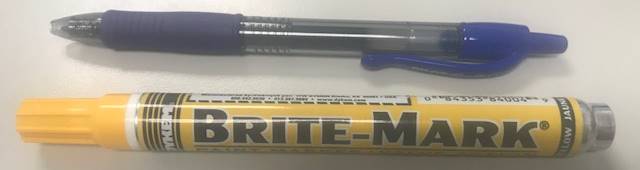
We utilize DYKEM Brite-Mark paint pens (example pictured below) to mark parts, etc. in our manufacturing operations to the tune of approximately 500 over the last three years.
Ink pen was included for scale.
Both the outside of the paint pen & Safety Data Sheet (copy was attached to email) indicate the content is flammable (characteristically hazardous) and I am sure from the long list of constituent chemicals (CAS #’s listed below) one could show up as a listed waste.
As such, do you agree with me that when we discard these they must be managed as a Hazardous Waste; even though when they are being discarded they have only a rather small residual amount of the original content in them? They would be discarded because they will not “write” anymore.
I would ship under the following US DOT description:
UN1263, Waste, PAINT, MARINE POLLUTANT (Copper, Copper Compounds), 3, III
Or
UN1993, Waste, Flammable liquids, n.o.s., 3, III
I believe either would be acceptable, but the 2nd would be more indicative of why it is a hazardous waste, do you agree?
Thank you very much for your consideration of this question!
By the way, we are a VSQG.
Best Regards,
Contact me with any questions you may have about the generation, identification, management, and disposal of hazardous waste
The paint pens meet the USEPA definition of a container at 40 CFR 260.10.
Container means any portable device in which a material is stored, transported, treated, disposed of, or otherwise handled.
USEPA exempts from regulation as a hazardous waste a container that is RCRA Empty: all contents that can be removed using common practices are removed and no more than one inch of residue remains in the container.
A container that is RCRA Empty is not a hazardous waste though it will remain a waste.
Based on your description I believe your paint pens are RCRA Empty. i.e., “…when they are being discarded they have only a rather small residual amount of the original content…”
If the pens are metal another exemption from regulation may be used: the scrap metal exemption at 40 CFR 261.6(a)(3)(ii). If reclaimed for its metal value through recycling the pen is exempt from all regulation as a waste – even if though it contains a hazardous waste and is not RCRA Empty.
Also…
A review of the USEPA List of Lists confirms that none of the constituents are a P- or U-listed material and so can’t be a P- or U-listed hazardous waste. Also, none of the constituents are an F-listed solvent and so can’t be an F-listed hazardous waste. The K-list of industry-specific sources is not applicable here. Therefore, the paint pens are not a listed hazardous waste at disposal.
Copper metal powder and some identified copper compounds are a marine pollutant. The Copper, Copper Compounds 10-20% in the paint pen is unlikely to be a copper metal powder or one of the identified marine pollutants (refer to: List of Marine Pollutants, Appendix B to the Hazardous Materials Table at 49 CFR 172.102). Even if it contained a listed marine pollutant, the pens would not be classified as one per USDOT/PHMSA regulations since the size of the container is not a bulk packaging (read: What is a Marine Pollutant?)
Make every effort to use the contents of the pens fully so they are RCRA Empty.
Recycle them as scrap metal (you may wish to check with scrap metal recycler to be sure it’s OK) to take advantage of scrap metal exemption.
If both of the above are done, your paint pens are not subject to regulation as a waste.
I hope this helps. Please contact me with any other questions.
Dan,
He was appreciative but some clarification was still necessary:
Excellent, thank you, I appreciate it!
So both the RCRA empty & metal recycle have to be met in order for the pens to be exempt?
In other words, if RCRA empty is met it can’t be disposed of into the trash, it must also be recycled in order to satisfy the requirements for exemption?
Or, is it simply best practice to RCRA empty them and also recycle? If the recycler won’t accept for some reason they can still be exempt if RCRA empty, correct?
Regards,
My clarification:
Please see below.
If RCRA Empty the pens are exempt from regulation as a hazardous waste but remain a non-hazardous waste. However, landfills do not allow for any free liquids (Not entirely true. Please this for clarification: Generator Ban on Liquids in Landfills Under the Generator Improvements Rule) so their presence in the pens may cause a problem for landfill disposal.
If recycled as scrap metal the pens are exempt from regulation as a waste entirely no matter the amount of liquid they retain. Some recyclers aren’t crazy about liquids but the quantities we’re talking about shouldn’t be a problem.
The two exemptions are independent of each other. However, I think it a good practice to first get the pens RCRA Empty and then to recycle them as scrap metal. The two exemptions together should ensure compliance and environmental protection.
I hope this helps. Please contact me with any other questions.
This hazardous waste generator had the right idea: conduct a thorough hazardous waste determination for every waste generated at your facility. Though the process may be time-consuming, it is required by USEPA – and state – regulations. Compliance requires initial and annual training for hazardous waste personnel of a large quantity generator.
Generator Ban on Liquids in Landfills Under the Generator Improvements Rule
Since its beginning, the Resource Conservation and Recovery Act (RCRA) has prohibited the landfill disposal of waste containing free liquids – with some narrowly defined exceptions per RCRA section 3004(c). The U.S. Environmental Protection Agency (USEPA) codified this prohibition as follows:
40 CFR 258.28 for municipal solid waste landfills (MSWLFs).
40 CFR 264.314 for permitted hazardous waste landfills.
40 CFR 265.314 for interim status hazardous waste landfills.
So, a ban on free liquids in landfills is nothing new. What is new: under the Generator Improvements Rule, the prohibition now also applies to hazardous waste generators. The purpose of this article is to explain the prohibition on landfill disposal of free liquids in hazardous waste landfills now applicable to hazardous waste generators. (more…)
U.S. Navy to pay $23,700 Penalty for Improper Management of Hazardous Waste
The Bullet:
Federal facility (U.S. Navy) found to be in violation of USEPA regulations. Settlement reached with monetary penalty.
Who:
USEPA Region 9 Pacific Southwest Region. CONTACT: Soledad Calvino (News Media Only) / calvino.maria@epa.gov / 415-972-3512
Department of the Navy
What:
Operations at the facility include:
Research and development of explosive materials and weapons
Aircraft maintenance
Facilities maintenance operations
Metal fabrication operations
Storage of hazardous materials and waste.
Under the agreement the federal facility will pay a $23,700 penalty.
The facility has resolved the identified violations and is now in compliance with the RCRA requirements.
Where:
The Naval Air Weapons Station – China Lake is in the Western Mojave Desert region of California, approximately 150 miles north of Los Angeles.
EPA’s 2018 inspections of the facility identified violations of Resource Conservation and Recovery Act (RCRA) regulations.
Violations identified during the inspection included:
Failure to comply with a permit condition that requires deteriorating containers to be replaced or put inside larger containers in good condition at the point of generation.
The Federal Facilities Compliance Act (FFCA) of 1992 expanded the reach of RCRA to include Federal facilities within the Executive branch of the U.S. government.
Conclusion:
“It is critical for federal agencies to comply with laws that protect public health and our natural resources,” said EPA Pacific Southwest Regional Administrator Mike Stoker. “This agreement will bring the Department of the Navy into compliance with hazardous waste laws and help minimize the potential for hazardous waste releases to the environment.”
It may come as a surprise to some, but public institutions – Federal, state, & local – even the U.S. Navy! is subject to USEPA’s hazardous waste regulations. If you work at or for a public facility make certain your operations comply with Federal and state regulations for the management of waste. My Hazardous Waste Personnel training is a good way to learn the regulations, inform your employees, and meet the regulatory requirements to provide training.
FAQ: What are the tests required by USEPA to indicate a nonbiodegradable sorbent for treatment of free liquids prior to landfill disposal?
Here’s another example of where I ask and answer my own ‘Frequently Asked Question’. The answer is found in U.S. Environmental Protection Agency (USEPA) regulations at 40 CFR 264.314(d)(2) for permitted Treatment, Storage, and Disposal Facilities (TSDF) and §265.314(e)(2) for interim status TSDFs. If you’re curious about the difference between a permitted TSDF and an interim status TSDF (and you needn’t be), you can read about it here: What’s the difference between a permitted TSDF (40 CFR Part 264) and an interim status TSDF (40 CFR Part 265).
A sorbent used to treat – i.e., remove – free liquids from a waste prior to disposal in a hazardous waste landfill must be nonbiodegradable. Nonbiodegradable sorbents are one of the following:
Determined by USEPA to be nonbiodegradable through the part 260 petition process.
Or…
Able to pass one of the tests specified by USEPA at either §264.314(d)(2) or §265.314(e)(2). A sorbent material may be determined to be nonbiodegradable under any one of the following:
ASTM Method G21-70 (1984a)-Standard Practice for Determining Resistance of Synthetic polymer materials to Fungi.
ASTM Method G22-76 (1984b)-Standard Practice for Determining Resistance of Plastics to Bacteria.
OECD test 301B: [C02 Evolution (Modified Sturm Test)]
Contact me with any questions you may have about the generation, identification, management, and disposal of hazardous waste
Why does this matter? Because preexisting regulations applicable solely to hazardous waste landfills prohibited the disposal of a hazardous waste containing free liquids. However, the same regulations allow for the treatment of hazardous waste prior to landfill disposal to remove free-standing liquid with a nonbiodegradable sorbent. After the Generator Improvements Rule, this same restriction now applies to both large quantity generators (LQG) and small quantity generators (SQG) of hazardous waste.
If you’re interested in this article you may also be interested in how the USEPA’s Generator Improvements Rule changed the regulations for placement of bulk or noncontainerized liquid hazardous waste in landfill.
FAQ: What are the nonbiodegradable sorbents required to treat free liquids prior to landfill disposal?
OK. Not really a ‘Frequently Asked Question’, but I asked it. The answer is found in U.S. Environmental Protection Agency (USEPA) regulations at 40 CFR 264.314(d)(1) for permitted Treatment, Storage, and Disposal Facilities (TSDF) and §265.314(e)(1) for interim status TSDFs. If you’re curious about the difference between a permitted TSDF and an interim status TSDF (and you needn’t be), you can read about it here: What’s the difference between a permitted TSDF (40 CFR Part 264) and an interim status TSDF (40 CFR Part 265).
A sorbent used to treat – i.e., remove – free liquids from a waste prior to disposal in a hazardous waste landfill must be nonbiodegradable. Nonbiodegradable sorbents are one of the following:
Able to pass one of the tests specified by USEPA.
Determined by USEPA to be nonbiodegradable through the part 260 petition process.
Or…
One of the materials listed or described by USEPA at either §264.314(d)(1) or §265.314(e)(1) and any mixtures of these materials:
Inorganic minerals
Other inorganic materials
Elemental carbon (e.g.,):
Aluminosilicates
Clays
Smectites
Fuller’s earth
Bentonite
Calcium bentonite
Montmorillonite
Clacined montmorillonite
Kaolinite
Micas (illite)
Vermiculites
Zeolites
Calcium carbonate (organic free limestone)
Oxides/hydroxides
Alumina
Lime
Silica (sand)
Diatomaceous earth
Perlite (volcanic glass)
Expanded volcanic rock
Volcanic ash
Cement kiln dust
Fly ash
Rice hull ash
Activated charcoal/activated carbon
Or…
High molecular weight synthetic polymers. This does not include polymers derived from biological material or polymers specifically designed to be degradable. (e.g.,):
Polyethylene
High density polyethylene (HDPE)
Polypropylene
Polystyrene
Polyurethane
Polyacrylate
Polynorborene
Polyisobutylene
Ground synthetic rubber
Cross-linked allylstyrene
Tertiary butyl copolymers
Contact me with any questions you may have about the generation, identification, management, and disposal of hazardous waste
Why does this matter? Because preexisting regulations applicable solely to hazardous waste landfills prohibited the disposal of a hazardous waste containing free liquids. However, the same regulations allow for the treatment of hazardous waste prior to landfill disposal to remove free-standing liquid with a nonbiodegradable sorbent. After the Generator Improvements Rule, this same restriction now applies to both large quantity generators (LQG) and small quantity generators (SQG) of hazardous waste.
If you’re interested in this article you may also be interested in how the USEPA’s Generator Improvements Rule changed the regulations for placement of bulk or noncontainerized liquid hazardous waste in landfill.