PO Box 1232 Freeport, IL 61032

A Different Kind Of Training

A Different Kind Of Training

A Different Kind Of Training

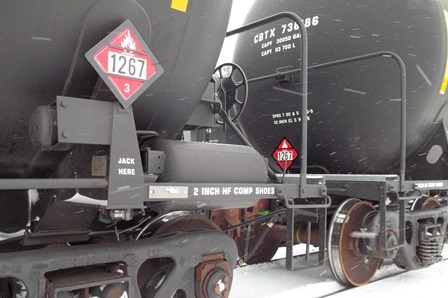
Rail transportation of Bakken crude oil

Safety Alert From PHMSA – Operation Classification for Bakken Region Crude Oil

Recent derailments and resulting fires indicate that the type of crude oil being transported from the Bakken region may be more flammable than traditional heavy crude oil

The above determination was made by the USDOT Pipeline and Hazardous Materials Safety Administration (USDOT/PHMSA) based on preliminary inspections conducted after recent train derailments in North Dakota, Alabama, and Lac-Mégantic, Quebec; each of which involved Bakken crude oil.

(more…)

Location of HazMat Incident near Hixton, WI

Leaking Hazardous Material in Transportation Results in HazMat Incident, but was it Reported?

The discovered leak of toluene and xylene from a 55-gallon drum transported by Wisconsin highway in February 2014 was reported and contained with, “…no real danger to life and health” according to Fire Chief of the responding community.  While that is certainly something to be thankful for, it then remains to determine if the HazMat Incident Reporting requirements of the PHMSA/USDOT were followed.

By reviewing the information available regarding the leak and the Hazardous Material Regulations, we will be able to determine if the correct HazMat Incident Report(s) were filed.

(more…)

Subscribe to my newsletter here or on my website

Immediate Notice of Certain HazMat Incidents per 49 CFR 171.15

In an earlier article I wrote about the two types of HazMat Incident Reports required by 49 CFR 171.15 & 171.16, respectively:  Immediate (by telephone or online) & Detailed (written report).  The article indicated that the responsibility to report a HazMat Incident will usually fall on the Carrier and not the Shipper of a hazardous material since it is the Carrier that is most likely to be in control (ie. “…in physical possession”) of a hazardous material when in transportation (“transportation” includes loading, unloading and temporary storage).  Therefore, a Carrier of HazMat must be aware of these reporting requirements while a Shipper of HazMat should be aware of them.  In this article I’ll review the conditions that require the Immediate Notice of a hazardous materials incident per 49 CFR 171.15. (more…)

The Required Information for an Immediate Notice to the NRC of a HazMat Incident

The HazMat transportation regulations of the PHMSA/USDOT at 49 CFR 171.15 require each person in physical possession of a hazardous material when in transportation (includes loading, unloading, and temporary storage) to immediately notify the National Response Center by phone or on-line in the event of certain incidents that occur during transportation.  The purpose of this article is to explain the specific information that must be included with an Immediate Notice of a specified HazMat Incident to the NRC. (more…)

The Description of a Special Permit or Exemption on a Hazardous Materials Shipping Paper – 49 CFR 172.203(a)

FAQs Regarding the Special Permits and Exemptions of the PHMSA for Hazardous Materials Transportation

The use of Special Permits (formerly known as Exemptions) in the Hazardous Material Regulations (HMR) of the USDOT/PHMSA presents opportunities and challenges for shippers and carriers of hazardous materials.  While they provide an opportunity to transport or offer for transportation a hazardous material in a manner not allowed for in the HMR, they will have requirements all of their own that are in addition to those of the HMR.  One example of this is that anyone who uses a Special Permit in the transportation of a hazardous material must provide additional Function Specific training to their HazMat Employees on the specific requirements of the Special Permit.

Below are some FAQs from the PHMSA website regarding the use of Special Permits for the transportation of hazardous materials. (more…)

January/February 2014 – Announcements of Proposed Rules, Changes to the Rules, and Final Rules for RCRA and the HMR

On its website the US Government Printing Office makes a wealth of Federal publications available for review and download; one of these is the Federal Register.

Published by the Office of the Federal Register, National Archives and Records Administration (NARA), the Federal Register is the official daily publication for rules, proposed rules, and notices of Federal agencies and organizations, as well as executive orders and other presidential documents.

See below for a brief summary of announcements in the Federal Register by the US EPA on the subject of Hazardous Waste and the Pipeline & Hazardous Materials Safety Administration (PHMSA) of the US DOT on the subject of Transportation of Hazardous Materials.

The Federal Register is a great way to look down the road and see potential changes to the regulations long before they are put into effect (sometimes The Rulemaking Process takes years before a final rule is issued, if ever).  Knowledge of these potential changes provides you with several advantages:

  • Additional time to modify your business operations to comply.
  • Awareness of on what topics the regulatory agencies intend to focus their efforts.
  • The ability to register your concerns, complaints, suggestions, etc. in order to modify the proposed rule before a final rule is issued.  It can be done, really!
  • Make changes to your training program to account for changes that become effective before the next training cycle.
  • Alert you to the need to re-train your employees prior to their next scheduled training cycle, if necessary.
  • Keep you abreast of changes to the regulations that affect your business and/or your industry group.

Please note that this is my best effort to identify the relevant announcements in the Federal Register that may be of interest to generators of hazardous waste and shippers of hazardous materials.  I encourage you to review the list of Federal Register publications yourself to ensure regulatory compliance.

January 1 through February 7, 2014

PHMSA – Hazardous Materials Regulations (HMR):

Rules and Regulations:

None

Proposed Rules:

None

Notices:

None

USEPA – Resource Conservation and Recovery Act (RCRA):

Rules and Regulations:

Hazardous Waste Management System: Conditional Exclusion for Carbon Dioxide (CO2) Pages 350 – 364 [FR DOC # 2013-31246] PDF | Text | More

Proposed Rules:

Hazardous Waste Management System; Modification of the Hazardous Waste Manifest System; Electronic Manifests Pages 7517 – 7563 [FR DOC # 2014-01352]          PDF | Text | More

Notices:

Twenty-Sixth Update of the Federal Agency Hazardous Waste Compliance Docket Pages 654 – 658 [FR DOC # 2013-31568] PDF | Text | More

Daniels Training Services

815.821.1550/Info@DanielsTraining.com/www.DanielsTraining.com

Information can be helpful but it’s useless if you are not able to make sense of it.  You must be able to determine how any changes to the rules and regulations (final or proposed) will affect your operations, and communicate the necessary information to your personnel.  I can help you to do that.

Please contact me for a free training consultation to determine your regulatory requirements and how training can help you to attain and maintain compliance with the regulations of the USEPA (and your state) and the PHMSA/USDOT.

Train Spilled 12,000 Gallons of Oil Across Minnesota

UPDATE 2/6/2014 2:45 PM ET: According to MPCA spokeswoman Cathy Rofshus, “The MPCA directed the railroad to begin cleanup actions Feb. 6, starting in Winona, where there is more oil in the snow between the tracks because the train had slowed. This cleanup is still underway today. Other areas of spillage are far less oiled and cleanup is not feasible — AT THIS TIME — for considerable lengths of the track. However, these areas will continue to be monitored and reassessed through the thaw and additional cleanup done if necessary.” The headline of this piece has been adjusted accordingly.

An oil train sprung a leak while traveling through southeastern Minnesota Monday, dribbling 12,000 gallons of crude oil over a 68-mile stretch of track. The spill was relatively small, but because of the way it spread, officials at the Minnesota Pollution Control Agency said they won’t be able to clean it up.

“It’s like it spray-painted oil,” MPCA spokeswoman Cathy Rofshus explained. She added that the amount leaked was about half the oil contained in a single tanker car. It was nothing, in other words, like the 1.5 million gallon spill that occurred when a train derailed in Lac-Mégantic, Quebec, this past July, killing 47 people.

And it was but a small contribution to the increasing amount of oil being spilled from trains in general: including over 1.15 million gallons in 2013, more than the combined amount spilled over the past four decades of federal record-keeping. Such “mishaps,” according to Bloomberg News, are more likely to occur on trains, while the amount spilled by pipelines, when leaks do occur, tends to be much greater.

Two questions need to be answered about the above incident:
  1. Is the oil being transported by rail a hazardous material as defined by the USDOT?  Refer to the definition at 49 CFR 171.8 for an answer.
  2. If it is a hazardous material, then did the carrier inspect all the rail cars prior to accepting them for transportation as is required by 49 CFR 174.9(a), which reads:

At each location where a hazardous material is accepted for transportation or placed in a train, the carrier must inspect each rail car containing the hazardous material, at ground level, for required markings, labels, placards, securement of closures, and leakage. These inspections may be performed in conjunction with inspections required under parts 215 and 232 of this title.

Daniels Training Services

815.821.1550/Info@DanielsTraining.com/www.DanielsTraining.com

If you are involved in any stage of the transportation of a hazardous material as a Shipper (0r Offeror), a Carrier, or as the destination facility (receiver) you must comply with the Hazardous Material Regulations of the PHMSA/USDOT which includes a requirement to provide triennial training for all HazMat Employees.  Don’t hesitate to contact me for HazMat Employee Training, RCRA Hazardous Waste Training or any questions about your training needs.

General Requirements of the HMR for Hazardous Material Packagings and Packages (49 CFR 173.24)

As a Shipper of a hazardous material it is your responsibility to choose the authorized packaging specified for that HazMat in column 8 of the Hazardous Materials Table that also conforms to any applicable special provisions found in column 7.  You must also fill and close the packaging as directed by the regulations and the instructions of the packaging manufacturer.  In addition to that you must also comply with the General Requirements for Packagings and Packages found at 49 CFR 173.24.

(more…)

Two-Day Multimodal Training Seminars From the PHMSA

Multimodal Training Seminars offer something for most HazMat Employers and HazMat Employees. Whether you are new to HazMat transportation or a seasoned professional, breakout sessions are presented to increase your knowledge for the safe and secure transportation of hazardous materials.

Each seminar begins with a General Session that provides a brief introduction and an overview of the Department of Transportation’s Hazardous Materials Program (HMR; 49 CFR Parts 171-180). The remainder of the two-day seminar consists of concurrent breakout sessions.

Sessions are organized and scheduled into three different tracks:

  1. Hazmat Basics
  2. Safety and Compliance
  3. Hazmat Essentials

You can follow a specific track or attend only those sessions that best meet your needs. Each session is offered twice to help you maximize your seminar experience.

Representatives from the Federal Aviation Administration, Federal Motor Carrier Safety Administration, Federal Railroad Administration, U.S. Coast Guard, Transportation Security Administration, and the hosting State’s HazMat Enforcement will join PHMSA to provide you with answers to your HazMat transportation questions.

Who should attend?

Though suitable for those new to the transportation of hazardous materials, it is my opinion that the two-day seminar is best suited for experienced professionals in the transportation of HazMat.

What does it cost?

Nothing.  There is no cost for this two-day multimodal HazMat transportation seminar.  It is sponsored by the Pipeline and Hazardous Materials Safety Administration.

Is prior registration required?

Yes, please register yourself and any others you wish to attend with you.  PHMSA encourages you to pre-register for the seminars and workshops as seating is limited and to ensure you receive a certificate of attendance.  Information about the venues for the workshops and to register can be found here:  Registration page for PHMSA HazMat Transportation Two-Day Seminars in 2014.

What information is covered at the two-day seminar?

Each seminar begins with a General Session that provides a brief introduction and an overview of the Department of Transportation’s Hazardous Materials Program (HMR; 49 CFR Parts 171-180). The remainder of the two-day seminar consists of concurrent breakout sessions.

Will attendance at this PHMSA two day seminar fulfill my HazMat Employee training requirements (initial and/or triennial)?

Likely not, since the two-day seminar does not include a test, which is a requirement of HazMat Employee training per 49 CFR 172.702(d).  Also, the requirement to provide Function Specific Training at 49 CFR 172.704(a)(2) may be a challenge, though perhaps not quite as difficult as at the one-day PHMSA workshops since the two-day seminars  will have opportunities to select from the different tracks.  However, a HazMat Employer may use a this seminar as the basis for his/her HazMat Employee training and may meet the regulatory requirements by providing any additional Function Specific Training that may be necessary and by administering a test (either written or verbal).  The final requirement is to document the completion of the training per the requirements of 49 CFR 172.704(d).

Where and when are the seminars being held?

Currently there are three scheduled dates through the end of August 2014.  Other dates may be added for the remainder of 2014.  Check back to the PHMSA website (Seminars, Workshops, and Meetings) for up-to-date information.

DateCity and State
March 11-12, 2014Seattle, WA
July 29-30, 2014Nashville, TN
August 26-27, 2014Newark, DE

These PHMSA two-day multimodal seminars are a great learning opportunity for all experience and knowledge-levels of HazMat Employees.  If a two-day seminar is not right for you, then consider attending one of the PHMSA one-day workshops.  I will strive to attend one of these seminars in 2014, and I hope you do as well.  You will likely come away with an improved knowledge of the HMR including the requirement to provide training for all of your HazMat Employees.  That’s where I come in.  Contact me for your mandatory HazMat Employee training and your Hazardous Waste Personnel (RCRA) training as well.

Daniels Training Services – – 815.821.1550 – – Info@DanielsTraining.com – – www.DanielsTraining.com

Search Website