PO Box 1232 Freeport, IL 61032

A Different Kind Of Training

A Different Kind Of Training

A Different Kind Of Training

Q&A: Must I renew the DOT specification (UN Standard) on packagings I have in stock?

A question from a recurring customer on 09.04.20:

We received the below note from our packaging supplier in regard to testing. We supply a hazardous material for transportation and ship using these boxes. Has there been any changes that you know off that would help us decide if the testing is necessary?

MESSAGE FROM PACKAGING SUPPLIER:

Good morning and hope all is well. The UN Certification on your 6 X 32 OZ UN SHIPPER is set to expire in November. If you plan to renew this UN certification, please ship the below test components to <<city, state>> to my ATTN at your earliest convenience. When received, the test regimen will be scheduled. Current lead time for testing is 8-10 weeks. Also, please issue a purchase order for this re-test to orders@<<company>>.com. Cost per UN Test is $1895.00.

  • 6 X 32 OZ UN SHIPPER
  • 13 Complete Cartons: Item # 30060/30060P
  • 78 32-OZ Brown HDPE BR Bottles: Item # 20205
  • 78 28/400 White Child Resistant Screw Caps: Item # 2C205
  • Closure Tape (Customer Provided): ULINE S-3267 2” Poly Tape

If you have any questions, please let me know.

By the way we have a large inventory of boxes and bottles that were certified when we bought them.

Interested in site specific training at your site that covers this topic, and more!

Ask me about my Onsite Training

I thought I could help but I required more information:

I can assist you. I require more information. Please see below.

  • An image of the packaging would be helpful.
  • What is the DOT specification / UN standard? It should be displayed on the side of the packaging.
  • What is the hazardous material to be packed and shipped in this packaging?

Thank you and please advise.

It took him a few days to reply with the information I requested (09.08.20):

Here is the info you asked for, thanks in advance.


He also provided a safety data sheet (SDS) for the product that confirmed it was a HazMat.

My reply that same day:

Please see below.

  • The packaging in the image is marked to indicate it is designed, manufactured, and tested to indicate it meets a UN standard.
  • The packaging met this UN standard as of its manufacture in 2018.
  • It is authorized for use within the the U.S. and is acceptable for transportation of hazardous materials wherever the UN standard is accepted (most of the world).
  • Any recertification of the packaging design is done by the packaging manufacturer or their agent.
  • There is no need to renew a UN certification on packagings that have already been manufactured.

In short:

  • The packagings you have in inventory marked as the above are fine for use.
  • There is no life-span on the use of this type of packaging. i.e., you could sit on these for 10 years and they would still be acceptable for use unless the UN standard for packagings changes in that time. Note: some plastic packagings have a five year lifespan under the international regulations and also within the U.S. if they are reused.
  • I don’t know what the packaging supplier is referring to.

I hope this helps. Please contact me with any other questions.

He was grateful:

Thanks Daniel as usual you are a big help.

Contact me with any questions you may have about the transportation of hazardous materials by air, highway, vessel, or rail

International and Domestic

Daniels Training Services, Inc.

815.821.1550

Info@DanielsTraining.com

https://danielstraining.com/

Conclusion:

I don’t know the entire story – I never spoke with the packaging supplier – but I am confused by what they seemed to be requesting. I wish to think that the supplier of a HazMat packaging would know the regulations well enough not to make a costly mistake like this, but I think this one did. Make certain you are aware of your responsibilities under the Hazardous Materials Regulations (HMR) of the Pipeline and Hazardous Materials Safety Administration within the US Department of Transportation (USDOT/PHMSA).

Q&A: May I transport an empty cargo tank when I don’t have the HazMat endorsement on my CDL?

A question, September 16, 2020:

Subject: placards

Message Body:
Sir:    If i pick up a propane truck (26,000 lb) with a new tank on it from the factory and it has the sticky placards on it can i cover them up to transport the truck to the destination?   I have a tank endorsement but no hazmat.  thank you.

My reply that same day:

As long as the cargo tank does not contain any HazMat at all. Not even the residue of the HazMat. Not even vapors. If you open the cargo tank and smell nothing but that fresh factory smell, then yes, you must cover up or remove the placards during transportation.

If any residue of the HazMat remains – even just vapors – then transport must be as fully-regulated, including the HazMat Endorsement on the CDL.

I hope this helps.

Please read:

Please contact me with any other questions.

Like this article?

Subscribe to my Monthly Newsletter

No marketing emails!

He had one more question for me (09.21.20):

I have one more question for you if you don’t mind. Can a state superseded any hazmat laws? If so would you have any idea what the fine would be?Also would the drivers license would be impacted if he violates any hazmat laws? Thanks again for your help.

I had another reply:

Good questions. See below.

  • The Hazardous Materials Regulations for HazMat transportation (including placards) are Federal. They are created by the Pipeline and Hazardous Materials Safety Administration within the US Department of Transportation (USDOT/PHMSA). States may not change them in any way, though a state may enforce the Federal regulations and issue state fines.
  • The commercial driver’s license (CDL) is issued by the state with both Federal and state requirements. Federal authority is under the Federal Motor Carrier Safety Administration within the USDOT (USDOT/FMCSA).
  • I don’t think – I am not entirely sure – violation of HazMat regulations will result in loss of CDL unless the violation is viewed to be criminal. The regulations of the FMCSA identify the ways a driver can lose their CDL and none of them are HazMat violations.

Other subjects related to HazMat and the CDL:

Daniels Training Services, Inc.

815.821.1550

Info@DanielsTraining.com

https://danielstraining.com/

That seemed to do it:

Thank you for the clarification.

e-Manifest Website

Last Day to Submit Paper Uniform Hazardous Waste Manifests is June 30, 2021

On and after July 1, 2021, the United States Environmental Protection Agency (EPA), will no longer accept paper uniform hazardous waste manifests by mail. All hazardous waste manifests must be submitted to the EPA electronically using the e-Manifest system. Paper manifests and any continuation sheets mailed to the EPA after June 30, 2021, will be returned to the sender.

To meet the Federal requirements for submitting  manifests, treatment, storage, and disposal facilities can submit paper manifests from hazardous waste generators by:

  • Uploading an image of the paper manifest (image upload) or
  • Uploading a data file plus image copy of the paper manifest (data plus image upload).

Hazardous waste generators who have not yet created an account in RCRAInfo for e-Manifesting are encouraged to do so as part of the transition. See the following resources for e-Manifesting and tracking:

For question on e-Manifests, please contact:

Contact me with any questions you may have about the generation, identification, management, and disposal of hazardous waste

Daniels Training Services, Inc.

815.821.1550

Info@DanielsTraining.com

https://danielstraining.com/

For more articles on the e-Manifest System:

The EPA began accepting hazardous waste manifests electronically using the e-Manifest system on July 1, 2018. At the launch, phase-out of the paper manifest option was targeted for June 30, 2021. The EPA has allowed submittal of paper, electronic, and hybrid (electronic and paper) manifests since launch, and has seen a significant decrease in the number of paper manifests submitted. Nationally only a few facilities continue to mail paper manifests, and the EPA is working with them to transition. Using the e-Manifest system will help reduced the EPA costs associated with processing paper manifests.

Q&A: What labels & marks are required for a lithium metal button cell battery contained in equipment?

A question from someone unknown to me on September 23, 2020:

Hi Daniel,

I just stumbled across your website and specifically this article: https://danielstraining.com/march-6-2019-usdot-changes-regulations-for-transport-of-lithium-batteries/

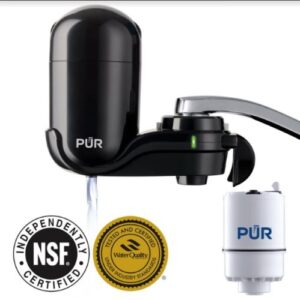
I am trying to mail a water filter like the one in the image I attached.

Pur water filter with lithium battery

When it showed up to me it had some of the UN stickers and said “forbidden for transport by air or vessel”. It does have some type of battery in it to monitor when the filter life is up.

My question is, do I need to provide one of the UN stickers on the attached image to mail it with USPS? I’m just confused if the stickers are only required for mailing batteries themselves, or if the stickers are required when there is just a battery inside the unit.

Thank you!

Daniels Training Services, Inc.

815.821.1550

Info@DanielsTraining.com

https://danielstraining.com/

My reply the same day:

I will try to answer your question. Please see below.

To give a complete answer the size and type of the battery must be known. However, based on the image I will presume the following:

  • It is a cell and not a battery. A lithium cell is a single encased eletrochemical unit with one positive and one negative electrode. A lithium battery is two or more cells electrically connected together and fitted with devices for use.
  • It is a “button cell”. Defined in the IATA Lithium Battery Guidance Document for 2021 as a round small cell or battery with an overall height that is less than the diameter.
  • It is a lithium metal type cell and not lithium ion. Lithium metal cells/batteries are non-rechargeable whereas lithium ion (Li-ion) cells/batteries are re-chargeable and typically used in consumer electronics.
  • Its lithium metal content is no more than 1 g. A cell of this size is subject to a packaging exception as a smaller lithium cell/battery.

If the above presumptions are true, the requirements for its transportation in commerce can be summarized as follows:

  • The equipment with cell inside must be packed securely in an outer packaging.
  • Outer packaging must be of suitable material and adequate strength.
  • The equipment must be secured against movement within the package.
  • The equipment must be packed to prevent accidental activation.
  • It is not necessary to display any package marks or labels on the outer package.
  • If the battery is packed by itself or with – but not in – the equipment it is meant to power more stringent regulations apply.
  • You may find more helpful information in this other article I wrote: Classification of Lithium Batteries for Transportation in Commerce.
  • Since you indicate you will be mailing by USPS, I suggest you refer to USPS regulations.

Also…

  • I don’t know why the package would display a mark or label indicating it is forbidden for transport by air or vessel. If my above presumptions are correct this package is not forbidden for transport by either mode.

I hope this helps. Please contact me with any other questions.

Interested in a Webinar that covers this topic, and more!

My Webinar Training Schedule

He had more information and more questions (09.24.20):

Thank you very much for your quick reply. I have a second one of these that I cracked open to find the battery. It is a button battery about the size of a nickel, so this would NOT require any markings on the package? And for the one I will be mailing the battery will be inside the unit just as it was from the manufacturer.

What would be a normal consumer product that would require the markings when shipping? Something like an iPhone?

Thank you for the USPS website reference!!

I had more answers:

The transportation of lithium batteries (all batteries) is very complicated. Please be advised that I am providing only general guidance. If you are shipping the batteries as part of a business you are subject to more strict penalties.

In general:

  • Smaller lithium batteries (those typically used in consumer devices) are subject to less regulation. This includes both lithium ion and lithium metal. My article: Classification of Lithium Batteries for Transportation in Commerce includes a table displaying the lithium content thresholds between “smaller” lithium cells/batteries and fully-regulated cells/batteries.
  • A lithium cell or battery packed alone is subject to the most stringent regulations.
  • A lithium cell or battery packed and shipped in the equipment it is meant to power is subject to less regulation.
  • A button cell battery contained in the equipment it is meant to power is subject to very little regulation other than safe packaging.
  • The battery in an iPhone – and most other consumer items – will likely be lithium ion and will also likely have a Watt-hour (Wh) rating below the threshold for a “smaller” cell/battery and therefore subject to less regulation. The only package mark or label it might require is the lithium battery mark.

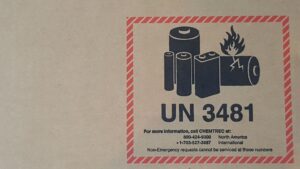
UN3481 Lithium Battery Mark

  • I wrote “might” regarding the display of the lithium battery mark because the requirements for its display depends on several factors:
    • The size of lithium cell/battery.
    • Whether the cell/battery is packed alone, with the equipment it is meant to power, or in the equipment it is meant to power.
    • The number of cells or batteries in the package and the number of packages in the consignment. e.g., if you ship more than two battery packages in a consignment, all packages must display the lithium battery mark.

Please contact me with any other questions.

He needed some additional clarification:

So since I am just mailing one unit, with a button cell battery contained inside the equipment, I should not include any markings on the package is what I am concluding from your bullet points, correct?

My reply:

Based on the information provided, that is correct.

He was grateful:

Thank you for your time!

Like this article?

Subscribe to my Monthly Newsletter

No marketing emails!

Conclusion:

If the above exchange doesn’t make this clear, let me clearly write it now: the transportation of lithium cells and batteries is very complex and is only going to become more so. By the time you read this article the regulations may have already become more stringent. Be sure to do your research into the applicable regulations before you prepare, package, and offer for transport a lithium cell or battery.

IATA Classification of Substances with Multiple Hazards

The Dangerous Goods Regulations of the International Air Transport Association (IATA) is the guide recognized by the world’s airlines to ensure compliance with the Technical Instructions of the International Civil Aviation Organization (ICAO). The transportation of dangerous goods (aka: hazardous materials or HazMat) by air must done in compliance with the ICAO Technical Instructions. Compliance with the IATA Dangerous Goods Regulations is one way to ensure compliance with the ICAO Technical Instructions.

At 49 CFR 171, subpart C the Hazardous Materials Regulations (HMR) of the Pipeline and Hazardous Materials Safety Administration within the U.S. Department of Transportation (USDOT/PHMSA) authorizes compliance with the ICAO Technical Instructions – along with some limitations and additional restrictions of its own – for the transportation by air of dangerous goods to, from, or anywhere through, the U.S.

In short: if you offer for transportation a dangerous good by air anywhere in the world (international or domestic) it will likely require that you comply with the Dangerous Goods Regulations of IATA.

The purpose of this article: Explain the requirements of Section 3.10 the IATA Dangerous Goods Regulations for the classification of a dangerous good with more than one hazard. (more…)

Closed Containers in the Satellite Accumulation Area

Prior to the Generator Improvements Rule the regulations for generators accumulating hazardous waste in a satellite accumulation area (SAA) required containers accumulating hazardous waste to be kept closed except when necessary to add or remove waste. Under the new rule, hazardous waste containers in a SAA may remain open under limited circumstances.

The purpose of this article is to explain the regulations at 40 CFR 262.15(a)(4) that allow for limited exceptions to the closed container requirements in a satellite accumulation area. (more…)
Hazardous waste in satellite accumulation area

Special Requirements for Incompatible Wastes and Materials in Satellite Accumulation Area

When first developing the satellite accumulation area (SAA) regulations in 1984 (hello Knight Rider!) the U.S. Environmental Protection agency (USEPA) inadvertently failed to account for the small quantity generators (SQG) and large quantity generators (LQG) of hazardous waste that might accumulate incompatible waste in a SAA. In the Generator Improvements Rule it fixed this oversight.

The purpose of this article is to explain the regulations of 40 CFR 262.14(a)(3) – created by the Generator Improvements Rule – that now require SQGs and LQGs to comply with special requirements for incompatible wastes accumulated in a satellite accumulation area. (more…)

Q&A: Does a bulk packaging require the display of the HazMat’s identification number on the vehicle?

A question from a shipper or carrier of HazMat (07.31.20):

I am hauling NA 1993 combustible liquid pg3 (2-methyoxymethylethoxy propanol) in a tote of 350 gallons. Its total weight is 2329lbs. This is the only hazmat on the truck.

*bulk haz. Mat placard accordingly*

Do I need to put UN number on the truck? Could you help me when is to put un number onto placards? Your help would really be appreciated.

Thanks

If you like this article, please share it using any of the social media platforms identified at the bottom of this article.

My reply that same day:

I will try to answer your question below.

  • You indicate your HazMat is a Class 3 Combustible Liquid.
  • I understand the HazMat is contained and transported in a bulk packaging (i.e., has a capacity of more than 119 gallons).
  • More specifically, the packaging is a tote, which I presume to be an intermediate bulk container (IBC).
  • The HazMat Regulations for the display of labels, marks, and placards on an IBC are complex. Read: HazMat Labels, Markings, and Placards on an Intermediate Bulk Container
  • A vehicle transporting a bulk packaging of a HazMat must display both of the following on all four sides of the vehicle or freight container:
    • The placard (in this case the Class 3 Combustible Liquid).
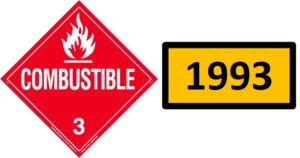
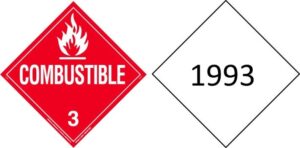
    • The identification number (in this case NA1993). It is displayed solely as “1993” it is not necessary to include the “NA”.
  • The identification number can be displayed in any one of three ways:
    • On the placard. (The white in the bottom of the placard is an option and is not required.)

Hazardous materials placard with identification number


    • On an orange panel near the placard.


    • On a white square-on-point near the placard.

NA1993 Mark with Plcard

I hope this helps. Please contact me with any other questions.

He wanted some more information:

Thank you for the information. Could you please tell me more when to include UN number. I always have same issue number of times.

Thanks in advance.

Like this article?

Subscribe to my Monthly Newsletter

No marketing emails!

I had the information:

Sure:

Any time you have a hazardous material in a bulk packaging (>119 gallons), the identification number must be displayed on all four sides of the vehicle.

Also, the identification number must be displayed on a vehicle if it contains a large amount of a single HazMat in a non-bulk packaging. Read: Vehicle Marking Requirements for Large Quantities of a Single Hazardous Materials in Non-Bulk Packagings

Contact me with any questions you may have about the transportation of hazardous materials by air, highway, vessel, or rail

International and Domestic

Daniels Training Services, Inc.

815.821.1550

Info@DanielsTraining.com

https://danielstraining.com/

That seemed to do it!

Thanks a lot.

Conclusion:

The Hazardous Materials Regulations of USDOT/PHMSA are a challenge for both shippers and carriers of HazMat. If you have a question, contact me. If you need HazMat Employee training, contact me!

Q&A: Will “Proprietary Ingredient 1” suffice as a technical name in the shipping description?

A question from a former customer June 18, 2020:

It’s been awhile, but I asked you a few questions in the past when I was working at <<Company>>. New job, new adventures.

I know I have come across this before, and I can’t remember the answer.

The following was copied into the email:

I have run into something I have never come across before so I am tapping you both to see if I can get some assistance.

We have a new item that one of our facilities is going to bring on-site that I am setting up in our system. The manufacturer SDS has some weird information in the shipping description that I wanted to get an expert opinion on.

The manufacturer lists the DOT classification as follows:

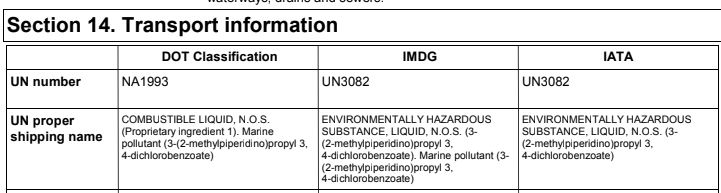
NA1993, Combustible Liquid, N.O.S. (Proprietary Ingredient 1). Marine pollutant (3-(2-methylpiperidno)propyl 3, 4-dichlorobenzoate).

Is it acceptable to ship a product with a generic shipping name and have it listed as a “Proprietary ingredient?” It seems odd to me when I think about an emergency response perspective.

Any insight is appreciated as I am at a loss here!

Section 14 SDS Combustible Liquid Marine Pollutant

My reply that same day:

Thank you for contacting me. Please see below.

  • Per 49 CFR 172.101(b)(4), a hazardous material with a ‘G’ in column 1 of the hazardous materials table requires the display of at least one of the technical names of the HazMat with the proper shipping name as a mark on the package and on the shipping paper.

Hazardous Materials Table entry for Combustible Liquid

  • “Technical name” is defined at 49 CFR 171.8:

Technical name means a recognized chemical name or microbiological name currently used in scientific and technical handbooks, journals, and texts. Generic descriptions are authorized for use as technical names provided they readily identify the general chemical group, or microbiological group. Examples of acceptable generic chemical descriptions are organic phosphate compounds, petroleum aliphatic hydrocarbons and tertiary amines. For proficiency testing only, generic microbiological descriptions such as bacteria, mycobacteria, fungus, and viral samples may be used. Except for names which appear in subpart B of part 172 of this subchapter, trade names may not be used as technical names.

  • In sum, a technical name is…
    • A recognized chemical name or microbiological name.
    • Generic descriptions are authorized only if they readily identify the general chemical or microbiological group. Acceptable generic chemical descriptions as technical names are:
      • Organic phosphate compounds
      • Petroleum aliphatic hydrocarbons
      • Tertiary amines
    • Trade names may not be used as technical names unless they are listed as a proper shipping name or shipping description in column B of the Hazardous Materials Table.
  • (Proprietary Ingredient 1) does not fulfill this requirement. It must be replaced with a technical name.
  • However, pursuant to 49 CFR 172.203(l) the HazMat is also described as a marine pollutant. This additional description includes the name of the marine pollutant in parenthesis after the words “Marine Pollutant”. It is possible that the inclusion of the name of the marine pollutant may suffice to also meet the requirement to include the technical name of the HazMat if it meets the requirements for a technical name described above. If the name of the marine pollutant is also used as the technical name of the HazMat, the text “(Proprietary Ingredient 1)” should be removed.

Further:

  • The requirement to include the technical name of a HazMat as an additional description to the shipping description is at 49 CFR 172.203(k).
  • The requirement to include the technical name of the HazMat as a mark on the package is at 49 CFR 172.301(b).

Daniels Training Services, Inc.

815.821.1550

Info@DanielsTraining.com

https://danielstraining.com/

I hope this helps. Please contact me with any other questions.

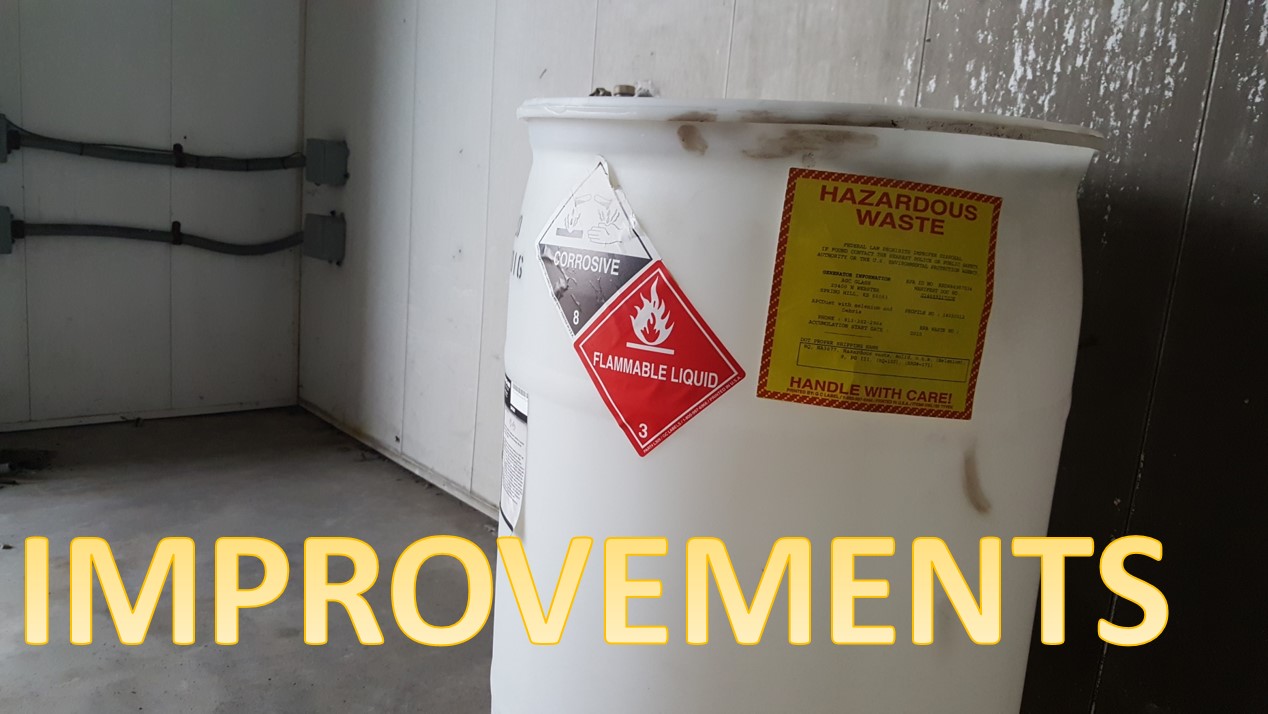
Hazardous waste container

Marking and Labeling of Hazardous Waste Accumulation Units Under the Generator Improvements Rule

The Generator Improvements Rule (effective 05.30.17 in the regulations of the U.S. Environmental Protection Agency and states without an authorized hazardous waste program) will make many changes to the regulations applicable to a generator of hazardous waste.

Read here for more information:

The purpose of this article is to identify and explain the USEPA regulations created by the Generator Improvements Rule that require additional hazard communication on various hazardous waste accumulation units throughout the cradle-to-grave management of hazardous waste. (more…)

Search Website