PO Box 1232 Freeport, IL 61032

A Different Kind Of Training

A Different Kind Of Training

A Different Kind Of Training

Q&A: How Must I use TCLP to Determine the Toxicity of my Hazardous Waste?

This series of questions came from a frequent reader of my newsletter:

Like this article?

Subscribe to my Monthly Newsletter

No marketing emails!

Good afternoon Daniel,

I appreciate the link to your google site. I knew I could come up with a question if I thought a little bit.

(1)  The filters on the aerosol can puncturing systems – may they be discarded as regular solid waste?   According to “New Pig”, the maker of the aerosol can puncturing system that my company sells, the filters may be discarded as regular solid waste.

(2)  In your experience with Black Beauty and its use as a sandblast material for unpainted metals, does used Black Beauty usually pass TCLP?  I know this is a very subjective question and I realize the parameters involved.  Just want your opinion.

(3)   How frequently do you see the use of the SPLP test vs. the TCLP?  Is it coming into more common use?

That’s all for now – and again, no pressing issues; these are simply some questions I have dragging around in the trunk of my car!

Feel free to call if you’d rather.

Contact me with any questions you may have about the generation, identification, management, and disposal of hazardous waste

Daniels Training Services

815.821.1550

Info@DanielsTraining.com

https://danielstraining.com/

My reply was vague but helpful:

I will take a look at your questions and strive to get you an answer soon.

I did reply, a few days later:

I apologize for my delay in responding.  Please see below for my attempt to answer your questions.

1)  The filters on the aerosol can puncturing systems – may they be discarded as regular solid waste?   According to “New Pig”, the maker of the aerosol can puncturing system that my company sells, the filters may be discarded as regular solid waste.

  • New Pig is correct in its direction but may not have provided all of the necessary information.  Any material upon the point of discard becomes a solid waste per USEPA regulations.  This does not mean that it is solid as it could be a liquid, gas, or semi-solid.  The USEPA defines a solid waste at 40 CFR 261.2.  So, “yes” the filter is a solid waste when discarded.  However, the generator of a solid waste must conduct a hazardous waste determination to determine if it is a hazardous waste, what exclusions or exemptions may apply, and, if applicable, its hazardous waste codes.  This determination is the sole responsibility of the generator of the waste.  Since it is unlikely in my opinion that a spent carbon filter would be a listed hazardous waste (unless the aerosols punctured were pesticides), the generator would have to determine if it displays a characteristic:  Ignitability (unlikely), Corrosivity (unlikely), Reactivity (unlikely), or Toxicity (possible depending on what was in the cans punctured).  If the generator determines it is not a hazardous waste, then they may be disposed of as a non-hazardous waste which might – depending on state regulations – allow for disposal with common trash and garbage at a municipal solid waste facility.

(2)  In your experience with Black Beauty and its use as a sandblast material for unpainted metals, does used Black Beauty usually pass TCLP?  I know this is a very subjective question and I realize the parameters involved.  Just want your opinion.

  • Black Beauty is a coal slag blasting abrasive.  The question of whether or not it passes TCLP depends on one assumption and two criteria:
    1. Assumption:  The concern is regarding toxic levels of heavy metals.  I don’t think any other toxins will be an issue.
    2. Criteria 1:  Are there toxic levels of heavy metals in the coal slag prior to use?  I don’t think this is likely but without analytical from the supplier or some other source it is impossible to tell.
    3. Criteria 2:  Are toxic levels of heavy metals derived from the unpainted metal surface?  This is quite possible depending on the steel alloy treated.
  • Answer:  It is quite difficult to determine if a used sandblast material contains toxic levels of heavy metals without analysis.  I suggest analysis of random samples to determine if the characteristic of toxicity is present.  If several samples show no or little presence of leachable toxins, then I think the generator could with confidence state that the waste is non-hazardous.

(3)   How frequently do you see the use of the SPLP test vs. the TCLP?  Is it coming into more common use?

  • I have not heard of SPLP at all prior to your email (I had to google it).  I have not heard anything from USEPA indicating they intend to accept anything for determination of the characteristic of Toxicity other than TCLP or the “Rule of 20”.
I hope this helps.
 
Please don’t hesitate to contact me with any other questions.

Interested in a Webinar that covers this topic, and more!

My Webinar Training Schedule

I think my answers were what she was looking for:

Thank you very much for your thorough response to my questions.  I don’t know if the Rule of 20 is used very much in Florida, but it’s certainly good to know about.  I do remember something about…but I had to pull it out from my memory bank.

Love being on your mailing list and receiving the newsletter.

Have a great week.

Answering questions is what I do.  Whether it’s through my training (Onsite or Webinar), my consulting services, or by responding to the questions I get from EHS professionals like you.
Q&A: What are the Packaging Specification Markings on an IBC?

Around the Fourth of July Holiday in 2016 I sent a “What’s up?” email to several past contacts.  One of them responded with this question:

If you are on holiday I hope your enjoying your 4th of July as well.
I do have one question.  Are you familiar with “markings” on ibc one way containers.  I call them stringers.
It starts of with the type of container/Y/Date/…….some specs, and date tested.
Then to the  far right of container will be a smaller marking from a reputable company that has retested the container.
For example M6148 L 3/15. a “L” or “General Maintenance” and the date of the re-test.
According to what I know, if the original “markings” are not clear or damaged from abuse that makes that container ineligible for haz mat shipping.
BUT…..what if the secondary marking to the right, from a reputable company,  is legible showing a current “L” retest that is current (2.5yrs) window…..would that make the container legal for shipping haz mat.
Call me if my inquiry makes no sense.

Daniels Training Services

815.821.1550

Info@DanielsTraining.com

https://danielstraining.com/

It took awhile, but almost two months later I responded:

I have an answer for you!

First of all, I apologize for my delayed response.  I’ve been busy providing Onsite Training and Webinar Training plus performing Consulting Services.  Questions like yours I research and reply to when I have the time.
The answer to your question is quite simple:
  • Per 49 CFR 173.35 General requirements for HazMat in IBCs, it is the responsibility of the shipper to ensure the markings required by 49 CFR 178.703 are present on an IBC before transportation.
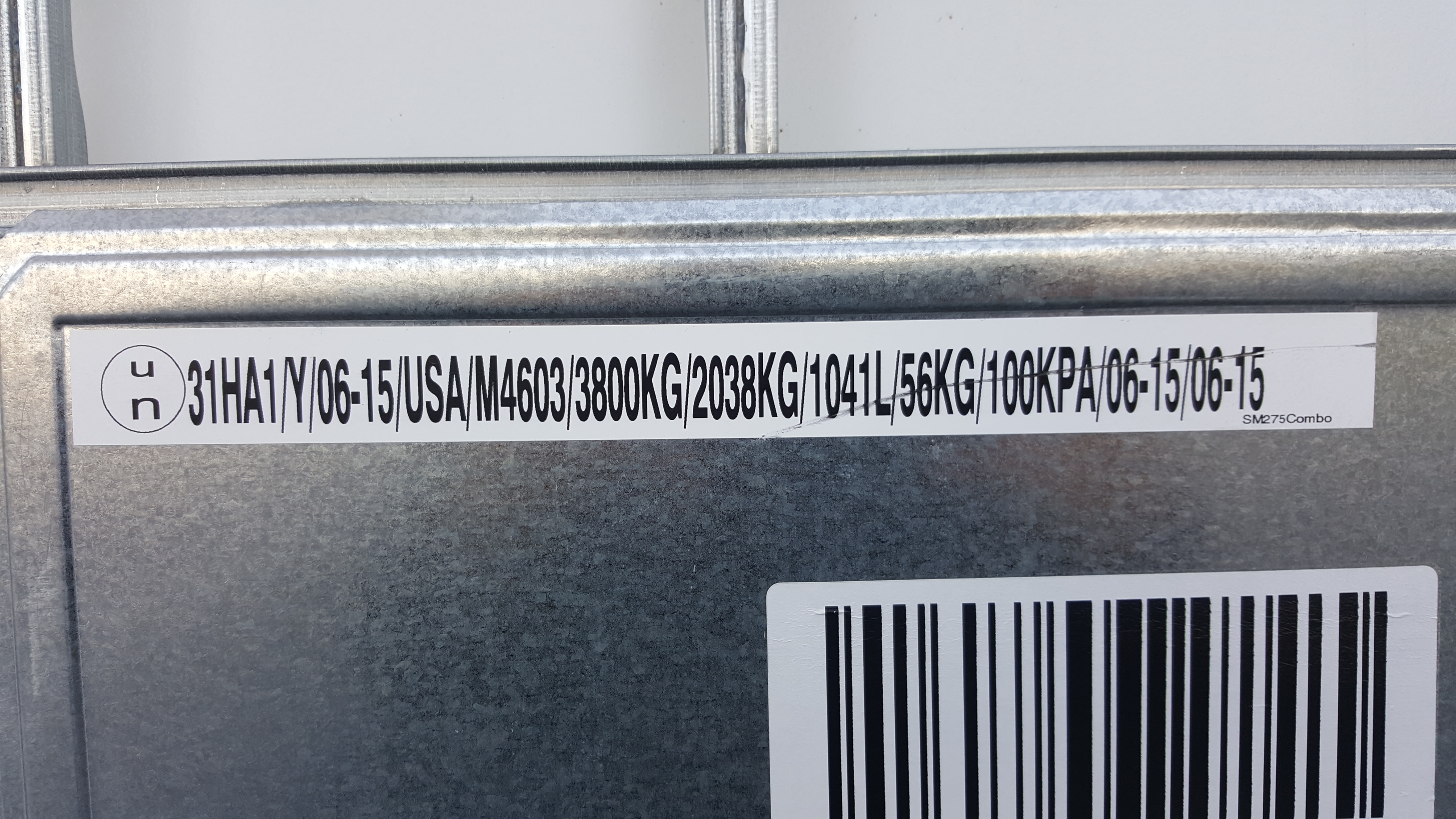
  • Specification Packaging Marking on an IBC49 CFR 178.703 Marking of IBCs, requires the manufacturer of an IBC to mark it in a durable and clearly visible manner in the following sequence (49 CFR 178.703(a)):
    • United Nations symbol (UN).
    • Code number designating IBC type.
    • Capital letter (X, Y, or Z) indicating performance standard.
    • Month (designated numerically) and year (last two digits) of manufacture.
    • Country authorizing the allocation of the mark.  e.g. USA indicates IBC is manufactured and marked in the U.S. in compliance with the USDOT Hazardous Material Regulations.
    • The name and address or symbol of the manufacturer of the IBC.
    • The stacking test load in Kg.  ‘0’ = not designed for stacking.
    • The maximum permissible gross mass of the IBC and HazMat in Kg.
  • Additional markings are required at 49 CFR 178.703(b)(1) for rigid plastic & composite IBCs.
    • No sequence is specified.
    • Markings must be near the required markings (see above) and readily accessible for inspection.
    • Where units of measure are used, metric unit (i.e. Kg or L) must be included in marking.
    • Rated capacity in L of water.
    • Tare mass in Kg.
    • Gauge test pressure in kPa.
    • Date of last leakproofness test, if applicable (month and year).
    • Date of last inspection (month and year).
    • General requirements:
    • Required markings:
Answer:
The presence of a marking indicating the date of the last leakproofness test or inspection (name of company performing test or inspection and country where test or inspection took place is not required) does not remove the need for the IBC to be marked with its date of manufacture (month and year).
I hope this answers your question.  I have more information I learned during my research that I am willing to share with you.
Once again, I apologize for my tardiness.
Please don’t hesitate to contact me with any questions.
It took him almost a month to respond to all of that information, but when he did it was with more questions!

Daniel,

Thank you.
If I may i have another question.
We have a carrier we like using for hot shots.
We will put 6 totes on his truck.  4 with 1760 ID and 2 with  1824 ID.  Both are Corrosive. We offer him placards for both ID’s.  He does not have means to attach placards to each side of his flatbed.  The sides are no issue. We also load equipment along with totes.  He will attach the placards on a 500g empty tank at the rear of his truck and also on the front end of his flatbed.  Is this acceptable, or legal?  So if you can imagine his flatbed with 6 totes, each tote having ID’s on them, and equipment such as tanks, pumps , etc……his flatbed placarded on each side, but the ends placarded on the tanks.
Thanks again.
My reply:
I will research and get you an answer.

Contact me with any questions you may have about the transportation of hazardous materials by air, highway, vessel, or rail

International and Domestic

Daniels Training Services

815.821.1550

Info@DanielsTraining.com

https://danielstraining.com/

As a teaser, I provided him with the following:

I will get you an answer on the above.
In the mean time…I wrote the following article for my blog based on the research I performed in answering your earlier question.  I hope they provide helpful information.
I hope this helps.
Finally, a few weeks later – and 3 1/2 months from his first question – I answered his latest query:
I will attempt to answer your question.  Please see below:
  • 49 CFR 172.504(a) requires placards on each side and each end of a vehicle required to display placards.
  • 49 CFR 172.516(a) requires placards to be clearly visible from the direction it faces, except when facing the tractor of a tractor/trailer combination.
  • The requirement of 49 CFR 172.516(a) may be met by the placards displayed on the vehicle or on the load itself if the display meets all of the requirements, i.e., readily visible, on background on contrasting color, clear of appurtenances and devices, &etc.  This PHMSA interpretation letter addresses this issue:  10-0075.
In sum, it is acceptable if the placards and identification numbers are mounted on the load and not on the vehicle as long as they are visible.  Without a picture I cannot be certain but I have a question about the visibility of the placard on the front tote on the flatbed.  Is it visible to the front?  Is the motive power separate from the trailer, i.e. a tractor/trailer combination?  Or, is it a straight truck?
I hope this helps.
If you have a question and want a free answer, don’t hesitate to contact me.  It may take me some time but I will respond!  If you want an answer faster, you’ll have to pay.  My consulting services will give you the answer you need in a timely manner so that you can continue with your business without fear of fines or incidents.  Whatever your question may be about the transport of hazardous materials or the management of waste (hazardous, universal, used oil, or non-hazardous), don’t hesitate to contact me.

Q&A: Is an Illinois Facility ID Number Required for a Company That Generates no More Than 100 kg of Special Waste per Month?

A question from a former coworker (way back a looong time ago we both worked for a hazardous waste transportation and disposal company that no longer exists:  Laidlaw Environmental Services) on August 8, 2016:

Hey Dan, hope you are doing well.

Wondering what your take is on the whole IEPA ID system…….I was always under the impression that if a generator was in the State of Illinois, regardless of their generator status, they have to ship waste for disposal on a Uniform Haz Manifest. This would also include Non haz special waste. I just had a conversation with Hope Wright (IEPA) and she told me that ILCESQG are not required to ship on a Uniform Haz manifest, therefore, they are not required to have an IEPA Number. She indicated that it would not hurt them to have one, but not required…I guess my questions is do you agree with her? I appreciate any input.

Thanks Dan!

Always happy to help an old friend; my reply that same day:

She is correct.

A CESQG of hazardous waste (generates no more than 100 kg of hazardous waste in a calendar month) is not required to have a USEPA Identification Number or to use the Uniform Hazardous Waste Manifest per USEPA and Illinois EPA regulations.
In Illinois, a company that generates more than 100 kg of Class A special waste per month  must use the Uniform Hazardous Waste Manifest for its off-site transportation.
Class A special waste includes the following:
  • Hazardous waste.
  • Potentially infectious medical waste (PIMW).  A non-hazardous waste.
  • Industrial process waste.  Even if a non-hazardous waste.
  • Pollution control waste.  Even if a non-hazardous waste.

Therefore, a company would need to generate no more than 100 kg (220 lbs) of all hazardous waste and non-hazardous waste in a calendar month in order to be a CESQG of special waste in Illinois and therefore be exempted from the requirement to use the Uniform Hazardous Waste Manifest.

Even if a company believes it is below this threshold, transporters of special waste (which must be registered in Illinois) are hesitant to accept any shipment without a manifest for fear that the company is not a legitimate IL CESQG.

Non-special waste does not require the Uniform Hazardous Waste Manifest.
I hope this helps.
My answer was what he was looking for:
I think it does. Thanks Dan, you’re still the man!!

Like this article?

Subscribe to my Monthly Newsletter

No marketing emails!

And, if you’re looking for more information about special waste in Illinois:

What’s on That Truck? UN2304!

I saw this truck while negotiating through Chicago-area highway traffic.  Luckily I had an assistant riding shotgun to take these few photos.  I was at first intrigued by the combination of a Division 4.1 Flammable Solid placard and a HOT marking both on a cargo tank motor vehicle.  “What is on that truck?” I thought.  Some research into the Hazardous Materials Regulations (HMR) of the Pipeline and Hazardous Materials Safety Administration (PHMSA) of the U.S. Department of Transportation (USDOT) provided the answers I sought.

Using the identification number on the placard I was able to determine the shipping description from the Hazardous Materials Table at 49 CFR 172.101:

UN2304, Naphthalene, molten, 4.1, packing group III.

Like this article?

Subscribe to my Monthly Newsletter

No marketing emails!

It’s hazard class/division is 4.1 which is designated as Flammable Solid.  It would appear that we have a solid, but a cargo tank – as defined at 49 CFR 171.8 – is intended primarily for the carriage of liquids or gases.  Apparently, a molten material fills that middle ground between a solid (and thus the Division 4.1) and a liquid (and thus the cargo tank).

The special provision codes in column 7 of the Hazardous Materials Table (IB1, T1, TP3) apply to the transport of this HazMat in an intermediate bulk container (IBC), or portable tank, respectively; and thus are not applicable to the transport of UN2304 in a cargo tank.

Read:  The Meaning of the Symbols in Column 7 of the Hazardous Materials Table

Column 8 of the Hazardous Materials Table references the applicable section of Part 173 to identify the authorized packaging for the HazMat.

  • Column 8A for the Limited Quantity Exception.
  • Column 8B for a non-bulk packaging
  • Column 8C for a bulk packaging

Read:  What is a Bulk Packaging?

Read:  Authorized Packaging in Column 8 of the Hazardous Materials Table

The reference in column 8C for UN2304 is 241, therefore:  49 CFR 173.241 – Bulk packagings for certain low hazard liquid and solid materials.  Here again we see how molten naphthalene is managed as both a liquid and a solid.  Authorized cargo tanks for this HazMat are identified in subparagraph (b):

  • DOT specification cargo tank motor vehicles: MC 300, MC 301, MC 302, MC 303, MC 304, MC 305, MC 306, MC 307, MC 310, MC 311, MC 312, MC 330, MC 331, DOT 406, DOT 407, and DOT 412.
  • Non-DOT specification cargo tank motor vehicles suitable for transport of liquids.

That last point is interesting as it means that a DOT specification packaging is not mandated for the transport of UN2304, Naphthalene, molten in a cargo tank!  As this encounter took place at freeway speeds, I was not able to determine if it was a DOT specification cargo tank and if so, what type.

Contact me with any questions you may have about the transportation of hazardous materials by air, highway, vessel, or rail

International and Domestic

Daniels Training Services

815.821.1550

Info@DanielsTraining.com

https://danielstraining.com/

Since its transport is in a bulk packaging, the cargo tank must display the applicable placard for the hazard class or division of the HazMat, and that is clearly the case here.  While only two sides of the cargo tank are visible, I’m going to assume that the placard is visible on all four sides of the cargo tank as required.

The identification number for the HazMat: UN2304 minus the “UN”, is visible on the placard.  Despite its display on the placard it is actually a marking and is required by 49 CFR 172. 302(a)(1).

The display of the HOT marking – yes, I know it looks like a placard but it actually a marking – must be displayed on two opposing sides of a bulk packaging containing an elevated temperature material (49 CFR 172.325).  It appears in this case more than the required number of HOT markings was used since it’s visible on in these photos on both the back and right side of the cargo tank.  I will assume that the HOT marking is also displayed on the two unseen sides of the cargo tank making it visible on all four sides of the cargo tank.

Read:  What is an Elevated Temperature Material?

Read:  Q&A: How Must I Display the HOT Marking and the Identification Number on a Cargo Tank?

Read:  Additional Description on a Shipping Paper for Elevated Temperature Material

You can tell a lot about the hazardous materials transported in our midst if you know how to read the hazard communication methods: placards, labels, markings, and shipping papers; and know how to use the Hazardous Materials Regulations of PHMSA/USDOT.

I can help you to read the hazard communication methods and learn what they mean to you.  You must know this for the hazardous materials you work with every day.  Contact me to schedule the HazMat Employee training required by PHMSA/USDOT regulations.

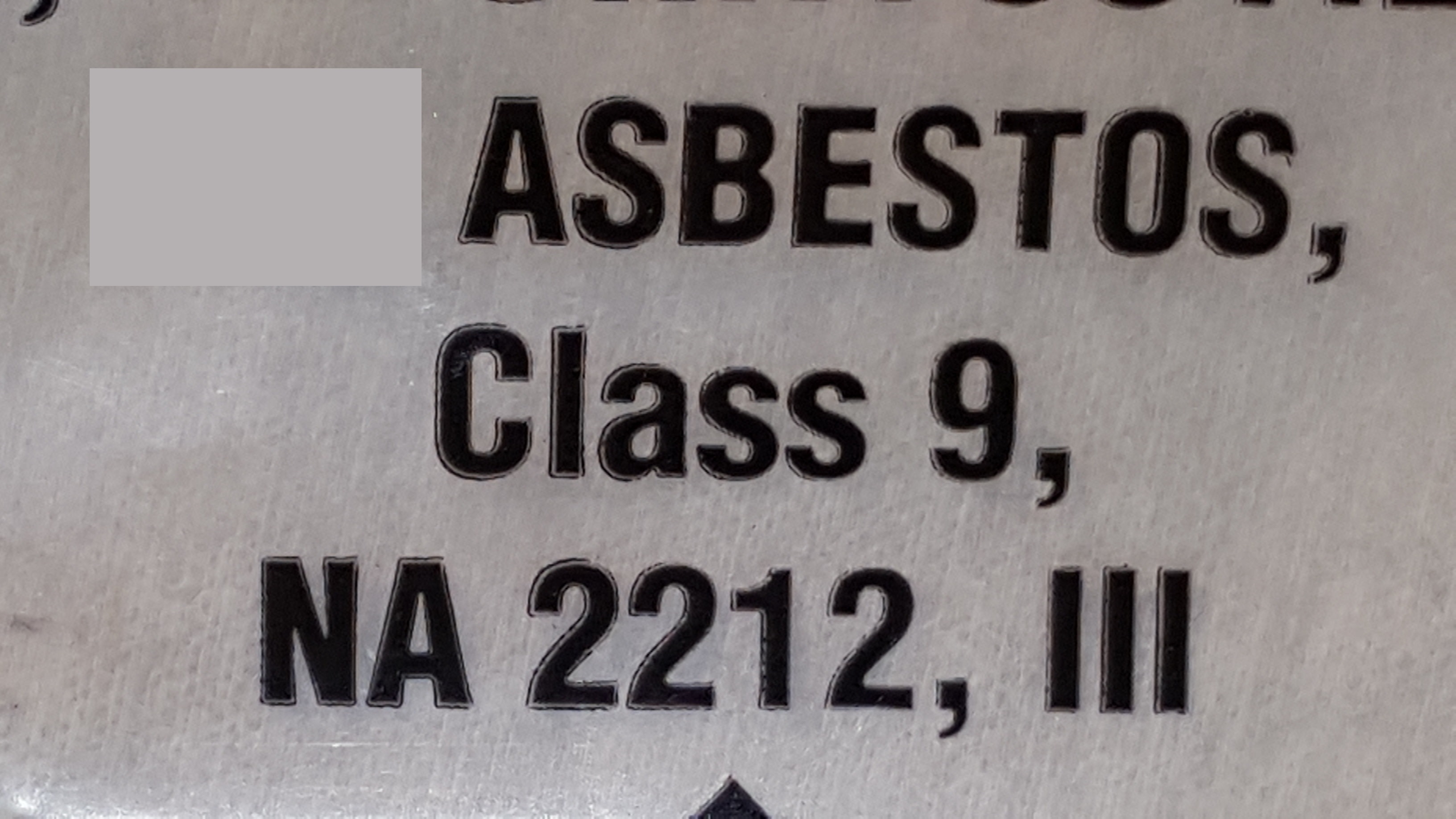
FAQ: Can I Ship non-Friable Asbestos as a Hazardous Material?

Yes. Though special provision 156 in column 7 of the Hazardous Materials Table excepts from regulation asbestos that is immersed or fixed in a natural or artificial binder material, i.e. non-friable, the shipper may still classify a non-friable asbestos and offer it for transportation as a Hazardous Material (HazMat).  [LOI 03-0262]

Special Provision 156:

Asbestos that is immersed or fixed in a natural or artificial binder material, such as cement, plastic, asphalt, resins or mineral ore, or contained in manufactured products is not subject to the requirements of this subchapter.

Daniels Training Services

815.821.1550

Info@DanielsTraining.com

https://danielstraining.com/

Interestingly, asbestos is identified as a hazardous substance in Table 1 to Appendix A of the Hazardous Materials Table. It has a low RQ (Reportable Quantity) of 1 lb (0.454 kg). However, a note to the entry reads as follows:

The RQ for asbestos is limited to friable forms only.

Shipping description for non-friable asbestos
A non-friable asbestos can’t be an RQ of a hazardous substance.

So, it is acceptable to ship a non-friable asbestos as a hazardous material even though it – because of special provision 156 – is not subject to the regulations, a shipper will not be able to identify it as a Reportable Quantity of a hazardous substance.

Free Seminars and Workshops Provided by PHMSA/USDOT in 2017

The Hazardous Materials Regulations (HMR) of the Pipeline and Hazardous Materials Safety Administration (PHMSA) within the U.S. Department of Transportation (DOT) regulates the transport of hazardous materials within the U.S. Compliance with these regulations are the responsibility of shippers and carriers of hazardous materials (HazMat) and those persons identified as the “destination” or “receiving facility” (aka: consignee).

Compliance with the HMR can be tough. That’s why PHMSA offers one-day training workshops and two-day multi-modal training seminars throughout the U.S.  And the best part?  Both the workshops and seminars are free!  Check out the calendar and details below to select a location and date that is convenient.

One-Day Workshop Calendar and Details

Two-Day Seminar Calendar and Details

Note:  There are no two-day training seminars scheduled for 2017 as of this writing (03.11.17).  Perhaps that will change soon.

Can’t find one that’s right for you?  That’s OK.  Be sure to check back frequently as new locations and dates will be added throughout the year.  Also, some of the workshops and seminars are limited to a certain number of early registrants.  Don’t miss out when the training is right in your back yard and free!

Contact me with any questions you may have about the transportation of hazardous materials by air, highway, vessel, or rail

International and Domestic

Daniels Training Services

815.821.1550

Info@DanielsTraining.com

https://danielstraining.com/

I am now scheduled to attend the one-day training workshop in Burlington, VT on June 27, 2017.  Perhaps I’ll see you there!

Ethanol Fast Facts

Economic Impact:
  • In 2014, the ethanol industry created and supported nearly 400,000 jobs.  Moving to E15 would create an additional 136,000 jobs.
  • A recent Louisiana State University study found ethanol reduces gas prices 78 cents a gallon. A consumer savings of more than 100 billion dollars annually.
  • In 2014, the ethanol industry contributed nearly 53 billion dollars to the nation’s GDP and added nearly 27 billion dollars to household income.
  • By creating a steady market for corn and other grains, ethanol helps to reduce federal farm program costs.
Environmental impact:
  • In 2014, the production and domestic use of more than 13 billion gallons of ethanol in the U.S. reduced greenhouse gas emissions by 38 million metric tons, the equivalent of removing roughly 8 million automobiles from the road.
  • Grain ethanol decreases greenhouse gas emissions by up to 57 percent compared to gasoline.
  • Cellulosic  ethanol is expected to reduce greenhouse gas emissions by 100 percent or more. Furthermore, the U.S. is home to more than 1 billion tons of available biomass that can be converted to 80-100 billion gallons of ethanol. This is a 50-state solution.
  • New technologies are improving efficiencies and allowing ethanol biorefineries to make better use of natural resources like water.
  • A recent USDA report shows ethanol is more energy efficient to produce than conventional gasoline. Every Btu put into creating ethanol yields a 2.3  Btu return.
Energy Security:
  • Every gallon of clean-burning ethanol that we produce in this country decreases the demand for foreign oil and keeps our money here at home where it can create American jobs.
  • The production of more than 14.3 billion gallons of ethanol in 2014 displaced the need for 515 million barrels of oil.
  • When the RFS when enacted in 2005, America imported 60 percent of its fuel. Today, we import 27 percent.  Switching to domestic energy sources has helped reduce our dependence on foreign oil, strengthening our national security and our economy.
  • We spend more than 300 billion dollars a year – nearly 1000 dollars for every man, woman and child in this country – on foreign oil.
Food and Fuel:
  • A 2003 World Bank study outlines how crude oil prices are responsible for at least 50 percent of the increase in food prices in 2004.
  • The real costs of putting food on the shelf are transportation, processing and packaging – all costs driven by oil.
  • The U.S. ethanol industry uses less than 3 percent of the global grain supply on a net basis.
  • Nearly one-third of every bushel of corn used in ethanol production is returned to the food chain in the form of distiller’s grains, a competitively-priced, nutritious animal feed.
  •  Since only the starch is used and distiller’s grains displace both corn and soybean meal, in reality only 17.5 percent of the net corn acres are used for renewable fuels.

Information provided by: Growth Energy America’s Ethanol Supporters

Daniels Training Services

815.821.1550

Info@DanielsTraining.com

https://danielstraining.com/

HazMat Labels, Markings, and Placards on an Intermediate Bulk Container

If you prepare for transportation or transport hazardous materials in an Intermediate Bulk Container (IBC), you may be just as confused as I am (or was!) regarding the proper display of the required hazard communication methods.  The answering of customer’s questions and the writing of this article forced me to look hard at the PHMSA/USDOT Hazardous Materials Regulations (HMR) and to arrive at an answer.  Five of them, actually.  In this article I will identify all of the options available to a shipper of HazMat in IBCs for the display of HazMat labels, markings, and placards.   I will do this in three sections:

  1. Dispense some preliminary information necessary for complete understanding.
  2. Identify the applicable regulations and their meaning.
  3. Relying on the preliminary information and referring to the applicable regulations, identify five options for display of the required hazard communication methods on IBCs

At the bottom of this article I have embedded a Power Point presentation which summarizes the information presented and illustrates the five options explained herein.  Please refer to it as a complement to this article and not a replacement for it.

Before we Begin:

An IBC is defined at 49 CFR 171.8:

Intermediate bulk container or IBC means a rigid or flexible portable packaging, other than a cylinder or portable tank, which is designed for mechanical handling. Standards for IBCs manufactured in the United States are set forth in subparts N and O of part 178 of this subchapter.

To sum up:

  • An IBC can take many forms, “…rigid or flexible…”.  It could be a plastic bladder in a metal cage mounted to a pallet.  It could be a nylon or plastic sack.  It could be a metal or plastic rigid packaging.
  • It is not a cylinder for a compressed gas nor is it a portable tank, which is usually much bigger.  Both of which are defined in §171.8.
  • It is designed to be handled by mechanical equipment and not a person or persons.  This eliminates most smaller packagings though the IBC is not specifically defined as a bulk packaging as is a cargo tank or portable tank.  As a practical matter, every IBC I have ever encountered has been a bulk packaging.  For the purposes of this article, we will assume an IBC to be a bulk packaging.
  • Standards for IBCs are set forth in subparts N and O of 49 CFR 178.  This differentiates an IBC from a large packaging or a flexible bulk container (standards set forth in subparts P/Q and R/S, respectively).  This is important since these three different types of packagings may appear very similar.

The average volume of an IBC is 275 – 330 gallons.  This is important because many of the requirements for HazMat labels, markings, and placards depend upon the volume of the bulk packaging or IBC.

[table “VolConv” not found /]

Read here:  What is a bulk packaging?

Contact me with any questions you may have about the transportation of hazardous materials by air, highway, vessel, or rail

International and Domestic

Daniels Training Services

815.821.1550

Info@DanielsTraining.com

https://danielstraining.com/

A Summary of the Applicable Hazard Communication Regulations of 49 CFR 172

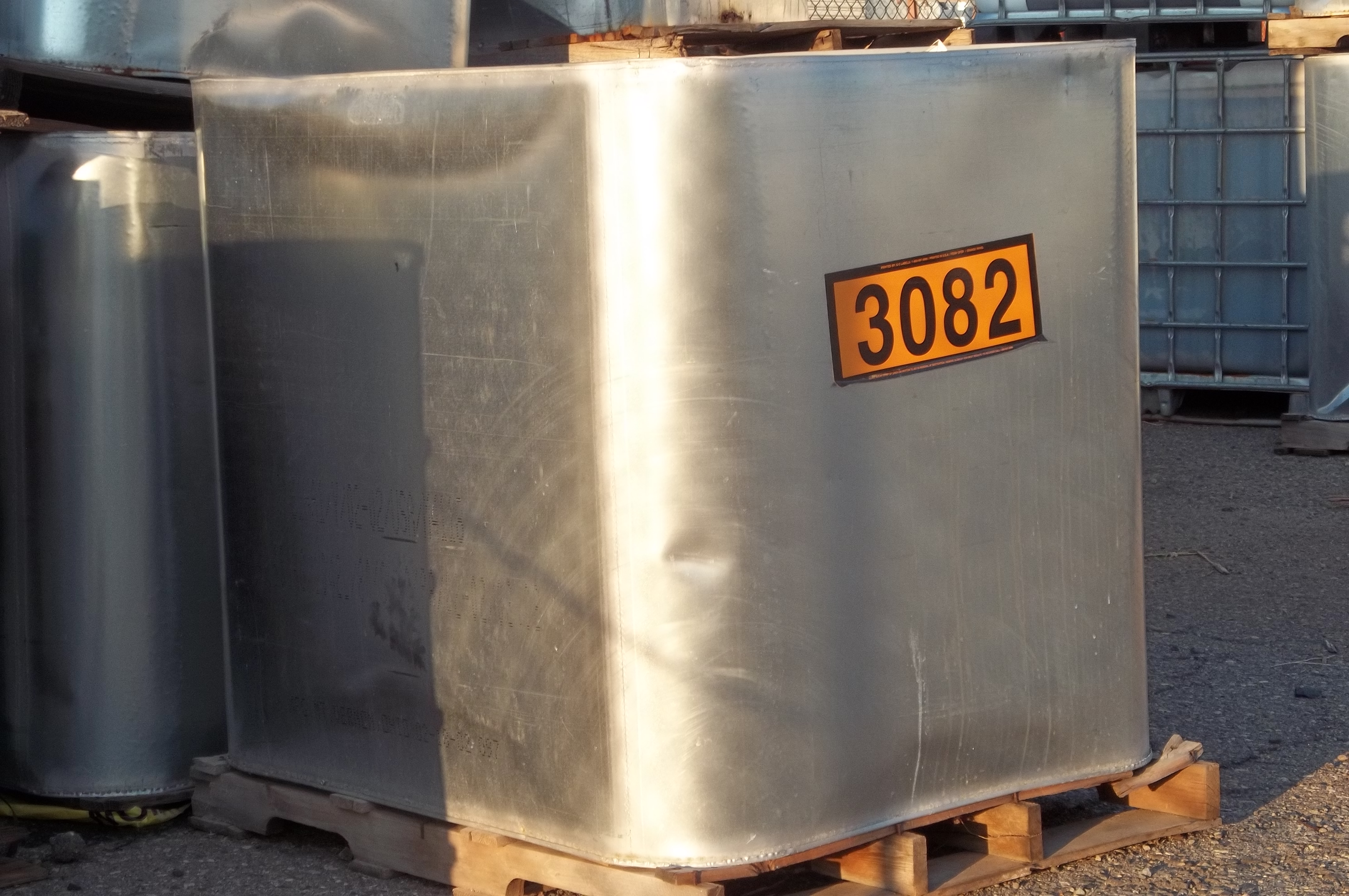
Intermediate Bulk Container of UN3082Subpart D Marking:

  • §172.301(a)(1):  A non-bulk packaging must display the identification number and proper shipping name.   There is no requirement to display this marking more than once.  As of January 1, 2017 there is a minimum size requirement for the identification number marking on a non-bulk packaging.
  • §172.302(a)(1):  A bulk packaging with a capacity of ≥3,785 L (1,000 gallons) must display the identification number – not the proper shipping name – on all four sides.
  • §172.302(a)(2):  A bulk packaging with a capacity of <3,785 L (1,000 gallons) must display the identification number on two opposing sides.
  • §172.336(d):  A bulk packaging that displays HazMat labels instead of placards according to §172.514(c), may display the identification number in the same manner as a non-bulk packaging at §172.301(a)(1) instead of the identification number marking as it is normally required to be displayed on a bulk packaging.
  • §172.332:  When required on a bulk packaging, the identification number marking must be displayed with one of the following methods:
    • On the placard.
    • On an orange panel near the placard.
    • On a white square-on-point configuration near the placard.

Subpart E Labeling:

  • §172.400(a)(1):  A non-bulk package must display the applicable HazMat label.
  • §172.400(a)(2):  A bulk packaging with a capacity of <18 m3 (640 ft3) must display the applicable HazMat label unless it is placarded according to subpart F.  The requirement to label bulk packagings of this capacity does not apply to a cargo tank, portable tank, or tank car.
  • §172.406(a)(1)(ii):  HazMat label – if displayed – must be on the same surface of the package and near the proper shipping name marking.
  • §172.406(a)(2):  Except as provided in paragraph (e) of this section, use of more than one HazMat label on a package is not required.
  • §172.406(e):  Generally, only one of each different required label must be displayed on a package.
  • §172.406(e)(6):  Duplicate labels must be displayed on at least two sides of an IBC with a capacity of ≥1.8 m3 (64 ft3).

Subpart F Placarding:

  • §172.504(a):  Except as otherwise provided, a bulk packaging containing any hazardous material must display the applicable placard on all four sides.
  • §172.514(c):  An IBC may display placards on two opposing sides or it may display HazMat labels according to subpart E.
  • §172.514(c)(4):  An IBC displaying HazMat labels in accordance with subpart E may display the identification number in the same manner as a non-bulk packaging at §172.301(a)(1) instead of the identification number marking as it is normally required to be displayed on a bulk packaging.

Like this article?

Subscribe to my Monthly Newsletter

No marketing emails!

Options for labeling, marking, and placarding Intermediate Bulk Containers

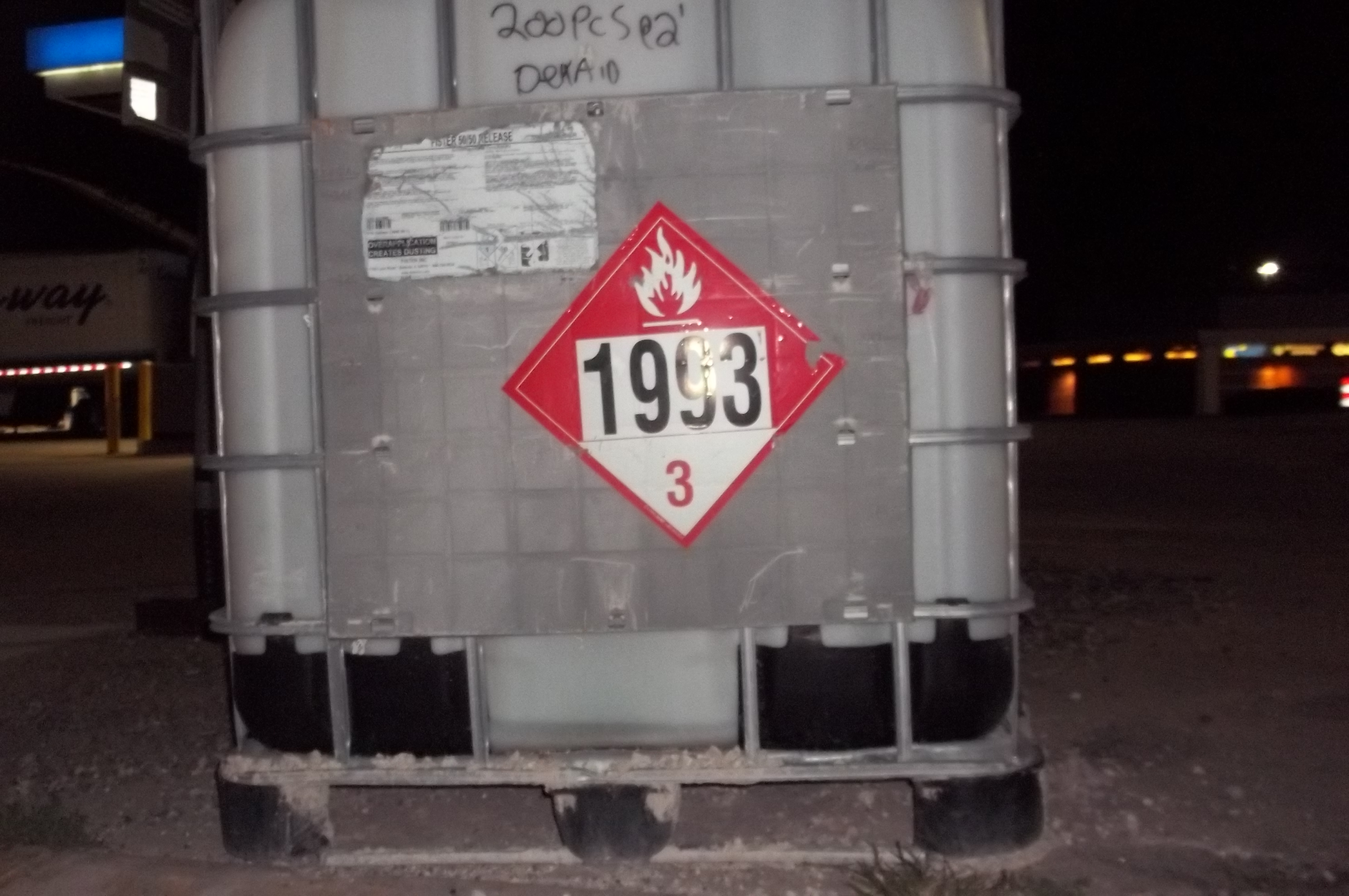
Option 1:UN1993 in Intermediate Bulk Container

An option available to all bulk packagings – and the most burdensome – is to display placards and identification number on all four sides of the bulk packaging.  The identification number must be displayed on or near the placard.

  • Display placards on all four sides of a bulk packaging per §172.504(a).
  • The display of the identification number marking on all fours sides is required for a bulk packaging of ≥1,000 gallons at §172.302(a)(1) and is an option for a bulk packaging with a capacity of <1,000 gallons.
  • Display the identification number marking on or near the placard per §172.332 as for any bulk packaging.

Option 2:

A small revision to option 1 is to display placards on all four sides of the IBC and, if the capacity is below the threshold amount, to display the identification number marking on two opposing sides.

  • Display placards on all four sides of a bulk packaging per §172.504(a).
  • Display the identification number marking on two opposing sides per §172.302(a)(2) for a  bulk packaging with a capacity of <1,000 gallons.
  • Display the identification number marking on or near the placard per §172.332 as for any bulk packaging.

Option 3:

Both option 1 and 2 are available for most bulk packagings.  With option 3 we arrive at one specifically designed to ease the regulatory burden for those who ship HazMat in IBCs.  Option 3 allows for the display of placards on two opposing sides of the IBC along with the identification number marking if the capacity of the IBC is below the threshold amount.

  • Display placards on two opposing sides of the IBC per §172.514(c).
  • Display the identification number marking on two opposing sides per §172.302(a)(2) for a  bulk packaging with a capacity of <1,000 gallons.
  • Display the identification number marking on or near the placard per §172.332 as for any bulk packaging.

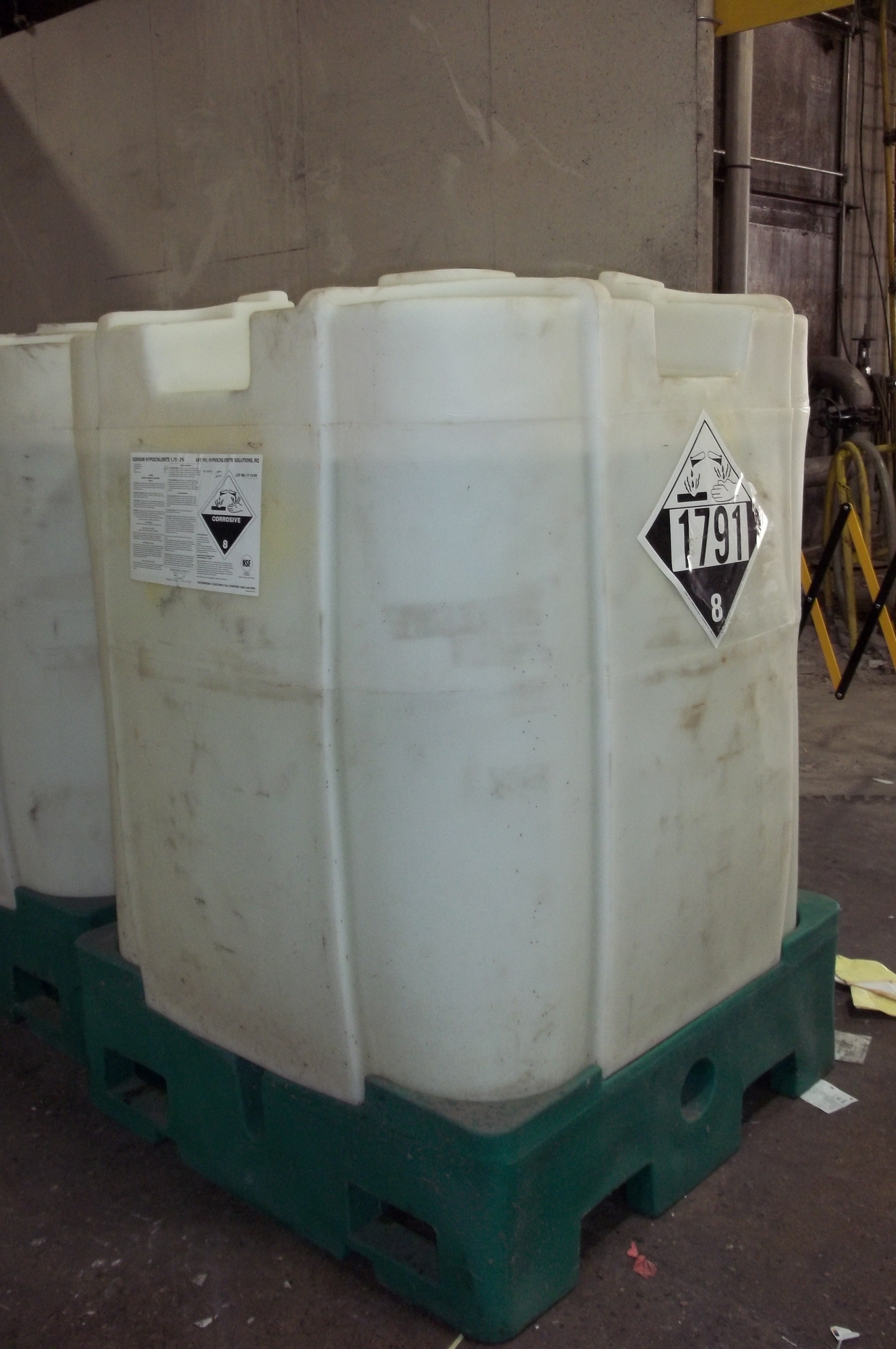
UN1791 in Intermediate Bulk ContainerOption 4:

Option 4 continues the progression of relaxing the regulatory responsibilities specifically for the use of IBCs as a packaging for HazMat.  Option 4 allows for the display of HazMat labels on two opposing sides of an IBC with a capacity of ≥1.8 m3 (64 ft3).  If taking advantage of this option the shipper may also display the proper shipping name and identification number marking near the HazMat label on one side of the IBC in the same manner as if it was a non-bulk packaging.

  • For a bulk packaging with a capacity of <18 m3 (640 ft3), either display HazMat labels or placards according to subpart F per §172.400(a)(2).
  • Display HazMat labels on the IBC as directed by subpart E per §172.514(c).
  • According to §172.406(a)(2) and §172.406(e), display of more than one HazMat label on a package is not required.
  • Display HazMat labels on two opposing sides of an IBC with a capacity of ≥1.8 m3 (64 ft3) per §172.406(e)(6).
  • Display the proper shipping name and identification number marking in the same manner as a non-bulk packaging as is described at §172.301(a)(1) per §172.514(c)(4).

Option 5:

I saved the best option for last.  A shipper of hazardous materials in an IBC may display a HazMat label on one side of an IBC with a capacity of <1.8 m3 (64 ft3).  Remember: the capacity of a typical IBC is 275 – 330 gallons (330 gallons = 1.25 m3 = 44 ft3).  If taking advantage of this option the shipper may also display the proper shipping name and identification number marking near the HazMat label on one side of the IBC in the same manner as if it was a non-bulk packaging.

  • For a bulk packaging with a capacity of <18 m3 (640 ft3), either display HazMat labels or placards according to subpart F per §172.400(a)(2).
  • Display HazMat labels on the IBC as directed by subpart E per §172.514(c).
  • According to §172.406(a)(2) and §172.406(e), display of more than one HazMat label on a package is generally not required.
  • Display HazMat labels on one side of an IBC with a capacity of <1.8 m3 (64 ft3) per §172.406(e)(6).
  • Display the proper shipping name and identification number marking in the same manner as a non-bulk packaging as is described at §172.301(a)(1) per §172.514(c)(4).

Daniels Training Services

815.821.1550

Info@DanielsTraining.com

https://danielstraining.com/

Conclusion:

If you are uncertain about the option to display the proper shipping name and identification number marking on the IBC per §172.301(a)(1) as if it was a non-bulk packaging, so was I!  Please refer to this PHMSA letter of interpretation issued in response to my query (LOI 15-0120) for confirmation that this option complies with the HMR.  Please note the reference in the letter to §172.302(b)(2) isn’t an error.  That particular citation was removed from the HMR during an update that took place after the date of the letter’s posting.  It was replaced with §172.301(a)(1).

Here’s that Power Point embed I referred to at the beginning of this article.  Remember, use it as an illustration to further explain the five options explained in this article.

That – I believe – is it.  I’ve scoured the Hazardous Materials Regulations and cannot find any other options for the display of HazMat labels, markings, and placards on an Intermediate Bulk Container.  Have you?  Please let me know if you have, I’d love to add another option to this article.  In truth, it’s option 5 that is the most important to shippers of hazardous materials in an IBC:  no placards; no identification number marking on an orange panel, or on the placard, or on a white square-on-point; just a HazMat label and proper shipping name and identification number marking displayed on one side just as if it was a non-bulk packaging.

If you like this article, please share it using any of the social media platforms identified at the bottom of this article.

You’ll look real smart recommending my articles!

Interested in more information about shipping HazMat in IBCs?

Loading and Unloading of Rail Tank Cars

The transportation in commerce of a hazardous material (HazMat) by rail may involve a variety of bulk and non-bulk packagings. One common bulk packaging for the transport of HazMat by rail is the tank car. Whatever the packaging, the transport of HazMat by rail is subject to a variety of modal-specific or packaging-specific requirements within the Hazardous Material Regulations (HMR) of the Pipeline and Hazardous Materials Safety Administration within the U.S. Department of Transportation (USDOT/PHMSA), including:

  • 49 CFR 174 – Carriage by rail
  • §173.10 – Tank car shipments
  • §173.31 – Use of tank cars

The purpose of this article is to identify and explain one small part of 49 CFR 173.31: The requirements for tank car loading and unloading at §173.31(g). (more…)

Q&A: How to Classify and Ship Used Medical Devices

My website – as it is intended – draws the attention of people who have questions about transporting hazardous materials.  Like this one on August 5, 2016:

Hi Daniel,

I saw your web page and the invite to contact you with questions about the transportation of hazardous materials. My questions involve the shipping of used medical devices.

Example 1. A used biopsy sampling gun from a hospital being returned to the manufacturer for failure investigation.

Example 2. A used medical machine which collects urine which is being returned to the manufacturer for:

  1. a) Reconditioning and return to same hospital or,
  2. b) Disposal if broken.

Example 3. A used medical ultrasonic machine which comes in contact with various patients skin which is being returned to the manufacturer for reconditioning and return to same hospital.

Example 4. A used catheter being used for personal home healthcare being returned to the manufacturer for failure investigation.

It may be precautionary assumed that recondition / reusable devices being returned from a healthcare facility came in contact with bodily liquids from floors or sprays from patients.

It is also assumed that these liquids are Category B infectious substance.

What are the suggestions for each Example:

  1. Shipping Name
  2. Inner Packaging Material and Markings
  3. Outer Packaging Material and Markings
  4. Acceptable types of transportation (i.e. personal cars, company sales cars, licensed carriers, etc)

Also can any regulated hazardous material be shipped to any off-site storage facility while awaiting decision dispositions?

Thank you very much Daniel.

Contact me with any questions you may have about the transportation of hazardous materials by air, highway, vessel, or rail

International and Domestic

Daniels Training Services

815.821.1550

Info@DanielsTraining.com

https://danielstraining.com/

My reply that same day acknowledged the question and my need for some time to research an answer.

Yow!  That’s a lot.  I’ll do my best to answer your questions in the next several days.

My response to his question more than a month later (09.26.16):

I will do my best to answer your questions below.  I apologize for my delay.

  • All of what you describe meets the definition of a Used Health Care Product at 49 CFR 173.134(a)(8).
  • A used health care product is a type of Division 6.2 Infectious Substance.
  • There is an exception from regulation as a hazardous material for used health care products at 49 CFR 173.134(b)(12)(ii).  Per this exception, a used health care product (UHCP) is not subject to USDOT regulations if the following conditions are met:
    • UHCP are drained of all free liquids.
    • UHCP are placed in a water-tight primary container.
    • Primary container is puncture-proof if required by UHCP.
    • BioHazard marking is displayed on primary container.
    • Primary container is placed in water-tight secondary container.
    • BioHazard marking is displayed on secondary container.
    • Secondary container is placed in outer packaging.
    • Sufficient cushioning is used to prevent movement of secondary container within outer packaging.
    • An itemized list of contents of secondary container and information regarding possible contamination with Division 6.2 infectious substance is placed between the secondary container and the outer packaging.
    • Persons involved in offering for transport or actual transport must know about the requirements of this exception.  HazMat Employee training is not required.

If packaged as summarized above (and explained in detail at 49 CFR 173.134(b)(12)(ii)), no other requirements of the USDOT Hazardous Material Regulations apply.

  1. Shipping name:  None.
  2. Inner packaging material and markings:  see above.
  3. Outer packaging material and markings:  see above.
  4. Acceptable transportation:  Any.  If the above is complied with, UHCP is not subject to USDOT regulation as a hazardous material.

Can any regulated HazMat be shipped to any off-site storage facility while awaiting decision dispositions?  I may need more information from you to understand exactly what you are asking but the short answer is yes.  USDOT does not regulate to where a HazMat is transported, only that the shipper is responsible to offer it to a carrier who then must transport it to its destination.

I hope this helps.
Please don’t hesitate to contact me with any other questions.

Like this article?

Subscribe to my Monthly Newsletter

No marketing emails!

I didn’t hear back from him after that so I can only assume that I provided him with the information he needed or my answer was too late to be of any use.

I admit it took me a long time to reply to this person but as you can see, the research necessary was extensive.  Perhaps you are a shipper of used health care products that are a Division 6.2 Infectious Substance.  Or, perhaps you offer for transport some other Division 6.2 HazMat.  Whatever your situation may be, and whatever HazMat you may be involved with, there is an explanation of how to ship it in the Hazardous Material Regulations of PHMSA/USDOT.  If you can’t find the answer, then contact me and I’ll be glad to assist you.

Search Website