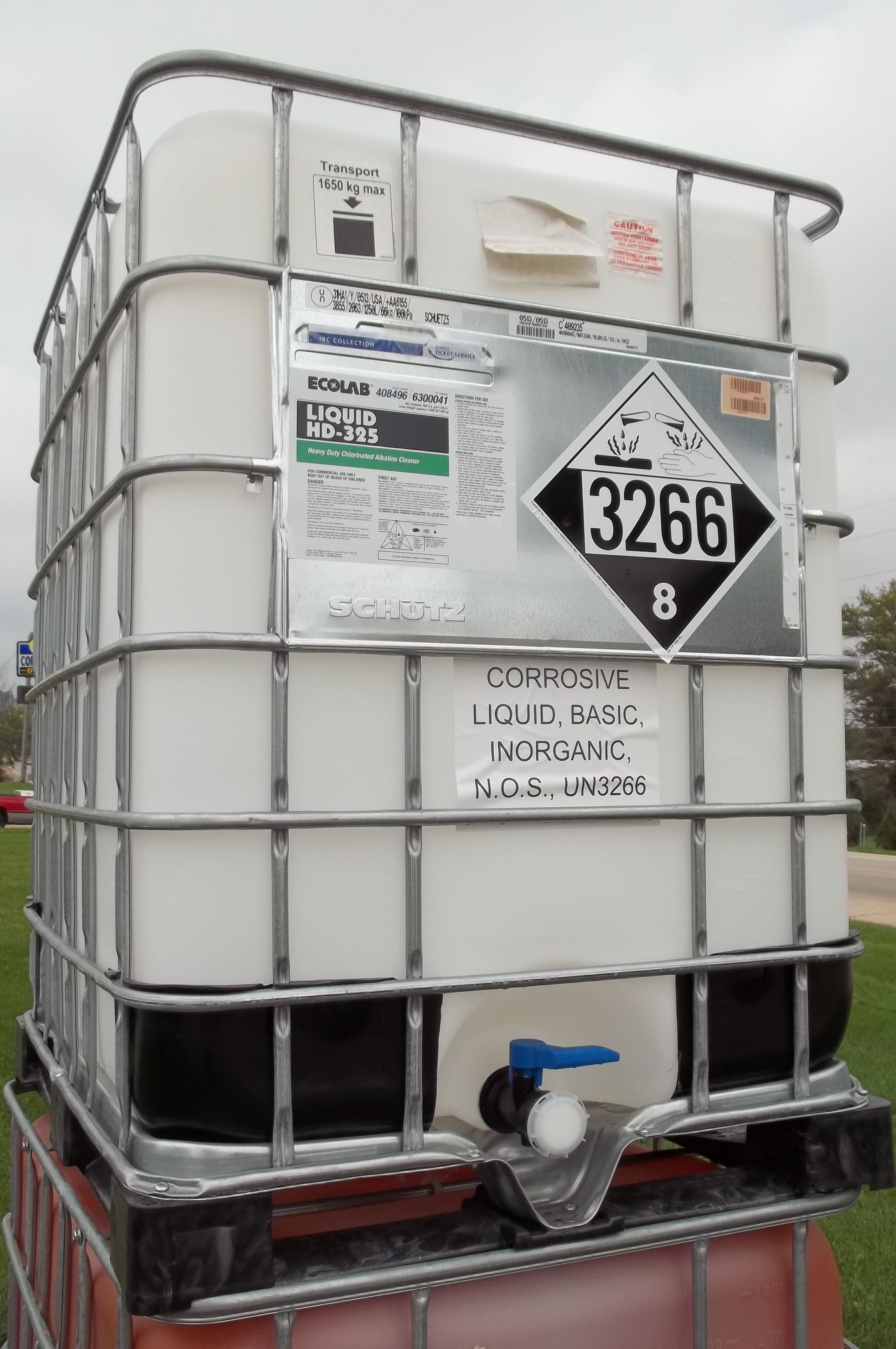
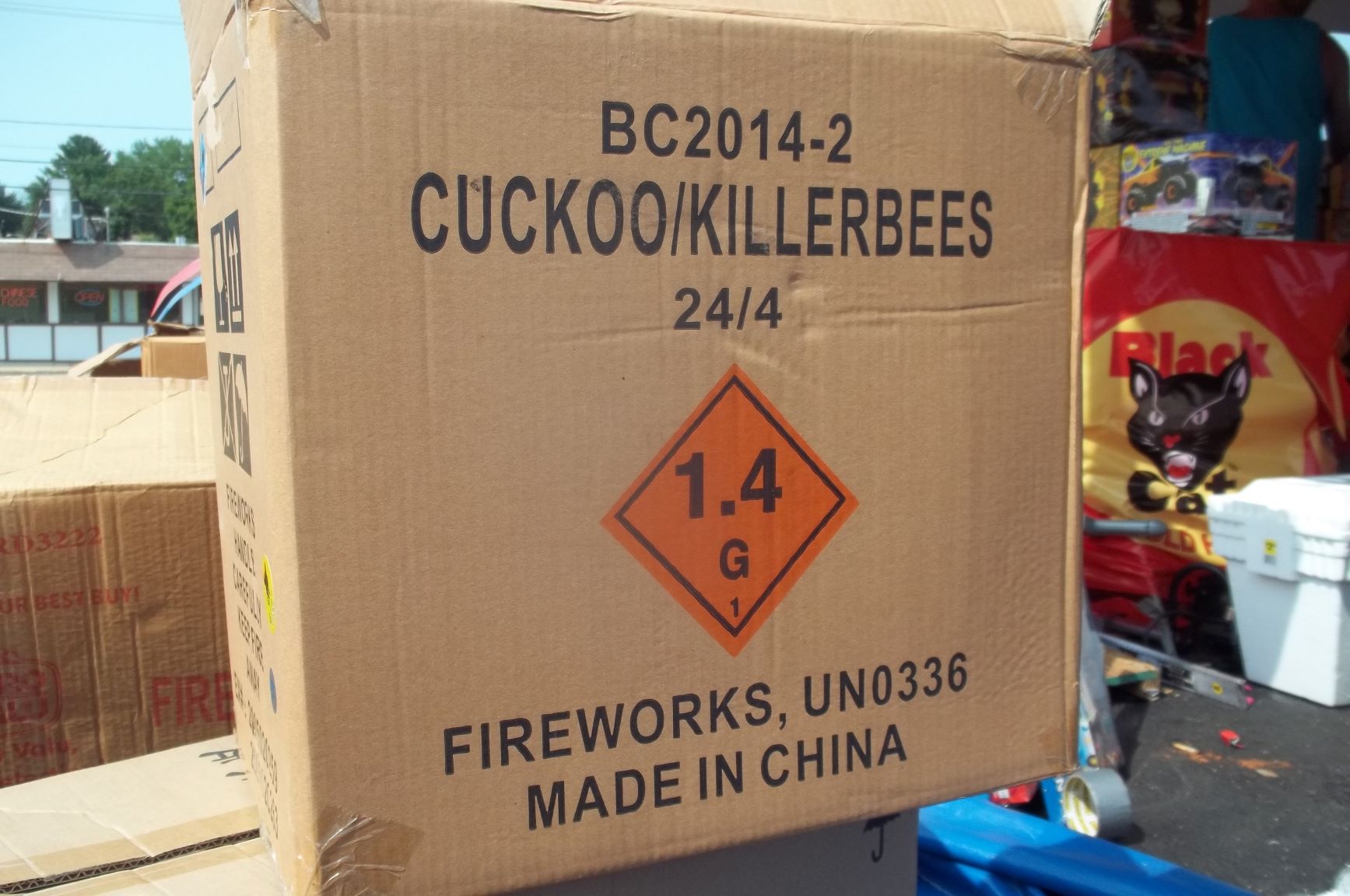
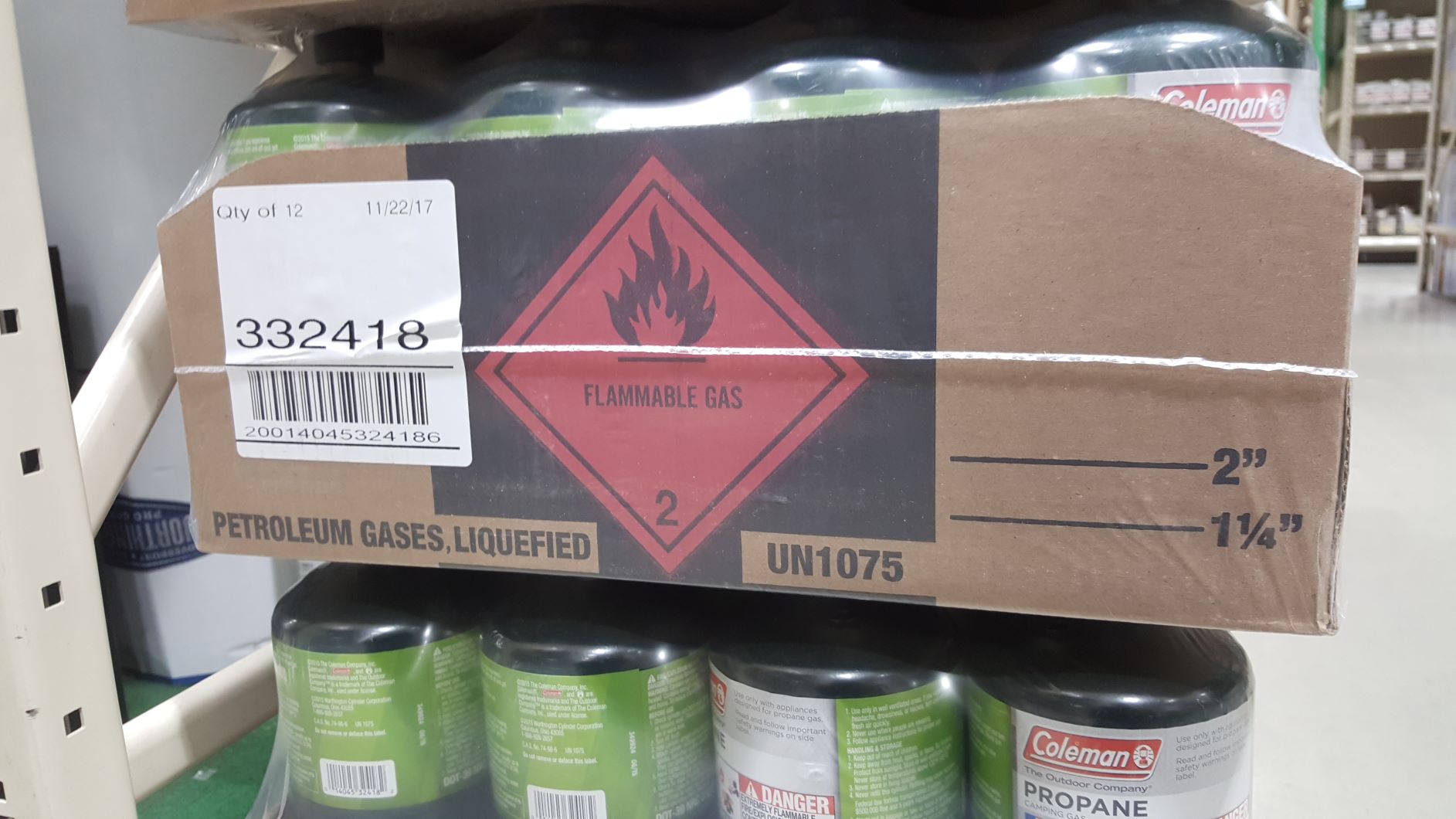
Can the following hazardous materials (HazMat) be transported by company employees in a company vehicle on a public road (for business purposes, natch)?
Q&A: Can I stack IBCs if empty but containing HazMat residue?
A question back on April o2, 2018:
I know ibc totes can be stacked but not recommend when full ( flammable), so can they be double stack when empty and still be labeled ( flammable)? I’ve read that totes have to be cleaned and labels removed can you please clarify, my safety director says that they can even when labeled empty w/flammable labels still on them. Thanks Your feedback will be appreciated.
My reply:
That’s a tough question to answer because it combines the regulations of the USDOT/PHMSA (with which I am familiar) with those of OSHA (with which I am not familiar). Please see below.
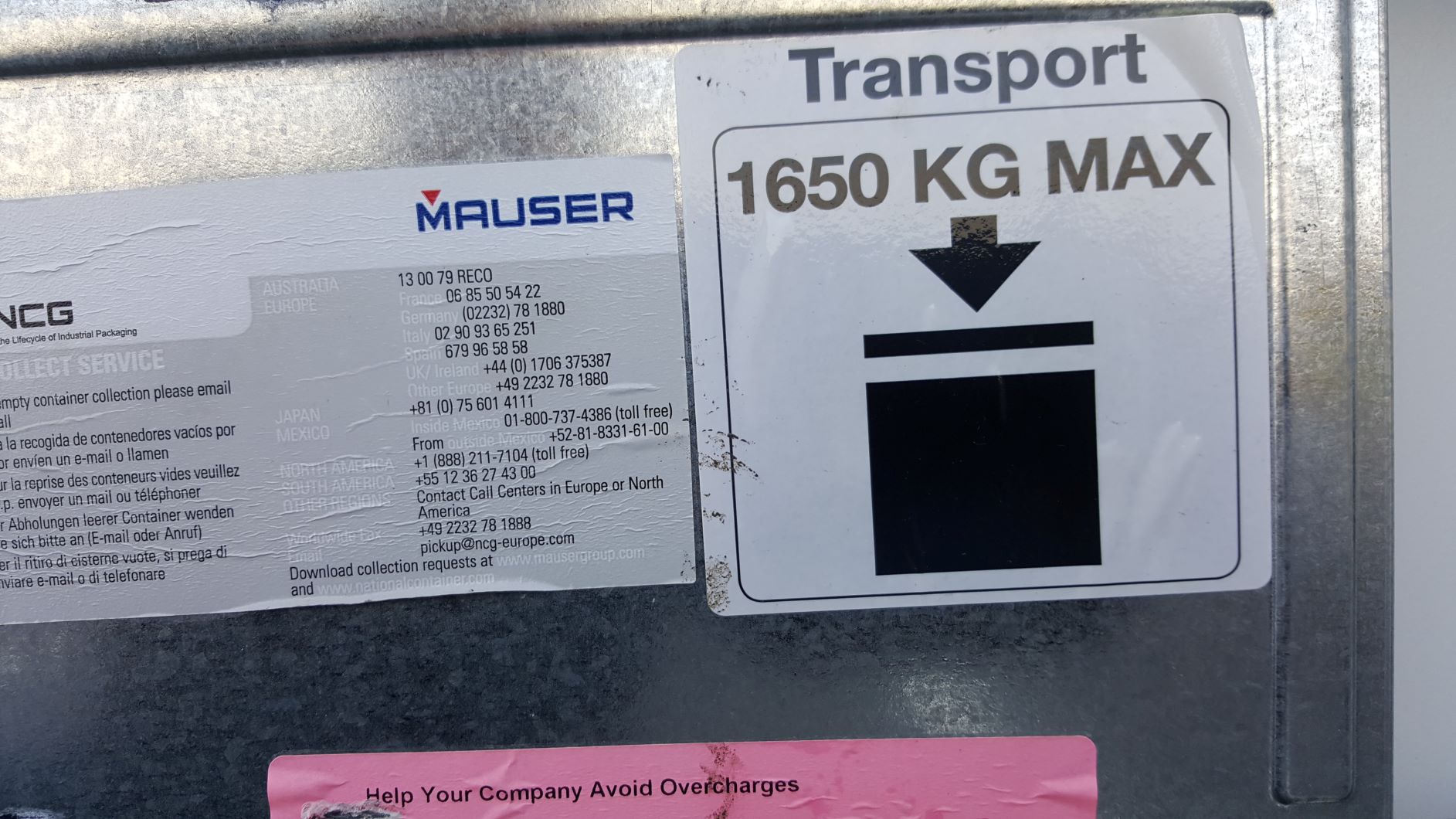
Per USDOT/PHMSA Hazardous Materials Regulations at 49 CFR 173.703(a)(1)(vii) each IBC must be marked with its stacking test load in kilograms. If an IBC is not designed for stacking, the figure of zero “0” must be displayed.
Also, per 49 CFR 178.703(b)(7), an IBC manufactured, repaired, or remanufactured after January 01, 2011 must display a symbol indicating if it is designed for stacking or not designed for stacking.
This symbol indicates an IBC designed for stacking
Unless the IBC has been cleaned of all hazards and had all labels and marks removed it must be managed “empty” the same as when it was full so the stacking load limits would still apply.
The above regulations only apply to the IBCs when they are in transportation, being prepared for transportation, or being loaded or unloaded. There may be regulations of OSHA that limit their stacking aside from the regulations of the USDOT.
I hope this helps. Please contact me with any other questions.
Contact me with any questions you may have about the transportation of hazardous materials by air, highway, vessel, or rail
This Q&A displays a common occurrence in HazMat transportation: people assume they know the regulations or rely on the assumptions of others instead of using the HMR themselves as the determination of compliance. Make certain that your compliance is based on the Hazardous Materials Regulations of USDOT/PHMSA and not what you’ve “heard” or what others have told you. Just one of the requirements of the HMR is that you provide initial and triennial HazMat Employee training.
FAQ: May the address of the consignee or consignor marked on a package be a PO Box?
The Hazardous Materials Regulations of the USDOT/PHMSA require the person who offers a hazardous material for transport (i.e., the shipper) to mark the package with the name and address of either the consignor or consignee except in certain specified circumstances. You can read all about this general marking requirement of 49 CFR 172.301(d) here: The Name of the Consignor or Consignee as a Marking on a HazMat Packaging.
When required, is it acceptable for the address to be a post office box instead of a physical address?
Yes.
This USDOT/PHMSA letter of interpretation makes it clear: 03-0156.
Contact me with any questions you may have about the transportation of hazardous materials by air, highway, vessel, or rail
Q&A: What hazard communication is required when transporting lithium batteries by highway?
Question (March 07, 2018):
Good day sir!
I am hauling 43,000 lbs of lithium ions UN3480 from NC to CA as truck driver. Are placards and proper shipping papers with emergency numbers required?
Thank you in advance.
Lily M.
My reply that same day:
I can answer your question but I will need more information.
Are the batteries being shipped for recycling or disposal?
Are the batteries contained in equipment? Packed with (but not in) equipment? Or, are they packed alone?
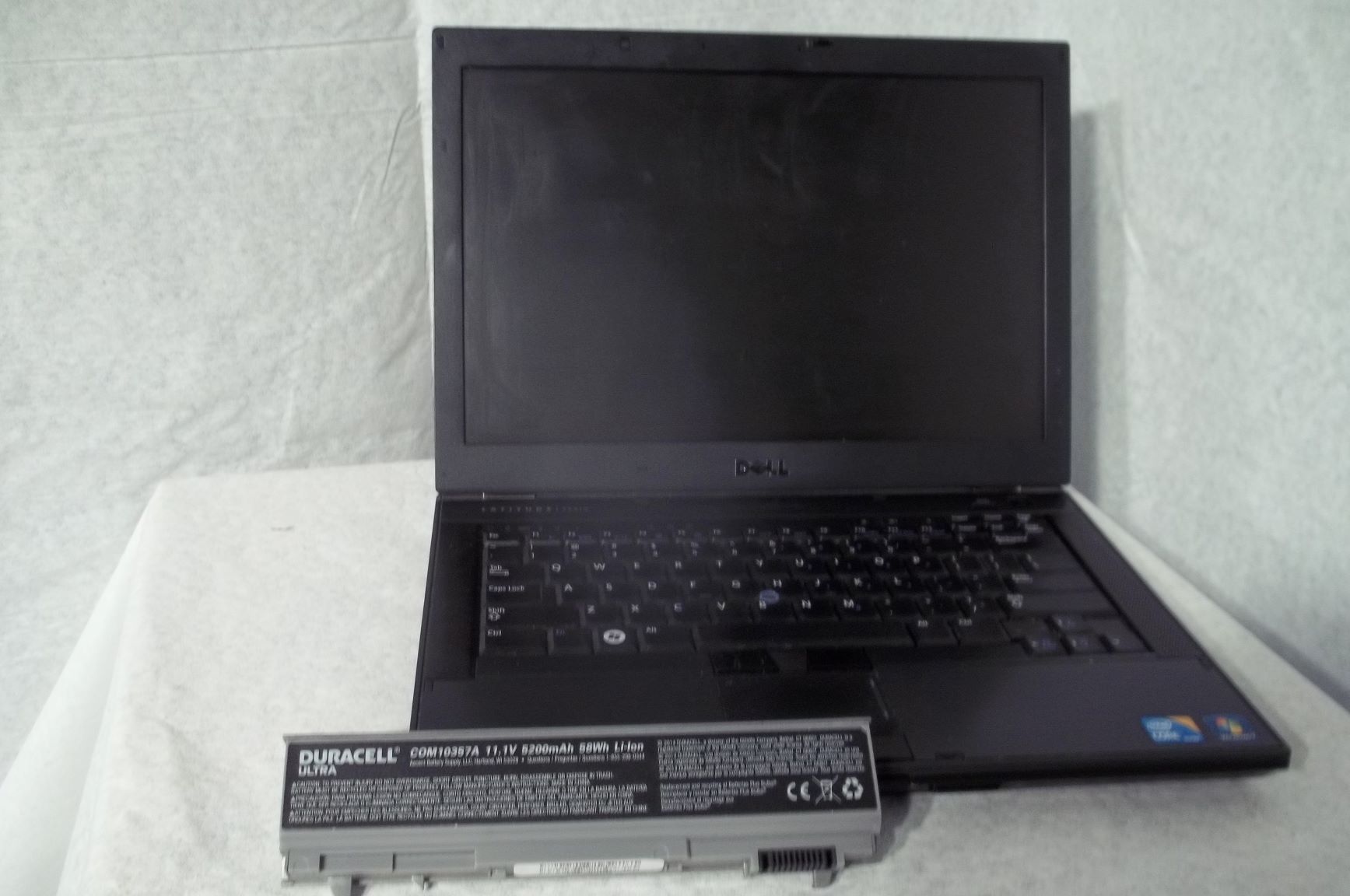
What is the Watt-hour rating for the batteries? If you do not know this, can you describe the batteries? Are they small round (button cell) batteries? If you do not know this, can you tell me what the batteries are meant to power: a mobile phone, lap top computer, something else?
How are the batteries packaged?
His reply to my request for more information:
Q1: Are the batteries being shipped for recycling or disposal?
A1: I believe they are going recycling because we are coming from company called recycling
Q2: Are the batteries contained in equipment? Packed with (but not in) equipment? Or, are they packed alone?
A2: I am not sure of this question but they are in boxes.
Q3: What is the Watt-hour rating for the batteries? If you do not know this, can you describe the batteries?
A3: Description says nonferrous, lcd monitor
Q4: Are they small round (button cell) batteries? If you do not know this, can you tell me what the batteries are meant to power: a mobile phone, lap top computer, something else?
A4: Looks like it is for laptop or computer.
Q5: How are the batteries packaged?
A5: In boxes wrapped and secured low on ground.
Thks
Lily
I decided to answer his question the best I could based on the available information:
Thank you for providing that information. I do not yet have all of the information I would like to have but I think I can make the following determination:
The shipment is excepted from most of the USDOT regulations if it meets the requirements of the packaging exception for lithium batteries sent for recycling or disposal. Requirements of the exception include, but are not limited to, the following:
Please note: this exchange took place prior to a new rule issued by USDOT/PHMSA for the transport of lithium batteries on March 6, 2019. As of that date this package must also display a package mark or label indicating the package is forbidden for transport by passenger aircraft. Read about the new rule here: New USDOT Regulations for the Transport of Lithium Batteries
If packaged as indicated above, the following is not required:
Other package labels or marks.
Placards on the truck.
HazMat shipping paper.
Emergency information.
HazMat Employee training for driver.
HazMat endorsement on CDL.
Please note: The above is my best determination based on the information available. More information may result in a different determination.
I hope this helps. Please don’t hesitate to contact me with any other questions.
Contact me with any questions you may have about the generation, identification, management, and disposal of hazardous waste
Yes sir. The shipper said no need to have all the paperwork done as HM and placard. Our company said we do. So you can see why were unsure what to do.
We just got pulled into weigh station for inspection and DOT officer saw the BOL acknowledging that we were hauling batteries. I am happy to report that we passed the inspection and report was noted that we are not carrying HM load.
So thank you very much for your help as you have helped clarified some things.
Have a great day sir! Sincerely, Lily
Conclusion:
As you can see, the regulations for the transportation of lithium batteries is complicated – and changing all the time! The way you transported or offered for transport lithium batteries in 2018 is not compliant in 2019. You can expect the regulations – domestic and international – to keep changing.
A good way to stay on top of the changes is to subscribe to my monthly newsletter, schedule Onsite or Webinar training, and contact me with questions like Lily M did.
The Analytical Sample Exemption
The regulations of the Resource Conservation and Recovery Act (RCRA) mandate a generator of waste manage it from “cradle-to-grave” meaning: from the first moment of its generation to its final disposal. However, there are times when something might be regarded as a waste but instead is subject to an exclusion or exemption from regulation. Samples collected for the purpose of a hazardous waste determination are subject to an exemption from regulation at 40 CFR 261.4(d): the analytical sample exemption.
The purpose of this article is to identify and explain the exemption from all RCRA regulations available to a sample submitted to a lab for analysis subject to the Analytical Sample Exemption. (more…)
Recycling Executive Sentenced to 3 Years in Prison for Scheming to Landfill and Re-Sell Potentially Hazardous Waste
The Bullet:
Recycling executive Brian Brundage was sentenced on April 12, 2019 to three years in federal prison for illegally landfilling potentially hazardous electronic waste as part of a scheme to re-sell the materials and avoid paying income taxes.
Who:
Brian Brundage 47, of Schererville, IN, formerly owned Intercon Solutions Inc. and was the owner of EnviroGreen Processing LLC at the time of his arrest, plea, and sentencing.
The sentence was announced by:
John C. Kocoras, First Assistant United States Attorney for the Northern District of Illinois.
Jennifer Lynn, Special Agent-in-Charge of the U.S. Environmental Protection Agency’s Criminal Investigation Division.
Gabriel L. Grchan, Special Agent-in-Charge of the Chicago office of the Internal Revenue Service Criminal Investigation Division.
James M. Gibbons, Special Agent-in-Charge of the Chicago office of the U.S. Immigration and Customs Enforcement’s Homeland Security Investigations.
Jeffrey Ryan, Special Agent-in-Charge of the U.S. General Services Administration’s Office of Inspector General, Great Lakes Regional Investigations Office.
The Hong Kong Environmental Protection Department provided valuable assistance in the investigation.
The government was represented by Assistant U.S. Attorneys Sean J.B. Franzblau and Kelly Greening of the Northern District of Illinois, and Special Assistant U.S. Attorney Crissy Pellegrin of the EPA.
What:
Intercon Solutions Inc. and EnviroGreen Processing LLC, purported to recycle electronic waste on behalf of corporate and governmental clients.
The companies represented to their clients that the materials would be disassembled and recycled in an environmentally sound manner. In reality thousands of tons of e-waste (including lead-containing cathode ray tubes or CRTs) and other potentially hazardous materials were landfilled, stockpiled, or re-sold at a profit to companies who shipped the materials overseas.
Mr. Brundage admitted in a plea agreement that he caused employees of Intercon and EnviroGreen to sell some of the e-waste and other materials to vendors who he knew would ship the materials overseas. At one point in 2011, Intercon was publicly accused of shipping potentially hazardous materials to Hong Kong. In response, Mr. Brundage began a fraudulent effort to publicly deny and conceal Intercon’s involvement in the shipment, the indictment states. Mr. Brundage destroyed business records related to the shipment and made efforts to conceal other overseas shipments of large quantities of e-waste, according to the indictment. The fraud scheme continued for another five years, the indictment states.
Mr. Brundage pleaded guilty to one count of wire fraud and one count of tax evasion.
U.S. District Judge Joan Humphrey Lefkow imposed a three-year prison sentence and ordered Brundage to pay more than $1.2 million in restitution to his victims.
Where:
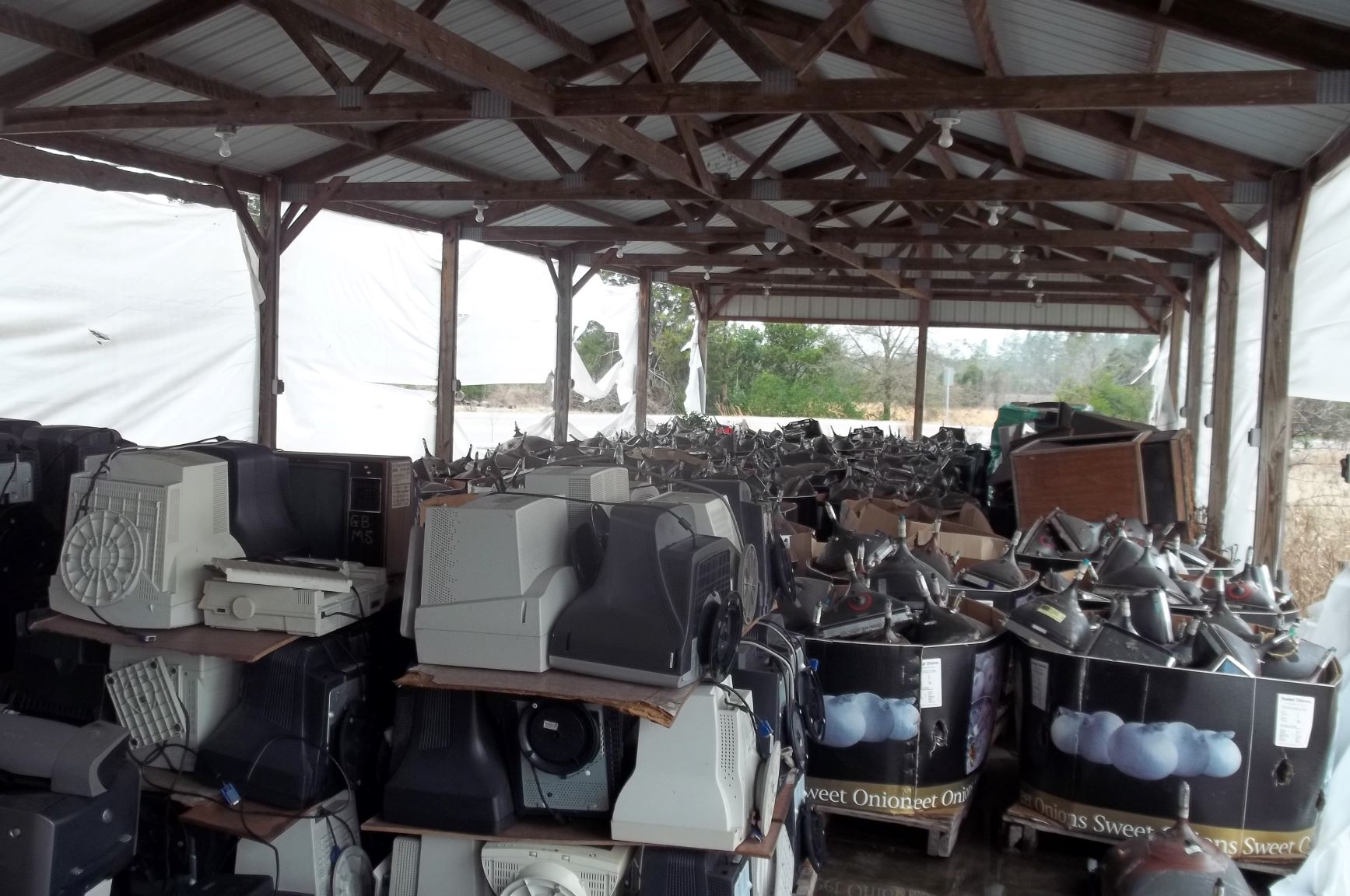
This photo does not represent the subject of this article but it does show how CRTs can be managed improperly.
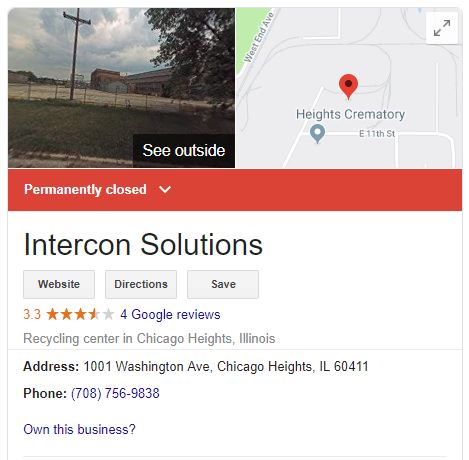
Intercon Solutions Inc. was based in Chicago Heights, IL.
EnviroGreen Processing LLC is based in Gary, IN.
When:
Fraudulent recycling activities took place from 2005 to 2016.
Mr. Brundage was arrested on December 19, 2016.
Mr. Brundage pleaded guilty September 18, 2018 to one count of wire fraud and one count of tax evasion.
Published in the EPA bulletin: Mar—Apr 2019
How:
The case was investigated by EPA’s Criminal Investigation Division, IRS, ICE’s Homeland Security Investigations, and GSA’s Office of Inspector General, with assistance from the Hong Kong Environmental Protection Department.
The case was prosecuted by a DOJ litigation team.
Why:
Mr. Brundage evaded $743,984 in federal taxes by concealing the income he earned from re-selling the e-waste and from paying himself funds that he falsely recorded as Intercon business expenses.
Mr. Brundage spent the purported expenses for his own personal benefit, including wages for a nanny and housekeeper, jewelry purchases, and payments to a casino in Hammond, IN.
“Improper management of cathode ray tubes can pose risk to human health and the environment, as they contain significant quantities of lead,” said Special Agent-in-Charge Lynn.
“This case demonstrates that EPA and our law enforcement partners are committed to protecting the environment and ensuring that companies follow the law.”
“The GSA Office of Inspector General will aggressively pursue contractors who make false representations in order to obtain federal business,” said Special Agent-in-Charge Ryan.
“This sentence should serve as a reminder that HSI will continue to work with its federal, state and local partners to pursue offenders who endanger others by engaging in fraud and deceit,” said Special Agent-in-Charge Gibbons.
Conclusion:
A generator of electronic waste is relieved to learn of a facility that will not only take their waste but will manage it in such a way through recycling and reuse that it is excluded or exempt from most of the “cradle-to-grave” regulations of the Resource Conservation and Recovery Act (RCRA). However, it is the generator who must be wary of unscrupulous businesses who will not manage the waste properly. The e-waste recycling industry – like any other – has its share of shady characters. Make sure you perform an audit of any facility that manages your waste – even waste that is recycled – to ensure it is being managed properly.
Contact me with any questions you may have about the generation, identification, management, and disposal of hazardous waste
Q&A: When transporting IBCs, must the identification number be displayed on the vehicle?
Question (March 03, 2018):
Sir, my company routinely ships HazMat totes 275-over 300 gallons that have UN numbered placards on two sides on freight trailers that are placarded that don’t have the UN number, like the kind used for packaged HazMat.
But,,,I remember from HazMat class at previous jobs that if there’s a UN number on the tote, it’s a bulk container and needs bulk placards with that UN number on all four sides of the truck.
Is this correct..?,, because this is the case often in freight companies, even the supervisors don’t know.
They say that no where does it say it’s illegal to use standard placards for bulk container transportation.
Note: An image of an intermediate bulk container (IBC) was included as an attachment to the email. A Class 3 Flammable Liquid placard with the identification number of (UN)1170 was visible on one side.
My reply (March 05, 2018):
Thank you for contacting me. Please see below.
The packaging you describe and the image shown is an intermediate bulk container (IBC).
The Hazardous Materials Regulations allow for many options for the display of labels, placards, and package marks on an IBC of this size. Read: HazMat Labels, Placards, and Marks on an IBC. However, in one form or another the identification number must be displayed on the IBC.
Per 49 CFR 172.331(c) when a bulk packaging like an IBC is contained in or on a transport vehicle the identification number marking on the IBC must be visible or the transport vehicle must be marked with the identification number on each side and each end.
Per 49 CFR 172.332, the identification number mark on a transport vehicle may be displayed in one of three ways:
On the placard (172.332(c)).
On an orange panel near the placard (172.332(b)).
On a white square-on-point near the placard (172.336(b)).
I hope this helps. Please contact me with any other questions.
Contact me with any questions you may have about the transportation of hazardous materials by air, highway, vessel, or rail
Daniel,,,,,,,, Thank You very much for the info. I forwarded this to my terminal manager.
You would be surprised to know how many freight drivers (City and shuttle drivers) do not follow the hazMat regs.
I have worked in fuel and oil jobs in the past. But in many cases Freight Companies hire drivers with zero HazMat experience and the company does not provide any HazMat training.
Well, maybe on paper, but not in actuality.
Conclusion:
Beware the things that “everyone knows to be true” about the Hazardous Materials Regulations (HMR) of USDOT/PHMSA. Sometimes what everybody knows turns out to be wrong. The correct answer can only be found in the HMR. You – or your employees – may contact me directly to get the answers to these questions or you could get your questions answered and fulfill the training requirements of the HMR by attending my HazMat Employee training.
Defendants Sentenced For Scheme Involving Improper Disposal Of Toxic Chemicals
The Bullet:
A Minnesota company providing recycling and waste disposal services pleaded guilty to fraudulently disposing of PCB-containing fluorescent light ballast. Both the company and two co-defendants were sentenced to imprisonment, fines, and probation.
Who:
Luminaire Environmental and Technologies, Inc.
John D. Miller Jr. is the owner of Luminaire.
Joseph V. Miller is an employee of Luminare and a co-defendant.
This case investigated by EPA’s Criminal Investigation Division and the Hennepin County Department of Environmental Protection.
Assistant U.S. Attorneys Benjamin F. Langner and Amber M. Brennan are prosecuting this case.
What:
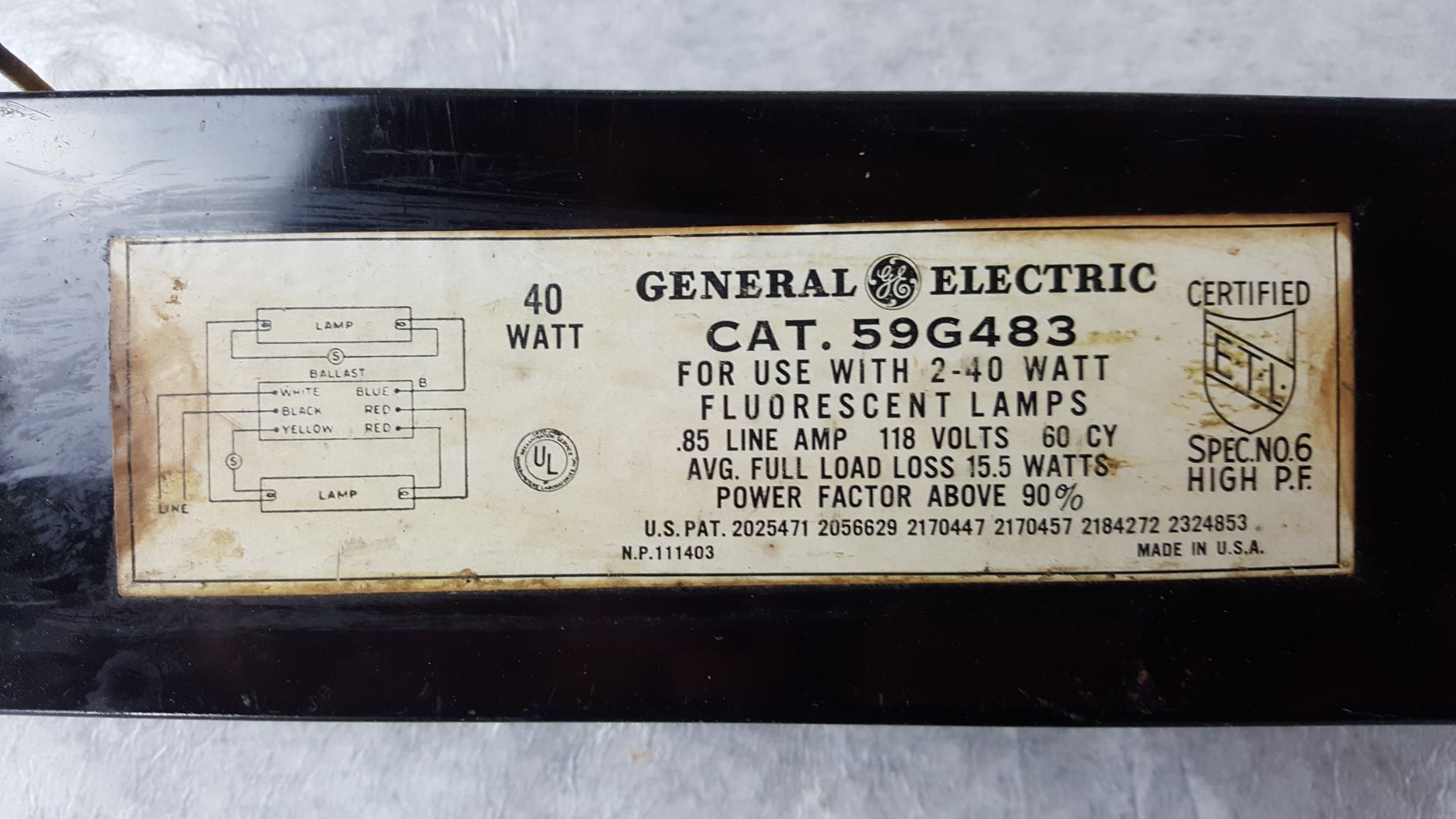
A lighting ballast made before 1979 may contain PCBs
After picking up loads of PCB ballasts from customers, John Miller instructed Luminaire employees to remove warning labels from the containers holding the PCB-ballasts, and then sell the PCB-ballasts as scrap metal to scrap yards and metal recycling facilities.
Luminaire was sentenced to five years probation with special conditions, including an Environmental Compliance Plan and fined $10,000.
John Miller was sentenced to 36 months imprisonment, fined $15,000 and ordered to pay $1,049,848.79 in restitution.
Joseph Miller was sentenced to two years probation and fined $3,000.
“Luminaire defrauded its customers and, in doing so, exposed the community to the toxic chemicals they had been paid to safely destroy. The United States will vigorously pursue those who steal and pollute for their own profit,” said U.S. Attorney Erica MacDonald in a statement.
Where:
The Luminaire facility is located in Plymouth, Minnesota,
When:
According to court documents the fraudulent activity took place between 2010 and 2015.
Charges were filed on September 20, 2017.
Guilty pleas were entered on October 12, 2018.
Luminaire and John Miller were sentenced on March 22, 2019.
Joseph Miller was sentenced on March 5, 2019.
Why:
Because the PCBs contained in the ballasts are considered a toxic chemical, TSCA mandates special procedures and documentation for the transportation and disposal of PCB waste.
As a result of the scheme, Luminaire fraudulently collected more than $1,000,000 in fees and additional profits.
How:
This case is the result of an investigation conducted by the U.S. Environmental Protection Agency and the Hennepin County Department of Environmental Protection.
Contact me with any questions you may have about the generation, identification, management, and disposal of hazardous waste
The Transportation of Hazardous Materials as Reverse Logistics
The Hazardous Materials Regulations (HMR) of the USDOT/PHMSA applies to the transportation in commerce of all hazardous materials (HazMat) to, from, or through the U.S. As a rule these regulations apply equally to all HazMat. However, sometimes USDOT/PHMSA provides for an exception from full regulation if a shipper of HazMat can meet certain conditions. One such exception is the one allowing for the transportation in commerce of hazardous materials under the reverse logistics exception.
Understanding the reverse logistics exception requires knowledge of three distinct regulations in the HMR:
The limited quantity section of a HazMat’s packaging exceptions (if it exists) in 49 CFR Part 173. Here some – not all – HazMat are explicitly authorized for reverse logistics transportation.
The definition of reverse logistics at §171.8.
The general requirements and exceptions for reverse logistics at §173.157.
This article will identify the reverse logistics exception and describe how it can be used to reduce a shipper’s responsibilities under the HMR.
It might be a good idea to understand some terms used in the HMR and this article.
A shipper of a HazMat is the person / business / government agency that prepares the HazMat for transportation and/or makes the HazMat available to the carrier. It’s a lot more complicated than that (read: Who is the Shipper When Transporting HazMat?) but that will do for moving forward. Also, it is possible for a consignment of a HazMat to have more than one shipper (LOI 18-0076).
Hazardous waste is defined at §171.8: Hazardous waste, for the purposes of this chapter, means any material that is subject to the Hazardous Waste Manifest Requirements of the U.S. Environmental Protection Agency specified in 40 CFR part 262. In regular language it means any hazardous waste regulated by the USEPA and generated by a large quantity generator or small quantity generator.
Special permit is also defined at §171.8. It allows both shippers and carriers to transport HazMat in a way not allowed by the HMR. Special permits have their own conditions, restrictions, & limitations that a holder of the special permit must comply.
Special permit means a document issued by the Associate Administrator, the Associate Administrator’s designee, or as otherwise prescribed in the HMR, under the authority of 49 U.S.C. 5117 permitting a person to perform a function that is not otherwise permitted under subchapter A or C of this chapter, or other regulations issued under 49 U.S.C. 5101 et seq. (e.g., Federal Motor Carrier Safety routing requirements).
Private carrier – despite its use in the HMR – is not clearly defined. This interpretation letter (02-0259, at the bottom of the first page) identifies it as a carrier who, “transports its own property for the purposes of sale, lease, or ‘in furtherance of any commercial enterprise.'” So, a private carrier transports its own HazMat for its own business.
A non-private carrier is any carrier not meeting the definition of the private carrier. Any carrier transporting HazMat it doesn’t own for another party will be a non-private carrier. A non-private carrier includes a contract carrier and a common carrier.
Limited quantity is defined at §171.8: Limited quantity, when specified as such in a section applicable to a particular material, means the maximum amount of a hazardous material for which there is a specific labeling or packaging exception. A full explanation requires a separate article, but a limited quantity is a packaging exception to full regulation under the HMR. Many – but not all – HazMat are authorized for the limited quantity exception.
Scope and Applicability Part 1: Conditions
The reverse logistics exception is authorized under the following conditions:
For highway transport by motor vehicle only.
It may be used solely within the U.S. Regulations of the International Air Transport Association (IATA) and the International Maritime Organization (IMO) do not include the reverse logistics exception.
The HazMat and its transport must meet the definition of reverse logistics at §171.8 (see later in this article).
Hazardous waste is not authorized for the reverse logistics exception.
HazMat subject to a special permit must be transported subject to the conditions of that special permit.
HazMat must meet the quantity limits and packaging requirements for a limited quantity.
When the HazMat is transported by a non-private carrier it must – in addition to meeting the requirements of a limited quantity – be explicitly authorized for reverse logistics under their applicable limited quantity section (see later in this article).
Certain HazMat transported by a private carrier are subject to distinct requirements as reverse logistics (see later in this article).
Scope and Applicability Part 2: What’s in?
The following HazMat are authorized to use the reverse logistics exception:
The following shipping descriptions:
Cartridges, small arms
Cartridges, power device
Cartridge for tools, blank
Cases, cartridge, empty with primer
The following Class 1 Explosives:
Division 1.4G materials
Division 1.4G or 1.4S fireworks
Division 1.4G ammunition
Division 1.4G or 1.4S flares
Limited quantities of compressed gases of Division 2.1 Flammable Gas and Division 2.2 Non-Flammable Gas
Class 3 Flammable Liquids
Division 4.1 Flammable Solids – except for self-reactive materials
The following HazMat are not authorized to use the reverse logistics exception:
Most Class 1 Explosives- except those noted in Part 2.
Division 2.3 Poisonous (aka: Toxic) Gas
Self-reactive materials in Division 4.1 Flammable Solids
Division 4.2 Spontaneously Combustible
Division 5.2 Organic Peroxide
Division 6.2 Infectious Substances
Class 7 Radioactive
Lithium batteries in Class 9 Miscellaneous
What is Reverse Logistics?
The term is defined at §171.8:
Reverse logistics means the process of offering for transport or transporting by motor vehicle goods from a retail store for return to its manufacturer, supplier, or distribution facility for the purpose of capturing value (e.g., to receive manufacturer’s credit), recall, replacement, recycling, or similar reason. This definition does not include materials that meet the definition of a hazardous waste as defined in this section.
Note the following regarding the above definition:
Transport must be from a retail store.
Transport must be to one of the following:
The manufacturer of the HazMat.
The supplier of the HazMat.
A distribution facility.
The transport must be a return for one of the following purposes:
Capturing value, e.g., to receive manufacturer’s credit.
As part of a recall.
For replacement.
For recycling. Note: If transported for disposal – such as landfill – instead of recycling, it is more likely to be subject to USEPA regulations as a hazardous waste and therefore not authorized for the reverse logistics exception.
Or similar reason.
If you like this article, please share it using any of the social media platforms identified at the bottom of this article.
You’ll look real smart recommending my articles!
Transported by a non-Private Carrier (§173.157(b)):
To be authorized for transport by a non-private carrier as reverse logistics, a HazMat must be both of the following:
Authorized for limited quantity provisions.
Explicitly authorized for reverse logistics under their applicable limited quantity section.
Look for the explicit authorizations in the following sections:
§173.63(d) for Class 1 Explosives
§173.306(m) for Class 2 Gases
§173.150(i) for Class 3 Flammable Liquids
§173.151(f) for Flammable Solids
§173.152(d) for Division 5.1 Oxidizers
§173.153(d) for Division 6.1 Infectious Substances
§173.154(e) for Class 8 Corrosive Material
§173.155(d) for Class 9 Miscellaneous
A HazMat authorized for the reverse logistics exception in this manner must – except for alternative training provisions (discussed later in this article) – be transported as a limited quantity. This includes:
Inner packaging packed in strong outer packaging to make a combination packaging.
Limits on the net quantity of the inner packaging(s).
Gross package weight limit of 30 kg (66 lb).
Display of the limited quantity mark on outer package as per §172.315(a).
No other hazard communication except orientation arrows if inner packagings contain liquids.
HazMat Transported by a Private Carrier (§173.157(c)):
Certain HazMat – identified below – transported by a private carrier have two options for their management under the reverse logistics exception:
Transport subject to §173.157(b): as a limited quantity plus the alternative training provisions of §173.157(e).
Transport subject to specific limitations identified in §173.157(c) and described below.
Class 1 Explosives (§173.157(c)(1,2)):
Division 1.4G consumer fireworks may be transported according to the packaging exception at §173.65 and the following:
The segregation requirements of §177.848.
The incident reporting requirements of §171.15.
The option for hazard communication at §173.157(d).
The training provisions for reverse logistics at §173.157(e).
When sold in retail facilities, the following Class 1 Explosives are authorized:
Division 1.4G or 1.4S fireworks
Division 1.4G ammunition
Division 1.4G or 1.4S flares
The above authorized HazMat are subject to the following:
Limited to 30 kg (66 lb) gross package weight. The regulation does not identify this as a gross package weight limit. However, conversation with USDOT/PHMSA indicated a gross package weight is presumed similar to the limited quantity exception.
Explosives subject to an approval must continue to meet the terms of that approval, including packaging.
And…
The segregation requirements of §177.848.
The incident reporting requirements of §171.15.
The option for hazard communication at §173.157(d).
The training provisions for reverse logistics at §173.157(e).
Q: May Division 1.4G fireworks at a retail facility be returned to the supplier as reverse logistics in the original packaging?
A: Yes. As long as the packaging used to transport fireworks as reverse logistics meets the terms of the original approval. In this situation, the package must only display the limited quantity mark or the reverse logistics mark as described in §173.157(d). If present, the original 1.4G label, proper shipping name and identification number must not be visible. (LOI 16-0057, Q/A 2 & 3)
Equipment Powered by Class 3 Flammable Liquid (§173.157(c)(3)(i)):
Equipment powered by an internal combustion engine using a Class 3 Flammable Liquid as fuel is authorized under these regulations and subject to the following:
Fuel tank and fuel lines must be in closed position.
All fuel tank caps or closures must be securely in place.
And…
The segregation requirements of §177.848.
The incident reporting requirements of §171.15.
The option for hazard communication at §173.157(d).
The training provisions for reverse logistics at §173.157(e).
Equipment Powered by Division 2.1 Flammable Gas (§173.157(c)(3)(ii)):
A combustion engine using flammable gas fuel or other devices using flammable gas fuel (such as: camping equipment, lighting devices, and torch kits) is authorized under these regulations and subject to the following:
The flammable gas source must be disconnected.
All shut-off devices must be in the closed position.
And…
The segregation requirements of §177.848.
The incident reporting requirements of §171.15.
The option for hazard communication at §173.157(d).
The training provisions for reverse logistics at §173.157(e).
Division 2.1 or 2.2 Compressed Gases(§173.157(c)(4)):
Division 2.1 or 2.2 compressed gases weighing less than 66 lb (it can be presumed this is a gross package weight) and sold as retail products are authorized under these regulations. For the purposes of the reverse logistics exception, a cylinder or aerosol container may be assumed to be a Division 2.1 or 2.2 material even if the exact pressure is unknown. Authorized HazMat is subject to the following:
The segregation requirements of §177.848.
The incident reporting requirements of §171.15.
The option for hazard communication at §173.157(d).
The training provisions for reverse logistics at §173.157(e).
Hazard Communication (§173.157(d)):
Packages displaying the surface limited quantity mark
HazMat transported by a non-private carrier and subject to the requirements of the limited quantity exception (codified at §173.157(b) and explained above) must display the surface limited quantity mark as described at §172.315(a).
HazMat transported by a private motor carrier in accordance with §173.157(c) may display the following marking instead of the surface limited quantity mark:
“REVERSE LOGISTICS – HIGHWAY TRANSPORT ONLY – UNDER 49 CFR 173.157”
The table below shows the required height of the letters of the package mark as required by §172.301(a)(1).
[table “IDNumber” not found /]
Contact me with any questions you may have about the transportation of hazardous materials by air, highway, vessel, or rail
Any person at a retail store who prepares a HazMat for transportation subject to the reverse logistics exception must have clear instructions on its preparation for transport to the supplier, manufacturer, or distributor. Clear instruction must include how to properly classify, package, mark, offer, and transport the HazMat. It is the supplier, manufacturer, or distributor of the HazMat – not the retail store – that must provide the clear instruction to the retail store to ensure the shipment is correctly prepared for transportation.
In lieu of providing clear instruction as described above, the HazMat Employer (who may, or may not, be the retail store) may provide HazMat Employee training per 49 CFR, Subpart H to employees who have a direct affect on the safe transportation of reverse logistics HazMat.
Employers who do not provide HazMat Employee training must then instead:
Identify HazMat subject to the reverse logistics exception.
Verify compliance with the reverse logistics exception.
Ensure clear instructions are provided by the HazMat supplier, manufacturer, or distributor.
Ensure the clear instructions are known and accessible to employees at the time they are preparing the HazMat for transport.
Document employees are familiar with the reverse logistics exception and the specific return instructions for each HazMat transported as reverse logistics.
You may be wondering – as I did – “What’s the point of the reverse logistics exception? It looks to be much the same as the limited quantity exception.” Well, there are two answers, the first from USDOT/PHMSA:
The exceptions provided in §173.157 are intended to provide minimum packaging, training, and hazard communication to address the risk posed by hazardous materials that are returned from retail facilities to the manufacturer, supplier, or distribution center. (LOI 16-0057, Q/A 6)
“OK.” You’re thinking, “So what?”
A more useful answer is this: HazMat transported as reverse logistics are not subject to the HazMat Employee training requirements of §172, Subpart H, whereas HazMat shipped as a limited quantity remain subject to it. HazMat transported as reverse logistics subject to §173.157, even those transported by a non-private carrier subject to §173.157(b) need only meet the training requirements of §173.157(e) which may only be “clear instructions” provided by the HazMat’s supplier, manufacturer, or distributor.
Q&A: Are VSQGs required to register under the Generator Improvements Rule?
A question from a former customer on February 14, 2018:
Hello Daniel,
I attended one of your training sessions several years ago and enjoy your newsletters.
My question is regarding VSQG changes. I’m pretty sure all of our sites probably fit into this category as we rarely deal with hazardous waste. Usually it’s either lab or process chemicals that are no longer needed.
So, I guess I have a couple questions:
I’ve heard that VSQGs will be required to register but Arizona still has not adopted the EPA’s Generator Improvements Rule so our state agency (Arizona Department of Environmental Quality or ADEQ) is being very closed mouthed at this time. At the time of this writing ADEQ had not yet adopted the Generator Improvements Rule. It did on February 5, 2019. Read about the status of the Generator Improvements Rule in your state.
If we contract a hazardous waste hauler, are we the generator or are they? I’m assuming it would be us because of the cradle to grave thing.
Keep up the good work!
Thank you,
Not sure of your hazardous waste generator status?
The generator of a hazardous waste is the person by site or act who generates the hazardous waste. That would be you. The hauler is the hazardous waste transporter. You are correct that you have a cradle-to-grave responsibility for the hazardous waste you generate.