PO Box 1232 Freeport, IL 61032

A Different Kind Of Training

A Different Kind Of Training

A Different Kind Of Training

The Requirements of 40 CFR 262.16(b)(8)(ii) Required Equipment for Preparedness, Prevention, and Emergency Procedures at Small Quantity Generator of Hazardous Waste

Federal regulations of the U.S. Environmental Protection Agency (USEPA) mandate a small quantity generator of hazardous waste (SQG) take certain precautions to prepare for and prevent hazardous waste emergencies and to follow emergency procedures if one were to occur. These regulations are found within the SQG conditions of exemption at 40 CFR 262.16:

  • 40 CFR 262.16(b)(8) Preparedness and prevention
  • 40 CFR 262.16(b)(9) Emergency procedures

This article is the second in a series that closely examines these regulations and attempts to make them understandable.

The previous article in this series addressed 40 CFR 262.16(b)(8)(i) Maintenance and operation of facility.

The purpose of this article is to address the requirements of 40 CFR 262.16(b)(8)(ii) Required equipment. (more…)
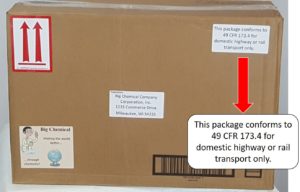
49 CFR 173.4 The Small Quantity Exception

Q&A: Can this HazMat be transported under the Small Quantity Exception?

A question from a customer and reader of my blogs (06.22.20):

Deal Mr. Daniel,

How are you? There was long time no contact, I believe you are doing well.

Recently i am reading your article: “Determining Authorized Packaging for the Transportation of a Hazardous Material

If a item to be shipped within US domestically by FX Ground, which is UN2925, class 4.1 (8), packing group II, and it can fully satisfy all the requirements of Small Quantity in §173.4, 49 CFR, but it is shown “None” in the field of column 8A, §172.101 Hazardous Materials Table, 49CFR.

Can this item be offered as small quantity packaging by FX Ground? Based on §172.101(i)(1) Column 8A , “None” in Column 8A means no packaging exceptions are authorized, except as may be provided by special provisions in Column 7. The referenced exceptions are in addition to those specified in subpart A of part 173 (which includes Small Quantity in §173.4) and elsewhere in this subchapter.

Best Regards,

My reply at the end of the week (06.26.20):Small quantity exception package mark

Thank you for contacting me. I apologize for my delay. Please see below.

  • According to 49 CFR 172.101(h)(1), “None” in column 8A means no packaging exceptions are authorized unless provided by special provisions in column 7.
  • “None” is present in column 8A of the Hazardous Materials Table for this HazMat (UN2925, Flammable solids, corrosive, organic, n.o.s. 4.1 (8), PG II).
  • There are no special provision codes in column 7 of the Hazardous Materials Table that change the conditions of column 8A.
  • 49 CFR 173.4 identifies hazardous materials of division 4.1 Flammable Solid as authorized for use of the the small quantity exception.
  • However, nothing I can see changes the conditions imposed by the “None” in column 8A. No. I don’t think this HazMat is eligible for transport under the small quantity exception.
  • Read: What is the small quantity exception?

I hope this helps. Please contact me with any other questions.

Contact me with any questions you may have about the transportation of hazardous materials by air, highway, vessel, or rail

International and Domestic

Daniels Training Services, Inc.

815.821.1550

Info@DanielsTraining.com

https://danielstraining.com/

Conclusion:

I prefer my answers to be good news for those that contact me and inform them they may transport a HazMat in the manner they wish. That was not the case here. However, it’s better they comply with the regulations than use a packaging exception for which they are not eligible. Make certain your hazardous materials classification is correct before you offer a hazardous material for transportation. Contact me for the USDOT HazMat Employee training that will teach how to get it done.

FAQ: What is an intermediate bulk container (IBC)?

The Pipeline and Hazardous Materials Safety Administration within the U.S. Department of Transportation (USDOT/PHMSA) regulates the transportation in commerce of hazardous materials to, from, or through the U.S. In its Hazardous Materials Regulations (HMR) it defines and authorizes the use of a variety of packagings for the transportation of hazardous materials (HazMat). Just one of those packagings is the intermediate bulk container (IBC).

Intermediate bulk container (IBC) is defined at 49 CFR 171.8:

Intermediate bulk container or IBC means a rigid or flexible portable packaging, other than a cylinder or portable tank, which is designed for mechanical handling. Standards for IBCs manufactured in the United States are set forth in subparts N and O of part 178 of this subchapter.

Daniels Training Services, Inc.

815.821.1550

Info@DanielsTraining.com

https://danielstraining.com/

So let’s break it down…
  • An IBC may be either rigid or flexible. So, it may be self-supporting (maybe stackable) or it might be similar to a plastic bag that is only provided structure by the HazMat it contains.
  • It must be portable, which makes sense if you’re going to offer it for transportation.
  • It cannot be a cylinder (for compressed gases) or a portable tank. Here, as elsewhere when defining HazMat packaging, at least part of the packagings definition is based on what it is not.
  • It must be designed for mechanical handling. Though imprecise, I believe this is the key to the definition of an IBC. In this language USDOT/PHMSA indicates that whatever its appearance, the IBC is not designed to be moved by a person (as may be a drum, box, or jerrican). Instead, an IBC will have hooks, straps, be palletized, or have some other feature that allows it to be moved by equipment such as a fork truck or crane.

And…

  • An IBC manufactured in the U.S. must be made according to the performance-oriented standards in 49 CFR 178, subpart N and be tested per the requirements of 49 CFR 178, subpart O.
  • And that’s it!

Interested in a Webinar that covers this topic, and more!

My Webinar Training Schedule

Notice anything strange?

The definition does not require an IBC to be a bulk packaging, i.e., have a capacity of more than 450 L (119 gal) even though the name includes the word “bulk”. Neither does the definition specify a minimum or maximum capacity as it does for the large packaging. Therefore, if it complies with the remainder of the definition, an IBC could have a capacity of no more than 1.3 L (5 gal), or less!

Where else is IBC mentioned?
  • Intermediate bulk container (IBC) is included in the definitions for the following in 49 CFR 171.8.
    • The definition of cargo tank specifies that it – the cargo tank – is not an IBC.
    • The definition of a UN portable tank specifies that an IBC may not be a UN portable tank.
  • 49 CFR 173.35 is a section of the HMR dedicated just to the filling and offering for transport of HazMat in IBCs.
  • IBC is identified as an authorized packaging for a variety of HazMat in 49 CFR 173.
  • There are special requirements and options for the display of hazard communication on IBCs in part 172 of the HMR.
Conclusion:

As you can see, the definition of an IBC is both simple and vague. Nowhere, not even in subparts N and O of part 178, does it mandate an appearance or specify a shape or design for the finished packaging. This presents both an opportunity and a challenge:

  • As an opportunity it allows the shipper to construct an IBC of any shape, size, or capacity to contain its HazMat.
  • A challenge in that sometimes you may not know if a packaging is an IBC unless it displays one of the packaging type codes designating it as an IBC:
    • 11 for a rigid IBC that discharges solids by gravity.
    • 13 for a flexible IBC that discharges solids by gravity.
    • 21 for a rigid IBC that discharges solids under pressure of more than 10 kPa (1.45 psig).
    • 31 for a rigid IBC designed for liquids.

If you like this article, please share it using any of the social media platforms identified at the bottom of this article.

Q&A: Is my product a marine pollutant? A limited quantity? A hazardous material?

A question June 16, 2020:

Good afternoon Daniel. I hope you are doing well.

I have a question for you that I hope you can help me to clear up.

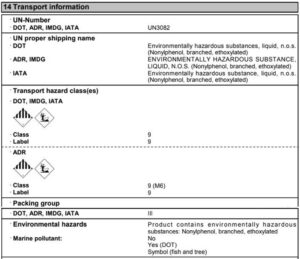
We have this product available in 11 oz tubes (caulking), 1 gallon plastic containers and 5 gallon buckets. See below for SDS Transportation section…Section 14 of SDS for Marine Pollutant

My question is regarding whether or not this item is regulated and needs to be noted on a BOL or requires markings or labels for over the road shipments (DOT).

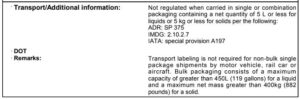
I noticed the Remarks below stating that labeling is not required when shipping non-bulk loads.

Are we able to ship this without any requirement for noting it on the BOL or any markings or labels needed?

Curious about what is required (if anything) on these:

  • 11 oz tubes
  • 1 gallon tub
  • 5 gallon bucket

Appreciate your help on this Daniel.

Thank you in advance.

My reply the same day:

I can assist you. Please see below.

  • Sections 12-15 of the SDS are not authorized for use within the U.S. I prefer to see the entire SDS.
  • Based on the information in section 14 (see bullet point above), this material is a marine pollutant per international and domestic regulations.
  • Per international and domestic regulations a marine pollutant in a single or combination packaging of 5 L / 5 kg or less is not subject to international or domestic regulation. Yours likely will be above these thresholds and therefore not eligible for the exception. Read: The Marine Pollutant Exception
  • Within the U.S. transport by highway, rail, or air (unlikely) of a marine pollutant is not subject to any regulation if it is in a non-bulk packaging i.e., ≤454 L (119 gal).

Daniels Training Services, Inc.

815.821.1550

Info@DanielsTraining.com

https://danielstraining.com/

In sum:

  • If the material is indeed a marine pollutant (not certain, but we’ll assume it is) it is not subject to any USDOT/PHMSA regulations when transported in commerce within the U.S. by highway or rail in the packaging quantities you indicate.
  • If ever transported in a packaging with a capacity of more than 119 gallons, it may be subject to regulation as a Class 9 Miscellaneous, Marine Pollutant.

I hope this helps. Please contact me with any other questions.

Marine Pollutant Mark
Marine Pollutant mark
He still had questions, so the next day:

Thank you Daniel.

I have attached the complete SDS copies for both products.

Firstly, I don’t completely understand your first bullet point from your email yesterday. Why is Section 12-15 not authorized for use within the U.S.?

Secondly, I am confused where the SDS states in Section 14 – Environmental hazards – Marine pollutant: it says “No” but directly under this it says Yes (DOT). What do they mean here?

Then in the Transport/Additional information: it says “not regulated if under 5 L or less for liquids (that’s fine for the 11 oz and 1 gallon product but what about the 5 gallon bucket?

Then again lower, the DOT shows nothing but immediately below it has “Remarks” and it talks about transport labeling is not required for non-bulk package shipments by motor vehicle. Are they talking about just labeling (no fish symbol needed)? Does this mean we do not need to label the 5 gallon buckets? I’m so confused…

I guess I need help in understanding the sequence of the SDS and which requirement I am to follow.

Additionally, I need to determine if the product in 11 oz tubes and 1 gallon tubs are required to have a “Limited Quantity” Label on the package?

Perhaps when you shed more light on the entire subject pertaining to the two SDSs attached, I might be able to understand how you are arriving at what is required and I will be able to apply that to other materials we have.

Thank you again for all your help Daniel.

Looking forward to your response.

Like this article?

Subscribe to my Monthly Newsletter

No marketing emails!

I could sense he was struggling to understand it all. (I know how he feels).

I can provide some clarification. Please see below.

  • When the SDS was authorized for use by OSHA in the U.S., it did not include authorization for sections 12-15. Many other countries in the world authorize these sections but we don’t in the U.S. Therefore, I do not rely entirely on the information in sections 12-15 of the SDS. I have found incorrect information there.
  •  I’m not certain either what is meant by the “no” and “yes” in section 14. It appears to me (based solely on section 14) that the manufacturer has identified this as a marine pollutant.
  • As my article on the Marine Pollutant Exception indicates (see previous email) a marine pollutant in a packaging of less than 5 L / 5 kg is not subject to domestic or international regulations as a marine pollutant.
  • Separate from the above, solely within the U.S. a marine pollutant in a non-bulk packaging is not subject to any regulation (see my article). That means you can ship it as if it was water.
  • You are only required to display the limited quantity mark Limited Quantity in strong outer packagingif using the limited quantity exception. The LQ exception may only be used if you have a fully-regulated HazMat. Based on section 14 of the SDS, you do not have a fully-regulated HazMat. The LQ mark is not required.

Please let me know if I can be of any further assistance.

Just one more question:

One other quick question regarding the same products and SDS as we were dealing with earlier.

We sometimes put these on a barge from Seattle to Alaska.

Vessel or barge transporting HazMat

Do we need to fill out the shipping papers, add markings and apply the Misc 9 and fish labels?

I’m sorry this product is so confusing to me.

Thank you.

One more Answer:

Please see below.

  • Transport by vessel is subject to USDOT and international regulation unless the quantity in a single or combination packaging is less than 5 kg / 5 L.
  • Some of the packagings you indicated may be below that threshold, others (5 gallon) are not. Therefore, some will be subject to full regulation as a HazMat and some will not.
And that seemed to do it!

That’s awesome!

Thank you again Daniel.

Have a great week!

Contact me with any questions you may have about the transportation of hazardous materials by air, highway, vessel, or rail

International and Domestic

Daniels Training Services, Inc.

815.821.1550

Info@DanielsTraining.com

https://danielstraining.com/

Conclusion:

The classification of a product offered for transportation to determine if it is a hazardous material, and if yes, what kind. Is the most important responsibility of a HazMat shipper. Only by doing this correctly can the shipper hope to pack, label, mark, prepare a shipping paper, offer placards, provide emergency information, and perform every other regulated function of a HazMat shipper.

I can help you by answering questions and by providing the training required for anyone with a direct affect on the safe transportation of hazardous materials.

Q&A: What hazard communication is required on a combination packaging of isopropyl alcohol?

A question, June 08, 2020:

Good morning Daniel,

We are planning to package and ship 1 gallon contains of Isopropyl alcohol 70% in boxes of 4 gallons per box.

We plan to mark the box with a label that describes the contents and the  4” flammable placard.

As long as the UN code (UN1219, Isopropyl alcohol, 3, PGII) and the  flammable pictogram are on the on the market label,  will this meet Dot regulations?

I appreciate your assistance.

Daniels Training Services, Inc.

815.821.1550

Info@DanielsTraining.com

https://danielstraining.com/

It took me a week, but by June 15th I had a reply:

Thank you for contacting me. Please see below.

  • What you describe will meet the package mark & labeling requirements of USDOT/PHMSA. (A picture would be helpful).
  • However, there is more to the USDOT/PHMSA Hazardous Materials Regulations:
    • The packaging must be authorized by the regulations as indicated in column 8B of the Hazardous Materials Table, meet the DOT specification (i.e., UN Standard), and be closed per the closure instructions provided by the packaging manufacturer.
    • Class 3 HazMat label (not placard) must be displayed on the package.
    • ID # (12 mm high) & proper shipping name must be displayed as marks on the package.
    • Name of shipper or receiver marked on package.
    • Orientation arrows must be displayed on two opposite vertical sides of package.
    • Shipping paper which includes:
      • HazMat’s basic description
      • Total quantity of HazMat
      • Number and type of packaging
      • Emergency information
      • Shipper’s certification
    • Placards for Class 3 Flammable Liquid must be displayed on all four sides of the transport vehicle if the weight of the HazMat is more than (454 kg) 1,001 lbs.

And…

    • HazMat Employee training (initial & triennial) must be provided to any person with a direct affect on its safe transportation.
  • Pictogram and description of contents are requirements of OSHA and not USDOT/PHMSA.

I left a vmail message as well. Please contact me with any other questions.

Like this article?

Subscribe to my Monthly Newsletter

No marketing emails!

June 15, 2020. Satisfied with the answer:

Thanks for the information, Daniel.

Conclusion:

Often the questions I receive apply to only one aspect of the regulations. Not knowing the questioners level of knowledge of the Hazardous Materials Regulations I try to inform them of all of their responsibilities. It’s a lot to learn, remember, and keep straight. Periodic high-quality training (mine!) can help. My USDOT/PHMSA HazMat Employee training webinars are live, interactive, monthly, done in three (3) hours, and only $189/trainee.

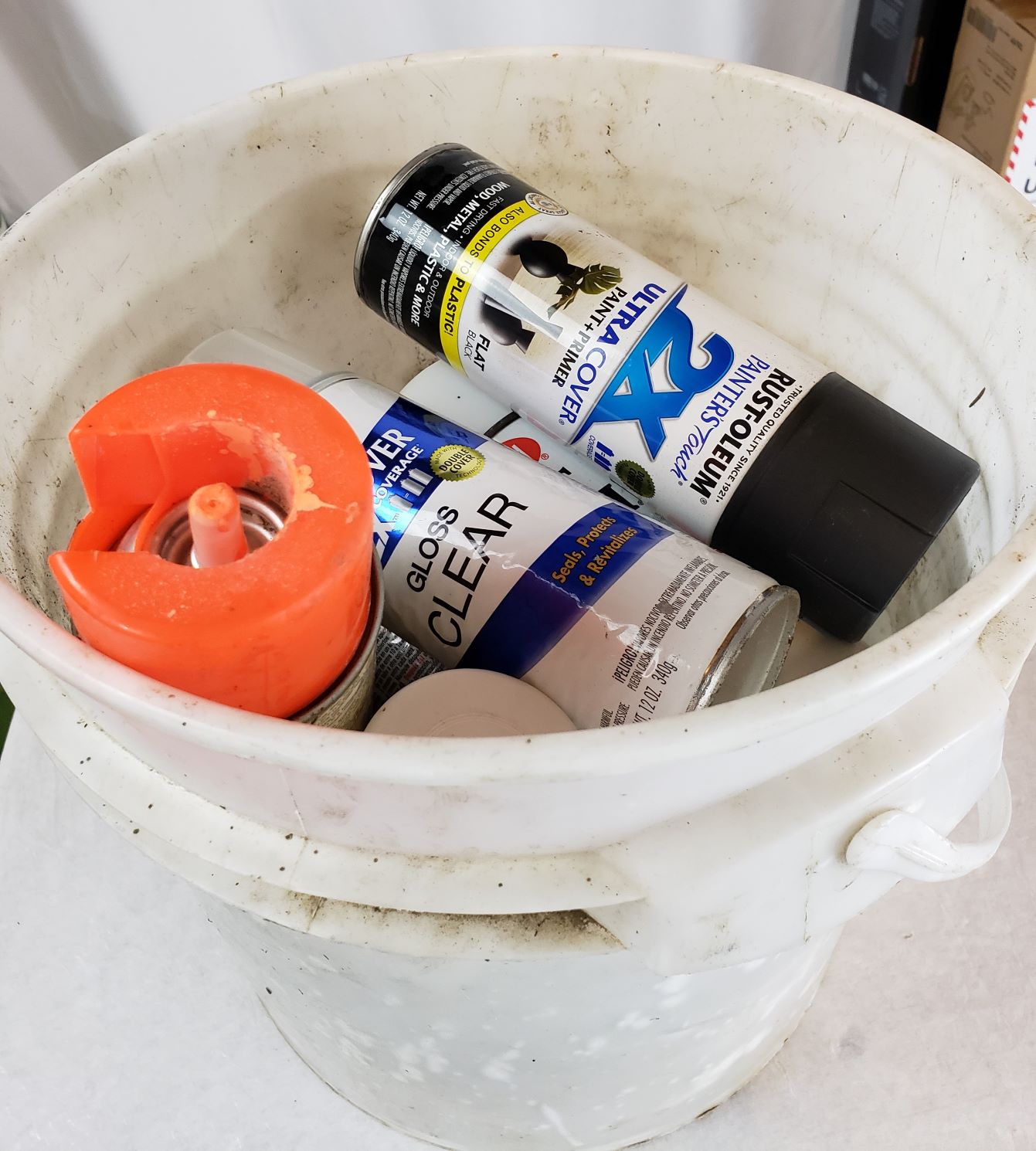
Aerosols in Container

Q&A: What hazard communication is required on an IBC filled with aerosol cans transported for recycling?

June 11, 2020:

Daniel

I have read your Bulk Packaging for hazmat.  I have a questions regarding the aerosol cans packed in an 11G fiber cubic yd boxes (aka: an intermediate bulk container or IBC). You have confirmed placards and UN numbers are not required due to inner containers. If boxes do display placards 2.1 with the 1950 across in the white panel would this be a violation for over placarding?

Thanks for your help.

My reply the same day:

Thank you for contacting me. I will try to answer your questions. Please see below.

  • I presume you are referring to the following Q&A at the end of the article:

Q: Are aerosol cans loaded in a UN specification bulk packaging, i.e. an 11G fiberboard Intermediate Bulk Container (IBC) subject to the marking, labeling and placarding requirements for a bulk packaging?

A: No. The definition of a bulk packaging specifies that it must contain hazardous materials that are loaded with no intermediate form of containment. The aerosol cans in the 11G box would be a form of intermediate containment and, thus, not considered a bulk packaging. It is interesting that in this situation what may start as a bulk packaging may not continue to meet the definition depending on how it is used.

  • As a rule, using hazard communication in excess of what is required, as long as the HazMat is present and other conditions are met, is not a violation.
  • I will need more information about your situation: Are the aerosols in this case being transported as a waste for disposal or recycling?

Please advise.

Some more information on June 11, 2020:Aerosol Cans in Container

Thanks Daniel for helping me.

I did call the DOT hotline and since the cubic yard box is acting as on overpack for the aerosol cans the placard with the UN number across the middle would not apply. I looked at Large Packaging requirements which do contain inner containers but the 11G IBC does not meet the requirements of a Large packaging since it does not exceed 119 gallons.

We are shipping these for disposal (hazardous waste).

We normally have the yellow haz waste marking with all the generator information, shipping description etc and a 2.1 placard with 1950 across the middle on two opposite sides of the IBC. Would this still be acceptable by DOT or a violation?

Thanks so much for your help.

Interested in site specific training at your site that covers this topic, and more!

Ask me about my Onsite Training

Still June 11th, my reply:

I will do my best to answer your question and provide guidance. Please see below.

  • I believe the Q&A in my article on bulk packaging & your call to DOT confirms the cubic yard box with aerosols is not a bulk packaging. Therefore, it could display the labels and marks as if it is a non-bulk packaging.
  • Non-bulk packagings must be display labels in compliance with 49 CFR 172, subpart E.
  • A placard with the ID # displayed on it will not meet the specifications of a label. I believe it would be a violation to display the placard instead of the required label.
  • However, it is not a violation to use hazard communication in excess of what is required as long as the hazard is present. You could display the placard in addition to the label, but not in place of it.
  • There is a good exception from full regulation for aerosols shipped for disposal or recycling at 49 CFR 173.306(k). Using it makes discussion of labels and placards on the cubic yard box unnecessary.

Also…

It didn’t come up in this Q&A, but check to see if your state has adopted the USEPA’s Final Rule including aerosol cans as a universal waste.

I hope this helps. Please contact me with any other questions.

Daniels Training Services, Inc.

815.821.1550

Info@DanielsTraining.com

https://danielstraining.com/

And, the next day, her final reply:

Thanks for your help. I start confusing myself when reading and rereading the requirements.

Conclusion:

There’s no shame in admitting you may become confused by the regulations (it happens to me all the time). The solution is to sit down and carefully review the regulations, guidance documents, and interpretation letters of the respective agency until you can finally make sense of it all. Or call me.

Contact me with any questions you may have about the transportation of hazardous materials by air, highway, vessel, or rail

International and Domestic

Daniels Training Services, Inc.

815.821.1550

Info@DanielsTraining.com

https://danielstraining.com/

Calculating the “Q” Value for Different Dangerous Goods in a Single Outer Packaging (All Packed in One)

The Dangerous Goods Regulations (DGR) of the International Air Transport Association (IATA) at 5.0.2.11 allow for the transportation of different dangerous goods in a single outer packaging (aka: all packed in one). A particular challenge when packing different dangerous goods in a single outer packaging is to comply with the dangerous good’s per package quantity limits found in the following columns of the List of Dangerous Goods at 4.2:

  • Column H for limited quantity
  • Column J for passenger and cargo aircraft
  • Column L for cargo aircraft only

In order to ensure the per package quantity limits are not exceeded IATA requires the shipper/packer of the dangerous good to calculate its “Q” value. The purpose of this article is to explain how to calculate the “Q” value of a package containing different dangerous goods to ensure compliance with the per package quantity limits of the IATA Dangerous Goods Regulations. (more…)

Q&A: Can the transport vehicle be the packaging for a hazardous material?

A question on August 06, 2020:

Hi Daniel,
I am long time reader of your publications. Thank you. I have found them most useful on many occasions.

Your recent post concerning specification packaging for NA3077 in IBCs left a question I’d like to ask.

Since a non-DOT specification rail cars and, motor vehicles (Sift proof closed vehicles)… are authorized, could the transport trailer be considered the package rather than the individual packages within?

While I think a box trailer meets “sift proof” I read an interpretation where the fine folk at PHMSA wrote that a package(s) on a flatbed trailer covered with a tarp meets and is considered to be closed and sift proof as well.

My reply 08.07.20:

That’s a good question. The answer is yes: under the right conditions a transport trailer (i.e., the trailer of a motor vehicle) may be the non-DOT specification bulk packaging for a hazardous material. Please see below for my reply.

  • The allowance for non-DOT specification packagings does not include intermediate bulk containers (IBCs). An IBC authorized for “certain low hazard materials” at §173.240 must be a specification packaging.
  • As noted in the list of authorized packagings above, a non-DOT specification, sift-proof closed vehicle is authorized. Also (01-0302).
  • Per this USDOT/PHMSA letter of interpretation, “a box van trailer is a ‘closed bulk bin'”. (05-0114)
  • This may be the USDOT/PHMSA letter of interpretation you refer to. It indicates a sift-proof closed vehicle with a tarpaulin cover meets the requirements of §173.240. (99-0226)
  • The following are also authorized as non-DOT specification bulk packagings for hazardous materials:
    • A roll-on/roll-off bulk container. (02-0068)
    • A 24-foor, rear-end loaded freight container. (98-0365)

Contact me with any questions you may have about the transportation of hazardous materials by air, highway, vessel, or rail

International and Domestic

Daniels Training Services, Inc.

815.821.1550

Info@DanielsTraining.com

https://danielstraining.com/

  • Siftproof packaging is defined at §171.8:

Siftproof packaging means a packaging impermeable to dry contents, including fine solid material produced during transportation.

In order to be deemed sift-proof the completed package may not permit the escape of any of the hazard material contained therein.

  • A non-DOT specification packaging must comply with the remainder of the HMR. This includes:
    • The general packing requirements of §173.24 and §173.24b. (01-0114)
    • The special provision codes of column 7 in the Hazardous Materials Table. (05-004)
    • The requirements for package marks and placards. (05-0114)
closed motor vehicle
Can the motor vehicle be the packaging for some HazMat? Sure! If sift-proof and closed.

I hope this helps. Please contact me with any other questions.

And that did it!

It may not be common-knowledge that a non-specification packaging for HazMat may include something as simple as a metal box with a tarp, or the vehicle itself. There’s a lot to learn about the HMR and I’m still learning. Contact me when you require HazMat Employee training.

Transportation of COVID-19 Diagnostic Samples

Because of the ongoing Coronavirus Disease 2019 (COVID-19) public health emergency, there is a growing need for transportation of COVID-19 diagnostic samples (e.g., nasal swabs, vials of sputum, and other related items) from the points of sample collection to the labs for analysis. It is the responsibility of the Pipeline and Hazardous Materials Safety Administration within the U.S. Department of Transportation (USDOT/PHMSA) to ensure the safe transportation of all hazardous materials (HazMat) to, from, or through the U.S. The purpose of this article is to identify and explain the two available methods for the transportation of COVID-19 diagnostic samples.

Note:

This will require consideration of the transportation methods recommended by USDOT/PHMSA in its Safety and Advisory Notice for the Transportation of COVID-19 Diagnostic Samples.

(more…)

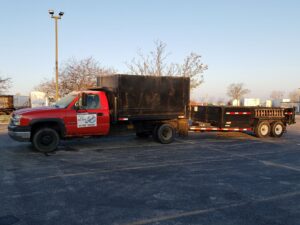
FAQ: What is a Private Carrier?

The Hazardous Materials Regulations (HMR) of the Pipeline and Hazardous Materials Safety Administration within the U.S. Department of Transportation (USDOT/PHMSA) at 49 CFR 173.29(c)(s) refer to a private carrier. It’s definition is critical to the understanding of this regulation as it is in many other locations throughout the HMR. What then is a private carrier as the term is used by USDOT/PHMSA in the HMR?

The term private carrier, though critical to compliance in several locations throughout the HMR, is not defined nor explained at any point. In that way it shares a dubious distinction with a couple of terms it is usually associated with: common carrier and contract carrier. But knowing that doesn’t help us any. Not defined at §171.8 nor anywhere else in the HMR and not explained either. Where does that leave us?

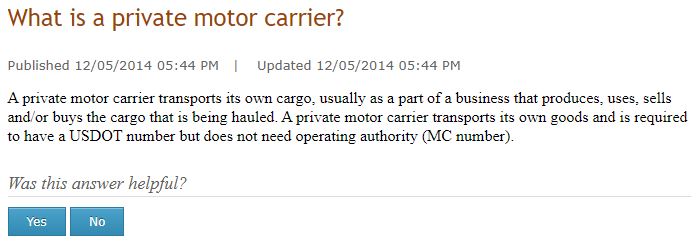
First, let’s look to the Federal Motor Carrier Safety Administration, also within the USDOT (USDOT/FMCSA). On its website USDOT/FMCSA has the following FAQ:

FAQ Private Carrier

A private carrier (a private motor carrier if transportation is by highway in a motor vehicle) owns the cargo it is transporting.

And, from this USDOT/PHMSA letter of interpretation (13-0068):

Although the HMR does not specifically define “private motor carrier,” this Office has interpreted this term to mean that a “private motor carrier” is a carrier that transports a business’ own products and does not provide such transportation service to other businesses.

Daniels Training Services, Inc.

815.821.1550

Info@DanielsTraining.com

https://danielstraining.com/

So, if you are transporting the products of your own business and not those of a third party, you are a private carrier.

Search Website