Q&A: Does a driver need HazMat certification to haul ferrous sulphate (UN3077)?
A question on June 29, 2020:
Good afternoon,
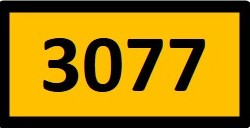
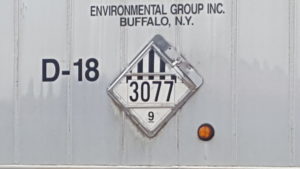
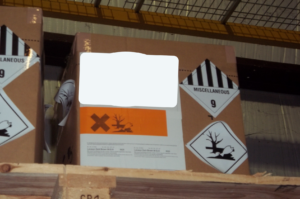
Does a driver need to be hazmat certified to haul 22 palletized tote bags of ferrous sulphate each weighing 2050 lbs? The shipper offers the rectangular orange four digit placard that says 3077 in black letters, but claims the driver isn’t required to be hazmat endorsed for their loads within the US. Each bag has the diamond shaped 3077, Class 9 placard stamped on it but the load is required to be tarped. Can our non-hazmat drivers take these loads and if so…should they not use placards?
Thank you for your help! I want to make sure we are legally able to use non-hazmat guys before sending them to load.
Contact me with any questions you may have about the transportation of hazardous materials by air, highway, vessel, or rail
Thank you for contacting me. Your non-HazMat drivers (drivers without the HazMat endorsement on their CDL) may transport those loads. They may or may not display the Class 9 placard on their vehicle as they wish. Please see below.
However, the driver – and anyone else involved in transportation – must have initial and triennial recurrent USDOT HazMat Employee training. In addition, drivers must have Driver Training.
Though not required, the Class 9 Miscellaneous placard is frequently displayed on motor vehicles in the U.S.
I hope this helps. Please contact me with any other questions or if you wish for me to provide USDOT HazMat Employee training.
Just checking back in (07.06.20):
Do you have any other questions for me? May I be of any further assistance?
The reply that same day:
Thank you very much for your response to my question. I really appreciate you getting back to me. As of right now I don’t have any other questions but I will reach out if anything comes up.
Actually what is the time commitment and cost involved with getting hazmat endorsement?
I don’t know the time commitment to obtain the HazMat endorsement on the CDL. It is not something I address. It depends on the requirements of your state.
I do provide USDOT HazMat Employee training which is required in addition to the HazMat endorsement if your job has a direct effect on the safe transportation of hazardous materials.
Q&A: Are discarded sodium-sulfur batteries eligible for a RCRA exclusion if the sodium is reclaimed for use?
A question on June 24, 2020:
Daniel,
I’ve come across some of your training online – quite informative – and was wondering if I could run a RCRA question past you. I have a client with some sodium-sulfur batteries that are no longer needed for their intended purpose. There are very few recyclers globally who can handle sodium-sulfur batteries and this is mainly due to the presence of sodium which is reactive and when thermally treated is detrimental to the refractory liner in the furnace.
We are exploring an option where we would reclaim the sodium from the cell, which can be used in, or to make, other products. In this case, would the company extracting the sodium require a TSDF permit? Based on the following logic, I would argue they are not a TSDF because the reclaimed sodium is not a hazardous waste. They would, however, be considered a waste generator with respect to the remainder of the battery:
In order for a waste to be a hazardous waste, it must first be considered a solid waste (40 CFR 261.3).
Sodium is a by-product of the chemical reaction in a sodium-sulfur battery – it is not present when produced at 0% SOC and is generated through chemical reaction when charging the battery and is consumed when discharging the battery. The process is not fully reversible so there is always some residual sodium present. For this scenario, where the sodium is desired to be extracted, it is more advantageous for the battery to not be discharged to 0% SOC.
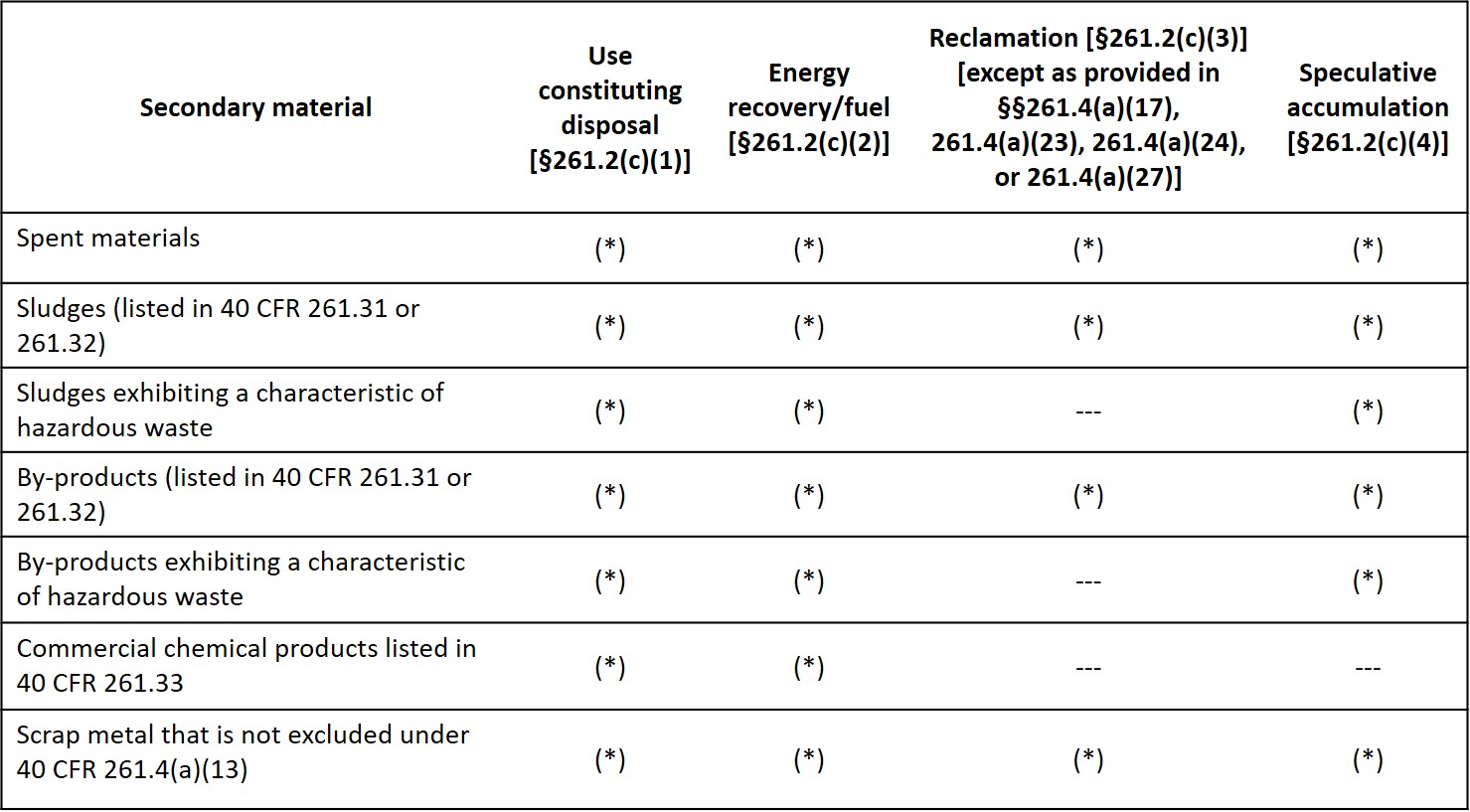
According to 40 CFR 261.2, Table 1, by-products exhibiting a characteristic of hazardous waste (sodium is reactive – D003) are not considered solid wastes when reclaimed. Per US EPA interpretations (which I have seen leveraged in your training) an analogy to this situation is a thermometer being reclaimed for its mercury. Because mercury is a Commercial Chemical Product, per 40 CFR 261.2, Table 1, it is not solid waste and therefore cannot be a hazardous waste.
The act of extracting the sodium now makes the remainder of the cell waste and the generator (the entity who extracted the sodium) would need to classify it for its hazardous properties. Assuming it is hazardous, the generator would likely take advantage of the universal waste option for management and disposal.
If you have time and are willing, I would appreciate your feedback on the above.
Stay safe and well,
My reply seeking more information that same day:
Thank you for contacting me. Please see below.
Q1: Is the battery a solid waste?
Q2: If it is a solid waste, is it a hazardous waste?
After that is determined, we can proceed to Table 1:
Q3: What category of hazardous waste is it? (left-hand column of Table 1).
Q4: What type of recycling are you practicing? (top row of Table 1).
Please clarify my understanding on the first two bullet points.
Note: an image of 40 CFR 261.2 – Table 1 is included below:
Where I find the RCRA rules difficult is that there are two situations not one. There is the sodium and then there is the remainder of the battery. The questions do not allow this differentiation.
Q1: Is the battery a solid waste?
A1: Yes, because the battery will be recycled by reclamation.
Q2: If it is a solid waste, is it a hazardous waste?
A2: Yes, sodium possesses a hazardous characteristic – reactivity (D003)
After that is determined, we can proceed to Table 1:
Q3: What category of hazardous waste is it? (left-hand column of Table 1).
A3: The battery would be considered spent, the sodium would be considered a by product.
Q4: What type of recycling are you practicing? (top row of Table 1).
A4: Reclamation. The battery will be smelted to recover metals for use in making products. The sodium will be reclaimed in its current form and used to make other products.
My reply:
Please see below.
I agree that the battery is a solid waste. This is because it is being discarded. Recycling is a form of discarding.
The presence of sodium does not by itself make the battery a reactive hazardous waste. The battery – not the sodium – when spent would have to display the characteristic of Reactivity (D003). Let’s presume it is a D003 Reactive hazardous waste.
Table 1 contains some of the exclusions from regulation as a solid waste for materials that are recycled.
It may be that the battery is considered to be a spent secondary material. However, the sodium is not a waste that is a by-product. It is part of the battery.
If reclaiming, the reclaimed materials may be excluded from regulation as a solid waste and therefore cannot be a hazardous waste. This would mean the process of reclamation would not require a RCRA permit.
Any waste generated during reclamation would have to be managed by the generator of the waste, that is, the person conducting the reclamation.
Please contact me with any other questions.
Later that same day with two more questions:
Thanks for your assessment. I would like to discuss further if you are open to it. My two follow-up questions:
Given the scenario below would the entity reclaiming the sodium be considered a TSDF? Since it is not a hazardous waste I would assume not.
While I follow your point, an intact sodium-sulfur battery does not demonstrate the characteristic because the cells are hermetically sealed. There is no possibility of water intrusion and thus no reactivity concern. The battery will be intact when it first becomes solid waste (abandon or recycled) but at some point in the process will demonstrate the characteristic because the cells will be breached. So when does the hazardous characteristic need to be demonstrated to be considered hazardous waste? I would argue that most intact industrial batteries do not demonstrate a characteristic hazardous waste when intact, yet nearly all are managed as universal waste (which inherently implies it demonstrates a hazardous characteristic).
I had more answers:
Please see below.
If the battery is excluded from regulation as a solid waste then its recycling by reclamation would not require a RCRA permit.
You’re correct that the hazardous waste determination is made at the point of generation for the entire battery. If the battery contains a reactive element (sodium) it would likely be a D003 Reactive hazardous waste.
I am available all day (06.25.20) to discuss. Can we schedule a time?
Contact me with any questions you may have about the generation, identification, management, and disposal of hazardous waste
Some more discussion took place over the phone (no transcripts available) but then another email on July 5th:
Daniel,
I hope you enjoyed the Independence Day holiday. I had a follow-up question on the definition of a commercial chemical product (CCP). RO 14012 states “For purposes of Section 261.2, CCP means all types of unused commercial products, whether chemicals or not.” The mercury thermometer example refers to new, off-spec thermometers. In my case, I have a used battery from which we will reclaim the sodium (which recall is produced through a chemical reaction during battery charging).
Through RO 14012, I found reference to an EPA memo which provides checklist to assist in evaluating whether CCPs are hazardous waste under the RCRA. In that memo, they state: “In the RCRA hazardous waste management regulations the term commercial chemical product generally refers to materials that would, under usual circumstances, be considered products and not wastes…”. It doesn’t specifically state ‘unused’ but rather “product”. I would argue that the reclaimed sodium from a used battery is useable product, which is also consistent with the definition of reclamation in 40 CFR 261.1(d).
I’ll submit this to state regulators but was curious of your opinion.
My reply July 06, 2020:
Please see below.
You are correct – and something I should have mentioned – that for the purposes of the recycling exclusions at 40 CFR 261.2 a commercial chemical product must be unused. The batteries you are considering are used and therefore are not eligible for inclusion with CCP as defined at 40 CFR 261.2.
Also, from McCoy Guidance: “Although Table 1 in 261.2(c) specifies ‘commercial chemical products listed in 40 CFR 261.33,’ EPA interprets the term to also include those products that are not listed in 261.33, but exhibit one or more characteristics of hazardous waste. [April 11, 1985; 50 FR 14219, RO 11713, 11726, 13356, 13490, 14883] So, a battery could be a CCP per 40 CFR 261.2 but only if unused.
I believe the USEPA memo you refer to confirms the requirement the CCP be unused, “…would…be considered products and not wastes…” If it does not state unused here, it clearly does elsewhere.
I don’t believe the status of the sodium in the battery or how it is recycled is any longer an issue. If the battery is not CCP per 40 CFR 261.2, it is not subject to the exclusion no matter how it is recycled.
Please contact me with any other questions.
If you like this article, please share it using any of the social media platforms identified at the bottom of this article.
You’ll look real smart recommending my articles!
No further communication after that – at least not yet.
It’s clear to see that knowledgeable persons can disagree about the exclusions from regulation in RCRA. In this situation I think the questioner did not fully understand that the hazardous waste determination – and thus any exclusions from regulation – begin at the point of generation. Subsequent treatment of a waste does not affect it’s eligibility for exclusions from regulation. But, perhaps, I wasn’t understanding his situation properly. It takes knowledge and careful research of the regulations to make a hazardous waste determination.
Q&A: Is the marine pollutant label required for transport by ground?
(June 26, 2020) A question from a customer of mine:
hi Daniel
I am shipping two boxes of un3077 environmentally hazardous substances, solid., n.o.s. ( dibutyl phthalate), 9, III. This is going ground to Texas. my question is do we have to put the marine pollutant label if its going ground.
I know marine pollutant labels is required for some going ocean. I am also wondering do we have to apply this label if its going air with the class 9.
thanks for your help.
Contact me with any questions you may have about the transportation of hazardous materials by air, highway, vessel, or rail
A non-bulk packaging transported by ground in the U.S. is not subject to regulation as a marine pollutant.
My reply that same day:
Thank you for contacting me. Please see below.
A marine pollutant is classified by USDOT/PHMSA for transportation within the U.S. as follows:
It must be identified by name in Appendix B of the Hazardous Materials Table at 49 CFR 172.101 (the Marine Pollutant Table).
The named marine pollutant must be at a concentration in a solution or mixture of 10% or more for a marine pollutant or 1% or more for a severe marine pollutant.
The substance must be transported in any packaging (bulk or non-bulk) by vessel or in a bulk packaging by highway, rail, or aircraft.
Your email does not indicate if the two boxes are bulk packaging or non-bulk packaging. Based on my knowledge of your operations I will presume them to be a non-bulk packaging.
A non-bulk packaging transported by highway within the U.S. can not be a marine pollutant subject to the Hazardous Materials Regulations (HMR) of the USDOT/PHMSA.
Also, dibutyl phthalate is not identified as a marine pollutant in the Marine Pollutant Table, so that’s strike three right there.
Unless subject to the HMR as a hazardous material for some other reason, this substance will not be regulated as a hazardous materials when offered for transport by highway within the U.S.
You are correct that the classification of a marine pollutant subject to the International Maritime Organization Dangerous Goods Code (IMDG Code) differs from that of USDOT/PHMSA. It is quite possible this substance is a marine pollutant subject to the IMDG Code. More information is necessary to make that classification. If a marine pollutant per the IMDG Code and it does not display any other hazards, e.g., flammability, corrosivity, it will be classified as a Class 9 Miscellaneous.
If to be transported by air, the Dangerous Goods Regulations of the International Air Transport Association (IATA) will apply. IATA classifies a marine pollutant in the same manner as the IMO, therefore, it is quite possible (more information is necessary to be certain) this substance is a marine pollutant – and therefore a Class 9 Miscellaneous as well – when transportation is by air.
I hope this helps. Please contact me with any other questions.
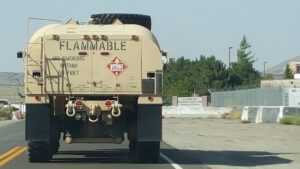
I have a couple of questions on behalf of the US Army Europe.
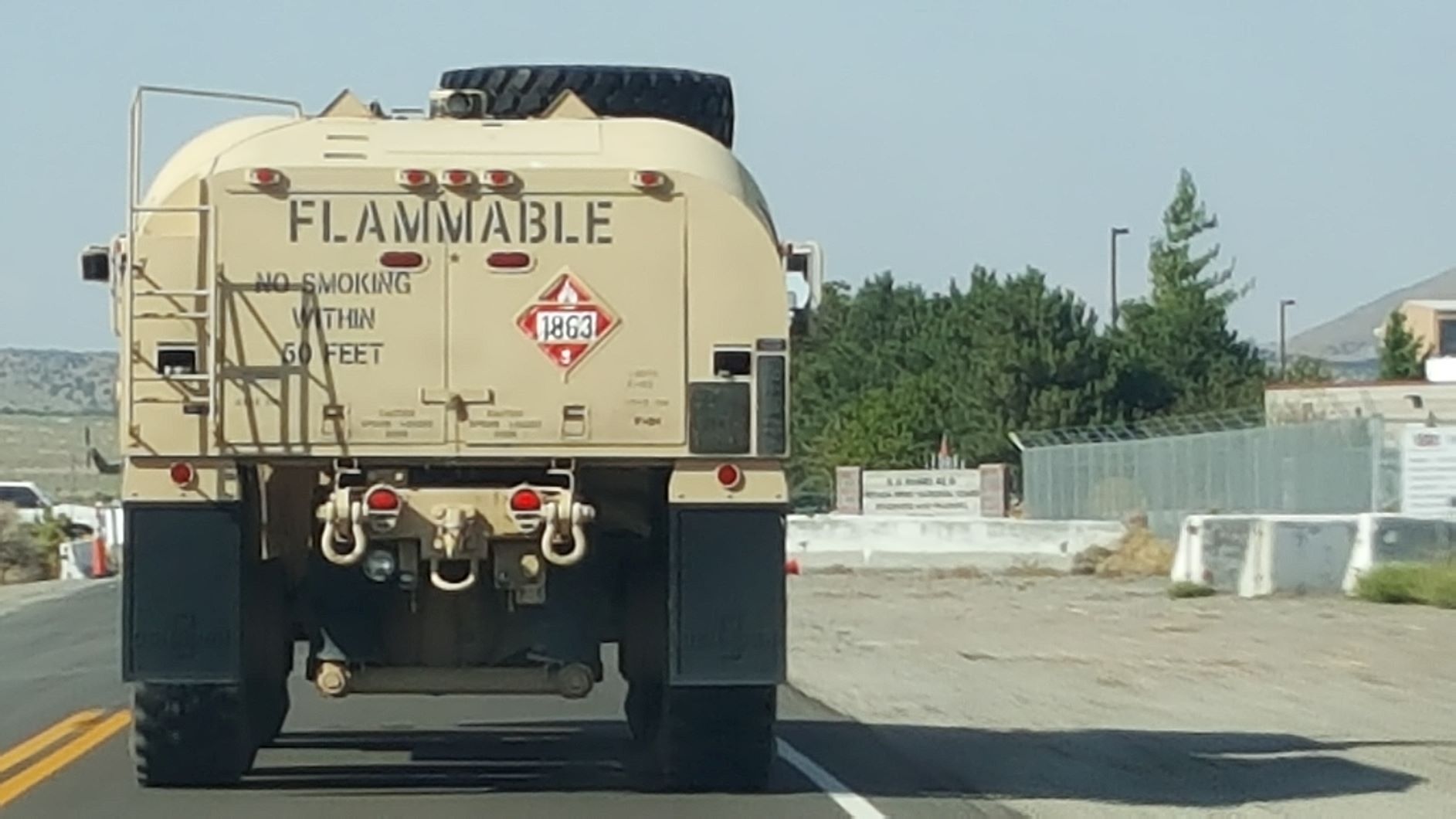
Situation: We have DOT 406 Bulk Fuel Cargo Tanks that must be returned to numerous Army bases across the USA from Europe. The tanks have contained fuel and have been completely drained (including pipes, pumps and removal filtering systems) according to the manufacturers technical manuals. There may be “Crevice” residue fuel trapped in pipe connection seals that is undrainable. We will use military vessels to get them back from Europe to the nearest port in the USA. The tanks will have onward shipping by commercial trucks to their final destinations in the USA. We find no examples or provisions in the 49 CFR 171-173 that define “Cleaning/Purging” certificates or statements. We want to make sure that the “Cleaning/Purging” certificate statement we prepare here in Europe is acceptable for commercial carriers in the USA to authorize them to carry these Bulk Fuel Cargo tanks as a Non-Hazardous Material shipment.
Question 1. What resource document tells me the “SHIPPER” is responsible to know the exact provisions (standards) of what is meant by sufficiently cleaned of residue and purged of Flammable Liquid Vapors” for the below fuel types?
Question 2. Must tanks be cleaned with liquid substance?
Question 3. Or is “Draining all liquids & ventilating vapors below LEL levels to satisfy both terms, “Sufficiently Cleaned of Residue and Purged of Flammable Liquid Vapors” even if the temporary LEL of 0.00%(V) is recorded?
As you can see above, all these fuels have different Lower/Upper Explosion Limits.
Question 4. Would you recommend that we set the standard with a LEL of 0.00% (V)?
Purpose of your efforts will help us establish a template certificate “Drain/Clean/Purge” statement for Fuel Cargo Tanks shipping for Soldiers returning from missions in support of the US Army in Europe.
Thank you in advance for any assistance you may provide us.
Contact me with any questions you may have about the transportation of hazardous materials by air, highway, vessel, or rail
Question 1: There is no clear regulatory citation on this specific point in the USDOT/PHMSA Hazardous Materials Regulations (HMR).
At 49 CFR 171.8 a person who offers or offeror of a hazardous material (aka: the shipper) is a person who performs or is responsible for performing a pre-transportation function (described at 49 CFR 171.1(b)) or makes the HazMat available to the carrier.
The shipper is responsible for compliance with 49 CFR 173.29 Empty packagings as it is with the remainder of part 173.
The shipper must determine if the consignment is a HazMat and if so, what type and communicate that information to the carrier. This requires the shipper to determine if a packaging, “Is sufficiently cleaned of residue and purged of vapors to remove any potential hazard”, or “Is refilled with a material which is not hazardous to such an extent that any residue remaining in the packaging no longer poses a hazard;”
Question 2: This is easier. No.
Question 3: The HMR do not reference the LEL or UEL. It is up to the shipper to ensure compliance with 49 CFR 173.29. The HMR do not indicate how to do this.
Question 4: I have no recommendation other than you ensure compliance with 49 CFR 173.29.
Your purpose: I think it a good idea to draft a “certificate of drain/clean/purge” though one is not required by the HMR. In my experience, most carriers wish to see one if they suspect the presence of HazMat.
I hope this helps. Please contact me with any other questions.
Conclusion:
That seemed to have answered the question since I did not hear back from him/her. I did not mention in my reply the potential use of the Government Employee Exemption. I did not mention it since the email indicated the cargo tanks would be transported by commercial carrier within the U.S. The use of a commercial carrier precludes use of the Government Employee Exemption.
Q&A: What can I do with the combustible liquid exception?
From a previous Onsite Training customer on January 30, 2018:
Good morning Daniel,
Hate to bother you but if you can find just a moment, our folks are making some changes to our labeling program and wanted me to confirm some information regarding the combustible liquid exception. Specifically –
Small quantities – correct that they are not subject to any hazmat regs? Is this true even if they are not in combo packaging?
Drum quantities – diamond required on drum (‘Combustible – 3’)?
If small quantity containers and drums are marked with our standard product label, which includes DOT shipping information and HMIS marking, do they need to also display the diamond?
Again, sorry to bother you but I wanted to be positive! Thanks for any guidance!
A non-bulk packaging (capacity of no more than 119 gallons) of a combustible liquid – meeting all other requirements of the exception – is not subject to USDOT regulations. I assume this is what you mean by “small quantities”. The type of packaging, i.e., combination, single, composite… does not matter as long as it is non-bulk packaging and all other requirements of the exception are met.
A drum quantity (55 gallons) is still a non-bulk packaging and is not subject to USDOT regulations if all of the conditions of the combustible liquid exception are met. The HazMat label “diamond…” is not required if the combustible liquid exception is used.
If you are taking advantage of the combustible liquid exception the non-bulk packaging should not display any of the USDOT hazard marks or labels. HMIS or GHS hazard communication required by OSHA may still remain. The hazard communication requirements of OSHA do not impact USDOT regulations.
I hope this helps. Please contact me with any other questions.
Thanks again Daniel, I really appreciate all the information.
And one more thing…
Under the combustible liquid exception a bulk packaging does not enjoy full relief from regulation as does the non-bulk packaging, but on advantage is this: A DOT specification packaging is not required for a bulk packaging of a combustible liquid.
A combustible liquid in a non-DOT specification bulk packaging
Pursuant to 49 CFR 172.504(c), a transport vehicle or freight container which contains a hazardous material covered by Table 2 in §172.504(e) is not required to display placards unless one of the following is true:
Signing the Hazardous Waste Manifest During COVID-19 Pandemic – UPDATED AND REVISED 08.20.20
Handlers of hazardous waste have expressed to USEPA their concern with the customer interaction required to obtain the generator’s signature on the uniform hazardous waste manifest and requested that transporters be allowed to sign the name of the generator on the Manifest to maintain social distancing during the COVID-19 public health emergency. USEPA responded to this concern May 18, 2020 with a memorandum explaining a temporary policy to allow for transporter signature for the generator on the Manifest. This temporary policy was set to expire on August 31, 2020. However, on August 20, 2020 USEPA released another memorandum updating and revising this policy in light of some states experiencing an increase in COVID-19 cases following efforts to reopen.
The purpose of this article is to explain USEPA’s new temporary policy for obtaining the necessary signatures on the uniform hazardous waste manifest during the COVID-19 public health emergency as it was updated and revised by the USEPA memorandum of August 20, 2020.
The Requirements of 40 CFR 262.16(b)(8)(v) Required Aisle Space for Preparedness, Prevention, and Emergency Procedures at Small Quantity Generator of Hazardous Waste
Federal regulations of the U.S. Environmental Protection Agency (USEPA) mandate a small quantity generator of hazardous waste (SQG) take certain precautions to prepare for and prevent hazardous waste emergencies and to follow emergency procedures if one were to occur. These regulations are found within the SQG conditions of exemption at 40 CFR 262.16:
40 CFR 262.16(b)(8) Preparedness and prevention
40 CFR 262.16(b)(9) Emergency procedures
This article is the fifth in a series that closely examines these regulations and attempts to make them understandable.
The purpose of this article is to address the requirements of 40 CFR 262.16(b)(8)(v) Required aisle space. (more…)
The Requirements of 40 CFR 262.16(b)(8)(iv) Access to Communications or Alarm Systems for Preparedness, Prevention, and Emergency Procedures at Small Quantity Generator of Hazardous Waste
Federal regulations of the U.S. Environmental Protection Agency (USEPA) mandate a small quantity generator of hazardous waste (SQG) take certain precautions to prepare for and prevent hazardous waste emergencies and to follow emergency procedures if one were to occur. These regulations are found within the SQG conditions of exemption at 40 CFR 262.16:
40 CFR 262.16(b)(8) Preparedness and prevention
40 CFR 262.16(b)(9) Emergency procedures
This article is the fourth in a series that closely examines these regulations and attempts to make them understandable.
The purpose of this article is to address the requirements of 40 CFR 262.16(b)(8)(iv) Access to communications or alarm systems. (more…)
The Requirements of 40 CFR 262.16(b)(8)(iii) Testing and Maintenance of Equipment for Preparedness, Prevention, and Emergency Procedures at Small Quantity Generator of Hazardous Waste
Federal regulations of the U.S. Environmental Protection Agency (USEPA) mandate a small quantity generator of hazardous waste (SQG) take certain precautions to prepare for and prevent hazardous waste emergencies and to follow emergency procedures if one were to occur. These regulations are found within the SQG conditions of exemption at 40 CFR 262.16:
40 CFR 262.16(b)(8) Preparedness and prevention
40 CFR 262.16(b)(9) Emergency procedures
This article is the third in a series that closely examines these regulations and attempts to make them understandable.

 Situation: