
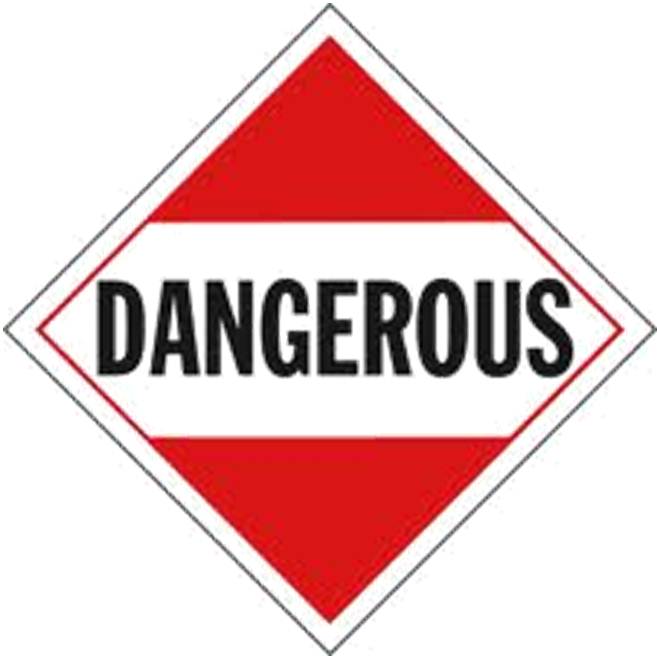
 Unless an exception exists, each bulk packaging, freight container, unit load device, transport vehicle or rail car (see 49 CFR 171.8 – Definitions for a better understanding of these terms) containing any quantity of a hazardous material must be placarded on each side and each end with the type of placards specified in tables 1 and 2 found at 49 CFR 172.504(e). The DANGEROUS placard is a useful tool for carriers of hazardous materials because it allows them to substitute one placard for any two or more hazardous materials that require placarding. (more…)
When not to use the Dangerous Placard for Shipments of HazMat
You may Display Placards When not Required by the Hazardous Material Regulations
The determination of the placarding requirements for a shipment of hazardous materials (found at 49 CFR 172, Subpart F) are, initially, straightforward. Placarding of a transport vehicle or freight container to be transported by highway or rail is required for…
- Any quantity of a hazardous material found in Table 1 of the Placarding Tables.
- Any quantity of a hazardous material found in Table 2 of the Placarding Tables in a bulk packaging.
- When the aggregate gross weight of all Table 2 hazardous materials in non-bulk packagings in the transport vehicle or freight container is ≥1,001 lbs.
But of course, it gets more complicated from there. You may be surprised to learn that 49 CFR 172.502(c) allows for the display of placards for a hazardous material even when not required by regulation, if the placarding otherwise conforms to the requirements of 49 CFR 172, Subpart F.
So, this means that even if none of the conditions in #’s 1-3 above are met, a carrier may desire to display placards on a shipment of hazardous materials and this will not be in violation of the Hazardous Materials Regulations (HMR).
The HMR are filled with little exceptions and restrictions just like this one. Make certain you and your HazMat Employees have received the training required by 49 CFR 172, Subpart H to ensure they maintain your company’s regulatory compliance. Contact me for a free consultation on your training needs.
The Symbols of Column 1 of the Hazardous Materials Table
If you are a carrier or shipper of hazardous materials, you should already be familiar with the Hazardous Materials Table. Found at 49 CFR 172.101, it contains the necessary information to complete the shipping paper and comply with other aspects of the Hazardous Material Regulations (HMR) of the Department of Transportation. You may not be familiar with the purpose and importance of the symbols that may be found in Column 1 of the HMT. These symbols (+, A, D, G, I, W), if present, will affect how the hazardous materials shipment is prepared and transported.
- The plus (+) sign fixes the proper shipping name, hazard class and packing group – but not the identification number – whether or not the material actually has the hazards of that class, packing group or any other hazard class definition. It’s purpose is to indicate a material that is known by the DOT to pose a risk to humans, such as: Aniline, Benzaldehyde, Bromine, Sulfuryl Chloride, and others. There may be times where the plus sign is assigned to a mixture or solution where the hazard to humans differs from that of the pure material (think methanol mixed with soil and water). In that case you may select an alternative shipping name that represents the hazards posed by the material (LOI 04-0204).
- The letter ‘A’ means the HMR only applies to the material if it is to be transported by aircraft. However, the HMR does apply, regardless of the mode of transportation, if the material is a hazardous substance or hazardous waste (check US DOT definitions at 49 CFR 171.8). A shipping description with ‘A’ in column 1 of the HMT may be used for a material to be transported by vessel or motor vehicle provided all applicable requirements of the HMR are met.
- The letter ‘D’ identifies a proper shipping name that is accepted for domestic transportation, but may not be acceptable for transportation under international regulations (the International Maritime Organization or International Civil Aviation Organization). An alternate proper shipping name may be selected for either domestic or international transportation.
- The letter ‘G’ identifies proper shipping names for which one or more technical names of the hazardous material must be entered in parentheses, near the basic description. This past article of mine explains in detail the requirements of 49 CFR 172.203(k) and the use of the technical name.
- The letter ‘I’, a counterpart to letter ‘D’, identifies proper shipping names which are accepted for international transportation of HazMat. An alternate proper shipping name may be selected when only domestic transportation is involved.
- The letter ‘W’, a fellow traveler with letter A, denotes a material that is subject to the requirements of the HMR only when transported by vessel (which means any form of watercraft used as a means of transportation on the water). Just like the letter ‘A’, the requirements of the HMR do apply if the material is a hazardous substance or a hazardous waste. A shipping description with ‘W’ in column 1 of the HMT may be used for a material to be transported by aircraft or motor vehicle provided all applicable requirements of the HMR are met.
A full understanding of the Hazardous Material Regulations of the DOT must include the use of the Hazardous Materials Table to determine the proper shipping description for your hazardous materials. I provide training on the regulations of the DOT pertaining to the shipment of HazMat and those of the EPA for the generation of hazardous waste. Contact me for a free consultation of your training needs.
The Uniform Hazardous Waste Manifest and Personal Liability
I used to work for a hazardous waste disposal company named Laidlaw Environmental Services in Pecatonica, IL. A frequent question I was asked as I directed the client to sign the Uniform Hazardous Waste Manifest (Manifest) was: “Will I go to jail for this?” I’d laugh and try to reassure them that we had everything under control and they were not going to jail. But the question is valid: Can the person who signs the Manifest be held personally liable for errors and omissions on the shipping paper or in the shipment itself? The answer, is yes.
The EPA notes that its requirements for preparing and signing Manifests are based on the corresponding DOT regulations for the use of shipping papers for hazardous materials. Note that the Certification Statement in section 15 of the Manifest refers to the “Generator’s/Offeror’s Certification” and not just the generator of the hazardous waste. Offeror (sometimes used interchangeably with Shipper) is a term used by the DOT. You can read more about the responsibilities of a shipper/offeror, but in brief, per the DOT an offeror is any person who performs or is responsible for performing a pre-transportation function for the shipment. This definition is deliberately vague and creates a situation where there may be more than one offeror/shipper, each of which could be held jointly and severally responsible for violations of the Hazardous Material Regulations (HMR).
DOT assumes that the signer of the shipper’s certification will have personal knowledge of the waste shipment and its preparation for transportation. Not that it is not necessary for the signer to be an officer of the entity generating the waste, it could be anyone (vendor, consultant, employee, carrier) who is knowledgeable about the shipment and the applicable regulations and is willing to sign on the dotted line.
Whomever is to sign the manifest should carefully read the certification statement:
I hereby declare that the contents of this consignment are fully and accurately described abouve by the proper shipping name, and are classified, packaged, marked and labeled/placarded, and are in all respects in proper condition for transport according to applicable international and national governmental regulations. If export shipment and I am the Primary Exporter, I certify that the contents of this consignment conform to the terms of the attached EPA Acknowledgement of Consent.
Note that the certification covers more than just the information on the Manifest. You are also certifying that all aspects of the shipment are in compliance with the HMR, so be sure you are involved with the preparation, loading, and securing of hazardous waste shipments prior to signing the Manifest.
But what if I’m trained and knowledgeable, I do my best and sign the Manifest, but something is wrong. You’re saying I would be held personally liable? Me?!? Well, yes. Typically the employer of the person signing would be subject to enforcement actions, in situations of egregious or criminal violations, the signer could be held personally liable.
Don’t get caught out of compliance. Contact me for the DOT HazMat Employee Training and the RCRA Training for Hazardous Waste Personnel that will help you to ensure you are following the regulations of both the DOT and the EPA when you ship hazardous waste.
DOT Requirements for Frequency of HazMat Employee Training
When must you train your HazMat Employees: How soon after employment begins, and how frequently must you provide refresher training? Fortunately 49 CFR 172.704(c) provides answers to these questions.
First of all a new hire or one whose job function changes to become a HazMat Employee must receive HazMat Employee Training (see: The Five Types of HazMat Employee Training) within 90 days. And, they must be under the direct supervision of a properly trained and knowledgeable HazMat Employee until they receive training.
HazMat Employees must receive full recurrent training (not a refresher, but the full training) at least once every three years thereafter, ie. triennially. The sole exception to this 3-year cycle is for HazMat Employees who require In-Depth Security Training. Any time the Security Plan is revised, those HazMat Employees must be trained within 90 days of the implementation of the revised plan.
If your new employee received their HazMat Employee training with a former employer, their previous training will suffice as long as you obtain and maintain a current record of their training.
As the HazMat Employer you are responsible to ensure your HazMat Employees have been trained on the requirements of this part and tested by appropriate means. You are also responsible for all of the requirements of the Hazardous Material Regulations (HMR) regardless of whether the required training has been completed.
If it’s been more than three years since your last HazMat Employee Training, or you’ve hired new HazMat Employees since your last training, or you’ve just lost track of when training was last completed, you should call me for a free consultation on your training needs. While we’re talking we can discuss the training requirements of the EPA for your Hazardous Waste Personnel as well.
General Display Requirements for Hazardous Material Placards
In an earlier article I wrote about the requirement of the Hazardous Materials Regulations (HMR) of the Pipeline and Hazardous Materials Safety Administration within the U.S. Department of Transportation (USDOT/PHMSA) to ensure the visibility of placards on a motor vehicle or rail car in transportation. Read: Visibility Requirements for Hazardous Materials Placards.
Those regulations at 49 CFR 172.516(a,b) affect where a carrier must display HazMat placards on a rail car or motor vehicle. Also important – and the subject of this article – are the remaining requirements of that part – §172.516(c-e) – for the display of hazmat placards in all vehicles and all packagings that require placards. (more…)
Visibility Requirements for Display of Hazardous Material Placards on a Motor Vehicle
In the general placarding requirements of 49 CFR 172.504(a) of the USDOT/PHMSA Hazardous Materials Regulations (HMR), it states that when required each bulk packaging, freight container, unit load device, transport vehicle, or rail car “must be placarded on each side and each end”. Simple enough, right?
It becomes more complicated when we consider the visibility and display of those placards on a motor vehicle such as a straight truck or semi-trailer truck.
This article will explain the requirements of 49 CFR 172.516(a) and (b) for the visibility and display of placards on a motor vehicle.
Whatever Happened to the “Drive Safely” Placard?
Stop and think, when was the last time you saw the once ubiquitous “Drive Safely” placard on a truck going down the highway? It’s been awhile hasn’t it? Since October 1, of 2001 to be exact. On that date 49 CFR 172.502(a)(2) went into affect for all packagings, freight containers, unit load devices, motor vehicles or rail cars prohibiting the use of any sign, advertisement, slogan, or device that, by its color, design, shape or content, could be confused with any placard required by the Hazardous Material Regulations (HMR). This means that anything that could be confused with a hazardous material placard cannot be visible, this includes some formerly common placard-like images such as:
- Drive Safely/Carefully
- Have a Nice Day
- Baby on Board
It also includes any product slogans or advertising.
But why? The answer lies in the goal of the Department of Transportation which is the safe transportation of hazardous materials. One of the foundations of this goal is communication of the potential hazards of a material in transportation. Placards are one of the four hazard communication methods used to communicate the potential hazards of a material, the others are: shipping papers, labels, & markings. The DOT believes that anything that could be confused with one of the prescribed hazard communication methods may cause confusion and misinterpretation of the hazards. So, if it looks like a duck, and walks like a duck, and quacks like a duck, but isn’t a duck; DOT doesn’t want to see it.
The prohibition of placard look-alikes applies even if you don’t ship hazardous materials since 49 CFR 171.2(k) reads: “No person may, by marking or otherwise, represent that a hazardous material is present in a package, container, motor vehicle, rail car, aircraft, or vessel if the hazardous material is not present.” So if you think a cool new logo for your milk delivery company is one resembling an explosive placard, think again.
If you have any questions about this regulation and how it may apply to your specific company logo, advertising, or other, the best thing to do is to contact the DOT for a written interpretation. Provide them with photos of the sign, marking, etc. in question and ask clearly for a written response. Questions of this nature or any regarding the HMR should be directed to the Hazardous Materials Information Center:
Call @: 800.HMR.4922 (800.467.4922) or Washington DC Metro area 202.366.4488
email @: phmsa.hm-infocenter@dot.gov
Mr. Charles E. Betts
Director, Standards and Rulemaking Division
U.S. DOT/PHMSA (PHH-10)
1200 New Jersey Avenue, SE East Building, 2nd Floor
Washington, DC 20590
While I can’t give you an answer with the authority of the HazMat Infocenter, I can tell you that training of your HazMat Employees is a requirement for anyone who transports a hazardous material or ships or receives a hazardous material. HazMat Employee Training is one of the two training services I provide in my 8 hour training, the other is RCRA Training for Hazardous Waste Personnel. I provide this training in public open enrollment events held nationwide and year round and on-site training right at your location and tailored to your site-specific needs. Please contact me for a free consultation on your training needs or any question you may have about the HMR.
A Possible Security Threat v. Security Breach
The latest political scandal at the time of this writing, and likely to be eclipsed by a new one by the time you read this, involves the President’s Secret Service detachment and a bevy of prostitutes in a Columbia hotel room. While listening to a panel discussion regarding this topic on National Public Radio, I heard something that triggered thoughts of the Enhanced Transportation Security Requirements of the US Department of Transportation. What caught my ear was the term used by a spokesman for the Secret Service agents as a form of damage control. He said that the alleged incident did not represent a “security breach”. He justified this by pointing out that no unauthorized personnel gained access to sensitive information. “True”, thought I, but while this may not represent a “security breach” it definitely represents a “possible security threat”. As a HazMat Employer, you must be aware of the difference between these two terms since they are topics to be covered in your HazMat Employee Training.
HazMat Employee Training includes the following 5 topics:
- General Awareness/Familiarization
- Function Specific
- Safety/Emergency Response
- Security General Awareness
- In-Depth Security Training
The first four are required for all HazMat Employees. Initial training must be provided within 90 days of new employment and full renewal training must be provided every three years. The fifth: In-Depth Security Training is required only for those facilities subject to the applicability determination of 49 CFR 172.800(b). Security General Awareness Training (required for all HazMat Employees) must include how to recognize and respond to a possible security threat. This contrasts with the In-Depth Security Training requirement to train applicable HazMat Employees on the specific actions to take in the event of a security breach. They sound alike, but are very different and your training must reflect this important difference.
Unfortunately the DOT does not provide definitions of these terms in its regulations or guidance documents. However, when a definition does not exist, the Agency directs us to use the accepted definition found in a dictionary. Following that guidance we can begin to focus on the key differences between these two terms and how it will affect your training.
Possible Security Threat – The key word here is “Threat” which is defined as, “an indication or warning of probable trouble”. In other words, nothing bad has happened…yet, but the warning signs are there, the potential for a security breach exists. It is critical that your HazMat Employees are able to recognize this warning of probable trouble when they see it and know how to respond appropriately. Signs of a possible security threat are:
- Security doors not latching properly or left open.
- Poor inventory control resulting in hazardous materials stored out-of-place.
- Inadequate or missing lighting.
- Fencing or other physical barriers compromised by damage or poor housekeeping (eg. pallets stacked near fence).
- Person (coworker, vendor, visitor, other ) acting strangely.
- And many others that may be specific to your site.
The proper response when a possible security threat is observed is going to vary based on your site-specific conditions, but when I provide HazMat Employee training I indicate the proper response is to observe and report through your facility’s proper channels of communication.
Security Breach – “Breach” is defined as, “to make a gap in and break through a wall, barrier, or defense”. This is the terrorist, criminal, or vandal act that the possible security threat may have warned us about earlier. That is, something has gone wrong, some act has been taken by a party that has had a negative impact on your facility or your operations. A security breach may be any of the following:
- Unexplained spill or leak.
- Signs of tampering around a lock or seal.
- Hazardous materials in an incorrect location.
- Damage to property or vandalism.
- And other site-specific signs.
Your response to a security breach will depend on your site and the skills and training of your HazMat Employees. In most situations, the response will be similar to that of a possible security threat (ie. “observe and report). But, given the higher level of risk, you may train your HazMat Employees to activate the alarm system, inform trained security personnel or law enforcement or take other steps documented in your Security Plan.
Remember: how to respond to a possible security threat is only one part of the full training requirement for Security General Awareness, which itself is only one of the four mandated components of HazMat Employee Training. The need to address the specific actions to take in the event of a security breach is one of the requirements of In-Depth Security Training. Review 49 CFR 172.800(b) to see if this training requirement and the Security Plan are applicable to your facility.
HazMat Employee Training is a big responsibility, and since it is required only once every three years, it is critical to get it right. Contact me for a free consultation on your HazMat Employee training needs. You may also review the information on the DOT Security website.
Who is Responsible for the Securing of Hazardous Material Packages on a Motor Vehicle: the Shipper or the Carrier?
49 CFR 177.834(a) requires packages of hazardous materials to be secured against shifting within the vehicle and between the packages under normal transportation conditions. If you offer a hazardous material for transportation (a shipper) to be transported by another company (a carrier), you may be surprised to learn that the shipper may be fined instead of or along with the carrier if the shipment of HazMat is found to be improperly secured.
This is because any person who performs, or is responsible for performing, a regulated function – such as loading and securing packages of hazardous materials on a truck – is responsible for compliance with all the applicable requirements of the Hazardous Materials Regulations (HMR).
Example: Employees of Company A (the shipper) load packages of hazardous materials on a truck as an employee of Company B (the carrier) looks on. After loading the Company B employee secures the load, while Company A employees confirm the vehicles readiness for transportation. Since both the shipper and the carrier were involved in the loading operation, both are responsible for compliance with all applicable requirements of the HMR, including 49 CFR 177.834(a). Refer to PHMSA interpretation letter 04-0082 for more information on this point.
What, then, are the regulatory requirements for securing a load of hazardous materials in a motor vehicle? Unfortunately, a specific method is not defined in the HMR. Agency interpretations indicate the regulatory requirements,”are met when the packages of hazardous materials are secured in a manner that precludes their movement within the transport vehicle, and between the packages themselves, under conditions normally incident to transportation.” (02-0044) Lacking a specific explanation of the proper methods in the HMR, the regulations of the Federal Motor Carrier Safety Administration (FMCSA) at 49 CFR 393.100-106 includes general requirements for the protection of shifting cargo.
If you are concerned about your responsibility to secure hazardous materials in transportation and need more information I suggest you contact the PHMSA in writing to request an interpretation for your specific situation. 10-0046 is an example of just such a letter you may use as a guide for yours. You can read here for the PHMSA requirments for the submittal of a letter requesting an interpretation.
If you are interested in topics such as this, then you must be a HazMat Employer with HazMat Employees to train. I provide HazMat Employee training and RCRA training for hazardous waste personnel in open enrollment events held nationwide and year round and on-site. Please contact me for a free consultation of your training needs.