PO Box 1232 Freeport, IL 61032

A Different Kind Of Training

A Different Kind Of Training

A Different Kind Of Training

Hazardous Material Shipping Paper Retention and Recordkeeping Requirements

Unless exempted by regulation, all shipments of hazardous materials must be accompanied by a shipping paper, the basic requirements for which are provided at 49 CFR 172, Subpart C.  All persons involved in the transportation of a hazardous material, including a hazardous waste, should be familiar with these regulations particularly the requirements for HazMat shipping paper retention and recordkeeping found at §172.201(e):

Retention and Recordkeeping. Each person who provides a shipping paper must retain a copy of the shipping paper required by § 172.200(a), or an electronic image thereof, that is accessible at or through its principal place of business and must make the shipping paper available, upon request, to an authorized official of a Federal, State, or local government agency at reasonable times and locations. For a hazardous waste, the shipping paper copy must be retained for three years after the material is accepted by the initial carrier. For all other hazardous materials, the shipping paper must be retained for two years after the material is accepted by the initial carrier. Each shipping paper copy must include the date of acceptance by the initial carrier, except that, for rail, vessel, or air shipments, the date on the shipment waybill, airbill, or bill of lading may be used in place of the date of acceptance by the initial carrier. A motor carrier (as defined in § 390.5 of subchapter B of chapter III of subtitle B) using a shipping paper without change for multiple shipments of one or more hazardous materials having the same shipping name and identification number may retain a single copy of the shipping paper, instead of a copy for each shipment made, if the carrier also retains a record of each shipment made, to include shipping name, identification number, quantity transported, and date of shipment.

The objective of this article is to better explain the terms used in the above regulation and inform persons involved in the transportation of hazardous materials their requirements to retain copies of shipping papers for hazardous materials under the regulations of the US DOT.  The regulations of the US EPA for shipments of hazardous waste differ in some ways from those of the US DOT.  These differences will be referenced below, but a more complete explanation of the record retention requirements of the US EPA will have to wait until a later article.

Lets take  a look at some of the key terms used in the above paragraph to better understand the retention requirements for hazardous material shipping papers.

“Each person who provides…”

This limits the applicability of this regulation to just the Shipper of the hazardous material (aka:  The Offeror, or the Person who Offers).  The requirements of this regulation do not apply to the Carrier or to the Receiver of the hazardous material, both of whose regulatory responsibilities are explained later.

“…must retain a copy…”

This clearly establishes the requirement to retain a copy of the shipping paper.

“…required by §172.200(a)…”

§172.200(a) establishes the applicability for all of Subpart C – of which this paragraph is a part – to shipments of hazardous materials.  Unless specifically exempted by regulation a shipping paper will be required for a shipment of a hazardous material.  And, as indicated in §172.200(a) it is the responsibility of “each person who offers a hazardous material for transportation”, aka:  The Shipper, to describe the hazardous material on the shipping paper.

“…or an electronic image thereof…”

An electronic image of the shipping paper is acceptable for retention provided the other requirements of this subpart are met.  So, you may scan or copy your shipping papers and save them electronically on a computer or other hardware as long as the other requirements of this paragraph are met.

The US EPA regulations for the retention of a hazardous waste manifest at 40 CFR 262.40(a) do not specifically indicate an electronic image of a manifest as an acceptable copy for recordkeeping purposes.  However, this US EPA document:  Interpretation and Findings Regarding Safety-Kleen Corp.’s Automated Manifest Record Storage System does state that an electronic copy of a signed manifest, if it meets all other regulatory requirements, would be acceptable to the US EPA.

It is important to note that while electronic images of the shipping paper are accepted by US DOT for recordkeeping, they are not an acceptable replacement of the shipping paper while the hazardous material is in transportation (LOI 04-0207).

“…that is accessible at or through its principal place of business…”

The regulations provide some flexibility as to where, and thus how, the shipping papers are retained.  The actual records (paper or electronic) might be at your principal place of business, or they might be stored elsewhere but available from your principal place of business.  No matter where they are stored, don’t fail to comply with the next requirement.

“…and must make the shipping paper available, upon request…at reasonable times and locations…”

No matter where they are stored, or how (paper or electronic), you must provide HazMat shipping paper records when requested by authorized officials.  What is a reasonable time and location?  4:45pm on a Friday?  7:30am on a Monday?  I think it will depend on the authorized official.  Even without this regulation I have found it best during any agency inspection to give them the documents they request as quickly as you can.  It demonstrates cooperation and professionalism on your part and it gets them off your property faster.

“For hazardous waste…three years…accepted by the initial carrier…”

This is an instance where US DOT has revised its regulations for the transportation of a hazardous material to encompass the regulations of the US EPA for the transportation of a hazardous waste.  Under US DOT regulations these regulations apply to a Shipper, similar US EPA regulations refer to the same person as a generator, the requirements are the same.  US EPA requires persons handling a hazardous waste in transportation to retain a copy of the manifest as follows:

  • Generator:  Three years from the date the hazardous waste is accepted  by the initial transporter [40 CFR 262.40(a)].  This matches the US DOT requirement of a Shipper found in this paragraph.
  • Transporter:  Three years from the date the hazardous waste is accepted by the initial transporter [40 CFR 263.22(a)].  This differs from the US DOT requirement of 1 year for a Carrier (see below).
  • Treatment Storage and Disposal Facility:  Three years from the date of delivery of the hazardous waste [40 CFR 264.71(a)(2)(v)].  This differs greatly from the US DOT which has no record retention requirement for those who solely receive a hazardous material.
“For all other hazardous materials…retained for two years…”

If the shipment is not a hazardous waste, then only the regulations of the US DOT are applicable.  In that case, a copy of the shipping paper must be retained for two years from the date the HazMat is accepted by the initial carrier.  Remember that these regulations apply only to a shipper of a hazardous material.  A carrier of a hazardous material is required to retain a copy of the shipping paper for one year after after the material is accepted by the carrier [49 CFR 177.817(f) and (LOI 09-0285)].  A person who receives a shipment of a hazardous material has no record retention requirement  and indeed is not required to receive a copy of the shipping paper at all (unless it is a hazardous waste).

“Whatever happened to 375 days?” You may ask.  Well, prior to enactment of the Hazardous Materials Safety and Security Reauthorization Act of 2005 (effective date of January 9, 2006) the mandatory retention period of a hazardous material shipping paper for both shippers and carriers was 375 days.  However, after January 9, 2006 it became two years for a shipper and one year for a carrier (LOI 06-0025).

“…must include the date of acceptance…”

This makes sense since the mandated time period for shipping paper retention begins on the date of acceptance by the initial carrier.

“…except that, for rail, vessel, or air shipments…”

A slight exception for the date of acceptance is allowed for shipments by rail, vessel, or air.

“A motor carrier…using a shipping paper without change…”

Referred to as a “Permanent” Shipping Paper, this aspect of the regulation deserves its own article, and so I did:  Using a “Permanent” Shipping Paper for the Transportation of Hazardous Materials.

That is a summary of the regulation, please contact me if you do not find the answers to your questions.  I initially thought this would be an easy article to write, but it just kept getting more complicated as I dug into it (I find that happens often with the regulations).  In later articles I will look more in-depth into the following:

  • Record retention requirements for Carriers of hazardous materials.
  • Signed by hand vs. manual signature on a shipping paper and a hazardous waste manifest.
  • Electronic transmission of the uniform hazardous waste manifest.
  • Record retention requirements for generators of hazardous waste.

The transportation of a hazardous waste is subject to the regulations of both the US EPA and the US DOT.  That is why I include the training required by both agencies in one day of training either at Public Seminars or Onsite Training.

Please contact me for a free consultation of your training needs.
International Standards & Regulations for the Transportation of Hazardous Materials

The US Department of Transportation (US DOT) regulates the transportation in commerce of hazardous materials within the US.  Its authority does not extend beyond our borders however and so the transportation of hazardous materials (referred to as dangerous goods in international regulations) outside US borders are subject to international standards and regulations.  At 49 CFR 171.22 the US DOT authorizes the use of international standards & regulations (with certain conditions) in lieu of compliance with the US DOT’s domestic regulations when shipping hazardous materials/dangerous goods either internationally and/or domestically.  The US DOT has reciprocal treaty agreements with four regulatory agencies and therefore authorizes the use of the following standards & regulations:

  • The International Civil Aviation Organization’s Technical Instructions for the Safe Transport of Dangerous Goods by Air (ICAO Technical Instructions).
  • The International Maritime Dangerous Goods Code (IMDG Code).
  • Transport Canada’s Transportation of Dangerous Goods Regulations (Transport Canada TDG Regulations).
  • The International Atomic Energy Agency Regulations for the Safe Transport of Radioactive Material (IAEA Regulations).

The transportation of a hazardous material/dangerous good in compliance with the standards & regulations of an international agency – even one authorized by the US DOT – is not enough, you must also comply with applicable DOT regulations (those conditions mentioned earlier).  These requirements are found at §171.22(b-g) as follows:

  • HazMat/dangerous good shipment must be transported in compliance with the applicable international standards & regulations.  Therefore the  US DOT has the authority to enforce the international standards & regulations when used in domestic transportation the same as they enforce the Hazardous Materials Regulations (HMR) of 49 CFR.
  • HazMat/dangerous good shipment must also comply with these regulations:  49 CFR 171, Subpart C – Authorization and Requirements for the Use of International Transport Standards and Regulations.
  • If a material is designated as a hazardous material by the US DOT but is not recognized as a dangerous good by international standards & regulations it cannot be transported as a non-hazardous material within the US.
  • Conversely if a material is not regulated as a hazardous material by the US DOT but is regulated as a dangerous good by international standards & regulations, it may be transported as a dangerous good within the US in full compliance with the applicable international standard or regulation.
  • If a material or package is forbidden to be transported within the US by the US DOT, then it may not be transported within the US even if allowed by international standards & regulations.
  • Except for transportation by highway or rail between the US and Canada pursuant to §171.12, importers of hazardous materials into the US must provide specified information to the forwarding agent at the place of entry into the US.
  • For imports, the shipper’s certification required by §172.204 must be provided to the initial US carrier by the shipper.  A US carrier may not accept a hazardous material shipment without a shipper’s certification unless the certification is not required by US DOT regulations.
  • Shipping paper and package markings must be in English.  However, you may use both English and another language if required by the regulations of a foreign entity.
  • Shippers and carriers must retain copies of shipping papers as required at §172.201(e).
  • Additional requirements for all shipments of HazMat within the US:
      • Emergency response information required by Subpart G of part 172.
      • Train and test HazMat Employees per 49 CFR 172, Subpart H.
      • HazMat security requirements of §172, Subpart I.
      • HazMat incident reporting requirements of §171.15-16.  Includes:
        • On board vessels in the navigable waters of the US.
        • Aboard aircraft of US registry anywhere in air commerce.
      • For export shipments:
        • General packaging requirements of §173.24 & §173.24(a).
        • The requirements for the reuse, reconditioning, and remanufacture of packagings in §173.28.
      • The registration requirements of §107, Subpart G.

49 CFR 171.23 contains requirements for shipments of specific materials shipped under international regulations within the US:

  • Cylinders
  • Aerosols
  • Air bag inflators
  • Chemical oxygen generators
  • Class 1 Explosives
  • Hazardous substances
  • Hazardous wastes
  • Marine pollutants
  • Organic peroxides
  • Poisonous by inhalation materials
  • Class 7 Radioactive
  • Self-reactive materials

49 CFR 171.24, 25, & 26 contain additional requirements when using the ICAO Technical Instructions, IMDG Code,  and the IAEA Regulations, respectively.

To sum up:  the US DOT allows the transportation of hazardous materials – even entirely within the US – in compliance with international standards & regulations in lieu of 49 CFR.  However,  you are still required to comply with the applicable requirements of the US DOT for the hazardous materials shipment.  And, if you follow international standards and regulations for your shipment of HazMat, the US DOT remains the enforcement agency in US Territory for determining compliance.

The 800-pound gorilla in the room that has yet to be mentioned – and indeed is not mentioned anywhere in the HMR – is the Dangerous Goods Regulations of IATA:  The International Air Transportation Association.  IATA is a creation of the airline industry, is based on the ICAO Technical Instructions, and is not authorized for use by the US DOT.  However, since it is based on the ICAO Technical Instructions and they are authorized by US DOT, compliance with IATA – and the regulations of this Subpart – will ensure compliance with the HMR.  More on IATA in future article.

I can provide training to comply with the HMR of the US DOT and the Dangerous Goods Regulations of IATA.  Contact me for a free consultation of your training needs.
Total Quantity of a Hazardous Material on a Shipping Paper

The regulations of the US Department of Transportation at 49 CFR 172.202 indicate the requirements for a hazardous materials description on a shipping paper.  A hazardous waste accompanied in transportation by a Uniform Hazardous Waste Manifest is subject to the regulations of both the US DOT and the US Environmental Protection Agency at 40 CFR 262, Subpart B (or authorized State agency).  The regulations of both agencies require an indication of the Total Quantity and the Number and Type of Containers/Packages when describing a Hazardous Waste/Hazardous Material on a Manifest/Shipping Paper.  They differ, however, in the form this information must take and so it is up to you as the Generator/Shipper to ensure you are in compliance.

The purpose of this article is to explain the requirements of both the US EPA and the US DOT for indicating the Total Quantity of a Hazardous Material (which includes Hazardous Waste) on a Shipping Paper (which includes a Uniform Hazardous Waste Manifest).  In a later article I will address the requirements for the Number and Type of Containers/Packaging.

The regulations of the US DOT at 49 CFR 172.202(a)(5) read:

Except for transportation by aircraft, the total quantity of hazardous materials covered by the description must be indicated (by mass or volume, or by activity for Class 7 materials) and must include an indication of the applicable unit of measurement, for example, ‘200 kg’ (440 pounds) or ’50 L’ (13 gallons).  The following provisions also apply:

Note the following:

  • The regulations for shipments of a hazardous material by air are found at §172.202(a)(6).
  • Total Quantity may be indicated by mass or volume.
  • Since the regulations do not indicate if a net or gross mass/volume is required for the Total Quantity, either is acceptable.  Therefore, the Total Quantity may include the weight of the hazardous material packaging (net), or solely the weight of the HazMat (gross).
  • Note the reference to Class 7 Radioactive materials.
  • Any unit of measure is acceptable as long as one is present, unless it is one of the exceptions referenced below that do not require a Total Quantity.
  • The following provisions also apply:“, refers to the following:
    • Class 1 Explosive materials.
    • Hazardous materials in salvage packaging.
    • Exceptions to 172.202(a)(5) for:  Bulk Packages, Cylinders, & Packages with Residue.

Also, §172.202(c) includes the following regarding the Total Quantity:

  • It must appear before or after, or both before and after, the hazardous materials description.
  • Abbreviations may be used to express the units of measurement for the Total Quantity.

At 40 CFR 262, Subpart B the US EPA indicates the requirements for a generator of hazardous waste who offers it for transportation.  §262.20(a)(1) requires a generator to prepare a Manifest, “…according to the instructions included in the appendix to this part.”  The instructions for Items 11 & 12 on the Manifest (Total Quantity & Units of Measure respectively) include the following:

Item 11.  Total Quantity:  Enter, in designated boxes, the total quantity of waste.  Round partial units to the nearest whole unit, and do not enter decimals or fractions.  To the extent practical, report quantities using appropriate units of measure that will allow you to report quantities with precision.  Waste quantities entered should be based on actual measurements or reasonably accurate estimates of actual quantities shipped.  Container capacities are not acceptable as estimates.

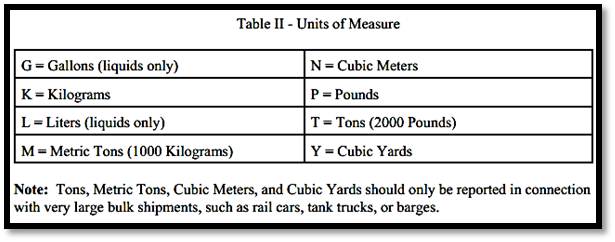
Item 12.  Units of Measure (Weight/Volume):  Enter, in designated boxes, the appropriate abbreviation from Table II (below) for the unit of measure.

Table II, Item 12.  Instructions for the completion of the hazardous waste manifest

 Note the following:

  • Total Quantity must be entered in Item 11 of the manifest, unit of measure in Item 12, no exceptions.
  • The US EPA is much more specific in its instructions as to how it wishes the number to appear:  “Round partial numbers…
  • Entering the “container capacity” or other rough estimates are not acceptable.  US EPA desires an “actual measurement or reasonably accurate estimate…” of the Total Quantity.
  • The US EPA instructions for the Manifest, like the US DOT in its regulations, does not specify the use of net or gross mass/volume for the Total Quantity.  Therefore, the Total Quantity may include the weight of the containers, or if an accurate measurement can be made, solely the weight of the hazardous waste in the containers.
  • Unlike the US DOT, the US EPA requires specific units of measure and acceptable abbreviations; refer to Table II – Units of Measure
  • The US EPA goes further to recommend the use of certain units of measure (Tons, Metric Tons, & Cubic Yards) for very large bulk shipments (rail cars, tank trucks, or barges).
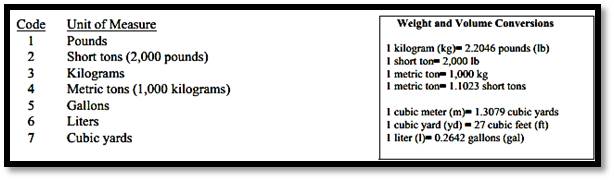
  • Whatever unit of measure you choose, completion of the Hazardous Waste Report will be easier if you remain consistent and select a unit of measure required by the Report (see below):

So, which regulations must you comply:  Those of the US DOT or those of the US EPA?  Well, if shipping a hazardous material that is not a hazardous waste, then you need only follow the requirements of the US DOT.  If, however, what you offer for transportation is a hazardous waste – and you are not a Conditionally Exempt Small Quantity Generator of hazardous waste – then you must comply with the regulations of both agencies (and those of your state if it has an authorized hazardous waste program).

So in sum…

At 49 CFR 172.205(a) the US DOT requires completion of the Manifest per the regulations of the US EPA for the transportation of a hazardous waste.  Further, at §172.205(h), it requires the Manifest to contain all of the applicable elements of the hazardous materials description.

and…

According to 40 CFR 262.202(a)(1), you must complete the Manifest per the instructions included in the appendix to §262.  Also, check with your state to see if it has any additional requirements for completion of the Manifest.

These types of questions come up in my training all the time.  Sign up to attend one of my training events, or contact me with a question regarding the regulations of the US DOT or the US EPA.


Manufacturers of Hazardous Material Packaging & HazMat Employee Training

The regulations of the US DOT that mandate training of HazMat Employees can be found at 49 CFR 172, Subpart H.  According to §172.702(a), “A HazMat Employer shall ensure that each of its HazMat Employees is trained in accordance with the requirements prescribed in this subpart.”  The full definition of a HazMat Employer can be found at §171.8 and can be summarized as follows:

  • person who employees at least one HazMat Employee as defined at §171.8; or,
  • A person who is self-employed transporting materials in commerce; or,
  • A department or agency of any Federal or State government or Indian tribe.

WHO…

  • Transports a hazardous material in commerce;
  • Causes a hazardous material to be transported in commerce; or,
  • “Designs, manufactures, fabricates, inspects, marks, maintains, reconditions, repairs or tests a package, container, or packaging component that is represented, marked, certified, or sold by that person as qualified for use in transporting hazardous materials in commerce.”

It is this last category of HazMat Employer that is often overlooked or misunderstood, and so requires further explanation.  Based on this definition a HazMat Employer includes…

Someone whose business has anything to do, “designs, manufactures, fabricates, inspects, marks, maintains, reconditions, repairs or tests…” for any type of packaging, “…a package, container, or packaging component…” that it indicates, “…represented, marked, certified, or sold by that person…” is suitable for the transportation of hazardous materials, “…as qualified for use in transporting hazardous materials in commerce.”

If this is you, then you are a HazMat Employer.  As a HazMat Employer you are required to ensure that each of your HazMat Employees are trained and tested.  HazMat Employee training must include:

  • General Awareness/Familiarization
  • Function Specific Responsibilities
  • Safety/Emergency Response
  • Security General Awareness
  • In-Depth Security (if applicable)

However, pursuant to §172.704(e)(1), a HazMat Employee who is only involved in the manufacture of HazMat packagings and does not perform any other regulated function, such as handling hazardous materials in transportation, does not require Safety/Emergency Response training.

Whether you ship or receive hazardous materials, transport hazardous materials, or manufacture hazardous material packaging, you must provide HazMat Employee training every three years.  Contact me to provide the required training at a time and place of your choosing and at a price you can afford.

Selecting Packaging for the Transportation of a Hazardous Material or Hazardous Waste

QUESTION:  “Can a plastic 55-gallon drum – or any plastic container – be used for the transportation of a flammable liquid hazardous waste?”

ANSWER:  Yes.  There is nothing in the regulations of the US DOT or US EPA that precludes the general use of a plastic container for the transportation of a flammable liquid hazardous material or hazardous waste.  In fact, the applicable regulations refer to plastic drums, jerricans, and boxes as acceptable packagings for the shipment of a flammable liquid.  You should check with your State environmental agency or Fire Marshall to learn their requirements.

Selecting a container/packaging for a hazardous waste is important for several reasons; the two most important:

  • When the container/packaging is onsite and being used for the accumulation/storage of hazardous waste it is subject to the regulations of the US EPA or authorized State agency.
  • When offered for transportation and transported in commerce – assuming the hazardous waste is not treated or disposed onsite – the container/packaging is subject to the regulations of the US DOT.

The US EPA’s regulations for the onsite management of hazardous waste in containers are located at 40 CFR 265, Subpart I referred there from §262.34 they include basic requirements such as the container must be in good condition, compatible with its contents, kept closed when not filling or emptying, inspected, managed to prevent ruptures and leaks, and separated from incompatible waste.

The US DOT’s regulations for the transportation of that same hazardous waste are more descriptive and specific than those of the US EPA without necessarily being more restrictive.  This is because the hazardous waste will now leave your property and begin a journey of unknown duration and distance until it reaches its designated facility.  It is important that you are aware of the applicable regulations of the US DOT when selecting a container for the accumulation of your hazardous waste (the selection of the container for a hazardous material or a hazardous waste is known as a Pre-Transportation Function and must be done by a trained HazMat Employee) if you intend to offer the hazardous waste for shipment.

Begin at 49 CFR 173.24 – General Requirements for Packagings and Packages of the US DOT regulations to ensure the selection of the correct packaging.  This section is applicable to bulk and non-bulk packagings, new packagings and reused, and specification and non-specification packagings.  It requires that every packaging used for the shipment of a hazardous material  be designed, constructed, maintained, filled, limited to its contents, and closed, so that under the normal conditions of transportation there is…

  • No release to the environment.
  • No loss of effectiveness of the packaging due to normal conditions of transportation (temperature, humidity, pressure, shocks, loadings, vibrations, etc).
  • No mixture of gases or vapors in the package which could damage it.
  • No hazardous material residue on the outside of the package.

In addition to the above, a packaging must be authorized for a hazardous material shipment as specified in Column 8 of the Hazardous Materials Table (§172.101) and as otherwise required by §173.24(c,d).  You’ll have to refer to §173.24(c,d) for the full list of applicable parts and sections as its just too much to list.

The container must be closed properly and, no matter what the regulations require, it is the responsibility of the Shipper to ensure the packagings are compatible with their contents.

Column 8 of the Hazardous Materials Table entry for a Packing Group I (highest degree of danger) Flammable Liquid references §173.201 – Non-Bulk Packagings for Liquid Hazardous Materials in Packing Group I which includes the types of packagings (steel drum, fiber drum, steel box, plastic, etc.) authorized for the shipment of the applicable hazardous material.

Years ago, employed as a truck driver for Laidlaw Environmental Services I would have sworn up and down that you could not use a plastic container for the accumulation and transportation of a hazardous waste.  I now know that – at least according to the Federal regulations of the US DOT & US EPA – such a thing is acceptable.

Attend my training, ask your questions, and see what you learn.

Punctuation in the Proper Shipping Name and Basic Description for a Hazardous Material

In an earlier article I used the regulations of the US DOT to debunk a common misconception that  the description of a hazardous material on a shipping paper or a marking on a package must appear exactly as it does in the Hazardous Materials Table; down to each and every comma.  In my days of driving a truck for Laidlaw Environmental Services I was told that each missing comma between the elements of a Basic Description:  Identification Number, Proper Shipping Name, Hazard Class, & Packing Group could result in a separate violation and fine.  This is not true.  The concern of the US DOT regarding the proper shipping description of a hazardous material is not its punctuation, but whether or not it communicates the hazards of the material in transportation.

There are, however, some situations where a specific form of punctuation is required by the Hazardous Materials Regulations (HMR):

  1. 49 CFR 172.203(k) requires the Technical Name of the material be entered in (parenthesis) in association with the Basic Description (meaning, somewhere at the beginning or the end) if its entry in the Hazardous Materials Table includes the letter G in column 1.
  2. §172.202(a)(3) requires the subsidiary hazard class(es) be entered in (parenthesis) immediately following the primary hazard class.  The presence of a subsidiary hazard class – or classes – will be indicated in column 6 of the Hazardous Materials Table.
  3. If the hazardous material is a Hazardous Substance and the name of the Hazardous Substance is not a part of the Proper Shipping Name, then §172.203(c) requires the name of the Hazardous Substance, or a Hazardous Waste Code if applicable, be entered in (parenthesis) in association with the Basic Description.
  4. If the hazardous material is a Marine Pollutant and the name of the Marine Pollutant does not appear in the Proper Shipping Name, then §172.203(l) requires the name of the Marine Pollutant be entered in (parenthesis) in association with the Basic Description.

There may be other regulations within the HMR that require the use of punctuation as part of the Basic Description, but these are the ones I am most familiar with, and the ones you are most likely to encounter.  If you have a question about the HMR (Hazardous Materials Regulations) of the US DOT or the hazardous waste regulations of the US EPA, please don’t hesitate to contact me.

What is the Consumer Commodity Exception to the Hazardous Material Regulations?

A substance or material that the US DOT has determined is capable of posing an unreasonable risk to health, safety, and property will be regulated as a Hazardous Material when offered for transportation or transported in commerce.  Some Hazardous Materials are granted an exception from full regulation under the Hazardous Materials Regulations (HMR) if the US DOT believes that under certain specified combinations of packaging, quantity, or form it poses a low enough risk to preclude the need for full regulation.  One example of such an exception is the Consumer Commodity Exception.

The Consumer Commodity Exception is designed to allow for the transportation in commerce of hazardous materials:  bleach, drain cleaners, solvents, aerosols, etc. in small packagings (Limited Quantities) as long as those materials are, or similar to, the consumer products you see on retail store shelves.  The process to determining if a hazardous material may be shipped as a Consumer Commodity involves several steps, they are briefly outlined below:

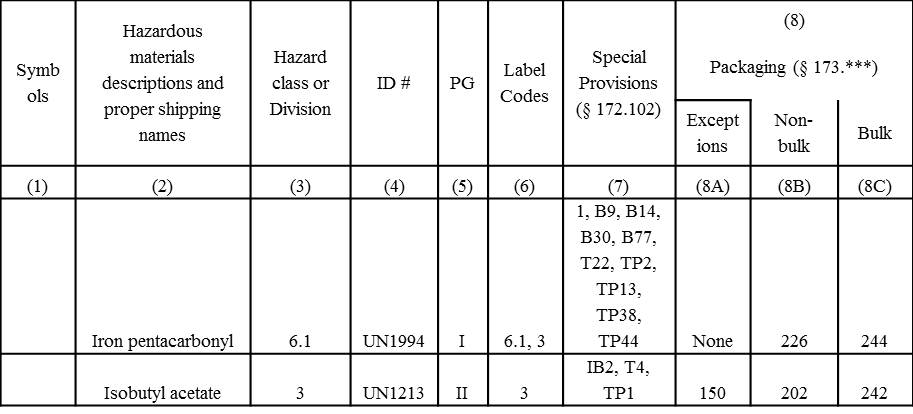
  1. The hazardous material must first be eligible for the Limited Quantity Exception; the applicability of the Limited Quantity Exception is indicated in Column 8A of the Hazardous Materials Table @ 49 CFR 172.101 for each entry.  If it is available, Column 8A will reference the Section of Part 173 of Title 49 CFR that includes the requirements for shipping the hazardous material as a Limited Quantity.  An example of a hazardous material that may not use the Limited Quantity Exception is:  Iron Pentacarbonyl; one that may is:  Isobutyl Acetate (refer to §173.150 for more information on shipping this HazMat as a Limited Quantity).
  2. In the example of Isobutyl Acetate in the Hazardous Materials Table, a shipper will need to comply with all the requirements of §173.150 in order to ship the HazMat in compliance with the Limited Quantity Exception.
  3. If the Limited Quantity Exception is available and it also meets the definition of a Consumer Commodity you may then change its shipping name to Consumer Commodity and its hazard class to ORM-D.  A Consumer Commodity is defined at §171.8:

Consumer commodity means a material that is packaged and distributed in a form intended or suitable for sale through retail sales agencies or instrumentalities for consumption by individuals for purposes of personal care or household use. This term also includes drugs and medicines.

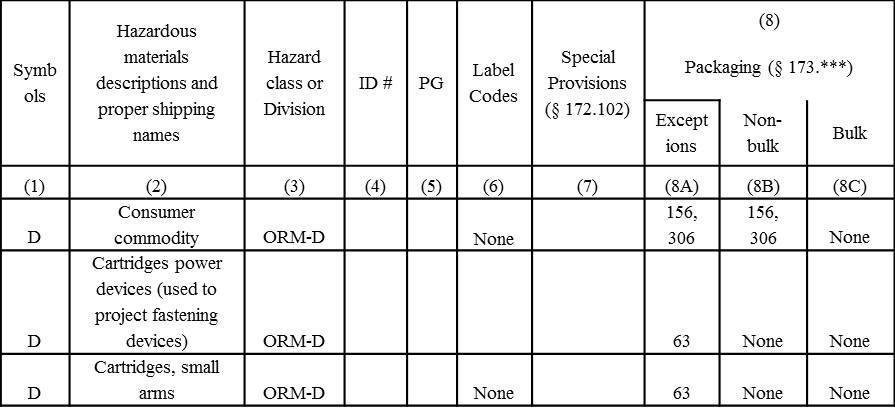
The Hazardous Materials Table entry for a Consumer Commodity looks like this:

Symbols

Hazardous materials descriptions and proper shipping names

Hazard class or Division

ID#

PG

Label Codes

Special Provisions (§ 172.102)

(8)

Packaging (§ 173.***)

Exceptions

Non-bulk

Bulk

(1)

(2)

(3)

(4)

(5)

(6)

(7)

(8A)

(8B)

(8C)

D

Consumer commodity

ORM-D

None

156, 306

156, 306

None

Benefits to use of the Consumer Commodity Exception include:

  • No placards.
  • No shipping papers.
  • No labels.
  • Strong outer packaging acceptable instead of specification packaging.
  • No marking, other than ORM-D or ORM-D Air as applicable.


Unfortunately, the Consumer Commodity Exception and the ORM-D hazard class are not acceptable for international shipments of hazardous materials.  In order to bring our regulations into alignment with the rest of the world, the US DOT is currently phasing out ORM-D and the Consumer Commodity Exception and replacing it with a revised Limited Quantity Exception on the following schedule.

  • ORM-D-Air not acceptable for use after 12.31.12.
  • ORM-D not acceptable for use after 12.31.13.  US DOT has proposed extending this deadline to 12.31.15.
READ HERE HOW USE OF THE CONSUMER COMMODITY EXCEPTION HAS BEEN EXTENDED UNTIL THE END OF 2020.

I recently conducted on-site training for a facility that manufactured and shipped Consumer Commodities.  This change to the regulations had a significant impact on their business, but with training and a productive Q & A session, I feel confident I left them with a path forward thr0ugh this revision to the regulations.  Contact me and let me know how this change to the HMR will affect your operations and if you have any questions for me.

HMT for ORM D

What is an Other Regulated Material (ORM-D)?

49 CFR 171.8 reads, “ORM means other regulated material. See §173.144 of this subchapter.”  That’s not much to go on but it’s a start.  §173.144 defines an ORM-D as:

Until December 31, 2013 and for the purposes of this subchapter, “ORM-D material” means a material such as a consumer commodity, cartridges, small arms or cartridges, power devices which, although otherwise subject to the regulations of this subchapter, presents a limited hazard during transportation due to its form, quantity and packaging. It must be a material for which exceptions are provided in Column (8A) of the § 172.101 Hazardous Materials Table.

Editors Note:  Though originally slated to expire December 31, 2013, the phase-out date for the ORM-D hazard class and the Consumer Commodity exception has now been extended until December 31, 2020.
Read:  Authorization for use of the ORM-D classification and the Consumer Commodity Exception extended through 2020!
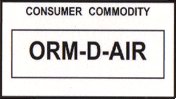
Consumer Commodity ORM-D Label
Though it’s days are numbered, you may still see this marking on store shelves

So, §171.8 refers to all ORM, but §173.144 is specific to just ORM-D.  It is left unsaid that there used to be five different divisions to the ORM hazard class:  ORM-A through ORM-E.  Of these five, only ORM-D remains, and its time is limited; thus the inclusion of “Until December 31, 2013…” in the definition.

For now, we’ll continue to focus on the definition of ORM-D, we’ll come back to “Until December 31, 2013…” later.  The above definition is found in Subpart D of Part 173 – Definitions Classification, Packing Group Assignments and Exceptions for Hazardous Materials Other Than Class 1 and Class 7.  Notice then that ORM-D is a type of Hazard Class, similar to Class 3 – Flammable and Combustible Liquid and Class 8 – Corrosive Material.  And, contrary to what you’ve been told, the “D” in ORM-D does not stand for Domestic.  It merely distinguishes it from the other ORM’s that used to exist.

Per the definition, an ORM-D is a hazardous material that normally would be subject to all the requirements of the Hazardous Material Regulations (HMR) but due to its (1) form, (2) quantity, and (3) packaging presents a limited risk in transportation.  All three of those conditions must be met for a HazMat to be re-classed as an ORM-D.

Hazardous Materials that are applicable to be re-classed as an ORM-D are limited to the following:

  • Consumer Commodity.
  • Cartridges, small arms.
  • Cartridges, power devices.

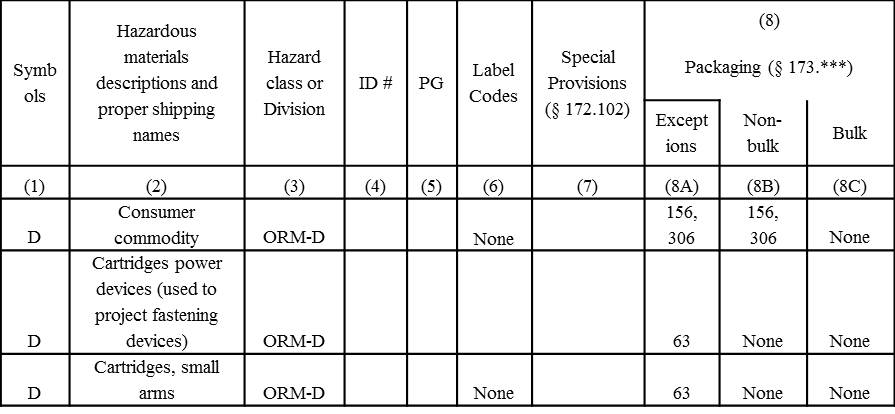
In addition to the above list, the ORM-D exception is available only if a section of  Part 173 is referenced in Column 8A of the Hazardous Materials Table (49 CFR 172.101).  For example, the Hazardous Material Table entries for the above ORM-D’s reads:

So, to learn the packaging exceptions available for a Consumer Commodity classed as an ORM-D, you refer to 49 CFR 173.156 or §173.306 (the sections of Part 173 referenced in column 8A of the Hazardous Materials Table).  For Cartridges, Power Devices and Cartridges, Small Arms, you refer to §173.63.

Benefits to the re-classification of a hazardous material as an ORM-D include:

  • No placards.
  • No labels unless shipped by air.
  • No shipping paper unless shipped by air or vessel.
  • No packing group or identification number.
  • Specification packaging not required as long as applicable packaging requirements are met.

The biggest drawback to using the ORM-D Hazard Class is that it is not recognized by international regulations.  To address this the US DOT is in the middle of a phase out of the Consumer Commodity Exception and the ORM-D hazard class.

Editors Note:  Though originally slated to expire December 31, 2013, the phase-out date for the ORM-D hazard class and the Consumer Commodity exception has now been extended until December 31, 2020.
Read:  Authorization for use of the ORM-D classification and the Consumer Commodity Exception extended through 2020!

The HMR is always changing, and no one will let you know of the changes until it is too late.  Stay on top of these changes by attending my Seminar Training, scheduling Onsite Training, or attending a Webinar.  It will bring you into compliance and inform you of what you need to do to stay in compliance in the future.

Daniels Training Services

815.821.1550

Info@DanielsTraining.com

https://danielstraining.com/

Former and Present Other Regulated Materials (ORM)

Currently, and only until December 31, 2013 when it will cease to exist (unless an extension requested by US DOT to December 31, 2015 is granted), there is only one category of Other Regulated Material.  In the distant past (known as “The 90’s”) however, there were five of them:  ORM-A through ORM-E.  What remains today is the one known as Other Regulated Material-D or ORM-D.

The definition of ORM at 49 CFR 171.8 identifies it as an Other Regulated Material and refers to §173.144 (see below) which goes on to define solely the ORM-D; no reference is made to the other types of ORM.  While they no longer impact the Hazardous Material Regulations, an understanding of the history the HMR does help to develop a full appreciation of the existing regulations.  To fulfill your curiosity the full list of Other Regulated Materials – both past and present – are identified below:

  • ORM-A means a material which has an anesthetic, irritating, noxious, toxic, or other similar property.  It is regulated due to concern that a release during transportation could cause extreme annoyance to passengers and crew of transport vehicles.  No longer in use.
  • ORM-B means a material, including a solid when wet with water, that could cause significant damage to the transportation vehicle if it were to leak during transportation. An ORM-B material (no longer in use) is:
    1. Specifically designated by name in §172.101, and/or;
    2. A liquid that has a corrosin rate exceeding 0.250 inch per year (IPY) on non-clad aluminum.
  • ORM-C means a material which has other inherent characteristics not described as an ORM-A or ORM-B, but which make it unsuitable for shipment, unless properly identified and prepared for transportation.  ORM-C materials are specifically designated by name at §172.101.  No longer in use.
  • ORM-D in use at least until December 31, 2013 and defined at §173.144 means a material such as a consumer commodity, cartridges, small arms or cartridges, power devices which, although otherwise subject to the regulations of this subchapter, presents a limited hazard during transportation due to its form, quantity and packaging.  It must be a material for which exceptions are provided in Column (8A) of the §172.101 Hazardous Materials Table.
  • ORM-E means a material that is not included in any other hazard class but is subject to the requirements of this subchapter.  Materials in this class (no longer in use) include:
    1. Hazardous Waste, and;
    2. Hazardous Substances.

The list above is more of a historical record than an identification of current regulations since all but the ORM-D have been eliminated and it will be no more within a few more years.  The Hazardous Material Regulations (HMR) of the US DOT are always changing, and it is your responsibility to stay on top of them, my training will help you to do that.  Contact me with questions about the HMR or the Hazardous Waste regulations of the US EPA.

Some Changes to the Hazardous Material Regulations for 2013

It seems that as soon as you understand the regulations they change it.  And that’s the case with several aspects of the Hazardous Material Regulations (HMR) that are scheduled to change as of this December 31st.  This list does not attempt be be all-inclusive but it does summarize the big changes to the HMR to watch for in the new year.

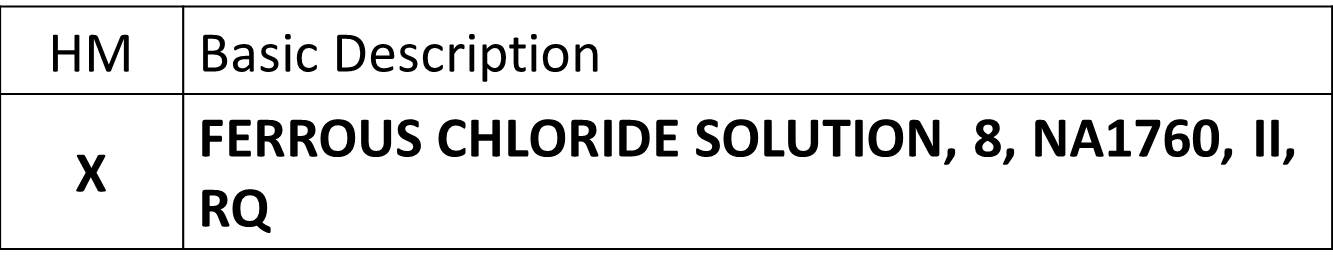
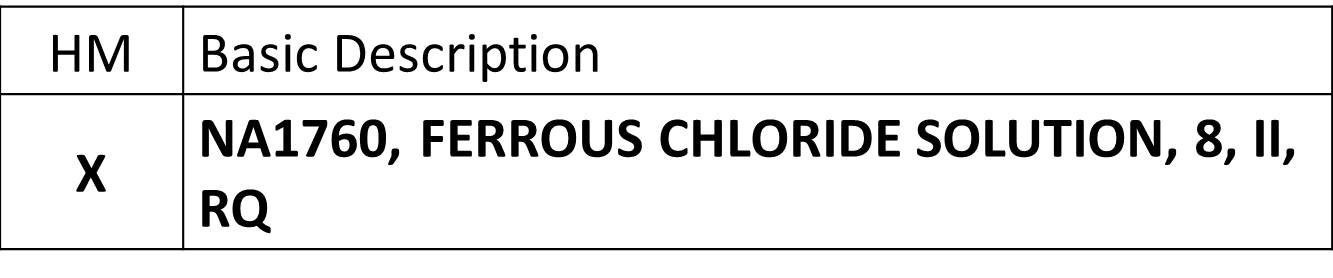
  • Change in the order of the basic description.  After 12.31.12, the only acceptable order for the basic description when describing a hazardous material is:  (1) Identification Number, (2) Proper Shipping Name, (3) Hazard Class, and (4) Packing Group.  The old order, and still acceptable until 12.31.12, but not after is:  (1) Proper Shipping Name, (2) Hazard Class, (3) Identification Number and (4) Packing Group.  Notice that the Identification Number has been moved from 3rd to 1st in the order of the Basic Description, this was done to align domestic regulations with international and to make the Identification Number, which plays a key role in emergency response, more visible.

The order of the Basic Description acceptable only until 12.31.12:

The order of the Basic Description that must be used as of 1.1.13:

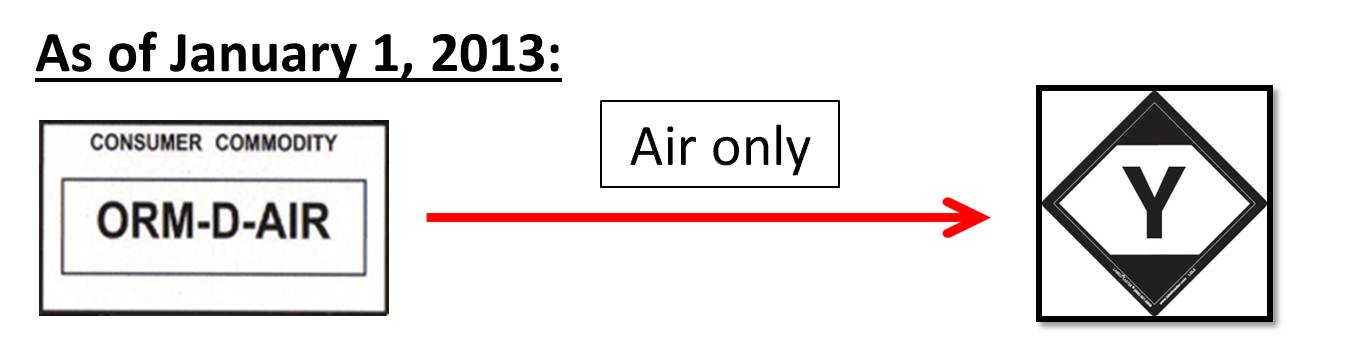
  • End of Consumer Commodity shipments as an ORM-D by air.  As part of its long-term phase out of the Consumer Commodity exception and the ORM-D hazard class, 12.31.12 is the deadline for use of this exception for shipments of hazardous materials by air.  After this date a hazardous material that meets the definition of a Consumer Commodity and is to be transported by air must either be shipped according to the new Limited Quantity rules, or as a hazardous material subject to the full HMR.  The purpose of this change is to align domestic and international regulations, since the Consumer Commodity Exception is not recognized in international transportation.  The revision was designed to minimize the impact on shippers of Consumer Commodities, so it is likely that any HazMat you are currently shipping as a Consumer Commodity will be applicable for the Limited Quantity Exception which, other than its marking, differs little from the current Consumer Commodity Exception.  Hazardous materials may continue to use the Consumer Commodity exception for shipments by ground or vessel until 12.31.13 (US DOT has requested an extension of this date to 12.31.15).

  • End of the Limited Quantity marking for shipments by air.  Along with the phase-0ut of the Consumer Commodity Exception referenced above the current Limited Quantity marking is being revised as of 12.31.12 to come into alignment with international regulations.  After 12.31.12 the current Limited Quantity marking will no longer be acceptable for shipments by air of a hazardous material using the Limited Quantity Exception.  Other changes to the regulation may affect other aspects of your Limited Quantity shipment as well.

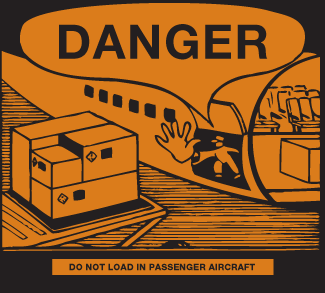
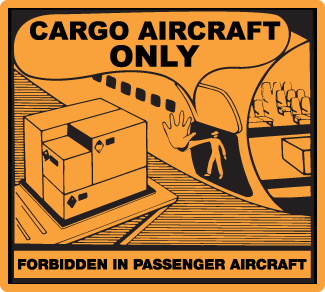
  • End of the “Danger” label for shipments of HazMat forbidden from transport in passenger aircraft.    The purpose of this label is to alert shipping personnel to hazardous material packages that can not be loaded on a passenger carrying aircraft; they are required by IATA, ICAO, and US DOT regulations.  The change (mandatory after 12.31.12) is being made to provide a better warning to HazMat Employees who may handle these packages.

Old label, valid until 12.31.12:

New label, must be used as of 1.1.13:

I’m sure there’s more, but these are the big ones I’m familiar with.  Please feel free to contact me if you are aware of any impending changes to the regulations or have any question about how these changes may affect you.  My training is a great way to learn the HazMat regulations and to get your questions answered.  I also provide training for Hazardous Waste Personnel required by the US EPA.


Search Website