PO Box 1232 Freeport, IL 61032

A Different Kind Of Training

A Different Kind Of Training

A Different Kind Of Training

Lac-Mégantic, Quebec Train Derailment of July 6, 2013

According to Rail Safety Advisory Letters issued by the Transportation Safety Board of Canada on July 19, 2013, the incident is summarized as follows.

At approximately 10:45 p.m. Eastern Daylight Time (EDT) on July 5, 2013, MMA train 2 was proceeding eastward from Montreal, Quebec, to St. John, New Brunswick.  The train was approximately 4,700 feet long and weighed over 10,000 tons.  It consisted of five locomotives, a loaded box car, and 72 loaded tank cars containing petroleum crude oil (U.S. DOT Hazard Class 3, UN 1267).  At approximately 11:00 p.m. the train stopped near milepost 7.40 near Nantes, Quebec.  At that location the operator of the train secured it and departed, leaving the train unattended on mainline track with a descending grade of approximately 1.2 percent.  At around 11:50 p.m. a local resident reported a fire on the controlling locomotive (MMA 5017) of the train.  The local fire department was called and responded with another MMA employee.  At approximately midnight, the controlling locomotive was shut down and the fire extinguished. After the fire was extinguished, the fire department and the MMA employee left the site.  At approximately 1:00 a.m. the next day (the early morning of July 6th) it appears that the train began rolling and picking up speed down the descending grade toward the town of Lac-Mégantic, Quebec, which sits approximately 30 miles from the United States-Canada border.  Near the center of town, the box car and 63 of the loaded tank cars derailed.  The locomotives, which separated from the train, traveled an additional 1/2 mile before coming to a stop.  A number of derailed tank cars released product resulting in multiple explosions and subsequent fires.  At this time, it is estimated that there were 42 fatalities and that 5 persons are still missing.  There was also extensive damage to the town, and approximately 2,000 people were evacuated from the surrounding area.  While the investigation is ongoing and the Transportation Safety Board of Canada has not reached any final conclusions, it has made a determination that the braking force applied to the train was insufficient to hold it on the 1.2-percent descending slope between Nantes and Lac-Mégantic.

Transport Canada Issues Rail Safety Advisory Letter 09/13 – The Securement of Equipment and Trains Left Unattended

View the letter as a pdf

Securement of Equipment and Trains Left Unattended

Place du Centre
4th Floor
200 Promenade du Portage
Gatineau, Quebec
K1A 1K8 617-09/13

18 July 2013

Mr. Luc Bourdon (ASR)

Director General, Rail Safety
Transport Canada
14th Floor, Enterprise Building
427 Laurier A venue
Ottawa, Ontario
K1A 0N5

Dear Mr. Bourdon:

SUBJECT:RAIL SAFETY ADVISORY LETTER – 09/13

Securement of Equipment and Trains Left Unattended

At about 22:45 Eastern Daylight Time (EDT) on 05 July 2013, Montreal Maine & Atlantic (MMA) freight train MMA 2 (the train) was proceeding eastward on the MMA Sherbrooke Subdivision, enroute from Montreal (QC) towards Saint John (NB). The train was 4701 feet long and weighed 10,287 tons. It was comprised of 5 head-end locomotives, a VB car used to house the locotrol equipment necessary for MMA’s single engineer train operation, 1 loaded box car used as a buffer followed by 72 non-pressure dangerous goods tank cars loaded with petroleum crude oil (Class 3, UN 1267).

At approximately 23:00, the train stopped at the designated MMA crew change point at Mile 7.40 near Nantes, Quebec. The single operator secured the train and departed for the evening leaving the lead locomotive unlocked and the train unattended on mainline track with a descending grade of 1.2%.

At about 23:50, a local resident reported a fire on the lead locomotive (MMA 5017) to the 911 emergency call centre. Subsequently the local fire department responded along with another MMA employee. At about midnight, similar with established operating practice, emergency shutdown procedures were initiated on the lead locomotive and the fire was extinguished. After extinguishing the fire, the second MMA employee and the fire department departed the site again leaving the train unattended.

Shortly before 01:00 on 06 July 2013, the train started to move and gathered speed as it rolled uncontrolled down the descending grade into the town of Lac-Mégantic, Quebec, 7.4 miles southeast of Nantes. While travelling at well in excess of the authorized speed, the train derailed near the centre of Lac-Mégantic. The locomotives separated from the train and came to a stop about ½ mile east of the derailment. The derailed equipment included the box car (buffer) and 63 tank cars.

Several derailed tank cars released product resulting in multiple explosions and subsequent fires causing an estimated 42 fatalities and 8 persons still missing, extensive damage to the town centre and precipitated the evacuation of about 2000 people from the surrounding area (TSB Occurrence No. R13D0054).

The ongoing investigation has determined that the braking force applied was insufficient to hold the train on the 1.2% descending slope between Nantes and Lac-Mégantic.

Over the years, the TSB has investigated a number of similar runaway accidents (see Appendix A). Each of these investigations brings into question the effectiveness of the Transport Canada (TC) approved Canadian Rail Operating Rules (CROR) Rule 112 entitled “Securing Equipment” and the standard railway operating procedures and practices utilized for performing that task.

Specifically CROR Rule 112 states:

(a)  When equipment is left at any point a sufficient number of hand brakes must be applied to prevent it from moving. Special instructions will indicate the minimum hand brake requirements for all locations where equipment is left. If equipment is left on a siding, it must be coupled to other equipment if any on such track unless it is necessary to provide separation at a public crossing at grade or elsewhere.

(b)  Before relying on the retarding force of the hand brake(s), whether leaving equipment or riding equipment to rest, the effectiveness of the hand brake(s) must be tested by fully applying the hand brake(s) and moving the cut of cars slightly to ensure sufficient retarding force is present to prevent the equipment from moving. When leaving a cut of cars secured, and after completion of this test, the cut should be observed while pulling away to ensure slack action has settled and that the cars remain in place.

(c)  Application of hand brakes must not be made while equipment is being pulled or shoved.

Trains are required to be secured in accordance with CROR Rule 112 in addition to any related railway company special instructions which vary from company to company. While most railway special instructions specify the minimum number of hand brakes needed in general operating conditions, they do not always provide the number of hand brakes required under specific conditions. In many cases, it is left up to the operating employee to determine the number of hand brakes to apply. The employee must take into consideration the slope or grade of the track and the approximate tonnage of the equipment to be secured at that location.

In addition, TSB investigation R96C0172 previously established that that there was considerable variability in the effectiveness of the hand brake system on railway cars. The variability was associated with the design, condition and maintenance of the hand brake system, as well as with differences among operators with respect to their physical capabilities and personal technique used to apply the hand brakes. Specifically, the torque applied by the operating employee may not be proportional to the effective brake shoe force actually applied. In other words, high torque does not necessarily generate a high braking force. This variability was not widely understood at the time of the investigation and could still present a risk particularly with new employees.

More recently, to add to the complexity, TSB investigation R12E0004 identified that the push –pull test used by railways to satisfy CROR Rule 112 (b) does not always adequately verify if the braking force of the hand brake application was sufficient to hold the cars.

CROR Rule 112 ensures that hand brakes are applied to prevent unwanted movement of the train while providing flexibility for a railway’s operational needs. However, CROR Rule 112 is not specific enough in that it does not indicate the number of hand brakes necessary to hold a given train tonnage on various grades and it continues to be left up to the operating employee to determine the number of hand brakes to apply. Furthermore, it has been demonstrated that the push–pull test is not always a good indicator of whether an adequate number of hand brakes have been applied and not all handbrakes are effective even when properly applied. Considering all these risks, Transport Canada may wish to review CROR Rule 112 and all related railway special instructions to ensure that equipment and trains left unattended are properly secured in order to prevent unintended movements.

Yours sincerely,

Original signed by Robert Johnston

Robert Johnston

Acting Director

Investigation Operations Rail/Pipeline

Attachment: Appendix A

Cc: Edward A. Burkhardt

Chairman of the Board

Rail World Inc.

Michael Bourque

President & Chief Executive Officer

The Railway Association of Canada


Transport Canada Announces Emergency Directive to Increase Rail Safety

No. H096/13

For release – July 23, 2013

OTTAWA — Today, Transport Canada announced an emergency directive pursuant to section 33 of the Railway Safety Act to increase rail safety.

Although the cause of the accident in Lac-Mégantic remains unknown at this time, Transport Canada is moving forward to build upon the safety advisories received last Friday from the Transportation Safety Board and further enhance existing safe railway operations and the security of railway transportation.

Transport Canada thanks all railway companies for their quick response in implementing this directive following the tragic events in Lac-Mégantic.

Effective immediately, the emergency directive requires all rail operators to:

  • Ensure that no locomotive attached to one or more loaded tank cars transporting dangerous goods is operated with fewer than two qualified persons on a main track or sidings;
  • Ensure that no locomotive attached to one or more loaded tank cars transporting dangerous goods is left unattended on a main track;
  • Ensure, within five days of the issuance of the directive, that all unattended controlling locomotives on a main track and sidings are protected from unauthorized entry into the cab;
  • Ensure the directional controls, commonly known as reversers, are removed from any unattended locomotives, preventing them from moving forward or backward, on a main track or sidings;
  • Ensure that their company’s special instructions on hand brakes are applied to any locomotive attached to one or more cars that is left unattended for more than one hour on a main track or sidings;
  • Ensure that, in addition to complying with their company’s special instructions on hand brakes referred to in the item immediately above, the automatic brake is set in full service position and the independent brake is fully applied for any locomotive attached to one or more cars that are left unattended for one hour or less on a main track or sidings.

The safety of Canadians is Transport Canada’s top priority.  The department is committed to working with the rail industry to examining any other means of improving rail safety.

Transport Canada has been in contact with the railway industry, and in particular with CN, CP and the Railway Association of Canada (RAC), to work together to promote the continued safety of Canada’s rail system.

The majority of railways maintain a culture of safety and security, as shown by the notable decline in derailments and train accidents over the past few years.

Transport Canada inspectors will continue to work in cooperation with the Transportation Safety Board as it conducts its investigation.

Transport Canada inspectors are at Lac-Mégantic determining whether there has been non-compliance with regulatory requirements.

Railway safety regulations exist to ensure the safety and protection of the public. If these regulations were not followed, the department will not hesitate to take action.

Contacts:

Media Relations
Transport Canada, Ottawa
613-993-0055

Appendix A to Transport Canada’s Rail Safety Advisory Letter-09/13

Over the years, the TSB has investigated a number of similar runaway accidents. A summary of several of the more significant accidents is appended below:

  • R96C0172 (Edson) – On 12 August 1996, all 3 three occupants in the operating cab of the lead locomotive of Canadian National (CN) westward freight train No. 117 were fatally injured when their train, which was travelling at about 54 mph, collided head-on with a cut of 20 runaway cars moving eastward at about 30 mph, some six miles east of Edson, Alberta. The runaway cars had been left on a track in Edson Yard by a crew who had applied hand brakes to 2 covered hopper cars. The crew had little supervision to ensure that the company’s car securement procedures were being correctly applied. The performance of the hand brakes on that type of car was found to be highly variable, and the variability was not commonly known amongst operating employees. Although the crew thought the cars had been secured, the resultant brake shoe force on the two cars was insufficient to prevent movement. Thus, the cut of 20 cars slowly moved east and accelerated toward the main track.
  • R09T0057 (Nanticoke) – On 11 February 2009 at 2118 Eastern Standard Time, the Southern Ontario Railway 0900 Hagersville Switcher, consisting of 4 locomotives and 43 cars, ran uncontrolled from Mile 0.10 to Mile 1.9 of the Hydro Spur track. The train reached a speed of 20.7 mph before travelling over a split switch derail and derailing 9 loaded dangerous goods tank cars. Three tank cars loaded with gasoline (UN 1203) were breached and released approximately 31 000 litres of gasoline. Two nearby homes were evacuated; there were no injuries.

    The investigation determined that the accident occurred when the crew left the train unattended on a one per cent descending grade, without the train being properly secured. Subsequently, the train rolled uncontrolled downgrade for 1.4 miles, across an unprotected crossing, reaching a speed of 20.7 mph before it encountered a split switch derail and derailed the nine tail-end cars. With only one crew member left at the end of the shift, the other crew members did not have an opportunity to verify whether the train was properly secured.

  • R11Q0056 (Doree) – On 11 December 2011, as freight train LIM-55 was descending a long steep grade, the locomotive engineer, unable to control the train speed using the dynamic and automatic brakes, applied the emergency brakes at Mile 68.00 of the Wacouna Subdivision to stop his movement. One hour later, the train ran away, descending the grade for a distance of almost 15 miles and reaching a maximum speed of 63 mph. The train finally came to a stop at Mile 52.80. No one was injured and there was no derailment.

    The investigation determined that 1 hour after the emergency brakes were applied and the train came to a stop, the air brakes released and, because the braking force applied by the hand brakes was insufficient, the train ran away. Without specific instructions that take into consideration local conditions, there is a risk of underestimating the number of hand brakes required to secure a train on a steep grade and preventing it from running away.

  • R12E0004 (Hanlon) – On 18 January 2012, at 1212 Mountain Standard Time, 13 loaded coal cars, which were running uncontrolled northward from the Hanlon siding, Mile 41.7 on the Grande Cache Subdivision, collided with stationary train A45951-16 at Mile 44.5. Nine of the 13 cars and the 3 leading locomotives from the train derailed. Two crew members sustained minor injuries and were treated on site. The 3rd crew member was seriously injured and was air lifted to hospital in Hinton, Alberta. Approximately 2800 litres of fuel and 740 tons of coal were spilled. About 250 feet of track was damaged.

    The investigation determined that the conductor’s belief that the cars were on level ground likely led to the conclusion that 1 hand brake was sufficient to secure the cut of cars. When the braking force from the train brakes was sufficiently reduced due to bleeding off of the air in the cars’ brake cylinders, the retarding force of the 1 applied hand brake could not resist the gravitational force of the 13 loaded coal cars. In addition, because the brake effectiveness test was conducted by attempting to push the cars upgrade, it did not adequately verify if the braking force of the hand brake application was sufficient to hold the cars.

Identification number for a Class 9 liquid

The Identification Number Marking on Transport Vehicles and Freight Containers

When required on transport vehicles or freight containers (defined below), identification numbers for hazardous materials (found in Column 4 of the Hazardous Materials Table) must be displayed in one of three ways as detailed in 49 CFR 172.336.  The allowable methods for display of identification numbers are as follows:

  • On orange panels with the specifications as detailed in §172.332(b),
  • On a plain white square-on-point display configuration that has the same outside dimensions as a placard:  250 mm (9.84 inches) on a side, or;
  • On a placard in conformance with the requirements of §172.332(c).

If a situation arises where both placards and the identification number are required but the display of the identification on the placard is prohibited per §172.334(a), then the identification number must be displayed on an orange panel or the plain white square-on-point display configuration.  Both must be displayed in association (i.e. next to) the required placard.

Definitions used in this article:

Transport vehicle means a cargo-carrying vehicle such as an automobile, van, tractor, truck, semitrailer, tank car or rail car used for the transportation of cargo by any mode. Each cargo-carrying body (trailer, rail car, etc.) is a separate transport vehicle.

Freight container means a reusable container having a volume of 64 cubic feet or more, designed and constructed to permit being lifted with its contents intact and intended primarily for containment of packages (in unit form) during transportation.

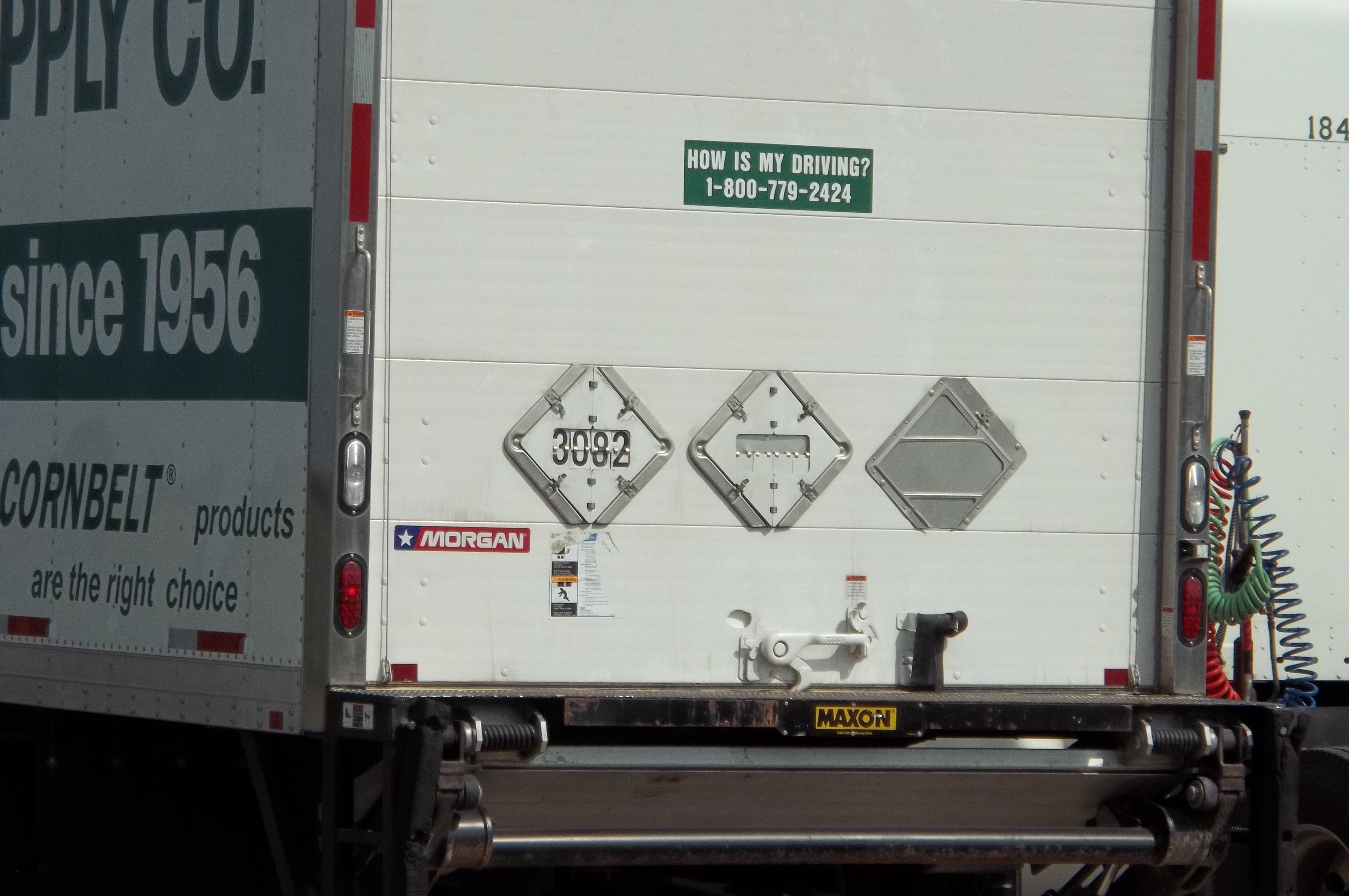
So, a question:  Is the display of the identification number in this photo in compliance with the Hazardous Material Regulations (HMR) of the PHMSA/USDOT?
Identification number for a Class 9 liquid
Is this display in compliance with 49 CFR 172.336(b)?

The answer is yes.  The identification number seen in the photo (3082) applies to a Hazard Class 9 liquid.  Not having seen inside the truck, I will assume that it contains a bulk packaging (>119 gallons for a liquid) of a Class 9.  The transportation of a Class 9 in a bulk package inside a transport vehicle mandates the display of the identification number on all four sides of the vehicle.  The HMR do not, however, require the use of the Class 9 placard for domestic transportation (read my article to learn why a Class 9 placard is not required for domestic transportation).  In this case the carrier has opted to display the identification number on his vehicle without the Class 9 placard.

Something like this may catch your eye on the highway (it did mine, anyway) and cause you to wonder how it can be so.  A review of the regulations reveals the reason why.  Take the time to attend one of my Training Webinars and you’ll learn about the HazMat transportation regulations of the PHMSA/USDOT.


PHMSA Seeks Volunteers for Paperless Haz Com Pilot Program

In a notice published in the Federal Register on July 19, 2013, the PHMSA (Pipeline and Hazardous Materials Safety Administration) of the USDOT announced its intent to seek volunteers to participate in its pilot project to evaluate the effectiveness of a paperless Haz Com system.  A paperless hazard communication system is defined as, “the use of advanced communication methods, such as wireless communications devices, to convey hazard information between all parties in the transportation chain”.  The volunteers who meet the criteria for acceptance (detailed in the notice) will be invited to participate in the pilot program.
(more…)

Safety Alert From the PHMSA: Risks Associated with LPG Odor Fade

Published in the July 17, 2013 Federal Register, the purpose of this Safety Alert Notice from the PHMSA is to advise Shippers and Carriers of HazMat of the risks associated with the under-odorization of Liquefied Petroleum Gases (LPG). (more…)

Federal Railroad Administration Issues Emergency Order to Prevent Unintended Hazardous Materials Train Movement

WASHINGTON – The U.S. Department of Transportation’s Federal Railroad Administration (FRA) today issued an Emergency Order and Safety Advisory to help prevent trains operating on mainline tracks or sidings from moving unintentionally. The FRA’s announcement was made in response to the July 6, 2013 derailment in Lac-Mégantic, Quebec, Canada, as it awaits additional data once the investigation into the crash is complete.  The actions announced today build on the success of FRA’s rigorous safety program, which has helped reduce train accidents by 43 percent over the last decade, and made 2012 the safest year in American rail history.

The Emergency Order is a mandatory directive to the rail industry, and failure to comply will result in enforcement actions against violating railroads.

“Safety is our top priority,” said U.S. Transportation Secretary Anthony Foxx.  “While we wait for the full investigation to conclude, the Department is taking steps today to help prevent a similar incident from occurring in the United States.”

Today’s Emergency Order outlines measures that all railroads must undertake within the next 30 days:

  • No train or vehicles transporting specified hazardous materials can be left unattended on a mainline track or side track outside a yard or terminal, unless specifically authorized.
  • In order to receive authorization to leave a train unattended, railroads must develop and submit to FRA a process for securing unattended trains transporting hazardous materials, including locking the locomotive or otherwise disabling it, and reporting among employees to ensure the correct number of hand brakes are applied.
  • Employees who are responsible for securing trains and vehicles transporting such specified hazardous material must communicate with the train dispatchers the number of hand brakes applied, the tonnage and length of the train or vehicle, the grade and terrain features of the track, any relevant weather conditions, and the type of equipment being secured.
  • Train dispatchers must record the information provided. The dispatcher or other qualified railroad employee must verify that the securement meets the railroad’s requirements, and they must verify that the securement meets the railroad’s requirements.
  • Railroads must implement rules ensuring that any employee involved in securing a train participate in daily job briefings prior to the work being performed.
  • Railroads must develop procedures to ensure a qualified railroad employee inspects all equipment that an emergency responder has been on, under or between before the train can be left unattended.
  • Railroads must provide this EO to all affected employees.

“Today’s action builds upon a comprehensive regulatory framework we have had in place for some time,” said FRA Administrator Joseph C. Szabo. “The safe shipment of all cargo is paramount and protecting the safety of the American public is fundamental to our enforcement strategy and we are encouraged by the industry’s willingness to cooperate with this approach going forward.”

In addition to the Emergency Order, the FRA, together with the Pipeline and Hazardous Materials Safety Administration (PHMSA), issued a Safety Advisory detailing a list of recommendations railroads are expected to follow.  U. S. DOT believes that railroad safety is enhanced through the use of multiple crew members, and the Safety Advisory recommends railroads review their crew staffing requirements for transporting hazardous material and ensure that they are adequate. Other recommendations in the Safety Advisory include:  conducting system-wide evaluations to identify particular hazards that may make it more difficult to secure a train or pose other safety risks and to develop procedures to mitigate those risks.  A copy of the Safety Advisory can be viewed HERE.

“When PHMSA talks about the transportation of hazardous materials, safety is a prerequisite to movement,” said PHMSA Administrator Cynthia Quarterman. “We are taking this action today and we will be looking hard at the current rail operating practices for hazardous materials to ensure the public’s safety.”

As FRA continues to evaluate safety procedures following the recent crash, it will convene an emergency meeting of its Railroad Safety Advisory Committee to consider what additional safety measures may be required.  FRA plans to develop a website that will allow the public to track industry compliance with the Emergency Order and Safety Advisory issued today. FRA has developed a plan that outlines six major actions that have occurred or will occur to further ensure that our regulatory response to the Canadian rail accident remains transparent.

Under current DOT regulations, all freight railroads are required to develop and implement risk assessments and security plans in order to transport any hazardous material, including a plan to prevent unauthorized access in rail yards, facilities and trains carrying hazardous materials. Railroads that carry hazardous materials are required to develop and follow a security protocol while en route; railroad employees are subject to background checks and must complete training.  Training programs and protocols are reviewed and audited by the FRA routinely and generally designed to be progressive so as the level of risk increases so does the level of security required. A description of past, present, and proposed FRA actions on this issue can be found here.

July 2013 – Announcements of Proposed Rules, Changes to the Rules, and Final Rules for RCRA and the HMR

On its website the US Government Printing Office makes a wealth of Federal publications available for review and download; one of these is the Federal Register.

Published by the Office of the Federal Register, National Archives and Records Administration (NARA), the Federal Register is the official daily publication for rules, proposed rules, and notices of Federal agencies and organizations, as well as executive orders and other presidential documents.

See below for a brief summary of announcements in the Federal Register by the US EPA on the subject of Hazardous Waste and the Pipeline & Hazardous Materials Safety Administration (PHMSA) of the US DOT on the subject of Transportation of Hazardous Materials.

The Federal Register is a great way to look down the road and see potential changes to the regulations long before they are put into effect (sometimes The Rulemaking Process takes years before a final rule is issued, if ever).  Knowledge of these potential changes provides you with several advantages:

  • Additional time to modify your business operations to comply.
  • Awareness of on what topics the regulatory agencies intend to focus their efforts.
  • The ability to register your concerns, complaints, suggestions, etc. in order to modify the proposed rule before a final rule is issued.  It can be done, really!
  • Make changes to your training program to account for changes that become effective before the next training cycle.
  • Alert you to the need to re-train your employees prior to their next scheduled training cycle, if necessary.
  • Keep you abreast of changes to the regulations that affect your business and/or your industry group.

Please note that this is my best effort to identify the relevant announcements in the Federal Register that may be of interest to generators of hazardous waste and shippers of hazardous materials.  I encourage you to review the list of Federal Register publications yourself to ensure regulatory compliance.

June 27 through July 31, 2013

PHMSA – Hazardous Materials Regulations (HMR):

Rules and Regulations:

Safety Advisory Guidance: Heating Rail Tank Cars To Prepare Hazardous Material for Unloading or Transloading

Pages 41853 – 41856 [FR DOC # 2013-16672]       PDF | Text | More

Specifications for Packagings

Pages 44894 – 44894 [FR DOC # 2013-18012]     PDF | Text | More

Hazardous Materials: Approval and Communication Requirements for the Safe Transportation of Air Bag Inflators, Air Bag Modules, and Seat-Belt Pretensioners (RRR)

Pages 45880 – 45893 [FR DOC # 2013-18263]     PDF | Text | More

Proposed Rules:

None

Notices:

Hazardous Materials: Revision to Fireworks Regulations (RRR)

Pages 42457 – 42478 [FR DOC # 2013-16986]     PDF | Text | More

Safety Advisory: Unauthorized Filling of Compressed Gas Cylinders

Pages 42817 – 42818 [FR DOC # 2013-17121]     PDF | Text | More

SafetyAlert: Safety Alert: Risks Associated With Liquid Petroleum (LP) Gas Odor Fade

Pages 42818 – 42819 [FR DOC # 2013-17120]     PDF | Text | More

Paperless Hazard Communications Pilot Program

Pages 43263 – 43268 [FR DOC # 2013-17363]     PDF | Text | More

Special Permit Applications

Pages 43268 – 43270 [FR DOC # 2013-17278]     PDF | Text | More

Office of Hazardous Materials Safety; Notice of Application for Special Permits

Pages 43270 – 43270 [FR DOC # 2013-17280]     PDF | Text | More

List of Applications Delayed

Pages 43270 – 43271 [FR DOC # 2013-17277]     PDF | Text | More

Office of Hazardous Materials Safety; Notice of Applications for Modification of Special Permit

Pages 43271 – 43272 [FR DOC # 2013-17279]     PDF | Text | More

USEPA – Resource Conservation and Recovery Act (RCRA):

Rules and Regulations:

State of Kansas; Authorization of State Hazardous Waste Management Program

Pages 43810 – 43817 [FR DOC # 2013-17566]     PDF | Text | More

Conditional Exclusions From Solid Waste and Hazardous Waste for Solvent-Contaminated Wipes

Pages 46447 – 46485 [FR DOC # 2013-18285]     PDF | Text | More

Proposed Rules:

State of Kansas; Authorization of State Hazardous Waste Management Program

Pages 43842 – 43843 [FR DOC # 2013-17038]     PDF | Text | More

Notices:

None

Information can be helpful but it’s useless if you are not able to make sense of it, determine how any changes to the rules and regulations (final or proposed) will affect your operations, and communicate the necessary information to your personnel.  I can help you do that.  Please contact me for a free consultation to determine your regulatory requirements and how training can help you to attain and maintain compliance.

The Management of Hazardous Waste Generated Off-Shore

The regulations of the the Resource Conservation and Recovery Act (RCRA) apply generally to any hazardous waste generated, transported, treated, stored, or disposed of within the US.  But what of a hazardous waste generated in waters off the coast of the US, perhaps on a vessel or an oil platform or rig?  The purpose of this article is to explain the applicability of the hazardous waste regulations of the USEPA and the HazMat Transportation regulations of the USDOT/PHMSA to the generation and transportation of hazardous waste within and without US territorial waters. (more…)

Search Website