
The Resource Conservation and Recovery Act (RCRA) as envisioned by the US Congress when it was passed in 1976 was meant to create a system for controlling hazardous waste from the time it is generated to its final disposal, i.e. “cradle to grave”. While acknowledging this system, many hazardous waste generators fail to realize their responsibility for compliance with the RCRA regulations for the hazardous waste they generate from its initial generation to its final disposal. In short, if you generate a hazardous waste you can be held responsible for its improper off-site transportation and disposal. Short of transporting, storing, treating, and disposing of your hazardous waste yourself, what can a hazardous waste generator do to minimize their potential liability once the hazardous waste is out of their hands? This article will provide guidance on questions to ask and information to seek out when choosing your hazardous waste transporters and TSDFs. (more…)
What’s a Hazardous Waste Generator to do About “Cradle to Grave” Responsibility Under RCRA?
The Meaning of the Symbols in Column 7 of the Hazardous Materials Table
A Shipper of a hazardous material is responsible for its classification and packaging prior to offering it for shipment to a Carrier. An important, but often overlooked, requirement for the safe and regulatory compliant transportation of a HazMat is an understanding of the special provisions in column 7 of the Hazardous Materials Table. When column 7 of the Hazardous Materials Table (49 CFR 172.101) includes a special provision code for an entry in the table, the requirement of that code – or codes, there may be several of them – is in addition to the general packaging requirements of §173.24 and any other applicable packaging requirements in Part 173. Further, the limitations and/or additional requirements found in the special provisions of column 7 will supersede the packaging authorizations of column 8 of the Hazardous Materials Table.
The purpose of this article is to explain the meaning of the coding system for the Special Provisions of column 7 in order to facilitate your review and understanding of them and how they may apply to your shipment of a hazardous material. (more…)
USDOT Regulations for Classification and Hazard Communication of Division 6.2 Infectious Substances in Transportation
The Pipeline and Hazardous Materials Safety Administration within the U.S. Department of Transportation (USDOT/PHMSA) creates and enforces the Hazardous Materials Regulations (HMR) for the transportation of hazardous materials (HazMat) within the U.S. One type of HazMat regulated by USDOT/PHMSA are substances that may cause sickness or death to humans or animals: Division 6.2 Infectious Substances.
The purpose of this article is to describe USDOT/PHMSA’s classification of a Division 6.2 Infectious Substance and the hazard communication: package labels, marks, and placards required for its transportation. (more…)
Rules & Regulations, Proposed Rules, & Notices From: USEPA (RCRA Only); and FAA, FMCSA, FRA, & PHMSA (HazMat Transportation Only) for November 2014
November 2014 – Rules & Regulations, Proposed Rules, and Notices Regarding the Management of Hazardous Waste and the Transportation of Hazardous Materials
On its website the US Government Printing Office makes a wealth of Federal publications available for review and download; one of these is the Federal Register.
Published by the Office of the Federal Register, National Archives and Records Administration (NARA), the Federal Register is the official daily publication for rules, proposed rules, and notices of Federal agencies and organizations, as well as executive orders and other presidential documents.
See below for a brief summary of announcements in the Federal Register by the US EPA on the subject of Hazardous Waste and the Pipeline & Hazardous Materials Safety Administration (PHMSA), Federal Railroad Administration (FRA), and the Federal Aviation Administration (FAA) of the US DOT on the subject of Transportation of Hazardous Materials.
The Federal Register is a great way to look down the road and see potential changes to the regulations long before they are put into effect (sometimes The Rulemaking Process takes years before a final rule is issued, if ever). Knowledge of these potential changes provides you with several advantages:
- Additional time to modify your business operations to comply.
- Awareness of on what topics the regulatory agencies intend to focus their efforts.
- The ability to register your concerns, complaints, suggestions, etc. in order to modify the proposed rule before a final rule is issued. It can be done, really!
- Make changes to your training program to account for changes that become effective before the next training cycle.
- Alert you to the need to re-train your employees prior to their next scheduled training cycle, if necessary.
- Keep you abreast of changes to the regulations that affect your business and/or your industry group.
Please note that this is my best effort to identify the relevant announcements in the Federal Register that may be of interest to generators of hazardous waste and shippers of hazardous materials. I encourage you to review the list of Federal Register publications yourself to ensure regulatory compliance.
November 1, 2014 through November 30, 2014
 USEPA – US Environmental Protection Agency:

Publications not related to the management of hazardous waste, solid waste, universal waste, or used oil are not included here.
Rules and Regulations:
- Consolidated Rules of Practice Governing the Administrative Assessment of Civil Penalties, Issuance of Compliance or Corrective Action Orders, and the Revocation, Termination or Suspension of Permits Pages 65897 – 65901 [FR DOC # 2014-26321] PDF| Text | More
- Hazardous Waste Management System; Identification and Listing of Hazardous Waste; Final Exclusion Pages 70108 – 70113 [FR DOC # 2014-27780] PDF| Text | More
Proposed Rules:
- Consolidated Rules of Practice Governing the Administrative Assessment of Civil Penalties, Issuance of Compliance or Corrective Action Orders, and the Revocation, Termination or Suspension of Permits Pages 65910 – 65912 [FR DOC # 2014-26318] PDF| Text | More
Contact me with any questions you may have about the management of hazardous waste Daniels Training Services815.821.1550 |
Notices:
- Agency Information Collection Activities; Proposed Collection; Comment Request; Requirements and Exemptions for Specific RCRA Wastes Pages 65652 – 65653 [FR DOC # 2014-26329] PDF | Text | More
FAA – Federal Aviation Administration:
Publications not related to the transportation of hazardous materials are not included here.
Rules and Regulations:
None
Proposed Rules:
None
Notices:
None
FMCSA – Federal Motor Carrier Safety Administration:
Publications not related to the transportation of hazardous materials are not included here.
Rules and Regulations:
None
Proposed Rules:
None
Notices:
None
FRA – Federal Railroad Administration:
Publications not related to the transportation of hazardous materials are not included here.
Rules and Regulations:
- Training, Qualification, and Oversight for Safety-Related Railroad Employees Pages 66459 – 66510 [FR DOC # 2014-26290] PDF| Text | More
Proposed Rules:
None
Notices:
- Roadway Worker Authority Limits-Importance of Clear Communication, Compliance With Applicable Rules and Procedures, and Ensuring That Appropriate Safety Redundancies Are in Place in the Event of Miscommunication or Error Pages 70268 – 70270 [FR DOC # 2014-27955] PDF| Text | More
PHMSA – Pipeline and Hazardous Materials Safety Administration:
Publications not related to the transportation of hazardous materials are not included here.
Rules and Regulations:
None
Proposed Rules:
None
Notices:
- List of Delayed Applications Pages 65296 – 65296 [FR DOC # 2014-25165] PDF| Text | More
- Actions on Special Permit Applications Pages 65297 – 65298 [FR DOC # 2014-25168] PDF| Text | More
- Pipeline Safety: Renewal Requests for Special Permit Pages 65477 – 65478 [FR DOC # 2014-26086] PDF | Text | More
- International Standards on the Transport of Dangerous Goods Pages 65768 – 65768 [FR DOC # 2014-26184] PDF| Text | More
- Office of Hazardous Materials Safety; Notice of Application For Special Permits Pages 69559 – 69560 [FR DOC # 2014-27426] PDF| Text | More
- Actions on Special Permit Applications Pages 69560 – 69561 [FR DOC # 2014-27427] PDF| Text | More
- Delayed Applications Pages 69561 – 69562 [FR DOC # 2014-27428] PDF| Text | More
- Notice of Application for Modification of Special Permit Pages 69562 – 69563 [FR DOC # 2014-27430] PDF| Text | More
Information can be helpful but it’s useless if you are not able to make sense of it. You must be able to determine how any changes to the rules and regulations (final or proposed) will affect your operations, and communicate the necessary information to your personnel. I can help you to do that.
| Contact me with any questions you may have about the transportation of hazardous materials by air, highway, vessel, or railInternational and DomesticDaniels Training Services815.821.1550Info@DanielsTraining.com |
Please contact for a free training consultation to determine your regulatory requirements and how training can help you to attain and maintain compliance with the regulations of the US Environmental Protection Agency (and your state) and the PHMSA, FAA, FRA, & FMCSA of the US Department Of Transportation.
What’s on that Truck? The Identification of Hazardous Materials in Transportation
Hazardous materials are a common fixture in our modern lives and an essential ingredient in many of things we take for granted; like drinking carbonated soda from the fountain at our favorite restaurants. Well, the HazMat has to get to the restaurant somehow and that’s where its transportation in commerce becomes necessary. Now, we all want the transportation of hazardous materials on our highways and in our neighborhoods to be safe, so that’s why we have the Hazardous Material Regulations of the PHMSA/USDOT. One way the HMR ensures the safe transportation of hazardous materials in commerce is by requiring the use of the four hazard communication methods:
- HazMat Labels
- Markings
- Shipping Papers
- Placards
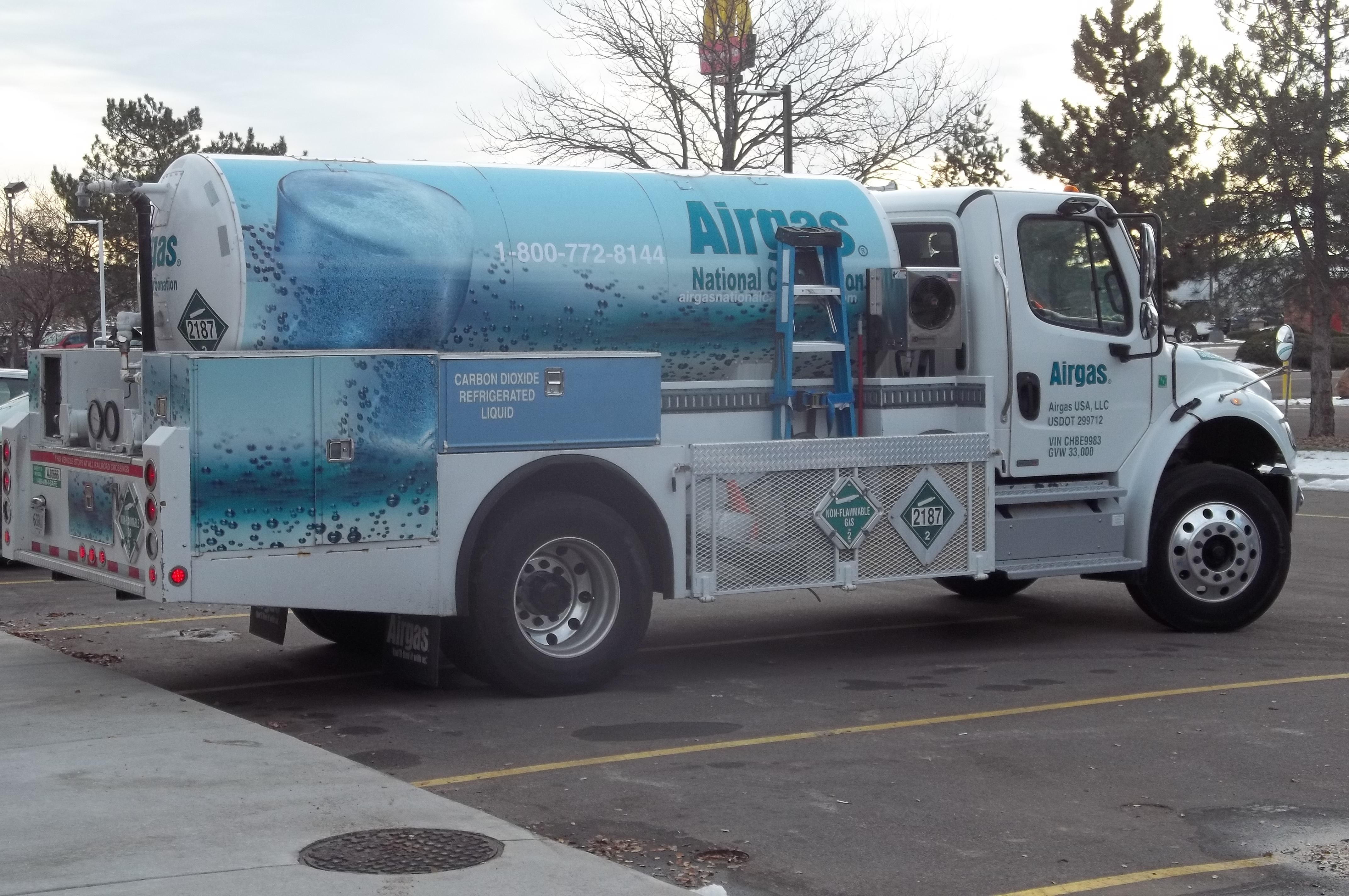
In this article I’ll take an example of HazMat transportation selected right from daily life and use the hazard communication methods (those I have available to me) to discern just what the HazMat is and what its potential hazards are. (more…)
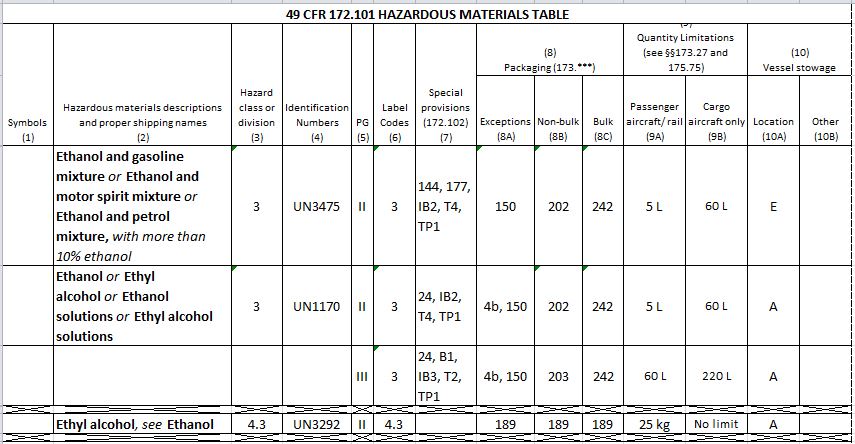
Fast Facts About Ethanol and the Hazardous Material Regulations of the PHMSA
Some interesting facts about the Ethanol industry from a brochure distributed by Growth Energy
Economic Impact:
- In 2013, the ethanol industry created and supported nearly 400,000 jobs. Moving to E15 would create an additional 136,000 jobs.
- A recent Louisiana State University study found ethanol reduces gas prices $.78/gallon – a consumer savings of more than $100 billion annually.
- In 2013, the ethanol industry contributed $44 Billion to the nation’s GDP and added $31 billion to household income.
- By creating a steady market for corn and other grains, ethanol helps to reduce federal farm program costs.
Environmental Impact:
- In 2013, the production and use of more than 13 billion gallons of ethanol in the U.S. reduced greenhouse gas emissions by 38 million metric tons, the equivalent of removing roughly 8 million automobiles from the road.
- Grain ethanol decreases greenhouse gas emissions by up to 57% compared to gasoline.
- Cellulosic ethanol is expected to reduce greenhouse gas emissions by 100% or more. Furthermore, the U.S. is home to more than one billion tons of available biomass that can be converted to 80-100 billion gallons of ethanol. This is a 50-state solution.
- New technologies are improving efficiencies and allowing ethanol biorefineries to make better use of natural resources like water.
- A recent USDA report shows ethanol is more energy efficient to produce than conventional gasoline. Every Btu put into creating ethanol is a 2.3 Btu return.
Energy Security:
- Every gallon of clean-burning ethanol that we produce in this country decreases the demand for foreign oil and keeps our money here at home where it can create American jobs.
- The production of more than 13 billion gallons of ethanol in 2013 displaced the need for 476 million barrels of oil.
- When the RFS was enacted in 2005, America imported 60% of its fuel. Today, we import 33%. Switching to domestic energy sources has helped reduce our dependence, strengthening our national security and our economy.
RFS The Renewable Fuel Standard (RFS) is a USA federal program that requires transportation fuel sold in the U.S. to contain a minimum volume of renewable fuels. The RFS originated with the Energy Policy Act of 2005 and was expanded and extended by the Energy Independence and Security Act of 2007 (EISA). Renewable Fuel Standard – Wikipedia, the free encyclopedia
en.wikipedia.org/wiki/Renewable_Fuel_Standard
Wikipedia
- We spend more than $300 billion a year – nearly $1,000 for every man, woman, and child in this country – on foreign oil.
Food and Fuel:
- A 2013 World Bank study outlines how crude oil prices are responsible for 50% of the increase in food prices since 2004.
- The real costs of putting food on the shelf are transportation, processing, and packaging – all costs driven by oil.
- The U.S. ethanol industry uses less than 3% of the global grain supply on a net basis.
- One-third of every bushel of corn used in ethanol production is returned to the food chain in the form of competitively-priced, nutritious animal feed – referred to as distiller’s grains.
- Since only the starch is used and distiller’s grains displace both corn and soybean meal, in reality only 17.5% of the net corn acres are used for renewable fuels. Academic, government, and third party research papers single out rampant Wall Street speculators, high oil prices, and the high costs of manufacturing, packaging and transporting groceries as the major drivers of increasing commodity prices and grocery store bills.
What does this have to do with the transportation of hazardous materials? Lots.  The ethanol industry is widely distributed throughout the U.S. – with the largest concentration in the Midwest – and promises to become more so as cellulosic ethanol production creates more potential feed-stocks for the the production of fuel-grade ethanol. All that production in the Midwest with the demand predominantly on the coasts means that a lot of hazardous materials: Ethanol and Ethanol and fuel mixtures; must be transported from their supply to the demand. Whether it’s by highway in a cargo tank motor vehicle, by rail in a tank car, or by vessel in a portable tank, the transportation in commerce of a hazardous material like ethanol requires compliance with the regulations of the Pipeline and Hazardous Materials Safety Administration (PHMSA). I’ve already had an opportunity to provide HazMat Employee training for the personnel of a few ethanol plants, and biodiesel plants as well. Contact me to provide HazMat Employee training for your employees involved in the transportation of hazardous materials.
Contact me with any questions you may have about the transportation of hazardous materials by air, highway, vessel, or rail International and Domestic Daniels Training Services 815.821.1550 |
| Growth EnergyAmerica’s Ethanol Supporters777 North Capitol StreetSuite 805 Washington, D.C. 20002 202.545.4000 GrowthEnergy.org EthanolRetailer.com AmericanEthanolRacing.com |
Packaging Wet Batteries for Transportation – 49 CFR 173.159
The transportation of various fluid-filled batteries containing either an acid electrolyte or an alkaline corrosive battery fluid will require the use of one of the following proper shipping names from the Hazardous Materials Table at 49 CFR 172.101:
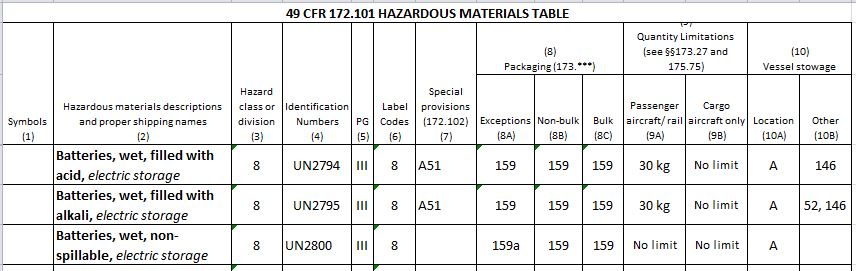
The first thing this tells us is that Wet Batteries, either filled with acid, filled with alkali, or non-spillable are a hazardous material when transported or offered for transportation in commerce. The purpose of this article is to identify and explain the packaging requirements of 49 CFR 173.159 for the transportation of Wet Batteries with a special emphasis on the exception from full compliance with the Hazardous Material Regulations (HMR) that’s available at §173.159(e). (more…)
Safety Advisory: Packaging and Handling Ebola Virus Contaminated Infectious Waste for Transportation to Disposal Sites
Announcements from regulatory agencies of the US Government in the Federal Register can have a profound impact on your business. Therefore it’s important for you to continuously monitor Federal Register publications for announcements applicable to your operations. I can help you to do this.
Sometimes an announcement in the Federal Register calls for a more thorough explanation than just what is conveyed by the headline. That is the point of this article. Here I will briefly summarize, and provide access to more information, on a specific Federal Register announcement: Safety Advisory: Packaging and Handling Ebola Virus Contaminated Infectious Waste for Transportation to Disposal Sites
What agency is making the announcement?
The Pipeline and Hazardous Materials Safety Administration (PHMSA), one of many administrations within the US Department of Transportation.
Daniels Training Services 815.821.1550 |
When was this announced in the Federal Register?
Thursday, October 30, 2014
Any other dates I need to know?
No
What type of action is this?
Safety Advisory Notice
What regulations may be impacted?
The entire HMR.
How is the announcement identified?
Safety Advisory: Packaging and Handling Ebola Virus Contaminated Infectious Waste for Transportation to Disposal Sites Pages 64646 – 64647 [FR DOC # 2014-25778]
I don’t have all day. Can you sum it up for me and I’ll determine if I need to read the whole thing?
It’s a short announcement, a total of three columns on two pages of the Federal Register. For the most part, it states the obvious: “Material contaminated or suspected of being contaminated with Ebola is regulated as a Category A infectious substance under the HMR” and must be packaged accordingly. And, “Ebola contaminated materials that have been appropriately incinerated, autoclaved, or otherwise inactivated are not considered Category A infectious substance and are not subject to the requirements of the HMR.”
It refers to the Government Employee Exemption of the HMR, which means that the transportation of Ebola-contaminated materials for disposal in a motor vehicle, aircraft, or vessel operated by a Federal, state, or local government employee is not subject to the HMR. However, PHMSA recommends compliance with appropriate safety requirements in the HMR when government employees transport Ebola-contaminated materials for disposal.
A special permit may be necessary to provide for a variance from the HMR packaging requirements in order to transport the large volume of contaminated wastes generated during treatment of Ebola patients. One special permit in particular is mentioned: Special Permit DOT-SP 16279. It is a non-site specific special permit issued to certain waste haulers authorizing the transportation for disposal of Ebola-contaminated waste. A waste hauler not yet authorized to use Special Permit DOT-SP 16279 may apply for party status.
What I believe is the greatest contribution of this PHMSA Safety Advisory is the sources of additional information it provides:
- PHMSA Guidance on Transporting Infectious Substances
- Centers for Disease Control and Prevention (CDC) guidance on how to handle infectious substances before transporting them
- DOT Guidance for Preparing Packages of Ebola
Contaminated Waste for Transportation and Disposal. Provides guidance for preparing packages containing Ebola-contaminated waste for transportation to off-site treatment and disposal.
- DOT Guidance for Transporting Ebola-Contaminated Items, a Category A Infectious Substance.
Provides common FAQs regarding the
HMR requirements for Category A infectious substances.
- Transporting Infectious Substances Safely. Brochure that explains the HMR for transporting infectious substance.
- Special Permit DOT-SP 16279 provides certain carriers with alternative authorized packaging options for transporting waste contaminated or suspected of being contaminated with the Ebola virus
for treatment and disposal. - All Centers for Disease Control and Prevention guidance regarding the Ebola virus.
Where can I look for more information?
Daniels Training Services 815.821.1550 |
October 2014 – Rules & Regulations, Proposed Rules, and Notices Regarding the Management of Hazardous Waste and the Transportation of Hazardous Materials
On its website the US Government Printing Office makes a wealth of Federal publications available for review and download; one of these is the Federal Register.
Published by the Office of the Federal Register, National Archives and Records Administration (NARA), the Federal Register is the official daily publication for rules, proposed rules, and notices of Federal agencies and organizations, as well as executive orders and other presidential documents.
See below for a brief summary of announcements in the Federal Register by the US EPA on the subject of Hazardous Waste and the Pipeline & Hazardous Materials Safety Administration (PHMSA), Federal Railroad Administration (FRA), Federal Motor Carrier Safety Administration (FMCSA), and the Federal Aviation Administration (FAA) of the US DOT on the subject of Transportation of Hazardous Materials.
The Federal Register is a great way to look down the road and see potential changes to the regulations long before they are put into effect (sometimes The Rulemaking Process takes years before a final rule is issued, if ever). Knowledge of these potential changes provides you with several advantages:
- Additional time to modify your business operations to comply.
- Awareness of on what topics the regulatory agencies intend to focus their efforts.
- The ability to register your concerns, complaints, suggestions, etc. in order to modify the proposed rule before a final rule is issued. It can be done, really!
- Make changes to your training program to account for changes that become effective before the next training cycle.
- Alert you to the need to re-train your employees prior to their next scheduled training cycle, if necessary.
- Keep you abreast of changes to the regulations that affect your business and/or your industry group.
Please note that this is my best effort to identify the relevant announcements in the Federal Register that may be of interest to generators of hazardous waste and shippers of hazardous materials. I encourage you to review the list of Federal Register publications yourself to ensure regulatory compliance.
October 1, 2014 through October 31, 2014

USEPA – US Environmental Protection Agency:
Publications not related to the management of hazardous waste, solid waste, universal waste, or used oil are not included here.
Rules and Regulations:
Arkansas: Final Authorization of State-Initiated Changes and Incorporation by Reference of State Hazardous Waste Management Program Pages 59438 – 59444 [FR DOC # 2014-23364] PDF | Text | More
Florida: Final Authorization of State Hazardous Waste Management Program Revisions Pages 60756 – 60759 [FR DOC # 2014-24006] PDF | Text | More
Criteria for the Certification and Recertification of the Waste Isolation Pilot Plant’s Compliance With the Disposal Regulations; Panel Closure Redesign Pages 60750 – 60756 [FR DOC # 2014-24025] PDF | Text | More
Arkansas: Final Authorization of State Hazardous Waste Management Program Revision Pages 64678 – 64682 [FR DOC # 2014-25724] PDF | Text | More
Proposed Rules:
Arkansas: Final Authorization of State-Initiated Changes and Incorporation by Reference of State Hazardous Waste Management Program Pages 59471 – 59472 [FR DOC # 2014-23363] PDF | Text | More
Florida: Final Authorization of State Hazardous Waste Management Program Revisions Pages 60795 – 60796 [FR DOC # 2014-24007] PDF | Text | More
Review Process To Determine Whether the Waste Isolation Pilot Plant Continues To Comply With the Disposal Regulations and Compliance Criteria Pages 61268 – 61271 [FR DOC # 2014-24260] PDF | Text | More
Arkansas: Final Authorization of State Hazardous Waste Management Program Revisions Pages 64721 – 64722 [FR DOC # 2014-25725] PDF | Text | More
Contact me with any questions you may have about the management of hazardous waste Daniels Training Services 815.821.1550 |
Notices:
None
FAA – Federal Aviation Administration:
Publications not related to the transportation of hazardous materials are not included here.
Rules and Regulations:

None
Proposed Rules:
None
Notices:
None
FMCSA – Federal Motor Carrier Safety Administration:
Publications not related to the transportation of hazardous materials are not included here.
Rules and Regulations:
None
Proposed Rules:
None
Notices:
Hours of Service of Drivers: Application for Renewal of Illumination Fireworks, LLC and ACE Pyro LLC Exemptions From the 14-Hour Rule During Independence Day Celebrations Pages 61687 – 61688 [FR DOC # 2014-24287] PDF | Text | More
FRA – Federal Railroad Administration:
Publications not related to the transportation of hazardous materials are not included here.
Rules and Regulations:
None
Proposed Rules:
None
Notices:
Proposed Agency Information Collection Activities; Comment Request Pages 59891 – 59893 [FR DOC # 2014-23511] PDF | Text | More
Proposed Agency Information Collection Activities; Comment Request Pages 62513 – 62517 [FR DOC # 2014-24688] PDF | Text | More
Proposed Agency Information Collection Activities; Comment Request Pages 63017 – 63018 [FR DOC # 2014-24987] PDF | Text | More
PHMSA – Pipeline and Hazardous Materials Safety Administration:
Publications not related to the transportation of hazardous materials are not included here.
Rules and Regulations:
None
Proposed Rules:
None
Notices:
List of Delayed Special Permit Applications Pages 59360 – 59361 [FR DOC # 2014-23077] PDF | Text | More
Office of Hazardous Materials Safety; Notice of Application for Special Permits; Special Permit Applications Pages 59552 – 59552 [FR DOC # 2014-23476] PDF | Text | More
Office of Hazardous Materials Safety; Notice of actions on Special Permit Applications Pages 59552 – 59554 [FR DOC # 2014-23478] PDF | Text | More
Office of Hazardous Materials Safety; Notice of Application for Special Permits Pages 63485 – 63486 [FR DOC # 2014-25167] PDF | Text | More
Office of Hazardous Materials Safety; Notice of Applications for Modification of Special Permit Pages 63486 – 63486 [FR DOC # 2014-25166] PDF | Text | More
Safety Advisory: Packaging and Handling Ebola Virus Contaminated Infectious Waste for Transportation to Disposal Sites Pages 64646 – 64647 [FR DOC # 2014-25778] PDF | Text | More
Information can be helpful but it’s useless if you are not able to make sense of it. You must be able to determine how any changes to the rules and regulations (final or proposed) will affect your operations, and communicate the necessary information to your personnel. I can help you to do that.
Contact me with any questions you may have about the transportation of hazardous materials by air, highway, vessel, or rail International and Domestic Daniels Training Services 815.821.1550 |
Please contact for a free training consultation to determine your regulatory requirements and how training can help you to attain and maintain compliance with the regulations of the US Environmental Protection Agency (and your state) and the PHMSA, FAA, FRA, & FMCSA of the US Department Of Transportation.
Use of the Electronic Manifest
The Hazardous Waste Electronic Manifest Establishment Act (e-Manifest Act) was signed into law by President Obama on October 5, 2012. It authorized the EPA to develop an electronic system for the tracking of hazardous waste manifests and create a system to collect fees to cover its operating costs. The EPA was given one year to promulgate regulations to turn the Act into a reality and three years to have an e-Manifest system fully operational. EPA announced a Final Rule in the February 7, 2014 Federal Register implementing the first portion of the e-Manifest Act.
The new rule, which created two new sections in Part 262 of Title 40 of the CFR (40 CFR 262.24 & 40 CFR 262.25) and modified others, is effective August 6, 2014. That doesn’t mean you can start emailing your manifests now, however; EPA has until October of 2015 to have a fully operational e-Manifest Tracking System and indicates it will issue a separate Final Rule in 2015 implementing the complete system.
A full review of how the e-Manifest Tracking System will work will have to wait for a later article. The purpose of this article is to explain the new regulations created in the CFR pertaining to the e-Manifest Tracking System. (more…)