PO Box 1232 Freeport, IL 61032

A Different Kind Of Training

A Different Kind Of Training

A Different Kind Of Training

Shipping description for non-friable asbestos

FAQ: Is Asbestos Waste a Hazardous Material? A Hazardous Waste?

Question:

I am the carrier for an asbestos waste that has been removed from schools, businesses, and residences.  Is it subject to PHMSA/USDOT regulations as a hazardous material (HazMat) when transported?  Please help!

Answer:

Asbestos waste may be a hazardous material according to PHMSA/USDOT regulations if it is friable (i.e. able to be reduced to powder by hand pressure).

  • Neither “asbestos”, “friable”, nor “non-friable” is defined by PHMSA/USDOT in its section of the regulations dedicated to definitions (49 CFR 171.8).
  • However, what PHMSA/USDOT considers applicable to its use of the term “asbestos” is found in the packing instructions referenced in column 8 of the Hazardous Materials Table (see below).
  • The term “non-friable” is explained in special provision 156 of column 7 of the Hazardous Materials Table (see below).
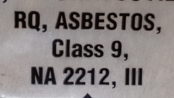
  • Asbestos is identified as the following proper shipping names in column 2 of the Hazardous Materials Table:
    • NA2212, Asbestos, 9, III
    • UN2212, Asbestos, amphibole amosite, tremolite, actinolite, anthophyllite, or crocidolite, 9, II
    • UN2590, Asbestos, chrysotile, 9, III
  • UN2212 & UN2590 are both more likely to be used for international transportation, whereas NA2212 is the preferred shipping description for asbestos when shipped within the U.S.
  • Each of the above shipping descriptions have the special provision code of 156 in column 7 of the Hazardous Materials Table.  It refers to PHMSA/USDOT’s explanation of a non-friable form of asbestos:

Asbestos that is immersed or fixed in a natural or artificial binder material, such as cement, plastic, asphalt, resins or mineral ore, or contained in manufactured products is not subject to the requirements of this subchapter.

Therefore, non-friable asbestos is not subject to the regulations of the PHMSA/USDOT when transported.
  • Column 8A of the Hazardous Materials Table indicates the packaging exceptions available for asbestos such as the Limited Quantity exception for packages of no more than 66 lbs each.
  • Packaging instructions for NA2212, Asbestos can be found at 49 CFR 173.216 for a non-bulk packaging and 49 CFR 173.240 for a bulk packaging.  In either section of the regulations, asbestos may be packaged as follows:
    • Must follow the general packing requirements, i.e. no HazMat residue on the outside of the container, container in good condition, &etc.
    • DOT specification packaging is not required.
    • Asbestos must be offered for transportation and transported in rigid, leak-tight packagings, such as metal, plastic or fiber drums, portable tanks, hopper-type rail cars, or hopper-type motor vehicles.
    • OR…
    • Bags or other non-rigid packagings in closed freight containers, motor vehicles, or rail cars that are loaded by and for the exclusive use of the consignor and unloaded by the consignee.
    • AND…
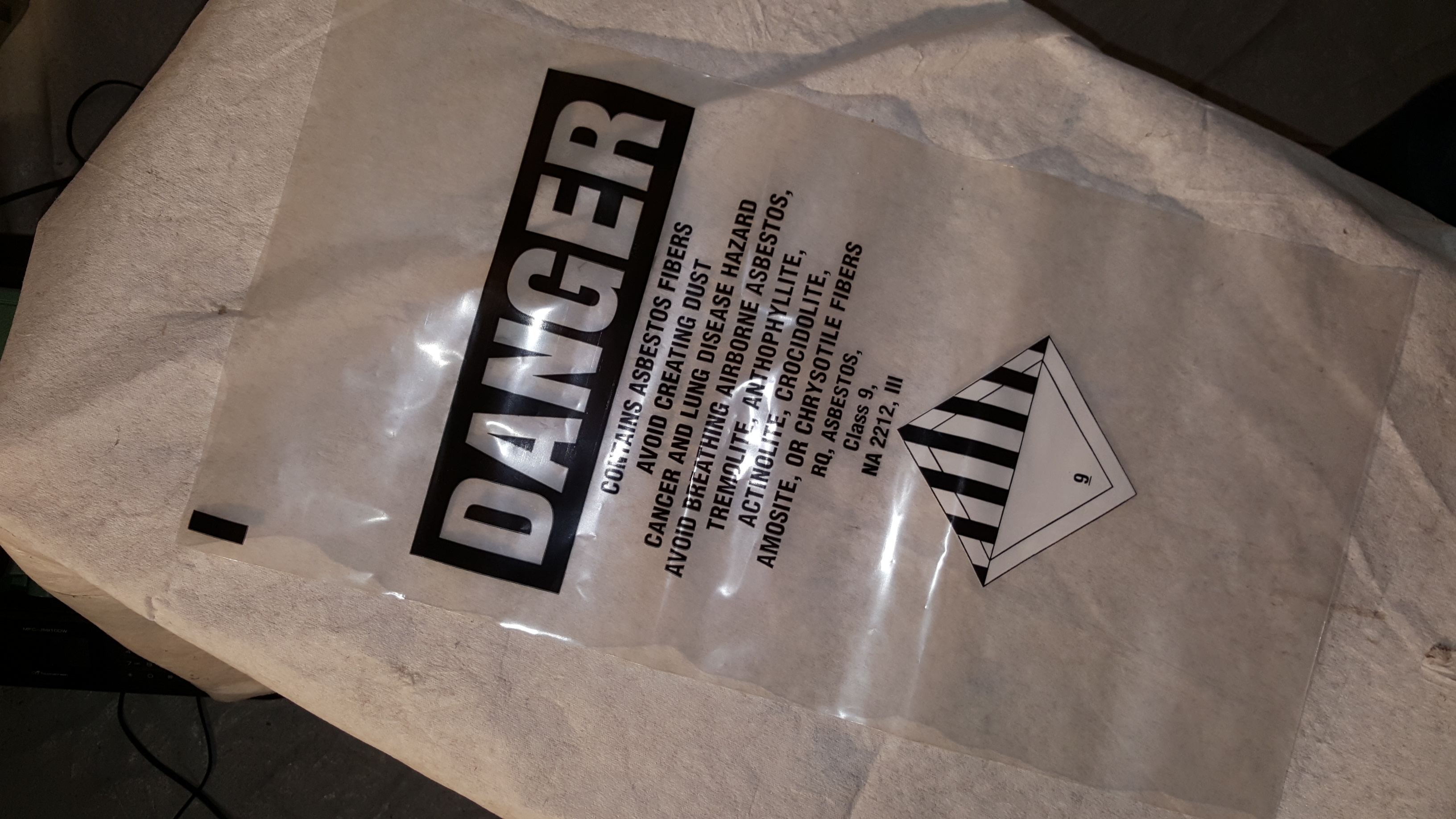
    • Bags or other non-rigid packagings which are dust and sift proof must be placed in rigid outer packagings or closed freight containers.Plastic bag packaging for transport of asbestos
In sum, the PHMSA/USDOT Hazardous Materials Regulations allow friable asbestos to be transported in non-rigid packagings, such as bags, as long as they are dust and sift proof and are placed inside rigid leaktight packagings and are not loaded or unloaded by anyone other than the shipper (its origin point) and its destination.
  • Asbestos is identified in Appendix A, Table 1 of the Hazardous Materials Table as a Hazardous Substance.  It is a Reportable Quantity (RQ) of a hazardous substance if it is contained in a single packaging in a quantity of one (1) pound or more.
    • However, The RQ for asbestos is limited to friable forms only.
    • A non-friable form of asbestos can not be a Hazardous Substance.
  • Non-friable asbestos is not identified in Appendix B of 49 CFR 172.102 as a marine pollutant.
  • Non-friable asbestos is not a hazardous waste per the regulations of the USEPA.

Contact me with any questions you may have about the transportation of hazardous materials by air, highway, vessel, or rail

International and Domestic

Daniels Training Services, Inc.

815.821.1550

Info@DanielsTraining.com

https://danielstraining.com/

Summary:

Friable asbestos is a hazardous material when offered for transportation or transported by a business.  Its transportation requires the use of authorized packagings (see above), a shipping paper with the shipping description and emergency information, and HazMat labels and markings on the packages.  Also, any persons involved in the loading, unloading, or transportation of friable asbestos (including drivers) must receive initial and triennial HazMat Employee training.
If non-friable, asbestos is not subject to PHMSA/USDOT’s HazMat transportation regulations.

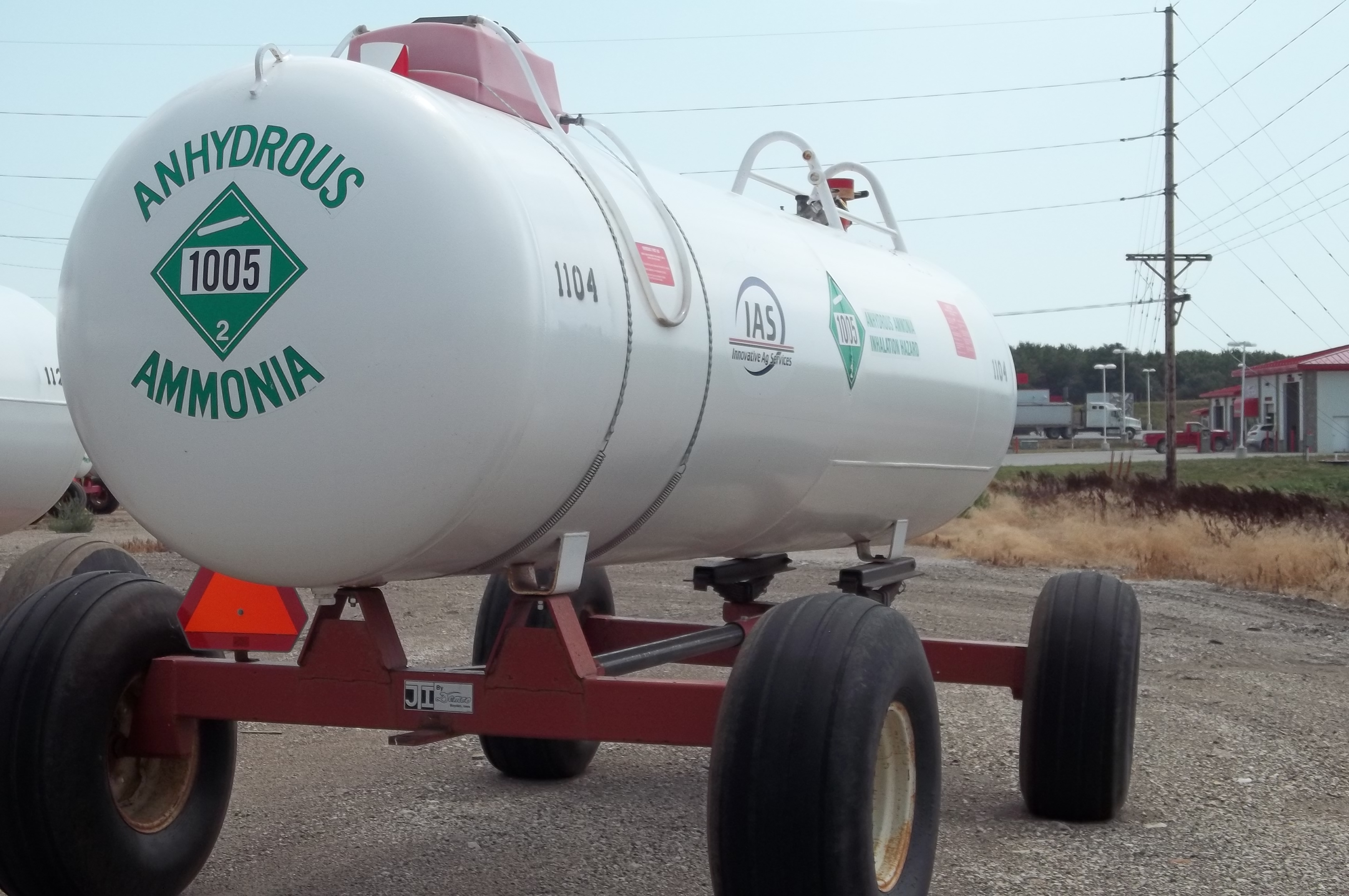
Q&A: Shipping Description for UN1005, Anhydrous Ammonia

From a member of the printing industry (not a customer) on December 14, 2016:
I’m looking for information on Anhydrous Ammonia,  I need the shipping paper detail for Anhydrous Ammonia 1005.  I’m a printer and have customers looking this information…. any information or direction on where to obtain the detail would be great!
My reply that day (12.14.16):
I can provide you with that information.
I am traveling today returning to the office tomorrow Thursday December 15th.
I will be able to get you the information you require no later than Friday December 16th.
My final reply – as promised – on December 16, 2016:
I will attempt to answer your question and provide information below:
  • There are two entries for anyhydrous ammonia in the Hazardous Materials Table at 49 CFR 171.101.  One is for use in international transportation (indicated by an ‘I’ in column 1) and the second is for use within the U.S. (indicated by a ‘D’ for Domestic in column 1).
  • Proper shipping description for use within the U.S.:  UN1005, Ammonia, anhydrous, 2.2.
    • Note:  As a compressed gas of Class 2, this HazMat is not assigned a packing group.
  • Per special provision 13 in column 7 the words “Inhalation Hazard” must be marked on the following:
  • No packaging exception is available for this HazMat.  This is indicated by the word “none” in column 8A of the Hazardous Materials Table.
  • This HazMat is forbidden for transport by air.  This is indicated by the words “none” in both columns 9A – for passenger aircraft – and 9B – for cargo aircraft – of the Hazardous Materials Table.
  • Authorized packagings are identified at 49 CFR 173.304 (non-bulk) and 173.314 & 315 for bulk.
I hope this helps.
Please don’t hesitate to contact me with any other questions.
And that must have done it because I didn’t hear from him again.
As you can see from the above, the transport of hazardous material can be made more complex when the variations created by column 1 (symbols) or column 7 (special provisions) of the Hazardous Materials Table are considered.  Contact me when you don’t know how to proceed and I will provide you with guidance.  Even if you’re not a customer!

Daniels Training Services, Inc.

815.821.1550

Info@DanielsTraining.com

https://danielstraining.com/

Ten Things About PHMSA

In a series of publications the U.S. Department of Transportation (USDOT) seeks to inform the public of its different responsibilities managed under its various bureaus and administrations.  This article refers to a particular issue of that series focusing solely on the Pipeline and Hazardous Materials Safety Administration (PHMSA).

Before we begin…

Created under the Norman Y. Mineta Research and Special Programs Improvement Act (P.L. 108-426) of 2004, PHMSA develops and enforces regulations for the safe, reliable, and environmentally sound operation of the nation’s 2.6 million-mile pipeline transportation system, and the nearly 1 million daily shipments of hazardous materials (HAZMAT) that travel by land, sea and air within the United States.

  1. Safety is the priority.
    Everything PHMSA does ultimately serves the purpose of promoting and improving safety; safety is why PHMSA exists.
  2. Regulations are important in ensuring safety.
    To minimize threats to life, property or the environment due to hazardous materials-related incidents, PHMSA develops regulations and standards for the classifying, handling and packaging of all hazardous materials (HAZMAT) shipments within the U.S., and the transportation of critical energy sources via our nation’s pipeline infrastructure. Click here to read more about HAZMAT and pipeline regulations.
  3. PHMSA monitors what’s happening with pipelines.
    The administration provides raw data, yearly summaries, multi-year trends of safety performance metrics, and inventories tracking the removal of aging pipeline infrastructure. Click here for data and statistics on all pipelines under PHMSA’s jurisdiction.
  4. PHMSA Monitors what’s happening with hazardous materials transportation.
    The administration tracks and provides statistical information on all incitements related to the transportation of HAZMAT within the U.S. Click here for data and statistics on HAZMAT transportation incidents within the U.S.

    Contact me with any questions you may have about the transportation of hazardous materials by air, highway, vessel, or rail

    International and Domestic

    Daniels Training Services, Inc.

    815.821.1550

    Info@DanielsTraining.com

    https://danielstraining.com/

  5. PHMSA works with first responders.
    PHMSA’s works closely with the emergency response communities to ensure they’re fully primed to deal with any type of HAZMAT or pipeline incident. One way it does so is producing critical training and reference materials. Click here to access one example of this, the Emergency Response Guidebook.
  6. PHMSA promotes and supports research.
    The agency sponsors projects focused on providing near-term solutions that will improve pipeline and HAZMAT safety. Click here for more information on research and development.
  7. PHMSA partners with states.
    The Office of Hazardous Materials Safety and the Office of Pipeline Safety each award about 70 grants every year to state agencies and Native American tribes through various grant programs.Click here to learn more about hazardous materials safety grants.  Click here to learn more about pipeline safety grants.
  8. PHMSA has a regional presence.
    Hazardous materials and pipeline offices are located in five regions to better serve the public. Click here to find PHMSA regional offices.
  9. PHMSA trains those who protect the public.
    The agency provides pipeline inspectors with the nation’s only specialized training for understanding and applying federal pipeline safety regulations and standards.The activities at the PHMSA Training Center, located in Oklahoma City, include in-depth classroom training and expanded outdoor/ lab areas to provide inspectors with hands-on opportunities to experience actual field scenarios.
  10. PHMSA can help members of the public find pipelines in their communities.
    The National Pipeline Mapping System’s (NPMS) Public Map Viewerincludes interactive maps showing the locations of hazardous liquid and gas transmission pipelines, and Liquefied Natural Gas (LNG) plants nationwide. Interested individuals also can access information about related pipeline incidents going back to 2002.

Did you learn something?  Not mentioned here is the requirement for HazMat Employers to provide initial and triennial training for their HazMat Employees (Read: What is HazMat Employee Training?)

PHMSA/USDOT Publishes DOT Chart 16. Replaces DOT Chart 15

Out with the old, in with the new!

The Pipeline and Hazardous Materials Safety Administration (PHMSA) has published the latest version of the Hazardous Materials Markings, Labeling, and Placarding Guide as DOT Chart 16. The following changes are included:

  • Inclusion of the “new” lithium battery mark (optional as of January 1, 2017, mandatory as of January 1, 2019) and the “old” lithium battery handling marking (optional until December 31, 2018, forbidden as of January 1, 2019).
  • Addition of the “new” Class 9 lithium battery handling label (optional as of January 1, 2017 and mandatory as of January 1, 2019).
  • Removal of the transitional all yellow Organic Peroxide 5.2 placard with the “new” red and yellow Organic Peroxide 5.2.  This transition was made final as of December 31, 2014.
  • The addition of information indicating the DOT Chart 16 is available as a free mobile app.

Contact me with any questions you may have about the transportation of hazardous materials by air, highway, vessel, or rail

International and Domestic

Daniels Training Services, Inc.

815.821.1550

Info@DanielsTraining.com

https://danielstraining.com/

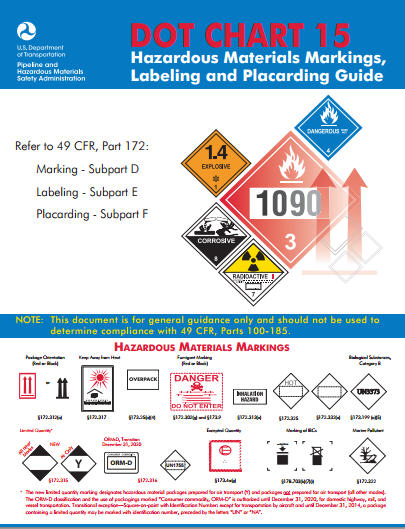
DOT Chart 15
Out with the old…


And of course, a disclaimer:  please note this chart is intended for general guidance only and should not be used to determine compliance with 49 CFR, Parts 100-185.

Click here to view DOT Chart 16 (PDF).

Hazardous Materials Information Center

Use the Hazardous Materials Regulations? Then you Must Bookmark These Pages

Compliance with the Hazardous Materials Regulations (HMR) of require access to them. Despite its intimidating size, likely you will only require knowledge of a small percentage of the entire HMR. Whatever your needs, below I have identified the parts and sections of the HMR with the most critical information. Be sure to bookmark these regulations for easy access.
Note: all of the below citations are found in Title 49 of the Code of Federal Regulations (49 CFR ***.***)

  • 171.8 – Definitions.  Almost every term PHMSA thought worthy of definition.
  • 172.101 Reference – UN & NA Lookup Tables.  This handy tool isn’t found in the official CFR published by the Government Printing Office but if your publication provides it, tab it.
  • 172.101 – Hazardous Materials Table.  By far the most important part of the HMR.  Take it a step further and bookmark the pages of the HazMat you routinely ship.
  • 172.101, Appendix A, Table 1 – Hazardous Substances Other Than Radionuclides.
  • 172.101, Appendix A, Table 2 – Radionuclides
  • 172.101, Appendix B – List of Marine Pollutants.  Whether you ship by vessel, rail, highway, or even air, you must determine if any substance you ship contains marine pollutants above the regulated threshold.
  • 172.102 – Special Provisions.  An explanation of the codes found in column 7 of the Hazardous Materials Table.
  • 172, Subpart C – Shipping papers.  Whether you use a bill of lading, uniform hazardous waste manifest, or some other shipping paper, you’ll find the requirements for its completion here.
  • 172, Subpart D – Marking.  The requirements for package marks on both bulk – this includes cargo tank trucks and rail tank cars – and non-bulk packagings.
  • 172, Subpart E – Labeling.  The labeling requirements for non-bulk packagings (mostly) and some options for labeling of bulk packagings.
  • 172, Subpart F – Placards. Placards are usually displayed on vehicles but may sometimes be required on bulk packagings that themselves are loaded into or on vehicles.
  • 172, Subpart G – Emergency Response Information.  An identification and description of the two types of emergency information the shipper must provide to the carrier.
  • 172, Subpart H – Training.  The responsibility of a HazMat Employer to provide initial and triennial training for their HazMat Employees.  Read: HazMat Employee Training
  • 172, Subpart I – Safety and Security Plans.  Is your facility subject to the requirement to have a Safety and Security Plan and to provide In-Depth Security Training?  This subpart identifies applicability and explains the requirements.


Contact me with any questions you may have about the transportation of hazardous materials by air, highway, vessel, or rail

International and Domestic

Daniels Training Services, Inc.

815.821.1550

Info@DanielsTraining.com

https://danielstraining.com/

  • 173.2 – Hazardous materials classes and index to hazard class definitions.  Every hazardous material must meet the definition of at least one hazard class, or division of a hazard class.
  • 173.2a – Classification of a material having more than one hazard.  Critical if you ship any solutions or mixtures not identified in the Hazardous Materials Table that have more than one potential hazard.  Unnecessary if you don’t.
  • 174 – Carriage by Rail.  Applicable to rail carriers but of interest to those who ship HazMat by rail.
  • 175 – Carriage by Aircraft.  This part is applicable to some helicopter operations.  It is largely superseded by the Dangerous Goods Regulations of the International Air Transport Association (IATA).
  • 176 – Carriage by Vessel.  An option for carriers of HazMat by vessel within U.S. territorial waters.  Another option is the International Maritime Dangerous Goods Code.
  • 177 – Carriage by Highway.  Includes load securement and segregation requirements that may be applicable to a shipper of HazMat.
  • 178 – Packaging Specifications.  The requirements for design, testing, manufacture, and marking of packagings to meet either a United Nations or USDOT specification.  Almost all of them.  The specifications for rail tank cars are found in 179.

That should be a good start.  As you become more familiar with the HMR you may find it useful to bookmark other pages or eliminate some entirely.

$63,000 Civil Penalty for Improper Shipment of Hazardous Material

The Bullet:

The FAA has proposed a civil penalty of $63,000 against a company that offered for shipment a hazardous material by air that did not comply with USDOT regulations.  Employees of UPS noticed the leaking package and – as required – notified the FAA.

Read the press release:  FAA Proposes $63,000 Civil Penalty Against Terrazzo USA for Alleged Hazardous Materials Violations

Who:

The shipper is Terrazzo USA & Associates, Inc., of McLoud, OK.

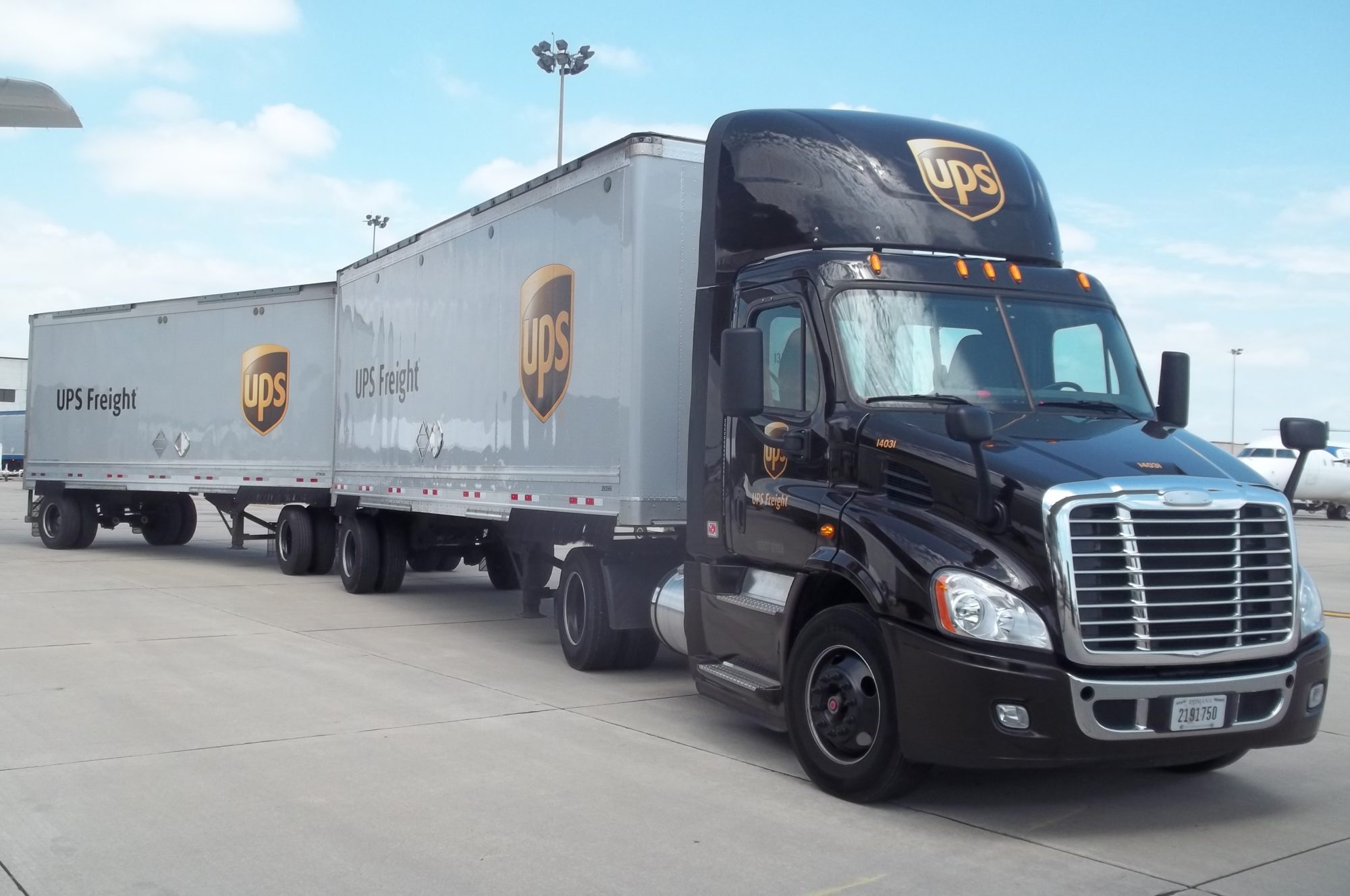
The carrier for this HazMat shipment is United Parcel Service (UPS).UPS tandem trailer

FAA is the Federal Aviation Administration.  It is one of thirteen administrations and bureaus within the U.S. Department of Transportation (USDOT).

Contact:  Elizabeth Isham Cory / Phone: 847-294-7849 / Email: elizabeth.cory@faa.gov

Another administration within the USDOT, the Pipeline and Hazardous Materials Safety Administration (PHMSA), has overall responsibility for the regulations of hazardous materials transportation within the U.S.

What:

A $63,000 penalty is proposed for alleged violations of the Hazardous Materials Regulations.  The alleged violations of the shipper include:

  • Did not provide signed copy of the shipping paper describing the hazardous material.
  • Package did not display the required marks or labels.
  • HazMat was not packaged in authorized packaging.  Nor was it packaged properly to prevent loss of contents during transportation.
  • Emergency response information was not included on the shipping paper.
  • Shipper did not provide HazMat Employee training for its employees responsible for the safe transport of hazardous materials.

The HazMat shipped is:  Master Flex Flexible Hardener.  A liquid Class 8 Corrosive Material.

Where:

The leaking package was detected at the UPS sort facility in Austin, TX.

When:

Date of incident:  June 23, 2016

Date of publication of this notice: June 28, 2017

Terrazo has 30 days from receipt of FAA’s enforcement letter to respond to the agency.

Why:

This incident may not have come to light at all if UPS employees had not noticed the package was leaking and notified the FAA.

How:

The FAA is authorized by USDOT to take the lead in the enforcement of PHMSA regulations when the transport of HazMat is by air within the U.S.

Conclusion:

The original violation in this situation, the one that if addressed initially would have prevented all of the others (and this bad press) is the shipper’s failure to provide initial and triennial HazMat Employee training for its personnel.  It may seem that the cost of good training and the difficulties in getting all of your HazMat Employees into a classroom at the same time is too much but consider the alternative.  One shipment.  One package.  One call to the FAA.  $63,000 penalty.  Not to mention other costs in time and stress responding to the FAA.

UPS is one of the few air carriers that provides the option of complying with PHMSA/USDOT regulations for the transport of HazMat by air within the U.S.  Most air carriers require compliance with the Dangerous Goods Regulations of the International Air Transport Association (IATA).  It is possible that this shipment was subject to the Dangerous Goods Regulations of IATA which has requirements similar to – and even more strict – than those of the PHMSA/USDOT.  Either way, compliance with IATA or PHMSA/USDOT regulations within the U.S. is required for transport of dangerous goods (aka: HazMat) by air and is subject to enforcement by FAA.

Contact me to assist you in providing the required training for your HazMat Employees

100

FAQ: Do I need an “All Clean” Certificate for my Cargo Tank Truck of HazMat?

Question:

I have been asked to transport a cargo tank truck containing the residue of a hazardous material, e.g. gasoline.  I do not have the HazMat endorsement on my Commercial Driver’s License (CDL).  If the cargo tank was empty I could transport it without the HazMat endorsement.  Do I require a certification of some type to ensure the cargo tank is empty before I accept it for transportation?

Answer:

No.  The Hazardous Materials Regulations (HMR) of PHMSA/USDOT do not apply to a cargo tank that once contained HazMat if it has been “…sufficiently cleaned of residue and purged of vapors to remove any potential hazard.”

Other requirements apply.  Read:  Requirements for Transport of Empty Packagings with HazMat Residue

However, the HMR does not establish a standard or require a certification for “…sufficiently cleaned of residue and purged of vapors to remove any potential hazard.”  While some establishments may offer this “certification” for their cleaning services, in the end it is up to the shipper of the HazMat to determine the status of the cargo tank and comply with the applicable regulations.

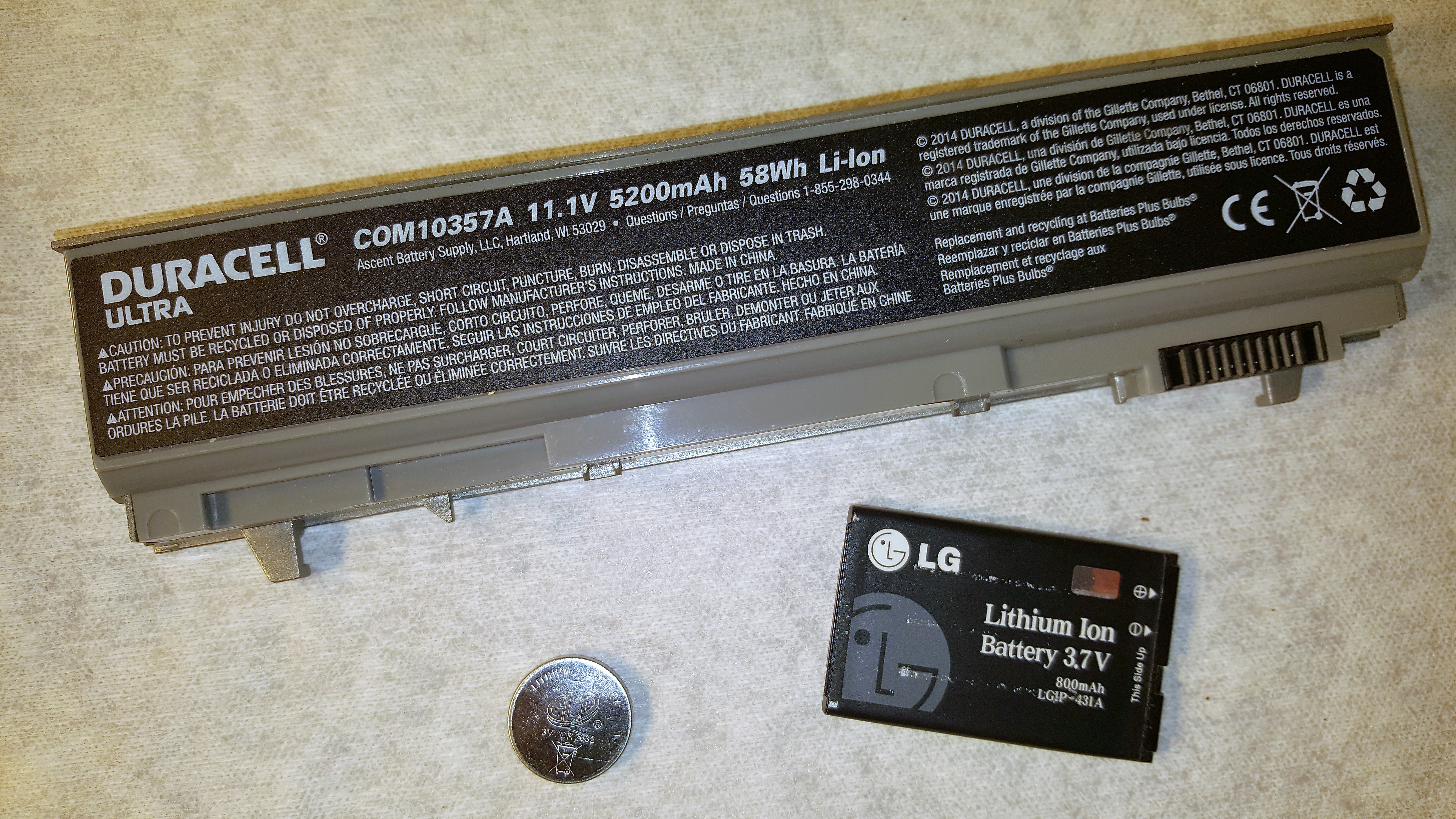
Lithium ion batteries

General Requirements and Provisions for the Transportation of Lithium Batteries

The transportation of a lithium cell or battery requires the shipper to ensure it meets certain standards of testing and production before its transportation in commerce can be considered. The purpose of this article is to identify and explain the general requirements applicable to all transportation of a lithium cell or battery.

The regulations this article seeks to explain can be found as follows (current as of August 2017):

  • The Hazardous Materials Regulations (HMR) of the Pipeline and Hazardous Materials Safety Administration (PHMSA) of the USDOT at 49 CFR 173.185(a).
  • The Dangerous Goods Regulations (58th Edition) of the International Air Transport Association (IATA) at 3.9.2.6.
  • The International Maritime Dangerous Goods Code (IMDG) at 2.9.4
  • Section 349 of Publication 52 of the United States Postal Service (USPS).

Daniels Training Services, Inc.

815.821.1550

Info@DanielsTraining.com

https://danielstraining.com/

Regulation:  Cell or Battery Proven to Meet UN Criteria:

Applicability:

  • PHMSA/USDOT:  yes
  • IATA:  yes
  • IMO:  yes
  • USPS:  yes.  USPS contains a specific reference to this requirement and blanket statement: “All packaging must meet all applicable requirements specified in 49 CFR 173.185.”

And…

  • All lithium cells and batteries regardless of lithium content or Watt-hour rating.
  • It is the responsibility of the shipper of the lithium cell or battery to ensure compliance with this regulation.

What it Requires:

  • Each cell or battery must be of a type proven to meet the criteria in part III, sub-section 38.3 of the UN (United Nations) Manual of Tests and Criteria.
  • Cells and batteries – including those that have been refurbished or otherwise altered – must meet the above-referenced UN criteria regardless of whether the cells used to construct the battery are composed of a tested type.
  • A battery or cell manufactured according to a type that meets the requirements of sub-section 38.3 of the UN Manual of Tests and Criteria, Revision 3, Amendment 1 or any subsequent revision and amendment applicable at the date of the testing may continue to be transported, unless otherwise provided in the regulations.
  • A battery or cell type that only meets the requirements of the UN Manual of Tests and Criteria, Revision 3, are no longer valid.  However, a battery or cell manufactured in conformity to the UN Manual of Tests and Criteria, Revision 3 before July 2003 may continue to be transported if all other applicable requirements have been met.

Comments:

  • It is the responsibility of the shipper to obtain confirmation from the battery manufacturer or supplier this requirement has been met.
Regulation:  Maintain a Record of Completion of Testing:

Applicability:

  • PHMSA/USDOT:  yes
  • IATA:  no
  • IMO:  no
  • USPS:  yes, “All packaging must meet all applicable requirements specified in 49 CFR 173.185.”

And…

  • All lithium cells and batteries regardless of lithium content or Watt-hour rating.
  • It is the responsibility of the manufacturer of the lithium cell or battery to ensure compliance with this regulation.

What it Requires:

  • Create a record of satisfactory completion of the required testing (i.e. the UN Manual of Tests and Criteria referred to above).
  • Maintain the record for as long as the lithium cell or battery design is offered for transportation and for one year thereafter.
  • Make the record available to an authorized representative of Federal, state, or local government upon request.

Comments:

  • This regulation – unique to PHMSA/USDOT and, by incorporation, USPS – specifically applies to the manufacturer of the cell or battery.

Like this article?

Subscribe to my Monthly Newsletter

No marketing emails!

Regulation:  Lithium Battery or Cell Design:

Applicability:

  • PHMSA/USDOT:  yes
  • IATA:  yes
  • IMO:  yes
  • USPS:  yes, “All packaging must meet all applicable requirements specified in 49 CFR 173.185.”

And…

  • This requirement does not apply to a lithium cell or battery subject to the “smaller lithium battery exception”.
  • It is the responsibility of the shipper of the lithium cell or battery to ensure compliance with this regulation.

What it Requires:

Each cell or battery must:

  • Incorporate a safety venting device or be designed to prevent a violent rupture under normal transportation conditions.
  • Be equipped with effective means of preventing external short circuits.
  • Be equipped with effective means of preventing dangerous reverse current flow (e.g. diodes or fuses).  This requirement is applicable solely to a battery that contains cells or a series of cells connected in parallel.

Comments:

  • Refer to this table for threshold lithium content for classification of a “smaller lithium battery”.
Industry and EPA hazardous waste No.Hazardous wasteHazard code
F020Wastes (except wastewater and spent carbon from hydrogen chloride purification) from the production or manufacturing use (as a reactant, chemical intermediate, or component in a formulating process) of tri- or tetrachlorophenol, or of intermediates used to produce their pesticide derivatives. (This listing does not include wastes from the production of Hexachlorophene from highly purified 2,4,5-trichlorophenol.)(H)
F021Wastes (except wastewater and spent carbon from hydrogen chloride purification) from the production or manufacturing use (as a reactant, chemical intermediate, or component in a formulating process) of pentachlorophenol, or of intermediates used to produce its derivatives(H)
F022Wastes (except wastewater and spent carbon from hydrogen chloride purification) from the manufacturing use (as a reactant, chemical intermediate, or component in a formulating process) of tetra-, penta-, or hexachlorobenzenes under alkaline conditions(H)
F023Wastes (except wastewater and spent carbon from hydrogen chloride purification) from the production of materials on equipment previously used for the production or manufacturing use (as a reactant, chemical intermediate, or component in a formulating process) of tri- and tetrachlorophenols. (This listing does not include wastes from equipment used only for the production or use of Hexachlorophene from highly purified 2,4,5-trichlorophenol.)(H)
F026Wastes (except wastewater and spent carbon from hydrogen chloride purification) from the production of materials on equipment previously used for the manufacturing use (as a reactant, chemical intermediate, or component in a formulating process) of tetra-, penta-, or hexachlorobenzene under alkaline conditions(H)
F027Discarded unused formulations containing tri-, tetra-, or pentachlorophenol or discarded unused formulations containing compounds derived from these chlorophenols. (This listing does not include formulations containing Hexachlorophene sythesized from prepurified 2,4,5-trichlorophenol as the sole component.)(H)
Regulation:  Manufactured Under a Quality Management Program:

Applicability:

  • PHMSA/USDOT:  no
  • IATA:  yes
  • IMO:  yes
  • USPS:  no, “All packaging must meet all applicable requirements specified in 49 CFR 173.185.”

And…

  • All lithium cells and batteries regardless of lithium content or Watt-hour rating.
  • It is the responsibility of the shipper of the lithium cell or battery to ensure compliance with this regulation.

What it Requires:

Lithium cell or battery must be manufactured under a quality management program that includes:

  1. A description of the organizational structure and responsibilities of personnel with regard to design and product quality.
  2. The relevant inspection and test, quality control, quality assurance and process operation instructions that will be used.
  3. Process controls that should include relevant activities to prevent and detect internal short circuit failure during manufacture of cells.
  4. Quality records, such as inspection reports, test data, calibration data and certificates.  Test data must be kept and made available to the appropriate national authority upon request.
  5. Management reviews to ensure the effective operation of the quality management program.
  6. A process for control of documents and their revision.
  7. A means for control of cells or batteries that are not conforming to the UN criteria (referred to earlier in this article).
  8. Training programs and qualification procedures for relevant personnel.
  9. Procedures to ensure that there is no damage to the final product.

Also…

  • An in-house quality management program may be accepted.
  • Third party certification of the quality management program is not required.
  • The procedures listed above (1 – 9) must be properly recorded and traceable.
  • A copy of the quality management program must be made available to the appropriate national authority (i.e. USDOT within the U.S.) upon request.

Comments:

  • Interestingly, there is no reference to the quality management program, or anything like it, in the Hazardous Materials Regulations of PHMSA/USDOT.
  • The reference in the last bullet point to “a copy of…” the quality management program implies that it be in the form of a document.
  • The requirements of the quality management program listed above (1 – 9) are almost verbatim as they appear in the dangerous goods regulations of IATA and IMO.  I could find no way to summarize them.

Contact me with any questions you may have about the transportation of hazardous materials by air, highway, vessel, or rail

International and Domestic

Daniels Training Services, Inc.

815.821.1550

Info@DanielsTraining.com

https://danielstraining.com/

There you have it!  As a shipper of lithium cells or batteries, don’t overlook the general requirements of the regulations and focus solely on the packaging requirements.  Compliance with these general requirements is what makes the safe transportation of lithium cells and batteries possible.

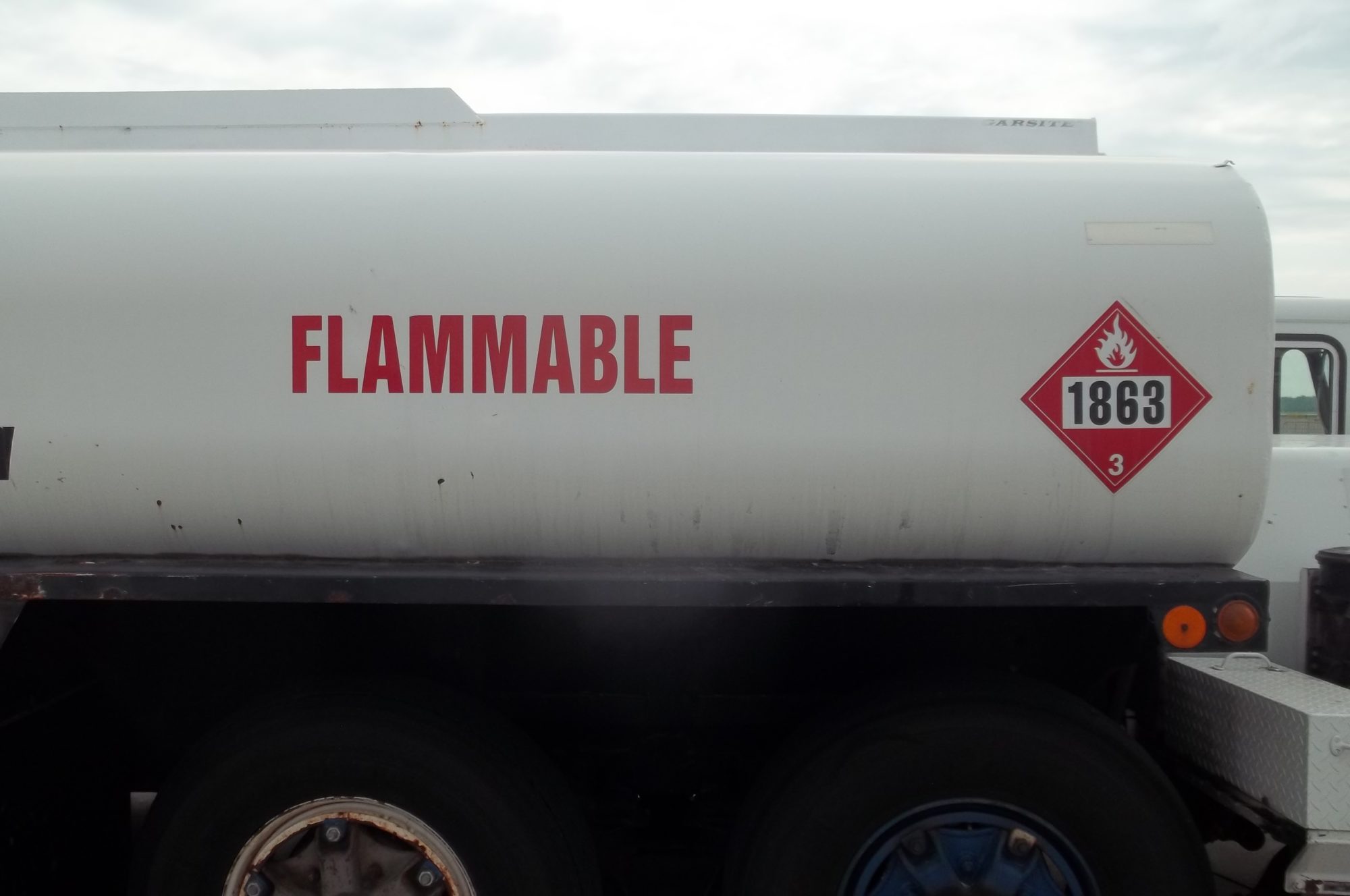
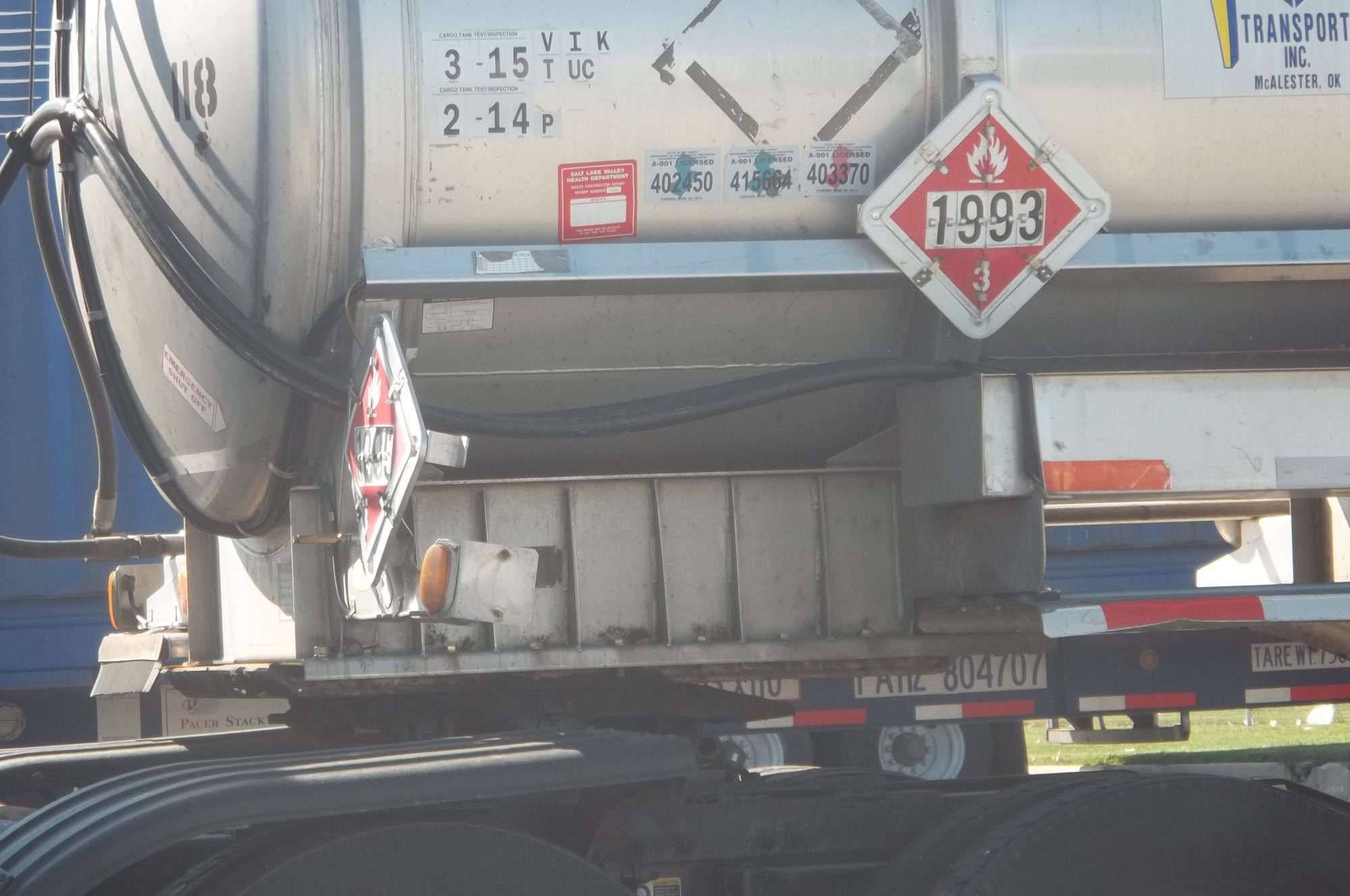
Placard and identification number for diesel fuel

Q&A: Are my Deck Engines and Diesel Fuel Subject to the Hazardous Materials Regulations?

From the contact form on my website on December 9, 2016:

We have a trailer with two Deck Engines w/ a 400 Gal. Diesel Tank that supply’s Fuel to both engines.

Question 1. Do we have to Placard the on all for sides of the tank.

2. Does the driver need a Haz-mat Endorsement. Thanks.

(the email included a picture of a flat bed trailer hauling the deck engine and two intermediate bulk containers of diesel fuel.)

Contact me with any questions you may have about the transportation of hazardous materials by air, highway, vessel, or rail

International and Domestic

Daniels Training Services, Inc.

815.821.1550

Info@DanielsTraining.com

https://danielstraining.com/

My reply December 11th:

Please see below:

  • Diesel fuel is classified as a Class 3 Combustible Liquid.
  • The diesel tanks on the trailer classify as a bulk packaging. The packaging is known as an IBC or Intermediate Bulk Container.
  • A bulk packaging of a combustible liquid is not subject to the exception at 49 CFR 173.150(f).
  • The requirements to use DOT specification packaging is not applicable to a bulk packaging of a Class 3 Combustible Liquid.
  • The placarding requirements of 49 CFR 172, subpart F do apply to this HazMat.
  • Per 49 CFR 172.514(c)(4) an IBC is required to display the applicable placards on two opposing sides. The 4-digit identification number must appear on or near the placard. Alternatively, the IBC may display HazMat labels and the proper shipping name and identification number on only one side.  Read:  HazMat Labels, Placards, and Marks on an IBC.
  • Per 49 CFR 172.504(a) each transport vehicle required to display placards (as in this situation) must display them on all four sides of the vehicle.
  • 49 CFR 172.516(a) requires the placards to be visible from the direction they face.
  • The placards on the IBCs may suffice to replace the required placards on the side of the truck that the placarded IBCs face. In short, if placards are displayed on the IBCs so that they are visible from all four sides of the vehicle, you can meet both requirements with the same 4 placards. A more conservative approach is the display placards or HazMat labels on the IBCs as required and also display placards on all four sides of the vehicle.

I hope this helps.

Please don’t hesitate to contact me with any other questions.

I guess that did it because I didn’t hear back from him.

Please feel free to contact me if you have any questions about the transportation of a combustible liquid.  See below for links to other articles for more information.

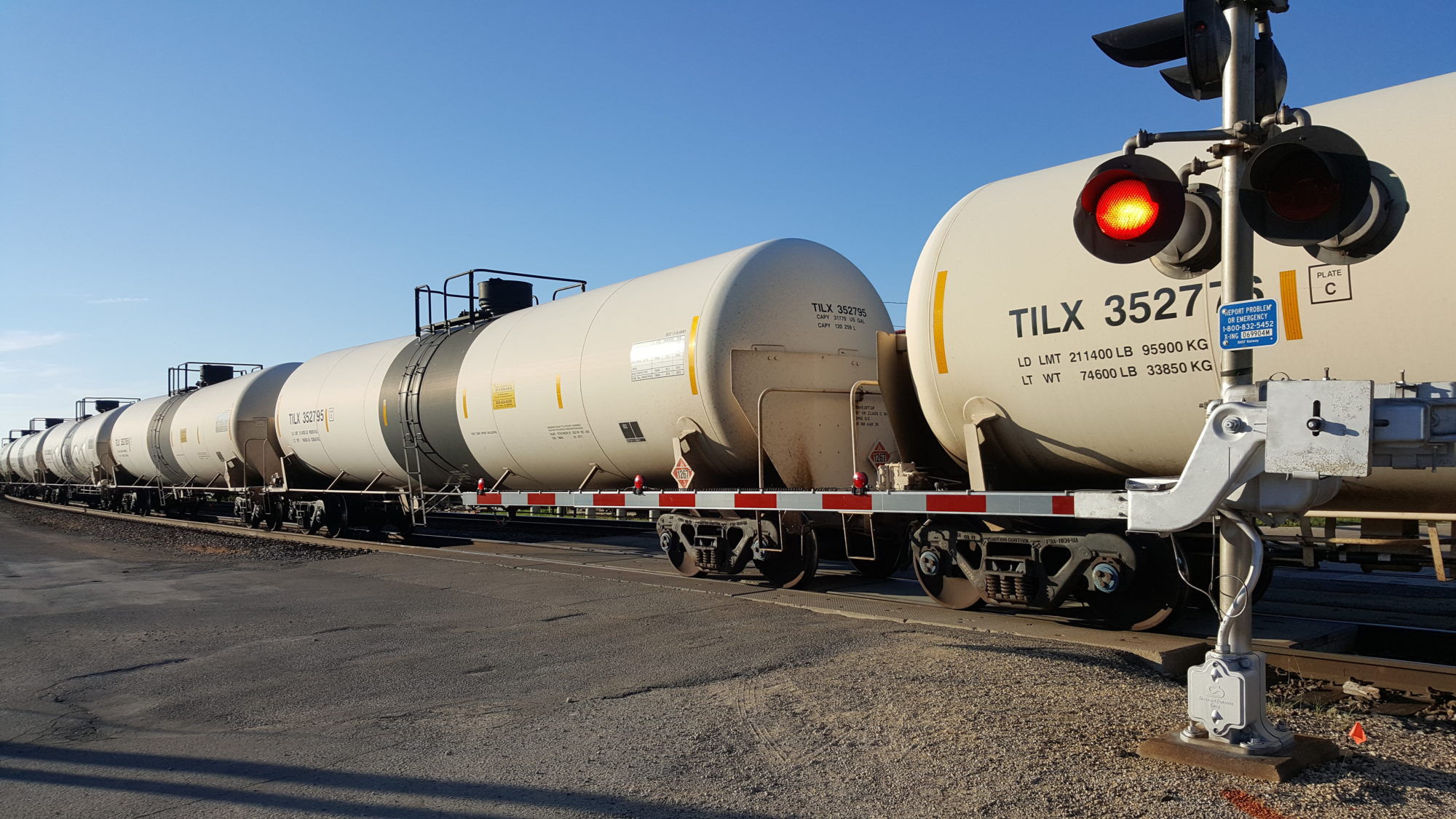
rail car of HazMat

Top Ten Best Practices For Rail Shippers

If you ship hazardous materials by rail there are a lot of things you have to take into consideration in addition to the standard requirements of all HazMat shippers.  These include:

  • The requirements and limitations on the use of tank cars for specific HazMat at 49 CFR 173.10
  • The requirements for loading/unloading and preparing tank cars for transportation at §173.31.
  • The marking requirements for tank cars and multi-unit tank car tanks at §173.330.
  • The additional planning requirements for transportation by rail at §172.820 within the existing regulations for a Safety and Security Plan in Subpart I of Part 172.
  • The option for use of an electronic shipping paper available at §172.201(a)(5).

…and others found throughout the Hazardous Materials Regulations.

While the guidance below will not ensure complete compliance with the HMR, it will assist a shipper of HazMat by rail to identify the best practices to achieve compliance.

Contact me with any questions you may have about the transportation of hazardous materials by air, highway, vessel, or rail

International and Domestic

Daniels Training Services, Inc.

815.821.1550

Info@DanielsTraining.com

https://danielstraining.com/

  1. Develop and implement a securement policy which includes pre-loading inspections, post-loading inspections and corresponding safety checklists.
    • Special attention should be given to ensure that no overloading of rail cars occurs, especially hazardous materials.
  2. Perform extra inspections of valves and manways for tightness (one of the leading causes of leaks/spills in rail transportation incidents).
    • After loading, leak-test the car by applying at least 10 psig of pressure over the maximum estimated transportation pressure. all valves, packing gland nuts, closures and flanges should be checked using leak detection solution or ultrasonic instrument. After completing the leak test, pressure should be released or reduced.
    • If a pressure test is impractical or unsafe, the car should be held and reinspected after twenty-four (24) hours, and valves and fittings tightened as needed to ensure proper securement.
  3.  Review shipping papers to ensure the proper information is provided.
    • Promote electronic data interchange (EDI) for all shipments.
  4. Ensure that proper placarding is maintained for all rail cars.
    • Shippers should eliminate using paper placards whenever possible.
  5. For Canadian shipments ensure that the emergency response plan is correct and updated for plant sites and transportation related releases.
    • Ensure that the emergency response plan is exercised annually (drill).
    • Shippers should show proper ERP number and associated telephone number on dangerous goods subject to the EDP requirements of transport Canada.
    • Ensure that emergency contacts ans telephone numbers and plant site are correct and updated regularly.
  6. Key training programs should be implemented to:
    • Ensure that all railroad personnel who enter a plant site are properly trained and/or receive orientation (especially for emergency actions).
    • Establish, document, communicate and implement a company-wide tank car securement training program.
    • Establish , document, train and implement a procedure for tank car customers to report poor securement, hard-to-operate valves and other fitting problems.
    • Establish , document, train and implement company-wide preventative maintenance practices for tank cars.
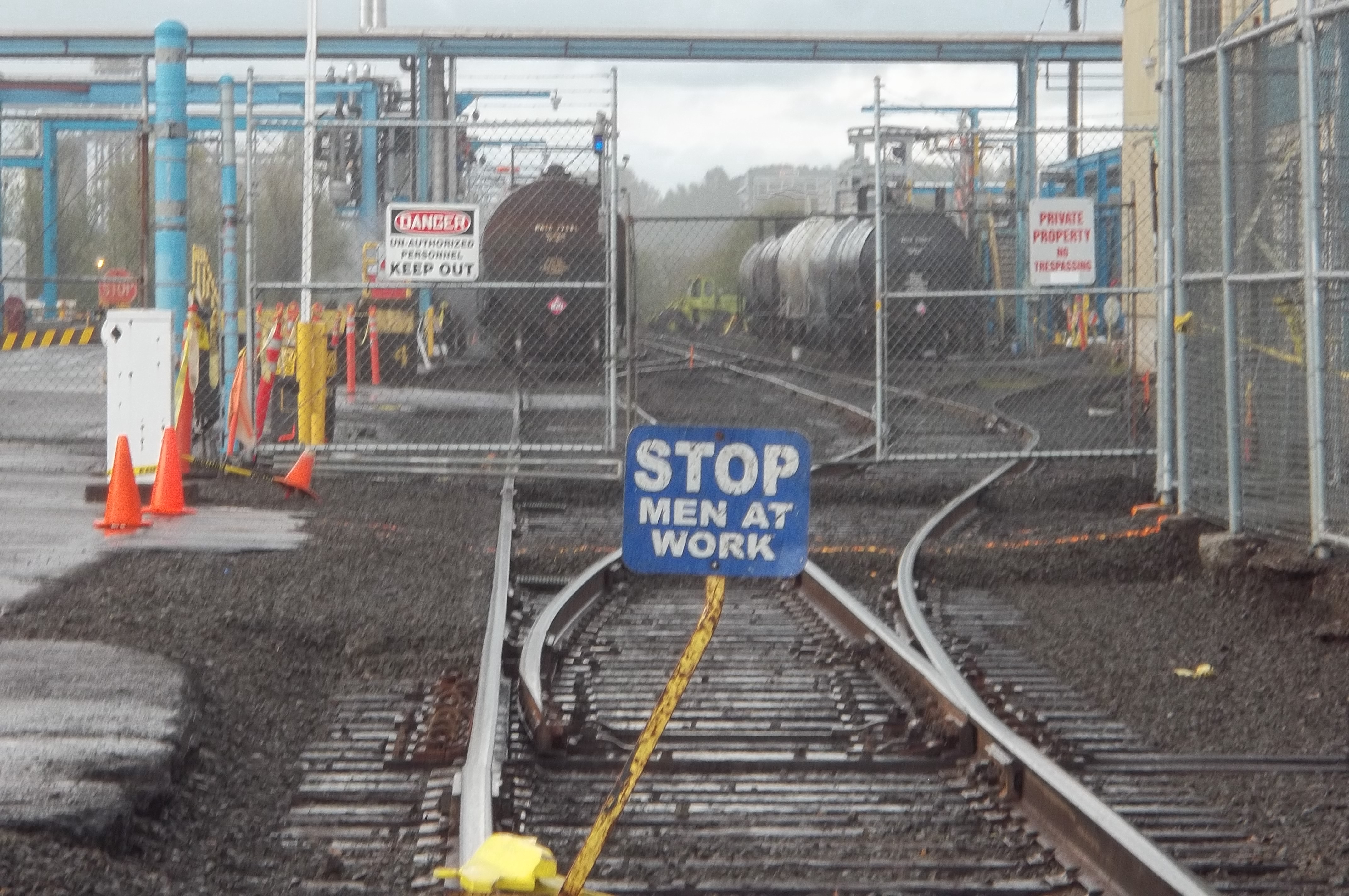
  7. STOP Men at WorkEnsure that all rail crossings within the plant site are properly marked with warning signs.
  8. Ensure rail lines are clear, switches are aligned properly, and car brakes are released before moving cars.
  9. Have plant personnel closely observe rail crews when they are operating within a plant site to assure plant and rail safety are being maintained.
  10. Have a documented routine process for providing feedback to the rail carrier.

Search Website