PO Box 1232 Freeport, IL 61032

A Different Kind Of Training

A Different Kind Of Training

A Different Kind Of Training

Small Business Environmental Assistance Program of the Minnesota Pollution Control Agency

The Bullet:

The Small Business Environmental Assistance Program (SBEAP) provides free, confidential, environmental assistance to small businesses.

Who:

The Small Business Environmental Assistance Program (SBEAP) is a service provided by the Minnesota Pollution Control Agency (MPCA).  The MPCA is the state agency authorized by the USEPA to regulate the protection of the environment (air, land, & water) in Minnesota.

Small businesses are generally defined as independently owned and operated businesses with fewer than 100 employees that are not major sources of waste or emissions.

What:

The focus of the SBEAP is compliance assistance with the regulations of the MPCA, but assistance is also available for going beyond compliance into reducing the regulatory burden faced by small businesses. The SBEAP promotes pollution prevention, best management practices, environmental stewardship, and sustainability.

Where:

Anywhere in the “Land of 10,000 Lakes”.

When:

Assistance begins when you pick up the phone and make the call.

Small Business Environmental Assistance Program staff

  •  Staff: Angie Bourdaghs, Nate Grand, Tom Jablonski, Hien Le, and Aneka Swanson.
  • Hotline: 651-282-6143 or toll free 800-657-3938
  • Fax: 651-297-8701
Why:

Well, it ain’t for the paycheck, the services are free, non-regulatory, and impose no obligations.  If you meet the definition of a small business then this free service is provided by the taxpayers of Minnesota.  And if confidentiality is a concern,

Business-specific information is held confidential from enforcement except in cases of imminent danger to human health and the environment.

How:

The SBEAP provides:

  • One-on-one, compliance assistance on the SBEAP Hotline at 651-282-6143 or 800-657-3938.
  • On-site visits.
  • Educational opportunities such as workshops, trainings, events, printed materials, and informational mailings.
  • Pollution prevention (P2) and best management practice (BMP) assistance and referrals,
  • Communication between the MPCA and businesses.
  • Advocacy on behalf of businesses.
Conclusion:

If I was a small business in Minnesota I would contact the Small Business Environmental Assistance Program of the MPCA whenever I had a question about regulatory compliance.

If you generate a hazardous waste, one thing the SBEAP may tell you is required is to provide annual training for all of your Facility Personnel.  I provide this training and can also provide you with the HazMat Employee training required by the USDOT/PHMSA.  Don’t hesitate to contact me if you have any questions about the regulations of RCRA or the Hazardous Materials Transportation Safety Act.
Subscribe to the Ohio EPA Compliance and Prevention Quarterly Newsletter

Any business in Ohio, especially one involved in manufacturing, likely find itself subject to the regulations of the Ohio Environmental Protection Agency.  As a state with an authorized environmental program, the Ohio EPA is allowed to make its state regulations more strict and more broad than those of the Federal USEPA.  Even where the regulations of the USEPA and Ohio EPA are similar, there can be differences in how the state chooses to interpret and enforce those regulations.  If you are subject to the regulations of the Ohio EPA then it is in your best interest to pay attention to their announcements, notices, and deadlines.  A good way to do that is to subscribe to the quarterly newsletter published by the Ohio EPA.  It’s a great way to stay informed of regulatory updates that may have a direct impact on your compliance status and suggestions on pollution prevention technologies.

Subscribe to the Ohio EPA Compliance and Prevention Quarterly Newsletter

In addition to receiving updated information, you can use the above link to review past newsletters.  See what you missed!

My recommendation to anyone involved in regulatory compliance is to stay informed.  The Ohio EPA Compliance and Prevention Newsletter is one way to do that.

From the Ohio EPA website:

Keep up with current pollution prevention and compliance assistance activities in Ohio and elsewhere. Find out what other industries are doing in the environmental arena, get regulatory updates, and info on new P2 technologies. If you have any comments or suggestions, we’d like to hear from you. Please send any comments or suggestions to Dave Foulkes or call (614) 644-3469.

The Ohio EPA regulations require training for Hazardous Waste Personnel and HazMat Employees.  Contact me for this training or any questions you may have about the management of hazardous waste or the transportation of hazardous materials.

If your interest extends beyond Ohio, you may wish to consider subscribing to my monthly HazMat Transportation and RCRA Newsletter

Clean up of Broken Fluorescent Lamps

If you have ever handled a fluorescent lamp you know how fragile they are and how easy it is to break one.  I myself have a – rather embarrassing – memory of dropping a box of approximately thirty 4′ long lamps from the height of 1 1/2 feet.  The nearly simultaneous explosion of all of those bulbs caused the box to swell outwards (luckily it held) and then compress in on itself due to the vacuum created.  I was lucky that neither I nor anyone else was hurt.  Lesson learned.  But what about cleaning up the mess?  In order to minimize the risk of mercury exposure (or other hazards that may be present such as lead), please follow these steps: (more…)

Notice of Data Availability for Retail Sector Extended 45 Days to May 30th!

Readers of my blog and subscribers to my monthly newsletter will know that the EPA published a NODA (Notice of Data Availability) in the Federal Register on February 14, 2014.  Its purpose:  to  present information assembled by the EPA during previous listening sessions and to provide an opportunity for stakeholders (not just the retail sector, but any  interested parties) to comment on this information.  It also offers the opportunity to provide additional information about any RCRA-related issues faced by the retail sector.  In a nutshell, the EPA is in the early stages of considering the creation of hazardous waste regulations specific to the retail industry.  At this stage they are looking for information, hence the NODA.

As published, the NODA set a deadline for comment of April 15th; however the EPA recently announced a 45 day extension of this date to a new deadline of May 30th.

Read my article on the subject with links to the original publication in the Federal Register or view the EPA page on the NODA and the status of the extension.

Daniels Training Services

815.821.1550

Info@DanielsTraining.com

https://danielstraining.com/

What’s Wrong With This Picture? Errors Made by Shippers and Carriers of Hazardous Materials

We all make mistakes.  But when it impacts compliance with the Hazardous Material Regulations (HMR) of the USDOT/PHMSA, a mistake can be costly and dangerous.  And since hazardous materials in transportation are so frequently in public view, violations of the HMR can be detected by anyone familiar with the regulations.  So… (more…)

Stay Informed of the Activities of the Texas Commission on Environmental Quality: Subscribe to TCEQ Rules e-Mail Updates

As a state authorized to create and enforce its own regulations, Texas has taken distinctive measures to protect its air, land, and water resources from the impacts of the regulated industry within its borders.  From my limited scope of the regulations pertaining to waste (hazardous waste, universal waste, used oil, & non-hazardous industrial waste) I can say that understanding the regulations of the TCEQ – not to mention compliance with them – can be a challenge.

TCEQ training for hazardous waste personnel
TCEQ regulates hazardous and non-hazardous waste from both industrial and non-industrial facilities.

All businesses in Texas must comply with the applicable regulations of the Texas Commission on Environmental Quality (TCEQ).

But to their credit, the TCEQ provides a multitude of tools for your use; one of them that I make great use of is a subscription to the TCEQ Rules e-Mail Updates.  More information is available on the TCEQ website:  TCEQ Rules EMail Updates, or if you’re ready to subscribe now you may sign up as a new subscriber: Sign up for e-mail updates or, change your existing profile to include it:  Access your user profile to add this subscription.

By subscribing you’ll receive updates on all topics before the TCEQ, whether it’s a new rule or a schedule for a public hearing.  To give you an idea of  the information available I have included below an entry for the week of April 11, 2014:

Items filed with the Chief Clerk for Future Agenda(s):

  • None

Items Continued or Remanded for Future Agenda(s):

  • Adoption, SB 1727: Light-Duty Motor Vehicle Purchase or Lease Incentive Program (Rule Project: 2013-039-114-AI) has been moved to the April 30, 2014 Agenda.

New Rule Projects Approved by the Executive Director:

  • None

Items Submitted for Texas Register Publication:

Petition for Rulemaking Received:

  • None

More information can be found in the TCEQ Rule Projects database.

 As I indicated above, I’ve been subscribed for over a year now and have found it a welcome weekly notice in my email:  a quick scan to see if there is any information of interest to me, a deeper look if necessary, and then deleting it and moving on knowing that nothing that affects my business is going to happen in Texas that week.  Take advantage of this free tool from the TCEQ to assist you in complying with the State of Texas regulations.

If you need training, then consider these options:

Daniels Training Services will help you to understand the solvent-contaminated wipe exclusion
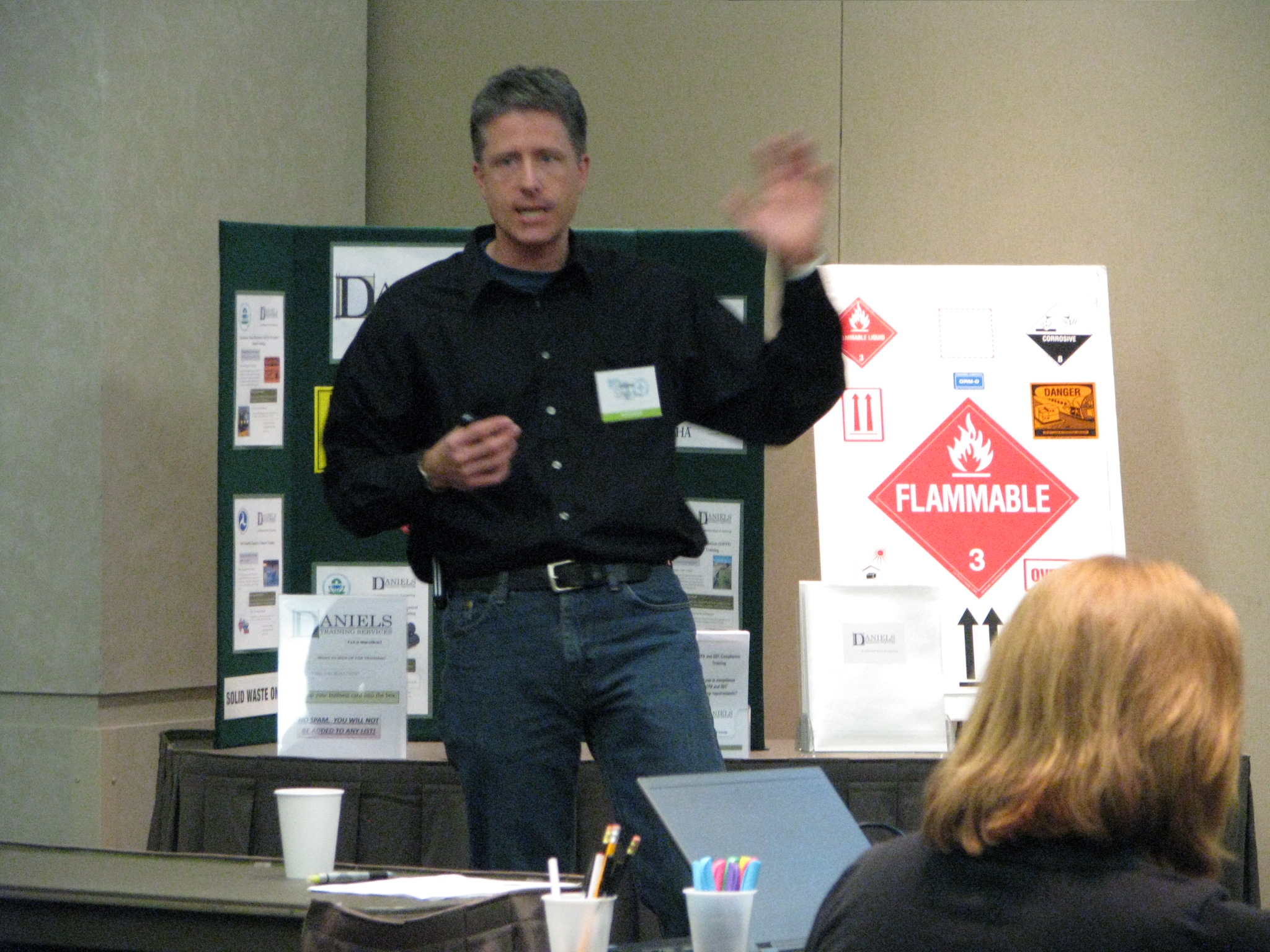
Any employee who is involved in generation or handling of hazardous waste at an LQG must be trained annually
  • Attend my one-day, all-Texas, training seminars.  I spend 8 hours covering nothing but the generation, management, and off-site transportation of waste (hazardous waste, universal waste, used oil, & non-hazardous industrial waste) in Texas.
  • Onsite Training.  Delivered right to your door and containing only the Texas-specific regulations that you and your personnel need to know.  Train everybody all at once for one low, flat fee.

And if you don’t need training, then don’t hesitate to contact me with a questions.  I’m glad to help.

March/April 2014– Announcements of Proposed Rules, Changes to the Rules, and Final Rules for RCRA and the HMR

Federal Register:  The Daily Journal of the United States Government
The Federal Register is a communication tool used by the US Government.

On its website the US Government Printing Office makes a wealth of Federal publications available for review and download; one of these is the Federal Register.

Published by the Office of the Federal Register, National Archives and Records Administration (NARA), the Federal Register is the official daily publication for rules, proposed rules, and notices of Federal agencies and organizations, as well as executive orders and other presidential documents.

See below for a brief summary of announcements in the Federal Register by the US EPA on the subject of Hazardous Waste and the Pipeline & Hazardous Materials Safety Administration (PHMSA) of the US DOT on the subject of Transportation of Hazardous Materials.

The Federal Register is a great way to look down the road and see potential changes to the regulations long before they are put into effect (sometimes The Rulemaking Process takes years before a final rule is issued, if ever).  Knowledge of these potential changes provides you with several advantages:

  • Additional time to modify your business operations to comply.
  • Awareness of on what topics the regulatory agencies intend to focus their efforts.
  • The ability to register your concerns, complaints, suggestions, etc. in order to modify the proposed rule before a final rule is issued.  It can be done, really!
  • Make changes to your training program to account for changes that become effective before the next training cycle.
  • Alert you to the need to re-train your employees prior to their next scheduled training cycle, if necessary.
  • Keep you abreast of changes to the regulations that affect your business and/or your industry group.

Please note that this is my best effort to identify the relevant announcements in the Federal Register that may be of interest to generators of hazardous waste and shippers of hazardous materials.  I encourage you to review the list of Federal Register publications yourself to ensure regulatory compliance. (more…)

The marking and labeling requirements of 40 CFR 262.34(a)(2,3)

USEPA Requirements for the Packaging, Labeling, and Marking of a Hazardous Waste Container for Off-Site Transportation

Both Large Quantity Generators and Small Quantity Generators of hazardous waste are responsible for the cradle-to-grave management of the hazardous waste they generate.  One of their responsibilities is to properly identify containers of hazardous waste when it is accumulated on-site and when it is offered for off-site transportation.  As an LQG or SQG it is important for you to know the distinct requirements for identifying your hazardous waste both when it is at its accumulation or storage area, and when it is being prepared for off-site transportation.

Not sure of your hazardous waste generator status?

Take this short survey

(more…)

California EPA Department of Toxic Substances Control Regulations

Violations of RCRA Regulations Result in Significant Cost for California Retailers

When thinking of those subject to state and Federal regulations for the management of hazardous waste, it’s natural to think manufacturing and industry.  However, when the Resource Conservation and Recovery Act (RCRA) was drafted the intent was to regulate the generation, management, treatment, transportation, and disposal of hazardous waste from Cradle-to-Grave no matter the source.  This means that businesses very different from what we think of as heavy industry or manufacturing are subject to RCRA regulations and can be subject to penalties, fines, and violations for non-compliance.  A perfect example of this is the retail sector which has had a few high-profile compliance issues recently:

As an example of the cost of non-compliance for the retail industry in just one state, see the table below for data collected by the California EPA’s Department of Toxic Substances Control for monetary settlements received just since 2010.

California EPA Department of Toxic Substances Control Regulations
The hazardous waste regulations in California are more strict & more broad than those of the USEPA.
Retailer

Year

Total Settlement

Money Recouped by DTSC

Wal-Mart

2010

$27.7 Million

$1.17 Million

Target

2011

$22.5 Million

$578,000

Walgreens

2012

$16.6 Million

$991,625

CVS

2012

$13.75 Million

$249,625

Costco

2012

$3.5 Million

$37,750

Save Mart

2013

$2.55 Million

$28,000

Lowe’s

2014

$18.1 Million

$1.67 Million

Let me help you to provide Hazardous Waste Personnel training
Have you trained your Facility Personnel on the RCRA Hazardous Waste regulations?

Of course, training – both HazMat Employee and Hazardous Waste Personnel – can prevent the violations that lead to these monetary settlements.  Another potential source of relief is the request for comments from the USEPA regarding the creation of hazardous waste regulations specific to the Retail Sector.  Now is the time for your voice to be heard!  But hurry, the deadline for comments is April 15th.

There is no deadline for training, so contact me with any questions you have about the regulations of the USEPA & the USDOT and the specific requirements of your state.

Illegal Handling and Disposal of Hazardous Waste Results in $18.1 Million Settlement for Lowe’s

The Bullet:

Lowe’s stores throughout California were busted by the California DTSC for gross violations of state and Federal hazardous waste regulations.  Lowe’s agreed to pay a settlement of $18.1 million.

Who:

The California Department of Toxic Substances Control (DTSC), DTSC’s Office of Criminal Investigations (OCI), 31 California district attorneys and two city attorneys.  OCI is a special investigation unit within DTSC consisting of peace officers, scientists and a computer forensic specialist who investigate criminal misconduct and other violations of the hazardous waste laws in California. It is the only criminal investigations unit within the California Environmental Protection Agency. It is part of the Office of Legal Affairs.

Lowe’s Home Centers operates more than 1,830 stores in the United States, Canada and Mexico. It serves approximately 15 million customers each week and employs more than 260,000 people.

What:

Under the final judgment, Lowe’s must pay $12.9 million in civil penalties and costs. An additional $2.1 million will fund supplemental environmental projects furthering consumer protection and environmental enforcement in California, and Lowe’s will fund hazardous waste minimization projects of $3.2 million. The retailer will be bound under terms of a permanent injunction prohibiting similar future violations of the law. DTSC will receive about $1.67 million paid as penalties.

Where:

The civil enforcement action was filed in Alameda County, California and led by the district attorneys of Alameda, San Joaquin and Solano counties.  The alleged violations occurred at more than 118 Lowe’s stores throughout California.

When:

The settlement was announced by the CA DTSC on April 2, 2014.  The violations are alleged to have occurred over a six and a half year period.

Why:

It is alleged that more than 118 Lowe’s stores throughout California unlawfully handled and disposed of hazardous wastes. Those hazardous wastes and materials included pesticides, aerosols, paint and colorants, solvents, adhesives, batteries, mercury-containing fluorescent bulbs, electronic waste and other toxic, ignitable and corrosive materials.  At some Lowe’s stores, employees were unlawfully throwing away batteries and compact fluorescent light bulbs that customers had turned in to be recycled.

Stores are required to retain their hazardous waste in segregated, labeled containers to minimize the risk of exposure to employees and customers and to ensure that incompatible wastes do not combine to cause dangerous chemical reactions. Hazardous waste produced by California Lowe’s stores through damage, spills and returns is being collected by hazardous waste haulers registered with DTSC and taken to proper disposal facilities.

How:

From 2011 to 2013, OCI scientists and investigators conducted 17 dumpster examinations to gather evidence. These dumpster examinations revealed that Lowe’s was routinely and systematically sending hazardous wastes into local landfills throughout California that were not permitted to receive those wastes.

For More Information:

Contact: Russ Edmondson
(916) 323-3372
russ.edmondson@dtsc.ca.gov
Contact: Tamma Adamek
(916) 324-2997
tamma.adamek@dtsc.ca.gov

FOR GENERAL INQUIRIES: Contact the Department of Toxic Substances Control by phone at (800) 728-6942 or visit www.dtsc.ca.gov. To report illegal handling, discharge, or disposal of hazardous waste, call the Waste Alert Hotline at (800) 698-6942.

Read the DTSC press release:  Lowe’s to Pay $18.1 Million Settlement for Illegal Handling and Disposal of Hazardous Waste

Conclusion:

Lowe’s, like others in the retail industry, face unique challenges in the management and disposal of the hazardous waste they generate.  That’s why the USEPA is currently seeking comments from those within the retail industry regarding the drafting of regulations specific to them.  These violations are a good example of what can happen at a retail store – or any business – when facility personnel do not receive the required training:  Hazardous Waste Personnel and HazMat Employee and as a result lack even a basic understanding of what is required for compliance.

USDOT and USEPA regulations require training for personnel who handle hazardous waste or work with hazardous materials
State and Federal regulations require the training of HazMat Employees and Hazardous Waste Personnel

Please don’t hesitate to contact me with any questions about the hazardous waste regulations of the USEPA, CA DTSC, or whatever state your business is located.

Daniels Training Services

815.821.1550/Info@DanielsTraining.com/https://danielstraining.com/

Search Website