PO Box 1232 Freeport, IL 61032

A Different Kind Of Training

A Different Kind Of Training

A Different Kind Of Training

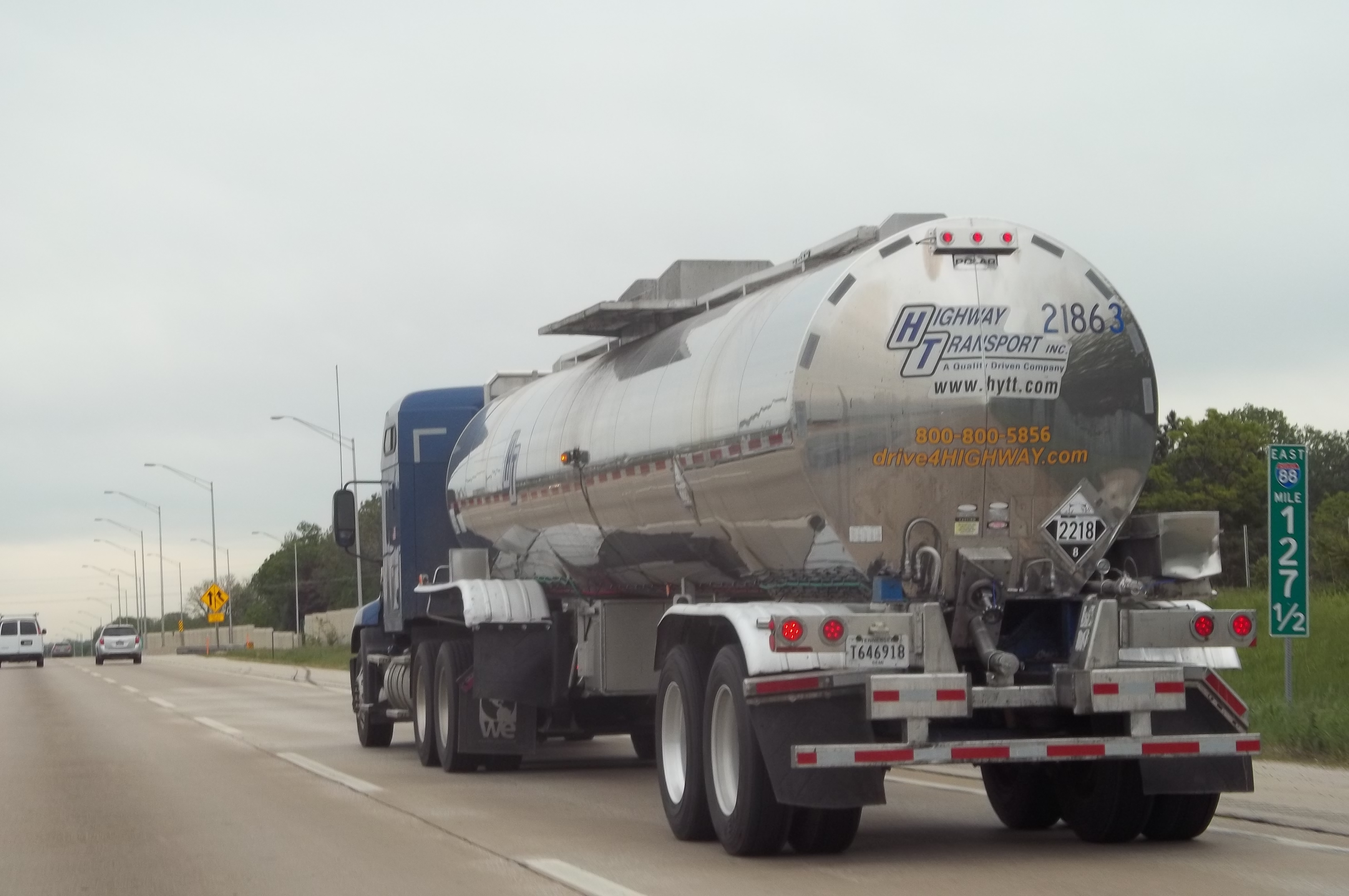
What’s on that truck?

Drive our nation’s highways and you’ll see hazardous materials in transportation.  Drive on some of the main transportation corridors – like Interstate 80 (I-80) – and you’ll see some very interesting HazMat transported in commerce.

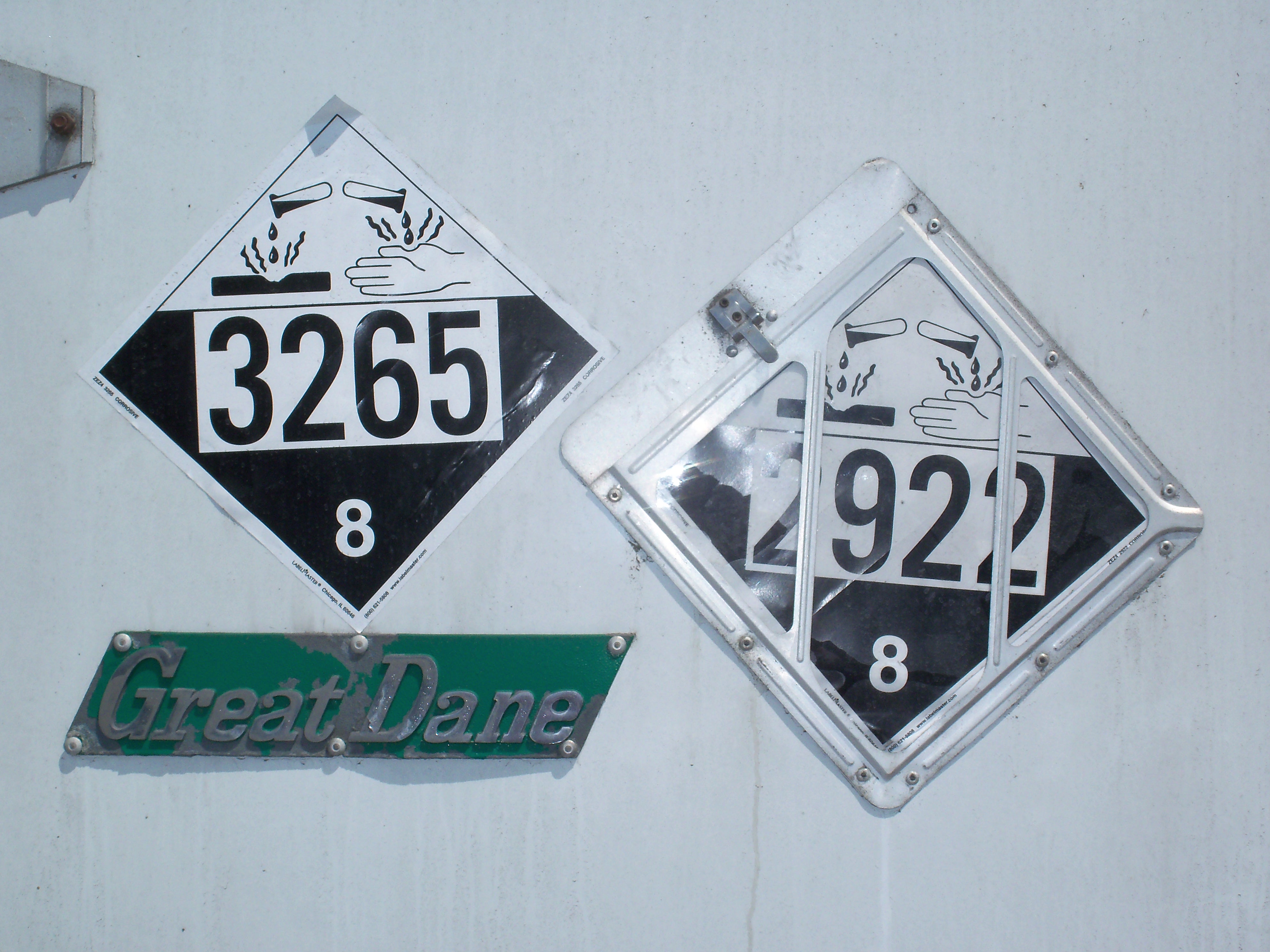
Class 8 Corrosive in cargo tank motor vehicle
What is the hazardous material on that truck?

And if you’re like me, you want to know what it is being transported in the vehicles you see on the highway.  Like this one.

(more…)

Gross Weight v. Net Explosive Weight When Transporting Explosives

In this business you just never know from what industry within the regulated community you might receive a question.  Like this one from a person with whom I’d had no prior business; he contacted me through MY WEBSITE with a question on March 23, 2015:
Oil and gas exploration and the transportation of explosives
Oilfield operations will occasionally require the transportation in commerce of hazardous materials

I’m going to be loading gun carriers for the oilfield with shaped charges and det cord. My previous job with <<redacted>>, we were told by DOT when we transported our guns that we only needed to count the explosive weight and not the gun carrier itself (shipping container) What is the proper way to calculate the weight to transport perforating guns. Any information would be greatly appreciated.

My honest reply the next day (3.24.15):

That question is going to take a little research (and time).  I have not yet had experience with DOT regulations for explosives, but am confident I can answer your question after digging into the regulations.

I’ll try to get you an answer later this week or early next.

True to my word, here’s my reply on March 30th:
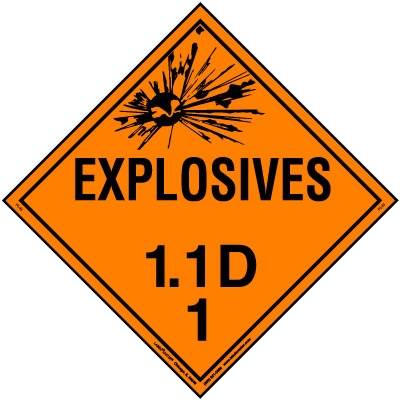
The answer to your question depends on what area of the HMR you are seeking to determine compliance.  I will do my best to summarize the requirements below based on the information available. HazMat Label for Hazard Division 1.1 Explosive Compatibility Group D

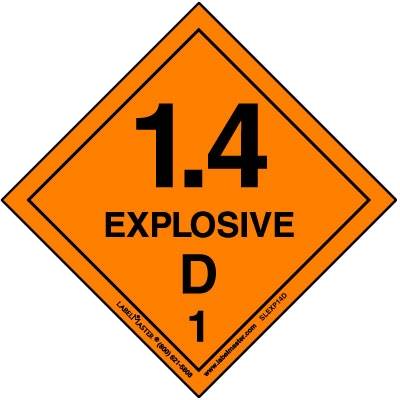
I believe you are describing the proper shipping name from column 2 of the Hazardous Materials Table (49 CFR 172.101) of:  Jet perforating guns, charged oil well, with detonator (either hazard class 1.1D or 1.4D).  Both hazard classes have the same special provisions (found in column 7 of the Hazardous Materials Table) and authorized packaging (found in column 8 of the Hazardous Materials Table).HazMat Label for Hazard Division 1.4 Explosive Compatibility Group D
Determining compliance based on net explosive weight v. weight of jet perforating gun:
  • The packing instructions (US1 in Table of Packing Methods at 49 CFR 173.62) include limits on the weight of the explosive content at 1(b):  “Each shaped charge affixed to the gun may not contain more than 112 g (4 ounces) of explosives.” and 1(e)(ii & iii): “A jet perforating gun classed as 1.4D may be transported by a private offshore supply vessel only when the gun is carried in a motor vehicle as specified in paragraph (d) of this packing method or on offshore well tool pallets provided that:
    (i) All the conditions specified in paragraphs (a), (b), and (c) of this packing method are met;
    (ii) The total explosive contents do not exceed 90.8 kg (200 pounds) per tool pallet;
    (iii) Each cargo vessel compartment may contain up to 90.8 kg (200 pounds) of explosive content if the segregation requirements in §176.83(b) of this subchapter are met; and
    (iv) When more than one vehicle or tool pallet is stowed “on deck” a minimum horizontal separation of 3 m (9.8 feet) must be provided.”  Otherwise there are no references to weight in the packing instructions.  So here, it is the weight of just the explosive content that matters and not the weight of the entire gun.  There is no reference in US1 to inner, outer, or intermediate packaging, because the gun itself is considered to be the authorized packaging.
  • The placarding determination at 49 CFR 172.504 includes specific information about placarding explosives, but no reference is made to using the weight of the entire article (jet perforating gun) or just the explosive content.  It is my opinion, absent of guidance from USDOT, that the weight of the entire article (jet perforating gun) would be considered when determining the need for displaying placards.  More information on the topic of placarding this HazMat is contained later in this article.
  • 49 CFR 172.202(a)(5)(i) for describing the total quantity of a HazMat on a shipping paper reads as follows: “For Class 1 materials, the quantity must be the net explosive mass. For an explosive that is an article, such as Cartridges, small arms, the net explosive mass may be expressed in terms of the net mass of either the article or the explosive materials contained in the article.” (emphasis mine)  I believe the jet perforating guns are an article and therefore have the option to be described on the shipping paper by either the net mass of the entire article or just the explosive content.  There are several USDOT letters of interpretation that confirm this interpretation:

I hope this helps.  Please let me know if you have any other questions.

Thinking the issue resolved – another happy customer, right? – I sent this email on April 9, 2015:
Walking rocket image
Certain fireworks are also a Class 1 hazardous material

With your permission I’d like to use the text of our emails (all names removed) as an article in my blog and newsletter.

Please let me know if that is OK.

The reply from my – not entirely satisfied – customer the next day (4.10.15):

Dan, as long as my name and the company name isn’t in there I don’t see a problem with it, maybe someone else can shed some light on the subject of net vs. gross explosive weight and placarding accordingly.

Thanks

Wait.  What?!  My reply on April 11, 2015:

I appreciate you letting me use the content of our emails.  Does your email indicate that I did not answer your question entirely?  I’d be more than happy to provide more information if you have any unanswered questions.

Still some unanswered questions (4.11.15):

Not entirely, I understand that most oilfield companies count gross weight which is the weight of the explosives and the weight of the gun barrels for placarding, at <<redacted>> we were told by somebody with dot that we only had to go by net explosive weight and not gross so we didn’t have to placard our vehicles even though we were carrying more than 1000 lbs gross weight.

OK, let me try that again (4.11.15):
HazMat Employee training for the transport of explosives in the oil and gas industry
USDOT HazMat Employee training is what I do!

I’ll research that question further and get you an answer next week.

My reply on April 22, 2015:

OK!  I think I have the answer you are looking for and it is right in the regulations.

49 CFR 172.504(c) indicates an exception from placarding requirements for a non-bulk packaging of a placard Table 2 material of less than 1,001 lbs aggregate gross weight of hazardous material.
“Aggregate gross weight” refers to the combined weight of the HazMat and the completed package (e.g. a 55-gallon drum and the HazMat it contains).  This requires that both the explosive content and the weight of the gun be considered for the purposes of determining placards.
Assumptions regarding the HazMat in question:
  • It is a placard Table 2 HazMat.
  • It is in a non-bulk packaging.

With the information you provided, my assumptions (see above), reference to 49 CFR 172.504(c), and a conversation with the PHMSA, I have determined that the entire weight of the explosive content and the gun itself (i.e. the aggregate gross weight) must be used when making the placarding determination for a vehicle.

If you like, I can assist you in submitting a request for a letter of interpretation to PHMSA to conclusively determine this regulation.
I hope this helps.
My follow-up on May 7, 2015:
Just curious if you have any more questions for me on this matter?  If you are not yet satisfied with my answer, I’d be happy to dig a little deeper.  If this is the answer you’re looking for and the issue is closed, I’d appreciate it if you would OK me to use the content of these emails (no identifying information) in an article on my website.

Thanks and please contact me with any questions you may have.

Contact me with any questions you may have about the transportation of hazardous materials by air, highway, vessel, or rail

International and Domestic

Daniels Training Services

815.821.1550

Info@DanielsTraining.com

https://danielstraining.com/

And now, finally, the satisfied customer I was hoping for! (5.7.15):
Yes, I believe you have answered my question, sorry I haven’t got back to you sooner, been very busy, I don’t mind that you use the info on your website.
Thanks again


Hazard Class 3 Flammable Liquid Placard

Q&A: Displaying the DANGEROUS Placard on a Motor Vehicle

Question from previously unknown contact on April 2, 2015 through the Contact Me page of my website:
Hazard Class 3 Flammable Liquid Placard
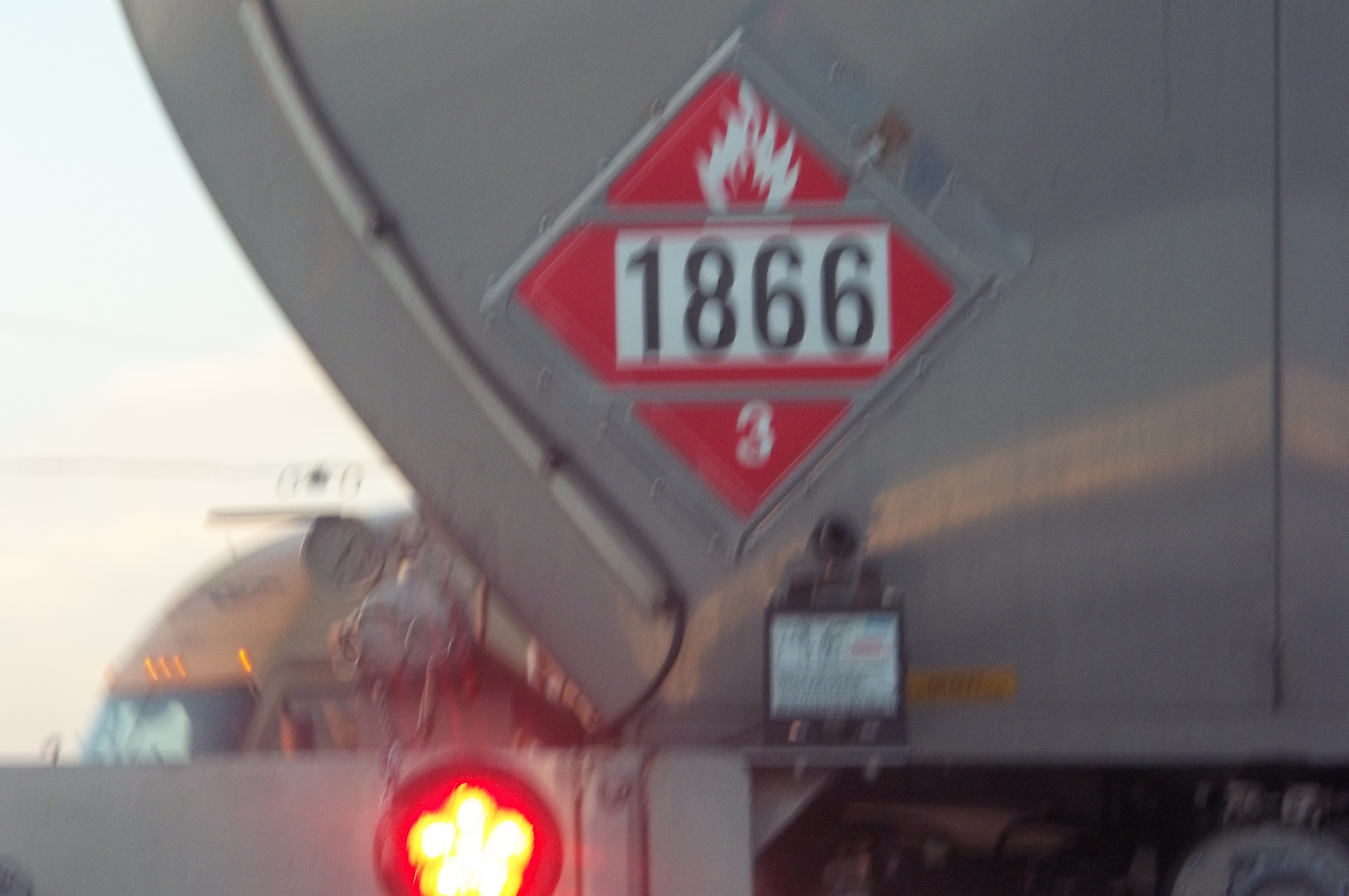
Placard on Cargo Tank Motor Vehicle for UN1866 Resin Solutions

Good morning, to my understanding I’ve known that we need placards on flammable over 1000 lb.  But when we have 324lb. of 4.1 Flammable and 525 lb. of UN1866, resin solution.  Is it ok to use Dangerous only or both placards? Tks!

My reply later that same day:
Dangerous Placard
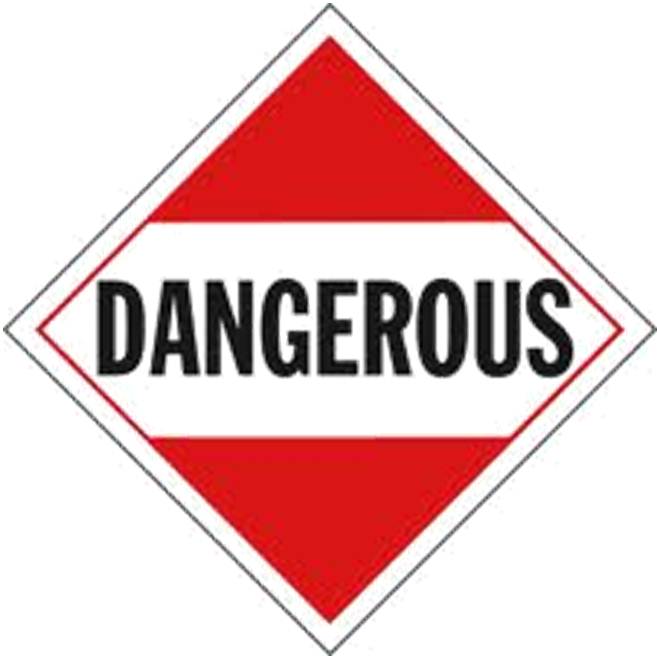
The Dangerous Placard can be used in a variety of situations – with limitations – when transporting HazMat

Thank you for contacting me.  I will try to answer your question below:

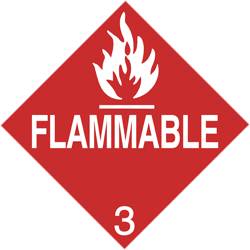
  • You are correct that vehicles transporting quantities of most HazMat, including Class 3 Flammable Liquids, of ≥1,001 lbs must display HazMat Placards on all four sides of the vehicle.
  • The amount of HazMat you describe is not enough to require placards to be displayed on the vehicle (324 lbs + 525 lbs = 849 lbs).  Though the driver may display placards in this instance if he wishes to.  Please read this article:  Driver Option to Display Placards When not Required.
  • If displaying placards at the driver’s discretion or if there is enough HazMat to require placarding the vehicle (e.g. 501 lbs of Division 4.1 Flammable Solid and 500 lbs of Class 3 Flammable Liquid) the driver has two options:  1.  Display the distinct placards for the separate HazMat (4.1 Flammable Solid & 3 Flammable Liquid) or; 2.  Display the Dangerous placard alone.  Please read this article:  Use of the Dangerous Placard for Shipments of HazMat.
Hazard Class 3 Flammable Liquid Placard
The display of the Class 3 Flammable Liquid placard is required for certain shipments of HazMat

Also, for general information about acceptable display of placards, please see this article:  What’s Wrong With These Pictures? Incorrect Display of Placards.

I hope this helps.
Please don’t hesitate to contact me with any other questions or if you require HazMat Employee Training (including Driver Training).
Dan
Another satisfied HazMat Shipper(April 2, 2015):
Thank you very much Daniel..
Please let me know if you have any questions about the transportation of hazardous materials; I’m here to help.

Contact me with any questions you may have about the transportation of hazardous materials by air, highway, vessel, or rail

International and Domestic

Daniels Training Services

815.821.1550

Info@DanielsTraining.com

https://danielstraining.com/

Determining a Class 8 Corrosive Material and a D002 Corrosive Hazardous Waste From the SDS

Question to me (3.19.15) from a customer who had recently attended one of my TRAINING SEMINARS:

Dan,

I have a waste that is liquid but has no pH because it is not water-based. The SDS says it is DOT Class 8 so that means it must corrode steel at >0.25 inches/ year.  RCRA has a similar criteria, but are DOT and RCRA referring to the same test standard? If yes, then I clearly have a hazardous waste. Let me know.

Thanks,

My reply, later that same day:

The EPA definition of the hazardous characteristic for corrosivity (40 CFR 216.22) is an aqueous solution with a pH of 2 or less or 12.5 or greater or…

(2) It is a liquid and corrodes steel (SAE 1020) at a rate greater than 6.35 mm (0.250 inch) per year at a test temperature of 55 °C (130 °F) as determined by Method 1110A in “Test Methods for Evaluating Solid Waste, Physical/Chemical Methods,” EPA Publication SW-846, and as incorporated by reference in §260.11 of this chapter.

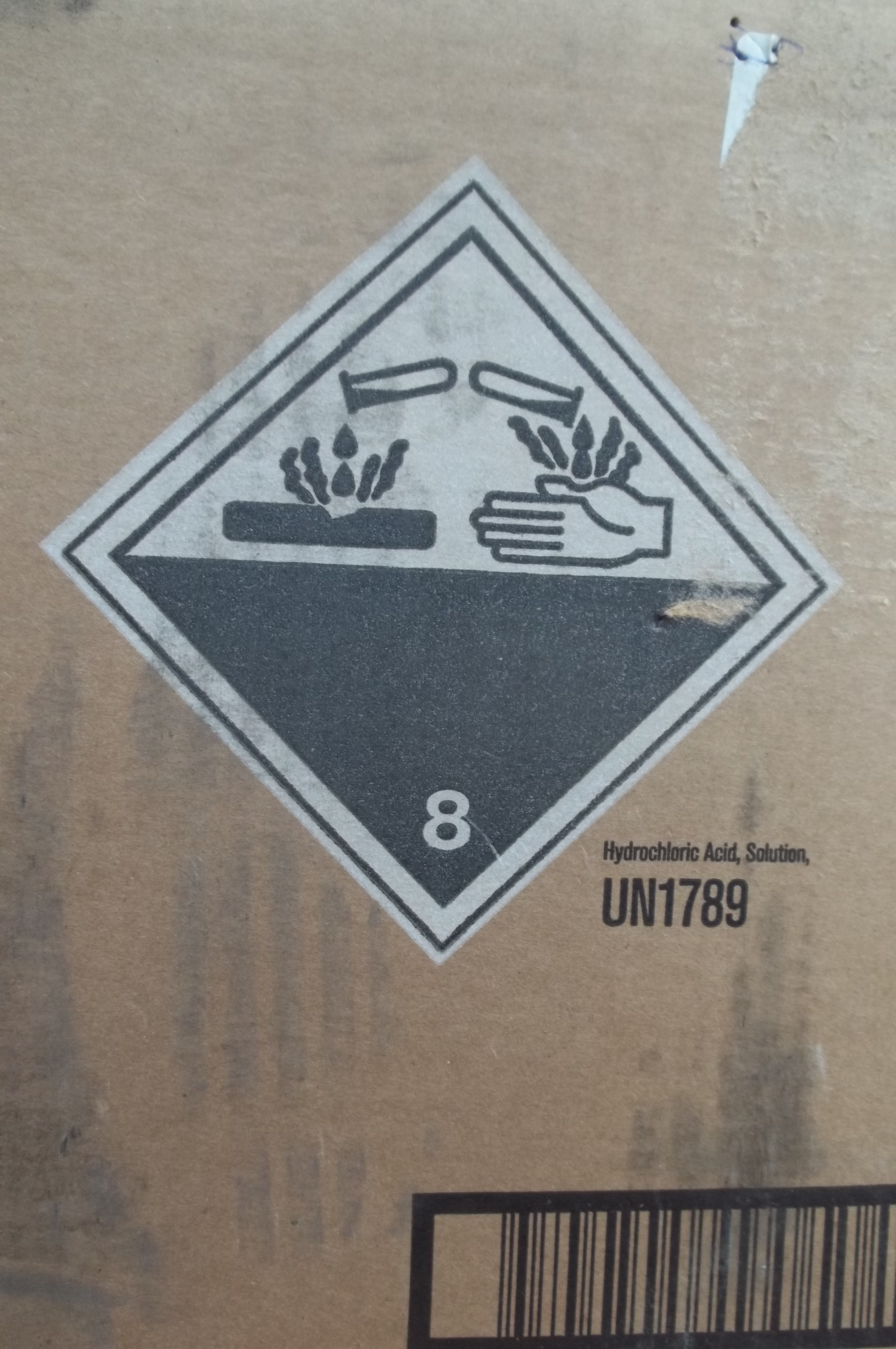
UN1789, Hydrochloric Acid SolutionThe DOT definition of Class 8 Corrosive includes a material that causes full thickness destruction of human skin at site of contact within a specified time period and…

A liquid, or a solid which may become liquid during transportation, that has a severe corrosion rate on steel or aluminum based on the criteria in §173.137(c)(2).

173.137(c)(2) indicates a corrosive material exhibits…

a corrosion on either steel or aluminum surfaces exceeding 6.25 mm (0.25 inch) a year at a test temperature of 55 °C (130 °F) when tested on both materials. The corrosion may be determined in accordance with the UN Manual of Tests and Criteria (IBR, see §171.7 of this subchapter) or other equivalent test methods.

I suggest you contact the supplier from the SDS to determine what test method they used.  If it is not SW-846 (note the “or other equivalent test method” in 173.137(c)(2)) it may be similar enough to yield the same result.  Also, once you determine the method the supplier used you may wish to contact a lab that performs both of the analysis types to see if there is a difference.
I hope this helps.
Dan
Customers quick reply (still 3.19.15):
Dan, Thanks. I’ll call my supplier & test lab.
I’m curious, so on 3.20.15 I write:
Please let me know what you learn from the lab.
Last correspondence on 3.20.15:
My lab only does ASTM 1110A.
Conclusion:
The test method performed by my customer’s lab (ASTM 1110A) is acceptable for purposes of determining the USEPA’s characteristic for corrosivity as that is referenced specifically at 40 CFR 261.22.  It may also be acceptable for determining if it is a Class 8 Corrosive Material as defined in the PHMSA/USDOT regulations even though it is not specifically referenced at 173.137(c)(2).  The inclusion of the language, “…or other equivalent test methods.”  may be interpreted to include ASTM 1110A as acceptable.
A note of warning:  my customers reference to section 14 of the SDS is worth a warning:
The SDS says it is DOT Class 8 so that means it must corrode steel at >0.25 inches/ year.
The information in the SDS (and the old MSDS, for that matter) is not authorized by PHMSA/USDOT for purposes of compliance with the Hazardous Material Regulations.  Therefore, any information on an SDS/MSDS that purports to provide PHMSA/USDOT regulatory information should be taken as guidance only and not be relied on solely for the purposes of determining compliance.Recommended orientation of placard holder

Contact me with any questions you may have about the transportation of hazardous materials by air, highway, vessel, or rail

International and Domestic

Daniels Training Services

815.821.1550

Info@DanielsTraining.com

https://danielstraining.com/

Delaware Department of Natural Resources and Environmental Control

Contact Information – Emergency and Otherwise for the Delaware Department of Natural Resources and Environmental Control

Got a spill or other emergency? Have a question about your air permit?  Wastewater discharge permit?  Management of hazardous waste?  Well, if you do business in Delaware, you’re in luck.  The Delaware Department of Natural Resources and Environmental Control (DNREC) provides contact information for all of its programs and departments.  Please refer to this list if you have any questions for the DNREC. (more…)

USEPA Requires Southern California Metal Finishers to Stop Illegal Hazardous Waste Releases, Wastewater Discharges

The Bullet:

The U.S. Environmental Protection Agency resolved a series of enforcement actions directed at five Southern California metal finishing companies which will collectively pay more than $223,700 in civil penalties for hazardous waste and Clean Water Act violations.

Who:
  • Anaplex Corporation in Paramount, CA
  • Barkens Hard Chrome in Compton, CA
  • Bowman Plating Company, Inc. in Compton, CA
  • Alumin-Art Plating Company in Ontario, CA
  • R.L. Anodizing and Plating, Inc. in Sun Valley, CA

Three of the facilities are located along the I-710 freeway corridor, an area of special concern to USEPA due to the disproportional impact of pollution on residents of this area.

What:

Anaplex has agreed to pay a $142,200 penalty for violations of RCRA and the Clean Water Act (CWA).  Hazardous waste violations include

  • Failure to properly label and close hazardous waste containers.
  • Failure to properly meet training requirements for its employees
  • Did not operate the facility in a way that minimizes the possibility of hazardous waste being released into the environment.

Barkens has agreed to pay $28,100 in penalties to resolve its hazardous waste violations, including:

  • Failure to minimize the release of hazardous waste.
  • Failure to meet certification requirements for tanks used to transfer, store or treat hazardous waste.
  • Failure to have proper decontamination equipment.
  • Facility did not have the proper contingency plan for emergencies.
  • Lacked adequate training records for its employees.

Bowman has agreed to pay a $9,900 penalty to resolve its hazardous waste violations, including:

Alumin-Art has agreed to pay a $28,000 penalty to resolve hazardous waste violations found at its Ontario, CA. facility, including:

R.L. Anodizing has agreed to pay a $15,500 penalty to resolve its hazardous waste violations including:

  • Storing hazardous waste without the proper permit.
  • Improper labeling, storing and maintenance of containers holding hazardous waste.
Where:
  • Anaplex Corporation in Paramount, CA
  • Barkens Hard Chrome in Compton, CA
  • Bowman Plating Company, Inc. in Compton, CA
  • Alumin-Art Plating Company in Ontario, CA
  • R.L. Anodizing and Plating, Inc. in Sun Valley, CA

Three of the facilities are located along the I-710 freeway corridor, an area of special concern to USEPA due to the disproportional impact of pollution on residents of this area.

When:

Released May 14, 2015.

Investigations and actions by USEPA go back to 2010.

Why:

Metal finishers use a plating or anodizing process to coat industrial metal, and typically generate hazardous wastes including: sludges containing heavy metals such as chromium, cadmium, and lead; spent plating solutions containing metals or cyanides; flammable liquids; and both alkaline and acidic corrosive liquids.

How:

The Federal Resource Conservation and Recovery Act (RCRA) requires metal finishing companies – and everyone else – to properly manage hazardous waste to prevent harm to human health and the environment.  Under RCRA the California EPA, and with Cal EPA the Department of Toxic Substances Control, California has the authority to create and enforce its own regulations for hazardous waste.  Here, however, the USEPA stepped in to enforce Federal regulations.

Conclusion:

A perfect example of the USEPA exercising its Federal authority to enforce its regulations within a state that has an authorized hazardous waste program.  Federal or State, all hazardous waste regulations require training, and that’s what I do.  Contact me to schedule Onsite Hazardous Waste Personnel Training for you and all of your employees right there at your facility in California.  In one day and for only a little money you can avoid violations such as these.

Daniels Training Services

815.821.1550

Info@DanielsTraining.com

https://danielstraining.com/

For more information:
Media Contact: Nahal Mogharabi, Mogharabi.nahal@epa.gov, 213-244-1814

For more information on The Clean Water Act, please visit: http://www.epa.gov/lawsregs/laws/cwa.html

For more information on the Resource Conservation and Recovery Act, please visit: http://www.epa.gov/compliance/civil/rcra/index.html

For more information on EPA’s work at the I-710 corridor, please visit: http://www.epa.gov/region9/strategicplan/i710.html


Oregon DEQ Logo

Hazardous Waste Training Classes by the Oregon DEQ

Oregon DEQ LogoBelow is the notice I received from the Oregon Department of Environmental Quality on May 18th:

This notice serves as a reminder that the Hazardous Waste Training Classes offered by the Oregon Department of Environmental Quality are free of charge and offered on a first come, first served basis.

There is space available in the training class scheduled for May 27th in Medford, as well as the training class scheduled for June 17th in Eugene. Once these trainings are filled, you may ask to be added to a waiting list for one of those dates or you may register for another class.

View the complete schedule and registration instructions at: Training Schedule.

If you are unable to access this link, please email miller.denise@deq.state.or.us for assistance.

Note: When accessing this link, some web browsers may display a stored version of the previous schedule. Clearing the browser cache and reloading the page should allow you to view the current schedule.

And if you can’t make these, please consider attending my one day Hazardous Waste and HazMat Transportation Seminar in Portland, OR on July 23, 2015.

April 2015 – Rules & Regulations, Proposed Rules, and Notices Regarding the Management of Hazardous Waste and the Transportation of Hazardous Materials

On its website the US Government Printing Office makes a wealth of Federal publications available for review and download; one of these is the Federal Register.

Published by the Office of the Federal Register, National Archives and Records Administration (NARA), the Federal Register is the official daily publication for rules, proposed rules, and notices of Federal agencies and organizations, as well as executive orders and other presidential documents.

See below for a brief summary of announcements in the Federal Register by the US EPA on the subject of Hazardous Waste and the Pipeline & Hazardous Materials Safety Administration (PHMSA), Federal Railroad Administration (FRA), and the Federal Aviation Administration (FAA) of the US DOT on the subject of Transportation of Hazardous Materials.

The Federal Register is a great way to look down the road and see potential changes to the regulations long before they are put into effect (sometimes The Rulemaking Process takes years before a final rule is issued, if ever).  Knowledge of these potential changes provides you with several advantages:

  • Additional time to modify your business operations to comply.
  • Awareness of on what topics the regulatory agencies intend to focus their efforts.
  • The ability to register your concerns, complaints, suggestions, etc. in order to modify the proposed rule before a final rule is issued.  It can be done, really!
  • Make changes to your training program to account for changes that become effective before the next training cycle.
  • Alert you to the need to re-train your employees prior to their next scheduled training cycle, if necessary.
  • Keep you abreast of changes to the regulations that affect your business and/or your industry group.

Please note that this is my best effort to identify the relevant announcements in the Federal Register that may be of interest to generators of hazardous waste and shippers of hazardous materials.  I encourage you to review the list of Federal Register publications yourself to ensure regulatory compliance.

 April 1, 2015 through April 30, 2015

USEPA – US Environmental Protection Agency:

Publications not related to the management of hazardous waste, solid waste, universal waste, or used oil are not included here.

Rules and Regulations:

Hazardous and Solid Waste Management System; Disposal of Coal Combustion Residuals From Electric Utilities Pages 21301 – 21501 [FR DOC # 2015-00257] PDF | Text | More

Vermont: Final Authorization of State Hazardous Waste Management Program Revisions Pages 21650 – 21654 [FR DOC # 2015-08997] PDF | Text | More

Proposed Rules:

Vermont: Proposed Authorization of State Hazardous Waste Management Program Revisions Pages 21691 – 21692 [FR DOC # 2015-08996] PDF | Text | More

Contact me with any questions you may have about the management of hazardous waste

Daniels Training Services

815.821.1550

Info@DanielsTraining.com

https://danielstraining.com/


Notices:

Inquiry To Learn Whether Businesses Assert Business Confidentiality Claims Regarding Waste Import and Export Pages 19080 – 19084 [FR DOC # 2015-08064] PDF | Text | More

Agency Information Collection Activities; Proposed Collection; Comment Request; NESHAP for Hazardous Waste Combustors; Renewal Pages 20223 – 20224 [FR DOC # 2015-08661] PDF | Text | More

FAA – Federal Aviation Administration:

Publications not related to the transportation of hazardous materials are not included here.

Rules and Regulations:

None

Proposed Rules:

None

Notices:

None

FMCSA – Federal Motor Carrier Safety Administration:

Publications not related to the transportation of hazardous materials are not included here.

Rules and Regulations:

Civil Penalties Inflation Adjustments Pages 18146 – 18158 [FR DOC # 2015-07701] PDF | Text | More

Proposed Rules:

None

Notices:

National Hazardous Materials Route Registry Pages 23859 – 24009 [FR DOC # 2015-09701] PDF | Text | More

FRA – Federal Railroad Administration:

Publications not related to the transportation of hazardous materials are not included here.

Rules and Regulations:

None

Proposed Rules:

None

Notices:

Hazardous Materials: Information Requirements Related to the Transportation of Trains Carrying Specified Volumes of Flammable Liquids Pages 22778 – 22779 [FR DOC # 2015-09437] PDF | Text | More

Emergency Order Establishing a Maximum Operating Speed of 40 mph in High-Threat Urban Areas for Certain Trains Transporting Large Quantities of Class 3 Flammable Liquids Pages 23321 – 23326 [FR DOC # 2015-09614] PDF | Text | More

PHMSA – Pipeline and Hazardous Materials Safety Administration:

Publications not related to the transportation of hazardous materials are not included here.

Rules and Regulations:

Clarification on Policy for Additional Name Requests Regarding Fireworks Pages 17706 – 17707 [FR DOC # 2015-07425]   PDF | Text | More

Proposed Rules:

None

Notices:

Hazardous Materials: Explosive Approvals-Applicant Contact Information and Compliance With Special Provision 347 Pages 20066 – 20073 [FR DOC # 2015-08470] PDF | Text | More

Hazardous Materials: Delayed Applications Pages 22779 – 22780 [FR DOC # 2015-09354] PDF | Text | More

Hazardous Materials; Notice of Application for Modification of Special Permit Pages 22780 – 22781 [FR DOC # 2015-09356] PDF | Text | More

Hazardous Materials: Actions on Special Permit Applications Pages 22782 – 22784 [FR DOC # 2015-09355] PDF | Text | More

Hazardous Materials: Notice of Application for Special Permits Pages 22784 – 22785 [FR DOC # 2015-09352] PDF | Text | More

Hazardous Materials: Information Requirements Related to the Transportation of Trains Carrying Specified Volumes of Flammable Liquids Pages 22778 – 22779 [FR DOC # 2015-09437] PDF | Text | More

Hazardous Materials: Emergency Response Information Requirements Pages 22781 – 22782 [FR DOC # 2015-09436] PDF | Text | More

Pittsburgh, Pennsylvania Permit Requirements for Transportation of Hazardous Material Pages 23328 – 23328 [FR DOC # 2015-09632] PDF | Text | More

New York City Permit Requirements for Transportation of Certain Hazardous Materials Pages 23328 – 23329 [FR DOC # 2015-09634] PDF | Text | More

Hazardous Materials: Information Collection Activities Pages 23852 – 23854 [FR DOC # 2015-09896] PDF | Text | More

Hazardous Materials: Safety Advisory-Unauthorized Certification of Compressed Gas Cylinders Pages 23851 – 23852 [FR DOC # 2015-09937] PDF | Text | More

Information can be helpful but it’s useless if you are not able to make sense of it.  You must be able to determine how any changes to the rules and regulations (final or proposed) will affect your operations, and communicate the necessary information to your personnel.  I can help you to do that.

Contact me with any questions you may have about the transportation of hazardous materials by air, highway, vessel, or railInternational and Domestic

Daniels Training Services

815.821.1550

Info@DanielsTraining.com

https://danielstraining.com/


Please contact me for a free training consultation to determine your regulatory requirements and how training can help you to attain and maintain compliance with the regulations of the US Environmental Protection Agency (and your state) and the PHMSA, FAA, FRA, & FMCSA of the US Department Of Transportation.

hazardous waste generator recordkeeping

The RCRA Recordkeeping Requirements in New York

A question from a past attendee of one of my RCRA TRAINING WEBINARS:

Hello Daniel,
I reviewed the material from our training and see that recordkeeping for Haz Waste is to maintain record for 3 years from last effective date.
I have inherited the file cabinet for our facility and have records going back to 1991. Is there some other requirement for NY that I may be missing or am I due for a file clean up?

My reply that same day (I must have been in the office):

That is a good question.  New York may have recordkeeping requirements that are more strict than those of USEPA.  It is possible that they may require a longer retention period for RCRA records, though I have not seen any indication of this.

Since the recordkeeping requirements are not in one location in the regs but are spread throughout, finding an answer I can offer with confidence will not be easy (i.e. it will take me time that you will have to pay me for).  One quick way to get a good answer is to contact the NYS Department of Environmental Conservation:
NYSDEC
Division of Environmental Remediation
625 Broadway
Albany, NY 12233-7012
518-402-9764
Send us an email
I hope this helps.
Dan
OK.  Not my best response.  But look!  I invested a little time in some research of the hazardous waste regulations of the New York State Department of Environmental Conservation and came up with this reply on March 18th:
I was curious about your question and decided to pursue it further.  I confirmed with a representative of the NYSDEC (and by referencing the regulations) that the RCRA recordkeeping requirements in New York are the same as those of the USEPA (i.e. three years from its effective date).

However, NYSDEC has an addtional requirement at NYCRR Part 372.2(c)(1)(iv):

All records required under this subdivision must be furnished to the Department upon request, postmarked within five business days of receipt of a written request.

So, you must be prepared to mail copies of your records (3 years worth) to NYSDEC if they request them in writing.
Keeping records beyond the time required by regulations is a business decision that I suggest you decide with the involvement of other parties in your company (maybe even lawyers!).  There are pros and cons to keeping records beyond the specified time frame.
See NYCRR Part 372.2(c)(1(iv) for yourself:

(c) Reporting and record keeping requirements.

(1) Record keeping.

(i) A generator must keep a copy of each complete manifest document as a record for at least three years from the date the waste was accepted by the initial transporter.

(ii) A generator must keep a copy of each Annual Report (paragraph (2) of this subdivision) and Exception Report (paragraph (3)) for a period of at least three years from the due date of the report.

(iii) A generator must keep records of any test results, waste analyses, or other determinations made in accordance with paragraph (a)(2) of this section for at least three years from the date that the waste was last sent to on-site or off-site treatment, storage or disposal.

(iv) All records required under this subdivision must be furnished to the Department upon request, postmarked within five business days of receipt of a written request. A generator must make such records available at all reasonable times for inspection by any officer, employee, or representative of the Department who is duly designated by the commissioner.

(v) The record keeping periods referred to in this section are extended automatically beyond the three-year period during the course of any unresolved enforcement action regarding the regulated activity, or as requested by the commissioner.

Thank you and please don’t hesitate to contact me with any questions.
I’m not aware of any state with an authorized hazardous waste program that has a requirement to keep records related to hazardous waste management longer than three years, do you?
Read this article on the hazardous waste recordkeeping requirements of the USEPA:  How long to keep records related to hazardous waste management.
And then contact me with any questions you may have about the management of hazardous waste in New York.
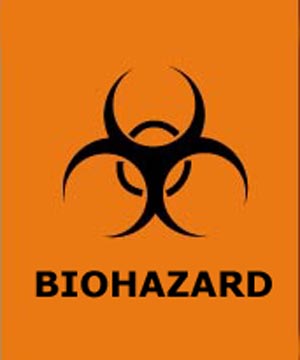
OSHA BioHazard Symbol

Q&A: Must I use the USDOT Division 6.2 Label or the OSHA BioHazard Mark on my Infectious Substance?

A question directed to me from the CONTACT ME page of my website on January 21, 2015:

I was reading your article on infectious labeling and marking. Under marking it  states that a “bulk” is (a) less than 1000 gallons or (b) greater than 1000. What about 49 CFR (Department of Transportation) §171.8 – Definitions and Abbreviations.

Bulk packaging means a packaging, other than a vessel or a barge, including a transport vehicle or freight container, in which hazardous materials are loaded with no intermediate form of containment.

A Large Packaging in which hazardous materials are loaded with an intermediate form of containment, such as one or more articles or inner packagings, is also a bulk packaging.

Additionally, a bulk packaging has: * * *
(1) A maximum capacity greater than 450 L (119 gallons) as a receptacle for a liquid;
(2) A maximum net mass greater than 400 kg (882 pounds) and a maximum capacity greater than 450 L (119 gallons) as a receptacle for a solid; or
(3) A water capacity greater than 454 kg (1000 pounds) as a receptacle for a gas as defined in §173.115 of this subchapter.

So therefore any package less than 119 gallons would be considered a non-bulk package. I personally have never seen an infectious or biohazard bulk package. It does not clearly state the information above – only stating a bulk is less than 1000 gallons.
Additionally, it is allowed to use either the DOT or the OSHA label correct?
I had an inspector recently tell me that I could not use the DOT label that the OSHA label was the only label allowed. Looking for some additional guidance.

My, as it turns out, overly optimistic reply that same day:

Thanks for the contact.  I will research the topic and reply to you a little bit later today.

My final reply, a few days late (1/26/15):

Thank you for contacting me about my article:  The BioHazard Marking for the Transportation of Infectious Substances.  I’ll do my best to answer your questions.

  • You are correct the Hazardous Materials Regulations (HMR) of the Pipeline and Hazardous Materials Safety Administration within the U.S. Department of Transportation (USDOT/PHMSa) define a bulk packaging at 49 CFR 171.8 as you indicate above.

Read more about bulk packaging

  • However, your understanding of my article is not correct. In the “Package Marks” section of my article I refer to the requirements to apply a marking to different sizes of a bulk packaging. A bulk packaging with a capacity of <1,000 gal must be marked on two opposing sides; whereas a bulk packaging of ≥1,000 gal must be marked on all four sides. Both are bulk packagings as they are both >119 gallons. The 1,000 gal threshold determines where the markings are applied on the respective bulk packaging.
  • My article explains that only UN3291 Regulated Medical Waste is authorized to be shipped in a bulk packaging.
  • My article identifies the situations where the Infectious Substance HazMat label is required, when the OSHA-compliant BioHazard label may be used as an alternative to the Infectious Substance HazMat label, and when the OSHA-compliant BioHazard label is required to be used.
  • There are two situations (identified in the “HazMat Labels” section of my article) where the DOT Infectious Substance HazMat label is required.  Perhaps that is the situation the inspector was speaking to.
I hope this helps.  Please don’t hesitate to contact me with any other questions.
Dan

Contact me with any questions you may have about the transportation of hazardous materials by air, highway, vessel, or rail

International and Domestic

Daniels Training Services

815.821.1550

Info@DanielsTraining.com

https://danielstraining.com/

And on January 28, 2015, another satisfied customer (well, not really a customer as they didn’t pay me.  But I’m glad to help):

Thanks!

Please feel free to contact me with any questions you may have about the transportation of hazardous materials (which includes Infectious Substances) and the regulations of the USDOT/PHMSA.

Search Website