PO Box 1232 Freeport, IL 61032

A Different Kind Of Training

A Different Kind Of Training

A Different Kind Of Training

Applicability of the HMR to HazMat Unloading Operations

HazMat Employee is defined at 49 CFR 171.8 as a full-time, part-time, temporary, or self-employed person who in the course of employment directly affects hazardous materials transportation safety.  This includes but is not limited to persons who:

  • Load, unload, or handle hazardous materials.
  • Design, manufacture, inspect, recondition, or repair hazardous material packagings.
  • Prepares hazardous materials for transportation.
  • Is responsible for safe transportation of hazardous materials.
  • Operates a vehicle used to transport hazardous materials.

The above definition may not be as complete as you may wish since it does not identify specific activities that meet the definition of a HazMat Employee.  Yet, you as the HazMat Employer have the responsibility to…

  1. Identify which of your operations are subject to the US DOT Hazardous Material Regulations (HMR).
  2. Determine which employees meet the US DOT definition of a HazMat Employee.
  3. Train, test, and certify your HazMat Employees every three years pursuant to 49 CFR 172, Subpart H.

This article will focus on one aspect of handling hazardous materials in transportation, that of unloading hazardous materials from the vehicle into your facility.  Below are three scenarios at a “Company A” and an explanation of how each may or may not be subject to the HMR and whether or not its employees are HazMat Employees.

Company A receives hazardous materials in a variety of forms:

  1. 55-gallon drums (non-bulk packagings) and 300-gallon portable tanks (bulk packagings) delivered by semitrailer to its Receiving Dock.  Company A’s employees assist the driver in the transfer of packagings from the vehicle into its facility.
  2. 5,000-gallon semitrailer tanker (cargo tank motor vehicle or CTMV) unloads bulk quantities at its tank farm.  While unloading operations are handled by the driver of the CTMV, a Company A employee supervises the process.
  3. 22,000-gallon railroad tank cars are detached from the train by railroad personnel, moved onto a private spur owned by Company A, and left for facility personnel to unload.

First, you must understand which activities are subject to the Hazardous Material Regulations (HMR).  Pursuant to49 CFR 171.1(c), the full HMR apply to the transportation in commerce of a hazardous material and each person involved in that process.  “Transportation” means the movement of property and loading, unloading, and storage incidental to that movement.  “Unloading incidental to movement” means removing a package or containerized hazardous material from a transport vehicle.  It also includes the emptying of a bulk packaging, such as a CTMV after it has been delivered when the performed by the driver or in his/her presence.   This last part is critical.  If the driver is not present for the unloading of the vehicle, the activity does not meet the definition found at 49 CFR 171.8 of “Unloading incidental to movement” and therefore, the activity – though in all other ways similar to “Unloading incidental to movement” – is not subject to the HMR and the employees involved in unloading cannot be HazMat Employees.  Read on…

In example #1 above, the unloading of the non-bulk and bulk packagings from the semitrailer meets the definition of “Unloading incidental to movement” since the driver of the vehicle remains on-site during the process.  It is therefore subject to regulation under the HMR.  Any of Company A’s employees involved in the unloading of that vehicle, including direct supervisors of employees involved, meet the definition of a HazMat Employee.

Example #2 is also subject to the HMR since the unloading of a bulk packaging while the driver is present meets the definition of “Unloading incidental to movement”.  This is a bit more of a challenge for some companies since they argue that the driver is responsible for the unloading and their employees are only there to ensure company policies and procedures are followed.  No matter, any Company A employee involved in the unloading of a bulk packaging while the driver is present will meet the regulatory definition of a HazMat Employee.

Example #3 differs from #2 in that the railroad personnel detach the tank car from the train and leave it for Company A employees to unload after the railroad personnel have left the property.  This operation does not meet the definition of “Unloading incidental to movement” since no “carrier personnel” (ie. railroad personnel) are present during the unloading.  Therefore, the unloading is not subject to the HMR – though the regulations of OSHA and US EPA may apply – and the Company A employees involved in unloading the railroad tank car are not HazMat Employees.

A US DOT interpretation letter that formed the basis of this article can be found here.

This article looks at only three examples of HazMat transportation activities in the identification of HazMat Employees; you may likely have many more.  If you offer hazardous materials – including hazardous waste – for shipment, then it is likely you have operations that meet the definition of “Loading incidental to movement” which are subject to the HMR and involve HazMat Employees.

You can learn more about who is a HazMat Employee at your facility, what training is required, and receive the required training yourself all in the afternoon session of my one-day public training events held nationwide and year-round, see here for a schedule.  The morning session meets the US EPA training requirements for RCRA Personnel employed by Large Quantity Generators of hazardous waste identified at 40 CFR 265.16.  So, in one day you will meet the training requirements of both the US EPA and the US DOT and learn a lot more about these critical regulations.
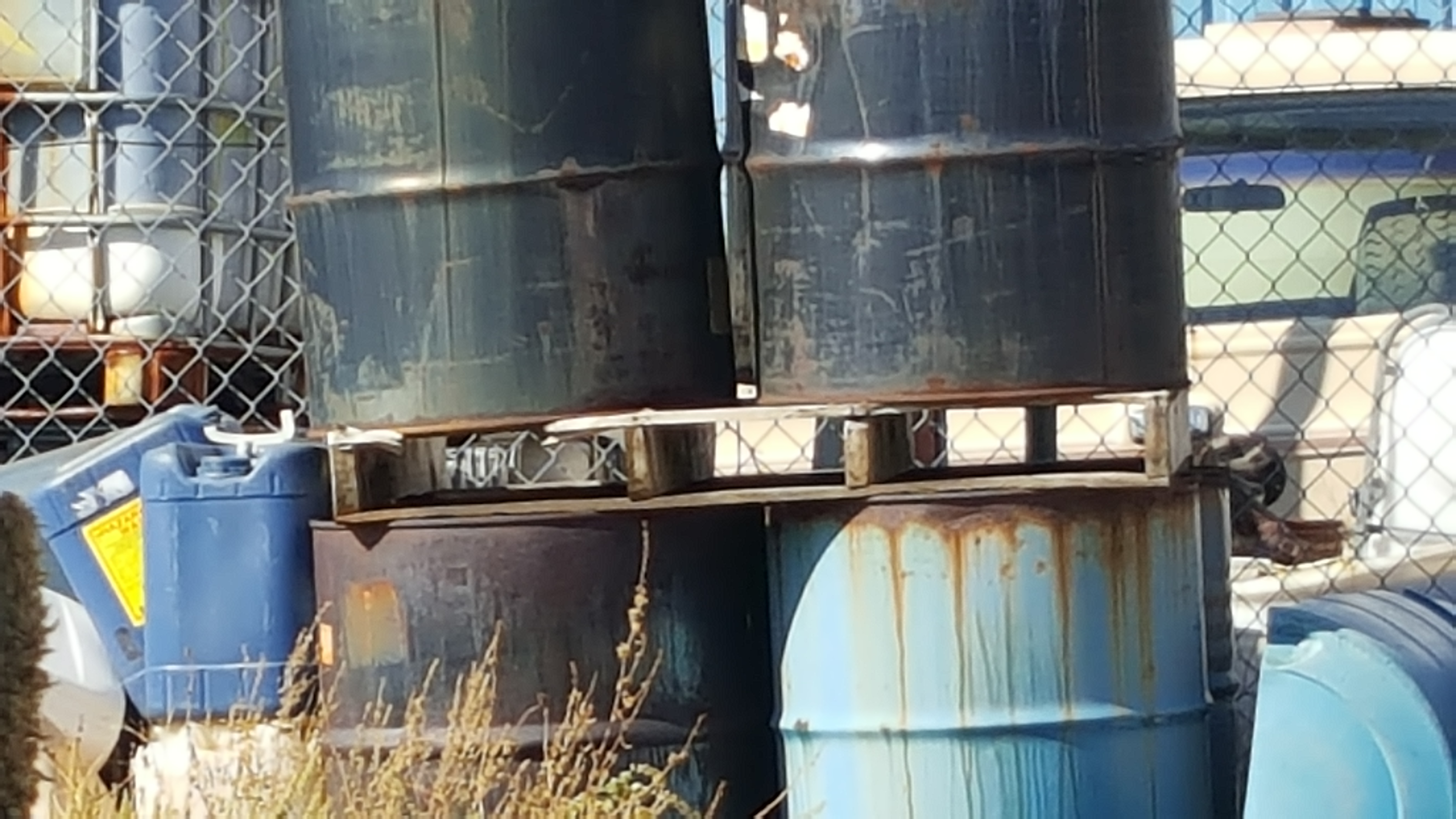
US DOT Requirements for the Shipment of Empty HazMat Packagings

It’s quite likely that at one time or another you have had to deal with the off-site shipment of empty packagings.  Most manufacturing facilities experience this when they empty various non-bulk (usually 55-gallons or smaller) packagings of their contents and then either return them to the supplier or send to them to a facility for reconditioning, remanufacture, or reuse.   If these packagings contained a hazardous material as defined by US DOT, then the shipment is subject to the requirements of the Hazardous Materials Regulations (HMR).  However, the HMR includes an exception from full regulation if the provisions of 49 CFR 173.29 are met.  Whatever your situation, a good understanding of the provisions and exclusions for shipment of empty packagings will help ensure you maintain compliance with US DOT regulations.

You must first understand that an empty packaging containing only the residue of its original hazardous material contents is subject to the same requirements of the HMR as it was when it contained a greater quantity (i.e. when it was full).  This includes use of the four hazard communication methods:  shipping papers, placards, labels, and markings; and the training required in 49 CFR 172, Subpart H for the HazMat Employees who prepare the empty packagings for shipment.  The two most useful exclusions in 49 CFR 173.29 can be found in paragraphs (b) & (c) and are explained below.  While paragraph (b) excludes the shipment from all of the HMR, it also contains the most restrictive provisions to gain that exclusion.  Paragraph c excludes the shipper from only some of the HMR, but is much easier to comply with.

Daniels Training Services, Inc.

815.821.1550

Info@DanielsTraining.com

https://danielstraining.com/

A close reading of 49 CFR 173.29(b) reveals that your empty packaging shipment – bulk and non-bulk – is not subject to any requirement of the HMR if you are able to meet all of the following provisions, as applicable:

First, any hazard communication method that identifies the empty packaging as containing a hazarous material (i.e. marking, labels, placards, etc.) are removed, obliterated, or securely covered in transportation.  Note that the requirement to remove all hazard communication is not necessary if the packagings are shipped in a transport vehicle or freight container, are not visible in transportation, and are loaded by you – the shipper – and unloaded by you or the consignee – the destination facility.

Second, the empty packaging is either unused, sufficiently cleaned of residue and purged of vapors to remove any potential hazard, or is refilled with a non-hazardous material such that any residue now won’t pose a threat.  Note that “cleaned of residue and purged…” and “now won’t pose a threat” is intentionally not defined by regulation.  It is your responsibility as the shipper to ensure these provisions are met.

Third, if the empty packaging contains only the residue of an ORM-D Consumer Commodity,  a Division 2.2 non-flammable gas described in 49 CFR 173.29(b)(2)(iv)(B), or the residue does not meet the definition of a hazardous substance, a hazardous waste, or a marine pollutant.  An example of where this last provision might apply is if a shipment is regulated as a hazardous material solely due to it being above the RQ in a single packaging and thus a hazardous substance.  If the amount of material in an empty container is below the RQ, then the material is no longer a hazardous substance and no longer subject to the HMR (02-0100).

So in conclusion, 49 CFR 173.29(b) allows you to ship packagings – both bulk and non-bulk – without any of the requirements of the HMR as long as all the hazards are removed – or not judged to be much of a hazard in the first place, such as ORM-D – and any information identifying the packaging as hazardous are removed or not visible in transportation.

49 CFR 173.29(c), while not as extensive in the exclusions from the HMR as is paragraph (b), also does not contain as many hoops to jump through.  It is most likely the applicable regulation if you ship empty non-bulk packagings to a drum re-conditioner or back to the material supplier.  There are three provisions or which you must be aware.

First, it must be a non-bulk packaging as defined at 49 CFR 171.8 which is a HazMat packaging that is:

  • ≤119 gallon capacity for a liquid.
  • ≤119 gallon and ≤882 pound capacity for a solid.
  • ≤1,000 gallon water capacity for a gas.

Read: Bulk Packaging Explained!

Second, the residue in the empty packaging may only be a hazardous material covered by Table 2 of 49 CFR 172.504 (see below) and is not a Poison Inhalation Hazard.

Table 2

Hazard Class or DivisionPlacard Name
1.4EXPLOSIVES 1.4
1.5EXPLOSIVES 1.5
1.6EXPLOSIVES 1.6
2.1FLAMMABLE GAS
2.2NON-FLAMMABLE GAS
3FLAMMABLE
Combustible LiquidCOMBUSTIBLE
4.1FLAMMABLE SOLID
4.2SPONTANEOUSLY COMBUSTIBLE
5.1OXIDIZER
5.2 (Other than organic peroxide, Type B, liquid or solid, temperature controlled)ORGANIC PEROXIDE
6.1 (Other than material poisonous by inhalation)POISON
6.2 (Infectious Substance)NONE
8CORROSIVE
9CLASS 9 (placard not required for domestic transportation)
ORM-DNONE

If the two above provisions are met for your shipment, then it is not subject to the placarding requirements of 49 CFR 172, Subpart F.

Further, if your shipment of non-bulk packages from Table 2 is transported by a contract or private carrier – not a common carrier – and is destined for reconditioning, remanufacture, or reuse, then you are not required to use a shipping paper as is required for most HazMat shipments per 49 CFR 172, Subpart C (00-0340).  For an explanation of these terms – contract, private, and common carrier – please refer to this guidance letter from USDOT/PHMSA (02-0259).

If required, 49 CFR 173.29(e) refers you to the regulations pertaining to shipping papers found at 49 CFR 172.203(e).  For most shipments – bulk and non-bulk – the description on the shipping paper may include, “RESIDUE: Last Contained…” near the basic description of the hazardous material.  For shipments in a tank car only, which is included in the definition at 49 CFR 171.8 of a railroad car, the description on the shipping paper must include, “RESIDUE: LAST CONTAINED…” before the basic description.

Note that 49 CFR 173.29(c) does not exclude the requirement to train your HazMat Employees per 49 CFR 172, Subpart H.  Therefore any employee that prepares the empty packagings for shipment, completes or signs the shipping papers, or loads/unloads the empty packagings onto the vehicle must receive DOT Hazardous Materials Training.

You must also ensure compliance with the US EPA regulations for emptying the container (US EPA refers to it as a container, not a packaging) in order to ensure the residue is no longer a hazardous waste.  The applicable US EPA regulations can be found at 40 CFR 261.7.  If you generate any hazardous waste, you may be subject to the training requirements of 40 CFR 265.16 for any employees who handle hazardous waste or sign a hazardous waste manifest.

Read: The “RCRA Empty” Exemption from Hazardous Waste Regulation

Contact me with any questions you may have about the transportation of hazardous materials by air, highway, vessel, or rail

International and Domestic

Daniels Training Services, Inc.

815.821.1550

Info@DanielsTraining.com

https://danielstraining.com/

If you are a shipper of empty packagings, then it is quite likely that you and perhaps several of your employees require triennial HazMat Employee training as required by the US DOT and annual RCRA Employee training per US EPA.

US EPA and US DOT Regulations for the Handling and Transportation of Samples of Hazardous Materials and Hazardous Waste

Q:  I need to ship a small amount of our product (let’s say <1 gallon of a flammable solvent blend) from our distribution facility in Des Moines, IA to our QC lab in Akron, OH.  Our salespeople travel this route regularly by company car, can I have one of them transport this hazardous material?  What US DOT regulations must I comply with?

A:  Transportation of product of this quantity by motor vehicle over public roadways is acceptable under the Materials of Trade Exception to the Hazardous Materials Regulations (HMR).  You need only comply with the relatively simple requirements of 49 CFR 173.6.

Q:  OK, what about the same material shipped by a common carrier or UPS or the US Postal Service?

A:  You must follow all the requirements of the HMR for shipping papers, placards, labels, and markings.  The Materials of Trade Exception only applies if you are transporting your HazMat in your motor vehicle.  The Carrier or their industry group (the International Air Transport Association or IATA is a creation of the airline industry) may have additional requirements.

Q:  What if I need to ship the sample in order to determine its hazards, how do I select a proper shipping name, identification number, hazard class, packing group, etc?

A:  49 CFR 172.101(c)(11) states that except for certain materials, you as a Shipper may assign a tentative shipping name, hazard class, and ID # to a hazardous material (including a hazardous waste) based on your knowledge of its characteristics, the hazard precedence found in 49 CFR 173.2(a), and the hazard classes as defined in the HMR.  Some additional – relatively simple – compliance requirements are found at 172.101(c)(11)(iv), research these if you wish to use this exemption.

Q:  What if the material I want to ship for analysis is a waste and has the potential to be a hazardous waste?  What then?

A:  As noted above, 49 CFR 172.101(c)(11) includes hazardous waste.

Daniels Training Services, Inc.

815.821.1550

Info@DanielsTraining.com

https://danielstraining.com/

Q:  Yeah, but what about the US EPA regulations for hazardous waste?  Have you forgotten about them?

A:  There are two US EPA exclusions from the full regulation of the Resource Conservation and Recovery Act (RCRA) for this type of material.  The first, found at 40 CFR 261.4(d) is for small (US EPA says <1 gallon) waste characterization samples collected and shipped solely to determine the hazardous waste characteristics or composition.  The exclusion applies to any stage of the process of sample collection, temporary storage, shipment, and analysis.  As long as you meet the requirements of the exclusion, the sample is not subject to the RCRA regulations for labeling, inspections, personnel training, on-site accumulation time limits, generator status determination, etc.  When shipping the sample you must either comply with the requirements of the US DOT or US Post Office (see above) or if there are none, the requirements of 40 CFR 261.4(d)(2)(ii).

The second exclusion, found at 40 CFR 261.4(e) is for treatability study samples as defined at 40 CFR 260.10.  Somewhat similar to the waste characterization sample exclusion already discussed, this exclusion is more narrow in its allowances and more strict in it requirements.  I suggest a close reading of this regulation if you wish to use this exclusion.  Like the waste characterization sample exclusion, the US EPA requires compliance with applicable US DOT and/or US Postal Service regulations, or compliance with the requirements of 40 CFR 261.4(e)(2)(iii)(B)(1-5) when it comes time for off-site shipment of the sample.  Anything else?

The Materials of Trade Exception for the Transportation of Hazardous Materials

As a shipper of hazardous materials, you are likely comfortable with routine HazMat shipments:

  1. Offer a hazardous material for transportation to a carrier.
  2. Carrier transports HazMat to destination.
  3. HazMat received at destination.

Sometimes, however, you’re faced with a non-routine situation:  you or an employee must transport a hazardous material by motor vehicle over a public roadway.  The need is not limited to, but may include, any one of the following:

  • A ‘sister’ facility requires a small amount of product or raw material from your location.
  • You are required to transport a sample of some material to an off-site location for analysis.
  • You must deliver a product to a customer.
  • A hazardous material is necessary to provide a service to a customer at their location.
  • A hazardous material is necessary to conduct a maintenance service activity at an off-site location.

In any of these situations your concern may be that as a shipper of hazardous materials (one who offers hazardous materials for transportation) you are not allowed to perform the role of a carrier (one who transports hazardous materials in commerce).  You may not be aware that the Hazardous Materials Regulations contain an option for shippers of HazMat in this situation.  Known as the Materials of Trade Exception and codified at 49 CFR 173.6, it was created to simplify the transportation of…

  • Certain hazardous materials…
  • In small quantities…
  • By motor vehicle over a public roadway.
Continue reading to see if the Materials of Trade Exception may be of use to you. (more…)

Use of the Technical Name with the Proper Shipping Name When Shipping HazMat

When determining a proper shipping name for your hazardous materials shipment it is important to select from the Hazardous Materials Table at 49 CFR 172.101 the most specific name that best describes the hazardous material to be shipped.  Proper shipping names should be selected in the following order:

  1. The chemical identity of the hazardous material:  its technical name.
  2. The name of a category or group of chemicals, e.g. “Alcohols, n.o.s.”
  3. The intended use of the material, e.g. “Resin Solution”.
  4. It describes the hazard(s) of the material, e.g. “Flammable Liquid, n.o.s.”

It is when the fourth option of the above is chosen that you must pay special attention to column 1 of the Hazardous Materials Table and see if the letter ‘G’ appears there.  The ‘G’ stands for Generic and means that the proper shipping name selected does not go far enough to describe the hazards of the material it represents.  It is necessary therefore to include the technical name of the hazardous material on the shipping paper.  Technical Name is defined at 49 CFR 171.8 and means a recognized chemical name used by science.  It does not allow for the use of trade names.

The regulations at 49 CFR 172.203(k) indicate the correct use of the technical name on the shipping paper; please continue for a summary of this information.

If the material is not a mixture or solution, than you need use only one technical name.  It must appear in parenthesis and be associated with the basic description.  It may appear thus:

“Corrosive liquid, n.o.s., (Octanoyl chloride), 8, UN 1760, II”, or

“Corrosive liquid, n.o.s., 8, UN 1760, II (contains Octanoyl chloride)”

Note that the use of the word “contains” is allowed, but not required.

If the hazardous material is a mixture or solution of two or more hazardous materials, then the technical names ofat least two hazardous components that contribute the most to the hazards of the material must be listed on the shipping paper as indicated above.  Note that you are required to list “at least two” of the most dangerous constituents, but no upper limit is set.  You may therefore list as many hazardous ingredients as you wish as long as the first two listed are the major contributors to the hazards of the material.  Also note that you are only required to list the hazardous constituents.  If you have a mixture of a hazardous material and non-HazMat, you are not required to list the non-HazMat.

Many people equate the presence of the “n.o.s.” (“not otherwise specified”) at the end of the proper shipping name to be synonymous in meaning with a ‘G’ in column 1, but this is not so.  There are several proper shipping names with “n.o.s.” – such as “Alcohols, n.o.s.” that lack a ‘G’ in column 1.  The regulations at 49 CFR 172.203(k) are clear that the technical name is required on a shipping paper only when a ‘G’ is found in column 1.

For organic peroxides which may qualify for more than one generic listing depending on concentration, the technical name must include the actual concentration being shipped or the concentration range for the appropriate generic listing.

Shipping descriptions for toxic materials that meet the criteria of Division 6.1, PG I or II (Poisonous Material) or Division 2.3 (Poisonous Gas) and are identified by the letter “G” in column 1 of the §172.101 Table, must have the technical name of the toxic constituent entered in parentheses in association with the basic description.

There are some situations where the use of a technical name is not required even if a “G” appears in column 1 of the Hazardous Materials Table.  If a material is a hazardous waste and is described using the proper shipping name of Hazardous waste, solid, n.o.s. or Hazardous waste, liquid, n.o.s. (class 9) it need not include the technical name provided the US EPA hazardous waste code is included near the basic description the same as the requirement for the technical name.  Or, if the material is a reportable quantity of a hazardous substance, you may describe it as required in 49 CFR 172.203(c) instead.

A technical name is also not required if you are shipping a sample of a material for analysis and the hazard class is not known.  Read my article about the US EPA and US DOT requirements for managing samples of hazardous materials.

49 CFR 172.203(k)(2)(iii-iv) allow for a relaxation of the requirement for a technical name in certain rare situations where the proper shipping name – though containing “n.o.s.” – is descriptive enough of the hazards of the material.  I suggest you read these two specific regulations to see if they apply to your operations.

Another exception for the use of the technical name can be found at 49 CFR 173.12 and applies solely to shipments of hazardous waste in lab packs.  I don’t have time to explain lab packs here, but suffice to say that as long as your lab pack shipment of hazardous waste meets the requirements of 49 CFR 173.12(b), then pursuant to 49 CFR 173.12(d) you need not include the technical name on the shipping paper or as a marking on the package.

All of the above is required to appear on the shipping papers, what about on the packaging as a marking?  49 CFR 172.301(b) specifies the requirements for including the technical name on a non-bulk packaging (<119 gallons) as the same as those required on a shipping paper.  Therefore the appearance of the technical name on the shipping paper should match its appearance on the packaging as a marking for non-bulk packages.

49 CFR 172.302 – General Marking Requirements for Bulk Packagings does not include a requirement for the proper shipping name on a bulk packaging unless it is a portable tank or a railroad tank car.  Therefore, the technical name is not required for bulk packagings except in the case of a portable tank or a railroad tank car.

Questions like these come up frequently at the HazMat Courses I hold nationwide and year-round.  My training events meet the regulatory requirements of the US EPA for RCRA training and those of the US DOT for HazMat Employees.  Both together in one day of training.  Please refer to my Schedule of Events to find a training event date and location convenient to you.  Or, contact me directly to schedule on-site training for all of your Hazardous Waste Personnel and HazMat Employees in one day of training for only $1,749.

Selecting a Carrier for Your Shipment of Hazardous Materials

I have the opportunity during my weekly nationwide training events to meet with a variety of HazMat Employers  who usually are also Shippers, since they “offer for shipment” a hazardous material to a Carrier who then transports it in commerce.  For most persons, their experience as a Shipper of hazardous materials is limited to their routine shipments of hazardous waste.  For this purpose they commonly rely on the hazardous waste disposal firm or TSDF to provide for off-site transportation of the waste.

Sometimes however, a person is faced with the responsibility of arranging for a non-typical HazMat shipment.  In this situation you will need to select a Carrier that can transport the hazardous material to its destination.  It is important to select a Carrier who meets the requirements of both the Pipeline and Hazardous Materials Safety Administration (PHMSA) and the Federal Motor Carrier Safety Administration (FMCSA).  Both of these are administrations within the US Department of Transportation and require a brief explanation.

PHMSA was created in 2005 to replace the Research and Special Provisions Administration (RSPA).  It is used by US DOT to develop and enforce regulations to ensure the safe transportation of hazardous materials (HazMat) in commerce by air, water, highway, rail, and all transportation by pipeline.

FMCSA was formed January 1, 2000 to regulate the trucking industry in the US.  Its regulations apply to employees and employers who transport HazMat – and non-HazMat – in commerce on public highways.

Whether it is a routine shipment of your hazardous waste that you have shipped a thousand times before, or a one-time or first-time shipment, you as the Shipper must ensure the Carrier you select is in compliance with all applicable regulations of the PHMSA and FMCSA.  Before you offer a hazardous material for shipment, confirm the following with your Carrier:

  1. Has the driver received training as a HazMat Employee per the requirements of 49 CFR 172, Subpart H within the last three years?  All HazMat Employees must receive the following training:
    1. General Awareness/Familiarization
    2. Function Specific
    3. Safety Procedures/Emergency Response
    4. Security Awareness
    5. In-Depth Security (if applicable, see here for more information)

In addition to the above, a person who transports hazardous materials over a public roadway must receive Driver Training.

  1. If the shipment is required to be placarded per the requirements of 49 CFR 172, Subpart F or otherwise meets the applicability requirements of 49 CFR 107.601; is the Carrier registered as a transporter of hazardous materials per the requirements of 49 CFR 107.608?  Click here for a short survey to determine the registration requirements.
  2. If the shipment meets the applicability requirements of 49 CFR 172.800(b) – Revised effective October 1, 2010 – does the Carrier have a DOT Security Plan and conduct In-Depth Security Training for its HazMat Employees per 49 CFR 172, subpart H?
  3. If the shipment is  required to be placarded per the requirements of 49 CFR 172, Subpart F; does the driver have the hazardous materials endorsement on their Commercial Driver’s License (CDL) per their respective state to the minimum standards mandated in 49 CFR 383, Subparts G & H?
  4. If the shipment meets the applicability requirements of 49 CFR 385.403; does the Carrier have a Hazardous Materials Safety Permit (HMSP)? A Carrier may take the following survey to determine if it is required to obtain an HMSP.  A Shipper may find this survey useful as well.

The selection of your Carrier is only the first of many of your responsibilities as a Shipper of hazardous materials.  You’re responsibilities include:

  • Determining the Proper Shipping Name, Hazard Class and/or Division, Identification Number, and packing group.
  • Select the proper packaging.
  • Affix the proper hazard class labels and markings.
  • Properly complete the shipping paper, including the…
    • Emergency response information
    • Emergency response phone number
    • Certification statement and signature
    • Provide correct placards to the driver.
    • Completion of a DOT Security Plan.  Take this simple survey to see if the DOT Security Regulations apply to you.
    • TRAINING FOR ALL OF YOUR HAZMAT EMPLOYEES.

Everything you need to know as a Shipper is covered in the afternoon session of my one-day, nationwide training events.  It also fulfills the US DOT triennial training requirements for HazMat Employees.  The remaining 4-hours cover the Hazardous Waste Personnel training requirements of the US EPA and provides a wealth of information for generators of hazardous waste.

When Must an Identification Number Not be Included on a Hazardous Material Placard?

An identification number, though usually displayed on or in association with a placard on a vehicle or bulk container, must be in compliance with the Marking requirements of 49 CFR 172, Subpart D and not the Placarding requirements of Subpart F.  And it is in 49 CFR 172.334(d) that a little known prohibition on the use of the identification number on placarded vehicles can be found.   Simply stated, the regulation prohibits the use of an identification number on a placard unless the identification number is applicable to all of the hazardous materials of the same hazard class in the vehicle.

Consider:  A truck is to be loaded with the following hazardous materials…

  • UN 3264, Waste Corrosive Liquid, Acidic, Inorganic, n.o.s  (Hydrochloric Acid, Hydrogen Peroxide), 8, II – 6 x 55 gallon drums @ 600 lb/drum = 3,600 lbs
  • UN1760, Waste Corrosive Liquid, n.o.s. (Nitric Acid, Hydrofluoric Acid), 8, II – 1 x 350 gallon bulk packaging = 350 lbs

Per the US Department of Transportation (US DOT) regulations at 49 CFR 172.504(c), a CORROSIVE placard is required on all four sides of the vehicle for two reasons:

  1. The gross weight of the hazardous material shipment is >1,001 lbs; and,
  2. A bulk packaging of a hazardous material is part of the shipment.

Further, 49 CFR 172.331(c)mandates the use of the identification number on all four sides of the vehicle since the identification number on the bulk packaging (UN1760) is not visible inside the closed transport vehicle.

The usual response to this situation is to placard the vehicle CORROSIVE on all four sides with the identification number (UN1760) for the bulk packaging on the placard.  All is well, right?  Not so fast there Shipper!  49 CFR 172.334(d) seems to prohibit the display of the identification number on the placard in this case.  Why?  Because the identification number may only be displayed if it represents all the hazardous materials in that hazard class loaded on the vehicle.  Since the six drums of Waste Corrosive Liquid, Acidic, Inorganic, n.o.s. has an identification number of UN3264, the identification number of UN1760 cannot be displayed solely on the CORROSIVE placard.  But, 49 CFR 172.331(c) requires the display of the identification number on all four sides of the vehicle.  Pretty confusing huh?

The solution is to display each applicable identification number in one of the following manners:

  • On an orange panel near the placard.  You can use as many orange panels as necessary.
  • On a white square-on-point near the placard.  You can use as many white square-on-points as necessary.
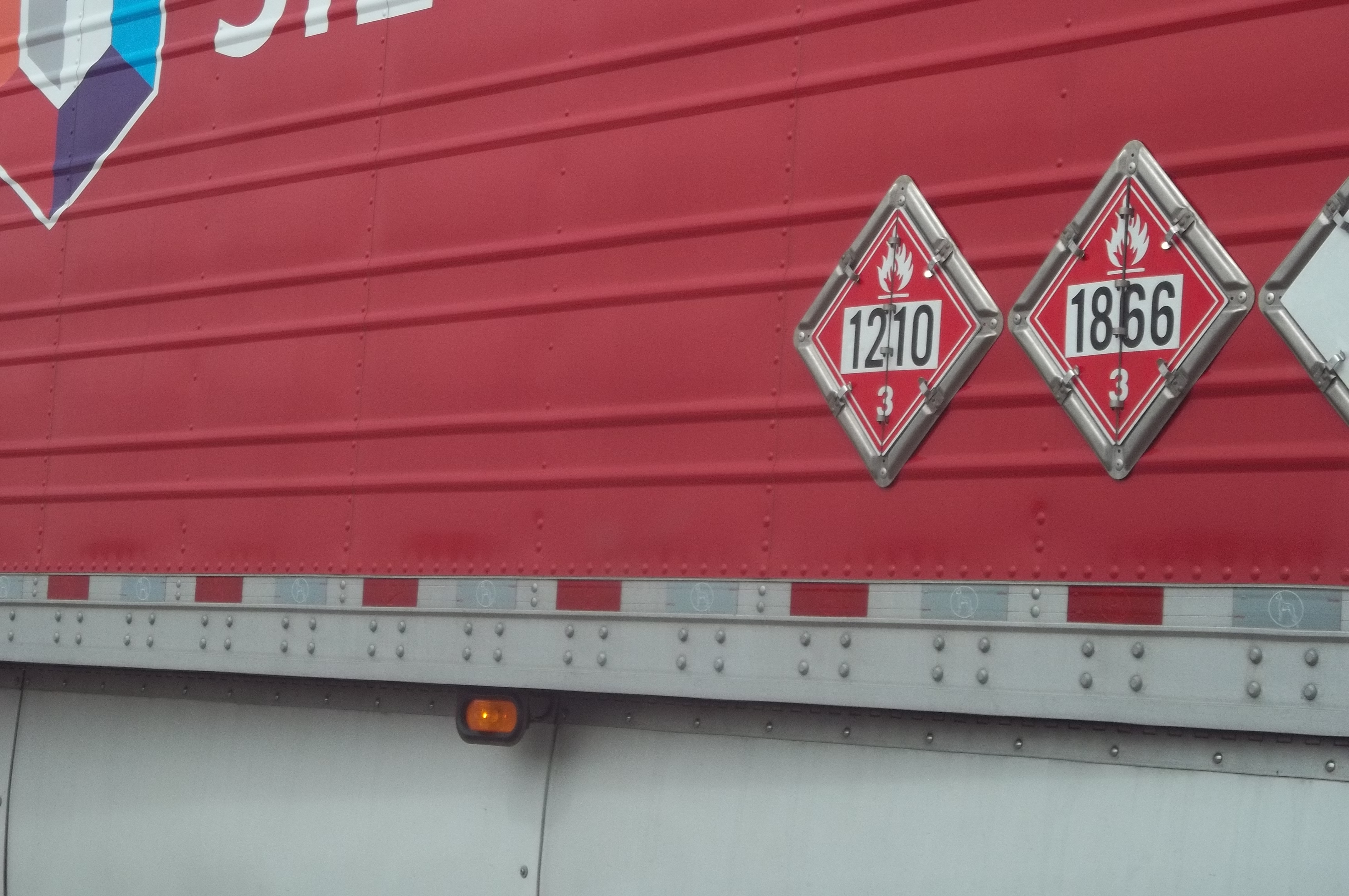
  • On separate placards of the same hazard class.  As demonstrated by the photo below:
Class 3 Flammable Liquid Placards
Class 3 placard with identification number for Printing Ink or Printing Ink Related Material (UN1210) and Resin Solution (UN1866)

And what does it matter to you anyway? You’re a shipper of hazardous materials, not a carrier.  Placarding is the responsibility of the carrier, right?  Wrong.   49 CFR 172.506(a) reads:  “Each person offering a motor carrier a hazardous material for transportation by highway shall provide to the motor carrier the required placards for the material being offered prior to or at the same time the material is offered for transportation, unless the carrier’s motor vehicle is already placarded for the material as required by this subpart.”  And 49 CFR 172.300(a) reads:  “Each person who offers a hazardous material for transportation shall mark each package, freight container, and transport vehicle containing the hazardous material in the manner required by this subpart.”  Since you are offering the hazardous material (which includes hazardous waste shipped on a Uniform Hazardous Waste Manifest) to a motor carrier for transportation it is your responsibility to ensure the bulk packaging and vehicle are properly placarded and marked.

Contact me with any questions you may have about the transportation of hazardous materials by air, highway, vessel, or rail

International and Domestic

Daniels Training Services

815.821.1550

Info@DanielsTraining.com

https://danielstraining.com/

There are many aspects of DOT’s Hazardous Material Regulations (The HMR) that place the burden of responsibility on the person who offers hazardous materials for transportation in commerce (i.e. the Shipper).  As a shipper of hazardous materials – including hazardous waste – it is important for you to be familiar with all of your regulatory requirements.


PHMSA Enhanced Security Requirements

In the aftermath of September 11, 2001 the US Department of Transportation mandated Enhanced Security Requirements for companies that transport (i.e. Carriers) and/or offer for transport (i.e. Shippers) hazardous materials – including hazardous waste – in commerce.

The Enhanced Security Requirements include:

  1. Security General Awareness training for all HazMat Employees.
  2. In-Depth Security training for applicable HazMat Employees of subject facilities.
  3. A DOT Security Plan for subject facilities.

When first published, the regulations mandated the Security General Awareness training be added to the currentHazMat Employee training content of:

  • General Awareness/Familiarization
  • Function Specific Responsibilities
  • Safety & Emergency Response
  • Professional Driving Skills – as necessary

In-Depth Security training was only to be added if applicable to the facility’s operations as defined by the regulations.  The original criteria to determine if a facility was subject to the requirements of the DOT Security Plan and In-Depth Security training closely mirrored the existing registration requirements for HazMat Shippers and Carriers found at 49 CFR 107, Subpart G and summarized on the PHMSA website.  Therefore it included the following:

“A quantity of hazardous material that requires placarding under the provisions of subpart F of this part.”

This particular criteria meant that many – perhaps too many – companies were required to have a DOT Security Plan and to conduct In-Depth Security training for an applicable HazMat Employee.   In my former employment, I had the responsibility of assisting many companies to comply with these regulatory requirements when all they shipped were two or three drums of hazardous waste.

Fortunately the DOT came to its senses, revised its regulations and changed the applicability determination for the Security Plan and In-Depth Security training.  I think the DOT realized it would be better to focus its attention on those shippers and carriers that have a legitimate security risk and not on the many shippers/carriers whose small volume of hazardous materials pose little or no security risk.  The new DOT Security regulations including the revised applicability determination went into effect October 1, 2010 and can be reviewed at 49 CFR 172.800(b).  Though the list is longer now, it no longer mandates the DOT Security Plan and In-Depth Security training for a shipper or carrier just because a hazmat load requires placarding.

In my experience, many companies that were subject to the DOT Security Plan and In-Depth Security training prior to October 1, 2010, are no longer so after that date.  Conversely, some that were not subject to the regulations prior to that date now are.  It is important for every HazMat Employer to identify the specific DOT regulations they are subject to.  Especially the Enhanced Security Requirements due to the current security concerns and the recent changes to the regulations.

If your company is still subject to the requirements to create and maintain a DOT Security Plan and to conduct In-Depth Security training triennially for applicable HazMat Employees, you should also be aware that the same regulations that revised the applicability determination also changed the content requirements for the Plan and Training.  Carefully review 49 CFR 172, Subparts H & I to ensure your Plan and Training meet regulatory requirements.  Additional guidance information can be found on the PHMSA website.

Non-Routine Shipments of Hazardous Materials

“Other than hazardous waste, we don’t ship hazardous materials, so we don’t need the DOT HazMat Employeetraining for our Shipping Department personnel.”   The preceding statement may be true when its ‘business as usual’, but there are a few situations that arise not infrequently in business that may require you to prepare a ‘one-time’ hazardous material for shipment.  A ‘one-time’ shipment is subject to the entire Hazardous Materials Regulation (HMR) – including training of HazMat Employees – so it’s important to be prepared for any of the following situations:

  1. A hazardous material received as product (paint, cleaner, solvent, plating solution, reactant, epoxy, etc…) must be returned to the supplier. Perhaps the product you received was the wrong color, off-spec, in excess of your needs, or in some other way was not what you wanted and must now be returned to the supplier.  In most cases, returning the material in the original packaging with the original shipping paper will suffice to meet most requirements of the HMR.  However, these items may not always be available.  And, in this case you are the Shipper and therefore responsible for any errors in the shipment, regardless if the same error was made by the entity that shipped it to you.
  2. A customer requires a small amount of your raw material – such as paint – to “touch-up” a product of yours they have received. Typically you receive your product as hazardous materials in quantities ranging from 5-gallon buckets to bulk containers.  A customer request may be for much smaller amounts.  How must the hazardous material be packaged?  What are the shipping paper requirements?  Are there exemptions to the HMR for this type of shipment?  You must be certain of the applicable regulations before you can meet your customer’s request.
  3. A ‘sister facility’ requires some proprietary material you have in stock. If you are offering a hazardous material for shipment in commerce, even if that shipment is across the street, that shipment will be subject to the full HMR unless specific exemptions apply.

Any one of these situations may arise without warning and require a rapid response.  Therefore it’s best to be prepared ahead of time.  HazMat Employee training presented by Daniels Training Services will provide you with three things:

Use of Commas in the Proper Shipping Description for Hazardous Materials

A question from an attendee of one of my recent training events forced me to re-think my strongly-held belief in the correct formatting of the proper shipping description for a hazardous materials shipment.  The question asked was, “Is a comma required between the primary hazard class (3 in the example below) and the subsidiary hazard class (8 in the example)?  Or, what if there is more than one subsidiary hazard class, must there be a comma between them?”

As a truck driver for Laidlaw Environmental Services for several years and ~13 years with Fehr-Graham and Associates (click here for more information), I have seen my share of shipping papers and thought I knew the correct answer.  I believed that a comma must appear between every distinct entry in the proper shipping description.

For example: UN2924, Flammable Liquid, Corrosive, n.o.s., 3, (8), PGII, (Isopropanol, Organic Amines).

Research brought me to 49 CFR 172, Subpart C which documents the requirements for completing a shipping paper if required for a shipment of hazardous materials (all hazardous waste shipments from Large Quantity Generators and Small Quantity Generators of hazardous waste are required to use a Uniform Hazardous Waste Manifest which is a type of shipping paper).  It does not however indicate specifically when – or if – commas are to be used.  49 CFR 172.202(a)(7)(b) of Subpart C reads, “Except as provided in this subpart, the basic description specified in paragraphs (a)(1), (2), (3) and (4) of this section must be shown in sequence with no additional information interspersed. For example, ‘UN2744, Cyclobutyl chloroformate, 6.1, (8, 3), PG II’.”   This would seem to indicate that the preferred method, as indicated by the example, is to use commas to separate each distinct part of the basic description.  However…

In the PHMSA webpage of FAQ’s,  in a question regarding the order of information in the basic description the comma is not present between the primary hazard class and the subsidiary hazard classes.  This would seem to indicate that the use of commas is arbitrary.  And….

The Pipeline and Hazardous Materials Safety Administration (PHMSA) Hotline reported that they have no set formatfor separating the information contained in the basic description or what may be included as “additional description”.

Also, PHMSA written interpretation #05-0180 – while directly addressing another aspect of the basic description – includes the following statement, “The basic shipping description must be easily recognizable and available to emergency responders in the event of an incident.”

This brings us all the way back to the basic function of all four of the DOT hazard communication methods (shipping papers, placards, hazard labels, & markings):  it’s all about communication; and not mindless adherence to the Hazardous Materials Regulations.   The purpose of the proper shipping description on the shipping paper is to communicate the potential hazards of the hazardous material in transportation for all who may come in to contact with it, but especially for emergency responders.  Therefore, as long as the proper sequence of the proper shipping  description is maintained as per 49 CFR 172.202(a)(7)(b) – see example above – and the necessary information is communicated, a shipper may use commas, multiple spaces, hyphens, semi-colons, etc. in the proper shipping description as they see fit. So, the above example may appear correctly as it is, or as any of the following:

UN2924   Flammable Liquid, Corrosive, n.o.s.   3   (8)   PGII   (Isopropanol, Organic Amines)

UN2924 – Flammable Liquid, Corrosive, n.o.s. – 3 – (8) – PGII – (Isopropanol, Organic Amines)

UN2924; Flammable Liquid, Corrosive, n.o.s.; 3  (8); PGII  (Isopropanol, Organic Amines)

In addition, per 49 CFR 172.101(c)(2) punctuation marks and words in italics are not part of the proper shipping name, but may be used.  So, commas are not even required within the proper shipping name, meaning any of the following proper shipping descriptions are acceptable as well:

UN2924   Flammable Liquid Corrosive n.o.s.   3   (8)   PGII   (Isopropanol, Organic Amines)

UN2924 – Flammable Liquid Corrosive n.o.s. – 3 – (8) – PGII – (Isopropanol, Organic Amines)

UN2924; Flammable Liquid Corrosive n.o.s.; 3  (8); PGII  (Isopropanol, Organic Amines)

Researching this question served as a good reminder for me that no part of the HMR – even a comma – is so small it’s unimportant.

Search Website