PO Box 1232 Freeport, IL 61032

A Different Kind Of Training

A Different Kind Of Training

A Different Kind Of Training

Authorized Packaging for HazMat and a PHMSA Video of Cargo Tank Explosion

The Hazardous Material Regulations of the Pipeline and Hazardous Materials Safety Administration (PHMSA, an administration within the US DOT), require all hazardous materials to be transported in authorized packaging (49 CFR 173.24(c)).  Authorized packaging can be determined in only one of two ways:

  • In columns 8A (packaging exceptions), 8B (non-bulk packaging), or 8C (bulk packaging) of the hazardous materials table at 49 CFR 172.101 of the HMR.  Each column will indicate the section of Part 173 where authorized packaging for that HazMat is identified.  “None” in any of column 8 indicates that form of packaging is not available.  Further, the HazMat shipment must conform to any applicable special provisions in column 7 of the hazardous materials table (special provision codes are explained at 49 CFR 172.102).  Also, if specification packaging, it must meet the requirements of parts 178 (for most packagings) and part 179 (for railroad tank cars).

Meeting the requirements of parts 178 and 179 does not apply to a UN Standard packaging that is manufactured outside of the U.S.

  • The packaging is permitted under and conforms to the requirements of the U.S Bureau of Energy found at §171, subpart B or those of the applicable international agency found at §171, subpart C.  Or, conforms to packing instructions found at:  §173.3, §173.4, §173.4a, §173.4b, §173.5, §173.5a, §173.6, §173.7, §173.8, §173.27, or §176.11.

So, what happens when the packaging for a hazardous material is not the authorized packaging as determined by compliance the HMR?  See below:

https://www.youtube.com/watch?v=8ZqRU9mBOf8

More significant because of the volume and nature of the HazMat, the lesson can be applied to smaller volumes and less hazardous materials:  using a packaging that is not authorized for a hazardous material can result in package failure leading to loss of property, injury, and death.

Contact me with any questions you may have about the transportation of hazardous materials by air, highway, vessel, or rail

International and Domestic

Daniels Training Services

815.821.1550

Info@DanielsTraining.com

https://danielstraining.com/

Q&A: Placement of HazMat Labels and Markings on a Package

QUESTION FROM A HAZMAT EMPLOYER (NOT A CUSTOMER OF MINE, YET!) IN LATE OCTOBER 2015 VIA TELEPHONE (I DON’T RECORD MY TELEPHONE CONVERSATIONS SO THIS IS JUST MY BEST RECOLLECTION):

Is it OK for HazMat labels and markings to appear on the top of a package of hazardous materials for transportation?

DURING THE COURSE OF THE TELEPHONE CONVERSATION I MUST HAVE TOLD THE QUESTIONER THAT IT WAS NOT ACCEPTABLE TO DISPLAY HAZMAT LABELS AND PLACARDS ON THE TOP OF A PACKAGE, ESPECIALLY IF THE TOP IS REMOVABLE, E.G. THE LID OF A 5-GALLON BUCKET.  MY FOLLOW-UP EMAIL ON NOVEMBER 2, 2015 WAS AN ATTEMPT TO SET THE RECORD STRAIGHT:

Thank you for contacting me with your question. Though I gave you my initial response over the phone, I’m glad I took the time to further research this issue. Because my initial response was wrong!

I had told you that I believed that HazMat markings and labels must appear on a non-removable part of a HazMat package but this is not so (for the most part).

Based on my review of the Hazardous Material Regulations and confirmation with the PHMSA Helpline, I have determined the following:

  • The marking regulations of 49 CFR 172, Subpart D do not specify a location for HazMat markings. With one exception, see next.
  • The packaging specification marking must be visible on a non-removable part of the packaging (49 CFR 178.3). This would preclude its placement on a removable lid.
    This is the specification packaging marking for a steel drum with a removable lid.Specification packaging marking
  • HazMat labels must, “Be printed on or affixed to a surface (other than the bottom)” of a HazMat package [172.406(a)(1)(i)]. And, per 49 CFR 172.406(a)(1)(ii): “Be located on the same surface of the package and near the proper shipping name marking, if the package dimensions are adequate.”

The HMR does not forbid the placement of HazMat labels and markings on the top or lid of a packaging, even a removable lid, except for the packaging specification marking. HazMat labels may not be affixed to the bottom of a package, though there is no such limitation for a marking. However, since the label and the marking are required to be located on the same surface and near each other, it can be reasonably assumed that the marking should not appear on the bottom of the package.

I hope this helps. Please don’t hesitate to contact me with any other questions.

It pays to do your research!  Also, you should never rely on the first answer of someone – even me – unless they are able to back up their response with a reference to the regulations.  Here is an example of when the common-sense answer – I mean, c’mon!  Do you really think it’s OK for HazMat labels to appear on the removable lid of a package? – is wrong.  But common-sense doesn’t always mean compliance.  Make sure you and your HazMat Employees are in compliance with the Hazardous Material Regulations.

Go Glow Placards to Comply with 49 CFR 172.516 – Visibility and Display of Placards

The Hazardous Material Regulations at 49 CFR 172.516 require the following for the display of placards.

  • On a motor vehicle or rail car a placard must be clearly visible from the direction it faces, except from the direction of another rail cargo or transport vehicle to which it is attached.  More…
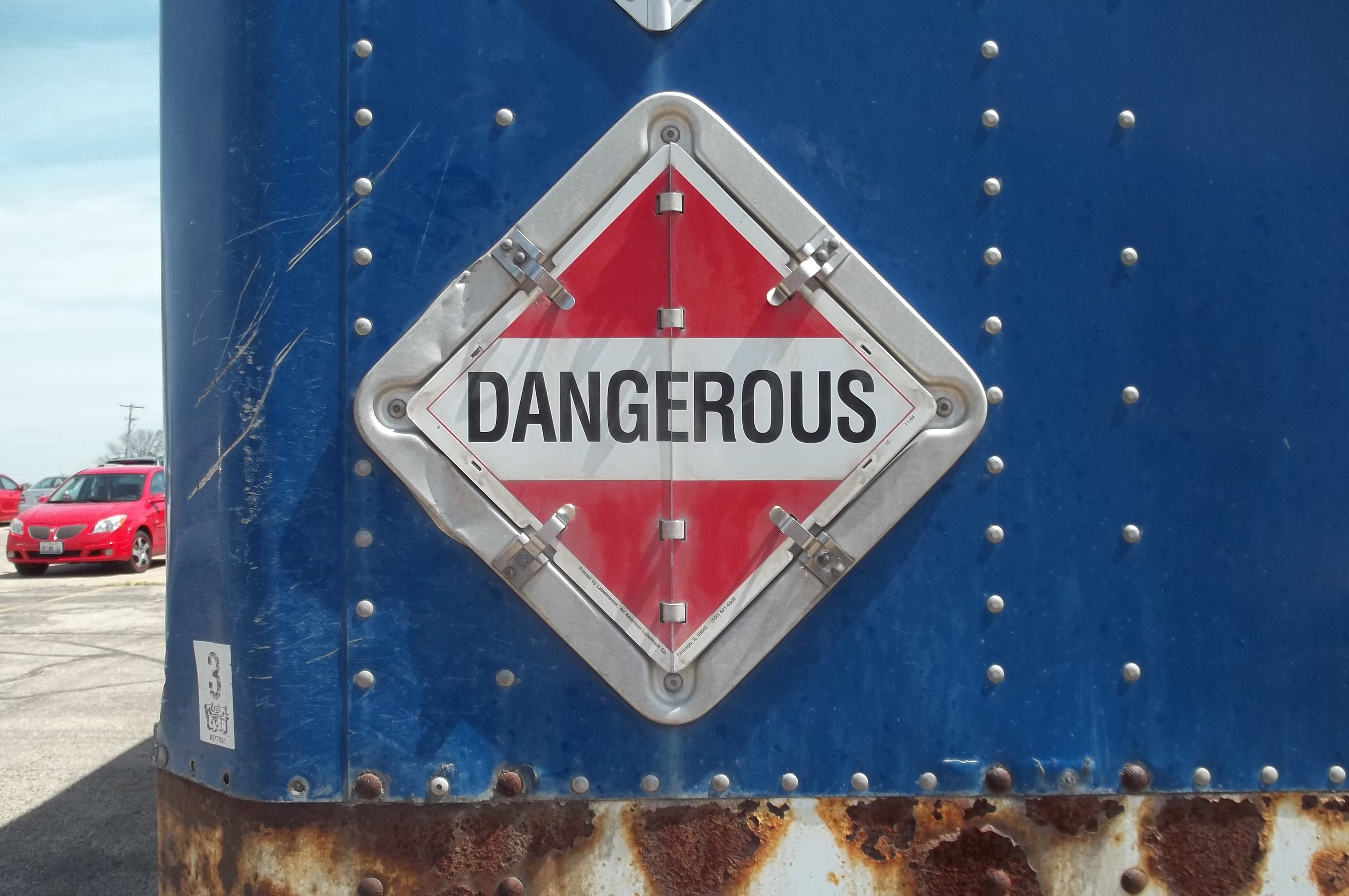
  • Dangerous PlacardIn all cases placards must be…
    • Securely attached or placed in a holder.
    • Located clear of ladders, pipes, doors, and tarps.
    • So far as practicable, located so that dirt or water is not directed to it from the wheels.
    • Located away (≥3 inches) from any marking (such as advertising) that could substantially reduce its effectiveness, i.e. make it harder to see.
    • Displayed horizontally so words or identification numbers read left to right.
    • Maintained by the carrier so no substantial reduction in visibility.
    • Affixed to a background of contrasting color or have dotted or solid line outer border which contrasts with the background color.
  • Recommended specifications for a placard holder found in Appendix C to 49 CFR part 172.
  • Placard or placard holder may be hinged if format, color, and legibility of the placard are maintained.
BUT WHAT ABOUT AT NIGHT?

Compliance with 49 CFR 172.516 won’t help the visiblity of your placards at all after dark.  But someone has come up with a good idea that I wish to share with you here.  Go Glow Placards, LLC makes an LED lit placard holder that will ensure 24 hour visibility of the placards you display.  I think it will also heighten overall safety as other drivers are more likely to notice placards displayed in the Go Glow Placard Holder.

Compliance is important but it may be just the starting point.  Be safe and be seen.

Federal Register logo

What’s up? What’s new? What’s coming? January 2016 – Rules & Regulations, Proposed Rules, and Notices Regarding the Management of Hazardous Waste and the Transportation of Hazardous Materials

January 1, 2016 through January 31, 2016

Logo for US Environmental Protection AgencyUSEPA – US Environmental Protection Agency:

Publications not related to the management of hazardous waste, solid waste, universal waste, or used oil are not included here.

Rules and Regulations:

Arkansas: Final Authorization of State-Initiated Changes and Incorporation by Reference of Approved State Hazardous Waste Management Program Pages 4961 – 4969 [FR DOC # 2016-01657] PDF | Text | More

Proposed Rules:

Contact me with any questions you may have about the management of hazardous waste

Daniels Training Services

815.821.1550

Info@DanielsTraining.com

https://danielstraining.com/

Arkansas: Final Authorization of State-Initiated Changes and Incorporation by Reference of State Hazardous Waste Management Program Pages 5006 – 5007 [FR DOC # 2016-01658] PDF | Text | More

Notices:

Agency Information Collection Activities; Proposed Collection; Comment Request; Hazardous Waste Specific Unit Requirements, and Special Waste Processes and Types Pages 1420 – 1420 [FR DOC # 2016-00412] PDF | Text | More

FAA – Federal Aviation Administration:Federal Aviation Administratino

Publications not related to the transportation of hazardous materials are not included here.

Rules and Regulations:

None

Proposed Rules:

None

Notices:

None

The FMCSA sets the minimum standards for Commercial Driver's Licenses
The FMCSA sets the minimum standards for Commercial Driver’s Licenses
FMCSA – Federal Motor Carrier Safety Administration:

Publications not related to the transportation of hazardous materials are not included here.

Rules and Regulations:

None

Proposed Rules:

None

Notices:

None

FRA – Federal Railroad Administration:Federal Railroad Administration

Publications not related to the transportation of hazardous materials are not included here.

Rules and Regulations:

None

Proposed Rules:

None

Notices:

None

Logo for the Pipeline and Hazardous Materials Safety Administration (PHMSA)PHMSA – Pipeline and Hazardous Materials Safety Administration:

Publications not related to the transportation of hazardous materials are not included here.

Rules and Regulations:

Hazardous Materials: Adoption of Special Permits (MAP-21) (RRR) Pages 3635 – 3686 [FR DOC # 2016-00780] PDF | Text | More

Proposed Rules:

None

Notices:

None

Information can be helpful but it’s useless if you are not able to make sense of it.  You must be able to determine how any changes to the rules and regulations (final or proposed) will affect your operations, and communicate the necessary information to your personnel.  I can help you to do that.

Contact me with any questions you may have about the transportation of hazardous materials by air, highway, vessel, or rail

International and Domestic

Daniels Training Services

815.821.1550

Info@DanielsTraining.com

https://danielstraining.com/

Please contact me for a free training consultation to determine your regulatory requirements and how training can help you to attain and maintain compliance with the regulations of the US Environmental Protection Agency (and your state) and the PHMSA, FAA, FRA, & FMCSA of the US Department of Transportation.

Q&A: Segregation of Limited Quantities

A question from a customer of my ONSITE TRAINING on October 15th, 2015:

Hey Daniel,

I just had a quick question regarding limited quantities.  If I have 2 different hazmat items that normally could not be shipped together per the shipping regs but one qualifies under the limited quantities provision then are they able to be shipped together?  The way I interpret the regulations is that if an item is being shipped as a limited quantity it no longer has to be segregated due to the amount since we are also not having to label it as the hazardous material.

Thank you for your input.

(10.15.15)  I was certain he was right about the segregation requirements for a Limited Quantity but I wanted a little more information:

What mode of transportation?  What is the HazMat?

I believe you are right, but I’d like a little more information to be certain.
Dan
And the next day (10.16.15) I got it:

Hey Dan,

So the items are being shipped via ocean.  The 2 hazmat items that I am wanting to put on the same pallet are Nitric Acid(UN2031) and a limited quantity of Silver Nitrate (UN1493).  They will be in their own boxes but on the same pallet.

The International Maritime Organization
The International Maritime Organization regulates the international transportation of dangerous goods by vessel.

Thanks,

With that information I replied with “The Big Answer” on October 17th:

Sorry for the delay, I hope I’m not too late, but my answer confirms yours:

  • Nitric Acid UN2031 may not be shipped as a limited quantity or any other exception under the HMR.
  • Silver Nitrate UN1493 may be shipped as a limited quantity according to 49 CFR 173.152.
  • Interestingly, there is no mention in 49 CFR 173.152 of a limited quantity not being subject to the HazMat segregation requirements.
  • However, 49 CFR 176.80(b) contains an exception for limited quantities from the segregation requirements of the HMR.
  • Nitric Acid UN2031 may or may not be shipped as a limited quantity per the IMDG Code depending on its concentration.
  • Silver Nitrate UN1493 may be shipped as a limited quantity per the IMDG Code.
  • Per 3.4.4.2 of the IMDG Code, the segregation provisions of chapter 7.2 do not apply to packagings of limited quantities.
Therefore, I believe you are correct that the Silver Nitrate UN1493 as a limited quantity is not subject to the segregation requirements of the HMR or the IMDG Code.  However, Nitric Acid UN2031 may not be shipped as a limited quantity within the U.S. (though it may outside of the U.S in some situations) and will be subject to the segregation requirements of the HMR and the IMDG Code.
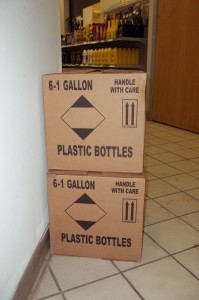
Non-bulk packaging of HazMat - Limited Quantity
The Limited Quantity marking

I hope this helps.  Please don’t hesitate to contact me with any other questions.

His final reply:
Thanks.  I’m only shipping the Silver Nitrate as the limited quantity with the acid which will be classified as hazardous.
Conclusion/Summary:
Notice from my answer on the 17th that I first determined compliance with the domestic regulations of PHMSA and then those of the International Maritime Organization in the IMDG Code.  The transportation to, from, or through the U.S. is subject to the Hazardous Material Regulations of PHMSA.  If it will also be shipped internationally – in this case on a vessel – then it will be subject to international regulations as well.  Here, the regulations of both PHMSA and the IMO were similar but that may not always be the case.

Contact me with any questions you may have about the transportation of hazardous materials by air, highway, vessel, or rail

International and Domestic

Daniels Training Services

815.821.1550

Info@DanielsTraining.com

https://danielstraining.com/

It’s not uncommon that person who have received my Onsite Training follow-up with questions once they begin to apply the information from the training on their job.

Contact me to schedule Onsite Training required by the International Maritime Organization (IMO) every three years, the International Air Transport Association (IATA) every two years, or the Pipeline and Hazardous Materials Safety Administration (PHMSA) every three years.

Q&A: Bulk Packaging for a Compressed Gas

Often I get questions from people who are not customers.  Though perhaps they will be customers in the future.

Hello

I came across your website and found the content to be very informative. I do have 1 question about bulk packages (I assume he read my blog article about Bulk Packaging for HazMat transportation). Can you further define the 3rd part of the bulk package definition? (3) A water capacity greater than 454 kg (1000 pounds) as a receptacle for a gas as defined in §173.115 of this subchapter.
Isn’t that a 119 gallon container? But how does that relate to gas?

Thanks for your time

My reply that same day:

That’s a really good question and one I struggled with when a customer of mine wanted to know the proper methods for shipment of compressed gas cylinders of Oxygen. Here is what I know about bulk packaging for a gas from researching the regulations and speaking with PHMSA/USDOT:

  • It applies to a gas as defined at 49 CFR 173.115, which includes the following:
    • Division 2.1 (Flammable gas)
    • Division 2.2 (non-flammable, nonpoisonous compressed gas—including compressed gas, liquefied gas, pressurized cryogenic gas, compressed gas in solution, asphyxiant gas and oxidizing gas)
    • Division 2.3 (Gas poisonous by inhalation)
    • Non-liquefied compressed gas
    • Liquefied compressed gas
    • Compressed gas in solution
    • Cryogenic liquid
    • Refrigerant gas or Dispersant gas
    • Adsorbed gas
  • The threshold amount for a gas (>454 kg or 1,000 pounds water capacity) is based on an estimated density of water of 8.403 lb/gal: 119 gal x 8.403 lb/gal = >1,000 lbs water capacity.
  • You are correct that a bulk packaging for a gas (as defined at 49 CFR 173.115) has a maximum capacity of >119 gallons – the same as for a liquid.
  • The definition of a bulk packaging for a solid also includes a threshold amount of >119 gallons, so clearly, this is a value used uniformly throughout the definition of a bulk packaging no matter the phase of the HazMat (liquid, solid, or gas).

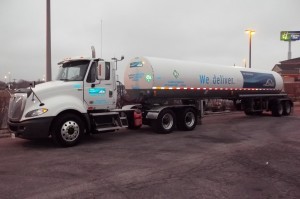
Cargo Tank Truck of Compressed GasI hope this helps. Please don’t hesitate to contact me with any questions.

His reply of gratitude and a good observation.

Daniel
Thanks for the quick response.
There is so much info out there so if you don’t travel with bulk quantities of material everyday it is tough to be sure we are in compliance.

Now I had a question for him.

Thank you for your cooperation.

One more thing, you may know this better than I, but I understand that it is unlikely to find a USDOT-approved compressed gas cylinder that meets the definition of a bulk packaging. Most gases if transported in a bulk packaging will either be in a cargo tank or portable tank. Is that your understanding as well?

Thank you and please advise.

Dan

And now he gave me some good advice.

Based on presentations and interaction with DOT enforcement offices and State Troopers, I believe you are correct. They mentioned something about older bulk containers being grandfathered in to the newest rules (like propane trucks?).
I didn’t pay much attention to it because we typically don’t get into it in our business. I have been told by our Mechanical Department that the 1 bulk compressed gas package we use is acceptable as long as we have a CDL holder with haz mat and bulk endorsements and the shipping papers/manifest to go with it.
I get the impression that the rules are interpreted differently from officer to officer too. There is just too much for 1 person to be an expert on.Bulk compressed gas cylinders of poison gas in transportation

I was grateful for his information and had an observation of my own.

While your Mechanical Department may be right, the packaging still must be authorized for the HazMat per column 8 of the Hazardous Materials Table and meet either the USDOT specifications for a compressed gas cylinder or the UN specifications for a pressure receptacle. Or, it could be subject to a Special Permit in which case neither may be necessary.

You are correct that it can be very confusing and you can hear different opinions from different people. That is why I always rely solely on the regulations and not what people tell me. If someone tells you something regarding compliance, they should be able to back it up by citing the applicable regulation.

Please don’t hesitate to contact me if you have any questions.

Dan

Contact me with any questions you may have about the transportation of hazardous materials by air, highway, vessel, or rail

International and Domestic

Daniels Training Services

815.821.1550

Info@DanielsTraining.com

https://danielstraining.com/

Federal Register logo

What’s up? What’s new? What’s coming? December 2015 – Rules & Regulations, Proposed Rules, and Notices Regarding the Management of Hazardous Waste and the Transportation of Hazardous Materials

December 1, 2015 through December 31, 2015

USEPA – US Environmental Protection Agency:Logo for US Environmental Protection Agency

Publications not related to the management of hazardous waste, solid waste, universal waste, or used oil are not included here.

Rules and Regulations:

Texas: Final Authorization of State-Initiated Changes and Incorporation by Reference of State Hazardous Waste Management Program Pages 80672 – 80682 [FR DOC # 2015-31881] PDF | Text | More

Proposed Rules:

Fall 2015 Regulatory Agenda Pages 78023 – 78030 [FR DOC # 2015-30656] PDF | Text | More

Contact me with any questions you may have about the management of hazardous waste

Daniels Training Services

815.821.1550

Info@DanielsTraining.com

https://danielstraining.com/

TCEQ training for hazardous waste personnel

Texas: Final Authorization of State-initiated Changes and Incorporation by Reference of State Hazardous Waste Management Program Pages 80722 – 80722 [FR DOC # 2015-31876] PDF | Text | More

Notices:

Agency Information Collection Activities; Proposed Collection; Comment Request; Generator Standards Applicable to Laboratories Owned by Eligible Academic Entities Pages 76467 – 76468 [FR DOC # 2015-31045] PDF | Text | More

Agency Information Collection Activities; Proposed Collection; Comment Request; Identification of Non-Hazardous Secondary Materials That Are Solid Waste (Renewal) Pages 76482 – 76483 [FR DOC # 2015-31046] PDF | Text | More

Cross-Media Electronic Reporting: Authorized Program Revision Approval, State of Illinois Pages 76467 – 76467 [FR DOC # 2015-30914] PDF | Text | More

Cross-Media Electronic Reporting: Authorized Program Revision Approval, State of Iowa Pages 76474 – 76474 [FR DOC # 2015-30913] PDF | Text | More

FAA – Federal Aviation Administration:Logo of the Federal Aviation Administration

Publications not related to the transportation of hazardous materials are not included here.

Rules and Regulations:

None

Proposed Rules:

None

Notices:

Second Meeting: RTCA Special Committee (235) Non-Rechargeable Lithium Batteries Pages 77696 – 77696 [FR DOC # 2015-31408]  PDF | Text | More

FMCSA – Federal Motor Carrier Safety AdministrationThe FMCSA sets the minimum standards for Commercial Driver's Licenses:

Publications not related to the transportation of hazardous materials are not included here.

Rules and Regulations:

None

Proposed Rules:

Driving of Commercial Motor Vehicles: Use of Seat Belts Pages 76649 – 76653 [FR DOC # 2015-30864] PDF | Text | More

Parts and Accessories Necessary for Safe Operation: Federal Motor Vehicle Safety Standards Certification for Commercial Motor Vehicles Operated by United States-Domiciled Motor Carriers; Withdrawal Pages 81503 – 81506 [FR DOC # 2015-32868]  PDF | Text | More

Notices:

None

Federal Railroad AdministrationFRA – Federal Railroad Administration:

Publications not related to the transportation of hazardous materials are not included here.

Rules and Regulations:

Monetary Threshold for Reporting Rail Equipment Accidents/Incidents for Calendar Year 2016 Pages 80683 – 80686 [FR DOC # 2015-32545]    PDF | Text | More

Proposed Rules:

None

Notices:

None

PHMSA – Pipeline and Hazardous Materials Safety Administration:Logo for the Pipeline and Hazardous Materials Safety Administration (PHMSA)

Publications not related to the transportation of hazardous materials are not included here.

Rules and Regulations:

Hazardous Materials: Requirements for the Safe Transportation of Bulk Explosives (RRR) Pages 79423 – 79453 [FR DOC # 2015-31880] PDF | Text | More

Proposed Rules:

Hazardous Materials: Safety Requirements for External Product Piping on Cargo Tanks Transporting Flammable Liquids Pages 81501 – 81503 [FR DOC # 2015-32681] PDF | Text | More

Notices:

Hazardous Materials: Notice of Application for Modification of Special Permit Pages 81431 – 81432 [FR DOC # 2015-32394] PDF | Text | More

Hazardous Materials: Actions on Special Permit Applications Pages 81432 – 81433 [FR DOC # 2015-32393] PDF | Text | More

Hazardous Materials: Notice of Application for Special Permits Pages 81434 – 81434 [FR DOC # 2015-32408] PDF | Text | More

Hazardous Materials: Delayed Applications Pages 81435 – 81436 [FR DOC # 2015-32407] PDF | Text | More

 Information can be helpful but it’s useless if you are not able to make sense of it.  You must be able to determine how any changes to the rules and regulations (final or proposed) will affect your operations, and communicate the necessary information to your personnel.  I can help you to do that.

Contact me with any questions you may have about the transportation of hazardous materials by air, highway, vessel, or rail

International and Domestic

Daniels Training Services

815.821.1550

Info@DanielsTraining.com

https://danielstraining.com/

Hazardous Waste Personnel Training and the CESQGPlease contact me for a free training consultation to determine your regulatory requirements and how training can help you to attain and maintain compliance with the regulations of the US Environmental Protection Agency (and your state) and the PHMSA, FAA, FRA, & FMCSA of the US Department of Transportation.


FAQ: OK to Load and Ship a Tank Car Nearing its Qualification Date?

A question from a former customer of MY ONSITE HAZMAT EMPLOYEE TRAINING on December 21, 2015:

Good Morning,

If the qualification due date on a rail tank car says 2015; can we still load it now and send it out one last time before we shop it?

Thank you,

My response later that day (I knew they needed an answer right away):
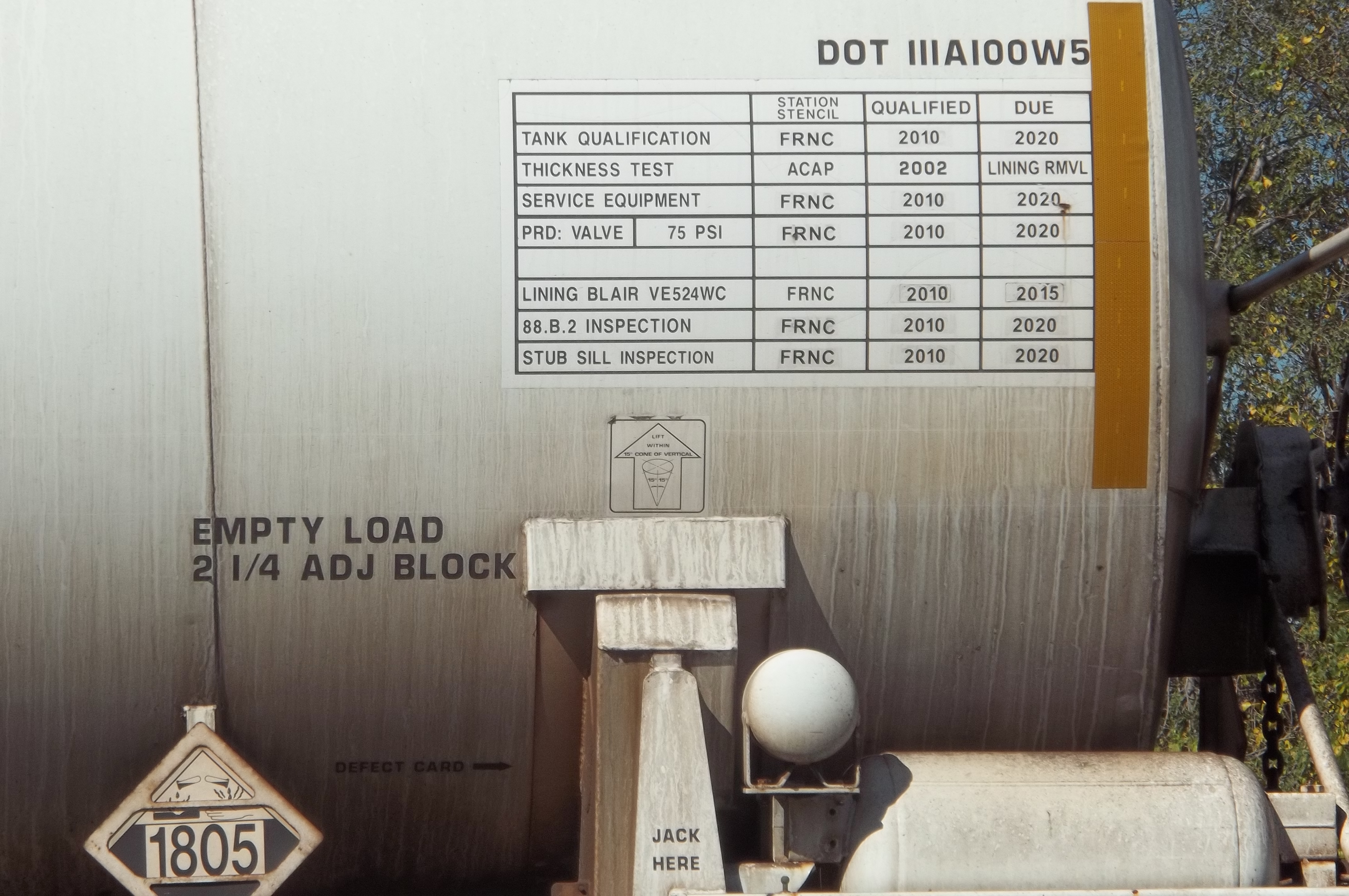
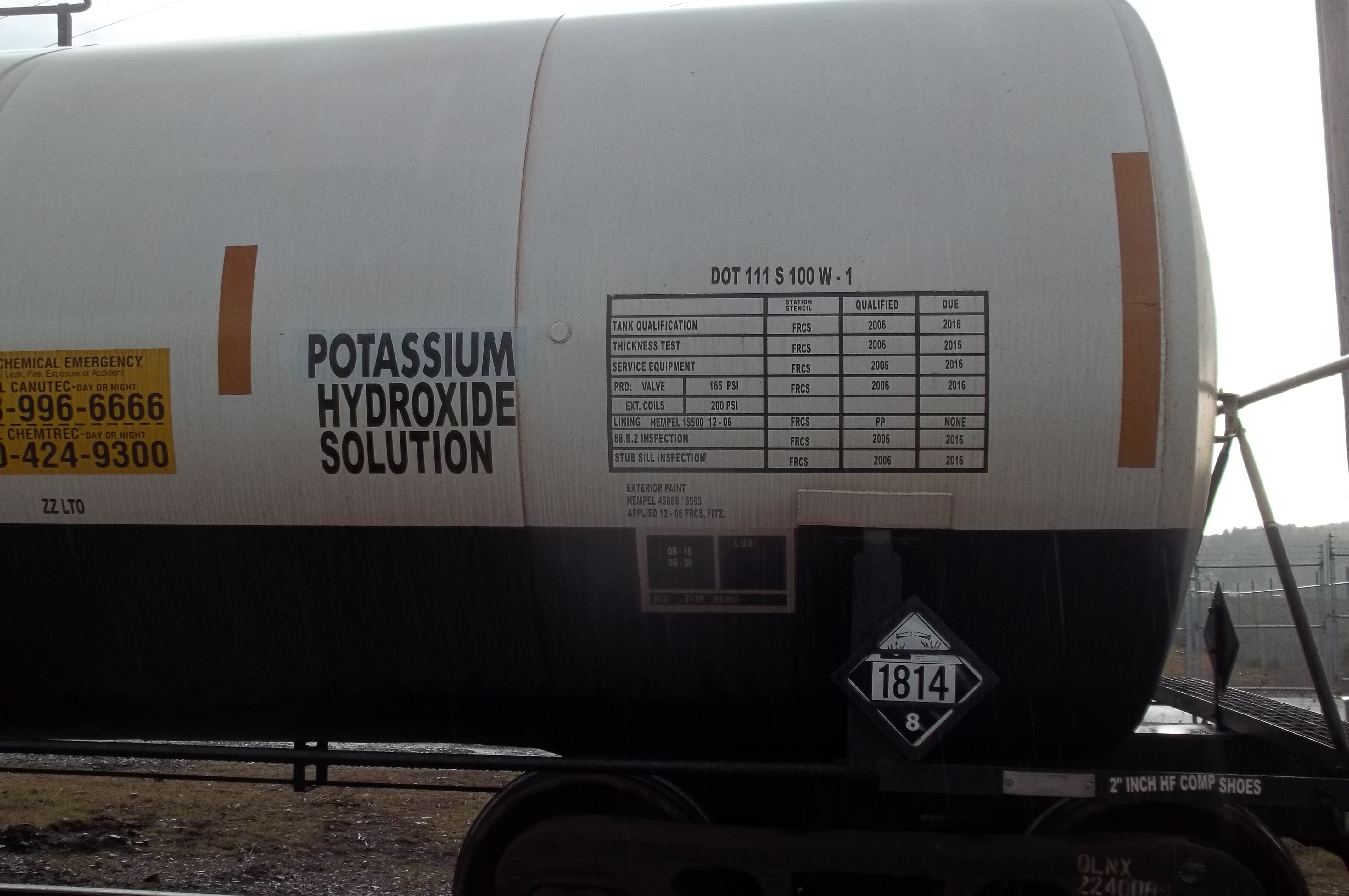
Markings on Rail Road Tank Car
This tank car’s qualification ends 12.31.20

Yes you may. Pursuant to 49 CFR 173.31(a)(3):

No person may fill a tank car overdue for periodic inspection with a hazardous material and then offer it for transportation.

Notice that non-compliance with this regulation requires two actions on the part of the Shipper:

  1. Fill a tank car that is overdue for its periodic inspection.  And,
  2. Offer for transportation (i.e. ship) a tank car that is overdue for its periodic inspection.

It does not say that a tank car that is overdue for its periodic inspection may not be transported in commerce.  Nor does it say that a tank car filled before its periodic inspection due date may not be offered for transportation after it is overdue for its periodic inspection.

A tank car that is marked with a due date of 2015 requires its periodic inspection by December 31, 2015 in order to remain qualified for the transportation of HazMat.  Therefore, a tank car so marked may be filled and shipped up until that date. It may even be offered for transportation and transported after 12.31.15 as long as it is not filled and shipped after that date.

Qualification marking on tank car
This tank car’s periodic inspection is due before December 31, 2016

I hope this helps.

Thank you and Merry Christmas!

Dan

And that was it!

Contact me with any questions you may have about the transportation of hazardous materials by air, highway, vessel, or rail

International and Domestic

Daniels Training Services

815.821.1550

Info@DanielsTraining.com

https://danielstraining.com/

As we approach the last few days of 2015 – or any year in which the periodic inspection of a tank car is due – be sure to fill those tank cars whose qualification expires at midnight on New Year’s Eve and then ship them anytime after that.

Contact me with your questions about the transportation of HazMat by highway, rail, water, or air.

FAQ: When is HazMat Employee Driver Training not Required?

Here’s a question from someone who attended one of my Training Seminars (now suspended) on October 8, 2015:

Dan did you say in training that companies can use a hazmat drivers license as hazmat training and not train them on hazmat every three years?

Sent from my iPhone

Contact me with any questions you may have about the transportation of hazardous materials by air, highway, vessel, or rail

International and Domestic

Daniels Training Services

815.821.1550

Info@DanielsTraining.com

https://danielstraining.com/

My response later that day (10.8.15):

USDOT regulations allow the HazMat Employer to rely on a driver’s maintenance of their CDL (with routine testing and renewal required by their state) as compliance with the requirement to train HazMat drivers at 49 CFR 177.816.

However, this does not preclude the requirement to provide triennial HazMat Employee Training.
It is also important to note that a Commercial Driver’s License is only required if a motor vehicle transports a quantity of HazMat that requires placarding.  It is quite possible that a driver of a motor vehicle transporting HazMat does not require placarding nor a CDL.
In other words, HazMat Employee Training is required every three years for the operator of a motor vehicle transporting any amount of HazMat, but the HazMat Employer may opt out of providing the additional Driver Training if they feel the maintenance of the CDL with endorsements is sufficient.

Daniels Training Services

815.821.1550

Info@DanielsTraining.com

https://danielstraining.com/

Read this article of mine for more information:  USDOT Driver Training Requirements.

I hope this helps.  Please don’t hesitate to contact me with any other questions.
Thanks
Dan
Got a question about training your HazMat Drivers or any other HazMat Employee?  Contact me and I’ll be glad to help.

FAQs: Walking HazMat Across the Street. Is it Regulated Transportation?

(9.28.15) A question from a site where I had provided Onsite HazMat Employee training in September 2014:

Dan,

A question came up while we were conducting training. We have employees that fill small containers of fresh acid in the lab and then walk across the street to the where the acid will be used. Would the person transporting the container be required to attend the DOT training?

My response later that day (9.28.15):

No. For two reasons:

  • First, the act of walking is not identified by PHMSA/USDOT as transportation and thus is not subject to the Hazardous Material Regulations.  At 49 CFR 171.8 Transportation is defined as:

Transportation or transport means the movement of property and loading, unloading, or storage incidental to that movement.

So, transportation is movement but it doesn’t specify how, so it’s possible that walking is regulated as transportation.  However, 49 CFR 171.1(c)(1) describes regulated transportation of a hazardous material as including:

Movement of a hazardous material by rail car, aircraft, motor vehicle, or vessel…

And, movement is defined at 49 CFR 171.8 as:

Movement means the physical transfer of a hazardous material from one geographic location to another by rail car, aircraft, motor vehicle, or vessel.

Therefore, the act of walking, even if transporting a hazardous material, is not subject to the HMR.

Daniels Training Services

815.821.1550

Info@DanielsTraining.com

https://danielstraining.com/

  • Secondly, I am not certain to which of your facilities you are referring (they have two) but if it is an internal “street” and the HazMat doesn’t leave your property, then it is not subject to the HMR which applies to transportation in commerce on a public roadway.  Again, 49 CFR 171.8 defines movement as the transfer of a HazMat from one geographic location to another (see above), which would not include its transfer within a contiguous property.

Further, 49 CFR 171.1(d) identifies activities that are exempt from the HMR as including:

Rail and motor vehicle movements of a hazardous material exclusively within a contiguous facility boundary where public access is restricted, except to the extent that the movement is on or crosses a public road or is on track that is part of the general railroad system of transportation, unless access to the public road is restricted by signals, lights, gates, or similar controls.

Like this article?

Subscribe to my Monthly Newsletter

No marketing emails!

So, the movement of a hazardous material – even if by motor vehicle – is not subject to the HMR if the movement takes place within a contiguous facility boundary where public access is restricted, i.e. is on private property.

I hope this helps.

Thanks

Dan

It doesn’t matter to me whether you’re a past customer, future customer, or no customer at all!  I’m happy to answer your questions about the transportation of hazardous materials.

Search Website