PO Box 1232 Freeport, IL 61032

A Different Kind Of Training

A Different Kind Of Training

A Different Kind Of Training

Energy Department settles with EPA for waste management violations at Hanford

Release Date: 07/01/2013

Contact Information: Mark MacIntyre, EPA/Seattle 206-553-7302/206-369-7999(cell) macintyre.mark@epa.gov

(Seattle – July 1, 2013) The U.S. Department of Energy (DOE) has agreed to improve waste handling practices and pay $136,000 in a settlement announced today by the U.S. Environmental Protection Agency. According to the agreement, DOE allegedly operated several dangerous waste storage units without proper permit authorization and placed waste in a landfill before treating it. Instead, DOE treated the waste after placement, a violation of existing dangerous waste regulations

“Today’s agreement includes commitments by DOE to address these allegations and ensure that these units are properly managed,” said Ed Kowalski, director of EPA’s Office of Compliance and Enforcement in Seattle. “When handling mixed (nuclear and hazardous) waste, there’s no such thing as being ‘too careful’. Strict compliance with all dangerous waste requirements is the only acceptable path here.”

Inspections were conducted by the EPA National Enforcement Investigations Center in 2011, where inspectors focused on the facility’s Solid Waste Operational Complex. At this facility, radioactive and dangerous wastes are stored and processed prior to shipment to other locations for treatment and disposal.

Under today’s agreement, DOE will:

· Close eight dangerous waste storage units that EPA contends had not received proper authorization under the state dangerous waste permit.
· Submit closure plans for the eight units through a state dangerous waste permit modification request.
· Close, or request an extension to the time allowed to close, an additional two inactive dangerous waste storage units.
· Treat dangerous waste before disposal as required by state & federal regulations.
· Pay a penalty of $136,000, payable to the U.S. Treasury.

As a state with an authorized hazardous waste program under RCRA, Washington is able to create and enforce its own regulations in lieu of those of the USEPA.  A state’s program will be authorized as long as it is at least as stringent and as broad as that of the USEPA.  In this case the state of Washington refers to “Hazardous Waste” as “Dangerous Waste” which you will notice in the above news release.  Washington has other state-specific regulations that you must comply with if you wish to avoid fines and penalties paid by the DOE.

At my Seminar Training I will point out the differences between the USEPA and your state when possible.  For Onsite Training I will research your state’s regulations and provide an in-depth explanation of what is required for compliance.  Please contact me for a free training consultation.

What is the PHMSA/USDOT Definition of a Hazardous Substance?

The PHMSA/USDOT definition of a hazardous material (HazMat) at 49 CFR 171.8 indicates that the term includes a Hazardous Substance.  In other words, if a material meets the definition of a hazardous substance, then it is also a hazardous material and subject to the regulations of the PHMSA/USDOT when in transportation or offered for transportation.  It is therefore important to understand what, exactly, a hazardous substance is. (more…)

Do Big Companies Know the Regulations?

Time and again when I’m assisting a company with regulatory compliance – either the Hazardous Material Regulations of the PHMSA/USDOT or the RCRA Hazardous Waste Regulations of the USEPA (or their state) – I’ll hear something like the following:

Company X shipped the hazardous material to us this way, so it must be OK for us to ship it out the same way.

or…

Company X always takes our hazardous waste/universal waste/used oil this way and they’ve never mentioned a problem.

or…

Company X is in the business of transporting this hazardous material/hazardous waste, they must be doing it right.

or…

Company X told me they’ve been doing it this way for years and they’ve never been fined or had a violation.

Sound familiar?

And as often as I hear comments like the above I’ll discover some egregious error made by a “Company X”, such as:

  • Incorrect sequence of the elements of a hazardous material basic description on a shipping paper.
  • Improperly placard vehicles.
  • Not providing annual training for Hazardous Waste Personnel.
  • Mistaken belief that the Hazardous Material Regulations of the PHMSA/USDOT don’t apply to their operations.
  • Improper or no labeling of hazardous waste containers.
  • Not providing triennial training for HazMat Employees.
  • Incorrect or no indication of a Reportable Quantity of a Hazardous Substance on a shipping paper.

I won’t name here the Company X’s I’ve come across, but believe me, they are common names that you would recognize.  They make mistakes just like smaller companies do.  And don’t expect your corporate-level EHS to always be correct either; another all-to-common statement I hear:

Corporate never told us anything about that!

The fact of the matter is that as a shipper of a hazardous material and/or a generator of a hazardous waste, the responsibility to comply with the regulations is yours alone.  The regulatory agencies – state or Federal – will hold you responsible for a violation of the regulations regardless of who may have told you to do it that way.  Make sure that your EHS programs (including hazardous material transportation) are based on the regulations and not what you were told by someone else or assumed to be true.

That is where my training comes in.  Not only do I tell you what is required to comply with regulations of the PHMSA/USDOT and the USEPA (or your state) but I also inform you of the source of that information, ie. the regulations themselves.  My training and all that tools and tips that come with it is a good start to ensuring compliance.  Please contact me to schedule HazMat Employee Training and Hazardous Waste Personnel/RCRA Training.


Environmental Enterprises cited for 22 violations after worker dies from burns suffered at Cincinnati hazardous waste treatment facility

US Labor Department’s OSHA places company in severe violator enforcement program

CINCINNATI – Environmental Enterprises Inc. has been cited by the U.S. Department of Labor’s Occupational Safety and Health Administration with 22 safety and health violations after a fire and explosion occurred at the Cincinnati waste treatment facility on Dec. 28. Two employees were severely burned by the fire, one fatally.

“Environmental Enterprises demonstrated a complete disregard for employee’s safety and health by failing to recognize and train employees on potentially dangerous interactions between materials being handled and tools in use,” said Bill Wilkerson, OSHA’s area director for its Cincinnati office. “Even after this tragic explosion, the company failed to immediately address procedures and ensure employees knew how to use appropriate personal protective equipment and properly handle hazardous waste such as sodium chlorate. OSHA is committed to protecting workers on the job, and educating employers about safety and health regulations.” (more…)

Comply with PHMSA/USDOT Regulations as you Celebrate the Fourth of July

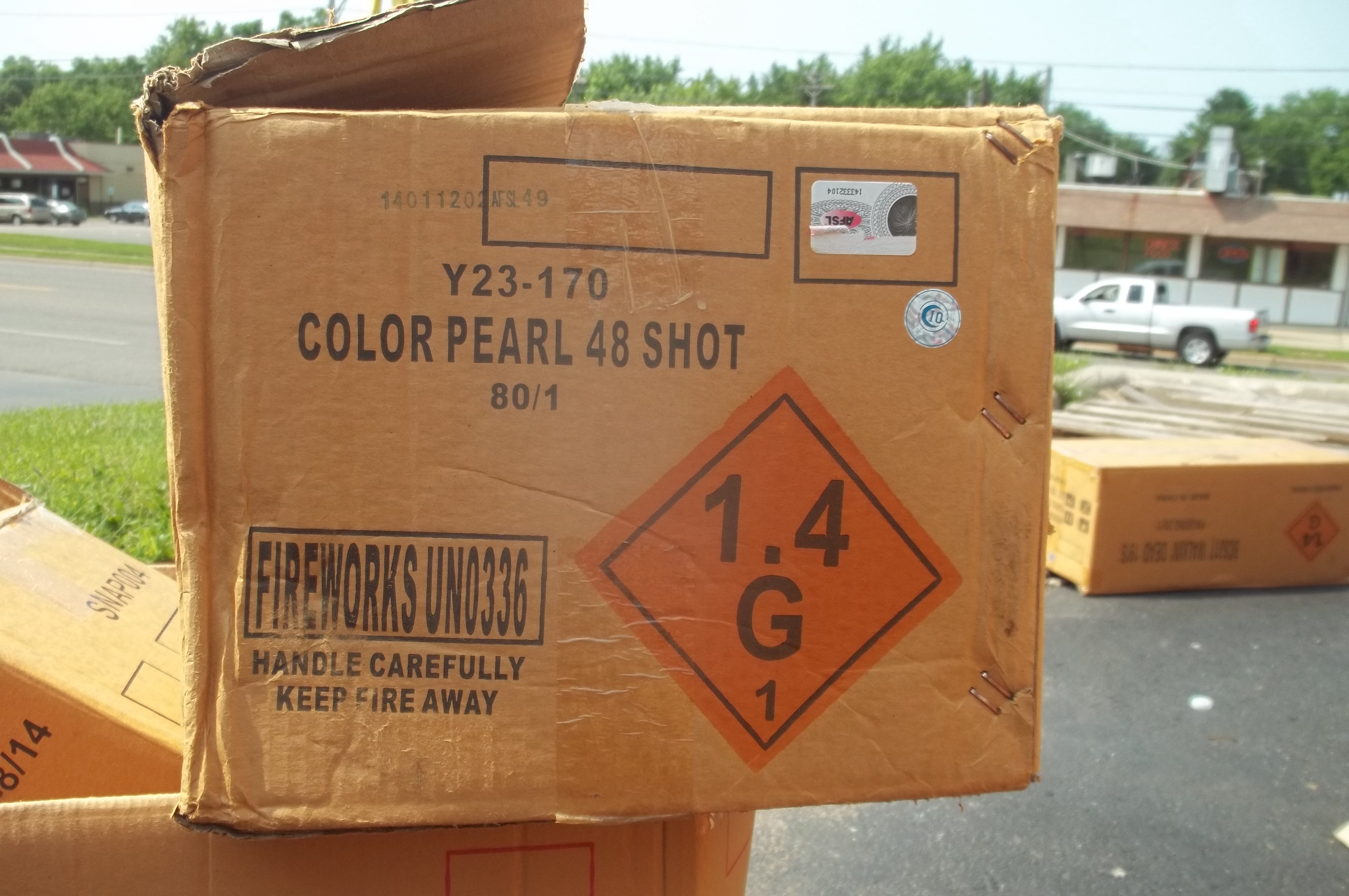
Division 1.4 Explosives FireworksThe purchase and use of fireworks are subject to State and local regulations, but their transportation in commerce is subject to the regulations of the PHMSA/USDOT.  If you intend to transport any fireworks to celebrate the holiday, be sure you are aware of the applicability of the Hazardous Material Regulations (HMR) and what is required for compliance.

(more…)

NRC INFORMATION NOTICE 2013-08: PENDING EXPIRATION OF THE NRC TYPE B TRANSPORTATION PACKAGE CERTIFICATE FOR SENTINEL™ MODEL 660 SERIES RADIOGRAPHIC PROJECTORS ON JUNE 30, 2013

UNITED STATES

NUCLEAR REGULATORY COMMISSION

OFFICE OF NUCLEAR MATERIAL SAFETY AND SAFEGUARDS

OFFICE OF FEDERAL AND STATE MATERIALS

AND ENVIRONMENTAL MANAGEMENT PROGRAMS

WASHINGTON, D.C. 20555

MAY 2, 2013

NRC INFORMATION NOTICE 2013-08: PENDING EXPIRATION OF THE NRC TYPE B

TRANSPORTATION PACKAGE CERTIFICATE

FOR SENTINEL™ MODEL 660 SERIES

RADIOGRAPHIC PROJECTORS ON JUNE 30,

2013

ADDRESSEES

All holders of radiography licenses for SENTINEL™ Model 660 Series radiographic projectors.

All Radiation Control Program Directors and State Liaison Officers.

PURPOSE

The U.S. Nuclear Regulatory Commission (NRC) is issuing this Information Notice (IN) to alert

addressees to the June 30, 2013, expiration of Certificate of Compliance (CoC) No. 9283 for the

SENTINEL™ Model 660 Series radiographic projectors. It is expected that recipients will review

the information for applicability to their facilities and consider other arrangements, as

appropriate. The NRC is providing this IN to the Agreement States for their information and for

distribution to their radiography licensees, as appropriate.

DESCRIPTION OF CIRCUMSTANCES

In August 2009, QSA Global, Inc. (QSA) notified its customers that it does not intend to renew

the CoC (for NRC Package Identification No. USA/9283/B(U)-96) for the Model 660 Series of

radiographic projectors and that the Type B(U) CoC No. 9283 will expire on June 30, 2013 (as

stated on Condition No. 11 of the CoC). QSA also indicated that their Type A package

certification will lapse on the same day.

QSA offered several factors for its business decision: “S” Tube wear, age of the units, resources

required to manufacture replacement parts and maintain documentation, and the inability to

meet the ISO 3999-1 2000E standard.

ML13107A027IN 2013-08

Page 2 of 3

BACKGROUND

As specified in the regulations, once a certification expires, the package cannot be shipped or

transported legally. A valid certificate must be in place to allow legal transport in accordance

with international and United States regulations.

DISCUSSION

Users may continue to use the package in accordance with the CoC until June 30, 2013. Users

of the package should specifically note Condition 8(c) of the CoC which states that “No service

operations shall include the replacement of the shell, of the depleted uranium shield, or any

shell weld repair.” The safety evaluation report details the reasons for condition 8(c). In

particular, the model is no longer manufactured (as of 2001) and QSA confirmed that it was not

willing to repair or replace the shell on packages currently in use or repair welds.

On July 1, 2013, the Model 660 Series device will no longer be an NRC-authorized

transportation package. On this date, an approved package other than the Model 660 Series

must be used for transport of the 660 Series radiography sources. This applies to the following

models: 660, 660E, 660A, 660AE, 660B, and 660BE.

After June 30, 2013, a certified Type B container (overpack) may be used to lawfully transport

the projectors containing a radiography source inside. If licensees have a need to transport 660

Series radiography projectors containing a radiography source inside after June 30, 2013,

without a certified Type B container (overpack) they may request that the NRC approve a limited

number of shipments pursuant to 10 CFR 71.17(a). These approvals are issued on a limited

basis to address unique situations. The Model 660 Series device incorporates depleted

uranium for shielding; therefore, even without a radiography source inside, the device must

meet the transportation requirements for a manufactured article containing depleted uranium.

Users are encouraged evaluate their program to identify the best option for them to be in

compliance with NRC regulations regarding transport of the 660 Series radiography projectors

with or without radiography sources. These options include making arrangements for final

disposition of the 660 Series radiography devices in their possession prior to the June 30, 2013,

expiration date. However, per 10 CFR 71.5(a), the projectors may still be used at an NRC or

Agreement State-licensed site provided that they are not moved while containing a radiography

source without a certified overpack.

If users dispose of the current radiography projector or obtain a radiography projector that has a

current CoC, they should be aware that changes in material held under its license may require

changes to its possession and use licenses issued by the NRC or an Agreement State. IN 2013-08

Page 3 of 3

CONTACT

This IN requires no specific action nor written response. If you have any questions about the

information in this notice, please contact the technical contacts listed below or the appropriate

regional office.

/RA Eric Benner for/ /RA/

Mark D. Lombard, Director Brian J. McDermott, Director

Division of Spent Fuel Storage Division of Materials Safety

and Transportation and State Agreements

Office of Nuclear Material Safety Office of Federal and State Materials

and Safeguards and Environmental Management Programs

Contacts: Pierre Saverot, NMSS Katie Wagner, FSME

(301) 492-3408 (301) 415-6202

E-mail: Pierre.Saverot@nrc.gov E-mail: Katie.Wagner@nrc.gov

Enclosure: List of Recently Issued FSME Generic Communications IN 2013-08

Page 3 of 3

CONTACT

This IN requires no specific action nor written response. If you have any questions about the

information in this notice, please contact the technical contacts listed below or the appropriate

regional office.

/RA Eric Benner for/ /RA/

Mark D. Lombard, Director Brian J. McDermott, Director

Division of Spent Fuel Storage Division of Materials Safety

and Transportation and State Agreements

Office of Nuclear Material Safety Office of Federal and State Materials

and Safeguards and Environmental Management Programs

Contacts: Pierre Saverot, NMSS Katie Wagner, FSME

(301) 492-3408 (301) 415-6202

E-mail: Pierre.Saverot@nrc.gov E-mail: Katie.Wagner@nrc.gov

Enclosure: List of Recently Issued FSME Generic Communications

ML13107A027

OFC MSSA/LB NMSS/DSFST/LB MSSA/LB NMSS/DSFST/LB

NAME KWagner PSaverot via Email MKotzalas MSampson via

Email

DATE 04/17/2013 04/17/2013 04/18/2013 04/26/2013

OFC MSSA/RMSB FSME/MSSA FSME/MSSA NMSS/DSFST

NAME AMcIntosh

via Email

PHenderson BJMcDermott MLombard

DATE 04/18/2013 04/22/2013 05/2/2013 05/2/2013

OFFICIAL RECORD COPY

June 2013 – Announcements of Proposed Rules, Changes to the Rules, and Final Rules for RCRA & the HMR

On its website the US Government Printing Office makes a wealth of Federal publications available for review and download; one of these is the Federal Register.

Published by the Office of the Federal Register, National Archives and Records Administration (NARA), the Federal Register is the official daily publication for rules, proposed rules, and notices of Federal agencies and organizations, as well as executive orders and other presidential documents.

See below for a brief summary of announcements in the Federal Register by the US EPA on the subject of Hazardous Waste and the Pipeline & Hazardous Materials Safety Administration (PHMSA) of the US DOT on the subject of Transportation of Hazardous Materials.

The Federal Register is a great way to look down the road and see potential changes to the regulations long before they are put into effect (sometimes The Rulemaking Process takes years before a final rule is issued, if ever).  Knowledge of these potential changes provides you with several advantages:

  • Additional time to modify your business operations to comply.
  • Awareness of on what topics the regulatory agencies intend to focus their efforts.
  • The ability to register your concerns, complaints, suggestions, etc. in order to modify the proposed rule before a final rule is issued.  It can be done, really!
  • Make changes to your training program to account for changes that become effective before the next training cycle.
  • Alert you to the need to re-train your employees prior to their next scheduled training cycle, if necessary.
  • Keep you abreast of changes to the regulations that affect your business and/or your industry group.

Please note that this is my best effort to identify the relevant announcements in the Federal Register that may be of interest to generators of hazardous waste and shippers of hazardous materials.  I encourage you to review the list of Federal Register publications yourself to ensure regulatory compliance.

May 29 through June 26, 2013

PHMSA – Hazardous Materials Regulations (HMR):

Rules and Regulations:

None

Proposed Rules:

None

Notices:

Safety Advisory: Compressed Gas Cylinders That Have Not Been Tested Properly

Pages 33891 – 33891 [FR DOC # 2013-13222]         PDF | Text | More

Hazardous Materials: Emergency Recall Order

Pages 34156 – 34160 [FR DOC # 2013-13354]         PDF | Text | More

USEPA – Resource Conservation and Recovery Act (RCRA):

Rules and Regulations:

Oklahoma: Final Authorization of State Hazardous Waste Management Program Revision

Pages 32161 – 32165 [FR DOC # 2013-12712]        PDF | Text | More

North Carolina: Final Authorization of State Hazardous Waste Management Program Revisions

Pages 35766 – 35769 [FR DOC # 2013-13850]         PDF | Text | More

Proposed Rules:

Oklahoma: Final Authorization of State Hazardous Waste Management Program Revisions

Pages 32223 – 32224 [FR DOC # 2013-12711]         PDF | Text | More

North Carolina: Final Authorization of State Hazardous Waste Management Program Revisions

Pages 35837 – 35837 [FR DOC # 2013-13847]         PDF | Text | More

Notices:

None

Information can be helpful but it’s useless if you are not able to make sense of it, determine how any changes to the rules and regulations (final or proposed) will affect your operations, and communicate the necessary information to your personnel.  I can help you do that.  Please contact me for a free consultation to determine your regulatory requirements and how training can help you to attain and maintain compliance.

Conducting a Hazardous Material Security Assessment

49 CFR 172, Subpart I requires shippers and carriers of certain hazardous materials to create and maintain a Safety and Security Plan.  §172, Subpart H indicates that a shipper or carrier required to have the Safety and Security Plan must also conduct In-Depth Security Training for certain HazMat Employees.  The criteria for applicability of the Safety and Security Plan can be found at §172.800(b).  If applicable, your Safety and Security Plan must contain certain elements, including but not limited to:

  • A site security assessment.
  • Personnel security.
  • Unauthorized access.
  • En route security

You can read more about the HazMat Security Requirements of the PHMSA here:  Hazardous Materials Security.  This article will provide guidance on how to complete the Site Security Assessment. (more…)

Hazardous Materials Security

Security concerns have always been a part of hazardous materials transportation, but since 2003 shippers and carriers of certain hazardous materials are required to include security concerns in their hazardous materials training (Security General Awareness & In-Depth Security).  Certain facilities are also required to complete and maintain a HazMat Safety and Security Plan.  This blog will serve as a source for links to any of my HazMat security related articles. (more…)

RCRA Exclusions from the Definition of Solid Waste @ 40 CFR 261.4(a)

The regulations of the USEPA include exclusions from the definition of solid waste for certain discarded materials.  This exclusion is limited to specific industries, processes, and chemicals identified by regulation.  This exclusion is important since if a discarded material is not a solid waste, then it can’t be regulated as a hazardous waste, even if it matches the description of a listed hazardous waste or exhibited the characteristics of a hazardous waste.

This article is meant to serve as an introduction and a starting point for all of the exclusions of §261.4(a).  Below are links to articles which themselves are Power Point presentation previously uploaded to SlideShare and later posted on my blog.  As of May 2013 I am still a long way from completion, but be patient, I’ll eventually get to them all. If you are not patient, then contact me with a request, I’ll do my best to accommodate your wishes as soon as I can by posting another blog post/SlideShare Upload.

40 CFR 261.4(a)…

(1) Domestic sewage.  Or, view with narration and animation as an Office Mix

(2) Industrial wastewater discharges.

(4) Source, special nuclear or by-product material as defined by the Atomic Energy Act of 1954.

(5) Materials subjected to in-situ mining techniques which are not removed from the ground as part of the extraction process.

(6) Pulping liquors ( i.e., black liquor) that are reclaimed in a pulping liquor recovery furnace and then reused in the pulping process.

(7) Spent sulfuric acid used to produce virgin sulfuric acid.

(8) Secondary materials that are reclaimed and returned to the original process or processes in which they were generated where they are reused in the production process.

(9) Spent wood preserving solutions that have been reclaimed and are reused for their original intended purpose.

(10) Coke by-product waste.

(11) Non-wastewater splash condenser dross residue.

(12) Hazardous oil-bearing secondary materials and recovered oil from petroleum refining operations.

(13) Excluded scrap metal being recycled.

(14) Shredded circuit boards being recycled.

(15) Condensates from Kraft Mill steam strippers.

(16) Comparable fuels or comparable syngas fuels.

(17) Mineral processing spent materials.

(18) Petrochemical recovered oil.

(19) Spent caustic solutions from petroleum refining.

(20) Zinc fertilizers made from recycled hazardous secondary materials.

(21) Zinc fertilizers made from recycled hazardous secondary materials excluded under 261.4(a)(20).

(22) Used cathode ray tubes.

(23) The Generator-Controlled Exclusion. (revised by the 2015 Definition of Solid Waste Rule)

(24) The Verified Recycler Exclusion. (revised by the 2015 Definition of Solid Waste Rule). Or, view with narration and animation as an Office Mix.

(25) Reclamation of hazardous secondary material outside the US.

(26) Solvent-contaminated wipes sent for laundering and reuse.

(27) Remanufacturing Exclusion for Spent Solvents.  (revised by the 2015 Definition of Solid Waste Rule)

Search Website