The Requirements of 40 CFR 265.52(b) Options for Contingency Plan for Large Quantity Generator of Hazardous Waste
Subpart D of 40 CFR 265 details the requirements for and the content of a Contingency Plan for a large quantity generator of hazardous waste (LQG) and for hazardous waste TSDFs. In an earlier article I explained most of the requirements of Section 265.52 of Subpart D: Content of a Contingency Plan. What I did not include in that article, and the subject of this one (the fourth in a series), are the options made available in §265.52(b) for the incorporation of the contingency plan into an existing plan, such as the SPCC, or the the development of a single plan (i.e., One Plan) to address all of a facility’s regulatory requirements.
The purpose of this article: identify and explain the requirements of 40 CFR 262.52(b) Options for Contingency Plan
Hold on a minute! These regulations were revised and moved to a new location within Title 40 of the CFR by the Generator Improvements Rule. If your state has not yet adopted the Generator Improvements Rule, then this article is still applicable to you (but it won’t be for much longer). If your state has adopted and been authorized to enforce the Generator Improvements Rule, then these regulations no longer apply to you. Read: What is the status of the Generator Improvements Rule in my state?
To see an explanation of these regulations as revised by the Generator Improvements Rule you must refer to the following:
Ohio Environmental Protection Agency Division of Materials and Waste Management
The reporting season has begun for the 2013 Hazardous Waste Report, which this year is due on March 3, 2014. You only have four weeks to finalize and submit your reports to the Ohio EPA detailing your 2013 hazardous waste activities. Please consider submitting your report as soon as possible. High numbers of users can slow down the posting process online causing many delays during the last week prior to the due date. This report is required of any facility that generated 2000 pounds or more of hazardous waste (or 2.2 pounds or more of acute hazardous waste) in any calendar month in 2013.
The only changes for the 2013 report are changes to some of the Management Method Codes and to the Waste Minimization Codes. You can see a list of these changes on pages 2 to 3, 29 to 30 and 62 in the Hazardous Waste Report Instructions. If you are filing a paper report or importing data files make sure that you are using correct and up to date codes or your report will fail data validation.
If you are considering filing electronically for the first time please make sure that the facility’s Responsible Official has requested a PIN and then associated their account with the facility once that PIN has been activated. These activities take time to complete and waiting until the last minute may result in a late submission. The software has many features that help you prepare the report quickly and more accurately than on paper. The software allows the user to validate some of the information provided in the report which helps to reduce the possibility of violations. It also includes the ability to copy a previous year’s report as a starting point for a new report, even if you haven’t filed electronically in the past.
If your facility’s report was filed electronically for 2011 but there have been personnel changes, it’s time to have new users get eBiz accounts and/or PINs or terminate access rights for users no longer involved with the facility’s report. For information on removing preparers or Responsible Officials, see “Changing Roles in eBiz” on the Report web page.
If you have any questions, including questions or concerns about getting started in eBiz, please contact:
State and Federal regulations require the training of HazMat Employees and Hazardous Waste Personnel
View the 2013 Hazardous Waste Report Reminder from the Ohio EPA here.
If you are a Large Quantity Generator of hazardous waste you will be required to submit a hazardous waste report to your state or the USEPA either every other year (biennially) or annually. In addition to submitting the hazardous waste report a Large Quantity Generator of hazardous waste must also complete initial and annual hazardous waste personnel training for all Facility Personnel involved in the generation, handling, management, disposal, treatment, or off-site shipment of hazardous waste. Contact me for training or for a free consultation.
Train Spilled 12,000 Gallons of Oil Across Minnesota
UPDATE 2/6/2014 2:45 PM ET: According to MPCA spokeswoman Cathy Rofshus, “The MPCA directed the railroad to begin cleanup actions Feb. 6, starting in Winona, where there is more oil in the snow between the tracks because the train had slowed. This cleanup is still underway today. Other areas of spillage are far less oiled and cleanup is not feasible — AT THIS TIME — for considerable lengths of the track. However, these areas will continue to be monitored and reassessed through the thaw and additional cleanup done if necessary.” The headline of this piece has been adjusted accordingly.
An oil train sprung a leak while traveling through southeastern Minnesota Monday, dribbling 12,000 gallons of crude oil over a 68-mile stretch of track. The spill was relatively small, but because of the way it spread, officials at the Minnesota Pollution Control Agency said they won’t be able to clean it up.
“It’s like it spray-painted oil,” MPCA spokeswoman Cathy Rofshus explained. She added that the amount leaked was about half the oil contained in a single tanker car. It was nothing, in other words, like the 1.5 million gallon spill that occurred when a train derailed in Lac-Mégantic, Quebec, this past July, killing 47 people.
And it was but a small contribution to the increasing amount of oil being spilled from trains in general: including over 1.15 million gallons in 2013, more than the combined amount spilled over the past four decades of federal record-keeping. Such “mishaps,” according to Bloomberg News, are more likely to occur on trains, while the amount spilled by pipelines, when leaks do occur, tends to be much greater.
Two questions need to be answered about the above incident:
Is the oil being transported by rail a hazardous material as defined by the USDOT? Refer to the definition at 49 CFR 171.8 for an answer.
If it is a hazardous material, then did the carrier inspect all the rail cars prior to accepting them for transportation as is required by 49 CFR 174.9(a), which reads:
At each location where a hazardous material is accepted for transportation or placed in a train, the carrier must inspect each rail car containing the hazardous material, at ground level, for required markings, labels, placards, securement of closures, and leakage. These inspections may be performed in conjunction with inspections required under parts 215 and 232 of this title.
If you are involved in any stage of the transportation of a hazardous material as a Shipper (0r Offeror), a Carrier, or as the destination facility (receiver) you must comply with the Hazardous Material Regulations of the PHMSA/USDOT which includes a requirement to provide triennial training for all HazMat Employees. Don’t hesitate to contact me for HazMat Employee Training, RCRA Hazardous Waste Training or any questions about your training needs.
Guidance from the USEPA: Voluntary Guidelines for Methamphetamine Laboratory Cleanup
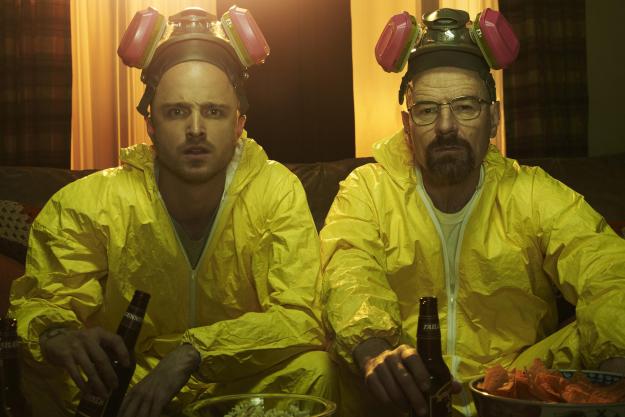
Walter and Jesse: Large Quantity Generators of hazardous waste
Breaking Bad may seem like a lot of fun and games, but what is often overlooked is that someone had to cleanup the mess Walter and Jesse made. The discovery of a meth lab, or the waste from one, provides law enforcement with a significant amount of hazardous waste to contain, manage, transport, and dispose. Unfortunately, the generators of the waste are not often the type that are concerned about the environment or take heed of the USEPA regulations regarding the “Cradle-to-Grave” management of hazardous waste. That leaves state and local law enforcement holding the bag and responsible for the disposal of the waste. Sometimes a small police force with a limited budget may find itself subject to the RCRA regulations as a large quantity generator of hazardous waste due to its discovery or closure of meth labs.
In an attempt to assist law enforcement the Methamphetamine Remediation Research Act of 2007 required USEPA to develop guidelines for the cleanup of meth labs and the disposal of waste associated with them. These are voluntary guidelines and are based on the best currently available knowledge in the field of meth lab remediation. A partial list of what the guidelines address includes:
Hiring a contractor
Ventilation
Worker safety and health
Removal of contaminated materials
Waste characterization and disposal procedures
Detergent-water solution washing
Outdoor remediation
Recommended best practices for the remediation of specific materials (eg. walls, ceilings, floors)
Methods of collecting samples from a structure to identify the presence of methamphetamine
Additional information and resources are included in the Appendices
The Methamphetamine Remediation Research Act of 2007 required EPA to develop guidelines for remediating former methamphetamine labs. This document provides those guidelines for States and local agencies to improve “our national understanding of identifying the point at which former methamphetamine laboratories become clean enough to inhabit again.” The legislation also required that EPA periodically update the guidelines, as appropriate, to reflect the best available knowledge and research.
Who should use these guidelines?
The guidelines are geared towards state and local government personnel charged with remediating or otherwise addressing former methamphetamine (meth) labs. This document helps disseminate the best available knowledge and research on meth lab remediation and will also prove useful to cleanup contractors and could be a resource for homeowners.
Does this document create new regulations for meth lab cleanup?
EPA prepared this document based on best current practices to provide voluntary cleanup guidelines to state and local governments, cleanup contractors, industrial hygienists, policy makers and others involved in meth lab remediation. It does not set requirements, but rather suggests a way of approaching meth lab remediation. Those using this document should also consult their appropriate municipal, county or state guidance documents, regulations and statutes. This document is not meant to supersede municipal, county or state guidance documents, regulations or statutes (however this document may be useful as they develop and/or review and revise their own guidelines).
The generation of a hazardous waste, even in a legal environment such as a factory, has its own risks and dangers. Be sure you are in compliance with the regulations of the USEPA and those of your state if you are a generator of hazardous waste (Large Quantity Generator, Small Quantity Generator, or Conditionally Exempt Small Quantity Generator). I provide the training in any format you require (Onsite, Seminar, Webinar, or Learning Management System) to ensure compliance and a happy ending.
The Recordkeeping Requirement for Primary Exporters of Hazardous Waste, Hazardous Secondary Materials, and Universal Waste
The primary exporter of certain wastes or materials outside of the US for disposal or recycling will require compliance with the applicable regulations in order to maintain a record of compliance. Exported wastes/materials subject to these regulations are:
Hazardous wastes
Hazardous secondary materials
Universal waste
Each has similar recordkeeping requirements that will be explained in this article.
Maintain a copy of the reports and notifications required for the export of hazardous waste.
The Organization for Economic Cooperation and Development is a forum of the governments of 34 democracies with market economies that work with each other as well as with more than 70 non-member economies to promote economic growth, prosperity, and sustainable development. In general, economic activity between member nations including the export and import of hazardous waste for recovery is encouraged and will go more smoothly than with non-members.
For the purposes of 40 CFR 262, Subpart H, the designated OECD Member countries consist of:
Australia
Austria
Belgium
The Czech Republic
Denmark
Finland
France
Germany
Greece
Hungary
Iceland
Ireland
Italy
Japan
Luxembourg
The Netherlands
New Zealand
Norway
Poland
Portugal
The Republic of Korea
The Slovak Republic
Spain
Sweden
Switzerland
Turkey
The United Kingdom
The United States
Canada and Mexico are considered OECD Member countries only for the purpose of transit.
Day Accumulation Containers for Hazardous Waste in Kansas
Just like every other state with an authorized hazardous waste program Kansas allows a generator to accumulate hazardous waste without a permit in what is known as a Satellite Accumulation Container. Most states (Missouri and California being exceptions) will allow for the accumulation of hazardous waste in a Satellite Accumulation Container without being subject to the on-site accumulation time limits of a Large Quantity Generator (no more than 90 days) or a Small Quantity Generator (no more than 180 days).
However, Kansas also provides the option of managing your hazardous waste in what the Kansas Department of Environmental Health (KDHE) refers to as a Day Accumulation Container.
Training for Hazardous Waste Personnel and HazMat Employees in Kansas
State Certified Labs for the Hazardous Waste Determination
Conducting a hazardous waste determination is a requirement for all persons that generate a solid waste, learn more: The Hazardous Waste Determination. The determination may be based on either or both of the following methods: Process Knowledge or Analysis. The regulations of the USEPA do not indicate which of these methods is preferred, however, many states with an authorized hazardous waste program will specify that they prefer (aka: require) the hazardous waste determination to rely on the analysis of a representative sample of the waste whenever that is possible. Some states will require that the lab used to conduct the analysis be a state approved or state certified lab in order for the results to be acceptable while others have no such requirement.
It is your responsibility as a generator of any waste, particularly a hazardous waste, to ensure the lab you use to determine the hazardous waste characteristics of your waste (eg. Ignitable, Corrosive, Reactive, or Toxic) complies with the following:
Maintain its approval/certification with a state’s environmental regulatory agency (if applicable).
The following is an attempt to tabulate the lab certification or approval requirements of the 50 states and provide a link to each state’s list of approve labs, if applicable. This list will be updated as the requirements of each state become known to me. Please don’t hesitate to contact me with information about your state if you wish to see it added to this list.
And finally, this information is correct to the best of my ability and knowledge. I make no guarantee of its correctness or completeness. Be sure to check with the requirements of your state to ensure compliance. (more…)
General Requirements of the HMR for Hazardous Material Packagings and Packages (49 CFR 173.24)
As a Shipper of a hazardous material it is your responsibility to choose the authorized packaging specified for that HazMat in column 8 of the Hazardous Materials Table that also conforms to any applicable special provisions found in column 7. You must also fill and close the packaging as directed by the regulations and the instructions of the packaging manufacturer. In addition to that you must also comply with the General Requirements for Packagings and Packages found at 49 CFR 173.24.
Company Owner Offers his Side of the Story Regarding Alleged Violations of Environmental Regulations
So often the story I read from USEPA and state environmental agency press releases is one of greedy and careless business owners violating the environmental regulations in an attempt to make more money at the cost of the environment and public safety. While I’m sure that image is sometimes correct it is also true that some business owners are simply unaware of the regulations they find themselves in violation of. By the time they are made aware of the violations (let’s say they didn’t properly identify themselves as a hazardous waste generator, properly identify hazardous waste, and train employees on the company’s regulatory requirements), it may be too late. Their awareness comes in the form of an agency inspection and a Notice of Violation.
Now of course we all know that “ignorance of the law is no excuse”, but it is also hard to understand how a company and it’s owners can be punished for the violation of regulations of whose existence they were not aware. That is frequently the case of those who attend my HazMat Employee and RCRA Training Seminars, they simply aren’t aware of the regulations and how they apply to them.
Also, while some actions are so egregious, eg. dumping hazardous waste out back or burning it, some seem relatively harmless and easy to fix without imposing a fine, eg. not labeling hazardous waste drums stored on-site. Yet, in the eyes of the government (state and federal) these are both violations of the regulations subject to fines and penalties.
Not sure of your hazardous waste generator status?
This appears to be the case with a New Haven, CT business owner that finds himself facing the closure of his business due to what seems to be innocent mistakes (Connecticut DEEP fines New Haven business for violations of RCRA regulations). Now, I don’t pretend to know all the facts in this case, and it appears that the business owner may have shot himself in the foot by ceasing to cooperate with the CT DEEP (Read the State of Connecticut’s complaint). Still, the question remains if this is an enforcement action that should have proceeded this far at all. Perhaps a good-faith approach to resolve the issues by both the CT DEEP and the business owner could have protected the environment and saved this small business and its local jobs.
I don’t pretend to know all the facts in this case, but here is what I do know: my high-quality training for Hazardous Waste Personnel could have prevented all of these violations. My training, whether Seminar, Onsite, or Web-Based would have revealed to the business owner the regulations he is alleged to have violated and what he could have done to come into compliance quickly and inexpensively.
An added feature of my Onsite Training is that it includes a free walk-through of your site and a consultation on your regulatory compliance. The information gathered during the walk-through is incorporated into the training materials along with options to attain compliance. Often the fix to the problem, eg. labeling a hazardous waste container , is simple and easy. Whereas the possible violations and fines can be devastating.
Contact me for the training you need, or for a free consultation. I’m happy to answer your questions.