State Department Approves Canadian Company’s Plan to Transport More Oil to the U.S.
The Bullet:
In order to avoid a possibly lengthy review process similar to that of the Keystone XL pipeline, Enbridge, Inc. has proposed – and had it accepted by the U.S. State Department – an alternative.
Contact me with any questions you may have about the transportation of hazardous materials by air, highway, vessel, or rail
Enbridge, Inc. is a Canadian energy infrastructure company.
What:
The State Department, gave the green light to Enbridge on its new plan, Bloomberg News reports.
Where:
The effects of such a decision are likely to be felt throughout North America.
When:
Uncertain of the timeline, but based on the tenor of the article I believe this decision is currently in affect.
Why:
The approved plan avoids a review process similar to that faced by the Keystone XL pipeline.
How:
Quite simply: switch the crude oil from one pipeline to another before it crosses the border.
Conclusion:
Kate Jacobson, of MN350, a climate group that joined the National Wildlife Federation, Sierra Club and more in voicing concern over the pipeline:
The State Department has violated the public’s right to transparency and participation in approval of projects that impact the health and safety of our communities, land, water and climate.
And…
Allowing significantly more tar sand oil to flow before a full environmental impact analysis is complete is unacceptable and irresponsible.
But…
Advocates of shipping Canada’s crude oil to the U.S. argue the Keystone XL pipeline and others will help make the U.S. energy independent and secure.
The management of crude oil within the U.S. requires training on the HazMat Transportation Regulations of the PHMSA. Contact me for a free training consultation.
An Overview of New Regulations in the 56th Edition (2015) of the IATA Dangerous Goods Regulations
http://youtu.be/C_I12kEIEKg
The transportation of hazardous materials (aka: Dangerous Goods) by air will likely have to comply with the Dangerous Goods Regulations of the International Air Transport Association. I say “likely” because compliance with the DGR of IATA is a requirement of most air carriers – though not all.
If you must comply with the IATA DGR, subsection 1.5 requires you to provide training for applicable personnel initially and every two years thereafter.
Please contact me for a free consultation on the HazMat/Dangerous Goods regulations of the PHMSA/USDOT, IATA, or the International Maritime Organization.
Contact me with any questions you may have about the transportation of hazardous materials by air, highway, vessel, or rail
FedEx HazMat Employee and Dangerous Goods Training
Does FedEx require a Shipper of hazardous materials (HazMat) or dangerous goods who uses their services to attend FedEx Training?
Answer: No
From the FedEx website:
The federal government requires every dangerous goods shipper to have job-specific dangerous goods training before tendering a dangerous goods shipment to FedEx or any air carrier. Shippers are directly responsible for the correct transport of dangerous goods by air.
Also from the FedEx website…
The government regulations state:
Each person involved in the shipping and/or handling of dangerous goods must be trained.
Recurrent training must occur every two years. Exception: In the U.S., the Department of Transportation (DOT), as competent authority, allows training for shippers every three years.
An enforcement agency may review your training records at any time.
Note that while FedEx references the Federal training requirement of the USDOT – more specifically, it is the Pipeline & Hazardous Materials Safety Administration (PHMSA) that requires the training – they do not state that the training must be provided or authorized by FedEx. As long as the HazMat Employee training meets the requirements of the PHMSA, you will be good-to-go to ship your HazMat or dangerous goods with FedEx.
The same is true of the Dangerous Goods Regulations of IATA/ICAO and the IMO. In either case, FedEx may encourage you to take the training they offer or authorize, but it is not required.
The catch, however, is that FedEx, just like any other Carrier, may reject a material or article that it is offered for transportation without cause. So, if they were to require you to attend their training – which they don’t – you would have no choice but to comply or find another Carrier.
Contact me with any questions you may have about the transportation of hazardous materials by air, highway, vessel, or rail
What should you do? Make sure you get the best HazMat Employee or Dangerous Goods Training available at the best price and the least inconvenience. Contact me for a free training consultation.
Spent Caustic Solutions From a Petroleum Refinery: A RCRA Conditional Exclusion at 40 CFR 261.4(a)(19)
August 2014 – Rules & Regulations, Proposed Rules, and Notices Regarding the Management of Hazardous Waste and the Transportation of Hazardous Materials
On its website the US Government Printing Office makes a wealth of Federal publications available for review and download; one of these is the Federal Register.
Published by the Office of the Federal Register, National Archives and Records Administration (NARA), the Federal Register is the official daily publication for rules, proposed rules, and notices of Federal agencies and organizations, as well as executive orders and other presidential documents.
See below for a brief summary of announcements in the Federal Register by the US EPA on the subject of Hazardous Waste and the Pipeline & Hazardous Materials Safety Administration (PHMSA), Federal Railroad Administration (FRA), and the Federal Aviation Administration (FAA) of the US DOT on the subject of Transportation of Hazardous Materials.
The Federal Register is a great way to look down the road and see potential changes to the regulations long before they are put into effect (sometimes The Rulemaking Process takes years before a final rule is issued, if ever). Knowledge of these potential changes provides you with several advantages:
Additional time to modify your business operations to comply.
Awareness of on what topics the regulatory agencies intend to focus their efforts.
The ability to register your concerns, complaints, suggestions, etc. in order to modify the proposed rule before a final rule is issued. It can be done, really!
Make changes to your training program to account for changes that become effective before the next training cycle.
Alert you to the need to re-train your employees prior to their next scheduled training cycle, if necessary.
Keep you abreast of changes to the regulations that affect your business and/or your industry group.
Please note that this is my best effort to identify the relevant announcements in the Federal Register that may be of interest to generators of hazardous waste and shippers of hazardous materials. I encourage you to review the list of Federal Register publications yourself to ensure regulatory compliance.
August 1, 2014 through August 31, 2014
USEPA – US Environmental Protection Agency:
`The USEPA regulates the cradle-to-grave management of hazardous waste.
Publications not related to the management of hazardous waste, solid waste, universal waste, or used oil are not included here.
Rules and Regulations:
Oklahoma: Final Authorization of State Hazardous Waste Management Program Revision Pages 51497 – 51500 [FR DOC # 2014-20647] PDF | Text | More
Proposed Rules:
Hazardous Waste Management System; Identification and Listing of Hazardous Waste; Proposed Exclusion. Pages 49252 – 49260 [FR DOC # 2014-19771] PDF | Text | More
Oklahoma: Final Authorization of State Hazardous Waste Management Program Revisions Pages 51520 – 51520 [FR DOC # 2014-20648] PDF | Text | More
Notices:
None
FAA – Federal Aviation Administration:
Publications not related to the transportation of hazardous materials are not included here.
Rules and Regulations:
None
Proposed Rules:
None
Notices:
None
FMCSA – Federal Motor Carrier Safety Administration:
The FMCSA sets the minimum standards for Commercial Driver’s Licenses
Publications not related to the transportation of hazardous materials are not included here.
Rules and Regulations:
None
Proposed Rules:
None
Notices:
None
FRA – Federal Railroad Administration:
Publications not related to the transportation of hazardous materials are not included here.
Rules and Regulations:
None
Proposed Rules:
None
Notices:
None
The PHMSA regulates the transportation of hazardous materials by all modes.
PHMSA – Pipeline and Hazardous Materials Safety Administration:
Publications not related to the transportation of hazardous materials are not included here.
Rules and Regulations:
Hazardous Materials: Transportation of Lithium Batteries. Pages 46011 – 46040 [FR DOC # 2014-18146] PDF | Text | More
Hazardous Materials: Failure To Pay Civil Penalties Pages 46194 – 46200[FR DOC # 2014-18617] PDF | Text | More
Proposed Rules:
Hazardous Materials: Enhanced Tank Car Standards and Operational Controls for High-Hazard Flammable Trains. Pages 45015 – 45079 [FR DOC # 2014-17764] PDF | Text | More
Hazardous Materials: Oil Spill Response Plans for High-Hazard Flammable Trains. Pages 45079 – 45083 [FR DOC # 2014-17762] PDF | Text | More
Hazardous Materials: Reverse Logistics (RRR) Pages 46748 – 46758 [FR DOC # 2014-18741] PDF | Text | More
Hazardous Materials: Special Permit and Approvals Standard Operating Procedures and Evaluation Process Pages 47047 – 47063 [FR DOC # 2014-18925] PDF | Text | More
Hazardous Materials: Harmonization With International Standards (RRR) Pages 50741 – 50834 [FR DOC # 2014-19161] PDF | Text | More
Notices:
Office of Hazardous Materials Safety; Notice of Application for Special Permits Pages 50983 – 50983 [FR DOC # 2014-20070] PDF | Text | More
Office of Hazardous Materials Safety; Special Permit Applications Pages 50984 – 50985 [FR DOC # 2014-20073] PDF | Text | More
Office of Hazardous Materials Safety; Notice of Delayed Special Permit Applications Pages 50985 – 50985 [FR DOC # 2014-20072] PDF | Text | More
Office of Hazardous Materials Safety; Notice of Applications for Modification of Special Permit Pages 50986 – 50986 [FR DOC # 2014-20071] PDF | Text | More
Information can be helpful but it’s useless if you are not able to make sense of it. You must be able to determine how any changes to the rules and regulations (final or proposed) will affect your operations, and communicate the necessary information to your personnel. I can help you to do that.
Good training can prevent fines and ensure compliance with all Federal and State regulations.
Please contact for a free training consultation to determine your regulatory requirements and how training can help you to attain and maintain compliance with the regulations of the US Environmental Protection Agency (and your state) and the PHMSA, FRA, FAA, & FMCSA of the US Department of Transportation.
Company in Baltimore Settles With USEPA Regarding Alleged RCRA Violations. Pays $39,400 Penalty.
The Bullet:
The owner/operator of a manufacturing facility in Baltimore, MD agreed to a settlement with the USEPA over its alleged violations of Federal regulations based on the Resource Conservation and Recovery Act (RCRA). As part of settlement the company agreed to come into full compliance with state and Federal regulations and to pay a penalty of $39,400.
Who:
Simpson Strong-Tie Company, Inc. manufactures epoxy-based products, grout and cement products, and fiberglass molds.
USEPA contact: Donna Heron 215-814-5113 / heron.donna@epa.gov
What:
The alleged violations involve containers of spent acetone and spent dibasic ester managed as hazardous waste and include:
Failure to make a hazardous waste determination.
Failure to keep hazardous waste containers closed except when adding or removing waste.
Failure to label and date hazardous waste containers
Failure to provide proper EPA identification numbers on hazardous waste manifests.
As part of this settlement, the company has neither admitted nor denied liability for the alleged violations, but has certified its compliance with applicable RCRA regulations.
Where:
The company operates a manufacturing plant located at 3100 Falls Cliff Rd., Baltimore, Md.
When:
Initial USEPA inspection of facility in April of 2012.
USEPA news release of settlement dated June 10, 2014.
Why:
RCRA is designed to protect public health and the environment, and avoid costly cleanups, by requiring the safe, environmentally sound storage and disposal of hazardous waste. By complying with regulatory requirements for managing hazardous waste, the company will significantly reduce the possibility of accidents that could contaminate soil and groundwater.
How:
Though Maryland has an authorized hazardous waste program administered by the Maryland Department of the Environment, in this case the USEPA was the lead Agency in settling this issue with the company.
Conclusion:
How expensive is training? How much time will it take? Will it be a big hassle? My answer to these questions, and others like it, is that my training is much less expensive and time-consuming than a single violation of the Federal or State hazardous waste regulations. If you’re a Large Quantity Generator of hazardous waste you must provide annual training for all of your Facility Personnel who are exposed to hazardous waste. Confused? Don’t be. Contact me for a free RCRA Training consultation.
Contact me with any questions you may have about the transportation of hazardous materials
“Shall”, “Must”, “Should”, and “May” in the IATA Dangerous Goods Regulations
Understanding the Dangerous Goods Regulations (DGR) can be challenging – though IATA, the International Air Transport Association does a pretty good job of keeping it simple. Sometimes compliance with the DGR can hinge on just one word. Sometimes a “should” means something very different than a “Shall”. The purpose of this brief article is to describe what it means when the IATA DGR uses terms such as: “shall”, “must”, “should”, & “may”.(more…)
Notice of Violation Issued to Dover Air Force Base for RCRA Violations
The Bullet:
The Dover Air Force Base was issued a Notice of Violation (NOV) for multiple violations of the RCRA regulations by the Delaware DNREC.
Notice of Violation Number: 2014-11918
Who:
Violator: Dover Air Force Base
Agency issuing NOV: Delaware Department of Natural Resources and Environmental Control (DNREC)
Improper, incorrect, or no preparation of the Uniform Hazardous Waste Manifest when hazardous waste is offered for off-site treatment, storage or disposal.
Design standards for waste piles were not met.
Hazardous waste offered for transportation to transporters that have not received an EPA identification number or a Delaware hazardous waste transporter permit.
Hazardous waste offered for transportation to treatment, storage, or disposal facilities that have not received an EPA identification number.
Actions of a treatment, storage, or disposal facility by a generator for which DNREC requires a permit.
Failure to complete and document a hazardous waste determination.
Where:
Location Address: 600 Chevron Avenue Dover AFB, DE 199025600
When:
Date Discovered: December 4, 2013
Enforcement Action Served: July 11, 2014
Why:
Violations of RCRA Regulations can jeopardize the environment and the health and safety of employees and the general public who live in that environment. It is the responsibility of all hazardous waste generators to know and comply with the regulations – both State and Federal – to which they are subject.
You may be surprised that property owned and operated by a branch of the US Armed Forces could be cited for violations of State environmental regulations, but they can. An Air Force base no less than your company must comply with the RCRA regulations that apply to a hazardous waste from cradle-to-grave (ie. from its point of generation, through its transportation in commerce, to its final disposal). A good first step to compliance is Facility Personnel Training required by 40 CFR 265.16. Contact me to discuss how the RCRA regulations apply to you and what training you must provide.
Contact me with any questions you may have about the transportation of hazardous materials
What’s on That Truck? The Identification of Hazardous Materials in Transportation
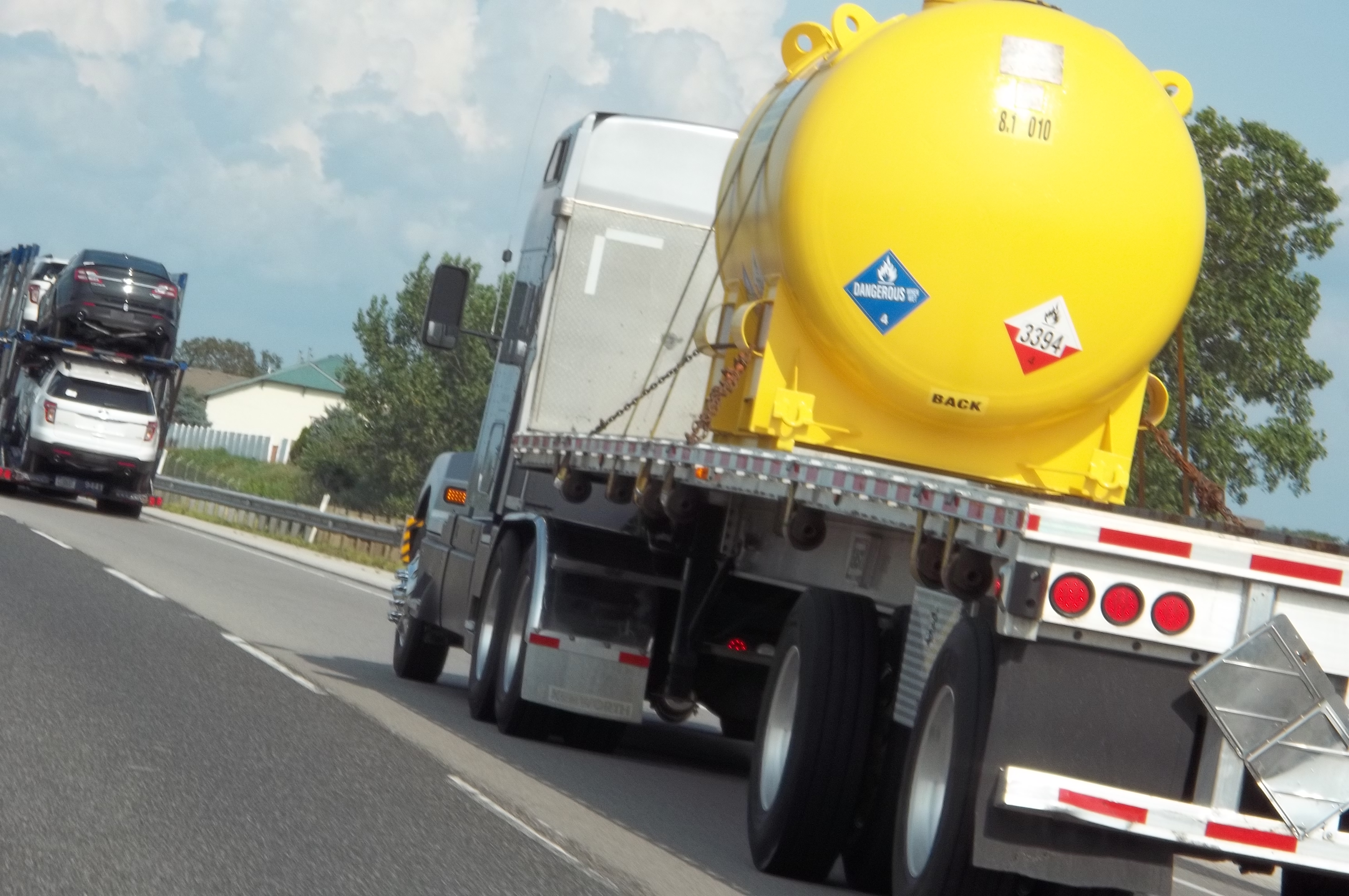
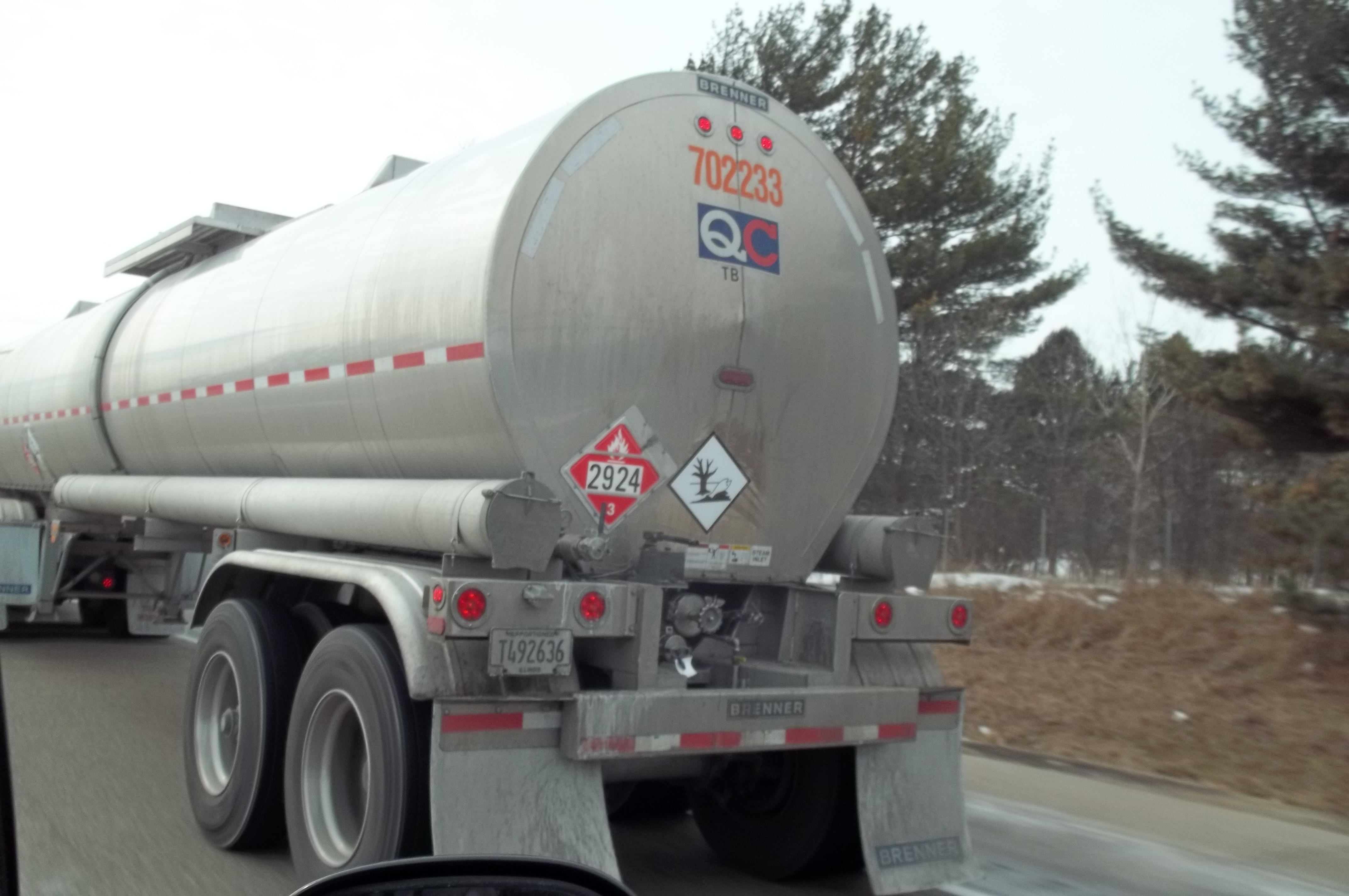
When traveling you may wonder about the potential hazards of the HazMat you see transported on our nation’s highways. Fortunately the Hazardous Material Regulations (HMR) of the Pipeline and Hazardous Materials Safety Administration (aka: PHMSA, one of many transportation-related administrations within the US Department of Transportation) require both Shippers and Carriers of HazMat to ensure it is transported in commerce safely and in a manner that communicates the potential hazards of the material. The purpose of this article is to take one example of HazMat in transportation and decipher the meaning of the hazard communication methods in use. The content of this article is based on the visible elements of the images in this article and my knowledge of the HMR.




 You may be surprised that property owned and operated by a branch of the US Armed Forces could be cited for violations of State environmental regulations, but they can. An Air Force base no less than your company must comply with the RCRA regulations that apply to a hazardous waste from cradle-to-grave (ie. from its point of generation, through its transportation in commerce, to its final disposal). A good first step to compliance is