
The Resource Conservation and Recovery Act (RCRA) as envisioned by the US Congress when it was passed in 1976 was meant to create a system for controlling hazardous waste from the time it is generated to its final disposal, i.e. “cradle to grave”. While acknowledging this system, many hazardous waste generators fail to realize their responsibility for compliance with the RCRA regulations for the hazardous waste they generate from its initial generation to its final disposal. In short, if you generate a hazardous waste you can be held responsible for its improper off-site transportation and disposal. Short of transporting, storing, treating, and disposing of your hazardous waste yourself, what can a hazardous waste generator do to minimize their potential liability once the hazardous waste is out of their hands? This article will provide guidance on questions to ask and information to seek out when choosing your hazardous waste transporters and TSDFs. (more…)
What’s a Hazardous Waste Generator to do About “Cradle to Grave” Responsibility Under RCRA?
The Solvent Contaminated Wipes Rule in Michigan
On January 31st of 2014, the USEPA’s Solvent Wipe Rule became effective at the Federal level and in those states lacking authorization under RCRA to operate their own hazardous waste program. As a state with an authorized hazardous waste program, Michigan has the option to adopt the new Federal Rule in its entirety, adopt it in part, or reject it outright and manage solvent-contaminated wipes by its own state rules. The purpose of this article is to explain the regulatory requirements for the management of solvent-contaminated wipes by a hazardous waste generator in Michigan.
Waste Prohibited from Landfill Disposal in Michigan
The following wastes are prohibited from landfill disposal under Part 115 of Act 451:

- Used oil
- Whole tires
- Liquid waste. Liquid Industrial Waste is subject to strict regulation in Michigan.
- Returnable beverage containers. Find a designated collection site and make some money on your returns!
- Lead acid batteries. Manage pursuant to Part 111 of Act 451, R 299.9206(2)(d), if reclaimed.
- Yard clippings. For disposal options, search the MDEQ website for registered composting facilities.
- Medical waste. A universal waste in Michigan.
- Sewage
- Asbestos unless the landfill meets specific federal requirements.
- Empty drums unless crushed.
- Hazardous waste from Small Quantity Generators (SQG) and Large Quantity Generators (LQG) of hazardous waste. Waste from a Conditionally Exempt Small Quantity Generator (CESQG) of hazardous waste is OK.
- Low level radioactive waste.
- PCB waste unless the landfill meets specific requirements.
For more information about wastes banned from landfill disposal in Michigan: MDEQ Prohibited Wastes.
| Daniels Training Services815.821.1550Info@DanielsTraining.comhttps://danielstraining.com/ |
Interested in more? Register now for my Training Seminar (USEPA Hazardous Waste & USDOT HazMat Transportation) in Detroit on April 23, 2015!
Frequently Asked Questions Regarding the Regulations of the Resource Conservation and Recovery Act
Got a question about the generation, identification, management, transportation, and disposal of hazardous waste, universal waste, used oil, or non-hazardous waste?
Q: What is the paint filter test?
A: The paint filter test is test method specified by the USEPA (USEPA Method 9095A) used to determine the presence of free liquids in a representative sample of waste. A predetermined amount of material is placed in a paint filter, any portion of the material that passes through the filter in a five-minute test period is identified as free liquids. The method is used to determine compliance with 40 CFR 264.314 and 265.314. However, the presence of free liquids is critical to a generators hazardous waste determination as well; especially for the characteristics of Ignitability (D001) and Corrosivity (D002).
The Meaning of the Symbols in Column 7 of the Hazardous Materials Table
A Shipper of a hazardous material is responsible for its classification and packaging prior to offering it for shipment to a Carrier. An important, but often overlooked, requirement for the safe and regulatory compliant transportation of a HazMat is an understanding of the special provisions in column 7 of the Hazardous Materials Table. When column 7 of the Hazardous Materials Table (49 CFR 172.101) includes a special provision code for an entry in the table, the requirement of that code – or codes, there may be several of them – is in addition to the general packaging requirements of §173.24 and any other applicable packaging requirements in Part 173. Further, the limitations and/or additional requirements found in the special provisions of column 7 will supersede the packaging authorizations of column 8 of the Hazardous Materials Table.
The purpose of this article is to explain the meaning of the coding system for the Special Provisions of column 7 in order to facilitate your review and understanding of them and how they may apply to your shipment of a hazardous material. (more…)
USDOT Regulations for Classification and Hazard Communication of Division 6.2 Infectious Substances in Transportation
The Pipeline and Hazardous Materials Safety Administration within the U.S. Department of Transportation (USDOT/PHMSA) creates and enforces the Hazardous Materials Regulations (HMR) for the transportation of hazardous materials (HazMat) within the U.S. One type of HazMat regulated by USDOT/PHMSA are substances that may cause sickness or death to humans or animals: Division 6.2 Infectious Substances.
The purpose of this article is to describe USDOT/PHMSA’s classification of a Division 6.2 Infectious Substance and the hazard communication: package labels, marks, and placards required for its transportation. (more…)
Classification of a Lithium Ion Battery and Available Packaging Exceptions Under the IATA DGR for Micro Q Technologies
The International Air Transport Association (IATA) is an organization of air carriers that regulates the worldwide transportation of people and property. IATA’s regulations pertaining to the transportation by air of dangerous goods (hazardous materials or HazMat within the U.S.) is known as the Dangerous Goods Regulations or DGR. The IATA DGR is updated annually; a new edition becomes effective January 1, 2015. Though not directly authorized by its regulations. the PHMSA/USDOT accepts compliance with the IATA DGR within the U.S. as compliance with its Hazardous Material Regulations (HMR). There are changes to the HMR scheduled to take affect in April of 2015 that will harmonize it with the IATA DGR, creating compatibility between these regulations for air transport of lithium batteries within the U.S. and internationally.
The correct transportation of any dangerous good requires the following:
- Identify the substance or article
- Classification of the dangerous good.
- Determination of packaging instructions.
- Identification of available packaging exceptions.
- Identification and use of required labels, markings, and the shipping paper.
Substance or article offered for transportation by air by Micro Q Technologies:
Lithium ion battery contained in equipment (e.g. cell phone, camera, lap top computer)
Battery specs: Single Battery consist of 25 cells of 3.7 Volt 2.6 amp hour ( 9.62 watt ) 18650 lithium ion cells configured 5 in series to achieve 18.5 Volts and 5 in parallel to achieve 13 amp hours, total battery power in watts 18.5 V x 13 amp hour = 240 watts
Classification:
UN/ID no.: 3481
Proper Shipping Name/Description: Lithium ion batteries contained in equipment (including lithium polymer batteries)
Class or Div. (Sub Risk): 9 MISCELLANEOUS
Packing Group: PGII
Packaging:
- Not eligible for the following packaging exceptions:
- Excepted Quantity
- Limited Quantity
- Maximum net quantity/package if transported by passenger aircraft = 5 kg
- Maximum net quantity/package if transported by cargo aircraft = 35 kg
- Packaging Instructions by passenger and cargo aircraft = 967
Special Provisions of column M:
- A48 – Packaging tests are not considered necessary.
- A99 – Maximum net quantity/package by cargo aircraft may exceed 35 kg if approved by PHMSA/USDOT.
- A154 – Damaged batteries are forbidden for air transport.
- A164 – Special packing requirements if potential for dangerous evolution of heat.
- A181 – If “batteries contained in equipment” are packaged with “batteries packed with equipment” must be identified as “batteries packed with equipment”. Must identify lithium ion batteries and lithium metal batteries separately if packaged together. However, button cell batteries installed in equipment need not be considered.
- A185 -Vehicles only powered by lithium metal batteries or lithium ion batteries must be shipped as UN 3171, Battery-powered vehicle.
Packaging Instructions 967:
- Operator variations for FedEx or UPS are not present or don’t apply. Other Operator variations are present.
- No State variation identified.
- PI 967 applies to lithium polymer cells & batteries contained in equipment (UN3481) for both passenger and cargo aircraft.
- There are three sections to PI 967 that must be considered:
- General Requirements apply to all lithium ion cells & batteries contained in equipment prepared for transport according to PI 967
- Section I applies if the equipment contains lithium ion cells of >20 Wh or lithium ion batteries of >100 Wh. These must be shipped as a Class 9 MISCELLANEOUS dangerous good.
- Section II applies if the equipment contains lithium ion cells of ≤20 Wh or lithium ion batteries of ≤100 Wh.
The lithium ion batteries of Micro Q Technologies have a Watt-hour rating of 240 Wh. Therefore the General Requirements and Section I of PI 967 are applicable; whereas the requirements of PI 967 Section II do not apply.
|
|
General Requirements:
- Cells and batteries must be manufactured under a quality management program as described in 3.9.2.6(e) of the IATA DGR.
- Cells and batteries that are damaged, defective, or that can produce dangerous heat or fire are forbidden from air transport. e.g. cells and batteries returned to the manufacturer for safety reasons.
- Cells and batteries must be protected so as to prevent short circuits.
- Equipment must be equipped to prevent accidental activation.
- Equipment containing lithium ion batteries must be packed in strong outer packaging per 5.0.2.4, 5.0.2.6.1, and 5.0.2.12.1 of the IATA DGR.
- Equipment containing lithium ion cells or batteries must be secured within the outer packaging and packed so as to prevent accidental operation during air transport.
Section I:
- Each cell or battery must comply with 3.9.2.6 of the IATA DGR (summarized below).
- Equipment must be packed in strong outer packagings, such as:
- Drums: steel, aluminum, plywood, fiber, plastic, or other metal.
- Jerricans: steel, aluminum, or plastic.
- Boxes: steel, aluminum, wood, plywood, reconstituted wood, fiberboard, plastic, or other metal.
- Batteries manufactured after December 31. 2011 must have the Watt-hour rating marked on the outside case.
|
|
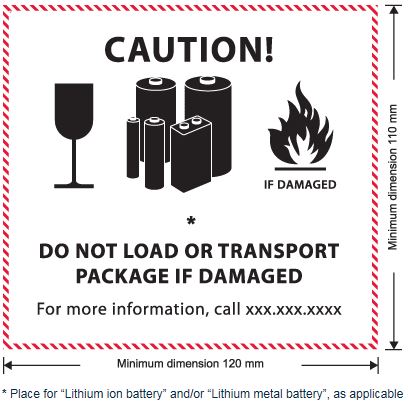
There are no other packaging exceptions available for Lithium ion batteries contained in equipment under PI 967.
Section II:
- If packaged per Section II, lithium ion cells and batteries are not subject to the remainder of the IATA DGR, except for the following:
- Limits on dangerous goods in passenger and crew baggage.
- Limits on dangerous goods in air mail.
- Reporting of dangerous goods accidents, incidents, and other occurrences.
- Cells and batteries must meet provisions of 3.9.2.6(a) and (e).
- Some devices (eg. radio frequency identification tags, watches, and temperature loggers) if not capable of generating dangerous heat may be transported when intentionally active. If active, must meet defined standards for electromagnetic radiation.
- Equipment must be packed in strong outer packagings. Type of packaging is not specified as it is for Section I.
- If package contains >4 cells or >2 batteries, then must be labelled with the Lithium Battery Handling Label. button cell batteries installed in equipment are not counted towards the battery threshold.
Question: “Answer to question G at the bottom of page 19 and followed on page 20 (IATA Lithium Battery Guidance Document, Revised for the 2014 Regulations) is rather confusing, (number of cells contained inside the lithium Ion battery are NOT counted towards the 4 cell limitation) Does this mean a loop hole to avoid Class 9?”
Answer: No. The exception referred to in question G applies only to the requirement to use the Lithium Battery Handling Label under PI 967 Section II. Question G also explains that the number of cells in a battery are not counted towards the 4 cell threshold when determining if this exception is available; rather it is the battery itself that is counted.
- A Shipper’s Declaration for Dangerous Goods is not required.
- Each shipment of packages bearing the Lithium Battery Handling Label must be accompanied by a document indicating:
- The package contains lithium ion cells or batteries.
- The package must be handled with care.
- Special procedures to follow if the package is damaged.
- A telephone number for additional information.
- Each shipment of packages bearing the Lithium Battery Handling Label must include the following on the air waybill, if an air waybill is used (air waybill is not required): “Lithium ion batteries in compliance with Section II of PI 967”
- Persons preparing cells or batteries for transport must receive adequate instruction on these requirements.
3.9.2.6 of the IATA DGR:
- Each cell or battery must be tested per the UN Manual of Tests and Criteria Part III Subsection 38.3.
- Each cell and battery must incorporate a safety venting device or be designed to preclude a violent rupture under conditions normally incident to transport.
- Each cell and battery must be equipped with an effective means of preventing external short circuits.
- Each battery containing cells or series of cells connected in parallel must be equipped with effective means as necessary to prevent dangerous reverse current flow (e.g., diodes, fuses, etc.).
- Cells and batteries must be manufactured under a quality management program specified at 3.9.2.6(e). In-house quality management programs may be accepted.
Requirements of the HMR:
The following are requirements of the HMR that are not found in the IATA DGR; they apply to the transportation of any hazardous material within the U.S. There are no other requirements of the HMR that will impact the shipment of this HazMat/dangerous good.
- Emergency response information
- HazMat Employee training
- HazMat Security
- HazMat incident reporting
- For export only:
- General packaging requirements
- Requirements for reuse of packaging
- Registration as shipper or carrier.
Conclusion:
The lithium ion batteries contained in equipment (UN 3481) of the Watt-hour rating you describe must be shipped as a Class 9 MISCELLANEOUS dangerous good per the IATA DGR. The General Requirements and Section I of Packaging Instructions 967 (PI 967) must be followed for its packing. No packaging exceptions are available for this dangerous good in transportation.
Disclaimer:
This document represents my interpretation of the IATA DGR (2015, 55th Edition) based on the information provided by Micro Q Technologies. It is meant to be a summary of the main features of the applicable regulations and is not a complete re-statement of them. As the Shipper of a HazMat/Dangerous Good, you must ensure compliance with the applicable Federal and International regulations. Please confirm all of the information presented here through your own thorough review of the IATA DGR and the HMR.
| Daniels Training Services815.821.1550Info@DanielsTraining.comhttps://danielstraining.com/ |
Rules & Regulations, Proposed Rules, & Notices From: USEPA (RCRA Only); and FAA, FMCSA, FRA, & PHMSA (HazMat Transportation Only) for November 2014
November 2014 – Rules & Regulations, Proposed Rules, and Notices Regarding the Management of Hazardous Waste and the Transportation of Hazardous Materials
On its website the US Government Printing Office makes a wealth of Federal publications available for review and download; one of these is the Federal Register.
Published by the Office of the Federal Register, National Archives and Records Administration (NARA), the Federal Register is the official daily publication for rules, proposed rules, and notices of Federal agencies and organizations, as well as executive orders and other presidential documents.
See below for a brief summary of announcements in the Federal Register by the US EPA on the subject of Hazardous Waste and the Pipeline & Hazardous Materials Safety Administration (PHMSA), Federal Railroad Administration (FRA), and the Federal Aviation Administration (FAA) of the US DOT on the subject of Transportation of Hazardous Materials.
The Federal Register is a great way to look down the road and see potential changes to the regulations long before they are put into effect (sometimes The Rulemaking Process takes years before a final rule is issued, if ever). Knowledge of these potential changes provides you with several advantages:
- Additional time to modify your business operations to comply.
- Awareness of on what topics the regulatory agencies intend to focus their efforts.
- The ability to register your concerns, complaints, suggestions, etc. in order to modify the proposed rule before a final rule is issued. It can be done, really!
- Make changes to your training program to account for changes that become effective before the next training cycle.
- Alert you to the need to re-train your employees prior to their next scheduled training cycle, if necessary.
- Keep you abreast of changes to the regulations that affect your business and/or your industry group.
Please note that this is my best effort to identify the relevant announcements in the Federal Register that may be of interest to generators of hazardous waste and shippers of hazardous materials. I encourage you to review the list of Federal Register publications yourself to ensure regulatory compliance.
November 1, 2014 through November 30, 2014
 USEPA – US Environmental Protection Agency:
Publications not related to the management of hazardous waste, solid waste, universal waste, or used oil are not included here.
Rules and Regulations:
- Consolidated Rules of Practice Governing the Administrative Assessment of Civil Penalties, Issuance of Compliance or Corrective Action Orders, and the Revocation, Termination or Suspension of Permits Pages 65897 – 65901 [FR DOC # 2014-26321] PDF| Text | More
- Hazardous Waste Management System; Identification and Listing of Hazardous Waste; Final Exclusion Pages 70108 – 70113 [FR DOC # 2014-27780] PDF| Text | More
Proposed Rules:
- Consolidated Rules of Practice Governing the Administrative Assessment of Civil Penalties, Issuance of Compliance or Corrective Action Orders, and the Revocation, Termination or Suspension of Permits Pages 65910 – 65912 [FR DOC # 2014-26318] PDF| Text | More
Contact me with any questions you may have about the management of hazardous waste Daniels Training Services815.821.1550 |
Notices:
- Agency Information Collection Activities; Proposed Collection; Comment Request; Requirements and Exemptions for Specific RCRA Wastes Pages 65652 – 65653 [FR DOC # 2014-26329] PDF | Text | More
FAA – Federal Aviation Administration:
Publications not related to the transportation of hazardous materials are not included here.
Rules and Regulations:
None
Proposed Rules:
None
Notices:
None
FMCSA – Federal Motor Carrier Safety Administration:
Publications not related to the transportation of hazardous materials are not included here.
Rules and Regulations:
None
Proposed Rules:
None
Notices:
None
FRA – Federal Railroad Administration:
Publications not related to the transportation of hazardous materials are not included here.
Rules and Regulations:
- Training, Qualification, and Oversight for Safety-Related Railroad Employees Pages 66459 – 66510 [FR DOC # 2014-26290] PDF| Text | More
Proposed Rules:
None
Notices:
- Roadway Worker Authority Limits-Importance of Clear Communication, Compliance With Applicable Rules and Procedures, and Ensuring That Appropriate Safety Redundancies Are in Place in the Event of Miscommunication or Error Pages 70268 – 70270 [FR DOC # 2014-27955] PDF| Text | More
PHMSA – Pipeline and Hazardous Materials Safety Administration:
Publications not related to the transportation of hazardous materials are not included here.
Rules and Regulations:
None
Proposed Rules:
None
Notices:
- List of Delayed Applications Pages 65296 – 65296 [FR DOC # 2014-25165] PDF| Text | More
- Actions on Special Permit Applications Pages 65297 – 65298 [FR DOC # 2014-25168] PDF| Text | More
- Pipeline Safety: Renewal Requests for Special Permit Pages 65477 – 65478 [FR DOC # 2014-26086] PDF | Text | More
- International Standards on the Transport of Dangerous Goods Pages 65768 – 65768 [FR DOC # 2014-26184] PDF| Text | More
- Office of Hazardous Materials Safety; Notice of Application For Special Permits Pages 69559 – 69560 [FR DOC # 2014-27426] PDF| Text | More
- Actions on Special Permit Applications Pages 69560 – 69561 [FR DOC # 2014-27427] PDF| Text | More
- Delayed Applications Pages 69561 – 69562 [FR DOC # 2014-27428] PDF| Text | More
- Notice of Application for Modification of Special Permit Pages 69562 – 69563 [FR DOC # 2014-27430] PDF| Text | More
Information can be helpful but it’s useless if you are not able to make sense of it. You must be able to determine how any changes to the rules and regulations (final or proposed) will affect your operations, and communicate the necessary information to your personnel. I can help you to do that.
| Contact me with any questions you may have about the transportation of hazardous materials by air, highway, vessel, or railInternational and DomesticDaniels Training Services815.821.1550Info@DanielsTraining.com |
Please contact for a free training consultation to determine your regulatory requirements and how training can help you to attain and maintain compliance with the regulations of the US Environmental Protection Agency (and your state) and the PHMSA, FAA, FRA, & FMCSA of the US Department Of Transportation.
Hazardous Waste Container not Labeled = RCRA Violation for Delaware Body Shop
The Bullet:
It does not appear that any fines were issued, but a simple violation of the state hazardous waste regulations could have been avoided with a little knowledge.
Who:
Enforcement Agency: Delaware Department of Natural Resources and Environmental Control (DNREC)
DNREC Contact: Davis, William B
Violator: Brandywine Body Shop
What:
Enforcement Number: 2014-11975 Program: Solid & Hazardous Waste
Where:
Brandywine Body Shop 1325 Newport Gap PikeWilmington DE
When:
Date violation discovered: 08/19/2014
Date corrected: 08/19/2014
Date notice of violation served: 11/28/2014
Why:
Containers of hazardous waste were not marked with the words “Hazardous Waste” or with other words that identify the contents of the containers.
How:
As a state with an authorized hazardous waste program, Delaware may conduct RCRA compliance inspections of businesses within its borders and issue violations and fines for non-compliance.
Conclusion:
Something as simple as failing to label a hazardous waste container resulted in a violation for this business. If you don’t have the time or resources for my Onsite Training or for one of my Training Seminars, consider the low-cost and quick alternative to formal training that will bring you into compliance: Webinar Training.
| Daniels Training Services815.821.1550Info@DanielsTraining.comhttps://danielstraining.com/ |
State and Federal Surplus Property Available for Eligible Organizations
The Bullet:

Eligible organizations may take advantage of the availability of surplus property acquired by the State of Texas and by the Federal Government. Property is available for a small processing fee which is usually much less expensive than purchasing the items through traditional channels.
Who:
The Texas Facilities Commission (TFC) manages the disposition of surplus property donated to the state by federal programs.
Examples of organizations eligible for the Federal Surplus Property Program include: cities, counties, state agencies, political subdivisions, public & private schools, colleges, universities, museums, libraries, medical institutions, child care centers, drug abuse treatment centers, public airports, educational radio stations, utility providers and other conservation agencies, select veterans service organizations (per the For Vets Act of 2013), Service Educational Activities (such as the Boys & Girl Scouts, YMCA, Red Cross, JROTC), and providers of assistance to the homeless, impoverished, or elderly. For a detailed list of eligible organizations, please visit: http://www.gsa.gov/portal/content/105055.
The state program is a little different in that unlike the federal program, state surplus property is offered for sale to the general public. After a ten day posting period, where only qualified entities can purchase, the state surplus property goes to the Austin warehouse to be sold to the general public. TFC also offers state surplus property for sale to the general public through online auctions at www.lonestarauctioneers.com.
What:
The federal program obtains property from the federal government and donates the property only to qualified organizations (see “Who”) for a small handling fee. Commonly available items include, but are not limited to, heavy equipment, tools, generators, fire trucks, trailers, vehicles, and furniture.
Some commonly available items through the state surplus program include office furniture, office supplies, knives, multi-tools, cars, trucks, and SUVs.
Where:
Not applicable
When:
Not applicable.
Why:
Sometimes the best way not to generate a waste is to reuse an existing resource. The Surplus Property Program (State or Federal) seeks to do just that.
How:
The program is not funded by the legislature, but is totally supported by the revenues generated from handling fees. This means that the cost of maintaining the staff and facilities are passed on to the program participants in the form of the handling fee. Handling fees will vary according to condition of the item and demand, but are usually significantly lower than the cost of comparable items on the open market. The difference in value is considered a “donation” from the federal government; hence, participants in the program are referred to as “donees.”
Conclusion:
For more information on the State and Federal Surplus Property Programs and to view available inventory, please visit their website: http://tfc.state.tx.us/