PO Box 1232 Freeport, IL 61032

A Different Kind Of Training

A Different Kind Of Training

A Different Kind Of Training

What is a D003 Reactive Hazardous Waste?

The EPA – and most states with an authorized hazardous waste program – identify two types of hazardous waste:

Listed:

  • Hazardous waste from non-specific sources (F-codes).
  • Hazardous waste from specific sources (K-codes).
  • Discarded commercial chemical products, off-specification species, container residues, and spill residues thereof (P-codes & U-codes).

And…

Characteristic:

The purpose of this article is to explain how EPA identifies the characteristic of Reactivity (D003).

The characteristic of Reactivity is codified in Title 40 of the Code of Federal Regulations at 40 CFR 261.23.  It reads:

a) A solid waste exhibits the characteristic of reactivity if a representative sample of the waste has any of the following properties:

(1) It is normally unstable and readily undergoes violent change without detonating.

(2) It reacts violently with water.

(3) It forms potentially explosive mixtures with water.

(4) When mixed with water, it generates toxic gases, vapors or fumes in a quantity sufficient to present a danger to human health or the environment.

(5) It is a cyanide or sulfide bearing waste which, when exposed to pH conditions between 2 and 12.5, can generate toxic gases, vapors or fumes in a quantity sufficient to present a danger to human health or the environment.

(6) It is capable of detonation or explosive reaction if it is subjected to a strong initiating source or if heated under confinement.

(7) It is readily capable of detonation or explosive decomposition or reaction at standard temperature and pressure.

(8) It is a forbidden explosive as defined in 49 CFR 173.54, or is a Division 1.1, 1.2 or 1.3 explosive as defined in 49 CFR 173.50 and 173.53.

Like this article?

Subscribe to my Monthly Newsletter

No marketing emails!

(b) A solid waste that exhibits the characteristic of reactivity has the EPA Hazardous Waste Number of D003.

Right from the start – paragraph (a) – the regulation may mislead you into thinking there is a test method for Reactivity because of its reference to “a representative sample of the waste…”.  There is not.  Nowhere in section §261.23 does it refer to a test method for determining the characteristic of Reactivity.  For the characteristic of Reactivity a generator making a hazardous waste determination must rely solely on generator knowledge as allowed by §261.10(a)(2)(ii).

From the EPA website:  "There are currently no test methods available."

So what is a reactive hazardous waste?  It is any solid waste (i.e. any material that is disposed of by being abandoned or recycled, is inherently waste-like, or is a military munition) that exhibits any one of the following characteristics:

Unstable:

It is normally unstable and readily undergoes violent change without detonating.

A waste meeting this characteristic would normally be in an unstable state; defined in general chemistry as compounds that readilydecompose or change into other compounds.  And it also must readily undergo a violent change without detonating (aka exploding).    Note that the trigger for the “violent change”, e.g. pressure, water, heat, &etc. is not specified.  It is clear that they do not mean to include explosives here as they are addressed later in this characterization.

A lithium battery may be a reactive hazardous waste due to its instability (Faxback 11274) unless it has been fully discharged (RO 11229).

I’m no scientist but here’s a good explanation of why lithium batteries sometimes go off:  Here’s why Lithium Batteries Occasionally Catch Fire.

Here is an example of a lithium battery’s instability:

Lithium batteries may be managed with other hazardous waste batteries as a universal waste.

Contact me with any questions you may have about the generation, identification, management, and disposal of hazardous waste

Daniels Training Services

815.821.1550

Info@DanielsTraining.com

https://danielstraining.com/

Water Reactives:

It reacts violently with water.

It forms potentially explosive mixtures with water.

When mixed with water, it generates toxic gases, vapors or fumes in a quantity sufficient to present a danger to human health or the environment.

A waste that performs any one of the above actions when exposed to water must be assigned the characteristic of Reactivity.  Certain elements and substances, e.g. sodium and sodium azide, respectively are known to be water reactive and may be a reactive hazardous waste.  But note the use of subjective and undefined terms such as “violently” and “potentially explosive”.  Also, while the generation of toxic gases, vapors or fumes can be detected or known what can’t be determined from this characterization is what quantity is “sufficient to present a danger to human health or the environment”?  One possible tool for answering this question is to refer to the applicable worker exposure standards of the Occupational Health and Safety Administration (OSHA) for the gas, vapor, or fume generated.  If it is at or near the OSHA maximum exposure limit it may be sufficient to present a danger to human health or the environment(RO14636) (RO12249).

Cyanide or Sulfide Bearing:

It is a cyanide or sulfide bearing waste which, when exposed to pH conditions between 2 and 12.5, can generate toxic gases, vapors or fumes in a quantity sufficient to present a danger to human health or the environment.

To be a reactive hazardous waste due to this characteristic the waste must:

  • Contain either cyanide or sulfide (an inorganic anion of sulfur).  The quantity or concentration is not specified.

And…

  • When exposed to pH conditions between 2 and 12.5 – note that this pH range is not characteristic of a D002 corrosive hazardous wastewhich is a liquid with a pH of less than or equal to 2 or equal to or greater than 12.5. – generate dangerous levels of toxic gases, vapors, or fumes.

How can a generator determine a “quantity sufficient to present a danger to human health or the environment.”?

Well, in 1985 EPA provided interim guidance on determining these levels (Faxback 11091).  However, this guidance was withdrawn in 1998 and has not been replaced (Faxback 14177).  So it looks like you’re on your own.

Explosives:

It is capable of detonation or explosive reaction if it is subjected to a strong initiating source or if heated under confinement.

It is readily capable of detonation or explosive decomposition or reaction at standard temperature and pressure.

It is a forbidden explosive as defined in 49 CFR 173.54, or is a Division 1.1, 1.2 or 1.3 explosive as defined in 49 CFR 173.50 and 173.53.

Note the three separate definitions of an explosive.

1.  IT COULD EXPLODE IF TRIGGERED…

The first is merely “capable” of detonation (an explosion at faster than the speed of sound) or explosive reaction which is not quite the same as an explosion.  Further, the waste will only begin detonation or explosive reaction if it is subjected to a strong initiating force or heated under confinement.

So then, what about aerosol cans and other compressed gas cylinders?  Could they be a D003 reactive hazardous waste solely because of their capability of detonation or explosive reaction when heated or otherwise punctured?  The answer from EPA, surprising to me, was “maybe”.  In 1987 EPA stated that a discarded aerosol can is a reactive hazardous waste due solely to the propellent and not any other waste it contains (RO13027).  However, six years later in 1993 EPA refused to answer the question: “At this time, the Agency is not able to determine whether various types of cans that may have contained a wide range of products are reactive.”  The Agency went on to state that nearly empty steel aerosol cans are subject to the scrap metal exemption at 40 CFR 261.1(c)(6) and as such may even be punctured and drained without a permit (RO11782).

You may manage your hazardous waste aerosol cans under the scrap metal exemption.

My interpretation is that unless RCRA Empty, an aerosol can will – at a minimum – be a D003 reactive hazardous waste due to the contents or the propellant being under pressure and capable of detonation if exposed to…

a strong initiating source:

Or heated under confinement:

But as the generator you must determine for yourself if your non-empty aerosol cans display the characteristic of Reactivity.

Some states, such as California and Minnesota, allow non-empty aerosol cans to be managed as a universal waste.

But I may be wrong because even though EPA has refused to directly answer if aerosol cans are a reactive hazardous waste, it has stated that ammunition up to and including 0.50 caliber does not display the characteristic of Reactivity (RO 13712).  So, if ammunition is not a reactive hazardous waste due to its explosive nature perhaps aerosol cans aren’t either.

We have two more types of explosives to consider…

2.  MORE LIKELY TO EXPLODE WITHOUT A TRIGGER…

Another explosive characteristic is one that is “readily capable” of exploding at standard temperature and pressure.  Note that this is a much more reactive material since it is “readily capable” instead of just merely “capable” and it does not require heat or a strong initiating source.

3.  FORBIDDEN AND THE BIG BOOMERS…

And finally, it is a specified type of explosive as defined by the Hazardous Material Regulations of the USDOT/PHMSA.  So let’s take a look at them:

  • Explosives that are forbidden in transportation by USDOT/PHMSA are identified at 49 CFR 173.54.  They include but are not limited to nitroglycerin, loaded firearms and toy torpedoes.  Simply refer to this
  • 49 CFR 173.50 identifies the six different divisions of hazard class 1 Explosives regulated by the HMR.  The three divisions that will be a reactive hazardous waste upon disposal are the most dangerous:

(1) Division 1.1 consists of explosives that have a mass explosion hazard. A mass explosion is one which affects almost the entire load instantaneously.

(2) Division 1.2 consists of explosives that have a projection hazard but not a mass explosion hazard.

(3) Division 1.3 consists of explosives that have a fire hazard and either a minor blast hazard or a minor projection hazard or both, but not a mass explosion hazard.
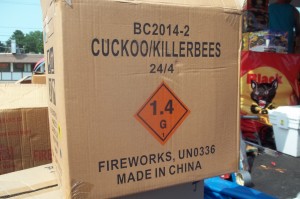
UN0336, Fireworks
Consumer firework in Division 1.4 will likely not be a reactive hazardous waste when discarded

Most consumer fireworks are a Division 1.4 Explosive and therefore would not display the characteristic of Reactivity when discarded.

Note:  A consumer firework that is a Division 1.4 Explosive may not display the characteristic of Reactivity but it may be a hazardous waste due to other characteristics such as Toxicity.

Commercial fireworks (the kind you see at a big show) and military munitions will likely be classified as a Division 1.1, 1.2, or 1.3 and will therefore be a reactive hazardous waste if discarded unused.

49 CFR 173.53 does not identify any new explosives not already identified in §173.50.  Instead it cross-references the current classification system of hazard class and division with a format used by USDOT/PHMSA prior to January 1, 1991 and still used by some states or other regulatory agencies.  Example:

  • Division 1.1 = Class A explosives
  • Division 1.2 = Class A or Class B explosives
  • Division 1.3 = Class B Explosives
  • Division 1.4 = Class C explosives
  • Division 1.5 = Blasting agents
  • Division 1.6 = No applicable hazard class

Contact me with any questions you may have about the generation, identification, management, and disposal of hazardous waste

Daniels Training Services

815.821.1550

Info@DanielsTraining.com

https://danielstraining.com/

If you’re looking for clear-cut thresholds or approved analytical methods for the determination of the characteristic of Reactivity, you won’t find it here.  The determination of a reactive hazardous waste relies heavily on your knowledge of the process generating and the waste itself at the point of generation.

Authorized Packaging for HazMat and a PHMSA Video of Cargo Tank Explosion

The Hazardous Material Regulations of the Pipeline and Hazardous Materials Safety Administration (PHMSA, an administration within the US DOT), require all hazardous materials to be transported in authorized packaging (49 CFR 173.24(c)).  Authorized packaging can be determined in only one of two ways:

  • In columns 8A (packaging exceptions), 8B (non-bulk packaging), or 8C (bulk packaging) of the hazardous materials table at 49 CFR 172.101 of the HMR.  Each column will indicate the section of Part 173 where authorized packaging for that HazMat is identified.  “None” in any of column 8 indicates that form of packaging is not available.  Further, the HazMat shipment must conform to any applicable special provisions in column 7 of the hazardous materials table (special provision codes are explained at 49 CFR 172.102).  Also, if specification packaging, it must meet the requirements of parts 178 (for most packagings) and part 179 (for railroad tank cars).

Meeting the requirements of parts 178 and 179 does not apply to a UN Standard packaging that is manufactured outside of the U.S.

  • The packaging is permitted under and conforms to the requirements of the U.S Bureau of Energy found at §171, subpart B or those of the applicable international agency found at §171, subpart C.  Or, conforms to packing instructions found at:  §173.3, §173.4, §173.4a, §173.4b, §173.5, §173.5a, §173.6, §173.7, §173.8, §173.27, or §176.11.

So, what happens when the packaging for a hazardous material is not the authorized packaging as determined by compliance the HMR?  See below:

https://www.youtube.com/watch?v=8ZqRU9mBOf8

More significant because of the volume and nature of the HazMat, the lesson can be applied to smaller volumes and less hazardous materials:  using a packaging that is not authorized for a hazardous material can result in package failure leading to loss of property, injury, and death.

Contact me with any questions you may have about the transportation of hazardous materials by air, highway, vessel, or rail

International and Domestic

Daniels Training Services

815.821.1550

Info@DanielsTraining.com

https://danielstraining.com/

Use of Package Orientation Arrows in the IATA Dangerous Goods Regulations

Logo of the International Air Transport AssociationThe 57th Edition of the Dangerous Goods Regulations (DGR) of the International Air Transport Association (IATA) specifies the requirements for, and exclusions from use of, package orientation arrows on certain packages of dangerous goods when transported by air.

The IATA DGR is a creation of the airline industry.  It is based on - and in some instances more strict than - the Technical Instructions of the International Civil Aviation Administration.  Compliance with the IATA DGR is required for most dangerous goods transportation by air for both domestic and international transportation.

The purpose of this article is to explain the use of package orientation arrows – and the conditions when they are not required – as regulated by the 57 Edition of the IATA DGR at 7.2.4.4 and 5.0.2.13.3.

Make certain you are referring to the current edition of the IATA DGR for compliance.  The 57th Edition is effective only for calendar year 2016 (January 1, 2016 to December 31, 2016).

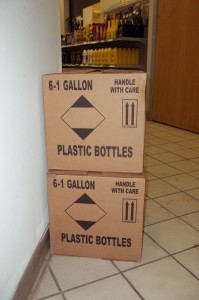
Package orientation arrows, or as they are referred to in the DGR: “Package Orientation ” (This Way Up) labels, are required – with some exclusions – on only two types of packaging, and then, only if they contain liquid dangerous goods:

  • Combination packaging
  • Overpack
The requirement for an overpack with liquid dangerous goods to display orientation arrows differs slightly from that of the USDOT/PHMSA which only requires orientation arrows on an overpack if it contains packagings that are required to display orientation arrows.  Read:  Orientation Arrows on HazMat Packaging.
REQUIREMENTS FOR DISPLAY OF PACKAGE ORIENTATION LABELS:
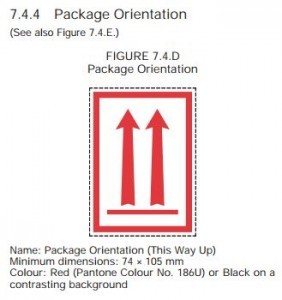
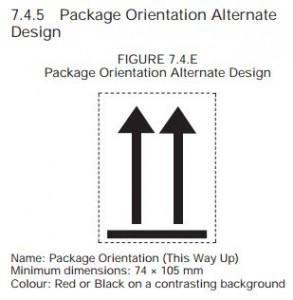
  • Must meet the specifications of Figure 7.4.D or Figure 7.4.E of the DGR (see below).
  • Must be displayed on two opposite sides of the package or overpack.
  • Must show the proper package orientation for the closures of the inner packaging to be in the upright position.
  • From 7.4.4 and 7.4.5:
    • Minimum dimensions:  74 x 105 mm
    • Color:  Red (Pantone Color No. 186U) or Black on a contrasting background

Figure 7.4.D

Package Orientation Figure 7.4.D

Figure 7.4.E

Package Orientation Figure 7.4.E

ADDITIONAL OPTIONS FOR DISPLAY OF PACKAGE ORIENTATION LABELS:20151119_113303
  • The words “Dangerous Goods” may be inserted below the line at the bottom of the label.
  • The words “THIS END UP” of “THIS SIDE UP” may also be displayed on the top of the package or overpack.

PACKAGE ORIENTATION LABELS ARE NOT REQUIRED ON THE OUTER PACKAGING OF COMBINATION PACKAGINGS CONTAINING:

  • Inner packagings each of 120 mL or less if there is sufficient absorbent material between the inner and outer packagings to completely absorb the liquid contents.
  • Inner packagings of 500 mL or less that are gas tight such as:  tubes, bags, or vials and that are opened by breaking or puncturing.
  • Division 6.2 Infectious Substances in primary receptacles of 50 mL or less.
  • Hazard Class 7 Radioactive.

The above exclusions only apply to combination packaging.

Like this article?

Subscribe to my Monthly Newsletter

No marketing emails!

transportation of HazMat by air

An Operator may have their own variations to the IATA DGR

ARE WE DONE?  NO.  WE STILL MUST CONSIDER STATE AND OPERATOR VARIATIONS:

Paragraph 2.8.0 of the DGR reads:

States and operators may submit variations to these Regulations.  These variations are listed in 2.8.2 and 2.8.4 respectively.

States (that’s nations to you and I) and operators (them that fly the planes) may manage dangerous goods transportation differently than the DGR.  Under certain conditions these variations have the same force as the DGR themselves.  The regulations pertaining to Package Orientation labels have three Operator Variations to consider:

  • ME-09 for Middle East Airlines:  Package orientation (This Way Up) labels must be used on any combination and single packaging containing dangerous goods (See 5.0.2.13.3 and 7.2.4.4).
  • SV-04 for Saudi Arabian Airlines:  Package Orientation (THIS WAY UP) labels must be used on any combination and single package containing liquid dangerous goods, excluding Infectious Substances if primary receptacles contain less than 50 mL and Radioactive Material (See 5.0.2.13.3 and 7.2.4.4).
  • VT-07 for Air Tahiti:  All dangerous goods packages must show the package orientation label (“This way up” label) and two hazard label(s) on two opposite sides (see 7.2.4.4).
A shipper of dangerous goods must comply with these operator variations only if said operator is used for the transport of dangerous goods.

Contact me with any questions you may have about the transportation of hazardous materials by air, highway, vessel, or rail

International and Domestic

Daniels Training Services

815.821.1550

Info@DanielsTraining.com

https://danielstraining.com/

If the transport of your dangerous goods (aka: hazardous materials) is to be transported by air you must comply with the regulations of the International Air Transport Association.  Learn what you need to know to ship dangerous goods by air and meet the biennial (every two years) training requirement of IATA for shippers and packers of dangerous goods (found at subsection 1.5 of the DGR) by scheduling my Onsite Training.

Q&A: Placement of HazMat Labels and Markings on a Package

QUESTION FROM A HAZMAT EMPLOYER (NOT A CUSTOMER OF MINE, YET!) IN LATE OCTOBER 2015 VIA TELEPHONE (I DON’T RECORD MY TELEPHONE CONVERSATIONS SO THIS IS JUST MY BEST RECOLLECTION):

Is it OK for HazMat labels and markings to appear on the top of a package of hazardous materials for transportation?

DURING THE COURSE OF THE TELEPHONE CONVERSATION I MUST HAVE TOLD THE QUESTIONER THAT IT WAS NOT ACCEPTABLE TO DISPLAY HAZMAT LABELS AND PLACARDS ON THE TOP OF A PACKAGE, ESPECIALLY IF THE TOP IS REMOVABLE, E.G. THE LID OF A 5-GALLON BUCKET.  MY FOLLOW-UP EMAIL ON NOVEMBER 2, 2015 WAS AN ATTEMPT TO SET THE RECORD STRAIGHT:

Thank you for contacting me with your question. Though I gave you my initial response over the phone, I’m glad I took the time to further research this issue. Because my initial response was wrong!

I had told you that I believed that HazMat markings and labels must appear on a non-removable part of a HazMat package but this is not so (for the most part).

Based on my review of the Hazardous Material Regulations and confirmation with the PHMSA Helpline, I have determined the following:

  • The marking regulations of 49 CFR 172, Subpart D do not specify a location for HazMat markings. With one exception, see next.
  • The packaging specification marking must be visible on a non-removable part of the packaging (49 CFR 178.3). This would preclude its placement on a removable lid.
    This is the specification packaging marking for a steel drum with a removable lid.Specification packaging marking
  • HazMat labels must, “Be printed on or affixed to a surface (other than the bottom)” of a HazMat package [172.406(a)(1)(i)]. And, per 49 CFR 172.406(a)(1)(ii): “Be located on the same surface of the package and near the proper shipping name marking, if the package dimensions are adequate.”

The HMR does not forbid the placement of HazMat labels and markings on the top or lid of a packaging, even a removable lid, except for the packaging specification marking. HazMat labels may not be affixed to the bottom of a package, though there is no such limitation for a marking. However, since the label and the marking are required to be located on the same surface and near each other, it can be reasonably assumed that the marking should not appear on the bottom of the package.

I hope this helps. Please don’t hesitate to contact me with any other questions.

It pays to do your research!  Also, you should never rely on the first answer of someone – even me – unless they are able to back up their response with a reference to the regulations.  Here is an example of when the common-sense answer – I mean, c’mon!  Do you really think it’s OK for HazMat labels to appear on the removable lid of a package? – is wrong.  But common-sense doesn’t always mean compliance.  Make sure you and your HazMat Employees are in compliance with the Hazardous Material Regulations.

Go Glow Placards to Comply with 49 CFR 172.516 – Visibility and Display of Placards

The Hazardous Material Regulations at 49 CFR 172.516 require the following for the display of placards.

  • On a motor vehicle or rail car a placard must be clearly visible from the direction it faces, except from the direction of another rail cargo or transport vehicle to which it is attached.  More…
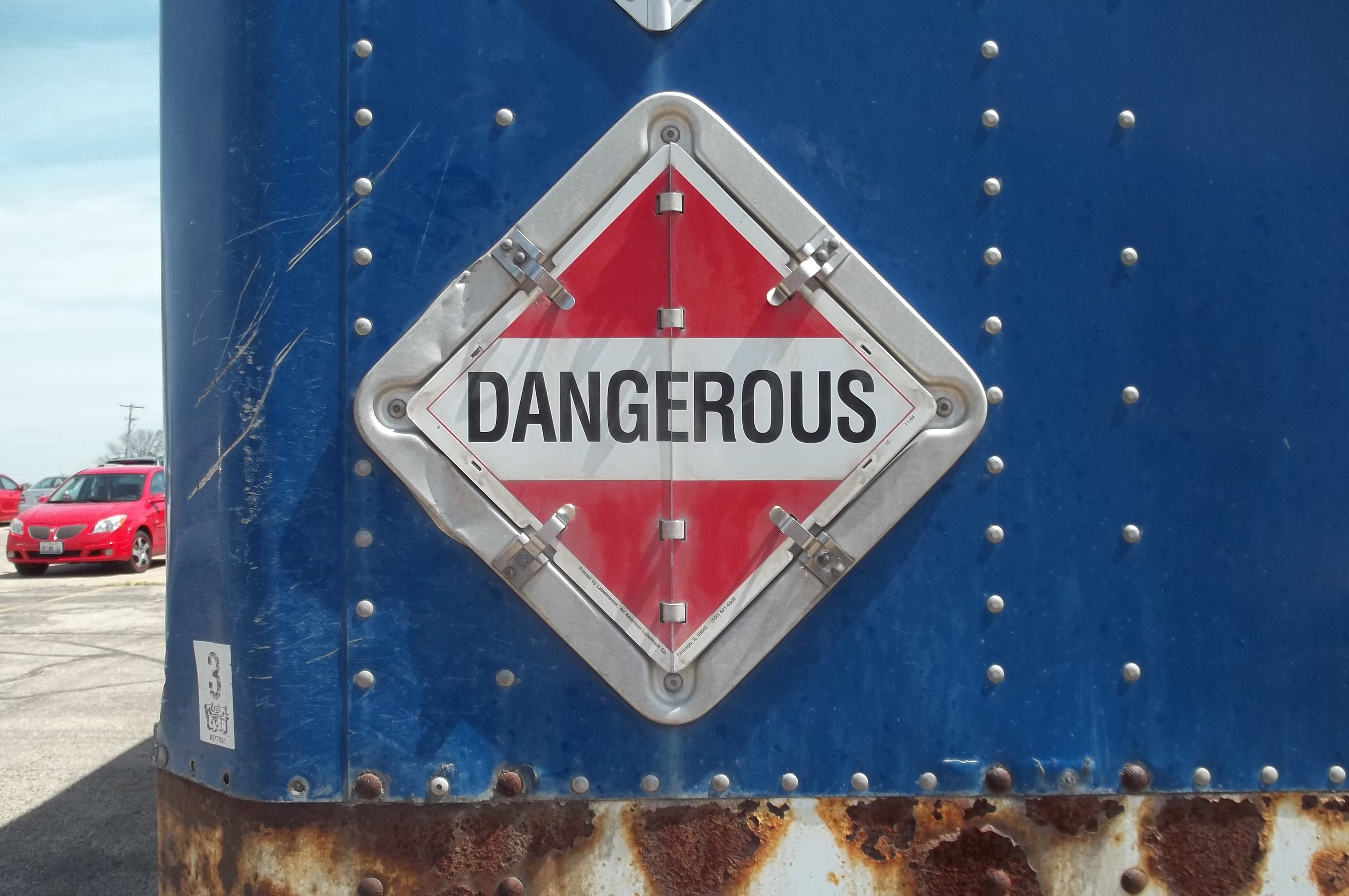
  • Dangerous PlacardIn all cases placards must be…
    • Securely attached or placed in a holder.
    • Located clear of ladders, pipes, doors, and tarps.
    • So far as practicable, located so that dirt or water is not directed to it from the wheels.
    • Located away (≥3 inches) from any marking (such as advertising) that could substantially reduce its effectiveness, i.e. make it harder to see.
    • Displayed horizontally so words or identification numbers read left to right.
    • Maintained by the carrier so no substantial reduction in visibility.
    • Affixed to a background of contrasting color or have dotted or solid line outer border which contrasts with the background color.
  • Recommended specifications for a placard holder found in Appendix C to 49 CFR part 172.
  • Placard or placard holder may be hinged if format, color, and legibility of the placard are maintained.
BUT WHAT ABOUT AT NIGHT?

Compliance with 49 CFR 172.516 won’t help the visiblity of your placards at all after dark.  But someone has come up with a good idea that I wish to share with you here.  Go Glow Placards, LLC makes an LED lit placard holder that will ensure 24 hour visibility of the placards you display.  I think it will also heighten overall safety as other drivers are more likely to notice placards displayed in the Go Glow Placard Holder.

Compliance is important but it may be just the starting point.  Be safe and be seen.

Federal Register logo

What’s up? What’s new? What’s coming? January 2016 – Rules & Regulations, Proposed Rules, and Notices Regarding the Management of Hazardous Waste and the Transportation of Hazardous Materials

January 1, 2016 through January 31, 2016

Logo for US Environmental Protection AgencyUSEPA – US Environmental Protection Agency:

Publications not related to the management of hazardous waste, solid waste, universal waste, or used oil are not included here.

Rules and Regulations:

Arkansas: Final Authorization of State-Initiated Changes and Incorporation by Reference of Approved State Hazardous Waste Management Program Pages 4961 – 4969 [FR DOC # 2016-01657] PDF | Text | More

Proposed Rules:

Contact me with any questions you may have about the management of hazardous waste

Daniels Training Services

815.821.1550

Info@DanielsTraining.com

https://danielstraining.com/

Arkansas: Final Authorization of State-Initiated Changes and Incorporation by Reference of State Hazardous Waste Management Program Pages 5006 – 5007 [FR DOC # 2016-01658] PDF | Text | More

Notices:

Agency Information Collection Activities; Proposed Collection; Comment Request; Hazardous Waste Specific Unit Requirements, and Special Waste Processes and Types Pages 1420 – 1420 [FR DOC # 2016-00412] PDF | Text | More

FAA – Federal Aviation Administration:Federal Aviation Administratino

Publications not related to the transportation of hazardous materials are not included here.

Rules and Regulations:

None

Proposed Rules:

None

Notices:

None

The FMCSA sets the minimum standards for Commercial Driver's Licenses
The FMCSA sets the minimum standards for Commercial Driver’s Licenses
FMCSA – Federal Motor Carrier Safety Administration:

Publications not related to the transportation of hazardous materials are not included here.

Rules and Regulations:

None

Proposed Rules:

None

Notices:

None

FRA – Federal Railroad Administration:Federal Railroad Administration

Publications not related to the transportation of hazardous materials are not included here.

Rules and Regulations:

None

Proposed Rules:

None

Notices:

None

Logo for the Pipeline and Hazardous Materials Safety Administration (PHMSA)PHMSA – Pipeline and Hazardous Materials Safety Administration:

Publications not related to the transportation of hazardous materials are not included here.

Rules and Regulations:

Hazardous Materials: Adoption of Special Permits (MAP-21) (RRR) Pages 3635 – 3686 [FR DOC # 2016-00780] PDF | Text | More

Proposed Rules:

None

Notices:

None

Information can be helpful but it’s useless if you are not able to make sense of it.  You must be able to determine how any changes to the rules and regulations (final or proposed) will affect your operations, and communicate the necessary information to your personnel.  I can help you to do that.

Contact me with any questions you may have about the transportation of hazardous materials by air, highway, vessel, or rail

International and Domestic

Daniels Training Services

815.821.1550

Info@DanielsTraining.com

https://danielstraining.com/

Please contact me for a free training consultation to determine your regulatory requirements and how training can help you to attain and maintain compliance with the regulations of the US Environmental Protection Agency (and your state) and the PHMSA, FAA, FRA, & FMCSA of the US Department of Transportation.

One-Time Waste Shipment Program in Texas

The regulations of the Texas Commission on Environmental Quality (TCEQ) divide Texas waste generators into two categories:  industrial and non-industrial.  TCEQ regulates the hazardous waste generated by both industrial and non-industrial facilities and the non-hazardous waste generated by an industrial facility; nonhazardous waste generated by a non-industrial facility is not regulated by TCEQ.  Non-hazardous waste generated by an industrial facility is classified as either Class 1 (almost hazardous), Class 2 (plant trash and empty containers), or Class 3 (inert, harmless, and rare).

Depending on the type and amount of waste generated a facility may need to register with TCEQ to obtain a Federal EPA ID number and/or a Texas Solid Waste Registration Number and apply determine the 8-digit Texas waste code for its waste.

The purpose of this article is to identify and explain the requirements of the One-Time Shipment (OTS) Program for waste generators in Texas. (more…)

Q&A: Segregation of Limited Quantities

A question from a customer of my ONSITE TRAINING on October 15th, 2015:

Hey Daniel,

I just had a quick question regarding limited quantities.  If I have 2 different hazmat items that normally could not be shipped together per the shipping regs but one qualifies under the limited quantities provision then are they able to be shipped together?  The way I interpret the regulations is that if an item is being shipped as a limited quantity it no longer has to be segregated due to the amount since we are also not having to label it as the hazardous material.

Thank you for your input.

(10.15.15)  I was certain he was right about the segregation requirements for a Limited Quantity but I wanted a little more information:

What mode of transportation?  What is the HazMat?

I believe you are right, but I’d like a little more information to be certain.
Dan
And the next day (10.16.15) I got it:

Hey Dan,

So the items are being shipped via ocean.  The 2 hazmat items that I am wanting to put on the same pallet are Nitric Acid(UN2031) and a limited quantity of Silver Nitrate (UN1493).  They will be in their own boxes but on the same pallet.

The International Maritime Organization
The International Maritime Organization regulates the international transportation of dangerous goods by vessel.

Thanks,

With that information I replied with “The Big Answer” on October 17th:

Sorry for the delay, I hope I’m not too late, but my answer confirms yours:

  • Nitric Acid UN2031 may not be shipped as a limited quantity or any other exception under the HMR.
  • Silver Nitrate UN1493 may be shipped as a limited quantity according to 49 CFR 173.152.
  • Interestingly, there is no mention in 49 CFR 173.152 of a limited quantity not being subject to the HazMat segregation requirements.
  • However, 49 CFR 176.80(b) contains an exception for limited quantities from the segregation requirements of the HMR.
  • Nitric Acid UN2031 may or may not be shipped as a limited quantity per the IMDG Code depending on its concentration.
  • Silver Nitrate UN1493 may be shipped as a limited quantity per the IMDG Code.
  • Per 3.4.4.2 of the IMDG Code, the segregation provisions of chapter 7.2 do not apply to packagings of limited quantities.
Therefore, I believe you are correct that the Silver Nitrate UN1493 as a limited quantity is not subject to the segregation requirements of the HMR or the IMDG Code.  However, Nitric Acid UN2031 may not be shipped as a limited quantity within the U.S. (though it may outside of the U.S in some situations) and will be subject to the segregation requirements of the HMR and the IMDG Code.
Non-bulk packaging of HazMat - Limited Quantity
The Limited Quantity marking

I hope this helps.  Please don’t hesitate to contact me with any other questions.

His final reply:
Thanks.  I’m only shipping the Silver Nitrate as the limited quantity with the acid which will be classified as hazardous.
Conclusion/Summary:
Notice from my answer on the 17th that I first determined compliance with the domestic regulations of PHMSA and then those of the International Maritime Organization in the IMDG Code.  The transportation to, from, or through the U.S. is subject to the Hazardous Material Regulations of PHMSA.  If it will also be shipped internationally – in this case on a vessel – then it will be subject to international regulations as well.  Here, the regulations of both PHMSA and the IMO were similar but that may not always be the case.

Contact me with any questions you may have about the transportation of hazardous materials by air, highway, vessel, or rail

International and Domestic

Daniels Training Services

815.821.1550

Info@DanielsTraining.com

https://danielstraining.com/

It’s not uncommon that person who have received my Onsite Training follow-up with questions once they begin to apply the information from the training on their job.

Contact me to schedule Onsite Training required by the International Maritime Organization (IMO) every three years, the International Air Transport Association (IATA) every two years, or the Pipeline and Hazardous Materials Safety Administration (PHMSA) every three years.

40 CFR 261.4(a)(23) The Generator-Controlled Exclusion

The 2015 Definition of Solid Waste Final Rule retained this conditional exclusion first created by the 2008 Definition of Solid Waste Rule.  However, not satisfied with the level of environmental protection it provided EPA strengthened its provisions.  In this presentation I briefly summarize the importance of conditional exclusions in general, explain the requirements of 40 CFR 261.4(a)(23), provide additional information that makes easy understanding of this regulation possible, and then close by providing you with the text of the regulation in its entirety.  Throughout the presentation are links to more documents to provide more detail and explanation. (more…)

Q&A: Bulk Packaging for a Compressed Gas

Often I get questions from people who are not customers.  Though perhaps they will be customers in the future.

Hello

I came across your website and found the content to be very informative. I do have 1 question about bulk packages (I assume he read my blog article about Bulk Packaging for HazMat transportation). Can you further define the 3rd part of the bulk package definition? (3) A water capacity greater than 454 kg (1000 pounds) as a receptacle for a gas as defined in §173.115 of this subchapter.
Isn’t that a 119 gallon container? But how does that relate to gas?

Thanks for your time

My reply that same day:

That’s a really good question and one I struggled with when a customer of mine wanted to know the proper methods for shipment of compressed gas cylinders of Oxygen. Here is what I know about bulk packaging for a gas from researching the regulations and speaking with PHMSA/USDOT:

  • It applies to a gas as defined at 49 CFR 173.115, which includes the following:
    • Division 2.1 (Flammable gas)
    • Division 2.2 (non-flammable, nonpoisonous compressed gas—including compressed gas, liquefied gas, pressurized cryogenic gas, compressed gas in solution, asphyxiant gas and oxidizing gas)
    • Division 2.3 (Gas poisonous by inhalation)
    • Non-liquefied compressed gas
    • Liquefied compressed gas
    • Compressed gas in solution
    • Cryogenic liquid
    • Refrigerant gas or Dispersant gas
    • Adsorbed gas
  • The threshold amount for a gas (>454 kg or 1,000 pounds water capacity) is based on an estimated density of water of 8.403 lb/gal: 119 gal x 8.403 lb/gal = >1,000 lbs water capacity.
  • You are correct that a bulk packaging for a gas (as defined at 49 CFR 173.115) has a maximum capacity of >119 gallons – the same as for a liquid.
  • The definition of a bulk packaging for a solid also includes a threshold amount of >119 gallons, so clearly, this is a value used uniformly throughout the definition of a bulk packaging no matter the phase of the HazMat (liquid, solid, or gas).

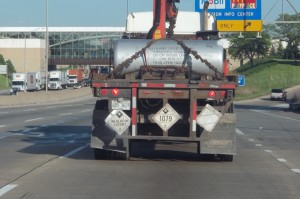
Cargo Tank Truck of Compressed GasI hope this helps. Please don’t hesitate to contact me with any questions.
His reply of gratitude and a good observation.

Daniel
Thanks for the quick response.
There is so much info out there so if you don’t travel with bulk quantities of material everyday it is tough to be sure we are in compliance.

Now I had a question for him.

Thank you for your cooperation.

One more thing, you may know this better than I, but I understand that it is unlikely to find a USDOT-approved compressed gas cylinder that meets the definition of a bulk packaging. Most gases if transported in a bulk packaging will either be in a cargo tank or portable tank. Is that your understanding as well?

Thank you and please advise.

Dan

And now he gave me some good advice.

Based on presentations and interaction with DOT enforcement offices and State Troopers, I believe you are correct. They mentioned something about older bulk containers being grandfathered in to the newest rules (like propane trucks?).
I didn’t pay much attention to it because we typically don’t get into it in our business. I have been told by our Mechanical Department that the 1 bulk compressed gas package we use is acceptable as long as we have a CDL holder with haz mat and bulk endorsements and the shipping papers/manifest to go with it.
I get the impression that the rules are interpreted differently from officer to officer too. There is just too much for 1 person to be an expert on.Bulk compressed gas cylinders of poison gas in transportation

I was grateful for his information and had an observation of my own.

While your Mechanical Department may be right, the packaging still must be authorized for the HazMat per column 8 of the Hazardous Materials Table and meet either the USDOT specifications for a compressed gas cylinder or the UN specifications for a pressure receptacle. Or, it could be subject to a Special Permit in which case neither may be necessary.

You are correct that it can be very confusing and you can hear different opinions from different people. That is why I always rely solely on the regulations and not what people tell me. If someone tells you something regarding compliance, they should be able to back it up by citing the applicable regulation.

Please don’t hesitate to contact me if you have any questions.

Dan

Contact me with any questions you may have about the transportation of hazardous materials by air, highway, vessel, or rail

International and Domestic

Daniels Training Services

815.821.1550

Info@DanielsTraining.com

https://danielstraining.com/

Search Website