PO Box 1232 Freeport, IL 61032

A Different Kind Of Training

A Different Kind Of Training

A Different Kind Of Training

Determining Authorized Packaging for the Transportation of a Hazardous Material

The General Requirements for Packagings and Packages at 49 CFR 173.24(c) of the PHMSA/USDOT Hazardous Material Regulations (HMR) require the shipper of a hazardous material to use only a packaging that is authorized for its use.  What’s known as “authorized packaging”, therefore is required in one form or another for all shipments of hazardous materials.  What may differ between shipments of HazMat is how an authorized packaging is determined, for there are several.  The purpose of this article is to identify and explain the methods for determining an authorized packaging using the HMR.

Other Methods for Determining Authorized Packaging:

While columns 8 and 7 of the Hazardous Materials Table are used to determine authorized packaging for most HazMat (more on that in a little bit), some methods of transportation, HazMat quantities, and specific operations rely on other methods.  Those “other methods” for determining authorized packaging are identified at §173.24(c)(1)(ii).  A packaging may be authorized for transportation of a HazMat without referring to columns 8 and 7 of the Hazardous Materials Table if it is permitted under, and conforms to, the requirements of any one of the following:

  • An approval or authorization issued by the Bureau of Explosives.
  • The international transportation regulations of the ICAO Technical Instructions, the IMDG Code, Transport Canada TDG Regulations, or the IAEA Regulations.
  • A packaging exception applicable to one of the following:
    • Salvage drums and cylinders.
    • Small quantities by highway or rail.
    • Excepted quantities.
    • De minimis exceptions.
    • Agricultural operations.
    • Oilfield service vehicles
    • Mechanical displacement meter provers
    • Roadway striping vehicles.
    • Portable and mobile refrigeration systems.
    • HazMat transported as Materials of Trade.
    • Government operations and materials.
    • Non-specification packagings used in intrastate transportation.
    • Authorized packaging for transportation by aircraft.
    • Exceptions for transportation of HazMat by vessel.
Using Columns 8 and 7 to Determine a HazMat’s Authorized Packaging:

Notwithstanding the above, a packaging is authorized for use in the transportation of a hazardous material if…

  • The packaging is prescribed or permitted for the HazMat in column 8 of the Hazardous Materials Table at §172.101.

And…

  • It conforms to the requirements of the special provisions of column 7.

And…

  • If DOT specification packaging is required, it complies with the applicable packaging specifications in parts 178 or 179 of the HMR.

So, let’s start with column 8 of the Hazardous Materials table.  Instructions for its use are found at §172.101(i).  Column 8 is broken down into three sub-columns:

  • Column 8A identifies exceptions from some of the requirements of the HMR for certain HazMat. These exceptions are in addition to those already listed in this article and some more that aren’t but can be found in 49 CFR 173, subpart A.  “None” in column 8A means no packaging exceptions are authorized unless one is provided in column 7.
  • Column 8B prescribes the authorized packaging – and other applicable packaging requirements – for a non-bulk packaging. “None” in column 8B means a non-bulk packaging is not authorized unless one is provided in column 7.
  • Column 8C prescribes the authorized packaging – and other applicable packaging requirements – for a bulk packaging. “None” in column 8C means a bulk packaging is not authorized unless one is provided in column 7.

Authorized packagings for both bulk and non-bulk shipments of cylinders are identified in Column 8B.  Unless “None” appears in Column 8C, a bulk cylinder may be used if specified through the section referenced in Column 8B.

WHAT IS A BULK PACKAGING?
Question:
Yeah, but how?  When I look at column 8 all I see are numbers or “None”.  How does that tell me the authorized packaging?
Answer:
Columns 8A, 8B, and 8C specify the applicable sections of part 173 for available packaging exceptions (8A); non-bulk packaging requirements (8B), if applicable; and bulk packaging requirements (8C), if applicable.  It is presumed that the numerical entry in column 8 – unless “None” appears – is preceded by “49 CFR 173.”.  Therefore, the entry “226” in column 8B for Methyl chloroformate indicates that its non-bulk packaging requirements, including but not limited to its authorized packaging, can be found at 49 CFR 173.226.
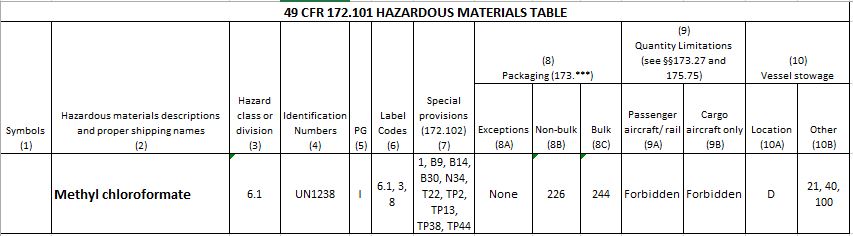
Hazardous Materials Table entry for UN12388

And that’s not all because the packaging requirements identified in column 8 are in addition to the standard packaging requirements of §173.24 and other applicable requirements of subparts A and B of part 173.  A shipper must research these areas of the HMR as well to determine any other applicable packaging requirements.

That leaves the special provisions of column 7 of the Hazardous Materials Table; the instructions for which are found at §172.101(h).  The special provisions of column 7 are represented by codes – explained at §172.102 – for the special provisions that may or may not be applicable to a particular shipment of HazMat.  As noted elsewhere in this article the special provisions of column 7 may indicate the authorized packaging or an exception for a HazMat even when “None” appears in column 8 for that packaging.

It helps that the codes in column 7 are categorized by packaging or mode of transportation.  For example, a code beginning with “B” applies only to bulk packagings, while a code beginning with “R” applies only to transportation by rail.  Read:  The Meaning of the Special Provision Codes of Column 7.

Like this article?

Subscribe to my Monthly Newsletter

No marketing emails!

When not to use the Section Referenced in Column 8B or 8C to Determine Authorized Packaging:

There are two situations when a shipper must disregard the section of part 173 referenced in column 8 of the Hazardous Materials Table and instead refer to an alternative citation.  These two situations are explained below.

Situation #1:

If an entry in the Hazardous Materials Table contains an “A” – for aircraft – or “W” – for water – in column 1, that entry is only subject to the HMR if its mode of transportation is by aircraft or vessel (“W” = “Water” = vessel) unless it is a hazardous waste or hazardous substance.  If such a HazMat is transported by air or vessel the section of part 173 specified in column 8 is used to determine the packaging requirements, including authorized packaging.  If it is transported by motor vehicle or rail but is subject to the HMR due to it being a hazardous waste or hazardous substance, a shipper does not refer to the section of part 173 specified in column 8 but instead will refer to §173.203 if it is a liquid or §173.213 if it is a solid.

Example:

UN3506, Mercury contained in manufactured articles, 8 (6.1)
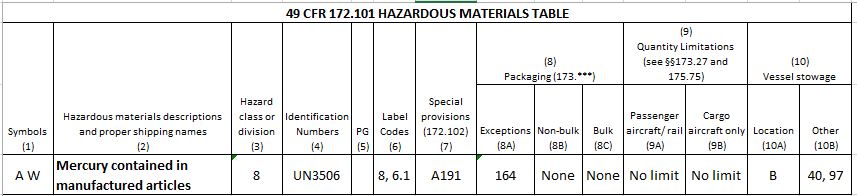
Hazardous Materials Table entry for UN3506


  • If transported by aircraft or vessel it’s subject to the HMR. §173.164 must be referenced to determine packaging requirements.
  • If transported by motor vehicle or rail and not a hazardous waste or hazardous substance it’s not subject to the HMR.
  • If transported by motor vehicle or rail and is either a hazardous waste or hazardous substance it’s subject to the HMR. §173.213 must be referenced to determine the packaging requirements.

Situation #2:

If a hazardous material is specifically named in column 2 of the Hazardous Materials Table and is shipped in a form that does not apply to the section of part 173 indicated in column 8, then the table at §172.101(i)(4) must be used to determine the appropriate section of part 173.

Packaging section reference for solid materialsCorresponding packaging section for liquid materials
§173.187§173.181
§173.211§173.201
§173.212§173.202
§173.213§173.203
§173.240§173.241
§173.242§173.243

Example:

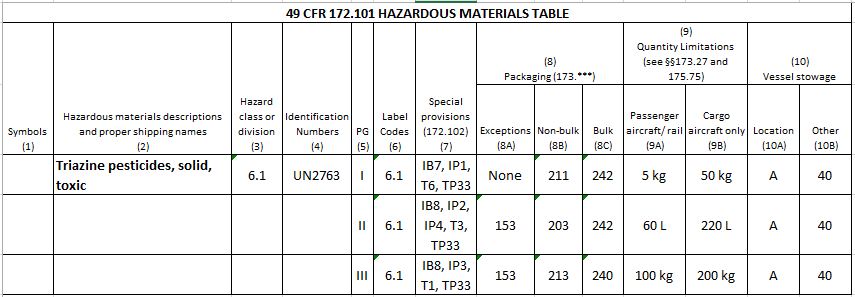
Hazardous Materials Table Entry for UN2763

UN2763, Triazine pesticides, solid, toxic, 6.1, I

  • If in a liquid form at the time it is offered for transportation disregard the reference to §173.211 in column 8B and instead refer to §173.201.

Contact me with any questions you may have about the transportation of hazardous materials by air, highway, vessel, or rail

International and Domestic

Daniels Training Services

815.821.1550

Info@DanielsTraining.com

https://danielstraining.com/

Conclusion:

The selection of an authorized packaging by the shipper of a HazMat is only one part of the packaging requirements for transportation in commerce of a hazardous material; a critical part.  When determining authorized packaging make certain you are not relying on information provided by someone else, or your “gut feeling”, or what you’ve always used for packaging in the past.  Only the Hazardous Material Regulations of the PHMSA/USDOT used as outlined in this article can identify the correct authorized packaging.
Revisions to Non-Waste Determinations and Variances From Classification as a Solid Waste by the 2015 DSW

This is another article in a series regarding the 2015 Definition of Solid Waste Rule (2015 DSW) and its affect on the regulations of the USEPA, and state agenices.  The primary goal of the 2015 DSW was to improve the regulations pertaining to the recycling of hazardous secondary materials.  It did this through the creation of new conditional exclusions, e.g. 40 CFR 261.4(a)(27) The Remanufacturing Exclusion for Spent Solvents, and the revision of existing conditional exclusions, e.g. 40 CFR 261.4(a)(23) The Generator Controlled Exclusion and 40 CFR 261.4(a)(24) The Verified Recycler Exclusion.  It also revised and strengthened other regulatory requirements of these conditional exclusions (see the entire series of articles).  Perhaps after reviewing the available recycling exclusions – not just those identified above, there are many more that were not affected by the 2015 DSW – you have not found one that applies to your recycling operations.  If so, you have two options:

  • Forget about getting a break from the RCRA regulations and manage your hazardous secondary material as a hazardous waste even as you continue to dispose of it by recycling.
  • Apply for and obtain a solid waste variance or a non-waste determination.
Hazardous secondary material means a secondary material (e.g., spent material, by-product, or sludge) that, when discarded, would be identified as hazardous waste under part 261 of this chapter.  (40 CFR 260.10)

The purpose of this article is to explain the revisions made by the 2015 DSW to the procedures for obtaining – and maintaining – a non-waste determination or solid waste variance.

FIRST OFF, WHAT IS A NON-WASTE DETERMINATION OR SOLID WASTE VARIANCE?

They exist to provide the generators and recyclers of hazardous secondary materials with a final option to receive a break from full regulation when no other recycling exclusion that applies to them exists in the regulations.  They can be found in Title 40 of the Code of Federal Regulations of the USEPA as follows:

  •  §260.30 Non-waste determinations and variances from classification as a solid waste.
  • §260.31 Standards and criteria for variances from classification as a solid waste.
  • §260.32 Variances to be classified as a boiler.  Not addressed in this article.
  • §260.33 Procedures for variances from classification as a solid waste, for variances to be classified as a boiler, or for non-waste determinations.
  • §260.34 Standards and criteria for non-waste determinations.
THE 2015 DSW REVISED THE EXISTING SOLID WASTE VARIANCE AND NON-WASTE DETERMINATION REGULATIONS AS FOLLOWS:

§260.31(c):

For a hazardous secondary material that is partially reclaimed but must be reclaimed further before recovery is completed the 2015 DSW…

  • Revised the criteria for the application of the variance.
  • Added a requirement that the recycling meet the legitimacy criteria  of §260.43.
  • Requires that all the criteria (§260.31(c)(1-5)) of the variance be met.

Like this article?

Subscribe to my Monthly Newsletter

No marketing emails!

§260.33(c):

If there is a change in circumstances after a solid waste variance or non-waste determination has been issued and this change affects how a hazardous secondary material meets the relevant criteria of a solid waste variance or a non-waste determination in §260.31 (for solid waste variance) or §260.34 (for non-waste determination) the applicant must now send a description of the change to the Administrator.  The Administrator may do one of the following:

Administrator may be either the USEPA or the environmental regulatory agency of your state depending on the status of the 2015 DSW in your state.
  • Issue a determination that the hazardous secondary material continues to meet the relevant criteria of the solid waste variance or non-waste determination.
  • Require the facility to re-apply for the solid waste variance or non-waste determination.
Note:  "description of the change...) is not the same as the notification required by §260.42.

§260.33(d):

Solid waste variances and non-waste determinations are now effective for a fixed term of ten (10) years.  Applicants must re-apply for a solid waste variance or non-waste determination at least six (6) months before the ten year term expires.

§260.33(e):

Facilities that receive a solid waste variance or non-waste determination now must provide a notification by March 1st of every even-numbered year as required by §260.42.

§260.34(b)(4) and §260.34(c)(5):

Facilities requesting a non-waste determination for a hazardous secondary material which is reclaimed in a continuous industrial process per §260.34(b) or a hazardous secondary material which is indistinguishable in all relevant aspects from a product or intermediate per §260.34(c) must now demonstrate why the hazardous secondary material cannot meet, or should not have to meet, any of the recycling exclusions found in §261.2 or §261.4.

This demonstration of no other options available is not required for facilities requesting a solid waste variance.

If your hazardous secondary material or the recycling method you utilize is not addressed by the existing recycling exclusions perhaps a solid waste variance or non-waste determination may be the way to receive some relief from the full weight of the RCRA regulations.  Be sure to check with your state to ensure they have implemented the 2015 DSW and if so, that they have adopted these revised solid waste variances and non-waste determinations.

Contact me with any questions you may have about the generation, identification, management, and disposal of hazardous waste

Daniels Training Services

815.821.1550

Info@DanielsTraining.com

https://danielstraining.com/

USEPA and your state also mandates the annual training of hazardous waste personnel of a large quantity generator.  Contact me for this training at your site or via webinar.

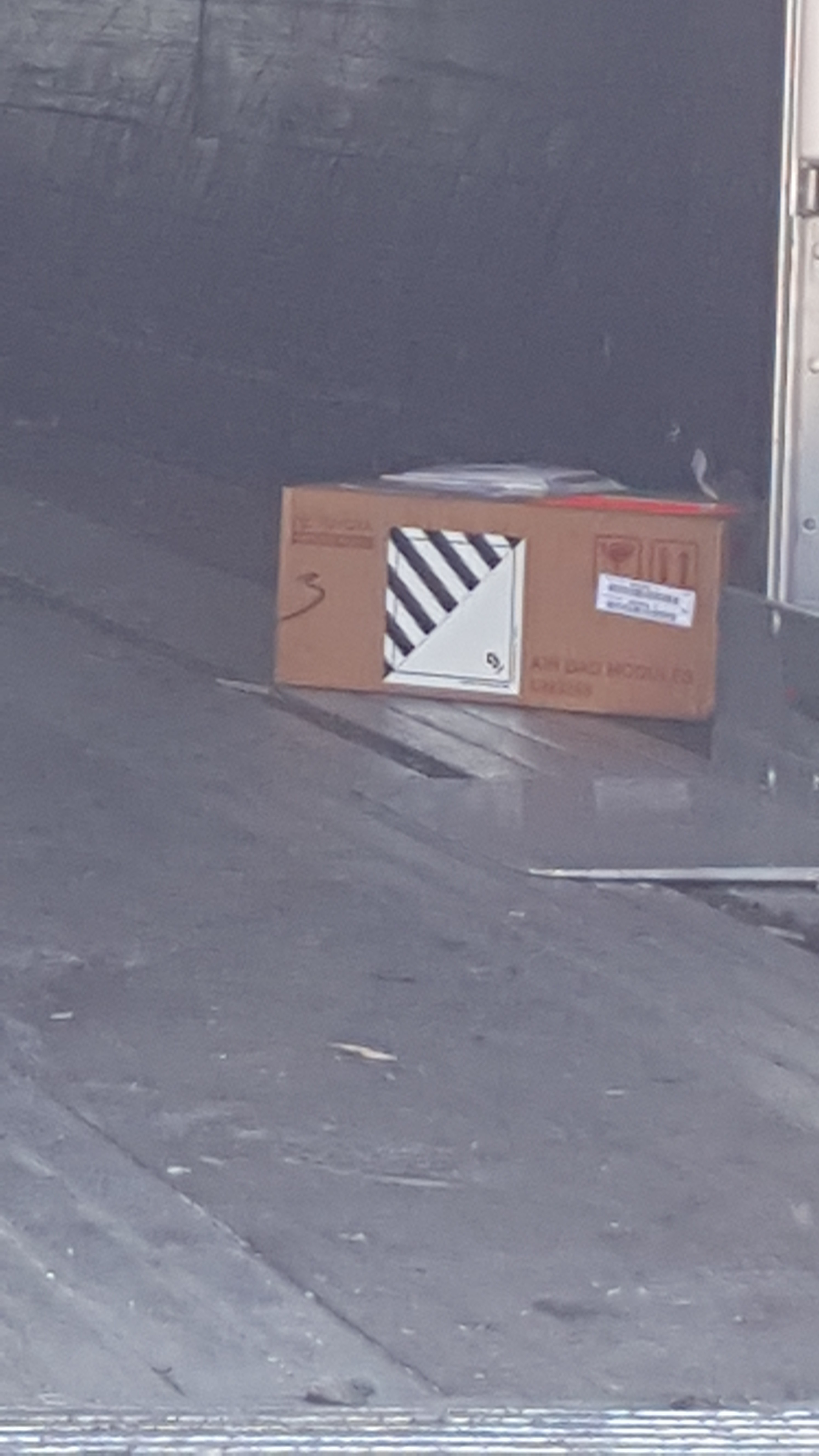
Packaging with class 9 HazMat label

An Explanation of USDOT’s Hazard Class 9 Miscellaneous

All hazardous materials subject to the regulations of the Pipeline and Hazardous Materials Safety Administration (PHMSA) within the USDOT must be classified as one or more of the nine hazard classes – or a division of a hazard class – identified at 49 CFR 173 subpart C (for Class 1 Explosives), subpart D (for hazardous materials other than Class 1 Explosive and Class 7 Radioactive), and subpart I (for Class 7 Radioactive).  while most hazard classes/divisions have very specific definitions based on their potential hazards, i.e. flash point, rate of corrosion, lethal dosage, &etc, one hazard class is deliberately vague in its definition.  Its vague definition results in the hazard class being applicable to many materials that might not normally be subject to the Hazardous Material Regulations.  It is hazard class 9 Miscellaneous, and the subject of this article. (more…)

Units of Measure Used in the Hazardous Material Regulations

Remember back in grade school when they told us that every other country in the world used the metric system and that America would be left behind if we didn’t change, pronto?

Well, they were half right.  I still pay for gas by the gallon and I still keep my speed below 55 mph to avoid a ticket but we also happen to be the most powerful country in the history of the world, so maybe the rest of the world needs to switch back to the U.S. standard.

But I’m not here to express my opinion on the metric system.  The purpose of this article is to identify the unit of measure used in the Hazardous Material Regulations (HMR) of PHMSA/USDOT and how to convert from metric units to the U.S. standard. (more…)

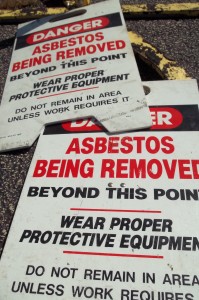
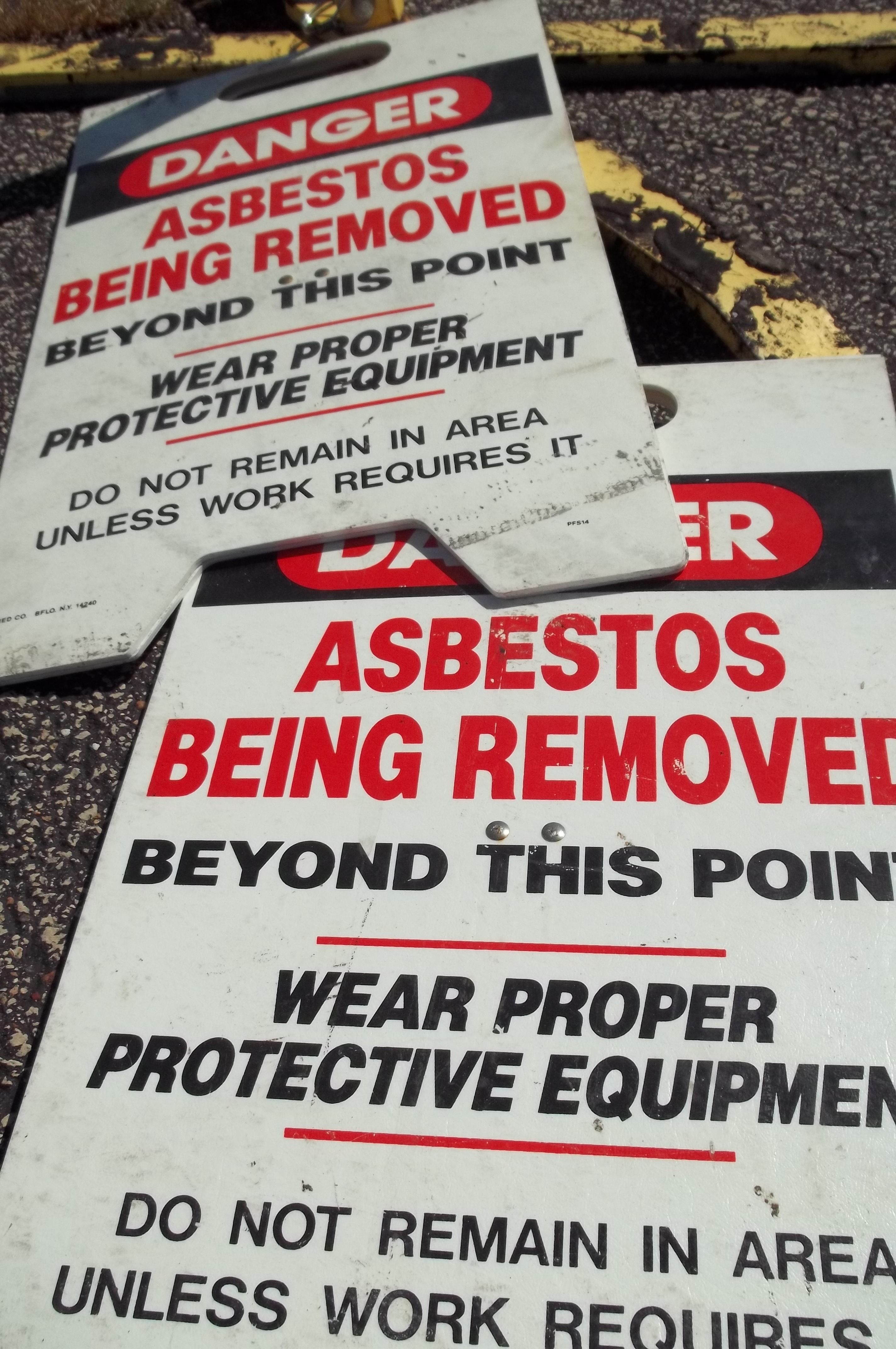
Asbestos Removal Sign

Q&A: Is the HazMat Endorsement Required When Transporting Asbestos?

December 8, 2015, not a customer but someone who needed help:

We are in the state of ########.  We will be hauling asbestos for a company, does my drivers need hazmat on their cdl’s?

I have read many conflicting items and just want to be sure we are covered correctly

  • Do we need to have hazmat?
  • Does the truck or container need to be placard?
  • Does the asbestos need to be wet?
  • Are there certain weight limits where it goes from no placards/no hazmat to yes placards/yes hazmat?

Any help will be greatly appreciated.

Thanks in advance.

My reply a few days later on December 11, 2015:

I apologize for my delay in responding.  I hope this is still of some use to you.

Asbestos is regulated as follows when in transportation:

  • When transported within the U.S. asbestos is a Class 9 Miscellaneous hazardous material except as noted below.
  • If asbestos is fixed in a binder material such as cement it is not a hazardous material when transported.
  • Class 9 Miscellaneous HazMat are not required to display a placard no matter the quantity in the vehicle or container.
  • The HazMat endorsement on the CDL is required only for drivers of placarded quantities of HazMat.

Based on the above, the answers to your questions are as follows:

  • The HazMat endorsement on the CDL is not required.
  • The vehicle or container does not require Class 9 Miscellaneous placards, no matter the quantity.
  • Wetting and bagging dusty asbestos is a requirement of OSHA and USEPA regulations and not those of the USDOT.  It would be a requirement of the Shipper of the asbestos who offers it to you and not to you as the Carrier.
  • The amount of asbestos does not change the fact that the use of Class 9 Miscellaneous placards is not required within the U.S.
  • Despite the above, you and your drivers are still transporting a hazardous material (unless it is fixed in a binder) and therefore require HazMat Employee training every three years.  I can provide you with this training.
I hope this helps.
The reply, later that day:

Thank you for your help and if we do need the training I will for sure contact you.

Thanks again.

Asbestos Removal SignAnd I meant it…

Thank you!  And please continue to contact me with any questions you may have.

And they decided to take me up on my offer (12.17.15):

I need to know if the below is for friable and non friable?  We were told we had to be cdl hazmat endorsed and trucks were to be placarded for friable.

And so, the next day, my reply:

Please see below.  Note that this is informal guidance.  For a full explanation of these regulations and how they affect your compliance I can provide you with my consulting services.

  • Asbestos, in various forms, is identified as a hazardous material by PHMSA/USDOT in the Hazardous Materials Table at 49 CFR 172.101.
  • PHMSA/USDOT regulations do not use or define the terms friable or non-friable.
  • However, Special Provision code 156 in column 7 of the Hazardous Materials Table reads as follows:

156   Asbestos that is immersed or fixed in a natural or artificial binder material, such as cement, plastic, asphalt, resins or mineral ore, or contained in manufactured products is not subject to the requirements of this subchapter.

  • Therefore, if asbestos meets the description of Special Provision 156, it is not subject to PHMSA/USDOT regulations when transported.  i.e. it is not a hazardous material.
  • If asbestos in transportation does not meet the description of Special Provision 156, then it would be a Class 9 Miscellaneous hazardous material.
  • A motor vehicle transporting Class 9 Miscellaneous Material is not required to be placarded within the U.S.
  • The Federal regulations of the FMCSA/USDOT and most states (check with your state) require a CDL with the HazMat endorsement for drivers of motor vehicles that transport a placarded amount of HazMat.
  • A CDL may be required for other reasons, such as vehicle weight, but the HazMat endorsement would not.
  • Even if a CDL with the HazMat endorsement is not required, asbestos that does not meet the description of Special Provision 156 remains a hazardous material and therefore HazMat Employee training is required.  I can provide this training.

Thank you and please don’t hesitate to contact me with any other questions.

Daniels Training Services

815.821.1550

Info@DanielsTraining.com

https://danielstraining.com/

Q&A: Reclassifying a Flammable Liquid to a Combustible Liquid

A question from a customer of mine after I had provided them with training:

Hi Daniel.  I just need clarification from what you had told us regarding reclassifying our product from Flammable to Combustible.  Do we need to change the Transport information on our SDS?  This is what is currently listed.

Section 14: Transport Information
UN number  3295
  • UN proper shipping name  Hydrocarbons, Liquid, N.O.S., 3, PG III
  • ICAO/IATAUN3295, Hydrocarbons, Liquid, N.O.S. 3, III
  • IMO/IMDG  UN3295, Hydrocarbons, Liquid, N.O.S. 3, III, (39.4°C)
  • ADR/RID  UN3295, Hydrocarbons, Liquid, N.O.S. 3, III, ADR
Not a good time for me.  I had to put them off:

I am about to begin a Webinar and am then preparing for transportation tomorrow morning.  I will get you an answer as soon as I can.

It took me a few days but I finally got them an answer:
My answers to your question is below.
  • While section 14 of the Safety Data Sheet is required to be completed, its information is for guidance purposes only as its content is not regulated by either OSHA (whose regulations require the SDS) or USDOT/PHMSA:

The SDS must also contain Sections 12 through 15, to be consistent with the UN Globally Harmonized System of Classification and Labeling of Chemicals (GHS), but OSHA will not enforce the content of these sections because they concern matters handled by other agencies.

  • But of course you want the information on your SDS to be as accurate as possible.
  • Describing the material as a Class 3 Flammable Liquid is correct since its flashpoint is below 140 degrees fahrenheit and its re-classification to a Class 3 Combustible Liquid and using the Combustible Liquid Exception are options, not mandatory.
  • If you wish to clarify why your SDS indicates it is a Flammable Liquid and you are shipping it as a Combustible Liquid, you may include language in Section 14 as follows:  Pursuant to 49 CFR 173.120(b)(2) and 49 CFR 173.150(f) a flammable liquid with a flash point at or above 100 degrees fahrenheit may be reclassed as a combustible liquid for transportation within the U.S. by motor vehicle or rail only.
I hope this is not too late to help.  Please don’t hesitate to contact me with any other questions.

Contact me with any questions you may have about the transportation of hazardous materials by air, highway, vessel, or rail

International and Domestic

Daniels Training Services

815.821.1550

Info@DanielsTraining.com

https://danielstraining.com/

It’s not uncommon for a customer to follow up with questions after Onsite Training or a Webinar.  And I’m only too happy to oblige.

Q&A: Using the Dangerous Placard in Place of Multiple HazMat Placards

A question posted to a Yahoo! Group back in November 2015:

Comparing notes.

For shipments in the U.S.
For shipments of hazardous materials that require placards of truck load of non-bulk packages, you are allowed to use the Dangerous placard in place of multiple hazard class placards (under certain conditions).

Can you you use the Dangerous placard if the load is only one Hazrad Class?

Same question for Canada for the Danger placard?

Thanks in advance.

Someone gave a reply before I did the next day:

49CFR 172.504 (b) DANGEROUS placard: …….”non-bulk packages with two or more categories of hazardous materials that require different placards specified in table 2 of paragraph (e) of this section may be placarded with a DANGEROUS placard instead of the separate placarding specified for each material…..”

So, it has to be 2 different hazards.  Also, can’t be used to substitute placarding from Table 1, and can’t be used if 1,000 kg (2205#’s) or more of ONE hazard class is loaded at one facility.

Here’s my reply just a few hours earlier:

I cannot speak with certainty about the Canada regulations, but I know that in the U.S. PHMSA/USDOT does not allow the use of the Dangerous Placard if there is only one HazMat on the vehicle.

Please see point #3 in this article:  When not to use the Dangerous placard.
I suspect that TDG Canada regulations are the same.
I hope I contributed something valuable to the conversation.

Like this article?

Subscribe to my Monthly Newsletter

No marketing emails!

Avoid These Mistakes on the Uniform Hazardous Waste Manifest

The generator of a hazardous waste is responsible for the accurate – and legible – completion of the Uniform Hazardous Waste Manifest. This is true even if your hazardous waste transporter or Treatment Storage or Disposal Facility (TSDF) provides you with a completed manifest for your shipment. The person who signs the manifest as a representative of the Offeror (this could be the generator, the transporter, or a consultant working for either) is liable for false or incorrect information on the manifest. If you are either the generator of the hazardous waste or the offeror of the shipment you must take care to avoid these common problems on the manifest that may lead to violations. (more…)

Suggestions for Selecting a Transporter for Your Hazardous Waste

The generator of a hazardous waste has a cradle-to-grave responsibility for its management. This responsibility, as the term implies, extends through the hazardous waste’s off-site transportation to its final disposal. This responsibility makes it imperative for the generator to choose their TSDF (Treatment Storage or Disposal Facility) and the transporter of their hazardous waste with care. Remember:  you may be liable for the clean-up costs due from an accident involving your hazardous waste even after you have given it to a transporter or disposal facility.  The purpose of this article is to provide some suggestions for a generator of a hazardous waste when selecting a transporter for their hazardous waste.

BE PREPARED BEFORE YOU CONTACT A HAZARDOUS WASTE TRANSPORTER:
  • What are the type and amounts of waste you have for transport?
  • In what form is the waste (solid, liquid, semi-solid, containerized gas)?
  • In what type of containers is the waste?
  • What is the frequency of your generation and expected rate of off-site transport?
FACTORS IN CHOOSING YOUR TRANSPORTER:
  • Does the transporter have a Federal EPA Identification number?
  • Is the transporter licensed by your state Department of Transportation?
  • What is the transporters driving record?  Have they been cited for violations within the last two years?  Have they had spills or accidents in which they were cited for a violation of the regulations?
  • Ask for and check references of past and existing customers.
  • Determine the type and amount of insurance maintained by the Transporter.  Depending on the type and amount of waste they transport, and the requirements of your state, they may be required to have between $1 and $5 million in liability insurance.
  • Have drivers receivedHazMat Employee Training required every three years by the USDOT/PHMSA?

When choosing your hazardous waste transporter don’t let cost be your only – or even the most important – criteria.  A few dollars saved on a low-cost transporter now will seem puny when you are faced with clean-up costs.

The off-site transportation of your hazardous waste is just one of your responsibilities as a generator of hazardous waste.  Be sure you are in compliance with the Federal regulations of both the USEPA and USDOT/PHMSA and also the regulations of your state environmental regulatory agency.

Contact me with any questions you may have about the generation, identification, management, and disposal of hazardous waste

Daniels Training Services

815.821.1550

Info@DanielsTraining.com

https://danielstraining.com/

Federal Register logo

Rules and Regulations, Proposed Rules, & Notices of EPA, FAA, FMCSA, FRA, & PHMSA for February 2016

Another month and another raft of regulatory agency publications in the Federal Register.  As an EHS Professional you may find it too much to stay on top of all these changes in the regulations.  That’s the reason for my monthly search through the Federal Register to identify for you the applicable regulations of the following agencies:

  • Environmental Protection Agency (EPA)
  • Federal Aviation Administration (FAA) – an administration within the Department of Transportation (DOT).
  • Federal Motor Carrier Safety Administration (FMCSA) – an administration within the Department of Transportation (DOT).
  • Federal Railroad Administration (FRA) – an administration within the Department of Transportation (DOT).
  • Pipeline and Hazardous Materials Safety Administration (PHMSA) – an administration within the Department of Transportation (DOT).

I couldn’t find any publications related to the management of hazardous waste or the transportation of hazardous materials from the FAA, FMCSA, or FRA.  There were, however, some publications by EPA and PHMSA that may have an impact on how you manage hazardous waste and/or ship hazardous materials.

Please note that this is my best effort to identify the relevant announcements in the Federal Register that may be of interest to generators of hazardous waste and shippers of hazardous materials.  I encourage you to review the list of Federal Register publications yourself to ensure regulatory compliance.

As you review this document note the different types of publications in the Federal Register and their relative import:

Rules and Regulations – These are notifications of rules and regulations that have passed the review process and will – now or at a later established date – become regulations in the CFR (Code of Federal Regulations).  Complying with them is not an option.

Proposed Rules – These are notifications of a new rule or a modification to an existing one that the agency has in the works.  Interested parties may still submit comments and possibly affect the outcome of a proposed rule.

Notices – For all the things the government does that don’t rise to the level of regulations.  These could be safety notices or announcements of meetings for interested parties regarding proposed rules.

FEBRUARY 1, 2016 THROUGH FEBRUARY 29, 2016
USEPA – US ENVIRONMENTAL PROTECTION AGENCY:

Publications not related to the management of hazardous waste, solid waste, universal waste, or used oil are not included here.

Rules and Regulations:

Additions to List of Categorical Non-Waste Fuels Pages 6687 – 6743 [FR DOC # 2016-01866] PDF | Text | More

Proposed Rules:

None

Contact me with any questions you may have about the management of hazardous waste

Daniels Training Services

815.821.1550

Info@DanielsTraining.com

https://danielstraining.com/


Notices:

Inquiry To Learn Whether Businesses Assert Business Confidentiality Claims Regarding Waste Import and Export Pages 7788 – 7791 [FR DOC # 2016-03102] PDF | Text | More

Proposed Information Collection Request; Comment Request; Recordkeeping and Reporting-Solid Waste Disposal Facilities and Practices  Pages 8956 – 8957 [FR DOC # 2016-03744] PDF | Text | More

FAA – FEDERAL AVIATION ADMINISTRATION:

Publications not related to the transportation of hazardous materials are not included here.

Rules and Regulations:

None

Proposed Rules:

None

Notices:

None

FMCSA – FEDERAL MOTOR CARRIER SAFETY ADMINISTRATION:

Publications not related to the transportation of hazardous materials are not included here.

Rules and Regulations:

None

Proposed Rules:

None

Notices:

None

FRA – FEDERAL RAILROAD ADMINISTRATION:

Publications not related to the transportation of hazardous materials are not included here.

Rules and Regulations:

None

Proposed Rules:

None

Notices:

NONE
PHMSA – PIPELINE AND HAZARDOUS MATERIALS SAFETY ADMINISTRATION:

Publications not related to the transportation of hazardous materials are not included here.

Rules and Regulations:

None

Proposed Rules:

None

Notices:

Hazardous Materials: Public Meeting Notice for the Research and Development Forum Pages 6103 – 6104 [FR DOC # 2016-02146]PDF | Text | More

Information can be helpful but it’s useless if you are not able to make sense of it.  You must be able to determine how any changes to the rules and regulations (final or proposed) will affect your operations, and communicate the necessary information to your personnel.  I can help you to do that.

Contact me with any questions you may have about the transportation of hazardous materials by air, highway, vessel, or rail

International and Domestic

Daniels Training Services

815.821.1550

Info@DanielsTraining.com

https://danielstraining.com/

Please contact me for a free training consultation to determine your regulatory requirements and how training can help you to attain and maintain compliance with the regulations of the US Environmental Protection Agency (and your state) and the PHMSA, FAA, FRA, & FMCSA of the US Department of Transportation.

Search Website