PO Box 1232 Freeport, IL 61032

A Different Kind Of Training

A Different Kind Of Training

A Different Kind Of Training

Q&A: What is the required font height for markings on bulk packagings?

Question (01.15.18):

I called about 2 pages in my catalog (attached page 30 and 45) covering ISO tanks and IBC containers.  The customer has always specified their font height. For example on a 24”x4” tank sign they usually specify a font that is 3” tall with all capital letters – on page 30.  Page 45 has NOS labels and we use a 1” font….unless the text is only 1 line tall and we use a 1.75” tall font.

Is there a rule of thumb or regulations that dictate the font height for a large proper shipping name label or NOS label or ISO label?

I really appreciate the help.

(Two images displaying their product labels were attached to the email)

My answer (01.18.18):

Please see below for a summary of the regulations for the size of package marks.

  • Per 49 CFR 172.302(b), except as otherwise provided in the regulations, markings on a bulk packaging must:
    • Have a width of at least 6.0 mm (0.24 in) and a height of at least 100 mm (3.9 in) for rail cars.
    • Have a width of at least 4.0 mm 90.16 in) and a height of at least 25 mm (1 in) for portable tanks with a capacity of less than 3,785 L (1,000 gal) and intermediate bulk containers (IBCs).
    • Have a width of at least 6.0mm (0.24 in) and a height of at least 50 mm (2.0 in) for cargo tanks and other bulk packagings.
    • Note: a marking on a bulk packaging includes – but is not limited to – the identification number.  For example, in some instances the proper shipping name is required as a marking on the package as well.
  • Per 49 CFR 172.332(b), if displayed on an orange panel the identification number must be at least 100 mm high of black helvetica medium numerals.
  • Per 49 CFR 172.332(c), if displayed on a placard the identification number must be 88 mm high of black alpine gothic or alternate gothic #3 numerals.
  • Per 49 CFR 172.336(b), if displayed on a white square-on-point the identification number must of the same dimensions as it is displayed on the placard at §172.332(c).
Then of course you get into all of the examples of “except as otherwise provided in the regulations”.  Below are examples of a font height specified for markings on bulk packagings.  These should be considered as otherwise provided for in the regulations:
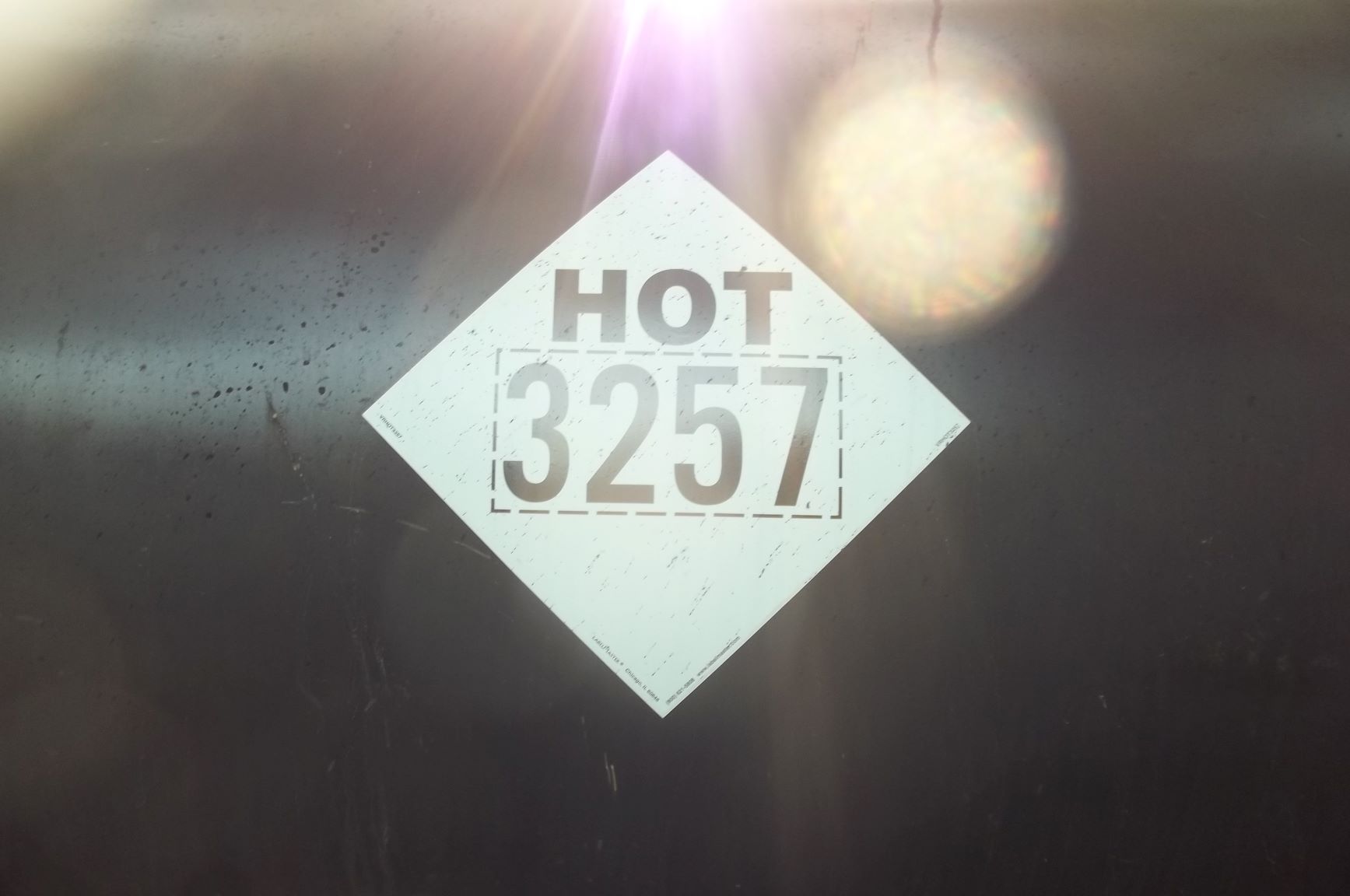
  • 49 CFR 172.325(c): “HOT” must be in black letters having a height of at least 50 mm (2.0 in).UN3257 HOT Marking
  • 49 CFR 172.326(a): portable tank marked on two opposing sides with proper shipping name with a minimum height of 65 mm (2.5 in).  However, portable tank of with a capacity of less than 3,00 L (792.52 gal) may be reduced to a marking size of not less than 12 mm (0.47 in).
  • 49 CFR 172.328(b): cargo tank transporting a Class 2 Compressed Gas – except certain nurse tanks – must be marked in lettering no less than 50 mm (2.0 in).
  • 49 CFR 172.328(c): each MC 330 and MC 331 cargo tank marked with “QT” or “NQT” in letters no less than 50 mm (2.0 in) in height.
  • 49 CFR 172.328(d): after October 3, 2005, “Emergency Shutoff” (if and where applicable) in letters at least 0.75 in in height.
  • 49 CFR 172.330(a)(2): shipping name and identification number marked on multi-unit tank car tank in letters and numerals no less than 50 mm (2.0 in) high.

Conclusion:

That seemed to answer his questions! Here is another example of where compliance isn’t just about avoiding fines, it’s about your business.  If you are in the business of providing products or services to shippers and carriers of hazardous materials you need to know the regulations just as well as your customers.  My USDOT/PHMSA HazMat Employee training can help you to do that!

Contact me with any questions you may have about the transportation of hazardous materials by air, highway, vessel, or rail

International and Domestic

Daniels Training Services, Inc.

815.821.1550

Info@DanielsTraining.com

https://danielstraining.com/

Q&A: Is the transport of oil (new and used) subject to USDOT regulations as a HazMat?

A question from a concerned truck driver (01.10.18):

I drive lube truck and carry 600 gal go new oil and 400 gal used oil in <<state>> and surrounding states my company told me to remove placards saying not needed. I am questioning them and can’t find answer if I am legal.

Contact me with any questions you may have about the transportation of hazardous materials by air, highway, vessel, or rail

International and Domestic

Daniels Training Services, Inc.

815.821.1550

Info@DanielsTraining.com

https://danielstraining.com/

My answer (01.10.18):

Thank you for contacting me.  I will try to answer your question below.

  • I cannot be certain without viewing the safety data sheet (SDS) or some other technical data, but it is unlikely that oil – new or used – will meet the definition of a hazardous material per USDOT regulations.
  • If not a HazMat the display of USDOT placards is not required.

I hope that answers your question.  Please don’t hesitate to contact me with any other questions.

Conclusion:

Easy but illustrating a very common issue in the regulated – or not regulated – community.  Before you can begin to consider the regulations applicable to the transportation of a hazardous material: hazard communication, packaging, training, load securement & segregation, & more; you must classify the article or substance according to the USDOT/PHMSA’s definition of a hazardous material.  No hazardous material, no Hazardous Materials Regulations.

It’s possible you transport or offer for transport both HazMat and non-HazMat.  My training and consulting services can help you to identify the difference.

Alcohol wipe

Q&A: How do I classify solvent wipes for transportation?

A question (01.04.18):

I’m looking for ability to confirm the DOT rating for particular product we have currently started to make. Is this something you’re able to help provide assistance/training?

I’m here to help, so my reply (01.05.18):

Yes. I can assist you with that.

If you are able to provide a safety data sheet (SDS) or some other technical information I will be happy to provide you with a “snap” classification at no charge.

If you decide to proceed a more formal classification can be provided under my consulting services for a fee.

He was OK with free advice:

I’ve attached two SDS for 70% IPA canister products. The only different to the two products would be the number of wipes in each canister. I believe the classification should be UN3175 – class 4a which one states but the other states UN1987 class 3. The IPA is fully absorbed into the fabric in each product which is why I’d think the classification should be a haz solid. Thank you in advance for any assistance.

Thanks
(SDS’s for two different wipes, both saturated with Isopropanol were attached)

Interested in a Webinar that covers this topic, and more!

My Webinar Training Schedule

My final answer (01.05.18):

Thank you for contacting me. I will try to answer your questions below.

  • I assume this classification is for the transportation by ground or rail within the U.S. International transport and transport by other modes will require a separate classification. However, I am confident the classification will remain the same.
  • Isopropyl alcohol is a Class 3 flammable liquid.
  • The wipes are best classified as: UN3175, Solids containing flammable liquids, n.o.s. (Isopropyl alcohlo) 4.1, PG II
  • However special provision 47 in column 7 of the Hazardous Materials Table for this entry reads in part (last sentence):

Small inner packagings consisting of sealed packets and articles containing less than 10 mL of a Class 3 liquid in Packing Group II or III absorbed onto a solid material are not subject to this subchapter provided there is no free liquid in the packet or article.

Therefore, as long as both products meet the requirements of special provision 47 (small sealed packets with no free liquids), they are not subject to the USDOT Hazardous Materials Regulations and are not a hazardous material when offered for transportation.

I hope this helps.

Contact me with any questions you may have about the transportation of hazardous materials by air, highway, vessel, or rail

International and Domestic

Daniels Training Services, Inc.

815.821.1550

Info@DanielsTraining.com

https://danielstraining.com/

Conclusion:

I never heard back so I can only assume all went well.  Here we have a perfect example of someone offering for transport a product as a hazardous material (subject to increased shipping and handling costs) when a perfectly good exception from regulation exists.  If applicable (and in this case I believe it is) the exception has the potential to save this business a lot of money.  Of course, USDOT/PHMSA HazMat Employee training is still required but that is a small price to pay for compliance and the knowledge that comes with it.

Hazardous waste container

Counting Hazardous Waste for the Generator Category Determination

After completing the hazardous waste determination as required by USEPA regulations at 40 CFR 262.11, the most fundamental responsibility of the generator of a waste is to count the hazardous waste it generates each month and determine its hazardous waste generator category.  From the Federal Register publication of the final rule (81 FR, 11.28.16, 85755):

A generator must correctly count the quantity of hazardous waste that it generates in order to determine its generator category.

Despite its importance, the requirements for counting hazardous waste and determining generator category were not presented in a clear and distinct manner.  That problem was corrected by the Generator Improvements Rule.  The purpose of this article is to identify and explain the requirements of 40 CFR 262.13 for the counting of hazardous waste and the determination of hazardous waste generator category as revised by the Generator Improvements Rule.

Before we begin…

The regulations of §262.13 are partially affected by the reorganization of the generator regulations undertaken by the Generator Improvements Rule (read: Reorganization of the Generator Regulations).  Some of the language in §262.13 was relocated from its previous location at §261.5(c)-(d), much of it is new text.  You can read a side-by-side comparison of old and new regulations here: Comparison of Changes to Hazardous Waste Counting and Determination of Hazardous Waste Generator Category Made by the Generator Improvements Rule

There are two types of hazardous waste:

  • Hazardous waste
  • Acute hazardous waste

Hazardous waste is identified at §261.3.  To briefly summarize, it is a solid waste that is not excluded by regulation that either displays a characteristic of a hazardous waste or is a listed hazardous waste.  Identifying a hazardous waste is the purpose of the Hazardous Waste Determination.

An acute hazardous waste is defined at §260.10:

Acute hazardous waste means hazardous wastes that meet the listing criteria in §261.11(a)(2) and therefore are either listed in §261.31 of this chapter with the assigned hazard code of (H) or are listed in §261.33(e) of this chapter.

Read:  FAQ: How does the Generator Improvements Rule define an acute hazardous waste?

Note:

As used in §262.13, the term “non-acute hazardous waste” means the same as hazardous waste as defined at §261.3.

Introduction:

Though created by the Generator Improvements Rule, the regulations in §262.13 do not constitute a new requirement for generators; merely a clarification of existing USEPA policy and enforcement.  So, this is something a hazardous waste generator should have been already doing.

Generator categories are now (thanks to the Generator Improvements Rule) defined at §262.10 as follows:

Large quantity generator is a generator who generates any of the following amounts in a calendar month:

(1) Greater than or equal to 1,000 kilograms (2200 lbs) of non-acute hazardous waste; or

(2) Greater than 1 kilogram (2.2 lbs) of acute hazardous waste listed in §261.31 or §261.33(e) of this chapter; or

(3) Greater than 100 kilograms (220 lbs) of any residue or contaminated soil, water, or other debris resulting from the cleanup of a spill, into or on any land or water, of any acute hazardous waste listed in §261.31 or §261.33(e) of this chapter.

Small quantity generator is a generator who generates the following amounts in a calendar month:

(1) Greater than 100 kilograms (220 lbs) but less than 1,000 kilograms (2200 lbs) of non-acute hazardous waste; and

(2) Less than or equal to 1 kilogram (2.2 lbs) of acute hazardous waste listed in §261.31 or §261.33(e) of this chapter; and

(3) Less than or equal to 100 kilograms (220 lbs) of any residue or contaminated soil, water, or other debris resulting from the cleanup of a spill, into or on any land or water, of any acute hazardous waste listed in §261.31 or §261.33(e) of this chapter.

And…

Very small quantity generator is a generator who generates less than or equal to the following amounts in a calendar month:

(1) 100 kilograms (220 lbs) of non-acute hazardous waste; and

(2) 1 kilogram (2.2 lbs) of acute hazardous waste listed in §261.31 or §261.33(e) of this chapter; and

(3) 100 kilograms (220 lbs) of any residue or contaminated soil, water, or other debris resulting from the cleanup of a spill, into or on any land or water, of any acute hazardous waste listed in §261.31 or §261.33(e) of this chapter.

Contact me with any questions you may have about the generation, identification, management, and disposal of hazardous waste

Daniels Training Services, Inc.

815.821.1550

Info@DanielsTraining.com

https://danielstraining.com/

Scope and Applicability:

The requirement to count hazardous waste and determine hazardous waste generator category applies to all hazardous waste generators – even the very small quantity generator (VSQG).  USEPA’s intent to include VSQGs is made clear in the opening line of the preamble to this particular rule (quoted in full in the first paragraph to this article), “…A generator must…”; that means all of them.

Also, the first line of the opening paragraph of §262.13 reads:

A generator must determine its generator category.

And finally, it is codified at §262.14(a) (also created new by the Generator Improvements Rule) which indicates a VSQG is exempt from most hazardous waste regulations but not those of §262.10 – §262.14.

Generators must determine their generator category each month for the simple reason that the amount of hazardous waste generated may change from month-to-month.

Q: If a generator must determine its generator category each month, must it make a count of the hazardous waste generated each month?

A: No.  Generators are not required to follow the prescribed steps of hazardous waste counting each month (81 FR 85756).

Q: If the amount of hazardous waste generated varies month-to-month, may I choose to operate as a large quantity generator?

A: Yes.  A generator may choose to operate as an LQG to simplify regulatory compliance even though its generator category can change month-to-month (84 FR 85755).

For Generators of Either Acute or Non-Acute Hazardous Waste:

Generators of either acute hazardous waste or non-acute hazardous waste must do the following:If a facility generates either solely acute hazardous waste or solely non-acute hazardous waste its requirements for counting hazardous waste and determining generator category are largely unchanged by the Generator Improvements Rule.

  • Count the total amount of hazardous waste generated in the calendar month.
  • Subtract from the total any amounts of waste exempt from counting as prescribed in §262.13(c) and (d).  See later in this article for the wastes exempt from counting.
  • Determine generator category using Table 1 to §262.13 (see below).

Like this article?

Subscribe to my Monthly Newsletter

No marketing emails!

For Generators of Both Acute Hazardous Waste and Non-Acute Hazardous Waste:

A facility may generate both acute hazardous waste and non-acute hazardous waste in the same calendar month.  Prior to the Generator Improvements Rule these wastes were counted separately (no change by the Generator Improvements Rule) and, if different generator categories determined managed separately according to the requirements of their respective generator category (this was changed by the Generator Improvements Rule).

Generators of both acute hazardous waste and non-acute hazardous waste must do the following:

  • Count separately the total amount of acute hazardous waste and the total amount of non-acute hazardous waste generated in the calendar month.
  • Subtract from each total any amounts of waste exempt from counting as prescribed in §262.13(c) and (d).  See later in this article for the wastes exempt from counting.
  • Determine separately the resulting generator categories for the quantities of acute and non-acute hazardous waste generated using Table 1 to §262.13 (see below).

Then…

  • Apply the more stringent generator category to the accumulation and management of both non-acute hazardous waste and the acute hazardous waste generated for the month.

Q:  I generate 2 kg/mo of acute hazardous waste but only 1 kg/mo of non-acute hazardous waste (none of the wastes are exempt from counting).  Can I manage the non-acute hazardous waste as a VSQG and the acute hazardous waste as an LQG?

A:  No.  The Generator Improvements Rule requires the generator to manage all hazardous waste – both acute hazardous waste and non-acute hazardous waste – according to the more stringent generator category.  In this case all waste must be managed subject to the conditions for exemption for a large quantity generator at §262.17.

TABLE 1 TO 262.13-GENERATOR CATEGORIES BASED ON QUANTITY OF WASTE GENERATED IN A CALENDAR MONTH

ContentsLithium ion cells and/or batteries with a Watt-hour rating of 2.7 Wh or lessLithium ion cells with a Watt-hour rating of more than 2.7 Wh but not more than 20 WhLithium ion batteries with a Watt-hour rating of more than 2.7 Wh but not more than 100 Wh
1234
Maximum number of cells/batteries per package No limit8 cells2 Batteries
Maximum net quantity (weight) per package2.5 kgN/AN/A

Q:  Normally my facility is a VSQG.  Recently we had a spill resulting in the generation of 150 kg of residues from the cleanup of acute hazardous waste.  Do we now have to change our generator status to large quantity generator and comply with all of 262.17 for the remainder of the month or as long as the waste remains on-site, whichever is longer?

A:  No. Not if your state adopted the Episodic Generation Regulations for a VSQG from the Generator Improvements Rule. Under certain conditions it allows a generator to maintain their generator category even though they generate an amount of hazardous waste in excess of the threshold for that generator category.  Note: a small quantity generator may also take advantage of the new Episodic Generation Regulations.

Wastes Exempt From Counting #1 [§262.13(c)]:

The following hazardous waste, are not counted by the generator when determining its generator category:

Daniels Training Services, Inc.

815.821.1550

Info@DanielsTraining.com

https://danielstraining.com/

Wastes Exempt From Counting #2 [§262.13(d)]:

The following are hazardous waste not subject to any of the exemptions identified at 262.13(c) but are still not counted when determining generator category.  Their exemption from counting is dependent on the fact that they have already been counted once towards the determination of generator category and need not be counted again.

  • Hazardous waste removed from on-site accumulation so long as it was previously counted once when generated.
  • Hazardous waste generated by on-site treatment of the generator’s hazardous waste so long as the hazardous waste that was treated had already been counted once when generated.
  • Hazardous waste spent materials generated, reclaimed, and then reused on site so long as the spent materials had been counted once when generated.

Q: Our facility takes a spent solvent hazardous waste and runs it through an on site distiller to reclaim the solvent for further use on site.  One result of the process is the generation of a listed hazardous waste (still bottoms).  The solvent is then reused which results in more spent solvent, more distillation, more still bottoms, &etc.  Must we count the still bottoms toward our generator category?  Must we count the solvent towards our generator category every time it is spent and sent to the distillation unit?

A:  No.  In the case of the still bottoms, it needs to be managed as a hazardous waste – if that is the result of your hazardous waste determination – but it is exempt from counting as a hazardous waste for determination of generator category as long as the spent solvent that was treated was counted once as a hazardous waste.  Also, the solvent is not counted as a newly generated hazardous waste every time it is spent and sent for reclamation as long as it was counted once the first time it became spent.

What’s Left After a Generator has Determined its Hazardous Waste Generator Category?

According to §262.13(e), it is now the responsibility of the generator to do the following:

  • Meet the applicable independent requirements for hazardous waste generators at §262.10.
  • Comply with the applicable provisions of the following in order to remain exempt from the storage facility permit, interim status, and operating requirements:
    • §262.14 for a very small quantity generator
    • §262.15 for the satellite accumulation of a hazardous waste
    • §262.16 for a small quantity generator
    • §262.17 for a large quantity generator

Mixing Hazardous Waste with Solid Waste:

The remainder of §262.13 addresses a generator mixing its hazardous waste with a solid waste and its affect on hazardous waste counting and generator category determination.  That will have to wait for a later article.

Conclusion:

As 262.13(e) indicates, after a generator has counted its hazardous waste and determined its generator category it must comply with the applicable regulations for that category.  Contact me with any question you may have about the hazardous waste determination, determining your hazardous waste generator category, or any of the responsibilities of a hazardous waste generator.

Daniels Training Services, Inc.

815.821.1550

Info@DanielsTraining.com

https://danielstraining.com/

Hazardous waste container

Comparison of Changes to Hazardous Waste Counting and Determination of Hazardous Waste Generator Category Regulations Made by the Generator Improvements Rule

In another article I review in detail the Federal USEPA regulations of 40 CFR 262.13 and its mandate to a generator to count the hazardous waste it generates and to determine its hazardous waste generator category. as those regulations were changed by the Generator Improvements Rule.  Read:  .

While the in-depth analysis of that article will assist you in understanding and complying with this very important regulation, it may also be of assistance to you to see – side-by-side – the applicable regulations before and after the changes of the Generator Improvements Rule.  That is the purpose of this article.

Contact me with any questions you may have about the transportation of hazardous materials by air, highway, vessel, or rail

International and Domestic

Daniels Training Services, Inc.

815.821.1550

Info@DanielsTraining.com

https://danielstraining.com/

Q&A: How do I report multiple waste codes in a lab pack on the biennial hazardous waste report?

A question (January 10, 2018):

Hi Daniel,
I have a specific question on the level of detail required for the haz waste report I file for our company on a biannual basis.
We had a lab pack in 2017 so I have a lot more codes than normal and want to understand the appropriate way to report.

Note:

The query contains a slight typographical error that requires clarification. The questioner uses the word “biannual” – meaning twice per year – when the correct word is “biennial” – every two years.  The biennial hazardous waste report is required to be submitted by March 1st of every even-numbered year for the hazardous waste managed in the previous (odd-numbered) calendar year.

My question is how to report labpack info consolidated on a manifest with multiple waste codes.

My concern is for example, the manifest says 60 lbs for an entry with six separate codes (U123, U147, D002, D004, D006, D007) when only ~1 lb (500g bottle) of actual material is formic acid (U123). The rest is ~5 lb other organic acids (D002), arsenic and chromium stds with nitric acid (D004, D007 – 100mL each), etc.

I guess my question is… does this 60 lbs on the manifest need to be broken down for each component with a unique waste code? If so, it would hard to determine how much is accounted for by the overpack container and vermiculite, etc.

Thanks if you can answer!

Note:

Another incorrect use of a word from the regulations could lead to confusion if not clarified.  The questioner uses the term “overpack” when the correct term is “lab pack”.  Overpack is the consolidation of one or more outer packages of hazardous materials or hazardous waste.  A lab pack is the consolidation of inner packagings or receptacles of hazardous waste within an outer packaging.

I could answer.  And I did. (January 15, 2018):

I believe I have an answer to your questions. Please see below.

The answer depends not on the waste codes in the lab pack (e.g., U123, U147, D002, D004, D006, D007) but on their management code. If the separate containers within the lab pack will all be managed in the same way (e.g., incineration), then the management would remain the same for the entire volume of all of the containers in the lab pack.

However, if some of the hazardous waste codes will be incinerated while others within the same lab pack will be landfilled or managed in some other way then you must report the amounts separately.

More information on reporting lab packs is below, taken from the report form instructions.

I hope this helps. Please contact me with any other questions.

From the USEPA website Biennial Hazardous Waste Report Instructions and Form:

Lab packs: Lab packs are containers of multiple smaller containers for transport purposes. The following rules should be applied to the reporting of lab pack wastes in the Hazardous Waste Report:

1) You may aggregate lab pack waste containers in most cases. However, you must report them as separate waste streams under the following conditions:

a) If they contain acute hazardous wastes (EPA Waste Codes F020, F021, F022, F023, F026, F027, and all “P” Waste Codes). Report separately from lab packs containing other hazardous wastes (all other EPA Waste Codes).

b) If they are managed differently from each other. For example, report lab packs that are land filled separately from those that are incinerated.

2) Enter a Form Code indicating lab packs (“W001” or “W004”) in Form GM, Section 1. These Form Codes may be used with any lab pack, whether the wastes are gaseous, liquid, solid, or sludge.

3) It is not necessary to report every EPA Waste Code included in a batch of lab packs if there are more than five waste codes. If there are many EPA Waste Codes enter “LABP” in the first Waste Code field and leave the remaining fields blank. If there are no more than five EPA Waste Codes in a drum/barrel, they should all be listed.

4) Density may be averaged. When reporting quantities for lab packs:

a) Include the weight of the containers if they are disposed (e.g., land filled) or treated (e.g., incinerated) along with the waste.

b) Exclude the weight of the containers if the waste is removed from the containers before treatment or disposal.

5) Source codes for lab packs vary depending on the situation. Review the Source Codes carefully to determine which is most appropriate in your case.

Like this article?

Subscribe to my Monthly Newsletter

No marketing emails!

That was everything he needed:

This is great.  Thank you Daniel.

Will contact you if have training opportunities in the future.

Appreciate your time.

Cheers,

Conclusion:

The next biennial hazardous waste report is due March 1st of 2020 for hazardous waste activities conducted in 2019.  Your state, if it’s one of the below, requires the report to be submitted annually.  And don’t forget, If you’re required to submit the hazardous waste report you are also required to provide annual Hazardous Waste Personnel training.

StatusLithium Ion Battery
(Watt-hour (Wh) Rating)
Lithium Metal Battery
(Lithium Content (g))
BatteryCellBatteryCell
Eligible for section II packing instructions depending on quantity per packageDoes not exceed 100 WhDoes not exceed 20 WhDoes not exceed 2 gDoes not exceed 1 g
Subject to section I or IA packing instructions regardless of quantity per packageExceeds 100 WhExceeds 20 WhExceeds 2 gExceeds 1 g

Contact me with any questions you may have about the generation, identification, management, and disposal of hazardous waste

Daniels Training Services, Inc.

815.821.1550

Info@DanielsTraining.com

https://danielstraining.com/

Q&A: Transporting human waste. Is it a HazMat?

An  interesting  question from California (that matters) on January 3, 2018:

Daniel;

I was searching Google when a link to your site came up. We are having to transport sludge and scum from an old wastewater plant across town to a newer plant. We are doing this in a tank truck. What placards do we need to put on the truck?

My reply that same day:

I will do my best to answer your question below.

  • If the waste is from a domestic sewage WWT it likely will not be a RCRA hazardous waste per USEPA regulations.
  • However, it may be a non-RCRA hazardous waste in California.  i.e. an appendix X listed non-RCRA Hazardous Waste.
  • Unless it contains or is suspected to contain pathogens – and therefore a Division 6.2 Infectious Substance – it is unlikely to be a hazardous material (HazMat) per USDOT/PHMSA regulations.
  • On the unlikely chance it is a HazMat, a government entity is subject to the Government Employee Exemption from USDOT regulations.
  • The transport in a tank truck (aka: cargo tank motor vehicle) will likely be subject to California regulations as a commercial vehicle.  I am not sure if California has a government employee exemption.
  • It’s handling may be subject to California Health Department regulations.
In sum:
  • Human waste is unlikely to be a USEPA hazardous waste though it may be a non-RCRA hazardous waste under California’s more strict regulations.  If its transportation is not subject to USDOT/PHMSA regulations as a hazardous material, then no placards are required to be displayed on the vehicle.  Due to the size and type of the vehicle it may be regulated in California as a commercial vehicle.  This may require fees, registration, driver licensing, &etc.

I hope this helps.

Please contact me with any other questions.

Contact me with any questions you may have about the generation, identification, management, and disposal of hazardous waste

Daniels Training Services, Inc.

815.821.1550

Info@DanielsTraining.com

https://danielstraining.com/

That seemed to satisfy him.  I was surprised he didn’t have any other questions:

Thank you for your prompt reply,

Conclusion:

The hazardous waste regulations are much more stringent and more broad in California than the Federal rule.  Compliance requires high-quality training that I can provide either as a Webinar or as Onsite Training.

Q&A: Are placards and shipping papers required when transporting lithium ion batteries?

A question March 7, 2018:

Good day sir!

I am hauling 43,000 lbs of lithium ions UN3480 from NC to CA as truck driver. Are placards and proper shipping papers with emergency numbers required?

Thank you in advance.

I was on it but needed more information:

I can answer your question but I will need more information.

  • Are the batteries being shipped for recycling or disposal?
  • Are the batteries contained in equipment?  Packed with (but not in) equipment? Or, are they packed alone?
  • What is the Watt-hour rating for the batteries?  If you do not know this, can you describe the batteries?  Are they small round (button cell) batteries?  If you do not know this, can you tell me what the batteries are meant to power: a mobile phone, lap top computer, something else?
  • How are the batteries packaged?

Contact me with any questions you may have about the transportation of hazardous materials by air, highway, vessel, or rail

International and Domestic

Daniels Training Services, Inc.

815.821.1550

Info@DanielsTraining.com

https://danielstraining.com/

His reply to my questions:

  • Are the batteries being shipped for recycling or disposal?

I believe they are going for recycling because we are coming from company called <<name redacted>>.

  • Are the batteries contained in equipment?  Packed with (but not in) equipment? Or, are they packed alone?
I am not sure of this question but they are in boxes.
  • What is the Watt-hour rating for the batteries? If you do not know this, can you describe the batteries?  Are they small round (button cell) batteries? If you do not know this, can you tell me what the batteries are meant to power: a mobile phone, lap top computer, something else?

Description says nonferrous, lcd monitor.  Looks like it is for laptop or computer.

  • How are the batteries packaged?

In boxes wrapped and secured low on ground.

Thks

It wasn’t everything, but I had enough information to go forward:

Thank you for providing that information.  I do not yet have all of the information I would like to have but I think I can make the following determination:

  • The shipment is excepted from most of the USDOT regulations if it meets the requirements of the packaging exception for lithium batteries sent for recycling or disposal.  Requirements of the exception include, but are not limited to, the following:
    • Packaged in strong outer packaging.
    • Each package weighs no more than 30 kg (66 lb).
    • Each package displays the lithium battery handling label or the lithium battery mark.
    • And…as of March 6, 2019, each package must display one of the following marks or labels:
      • “PRIMARY LITHIUM BATTERIES – FORBIDDEN FOR TRANSPORT ABOARD PASSENGER AIRCRAFT”
      • “LITHIUM METAL BATTERIES – FORBIDDEN FOR TRANSPORT ABOARD PASSENGER AIRCRAFT”
      • “LITHIUM ION BATTERIES – FORBIDDEN FOR TRANSPORT ABOARD PASSENGER AIRCRAFT”
      • Or…display the “CARGO AIRCRAFT ONLY” label specified in 49 CFR 172.488.
  • If packaged as indicated above, the following is not required:
    • Other package labels or marks.
    • Placards on the truck.
    • HazMat shipping paper.
    • Emergency information.
    • HazMat Employee training for driver.
    • HazMat endorsement on CDL.

Please note:  The above is my best determination based on the information available.  More information may result in a different determination.

I hope this helps.  Please don’t hesitate to contact me with any other questions.

His reply:

Yes sir.  The shipper said no need to have all the paperwork done as HM and placard. Our company said we do. So you can see why were unsure what to do.

We just got pulled into weigh station for inspection and DOT officer saw the BOL acknowledging that we were hauling batteries. I am happy to report that we passed the inspection and report was noted that we are not carrying HM load.

So thank you very much for your help as you have helped clarified some things.

Have a great day sir!

Daniels Training Services, Inc.

815.821.1550

Info@DanielsTraining.com

https://danielstraining.com/

And if you’re interested in learning more about the transport of lithium batteries, refer to these articles on my blog:

Q&A: Do I need shipping papers to transport off-road diesel fuel?

A question on December 16, 2017:

I work for a construction company operating a fuel/lube truck with an 850 gallon tank of off road diesel fuel that I load out of our yard from a 2000 tank we have filled by a fuel supplier. I then drive to our multiple job site locations and fuel all our company owned equipment. I am unclear on weather we need shipping papers for this load. The truck is placarded and I also possess my haz mat and tanker endorsements on my CDL. Do we also need to be registered with the USDOT for haz mat transportation?

My reply two days later:

I will attempt to answer your questions below.

  • The transportation of diesel fuel (class 3 combustible liquid) in a bulk packaging (>119 gallons) is subject to DOT regulations.
  • It’s transportation requires a shipping paper.
  • For simplicity, you may use a permanent shipping paper.
  • Since the vehicle is required to display a placard, registration with DOT is required.  Read:  Register with PHMSA/USDOT

I hope this helps.  Please contact me if you have any other questions.

Contact me with any questions you may have about the transportation of hazardous materials by air, highway, vessel, or rail

International and Domestic

Daniels Training Services, Inc.

815.821.1550

Info@DanielsTraining.com

https://danielstraining.com/

March 6, 2019: USDOT Changes Regulations for Transport of Lithium Batteries

USDOT/PHMSA issued an interim final rule (IFR) on March 6, 2019; its purpose: to revise the Hazardous Materials Regulations (HMR) for lithium cells and batteries transported by aircraft.  In this revision the USDOT/PHMSA harmonizes its HMR with the international regulations.  This rule codifies the following:

  • Prohibits the transport of lithium ion cells and batteries when packed alone as cargo on passenger aircraft.
  • Requires lithium ion cells and batteries to be shipped at not more than a 30% state of charge aboard cargo-only aircraft if not packed with or in the equipment it is meant to power (i.e., packed alone).
  • Limits the use of the “small lithium cell or battery exception” for transport by aircraft at 49 CFR 173.185(c)(4) to one package per overpack or consignment.
  • Allows for a limited exception from the above restrictions on air transportation for lithium cells or batteries in medical devices.

The purpose of this article is to identify and explain this new USDOT/PHMSA regulation for the transport of lithium cells and batteries by air.

Note:

The impact of this new rule is not just limited to air transport. It affects the transport of lithium cells and batteries by other modes (highway, rail, vessel) as well.

(more…)

Search Website