The U.S. Department of Transportation’s Federal Aviation Administration (FAA) proposes a $120,000 civil penalty against UPS, Inc., of Atlanta, GA, for allegedly violating the Hazardous Materials Regulations.
The FAA alleges that UPS, performing a shipper function, knowingly offered a shipment containing lithium batteries to the company’s UPS Airlines for transportation by air from Ontario, CA, to Louisville, KY, on Nov. 15, 2018.
The FAA alleges the shipment of lithium batteries violated the following regulations of the HMR:
Shipment of lithium batteries was not properly packaged.
Shipment was not accompanied by a Shipper’s Declaration for Dangerous Goods, and was not properly described, marked or labeled to indicate the hazardous nature of its contents.
The FAA also alleges UPS failed to include emergency response information with the shipment.
Employees at the UPS facility in Louisville examined the contents of the shipment and discovered that it contained multiple loosely packed lithium batteries which had no protection from short circuit, were damaged, and several of which were in a reactive state, the FAA alleges.
Where:
Consignment was offered for transport in Ontario, CA. For delivery to the UPS facility in Louisville, KY.
When:
Consignment of lithium batteries was offered for transport on November 15, 2018.
FAA press release: January 24, 2020
UPS has 30 days after receiving the FAA’s enforcement letter to respond to the agency.
Why:
Lithium ion (and lithium metal) batteries that are damaged, defective and likely to generate a dangerous evolution of heat are forbidden for air transportation on cargo and passenger carrying aircraft.
How:
The FAA does not create the Hazardous Materials Regulations – that’s the job of another administration within the USDOT: the Pipeline and Hazardous Materials Safety Administration (PHMSA) – but it does enforce the HMR when a hazardous material is transported by air.
Even big companies make mistakes. Another reason why the person who offers a HazMat for transportation (the shipper) should not rely on the carrier to ensure compliance with the regulations. Only knowledge of the regulations and the biennial training required by IATA (USDOT/PHMSA requires training every three years) can keep your company from facing civil penalties like the one now faced by UPS.
Quick Take: Items to Include in a Daily Tank Inspection
From a USEPA guidance document (EPA OSWER Directive 9523.00-10), the following are examples of items that can be considered for inclusion in a typical tank inspection checklist or record:
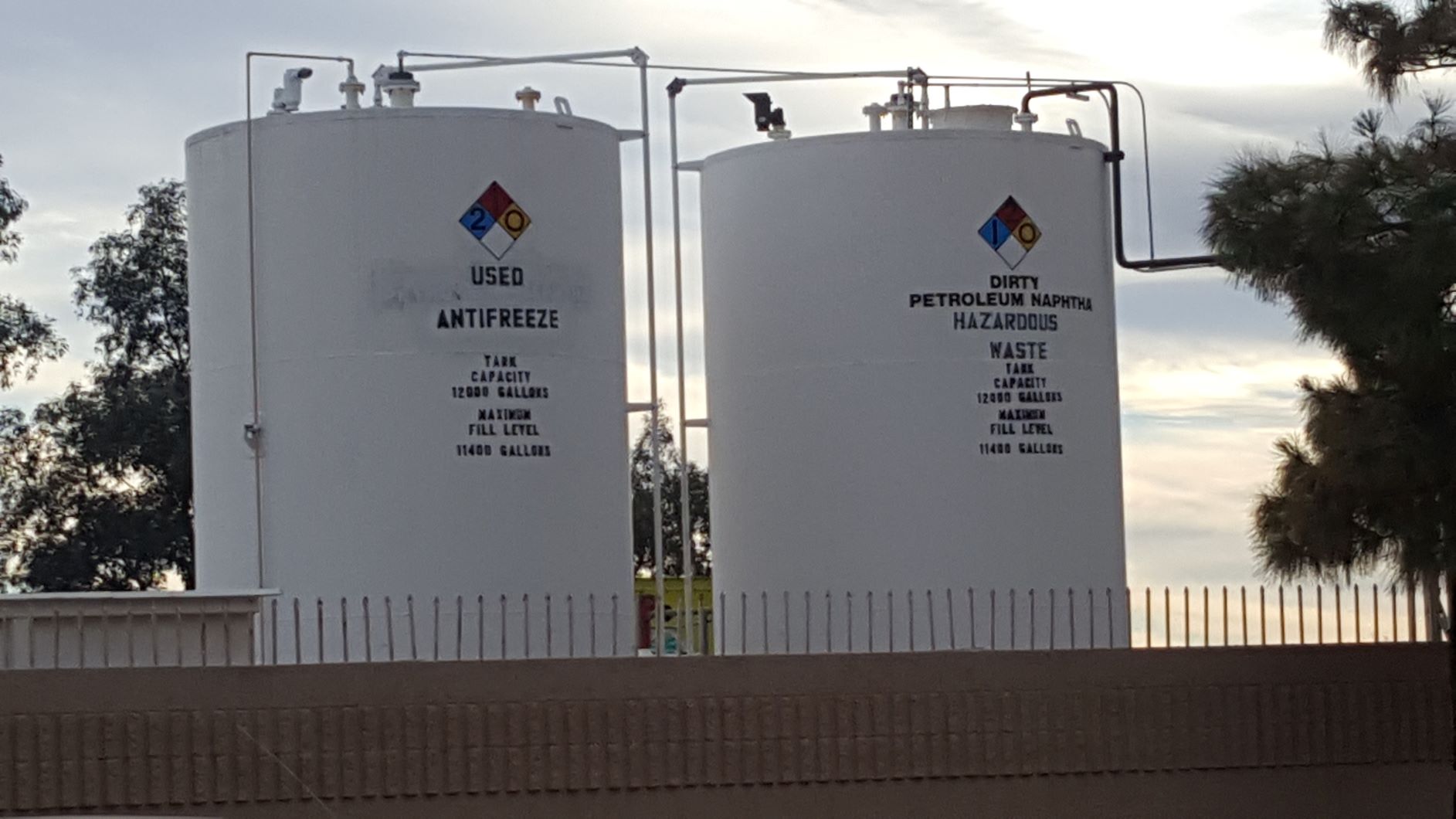
Appropriate tank and piping labeling / marking.
Leaks from tanks, pumps, and inlet/ outlet nozzles or flanges.
Leaks from or damage to ancillary equipment.
Seal integrity on manholes, gauge hatches, weather shields, and level gauges.
High liquid level / overflow.
Structurally intact with no damage to tank walls.
Evidence of corrosion, excessive rusting, or damage.
Overfilling controls operative.
Secondary containment free of waste, chips, cracks, holes, etc.
Any sump pump operations.
Contact me with any questions you may have about the generation, identification, management, and disposal of hazardous waste
In my experience most shippers of a hazardous material (HazMat) will use a packaging only once. After that initial use the packaging is either disposed of, recycled, or sent for reconditioning. All of these options are subject to USEPA, USDOT/PHMSA, and possibly state regulations. Many HazMat shippers are unaware of the allowance to reuse a packaging for the transport in commerce of a hazardous material; perhaps many times. This allowance of the Hazardous Materials Regulations (HMR) of USDOT/PHMSA will not only result in less waste generation but will also save you money.
The purpose of this article is to identify and explain the USDOT/PHMSA regulations at 49 CFR 173.28(a,b, & e) for the reuse of a packaging for the transport of a hazardous material.
Scope and Applicability:
The scope and applicability of these regulations are limited to the following:
Transport must be “in commerce”. i.e., by or for a business or government agency engaged in commercial activity.
Packaging must be used for the transport of a hazardous material (HazMat). Non-HazMat are not subject to these regulations.
Non-bulk packaging only. Bulk packagings may be reused but are subject to different regulations dependent on their packaging type. The reuse of bulk packagings will not be considered in this article.
MADE IN THE USA: “The reuse provisions only apply to UN performance-oriented or specification packagings manufactured and filled in the United States.” (01-0270)
Not limited to original user: “There is no limitation on who may reuse a packaging for the transportation of hazardous materials. The person who reuses the packaging does not have to be the original user.” (99-0125)
Contact me with any questions you may have about the transportation of hazardous materials by air, highway, vessel, or rail
§173.28(c) addresses the requirements for the reconditioning of non-bulk packagings. The reconditioning of non-bulk packagings will not be addressed in this article.
§173.28(d) addresses the remanufacture of non-bulk packagings. The remanufacture of a non-bulk packaging will not be addressed in this article.
The reuse of a packaging for a Division 6.2 Infectious Substance is described in §173.28(f) and will not be addressed in this article.
Before reuse each packaging – even a non-reusable container – must be inspected. The purpose of the inspection is to ensure that all packagings and receptacles to be reused are in a condition that complies with all of the requirements of the HMR; this includes closure devices and cushioning materials. This requires compliance with the HMR’s general packaging requirements:
§173.24 – General requirements for packagings and packages
§173.24(a)(2) indicates the regulations apply to both new packagings and packagings to be reused.
§173.24a – Additional general requirements for non-bulk packagings and packages
But that’s not all. The inspection must also determine the non-bulk packaging to be reused is capable of passing all performance tests represented by the packaging markings (11-0085). These are found at §178, subpart M.
A packaging may not be reused under any of the following conditions:
Contains a residue that is incompatible with the HazMat it is to be refilled. Note: This does not mean free from anyresidue. Just free from any incompatibleresidue.
Has been ruptured.
Displays evidence of other damage which reduces its structural integrity. Note: The key term here is, “…reduces its structural integrity.” The person reusing the packaging must determine if damage – if any is observed – is sufficient to reduce the packagings structural integrity.
A non-bulk packaging that shows evidence of a reduction in integrity may not be reused unless it is reconditioned per §173.28(c).
Q: What is the definition of “other damage”? Does the shipper have the authority to determine when “other damage” has occurred to one of its packagings?
A: The HMR do not provide a definition for “other damage” beyond that provided in §173.28(a), i.e., “damage which reduces [the packagings’] structural integrity.” The shipper is responsible for identifying packaging deficiencies that may reduce the packagings structural integrity. (o4-0101)
That may seem like a lot. But really, the general conditions for reuse of a packaging aren’t any different than the responsibilities of the shipper prior to the first use of a non-bulk packaging.
Conditions for Reuse of Specific Packaging Types:
Packagings made of paper (other than fiberboard), plastic film, or textile:
Per §173.28(b)(3), packagings made of the following materials may not be reused:
Paper (other than fiberboard).
Plastic film.
Textile
Packagings made of fiberboard (box or drum) may be reused. A challenge specific to this type of packaging is damage that may be caused by removal of tape used for closure. Tears to the facing / laminate of the fiberboard may result in a reduction in structural integrity of the packaging which will render the packaging unfit for reuse. For this type of packaging, cutting the tape, leaving it attached to the packaging, and then taping over the old tape may be a better option than removing the old tape entirely. (04-0101, 06-0019)
Contact me with any questions you may have about the generation, identification, management, and disposal of hazardous waste
Previously used non-bulk packaging reused for the shipment of hazardous waste:
§173.28(b)(6) allows a previously used non-bulk packaging to be reused for the shipment of hazardous waste, not subject to the regulations of §173.28 if done in compliance with §173.12(c).
The definition of the term at §171.8 refers back to §173.28:
NRC (non-reusable container) means a packaging (container) whose reuse is restricted in accordance with the provisions of §173.28 of this subchapter.
Per §173.28(e) a packaging marked as NRC according to the DOT specification or UN standard requirements of 49 CFR part 178 may only be reused for the transport of a HazMat that does not require a DOT specification or UN standard packaging.
Q: What is an example of a HazMat that does not require a DOT specification or UN standard packaging?
A: Any hazardous material subject to one of the following packaging exceptions:
Limited quantity
Small quantity
Excepted quantity
De Minimis
Lithium battery subject to §173.185(c)
And other exceptions in the HMR…
This means, however, that a packaging marked as NRC according to the DOT specification or UN standard requirements of 49 CFR part 178 may not be used for the transport in commerce of a hazardous material unless it is subject to one of the above-referenced packaging exceptions. If used, the packaging still must meet the general conditions for reuse identified earlier in this article (11-0085).
The inclusion of text, “…a packaging marked as NRC according to the DOT specification or UN standard requirements of 49 CFR part 178…” (emphasis added) may seem unnecessary until you learn that a packaging might be marked with “NRC” for an entirely different reason than its reuse: i.e., it is a packaging approved by the Nuclear Regulatory Commission (NRC). §172.203(d)(7) and §173.471 refer to the display of “NRC” as a packaging mark because it is approved by the Nuclear Regulatory Commission.
Prior to 1991, the letters “STC” (single trip container) and “NRC” (nonreusable container) were used as markings on certain, now obsolete, DOT specification non-bulk packagings that restricted the use of those packagings. Currently, the only packaging required to have an NRC marking is the DOT 39 cylinder at §178.65(i).
Q: What options for reuse do I have for a packaging marked by the manufacturer as NRC according to the DOT specification or UN standard requirements of 49 CFR Part 178?
A: Not much. The packaging may only be used for a hazardous material that does not require DOT specification or UN standard packaging, a non-hazardous material, or the shipper may request a special permit from USDOT/PHMSA that allows for its reuse.
Plastic inner receptacles of composite packagings:
Plastic inner receptacles of composite packagings must have a minimum thickness of 1.0 mm (0.039 inch).
Metal and plastic drums and jerricans used as single packagings or the outer packagings of composite packagings:
First of all, let’s make sure we’re clear on the type of packagings subject to this regulation at §173.28(b)(4). Two types of packagings are identified, both are defined at §171.8:
“Single packaging means a non-bulk packaging other than a combination packaging.” Single packagings subject to this regulation include:
Steel drum (1A1 or 1A2)
Aluminum drum (1B1 or 1B2)
Metal drum (1N1 or 1N2)
Steel jerrican (3A1 or 3A2)
Aluminum jerrican (3B1 or 3B2)
Plastic drum (1H1 or 1H2)
Plastic jerrican (3H1 or 3H2)
“Composite packaging means a packaging consisting of an outer packaging and an inner receptacle, so constructed that the inner receptacle and the outer packaging form an integral packaging. Once assembled it remains thereafter an integrated single unit; it is filled, stored, shipped and emptied as such.” Though composite packagings are many, only the following are subject to this regulation:
Plastic receptacle within a protective steel drum (6HA1)
Plastic receptacle within a protective aluminum drum (6HB1)
Plastic receptacle within a protective plastic drum (6HH1)
Glass, porcelain, or stoneware receptacles within a protective steel drum (6PA1)
Glass, porcelain, or stoneware receptacles within a protective aluminum drum (6PB1)
These regulations do not apply to any of the above packagings if they are the outer packaging of a combination packaging (14-0136).
To be authorized for reuse, the above packagings must be marked in a permanent manner (e.g., embossed) as follows:
The nominal thickness of the packaging material in mm for metal packagings.
The minimum thickness of the packaging material in mm for plastic packagings.
For a full description of the required marking refer to §178.503(a)(9).
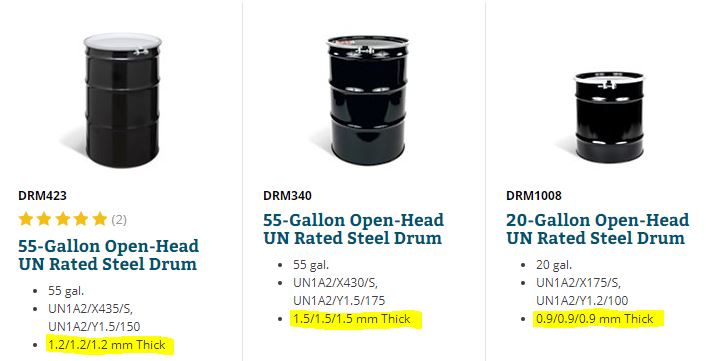
Each of these steel drums meet the minimum thickness requirements for their size
But we’re not done. To be eligible for reuse the packaging must conform to the following minimum thickness criteria (an exception to these criteria for packagings manufactured before January 1, 1997 is identified after the table):
Net quantity per package Passenger aircraft
Net quantity per package Cargo Aircraft Only
Lithium ion cells and batteries
Forbidden
10 kg
1 Metal drums or jerricans manufactured and marked before January 1, 1997 with a minimum thickness of 0.82 mm body and 1.09 mm heads may be reused. Those packagings manufactured and marked after January 1, 1997 and intended for reuse must be constructed with a minimum thickness of 0.82 mm body and 1.11 mm heads.
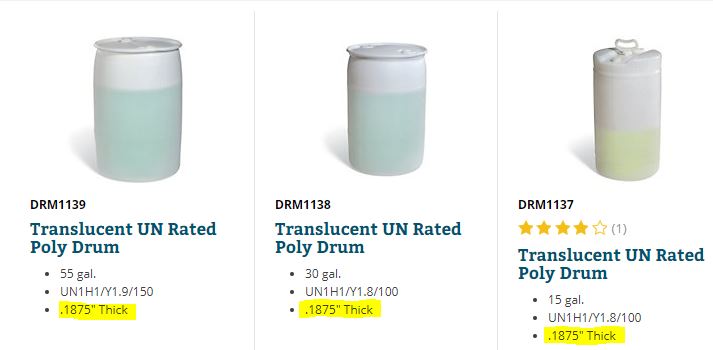
Each of these packagings meet the nominal requirements for their size
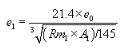
Stainless steel drums and jerricans are not subject to the requirements of the above table. They must conform to a minimum wall thickness as determined by the following equivalence formula:
FORMULA FOR METRIC UNITS
FORMULA FOR U.S. STANDARD UNITS
Symbols in the above formulas have the following values:
e1 = required equivalent wall thickness of the metal to be used (in mm or, for U.S. Standard units, use inches).
e0 = required minimum wall thickness for the reference steel (in mm or, for U.S. Standard units, use inches).
Rm1 = guaranteed minimum tensile strength of the metal to be used (in N/mm2 or for U.S. Standard units, use psi).
A1 = guaranteed minimum elongation (as a percentage) of the metal to be used on fracture under tensile stress (see paragraph (c)(1) of this section).
How important is this requirement? Well, §173.28(a) includes as a general condition that a packaging not meeting the minimum thickness requirements may not be reused or reconditioned for reuse.
Q: Does that mean I must measure the minimum / nominal thickness of this packaging type before each reuse?
A: No. What you must do is ensure the packaging is permanently marked with its minimum / nominal thickness and that the marked thickness meets the minimum thickness criteria either of the table or the equivalence formula, as applicable.
Q: If a packaging was not marked by the manufacturer with the minimum / nominal thickness at the time of manufacture, may it be marked at a later date by the reuser or reconditioner of the packaging?
A: Yes. A packaging not marked at the time of manufacture with the minimum / nominal thickness may be permanently marked at a later date by the reuser or reconditioner provided the integrity of the packaging is not degraded and the packaging was initially intended to be reused. (00-0227)
If you like this article, please share it using any of the social media platforms identified at the bottom of this article.
You’ll look real smart recommending my articles!
Packagings subject to the leakproofness test with air:
§173.28(b)(2) specifies the requirements for the leakproofness test prescribed at §178.604 for certain packagings to be reused. §173.28(b)(7) identifies conditions where a packaging subject to the leakproofness test may not be required to be tested.
Before we go any further, what packagings are subject to the leakproofness test with air prescribed in §178.604? Quite simply: all packagings intended to contain liquids, except that:
The inner receptacle of a composite packaging may be tested without the outer packaging if the test results are not affected.
The test is not required for inner packagings of combination packagings.
The leakproofness test is not required for any packaging intended for the transport of solid HazMat.
Q: Is the leakproofness test required for packagings intended for reconditioning or remanufacture?
A: Yes, though not clearly stated in §173.28(c) for reconditioning or §173.28(d) for remanufacture. The determination is made as follows:
§173.28(c)(3) requires a reconditioned packaging to be marked as indicated at §178.503(c) & (d). Per §178.503(c)(1)(v), every reconditioned packaging that passed a leakproofness test must be marked with an “L”.
§173.28(d) states a remanufacturer of a packaging is subject to the requirements of part 178 as a manufacturer. A packaging manufacturer must ensure each packaging is capable of passing the prescribed tests, which includes the leakproofness test at §178.604.
§173.28(b)(2) requires the following for packagings subject to the leakproofness test prior to reuse:
48 kPa (7.0 psig) for Packing Group I. Note: this is higher than the minimum air pressure required at §178.604(e)(1) for Packing Group I.
20 kPa (3.0 psig) for Packing Group II. Note: this is the same as §178.604(e)(2) for Packing Group II.
20 kPa (3.0 psig) for Packing Group III. Note: this is the same as §178.604(e)(3) for Packing Group III.
The packaging that is retested without failure per above must then be marked:
With the letter “L”.
Name and address or symbol of the person conducting the test.
Last two digits of the year the test was conducted.
Symbols, if used must be registered with the Associate Administrator (aka: USDOT/PHMSA).
However, §173.28(b)(7) allows for the reuse of a packaging without the leakproofness test if the packaging complies with the following:
Reuse of a packaging subject to the leakproofness test without performing the leakproofness test:
A packaging subject to the leakproofness test at §173.28(b)(2) may be authorized for reuse without performing the leakproofness test if the packaging complies with all of the following requirements of §173.28(b)(7):
Is otherwise authorized for use according to the requirements of §173.28.
Is refilled with a HazMat compatible with the previous contents. Note: this does not require the same HazMat, merely one that is compatible with what was in the packaging previously.
Is refilled and offered for transport by the original filler. Note: this does not specify who performs the transport, merely who fills and “offers for transport” (aka: the shipper).
Is transported in a transport vehicle or freight container under the exclusive use of the refiller of the packaging.
“Exclusive use” means that the transport vehicle does not contain any material offered by anyone other than the filler of the packaging (04-0111).
Is constructed of one of the following:
Stainless steel, monel, or nickel with a thickness not less than 1 1/2 times the minimum thickness prescribed in §173.28(b)(4), (see above in this article).
Plastic, if it is not refilled for reuse more than five (5) years from its date of manufacture. The month and year of a plastic packaging’s manufacture is marked on the packaging pursuant to §178.503(a)(6).
Another material or thickness when approved under the conditions established by the Associate Administrator (aka: USDOT/PHMSA) for reuse without retesting.
Q: Does this mean that a plastic packaging has a five year limit on its use for the transport of a HazMat?
A: No. A plastic packaging may continue to be reused pursuant to §173.28 even after five (5) years. However, after five (5) years from its date of manufacture it is no longer eligible for this exception and must be leakproofness tested before reuse.
Don’t confuse this limit for the reuse of plastic packaging under §173.28 with a similar but more restrictive limit on the use of plastic packagings in the dangerous goods regulations of the International Air Transport Association (IATA) and the International Maritime Organization (IMO). Under their regulations (5.0.2.1.5 for IATA and 4.1.1.15 for IMO) a plastic packaging may not be used or reused more than five (5) years after its date of manufacture. USDOT/PHMSA has no such limitation (17-0031).
Whew! After all that you might be thinking the reuse of a HazMat packaging is not worth the trouble of compliance, but hold on. Let’s summarize the requirements:
Perform an inspection of the packaging to ensure in good condition for reuse.
No incompatible residue.
If the packaging is designed for liquid HazMat, perform the leakproofness test. No leakproofness test for solid HazMat.
The leakproofness test may not be required if the packaging is refilled and shipped by the original filler, is transported in a vehicle under the exclusive use of the refiller, and the packaging is made of stainless steel, monel, or nickel of the prescribed thickness or plastic and not more than five (5) years old.
And…
Metal and plastic drums and jerricans used as single packagings or the outer packaging of composite packagings must be permanently marked to indicate they meet the minimum thickness requirements.
And remember, “There is no limitation on who may reuse a packaging for the transportation of hazardous materials. The person who reuses the packaging does not have to be the original user.” (99-0125)
FAQ: What is the leakproofness test?
The Hazardous Materials Regulations (HMR) of the USDOT/PHMSA require most packagings used for the transport in commerce of a hazardous material (HazMat) to meet a DOT specification or a UN standard. Some HazMat are subject to a packaging exception and others – though fully regulated – are allowed to be transported in other forms of specification packaging, e.g., a packaging in compliance with a special permit; these do not require DOT specification or UN standard packaging.
Most shipments of HazMat, however, will require a DOT specification or UN standard packaging. Those that are non-bulk packagings must be manufactured to a standard identified in 49 CFR 178, subpart L and be able to pass certain tests specified in §178, subpart M. One of those required tests is the leakproofness test. (more…)
Quick Take: Alternatives to the Leakproofness Test Method
The Hazardous Materials Regulations (HMR) of USDOT/PHMSA require certain packagings (mostly single and composite packagings intended for the transport of liquid hazardous materials) to undergo a leakproofness test prior to use or reuse.
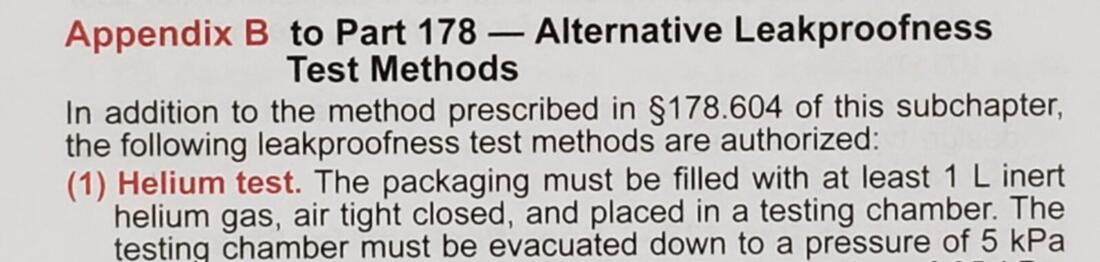
The requirements for the leakproofness test are found at 49 CFR 178.604. §178.604(d) identifies the test method to use. It also reads, “Other methods, at least equally effective, may be used in accordance with appendix B of this part.” So, in addition to the method prescribed in §178.6o4, the leakproofness test methods of appendix B to part 178 are authorized.
What follows is a list of the alternative leakproofness test methods of Appendix B to Part 178. For a more complete description, refer to the regulation.
Helium test
Pressure differential test
Solution over seams
Solution over partial seams test
Contact me with any questions you may have about the transportation of hazardous materials by air, highway, vessel, or rail
Q&A: My truck has Corrosive, Combustible Liquid, and Class 9 Miscellaneous. What placards are required?
A question from a recent customer (June 06, 2018):
Daniel,
Hope this finds you well. I am the warehouse manager at <<Company>>. I was wondering if you can clear something up for us. When placarding trucks if we have multiple hazard classes shipping and it is over 1000# we have to placard all the hazard classes correct? If you look at the attachment I believe we should’ve placarded both class 8 & 9. (A shipping paper was attached showing a consignment of more than 2,500 lb of various Class 8 Corrosive Materials, more than 3,000 lbs of a Class 9 Miscellaneous, 220 lb of a Class 3 Combustible Liquid, and some non-hazardous materials). I have some that believe if one class is over the 1000# that is what gets placarded. Would you be kind enough to help clear this confusion.
Contact me with any questions you may have about the transportation of hazardous materials by air, highway, vessel, or rail
49 CFR 172.504(a) indicates it is necessary to display placards on a vehicle containing any amount of a hazardous material except in the following conditions:
A hazardous material identified in Table 2 of the placarding tables at §172.504(e), in a non-bulk packaging, if the total amount of HazMat in the vehicle is less than 454 kg (1,001 lb).
Since neither the Class 9 Miscellaneous nor the Class 3 Combustible Liquid in a non-bulk packaging are required to display placards, their respective weight is not counted toward the placarding threshold.
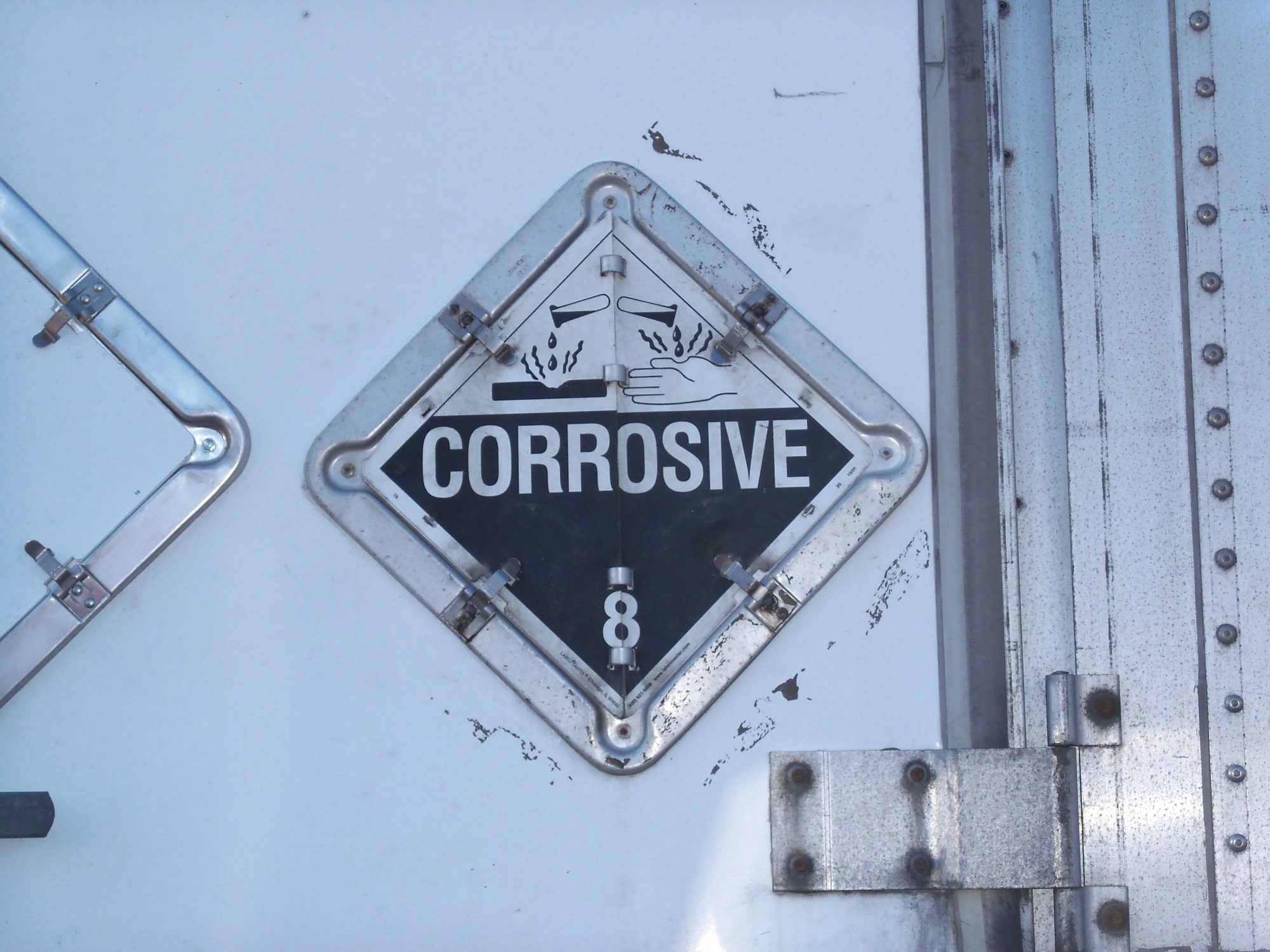
This letter of interpretation from USDOT/PHMSA (97-0099) is too old to be available as a link from their website. However, it indicates that Class 9 Miscellaneous HazMat is not counted toward the placarding threshold: “Only materials that are covered by Table 2 and that require placarding are included in the aggregate gross weight.” Though not stated directly, this would apply to Class 3 Combustible Liquids in a non-bulk packaging as well.
If the weight of the Class 8 Corrosive is 454 kg (1,001 lbs) or more, then it is necessary to display the Class 8 Corrosive placard on the vehicle.
Display of the Class 9 Miscellaneous and the Class 3 Combustible Liquid placards on the vehicle are optional – at the discretion of the driver – but not required.
I hope this helps.
Please contact me with any other questions.
If you like this article, please share it using any of the social media platforms identified at the bottom of this article.
You’ll look real smart recommending my articles!
And that did it!
This absolutely helps. Thank you for this info.
Q&A: I’m picking up Class 8 Corrosive and Class 9 Miscellaneous (Marine Pollutants). What placards do I need?
Sent May 05, 2018, all in uppercase so I knew he was serious.
TUESDAY I HAVE TO PICK UP 9,000 LBS OF CLASS 8 MATERIALS IN 200 BOXES ON 10 PALLETS PLUS 50 BAGS ON 2 PALLETS AT 1500 LBS OF CLASS 9 MARINE POLLUTANT MATERIALS.
DO I NEED A CORROSIVE PLACARDS WITH THE UN NUMBER ON THEM AND MARINE POLLUTANT PLACARDS FOR MY TRAILER?
I REFUSED THIS LOAD FRIDAY FOR THE LEAKING OF ONE BAG OF THE MARINE POLLUTANTS AND NO HAZMAT DOCUMENTS FOR THE CLASS 8 BOXES.
However, it is not necessary to display the HazMat’s identification number (UN NUMBER) on the placard because both of the following are true for this consignment:
The HazMat is not in a bulk packaging. If in a bulk packaging it would be necessary to display the identification number on the vehicle.
FYI: though it has the same dimensions and visibility requirements as a placard, the identification of a marine pollutant is a mark, not a placard.
You were correct to reject the original consignment due to damaged packaging and lack of hazardous material shipping paper. Per 49 CFR 177.801:
No person may accept for transportation or transport by motor vehicle a forbidden material or hazardous material that is not prepared in accordance with the requirements of this subchapter.
I hope this helps. Please don’t hesitate to contact me with any other questions.
That must have done it because I didn’t hear from him after that.
Contact me the next time your USDOT Training is due to expire.
Q&A: How do I classify a Class 3 Combustible Liquid for both international and domestic transport?
This e-mail was sent from a contact form on Daniels Training Services (https://danielstraining.com) on December 05, 2019
Hello,
I am trying to name a chemical for transport. It has a flashpoint of 81 C. It is not a US DOT marine pollutant, but it is an IMDG marine pollutant. We ship in both bulk and non-bulk packaging, both domestically and internationally. I believe the US DOT name would be NA1993, combustible liquids, n.o.s. (name), 3, III -is that correct?
I am having a hard time with the IATA and IMDG name. Would those still be the NA1993? I know that NA1993 isn’t recognized internationally, so I am little confused as how this should be named. Any help you can provide with the naming would be greatly appreciated!!
Thank you for contacting me. I apologize for my delay. I will review and reply. Please advise on the below.
What is the chemical? Do you have an SDS?
What makes it an IMDG marine pollutant?
What is the expected capacity of the packaging: <5 L / 5 kg? <119 gallons? >119 gallons?
Does transport begin or end in the U.S.?
Thank you and please advise.
Answer:
Hello Daniel,
Thanks for taking the time to help me with this!!
The product is a blend of basic epoxy resin (casRn 25085-99-8) and Oxirane, 2-(butoxymethyl)- (casRn 2426-08-6); flash point 81 °C
No, we do not have a SDS. We are trying to make one and the SDS author asked me to assist in the naming.
It is IMDG marine pollutant because it meets the UN model regulation criteria for classification as a Chronic Aquatic Toxicity Cat 2.
When we make a SDS, we include the names for each package type and mode of transport. We ship 1L to 20L/5 gallon samples, 55 gallon drums, and 275 gallon totes
1L to 5 gallon samples ship by ground or air both domestically and internationally
55 gallon drums and 275 gallon totes ship by ground domestically and by vessel internationally
Transport begins in the US
Thanks,
Interested in site specific training at your site that covers this topic, and more!
It was after Christmas, (12.27.19) but I got him an answer:
I will try to answer you questions. Please see below.
Based on the flash point it is a Class 3 Combustible Liquid per USDOT regulations.
A material with a flash point higher than 60 degrees C is not subject to international regulations (IATA or IMO).
Based on your information it is not a marine pollutant per USDOT regulation but is a marine pollutant per international regulations.
A combustible liquid is not subject to USDOT regulation if transported by highway or rail within the U.S. and in a non-bulk packaging (and other conditions).
A non-bulk packaging of this material is not subject to USDOT regulations within the U.S. In a bulk packaging it is a Class 3 Combustible Liquid. NA1993, combustible liquids, n.o.s. (name), 3, III may be the proper shipping description if a more specific name is not available. There may be other shipping names that are more descriptive of the HazMat.
The material is subject to international regulation as a marine pollutant unless subject to the marine pollutant exception (packaging of less than 5 L or 5 Kg).
USDOT regulations allow a non-HazMat to be classified as a marine pollutant within the U.S. if subject to international regulation as a marine pollutant.
Also:
Section 14 of the SDS is not required to be completed within the U.S.
My suggestion:
Classify as marine pollutant for all transport.
Classify as Class 3 Combustible Liquid only when in bulk packaging within the U.S. All other transport is non-HazMat.
I hope this helps. Please don’t hesitate to contact me with any other questions.
His reply December 30th:
Thanks Daniel! This was very useful!!
Michigan Electro-Plating Company and Owner Sentenced for Illegally Storing Hazardous Waste
The Bullet:
Electro-Plating Services Inc. (EPS), located in Madison Heights, Michigan, was sentenced in federal court in Detroit on November 6, 2019 to five years of probation, and was ordered to pay restitution of $1,449,963.94 joint and several with Gary Sayers to the U.S. Environmental Protection Agency. Sayers, EPS’s owner, was sentenced to one year in prison followed by three years of supervised release. EPS and Sayers pleaded guilty on Feb. 14, 2018 to violating the Resource Conservation and Recovery Act (RCRA).
Not sure of your hazardous waste generator status?
Gary Sayers, owner of Electro-Plating Services, Inc.
Assistant Attorney General Jeffrey Bossert Clark for the Justice Department’s Environment and Natural Resources Division
U.S. Attorney Matthew Schneider of the Eastern District of Michigan
Special Agent in Charge Jennifer Lynn of the EPA’s criminal enforcement program in Michigan
What:
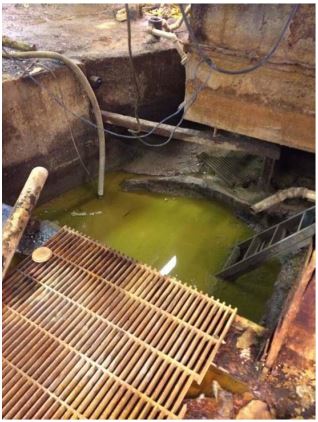
Pit used to illegally store hazardous waste
The crime related to Sayers’s operation of EPS, which used chemicals such as cyanide, chromium, nickel, chloride, trichloroethylene, and various acids and bases, as part of the plating process. After these chemicals no longer served their intended purpose, they became hazardous wastes, which required handling in compliance with RCRA.
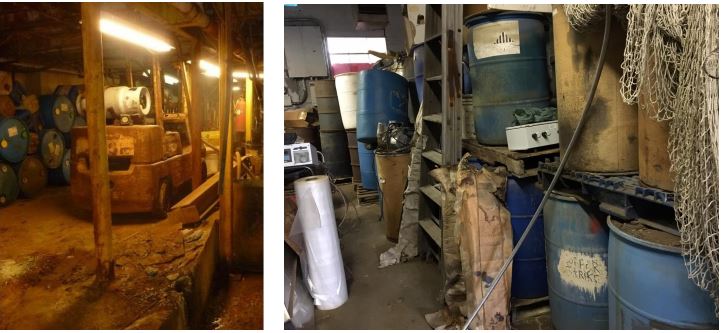
Rather than having EPS’s hazardous wastes legally transported to a licensed hazardous waste facility, Sayers stored the hazardous waste in numerous drums and other containers, including a pit dug into the ground in the lower level of the EPS building in Madison Heights. For years, Sayers stonewalled state efforts to get him to legally manage the hazardous wastes. Ultimately, the EPA’s Superfund program spent $1,449,963.94 to clean up and dispose of the hazardous wastes.
According to court records, Sayers—who owned and was the President of EPS—knew that such storage was illegal and had managed the company’s former Detroit facility where he kept hazardous wastes illegally.
Contact me with any questions you may have about the generation, identification, management, and disposal of hazardous waste
Starting in 1996, the Michigan Department of Environmental Quality (MDEQ) repeatedly sent Mr. Sayers warnings about his illegal handling of hazardous waste.
In 2005, Sayers was charged with and pleaded guilty to illegally transporting hazardous wastes in state court.
During the ensuing years, the MDEQ attempted to get Sayers and EPS to properly manage the amounts of hazardous wastes piling up at the Madison Heights location. The MDEQ issued numerous letters of warning and violation notices to the company regarding its hazardous wastes.
In 2016, the MDEQ identified over 5,000 containers of liquid and solid wastes at the Madison Heights location. That same year, the city of Madison Heights revoked the company’s occupancy permit.
In January 2017, the EPA initiated a Superfund removal action, after determining that nature and threats posed by the stored hazardous waste required a time-critical response.
The cleanup was completed in January 2018.
Sentencing November 6, 2019.
Where:
Electro-Plating Services Inc. (EPS), located in Madison Heights, Michigan
Illegal storage of hazardous waste
Why:
“This case shows that anyone who chooses to do business with dangerous materials must obey federal laws that protect our fellow Americans and the environment. These defendants’ knowing, illegal storage of waste cyanide, highly corrosive wastes, toxic chromium waste, and reactive wastes posed a significant danger and threat to nearby communities and the environment,”
“They disregarded the law and numerous warnings and requests by state authorities to comply with their legal obligations. The Department of Justice will act to protect public health and safety.”
How:
The case was investigated by EPA’s Criminal Investigation Division, the Michigan Department of Natural Resources-Environmental Investigation Section, the Michigan Department of Environment, Great Lakes, and Energy (EGLE, formerly the MDEQ) and the Coast Guard Investigative Service.
The conclusion I draw from this is that you can avoid compliance with the hazardous waste regulations for a long time. From its beginning in 1996 (and I would not be surprised if it started long before that) until sentencing in 2019 is 25 years! Twenty five years of being in business, making a profit, and violating federal and state regulations. I’d like to see a case like this settled long before twenty-five years had passed. I think that persons who deliberately violate the law are few. Many more are those who through ignorance violate a regulation and pay a civil penalty instead of criminal prosecution as in this case.
My training won’t keep you out of jail if you break the law but it can help you learn more about the regulations to which you are subject, and with some effort on your part, keep you in compliance. RCRA training webinars are held regularly and Onsite Training is available.
Q&A: When must I – and when can’t I – display the identification number on a placard?
Date: May 10, 2018
Subject: Corrosive example for placarding on the website
Message Body:
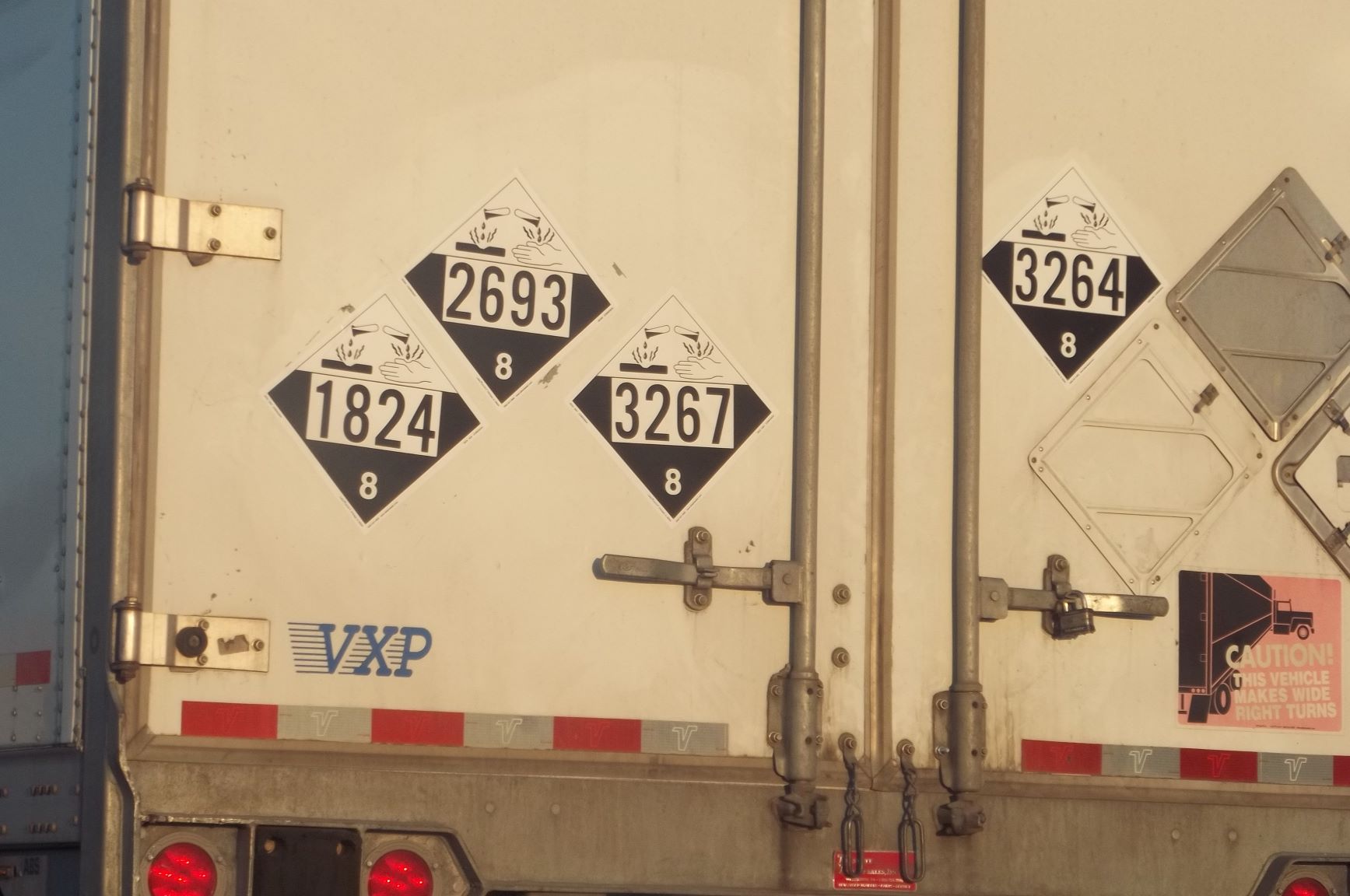
UN 3264, Waste Corrosive Liquid, Acidic, Inorganic, n.o.s (Hydrochloric Acid, Hydrogen Peroxide), 8, II – 6 x 55 gallon drums @ 600 lb/drum = 3,600 lbs
UN1760, Waste Corrosive Liquid, n.o.s. (Nitric Acid, Hydrofluoric Acid), 8, II – 1 x 350 gallon bulk packaging = 350 lbs
So two corrosive 8 placards with both UN numbers is required in this example. What would be required if there were no bulk items?
Two separate Class 8 Corrosive placards must be displayed on all four sides of the vehicle.
The identification number 3264 is not required to be displayed on a Class 8 placard since the HazMat is not in a bulk packaging and it is not the sole HazMat in the vehicle.
The identification number 1760 is required on a Class 8 placard since the HazMat is in a bulk packaging.
If no bulk items then one Class 8 Corrosive placard per side with no identification number would suffice.
I hope this helps.
Please contact me with any other questions.
It took awhile, but on May 23rd he still had questions:
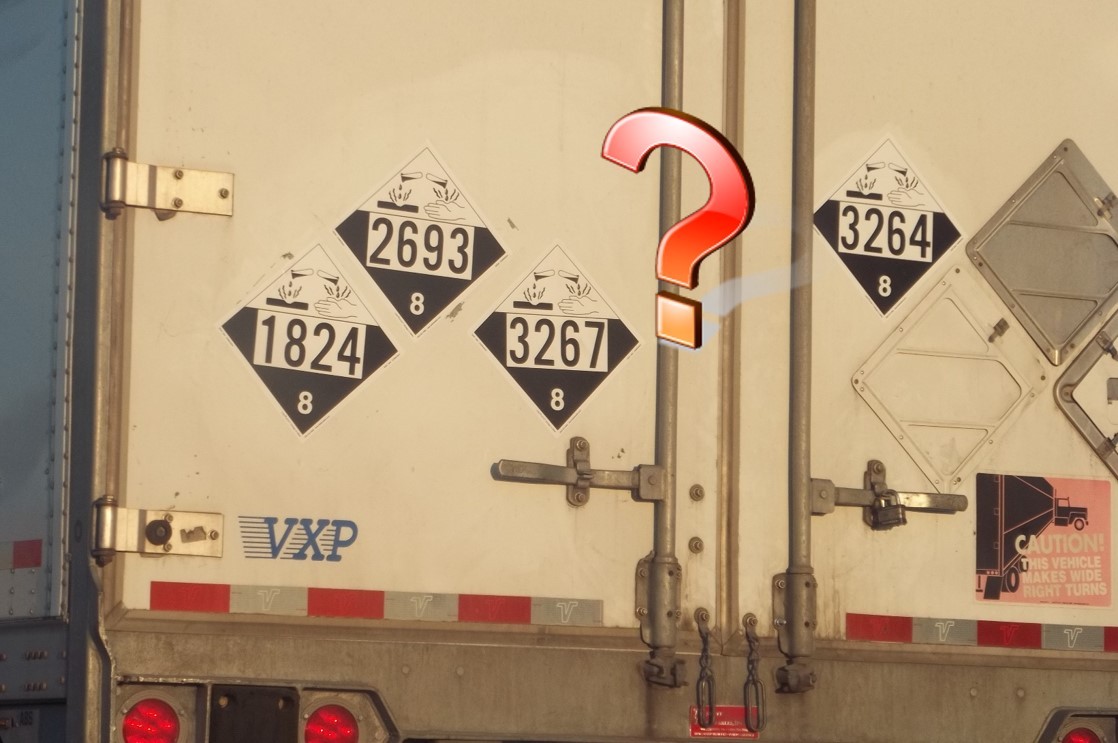
There are at least four separate bulk packagings on this vehicle.
Thanks for the answer but I’m still confused. (when must an identification number not be included on a hazardous material placard) it says “the solution is to display each applicable identification number in one of the following manners”. “on separate placards of the same hazard class”. In your response you say the identification number isn’t “required” for 3264. Wouldn’t it be prohibited to put the 3264 number on the placard since it is not bulk and does not cover the entire load? Can I use a placard with the 3264 and one with 1760 or MUST I use a plain corrosive 8 placard with a 1760 placard?
I tried to clarify:
I will try to clarify.
Vehicle must display two Class 8 Corrosive placards on all four sides.
One of the placards on each side must display the identification number 1760. It represents the Class 8 Corrosive in a bulk packaging.
The other Class 8 placard must not display an identification number. It’s purpose is to represent the non-bulk quantity of Class 8 Corrosive (UN2364).
Please contact me if you have any other questions.
The requirements for display of placards on a vehicle can be complicated. Having to also display the HazMat’s identification number on or near the placard can complicate things further. Whether you transport a HazMat (carrier) or offer for transport (shipper) you must determine what placards and/or identification numbers are required to be displayed on the vehicle and then either offer them to the driver (responsibility of the shipper) or display them properly on the vehicle (responsibility of the carrier).