PO Box 1232 Freeport, IL 61032

A Different Kind Of Training

A Different Kind Of Training

A Different Kind Of Training

What is a Shipping Paper?

Shipping Paper is defined at 49 CFR 171.8 as:

Shipping paper means a shipping order, bill of lading, manifest or other shipping document serving a similar purpose and prepared in accordance with subpart C of part 172 of this chapter.

So what is it, exactly…?  A bill of lading?  A Uniform Hazardous Waste Manifest?  A shipping order?  A shipping document?  Half a page of scribbled lines?

Yes to all.

As far as the USDOT/PHMSA (the Pipeline and Hazardous Materials Safety Administration, the administration within US DOT responsible for hazardous material transportation) is concerned a shipping paper is a document whose purpose is to provide information about a material (hazardous or non-hazardous) when in transportation.  The USDOT/PHMSA doesn’t care (their own words) what the shipping paper looks like, what format is used, or whether it is printed by machine or by hand.

Now, if you are transporting (a carrier) or offering for transport (a shipper) a hazardous material (HazMat) in commerce, then the USDOT/PHMSA requires the shipping paper to meet its requirements at 49 CFR, Subpart C.  Even in this case, the USDOT/PHMSA does not require a specific type or form of shipping paper.  You may create your own, even write one up by hand, as long as it meets the requirements of §172, Subpart C.

There are some hazardous material shipments that require a specific type of shipping paper; such as the transportation of a hazardous waste for which the US Environmental Protection Agency (USEPA) requires a Uniform Hazardous Waste Manifest.  Or a bill of lading which is required pursuant to the regulations (49 CFR 375.505) of the Federal Motor Carrier Safety Administration (FMCSA, another administration within the US DOT).  In both cases however, the use of a specific form is required by an agency other than the USDOT/PHMSA.

Contact me with any questions you may have about the transportation of hazardous materials by air, highway, vessel, or rail

International and Domestic

Daniels Training Services

815.821.1550

Info@DanielsTraining.com

https://danielstraining.com/

Whatever its appearance, the regulations of §172, Subpart C are specific about what information must be included on a hazardous material shipping paper.  My HazMat Employee training covers these requirements and where you must go to get the information.  Contact me to discuss your HazMat transportation requirements.

Oil-Based Finishes as Universal Waste in Pennsylvania

The Universal Waste regulations of the US EPA at 40 CFR 273 provide an option for generators to manage what would be a hazardous waste according to a reduced regulatory burden.  Relaxed regulatory requirements for Universal Waste include, but are not limited to:

  1. One year on-site accumulation time limit.
  2. Universal Waste doesn’t count towards your Hazardous Waste generator status.
  3. Uniform Hazardous Waste manifest not required for off-site shipments.
  4. Reduced training requirements for facility personnel.
  5. No inspection requirements.

The US Environmental Protection Agency currently identifies four (4) types of Universal Waste:

  1. Lamps.
  2. Batteries.
  3. Mercury-Containing Devices.
  4. Pesticides.

Read more about the Federal Universal Waste regulations.

States with authorized hazardous waste programs under RCRA are allowed to expand on this Federal list of Universal Waste, and many have.

The State of Pennsylvania, at Chapter 266b of its code, has added the following two wastes in addition to its adoption of the four Federal Universal Wastes:

  1. Oil-Based Finishes.
  2. Photographic Solutions.

The State code defines an Oil-Based Finish as:

Any paint or other finish that may exhibit, or is known to exhibit, a hazardous waste characteristic as specified in 40 CFR Part 261, Subpart C (relating to a characteristics of hazardous waste), or which contains a listed hazardous waste as specified in 40 CFR Part 261, Subpart D (relating to lists of hazardous wastes), and is in original packaging, or otherwise appropriately contained and clearly labeled.  Examples of oil-based finishes include, but are not limited to, oil-based paints, lacquers, stains and aerosol paint cans.

In other words, any paint, in any form (aerosols!), if it first meets the definition of a hazardous waste (characteristic or listed) can be managed as a Universal Waste in Pennsylvania.  It is, however, limited to paints and finishes, it does not include clean-up solvents or other paint-related waste.

Photographic Solutions are defined as “silver-bearing waste streams resulting from photographic processing solutions or rinse water.”

The identification of Oil-Based Finishes and Photographic Solutions as a Universal Waste is specific to Pennsylvania.  If these two Universal Wastes are shipped out of state for recycling, the Universal Waste regulations of the destination state must be considered and it is likely that your Oil-Based Finish or Photographic Solution will then have to be managed as a Hazardous Waste.

State-specific regulations such as these are best addressed during On-Site Training.  For On-Site Training I will work with you to create a presentation specific to your operations and only the regulations that your employees need to know.  Train all of your HazMat Employees and Facility Personnel in one day (or more if necessary).  Contact me for a free consultation.


York County Company Settles Hazardous Waste Violations at its Glen Rock, Pa. Manufacturing Facility

PHILADELPHIA (Oct. 2, 2012) — Bimax, Inc. has agreed to pay a $36,455 penalty to settle alleged violations of hazardous waste regulations at its chemical manufacturing facility, located at 158 Industrial Road in Glen Rock, Pa., the U.S. Environmental Protection Agency announced today. As part of the settlement, Bimax has also agreed to spend $305,000 to install a system that will eliminate 99 percent of the hazardous pollutants emitted from the facility.

Following a March 2011 compliance inspection at Bimax, EPA noted hazardous waste, including solvents, that was improperly stored in violation of the Resource Conservation and Recovery Act (RCRA), the federal law governing the treatment, storage, and disposal of hazardous waste. RCRA is designed to protect public health and the environment, and avoid costly cleanups, by requiring the safe, environmentally sound storage and disposal of hazardous waste.

The alleged violations included operating a treatment, storage or disposal facility without a permit, failure to determine if the waste was hazardous, failure to obtain required certification from a qualified professional engineer attesting that the facility’s tank system has sufficient structural integrity for the storage of hazardous waste, failure to monitor pump leaks weekly, and failure to monitor valves for air emission leaks.

By completing the supplemental environment project valued at $305,000, Bimax exceeds the requirements of federal and state environmental regulations. The company will install and operate a thermal oxidizer as part of its existing air pollution control system at the Glen Rock facility that is designed to reduce emissions of volatile organic compounds and hazardous air pollutants by 99 percent.

The settlement penalty reflects the company’s compliance efforts, and its cooperation with EPA in the investigation and resolution of this matter. As part of the settlement, Bimax has neither admitted nor denied liability for the alleged violations, but has certified its compliance with applicable RCRA requirements.

For more information about hazardous waste and RCRA, visit http://www.epa.gov/epawaste/hazard/index.htm.

Olson Wire Products Co., Inc. Settles Hazardous Waste Violations at its Baltimore Facility

 PHILADELPHIA (October 2, 2012) — Olson Wire Products Co. has agreed to pay a $80,000 civil penalty to settle alleged violations of hazardous waste regulations at its manufacturing facility located at 4100 Benson Ave., in Baltimore, Md., the U.S. Environmental Protection Agency announced today.

EPA cited Olson Wire, which manufactures steel wire shelving and fabricated wire products, for violating the Resource Conservation and Recovery Act (RCRA), the federal law governing the treatment, storage, and disposal of hazardous waste. RCRA is designed to protect public health and the environment, and avoid costly cleanups, by requiring the safe, environmentally sound storage and disposal of hazardous waste.

Following an inspection by on May 25, 2011 EPA cited the company for violations of federally authorized state regulations involving hazardous waste stored at the facility, including wastewater treatment sludge from the electroplating operations, spent lead anode rods from plating processes and used aerosol cans containing an enamel-based product that is sprayed onto metal parts in preparation for powder coating.

The alleged violations included the failure to make required hazardous waste determinations, storage of hazardous waste for periods greater than 90 days without a permit, failure to properly label and keep containers of hazardous waste closed during storage, offering hazardous waste for off-site transport and disposal without preparing approved manifest forms and through parties not authorized to transport or receive hazardous waste, failure to maintain training records of personnel having hazardous waste management responsibilities and failing to prepare and submit a biennial report concerning hazardous waste activities at the facility in calendar year 2009.

             The settlement penalty reflects the company’s compliance efforts, and its cooperation with EPA in the resolution of this matter. As part of the settlement, Olsen Wire has neither admitted nor denied liability for the alleged violations, but has certified its compliance with applicable RCRA requirements.

For more information about hazardous waste and RCRA, visit http://www.epa.gov/epawaste/hazard/index.htm.

Shipment of Empty Division 2.2 Compressed Gas Cylinders

When transported in commerce, a Division 2.2 Non-Flammable Gas must comply with all of the requirements of the Hazardous Material Regulations (HMR) of the US Department of Transportation.  When empty, a packaging of Division 2.2 Non-Flammable Gas is allowed to use an exception found at 49 CFR 173.29 that allows for the transportation of the empty packaging as a non-hazardous material, not subject to the HMR.  This is important, because 49 CFR 173.29(a) states the US DOT’s position that, besides exceptions to the regulation, like this one, an empty packaging containing residue is regulated the same as if the packaging was full; it reads,

Except as otherwise provided in this section, an empty packaging containing only the residue of a hazardous material shall be offered for transportation and transported in the same manner as when it previously contained a greater quantity of that hazardous material.

To use this exception to the HMR, the packaging must meet the following conditions:

  1. Packaging contains only the residue of a Division 2.2 Non-Flammable Gas.
  2. The gas is not ammonia, anhydrous.
  3. There are no subsidiary hazards associated with the gas.
  4. The gas is at a gauge pressure of <200 kPA (29.0 psig); at 20°C (68°F).
  5. No material in the packaging is a Hazardous Substance, Hazardous Waste, or a Marine Pollutant as defined at 49 CFR 171.8.

This means that as long as it meets the above 5 conditions, an empty Division 2.2 Non-Flammable Gas may be shipped off-site (eg. returned to the supplier for reuse) without the need for shipping papers, placards, labels, markings, trained personnel, etc.

As the shipper of an empty packaging of a Division 2.2 Non-Flammable Gas you are responsible to ensure that all markings, labels, and placards that identify the empty packaging as a hazardous material are removed, obliterated, or securely covered.  This is not necessary if…

  1. The packaging is not visible in transportation, and;
  2. The packaging is loaded by the shipper and unloaded by the shipper or consignee.  Per 49 CFR 171.8, “Consignee means the person or place shown on a shipping document, package marking, or other media as the location to which a carrier is directed to transport a hazardous material.”

The transportation of hazardous materials can be tricky.  Sometimes there is an exception like this one for certain hazardous materials, and sometimes there isn’t.  It’s up to you to know which regulations apply to your operations and how to comply with them.  Attendance at my HazMat Employee Training is a good way to learn what you need to know in order to safely ship hazardous materials.

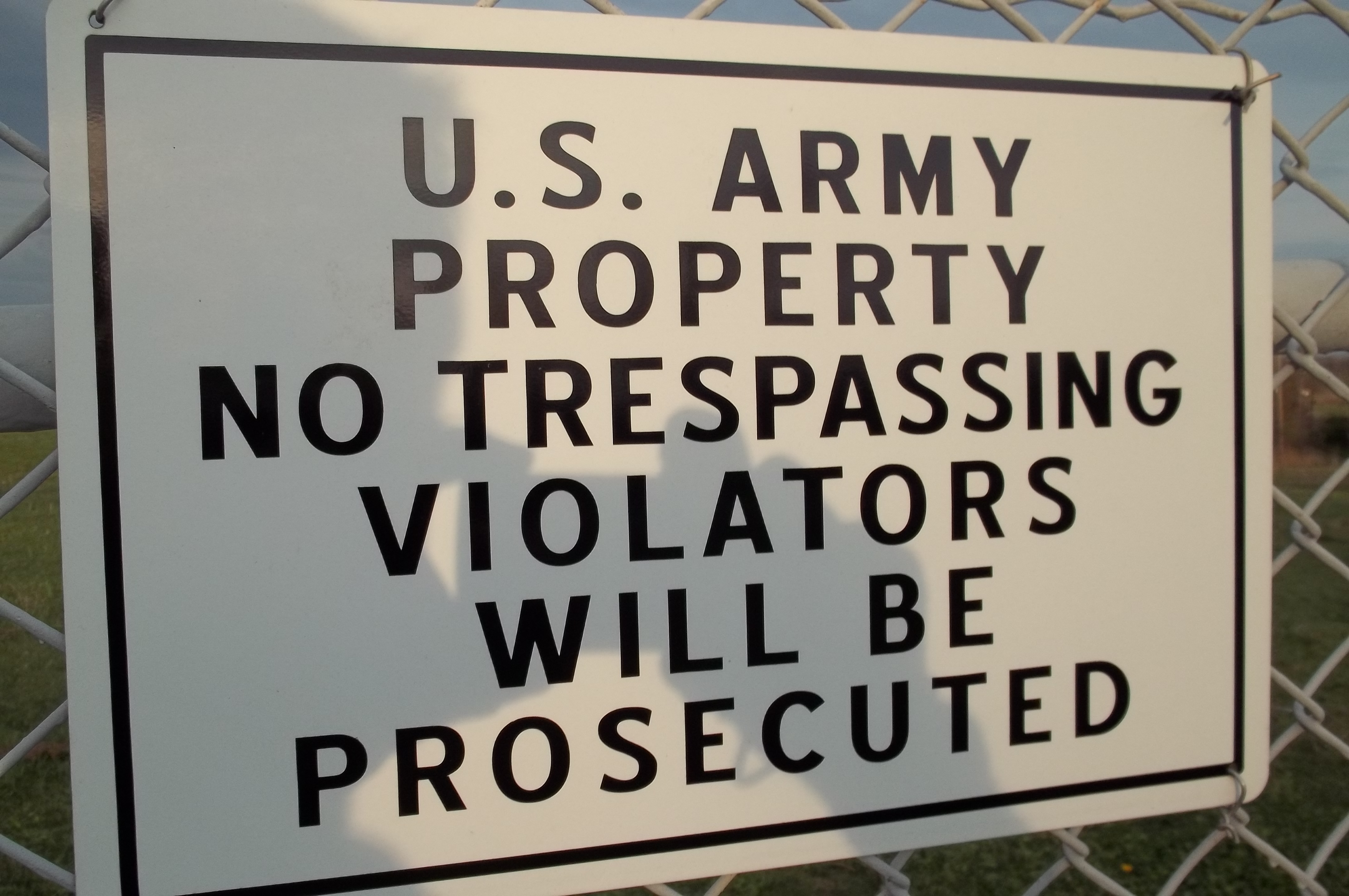
No Trespassing Sign on Army Base

Military Munitions, RCRA, and the Federal Facilities Compliance Act of 1992

No Trespassing Sign on Army BaseThe legislation known as RCRA (the Resource Conservation and Recovery Act) was passed in 1976, with regulations being enacted by the US EPA in 1980.  For the longest time, it was uncertain if the RCRA regulations applied to Federal facilities.  Some cited sovereign immunity to claim that they need not follow the RCRA regulations in managing their hazardous waste.  Others, voluntarily complied with RCRA in a haphazard way that made enforcement difficult.

To clear up this confusion, FFCA (the Federal Facilities Compliance Act) was passed in 1992.  It required federal facilities (those within the Executive branch of the US Government) to comply with the RCRA regulations enforced by federal, state, or local authorities or face civil and criminal penalties.  Federal facilities includes the US Armed Services, which resulted in waste generated by the military, including military munitions, becoming subject to RCRA regulations.  Confusion about the exact management requirements of military munitions under RCRA continued, however, until the passage of the Military Munitions Rule in 1997.  This rule clarified the point of generation of solid and hazardous waste for military munitions and who is subject to the regulations.

The rule created a definition of military munitions, found at 40 CFR 260.10:

Military munitions means all ammunition products and components produced or used by or for the U.S. Department of Defense or the U.S. Armed Services for national defense and security, including military munitions under the control of the Department of Defense, the U.S. Coast Guard, the U.S. Department of Energy (DOE), and National Guard personnel. The term military munitions includes: confined gaseous, liquid, and solid propellants, explosives, pyrotechnics, chemical and riot control agents, smokes, and incendiaries used by DOD components, including bulk explosives and chemical warfare agents, chemical munitions, rockets, guided and ballistic missiles, bombs, warheads, mortar rounds, artillery ammunition, small arms ammunition, grenades, mines, torpedoes, depth charges, cluster munitions and dispensers, demolition charges, and devices and components thereof.  Military munitions do not include wholly inert items, improvised explosive devices, and nuclear weapons, nuclear devices, and nuclear components thereof. However, the term does include non-nuclear components of nuclear devices, managed under DOE’s nuclear weapons program after all required sanitization operations under the Atomic Energy Act of 1954, as amended, have been completed.

Note the list of materials that the term military munitions includes, and doesn’t include (note my emphasis added to the above).  Also, be aware that the rule applies not only to the military, but to contractors or other parties acting as their agent.

Further, the rule amended §261.2(a)(2) to include military munitions identified as a solid waste per §266.202 as a 4th type of discarded material.  This is important, because in order to be a hazardous waste, and therefore subject to Cradle to Grave regulation, it must first be a solid waste.  The identification of a solid waste starts you on the path toward determination of a hazardous waste, if exemptions apply, and what regulations with which you must comply.

So, when is a military munition a solid waste?

The RCRA regulations at §266.202 (§266, Subpart M) identifies the status of four activities involving military munitions and whether or not they are a solid waste:

  1. SOLID WASTE:  Unused munitions designated for disposal; these include:
    1. Munitions that have been or are being disposed, burned, or otherwise treated prior to disposal [§266.202(b)(1)].
    2. Munitions removed from storage for the purpose of being disposed, burned, or otherwise treated prior to disposal [§266.202(b)(2)].
    3. Leaking or deteriorated munitions [§266.202(b)(3)].
    4. When an authorized military official declares the munitions to be a solid waste [§266.202(b)(4)].
  2. NOT SOLID WASTE:  Unused munitions that are disassembled, repaired, or otherwise recovered [§266.202(a)(2)].
  3. NOT SOLID WASTE:  Munitions used for training, research and development, or evaluation.  If used for its intended purpose, it is not a solid waste.  The regulations cite two situations where this condition applies:
    1. Military training exercises [§266.202(a)(1)(i)].
    2. Weapons testing, research and development, or evaluation [§266.202(a)(1(ii)].
  4. NOT SOLID WASTE:  Range clearance operations that take place on-range at active or inactive sites [§266.202(a)(1)(iii)].  SOLID WASTE:  Military munitions shipped off-range for treatment or disposal for range clearance operations.

The Federal Facilities Compliance Act (FFCA) of 1992 expanded the reach of RCRA to include federal facilities within the Executive branch of the US government.  If you are a commercial or industrial facility, you were already subject to the Resource Conservation and Recovery Act and compliance with these regulations is not an option.  The RCRA regulations require generators of hazardous waste to train their Facility Personnel who need to know the regulations in order to do their job safely and in compliance with the regulations.  Contact me to determine the type of training that is right for you.

U.S. EPA Fines U.S. Pipe Company for Hazardous Waste Violations

“Baghouse dust” improperly managed, posed threat to worker safety

SAN FRANCISCO – The U.S. Environmental Protection Agency has fined the Union City, Calif.-based United States Pipe and Foundry Company (U.S. Pipe) $158,000 for improperly managing “baghouse dust,” a hazardous waste containing cadmium and lead generated from iron pipe fabrication, under the federal Resource Conservation and Recovery Act (RCRA).

EPA discovered in an August 2011 inspection that U.S. Pipe had failed to contain the dust, which was found on the ground of the facility.  The facility cleaned up the spilled dust and soil where the dust was found, and conducted subsequent sampling to ensure all contamination was removed.

“EPA is committed to ensuring hazardous waste is properly managed,” said Jared Blumenfeld, EPA’s Regional Administrator for the Pacific Southwest.  “Preventing the release of this dust is critical to protect U.S. Pipe workers and the environment.”

Following EPA’s findings, U.S. Pipe modified its operational practices to minimize the potential for future releases and improved staff training in proper dust management.

The Resource Conservation and Recovery Act authorizes EPA to oversee the generation, transportation, treatment, storage, and disposal of hazardous waste.  Under RCRA, hazardous waste must be stored in closed and labeled containers.

For more information on the Resource Conservation and Recovery Act, visit:  http://www.epa.gov/lawsregs/laws/rcra.html.

What is a Universal Waste Pesticide?

The Universal Waste regulations found at 40 CFR 273 present an option for generators of hazardous waste to manage certain of those waste by a reduced regulatory burden.  The Universal Waste regulations contain many differences between the Federal level (the subject of this article) and the states.  For that reason, it is a good idea to check with your state’s Universal Waste program to ensure compliance.

The US EPA recognizes four types of Universal Waste, most states I am familiar with accept these four as well, and may add additional types of waste of their own; they are:

  • Lamps
  • Mercury-Containing Devices
  • Batteries
  • Pesticides

As the title implies, the purpose of this article is to identify what is meant by a “pesticide” in the context of the Universal Waste regulations.  This requires an answer to two questions:

1.  How do the Universal Waste regulations define a pesticide?

40 CFR 273.9:  Pesticide means any substance or mixture of substances intended for preventing, destroying, repelling, or mitigating any pest, or intended for use as a plant regulator, defoliant, or desiccant, other than any article that:

(a) Is a new animal drug under FFDCA section 201(w), or

(b) Is an animal drug that has been determined by regulation of the Secretary of Health and Human Services not to be a new animal drug, or

(c) Is an animal feed under FFDCA section 201(x) that bears or contains any substances described by paragraph (a) or (b) of this section.

2.  What pesticides are applicable to use the Universal Waste option?

This is more complicated and requires a close reading of §273.3.  If a pesticide meets the definition of §273.9, it must also meet all of the conditions listed below.

  1. Like all Universal Waste, a pesticide as defined above, must first be a waste as described in §261 (ie. it must be something to be discarded or no longer able to perform its function).  A further explanation of when a pesticide is, or isn’t, a waste is explained later in this article.
  2. Also, just like all other Universal Waste, a pesticide must be identified as a hazardous waste in §261 subparts C (characteristic) or D (listed).
  3. It must be a recalled pesticide that is part of a voluntary or mandatory recall under Section 19(b) of FIFRA (Federal Insecticide, Fungicide, and Rodenticide Act).  This includes but is not limited to those pesticides owned by the registrant responsible for conducting the recall. Or, stocks of a suspended or cancelled pesticide, out of compliance with FIFRA, that are part of a voluntary recall by the registrant.
  4. Or, it may an unused pesticide products that is collected and managed as part of a waste pesticide collection program.

However, pesticides that meet the conditions of #’s 3 & 4 above are not covered by and cannot use the Universal Waste regulations if they are managed by farmers in compliance with 40 CFR 262.70.

§273.3(c) describes when a pesticide becomes a waste for the purposes of this part, and would therefore meet condition #1 above:

  • A recalled pesticide becomes a waste when the generator of the recalled pesticide agrees to participate in the recall, and, when the person conducting the recall decides to discard.
  • An unused pesticide becomes a waste on the day the generator decides to discard it.

§273.3(d) identifies pesticides that are not wastes, and therefore would fail the requirements of condition #1 above, as follows:

  • The person conducting the recall of a recalled pesticide has not made a decision to discard it.  The recalled pesticide would remain subject to the requirements of FIFRA.
  • The person conducting the recall of a recalled pesticide has decided on a management option, that under §261.2, does not cause the pesticide to be a solid waste.  The recalled pesticide would remain subject to the requirements of FIFRA.
  • An unused pesticide which the generator was not decided to discard.  The unused pesticide would remain subject to the requirements of FIFRA.

If you are able to manage your pesticides as a Universal Waste instead of a hazardous waste, I suggest you research your State’s Universal Waste regulations as they pertain to pesticides.

The Universal Waste regulations are a great option for generators of hazardous waste, others include Used Oil and Satellite Accumulation Areas.  Your knowledge of these options and how to use them can save you time and money.  My training sessions address topics just like these in addition to meeting the regulatory requirements of 40 CFR 262.34(a)(4) and 40 CFR 265.16.  Contact me for a free consultation on your training needs.

Boehringer Ingelheim Vetmedica, Inc., in St. Joseph, Mo., to Pay Penalty and Build New Hazardous Waste Facility for Mercury Violations

Release Date: 09/24/2012

Contact Information: Ben Washburn, 913-551-7364, washburn.ben@epa.gov

(Kansas City, Kan., Sept. 24, 2012) – Boehringer Ingelheim Vetmedica, Inc., a veterinary health products company, has agreed to pay a $68,475 civil penalty to the United States to settle a series of Resource Conservation and Recovery Act violations based on its mishandling of mercury waste in St. Joseph, Mo.

In addition to paying the civil penalty, the company will spend a minimum of $300,000 to build a state-of-the art hazardous waste storage facility at the site as part of a supplemental environmental project.

According to an administrative consent agreement and final order filed by EPA Region 7 in Kansas City, Kan., EPA representatives inspected the company’s St. Joseph facilities in May 2010, and noted several violations of the federal Resource Conservation and Recovery Act (RCRA), which regulates hazardous waste. Boehringer generates mercury as part of its vaccine production process.

“The proper handling and management of hazardous waste is an integral part of protecting human health and the environment,” EPA Region 7 Administrator Karl Brooks said. “In the event of an accidental release on site or while in transport, proper labeling, storing, and management practices can help reduce the risk of exposure to hazardous material by response personnel as well as reduce risk to public health by identifying the necessary and proper cleanup methods.”

The violations included failure to perform hazardous waste determinations on multiple waste streams, storing hazardous wastes without a RCRA permit, failing to comply with generator requirements, sending hazardous waste containing mercury to a non-authorized facility, transporting hazardous waste without a hazardous waste transporter license or manifest, failure to comply with universal waste lamp requirements, and failure to comply with recycled used oil management standards.

By agreeing to the settlement with EPA, Boehringer Ingelheim Vetmedica, Inc., has certified that it is now in compliance with all requirements of the RCRA regulations.

Proper training is the answer to the question, “How can I avoid these violations?”  Contact me to receive the training you need to learn what you need to know to maintain compliance.

Why Doesn’t a Bulk Packaging Include a Barge or Vessel?

A Bulk Packaging, defined at 49 CFR 171.8:  “Means a packaging, other than a vessel or a barge, including a transport vehicle or freight container, in which hazardous materials are loaded with no intermediate form of containment. A Large Packaging in which hazardous materials are loaded with an intermediate form of containment, such as one or more articles or inner packagings, is also a bulk packaging. Additionally, a bulk packaging has:

  1. A maximum capacity greater than 450 L (119 gallons) as a receptacle for a liquid;
  2. A maximum net mass greater than 400 kg (882 pounds) and a maximum capacity greater than 450 L (119 gallons) as a receptacle for a solid; or
  3. A water capacity greater than 454 kg (1000 pounds) as a receptacle for a gas as defined in §173.115 of this subchapter.”

Simple enough, but why is it that a vessel or barge is specifically excluded from the definition of a Bulk Packaging?

Before we get to the answer, let’s make sure we understand the terms, both of which are defined at 49 CFR 171.8:

  • “Vessel includes every description of watercraft, used or capable of being used as a means of transportation on the water.”
  • “Barge means a non-self propelled vessel.”

The answer, is that any material, including a hazardous material, loaded directly into the hold of a vessel or barge is subject to the regulations of the US Coast Guard and not the Pipeline and Hazardous Materials Administration (PHMSA) of the US DOT and therefore not subject to the Hazardous Material Regulations.

The transportation of hazardous materials involves many different methods (air, water, highway, rail) each of which is subject to the regulations of the PHMSA.  But other Federal agencies have their own authority and their own regulations that may impact the shipment as well.  Learn what you need to know about the transportation of hazardous materials at my training, either On-Site or Public Workshop/Open Enrollment.  Contact me for a free consultation on your training needs.

Search Website