PO Box 1232 Freeport, IL 61032

A Different Kind Of Training

A Different Kind Of Training

A Different Kind Of Training

Punctuation in the Proper Shipping Name and Basic Description for a Hazardous Material

In an earlier article I used the regulations of the US DOT to debunk a common misconception that  the description of a hazardous material on a shipping paper or a marking on a package must appear exactly as it does in the Hazardous Materials Table; down to each and every comma.  In my days of driving a truck for Laidlaw Environmental Services I was told that each missing comma between the elements of a Basic Description:  Identification Number, Proper Shipping Name, Hazard Class, & Packing Group could result in a separate violation and fine.  This is not true.  The concern of the US DOT regarding the proper shipping description of a hazardous material is not its punctuation, but whether or not it communicates the hazards of the material in transportation.

There are, however, some situations where a specific form of punctuation is required by the Hazardous Materials Regulations (HMR):

  1. 49 CFR 172.203(k) requires the Technical Name of the material be entered in (parenthesis) in association with the Basic Description (meaning, somewhere at the beginning or the end) if its entry in the Hazardous Materials Table includes the letter G in column 1.
  2. §172.202(a)(3) requires the subsidiary hazard class(es) be entered in (parenthesis) immediately following the primary hazard class.  The presence of a subsidiary hazard class – or classes – will be indicated in column 6 of the Hazardous Materials Table.
  3. If the hazardous material is a Hazardous Substance and the name of the Hazardous Substance is not a part of the Proper Shipping Name, then §172.203(c) requires the name of the Hazardous Substance, or a Hazardous Waste Code if applicable, be entered in (parenthesis) in association with the Basic Description.
  4. If the hazardous material is a Marine Pollutant and the name of the Marine Pollutant does not appear in the Proper Shipping Name, then §172.203(l) requires the name of the Marine Pollutant be entered in (parenthesis) in association with the Basic Description.

There may be other regulations within the HMR that require the use of punctuation as part of the Basic Description, but these are the ones I am most familiar with, and the ones you are most likely to encounter.  If you have a question about the HMR (Hazardous Materials Regulations) of the US DOT or the hazardous waste regulations of the US EPA, please don’t hesitate to contact me.

What is the Consumer Commodity Exception to the Hazardous Material Regulations?

A substance or material that the US DOT has determined is capable of posing an unreasonable risk to health, safety, and property will be regulated as a Hazardous Material when offered for transportation or transported in commerce.  Some Hazardous Materials are granted an exception from full regulation under the Hazardous Materials Regulations (HMR) if the US DOT believes that under certain specified combinations of packaging, quantity, or form it poses a low enough risk to preclude the need for full regulation.  One example of such an exception is the Consumer Commodity Exception.

The Consumer Commodity Exception is designed to allow for the transportation in commerce of hazardous materials:  bleach, drain cleaners, solvents, aerosols, etc. in small packagings (Limited Quantities) as long as those materials are, or similar to, the consumer products you see on retail store shelves.  The process to determining if a hazardous material may be shipped as a Consumer Commodity involves several steps, they are briefly outlined below:

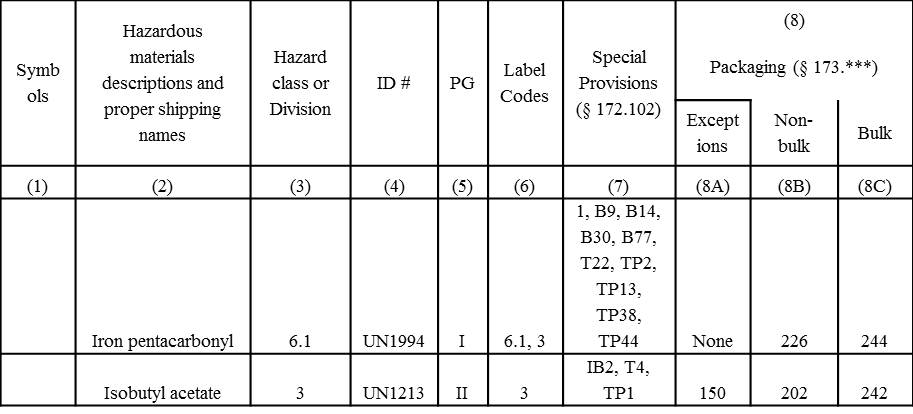
  1. The hazardous material must first be eligible for the Limited Quantity Exception; the applicability of the Limited Quantity Exception is indicated in Column 8A of the Hazardous Materials Table @ 49 CFR 172.101 for each entry.  If it is available, Column 8A will reference the Section of Part 173 of Title 49 CFR that includes the requirements for shipping the hazardous material as a Limited Quantity.  An example of a hazardous material that may not use the Limited Quantity Exception is:  Iron Pentacarbonyl; one that may is:  Isobutyl Acetate (refer to §173.150 for more information on shipping this HazMat as a Limited Quantity).
  2. In the example of Isobutyl Acetate in the Hazardous Materials Table, a shipper will need to comply with all the requirements of §173.150 in order to ship the HazMat in compliance with the Limited Quantity Exception.
  3. If the Limited Quantity Exception is available and it also meets the definition of a Consumer Commodity you may then change its shipping name to Consumer Commodity and its hazard class to ORM-D.  A Consumer Commodity is defined at §171.8:

Consumer commodity means a material that is packaged and distributed in a form intended or suitable for sale through retail sales agencies or instrumentalities for consumption by individuals for purposes of personal care or household use. This term also includes drugs and medicines.

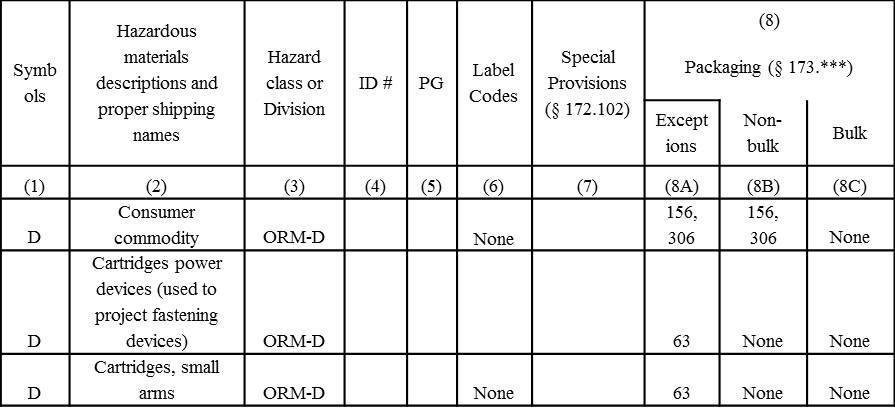
The Hazardous Materials Table entry for a Consumer Commodity looks like this:

Symbols

Hazardous materials descriptions and proper shipping names

Hazard class or Division

ID#

PG

Label Codes

Special Provisions (§ 172.102)

(8)

Packaging (§ 173.***)

Exceptions

Non-bulk

Bulk

(1)

(2)

(3)

(4)

(5)

(6)

(7)

(8A)

(8B)

(8C)

D

Consumer commodity

ORM-D

None

156, 306

156, 306

None

Benefits to use of the Consumer Commodity Exception include:

  • No placards.
  • No shipping papers.
  • No labels.
  • Strong outer packaging acceptable instead of specification packaging.
  • No marking, other than ORM-D or ORM-D Air as applicable.


Unfortunately, the Consumer Commodity Exception and the ORM-D hazard class are not acceptable for international shipments of hazardous materials.  In order to bring our regulations into alignment with the rest of the world, the US DOT is currently phasing out ORM-D and the Consumer Commodity Exception and replacing it with a revised Limited Quantity Exception on the following schedule.

  • ORM-D-Air not acceptable for use after 12.31.12.
  • ORM-D not acceptable for use after 12.31.13.  US DOT has proposed extending this deadline to 12.31.15.
READ HERE HOW USE OF THE CONSUMER COMMODITY EXCEPTION HAS BEEN EXTENDED UNTIL THE END OF 2020.

I recently conducted on-site training for a facility that manufactured and shipped Consumer Commodities.  This change to the regulations had a significant impact on their business, but with training and a productive Q & A session, I feel confident I left them with a path forward thr0ugh this revision to the regulations.  Contact me and let me know how this change to the HMR will affect your operations and if you have any questions for me.

HMT for ORM D

What is an Other Regulated Material (ORM-D)?

49 CFR 171.8 reads, “ORM means other regulated material. See §173.144 of this subchapter.”  That’s not much to go on but it’s a start.  §173.144 defines an ORM-D as:

Until December 31, 2013 and for the purposes of this subchapter, “ORM-D material” means a material such as a consumer commodity, cartridges, small arms or cartridges, power devices which, although otherwise subject to the regulations of this subchapter, presents a limited hazard during transportation due to its form, quantity and packaging. It must be a material for which exceptions are provided in Column (8A) of the § 172.101 Hazardous Materials Table.

Editors Note:  Though originally slated to expire December 31, 2013, the phase-out date for the ORM-D hazard class and the Consumer Commodity exception has now been extended until December 31, 2020.
Read:  Authorization for use of the ORM-D classification and the Consumer Commodity Exception extended through 2020!
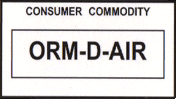
Consumer Commodity ORM-D Label
Though it’s days are numbered, you may still see this marking on store shelves

So, §171.8 refers to all ORM, but §173.144 is specific to just ORM-D.  It is left unsaid that there used to be five different divisions to the ORM hazard class:  ORM-A through ORM-E.  Of these five, only ORM-D remains, and its time is limited; thus the inclusion of “Until December 31, 2013…” in the definition.

For now, we’ll continue to focus on the definition of ORM-D, we’ll come back to “Until December 31, 2013…” later.  The above definition is found in Subpart D of Part 173 – Definitions Classification, Packing Group Assignments and Exceptions for Hazardous Materials Other Than Class 1 and Class 7.  Notice then that ORM-D is a type of Hazard Class, similar to Class 3 – Flammable and Combustible Liquid and Class 8 – Corrosive Material.  And, contrary to what you’ve been told, the “D” in ORM-D does not stand for Domestic.  It merely distinguishes it from the other ORM’s that used to exist.

Per the definition, an ORM-D is a hazardous material that normally would be subject to all the requirements of the Hazardous Material Regulations (HMR) but due to its (1) form, (2) quantity, and (3) packaging presents a limited risk in transportation.  All three of those conditions must be met for a HazMat to be re-classed as an ORM-D.

Hazardous Materials that are applicable to be re-classed as an ORM-D are limited to the following:

  • Consumer Commodity.
  • Cartridges, small arms.
  • Cartridges, power devices.

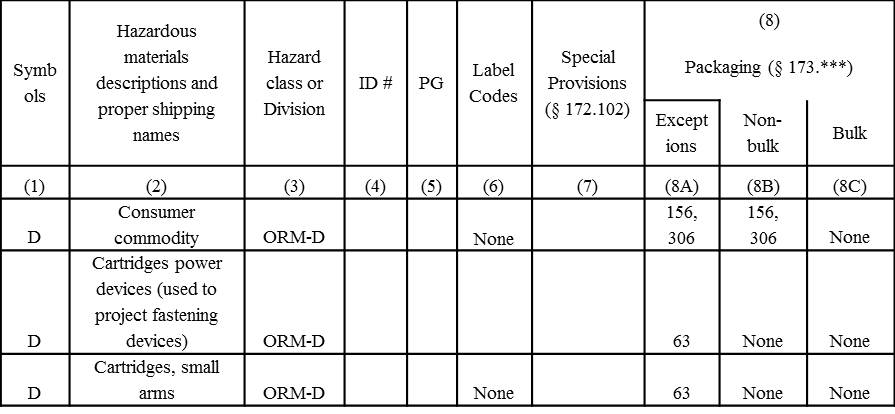
In addition to the above list, the ORM-D exception is available only if a section of  Part 173 is referenced in Column 8A of the Hazardous Materials Table (49 CFR 172.101).  For example, the Hazardous Material Table entries for the above ORM-D’s reads:

So, to learn the packaging exceptions available for a Consumer Commodity classed as an ORM-D, you refer to 49 CFR 173.156 or §173.306 (the sections of Part 173 referenced in column 8A of the Hazardous Materials Table).  For Cartridges, Power Devices and Cartridges, Small Arms, you refer to §173.63.

Benefits to the re-classification of a hazardous material as an ORM-D include:

  • No placards.
  • No labels unless shipped by air.
  • No shipping paper unless shipped by air or vessel.
  • No packing group or identification number.
  • Specification packaging not required as long as applicable packaging requirements are met.

The biggest drawback to using the ORM-D Hazard Class is that it is not recognized by international regulations.  To address this the US DOT is in the middle of a phase out of the Consumer Commodity Exception and the ORM-D hazard class.

Editors Note:  Though originally slated to expire December 31, 2013, the phase-out date for the ORM-D hazard class and the Consumer Commodity exception has now been extended until December 31, 2020.
Read:  Authorization for use of the ORM-D classification and the Consumer Commodity Exception extended through 2020!

The HMR is always changing, and no one will let you know of the changes until it is too late.  Stay on top of these changes by attending my Seminar Training, scheduling Onsite Training, or attending a Webinar.  It will bring you into compliance and inform you of what you need to do to stay in compliance in the future.

Daniels Training Services

815.821.1550

Info@DanielsTraining.com

https://danielstraining.com/

Former and Present Other Regulated Materials (ORM)

Currently, and only until December 31, 2013 when it will cease to exist (unless an extension requested by US DOT to December 31, 2015 is granted), there is only one category of Other Regulated Material.  In the distant past (known as “The 90’s”) however, there were five of them:  ORM-A through ORM-E.  What remains today is the one known as Other Regulated Material-D or ORM-D.

The definition of ORM at 49 CFR 171.8 identifies it as an Other Regulated Material and refers to §173.144 (see below) which goes on to define solely the ORM-D; no reference is made to the other types of ORM.  While they no longer impact the Hazardous Material Regulations, an understanding of the history the HMR does help to develop a full appreciation of the existing regulations.  To fulfill your curiosity the full list of Other Regulated Materials – both past and present – are identified below:

  • ORM-A means a material which has an anesthetic, irritating, noxious, toxic, or other similar property.  It is regulated due to concern that a release during transportation could cause extreme annoyance to passengers and crew of transport vehicles.  No longer in use.
  • ORM-B means a material, including a solid when wet with water, that could cause significant damage to the transportation vehicle if it were to leak during transportation. An ORM-B material (no longer in use) is:
    1. Specifically designated by name in §172.101, and/or;
    2. A liquid that has a corrosin rate exceeding 0.250 inch per year (IPY) on non-clad aluminum.
  • ORM-C means a material which has other inherent characteristics not described as an ORM-A or ORM-B, but which make it unsuitable for shipment, unless properly identified and prepared for transportation.  ORM-C materials are specifically designated by name at §172.101.  No longer in use.
  • ORM-D in use at least until December 31, 2013 and defined at §173.144 means a material such as a consumer commodity, cartridges, small arms or cartridges, power devices which, although otherwise subject to the regulations of this subchapter, presents a limited hazard during transportation due to its form, quantity and packaging.  It must be a material for which exceptions are provided in Column (8A) of the §172.101 Hazardous Materials Table.
  • ORM-E means a material that is not included in any other hazard class but is subject to the requirements of this subchapter.  Materials in this class (no longer in use) include:
    1. Hazardous Waste, and;
    2. Hazardous Substances.

The list above is more of a historical record than an identification of current regulations since all but the ORM-D have been eliminated and it will be no more within a few more years.  The Hazardous Material Regulations (HMR) of the US DOT are always changing, and it is your responsibility to stay on top of them, my training will help you to do that.  Contact me with questions about the HMR or the Hazardous Waste regulations of the US EPA.

Some Changes to the Hazardous Material Regulations for 2013

It seems that as soon as you understand the regulations they change it.  And that’s the case with several aspects of the Hazardous Material Regulations (HMR) that are scheduled to change as of this December 31st.  This list does not attempt be be all-inclusive but it does summarize the big changes to the HMR to watch for in the new year.

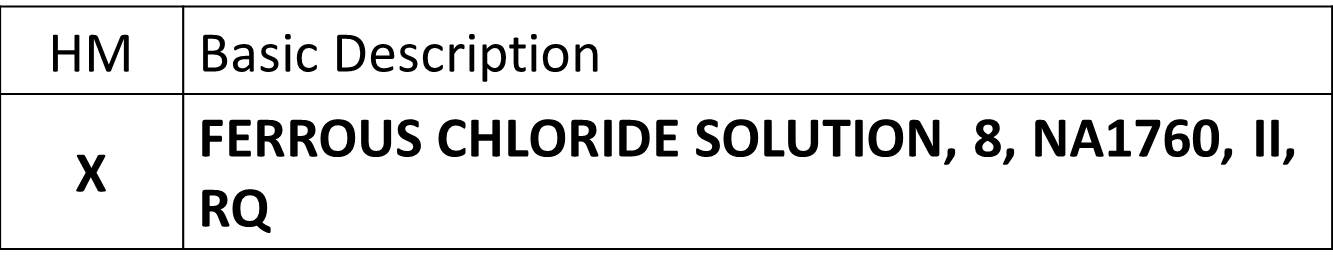
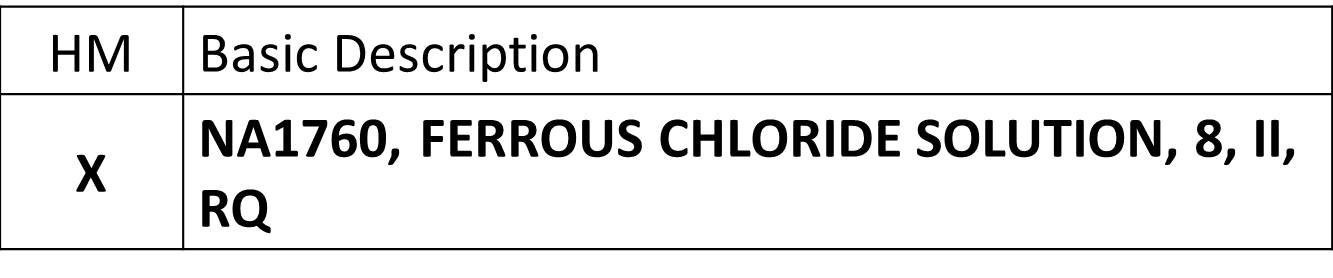
  • Change in the order of the basic description.  After 12.31.12, the only acceptable order for the basic description when describing a hazardous material is:  (1) Identification Number, (2) Proper Shipping Name, (3) Hazard Class, and (4) Packing Group.  The old order, and still acceptable until 12.31.12, but not after is:  (1) Proper Shipping Name, (2) Hazard Class, (3) Identification Number and (4) Packing Group.  Notice that the Identification Number has been moved from 3rd to 1st in the order of the Basic Description, this was done to align domestic regulations with international and to make the Identification Number, which plays a key role in emergency response, more visible.

The order of the Basic Description acceptable only until 12.31.12:

The order of the Basic Description that must be used as of 1.1.13:

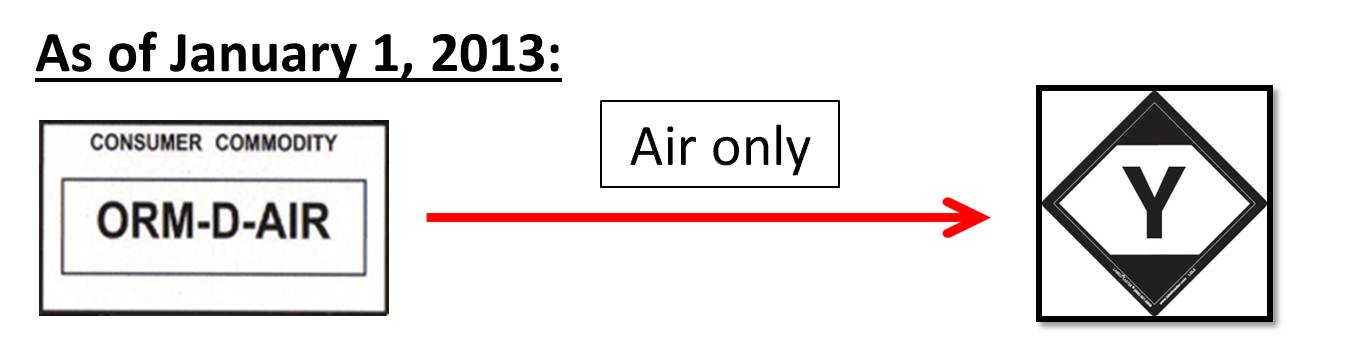
  • End of Consumer Commodity shipments as an ORM-D by air.  As part of its long-term phase out of the Consumer Commodity exception and the ORM-D hazard class, 12.31.12 is the deadline for use of this exception for shipments of hazardous materials by air.  After this date a hazardous material that meets the definition of a Consumer Commodity and is to be transported by air must either be shipped according to the new Limited Quantity rules, or as a hazardous material subject to the full HMR.  The purpose of this change is to align domestic and international regulations, since the Consumer Commodity Exception is not recognized in international transportation.  The revision was designed to minimize the impact on shippers of Consumer Commodities, so it is likely that any HazMat you are currently shipping as a Consumer Commodity will be applicable for the Limited Quantity Exception which, other than its marking, differs little from the current Consumer Commodity Exception.  Hazardous materials may continue to use the Consumer Commodity exception for shipments by ground or vessel until 12.31.13 (US DOT has requested an extension of this date to 12.31.15).

  • End of the Limited Quantity marking for shipments by air.  Along with the phase-0ut of the Consumer Commodity Exception referenced above the current Limited Quantity marking is being revised as of 12.31.12 to come into alignment with international regulations.  After 12.31.12 the current Limited Quantity marking will no longer be acceptable for shipments by air of a hazardous material using the Limited Quantity Exception.  Other changes to the regulation may affect other aspects of your Limited Quantity shipment as well.

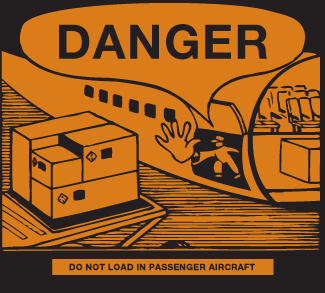
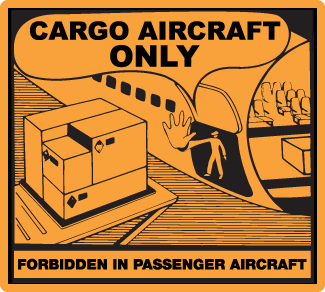
  • End of the “Danger” label for shipments of HazMat forbidden from transport in passenger aircraft.    The purpose of this label is to alert shipping personnel to hazardous material packages that can not be loaded on a passenger carrying aircraft; they are required by IATA, ICAO, and US DOT regulations.  The change (mandatory after 12.31.12) is being made to provide a better warning to HazMat Employees who may handle these packages.

Old label, valid until 12.31.12:

New label, must be used as of 1.1.13:

I’m sure there’s more, but these are the big ones I’m familiar with.  Please feel free to contact me if you are aware of any impending changes to the regulations or have any question about how these changes may affect you.  My training is a great way to learn the HazMat regulations and to get your questions answered.  I also provide training for Hazardous Waste Personnel required by the US EPA.


Transportation of Hazardous Materials Between the US and Canada

Persons responsible for the safe transportation of hazardous materials within the U.S., known as HazMat Employees, must receive the training required by the US DOT at 49 CFR 172, Subpart H.  If you only ship hazardous materials domestically, by highway or rail, then this is the only training necessary.

The transportation of HazMat in Canada – known there as dangerous goods – is subject to the regulations of Transport Canada:  The Canadian Transportation of Dangerous Goods Regulations.  Transport Canada has similar training requirements to those of the US DOT for all persons involved in the handling, offering for transport and/or transporting of dangerous goods.  With a few exceptions for differences between the two country’s regulations (see below); both the US DOT @ 171.12 and Transport Canada generally accept compliance with the other’s regulations for transport by highway or rail between the two countries.

This acceptance extends to the allowance of training completed per the regulations of one country (either the US or Canada) to meet the training requirements of the other for the transportation of HazMat/dangerous goods by highway or rail.  In other words, HazMat Employees trained and tested per the requirements of the US DOT may handle, offer for transport, or transport a HazMat/dangerous good into, from, and/or through Canada by highway or rail.  Conversely, a person trained according to the requirements of Transport Canada’s regulations may handle, offer for transport, or transport a HazMat/dangerous good into, from, and/or through the US by highway or rail.  This guidance document from Transport Canada explains their side of this agreement (RDIMS #5907129, June 2010).

Regardless of the understanding between the two countries (limited only to shipments by highway or rail), as the shipper of a hazardous material/dangerous good, it is your responsibility to ensure your compliance with the regulations of the respective national agency.  Below are a few situations where compliance with one nation’s regulations will not suffice for the requirements of the other:

  • A hazardous material/dangerous good forbidden by one country but not by the other.
  • A hazardous material/dangerous good regulated by one country but not by the other.
  • The hazardous material/dangerous good is transported under an exception to the regulations recognized by one country but not the other.
  • Other differences in the regulations.  Example:  The Class 9 placard is required to be used in Canada if applicable, but is not required to be used in the US under any circumstances.

Also please note that an agreement of accepting compliance with another country’s regulations for transportation within another does not exist between the US and Mexico.

Determination of compliance with the regulations, both domestic and international, is your responsibility as the shipper of a hazardous material/dangerous good.  As a HazMat Employer you must also ensure your HazMat Employees are properly trained.  My training will not only meet the regulatory requirements, but it will give you the tools you need to ensure compliance with the regulations, no matter the destination of your hazardous materials.


Episodic Generation of Hazardous Waste

The RCRA regulations identify three status of hazardous waste generators determined by the amount of hazardous waste generated in a calendar month:

  1. Large Quantity Generator (LQG) – Generates ≥1,000 kg of hazardous waste or >1 kg of acute hazardous waste per calendar month.
  2. Small Quantity Generator (SQG) – Generates >100 kg but <1,000 kg of hazardous waste per calendar month.
  3. Conditionally Exempt Small Quantity Generator (CESQG) – Generates ≤100 kg of hazardous waste and ≤1 kg of acute hazardous waste per calendar month.

For many facilities their hazardous waste generation is routine enough that they are able to determine their hazardous waste generator status and then comply with the regulations of that status year after year.  For some facilities however, it’s not so easy; their rate of hazardous waste generation may vary from  month to month, as in the following example:  During a once every two years clean out of a storage tank, a CESQG that routinely generates < 50 kg/mo of spent acid generates 2,000 kg of a hazardous waste paint sludge all at once.  The US EPA foresaw this situation and describes such facilities as Episodic Generators of Hazardous Waste.  In the example the facility has two options:

  1. Comply with the regulations applicable to an LQG for the tank clean out waste for as long as it remains on-site, but continue to manage the spent acid according to the regulations of a CESQG; assuming of course that the generator is able to keep the two wastes distinct and separate (RO 12602).
  2. Manage all waste it generates in that month according to the regulations applicable to an LQG.

The management of hazardous waste at one facility according to two different standards may seem confusing, and may be more trouble than its worth however, it makes sense when you consider the spirit of the rule these regulations are based on:  The US EPA believes that an LQG should be held to a higher standard than a generator of less hazardous waste due to its higher potential for a significant environmental impact in the event of a release.  A distinct waste, generated at a lower rate, and kept separate from the higher-volume, higher-risk waste can be managed according to a less strict standard.  If, however, you are not able to keep the waste separate, then all of the waste must be managed pursuant to the regulations of the higher hazardous waste generator status.

In the preamble to the regulations that created the SQG status in 1986, the US EPA addressed this issue:

The Agency has always taken the position that a generator may be subjected to different standards at different times, depending upon his generation rate in a given calendar month (51 FR 10146, 10153 March 24, 1986).

The Agency goes on to state:

Thus, any non-exempt waste (referring to hazardous waste generated above the LQG threshold) that is generated during a calendar month in which the 1,000 kg/mo cutoff is exceeded is subject to full regulation until it is removed from the generator’s site.  If such fully regulated waste is mixed or combined with waste exempt or excluded from regulation or waste that is subject to reduced regulation under today’s final rule (the rule creating the SQG status), then all of the waste is subject to full regulation.

I added text in (parenthesis) in the above quote for clarification.

In addition, the RCRA Orientation Maual (EPA530-R-98-004) reads:

If a generator’s status does in fact change, the generator is required to comply with the respective regulatory requirements for that class of generators for the waste generated in that particular month.

I read it this way, If a generator’s status changes, the generator is required to comply with the respective regulatory requirements…

  • for the applicable generator status,
  • only for the distinct waste generated above the generator status threshold,
  • in the calendar month the waste was generated and for as long as it remains on-site.

Of course, once the waste generated above the threshold is shipped off site for treatment, storage, or disposal, the facility may resort to compliance with its routine generator status.

Be sure to check with your State before you take advantage of this Federal interpretation of the regulations.  It is quite possible that your State takes a more strict approach to this aspect of the regulations.

Compliance with the regulations is tricky, this particular article was written to answer a question I received at training a while back.  It took me far longer to answer the question than I prefer, but I now feel confident that I understand this particular aspect of the regulations and will be better able to field related questions in the future.  At my training, both On-Site or Public Seminars, I pride myself on answering the questions of my clients.  Contact me and give me a chance to answer your questions too.

Behlen Manufacturing Company to Pay $59,996 Civil Penalty for Hazardous Waste Violations in Columbus, NE

(Lenexa, Kan., Nov. 5, 2012) – Behlen Manufacturing Company, an agricultural and industrial product manufacturer, has agreed to pay a $59,996 administrative civil penalty to settle a series of Resource Conservation and Recovery Act (RCRA) violations in Columbus, Neb.

In addition to paying the civil penalty, the company will spend a minimum of $75,578 to install pollution reducing equipment as part of a supplemental environmental project.

According to an administrative consent agreement filed by EPA Region 7 in Kansas City, Kan., EPA representatives conducted a compliance evaluation inspection at the company’s Columbus facility in October 2009, and noted several RCRA violations. RCRA regulates the storage, handling, and labeling of hazardous waste.

“Behlen Manufacturing was cooperative throughout the negotiation process,” EPA Region 7 Administrator Karl Brooks said. “The innovative environmental project that Behlen will complete will turn wastes into a useful product and is an example of environmental stewardship for similar companies to follow.”

The violations at Behlen Manufacturing included failure to perform a hazardous waste determination, operating a hazardous waste storage facility without a RCRA permit, and failure to comply with universal waste requirements.

By agreeing to the settlement with EPA, Behlen Manufacturing Company has certified that it is now in compliance with all requirements of the RCRA regulations.

This article documents the fines paid by Behlen, but it can’t account for the loss to its good name by publicity of this sort.  Nor does it account for lawyer fees (you know lawyers were involved).  And yet, the cost for compliance is so low.  What would it take to prevent these violations from occurring?  Using the above news release as a guide, I say a few hours of documenting a hazardous waste determination, staying on top of hazardous waste accumulation dates through weekly inspections, and proper labeling and handling of universal waste.  I cover all of these topics, and a lot more, in my RCRA training (on-site or public workshops).  Contact me for a free consultation on your training needs and don’t let the next news release be about your company.

Maryland Air National Guard Settles Hazardous Waste Violations at Baltimore Facility

PHILADELPHIA (Oct. 18, 2012) — In a consent agreement with the U.S. Environmental Protection Agency, the Maryland Air National Guard (MDANG), 175th Wing, has agreed to pay a $75,000 penalty to settle alleged violations of hazardous waste regulations at its facility at 2701 Eastern Blvd., Baltimore, Md.

EPA cited MDANG for violating the Resource Conservation and Recovery Act (RCRA), the federal law governing the treatment, storage, and disposal of hazardous waste. RCRA is designed to protect public health and the environment, and avoid costly cleanups, by requiring the safe, environmentally sound storage and disposal of hazardous waste.

The consent agreement resolves alleged violations discovered in an April 2011 inspection of the facility. According to EPA, MDANG stored hazardous waste for more than 90 days without a RCRA hazardous waste permit or interim status, failed to provide annual hazardous waste training to some of its employees for a three-year period, and violated RCRA rules on labeling and recordkeeping. The wastes involved in these alleged violations include lubricants, paints, sealants, cleaning solutions and adhesive wastes. These wastes are hazardous because they exhibited the characteristics of being ignitable, corrosive or toxic due to chromium, methyl ethyl ketone or other compounds.

The settlement penalty reflects the MDANG’s compliance efforts, and its cooperation with EPA in the resolution of this matter. As part of the settlement, MDANG has neither admitted nor denied liability for the alleged violations, but has certified its compliance with applicable RCRA requirements.

Compliance with the RCRA regulations begins with training.  Contact me to learn just what training you need to ensure this doesn’t happen to you.

Sunoco Settles Hazardous Waste Violations at its Former Philadelphia Facility

PHILADELPHIA (Oct. 25, 2012) — Sunoco, Inc. (R&M) has agreed to pay a $117,000 penalty to settle alleged violations of hazardous waste regulations at its former facility located at 4701 Margaret St., Philadelphia, Pa., the U.S. Environmental Protection Agency announced today. 

EPA cited Sunoco for violating the Resource Conservation and Recovery Act (RCRA), the federal law governing the treatment, storage, and disposal of hazardous waste. RCRA is designed to protect public health and the environment, and avoid costly cleanups, by requiring the safe, environmentally sound storage and disposal of hazardous waste.

According to EPA, Sunoco violated RCRA requirements involving hazardous waste storage. The alleged violations related to storage of a hazardous waste (phenol sludge) without a RCRA hazardous waste permit; storage of a leaking spent lead-acid battery; and failure to keep universal waste lamps in a closed container.

The violations were discovered in an EPA inspection in September 2010. Sunoco subsequently sold this facility in July 2011. The settlement penalty reflects the company’s compliance efforts, and its cooperation with EPA in the resolution of this matter. As part of the settlement, Sunoco has neither admitted nor denied liability for the alleged violations, but has certified its compliance with applicable RCRA requirements.

Compliance begins with training.  Contact me for a free consultation of your training requirements for both hazardous waste and the transportation of hazardous materials.

Search Website