PO Box 1232 Freeport, IL 61032

A Different Kind Of Training

A Different Kind Of Training

A Different Kind Of Training

The Environmental Guide for Small Businesses in Minnesota

A guide created by the Small Business  Environmental Assistance Program (SBEAP) within the Minnesota Pollution Control Agency (MPCA).  It was created for small business manufacturers to provide them with a user-friendly guide to the regulations of the MPCA.  With this information an Environmental Health and Safety professional can determine if their company’s operations are subject to regulation and where they can go for assistance.

The Environmental Guide contains:

  • Short chapters focused by rule areas.
  • A flow chart helps you determine which rules apply to your business.
  • Details on regulation and step-by-step approach to complying.
  • Resources for additional information and assistance.

See the guide for yourself here:  The Environmental Guide for Small Businesses in Minnesota

Daniels Training Services

815.821.1550

Info@DanielsTraining.com

https://danielstraining.com/

If used correctly the information in a guide such as this can be used to acquire knowledge.  What you do with that knowledge as an EHS Professional is up to you.  I suggest you contact me for a free consultation on your requirements to comply with the hazardous material transportation regulations of the PHMSA/USDOT and the hazardous waste regulations of the MPCA.
Clean Harbors El Dorado, LLC fined $581,236 for Hazardous Waste Violations

The Bullet:

A big name Treatment Storage and Disposal Facility that should have known better got itself fined for what amounts to as a mis-interpretation of 40 CFR 261.2(e).  If you ever thought that some firms (the ones you know by name) are too big to make mistakes in complying with the hazardous waste regulations, think again.

Who:

United State Environmental Protection Agency (USEPA) Region 6.

Clean Harbors El Dorado, LLC

What:

The facility specializes in the treatment of hazardous and non-hazardous wastes by high temperature incineration. As part of its operations, Clean Harbor’s generated hazardous waste that was improperly sold as a commercial substitute. Under the federal RCRA program, hazardous substances must be stored, handled and disposed of using measures that safeguard public health and the environment. This waste is no longer being sold and all wastes are now properly being disposed.

Where:

El Dorado, AK

When:

Announced May 13, 2014.  Initial inspections that brought the violations to light were in 2009 & 2011.

Why:

EPA Regional Administrator Ron Curry:  “Environmental protection is everyone’s job and companies must follow our environmental laws.  Communities expect company’s work practices to protect lives and the environment. By enforcing the law, we do our part in protecting people where they live, work and play.”

How:

The USEPA is tasked with protecting the land, water, and air of the US from excessive environmental damage.

Conclusion:

As part of the agreement, Clean Harbors has also committed to conduct an environmental project, valued at $750,000 routing hazardous emissions from hazardous waste storage tanks to the secondary combustion chamber.

Read the USEPA Press Release

If a big company like Clean Harbors can make a mistake about the hazardous waste regulations, and then be fined because of that mistake, it behooves all of us to ensure we have received the proper training.  Please contact me for your free training consultation.

FMCSA Logo e1401833898795

What is a Commercial Learner’s Permit?

The primary mission of the Federal Motor Carrier Safety Administration (FMCSA) within the USDOT is to prevent commercial motor vehicle-related fatalities and injuries on US highways.  It does this through a variety of activities, one of which is to develop standards for the testing and licensing of commercial motor vehicle drivers.  Individual states have the option to exceed the requirements of the FMCSA in some areas, such as: medical, fitness, and other driver qualifications.  In addition, the administration of the Commercial Driver’s License (CDL) program and the issuing of licenses is the exclusive responsibility of each individual state.  So…FMCSA sets the minimum standards for CMV driver testing and licensing and states have the authority to exceed these standards – only for drivers domiciled within their state – and the responsibility to administer the CDL program – again only for drivers living within their state.FMCSA Logo

In addition to the CDL and pursuant to 49 CFR 383.25, states may issue a commercial learner’s permits (CLPs) for the purpose of behind-the-wheel driver training on public roads or highways.  A CLP is considered a valid CDL for behind-the-wheel training purposes only, as long as the following conditions are met:

  • CLP holder is accompanied and directly observed by someone with a valid CDL appropriate for the class and type of vehicle being operated.
  • CLP holder has a valid driver’s licensed from the same state that issued the CLP.
  • CLP holder has taken and passed a general knowledge test that meets the FMCSA standards for the CMV they operate or will operate.  This includes the applicable endorsements which are limited to:
    • ‘P’ for passenger.  Note:  a CLP holder may not transport passengers other than auditors, inspectors, other trainees, & the CDL holder.
    • ‘S’ for school bus.  Note:  a CLP holder may not operate a school bus with passengers other than auditors, inspectors, other trainees, & the CDL holder.
    • ‘N’ for tank vehicle.  Note:  a CLP holder may only operate an empty tank and can’t operate any tank vehicle containing the residue of a hazardous material.
    • No other Federal endorsements are allowed on a CLP.
  • CLP holder is 18 years old or older.
  • The CLP holder may not operate a CMV transporting a hazardous material as defined at 49 CFR 383.5.  Does this mean that the CMV operated by a CLP holder may have no hazardous materials?  No.  Read the FMCSA definition of a hazardous material to see why:

Hazardous materials means any material that has been designated as hazardous under 49 U.S.C. 5103 and is required to be placarded under subpart F of 49 CFR part 172 or any quantity of a material listed as a select agent or toxin in 42 CFR part 73.

So as long as it is not a select agent or toxin and placarding is not required per 49 CFR 172, Subpart F, it is possible for a CLP holder to transport a hazardous material in a CMV.

  • The CLP is valid for no more than 180 days from date of issuance.

There are a few more conditions, but those above are the main ones.  Be sure to read the full Federal regulations at 49 CFR 383.25 for yourself and check with your state to determine if their regulations are more strict.

Please note that the transportation in commerce of any hazardous material as defined by the Pipeline and Hazardous Materials Safety Administration (PHMSA) – another administration within the USDOT – requires HazMat Employee training for the operator of the motor vehicle within 90 days of employment and every three years thereafter.  This training must include an extra component on Safe Operation of a Motor Vehicle for drivers.  If you are interested in more information about HazMat Employee training for your drivers, I recommend the following:

Daniels Training Services

815.821.1550

Info@DanielsTraining.com

https://danielstraining.com/

If after reading the above you still have questions, please don’t hesitate to contact me for a free training consultation.


USEPA Announces $3.6 Million Made Available for Environmental Job Training Grants

The Bullet:

A lot of money ($3.6 million, to be exact) was made available to a variety of organizations to provide training in unspecified environmental disciplines for the unemployed and underemployed in their area.

Who:

United States Environmental Protection Agency (USEPA) made grant money available to 18 grantees nationwide; they are:

  • Hunters Point Family; San Francisco, Calif.
  • City of Durham, N.C.
  • Memphis Bioworks, Tenn.
  • City of Milwaukee, Wis.
  • Los Angeles Conservation Corps, Calif.
  • Cypress Mandela Training Center; Oakland, Calif.
  • St. Nicks Alliance; Brooklyn, N.Y.
  • Civic Works; Baltimore, Md.
  • Community Development Corporation of Tampa, Fla.
  • Limitless Vistas; New Orleans, La.
  • City of Camden, Ark.
  • Energy Coordinating Agency; Philadelphia, Penn.
  • Lewis and Clark County, Mont.
  • Alaska Forum
  • Northstar Center for Human Development; Hartford, Conn.
  • City of Detroit, Mich.
  • The Workplace, Inc.; Bridgeport, Conn.
  • Mo-Kan Regional Council; St. Joseph, Mo.
What:

Grant money to be used to train the unemployed and underemployed on the hazardous waste response (HazWoper) regulations of  the Occupational Health and Safety Administration.

Where:

Nationwide

When:

Announcement made May 12, 2014.

Why:

It is hoped that graduates of the program will go on to private-sector jobs in the “Green Economy”.

How:

Grant money is made available to local/regional organizations that then work with the private sector to provide the training and assist trained individuals with employment.  Read on if you’re interested in Funding Available Through the Workforce Investment Act.

Conclusion:

Daniels Training Services

815.821.1550

Info@DanielsTraining.com

https://danielstraining.com/

I’m all for training.  And if grant money is what it takes to get it done, that’s OK too.  Just be sure you get the right training.

Read the USEPA press release.

Pioneer Natural Resources in Amarillo, TX is Awarded the Texas Environmental Excellence Award

By taking an innovative approach to its pigging operations Pioneer Natural Resources earned for itself a 2014 Texas Environmental Excellence Award (TEEA). Using a three-tiered approach, Pioneer was able to reduce its operational emissions by 90 percent.  For its efforts, Pioneer was recognized with other winners’ projects at a banquet held on the last night of the TCEQ Environmental Trade Fair and Conference in Austin, TX.  BTW, I wasn’t able to make the TCEQ conference even though I had already registered and paid.  I highly recommend attendance at the conference in 2015 for anyone who does business in Texas.

So what did Pioneer do?  Well, you can read a short summary below, but much more information about the project and a short video summary is available here:  http://teea.org/winners/2014/pollution-prevention/pioneer-natural-resources

First, Pioneer installed larger barrels for pig launching and receiving.  These larger barrels held more pigs – natch! – resulting in less venting of natural gas to the atmosphere when valves are opened to add or remove them.

Secondly, the pressure in the barrels was reduced from 100 pounds of pressure to 1 pound prior to opening.  The result:  Less venting of natural gas to the atmosphere.

And finally, Pioneer installed suction drain lines to route accumulated natural gas liquids back into production.  This differs from standard industry practice which is to drain the liquids into open-air tubs that evaporate into the air.  Yikes!  Really?  That’s “standard industry practice”?

What is pigging?

Pigging is a standard industry process involving running a spherical ball, called a pig, through a pipeline to sweep out accumulated produced liquids and debris.  Loading and retrieving pigs into and from a pipeline often requires opening several hatches and valves that allow small amounts of natural gas to vent into the atmosphere.

Interested in snagging a TEEA for your company in 2015?  The 2015 Application Cycle will open August 2014. Visit the TEEA site to apply. http://teea.org/texas-environmental-excellence-awards

Daniels Training Services

815.821.1550

Info@DanielsTraining.com

https://danielstraining.com/

I’ve been conducting Training Seminars and Onsite training in Texas for several years now on the topics of Hazardous Material transportation and Waste Management.  And though they are more strict and more broad than  those of the USEPA and most other states (California being the exception) the regulations of the TCEQ for the management of hazardous waste, Used Oil, Universal Waste, and Non-Hazardous Industrial Solid Waste can be understood.  It just takes good training.

40 CFR 261.4(b)(12) The RCRA Exclusion from Hazardous Waste for Used Chlorofluorocarbons

Recent Upgrades to ScrapTheftAlert.com Will Make the Recovery of Stolen Recyclables Easier

The Institute of Scrap Recycling Industries (ISRI) recently revised and improved on its on-line tool to assist law enforcement in the recovery of stolen recyclable materials.  Known as ScrapTheftAlert.com, the site allows users to report thefts of recyclable scrap, check the database for reported thefts in their area, and view statistics related to the reporting and recovery of scrap on the site.

The recent upgrade will make it easier for law enforcement to track stolen recyclable materials, including:

  • Easier user interface for registering and submitting alerts.
  • The ability to select multiple locations to receive alerts of thefts in your area.
  • Enhanced customizable search capabilities by material, region, date, and key words.
  • Extractable search results.
  • And other features.

For more information about the Institute of Scrap Recycling Industries or the ScrapTheftAlert.com website:

Institute of Scrap Recycling Industries, Inc.
1615 L Street, NW
Washington, DC 20036-5610
phone:  202-662-8500  Fax:  202-626-0900

Daniels Training Services is your source for the best HazMat Employee training and (RCRA) Hazardous Waste Personnel training.

April/May 2014– Rules & Regulations, Proposed Rules, and Notices Regarding the Management of Hazardous Waste and the Transportation of Hazardous Materials

On its website the US Government Printing Office makes a wealth of Federal publications available for review and download; one of these is the Federal Register.

Published by the Office of the Federal Register, National Archives and Records Administration (NARA), the Federal Register is the official daily publication for rules, proposed rules, and notices of Federal agencies and organizations, as well as executive orders and other presidential documents.

See below for a brief summary of announcements in the Federal Register by the US EPA on the subject of Hazardous Waste and the Pipeline & Hazardous Materials Safety Administration (PHMSA), Federal Railroad Administration (FRA), Federal Motor Carrier Safety Administration (FMCSA) and the Federal Aviation Administration (FAA) of the US DOT on the subject of Transportation of Hazardous Materials.

The Federal Register is a great way to look down the road and see potential changes to the regulations long before they are put into effect (sometimes The Rulemaking Process takes years before a final rule is issued, if ever).  Knowledge of these potential changes provides you with several advantages:

  • Additional time to modify your business operations to comply.
  • Awareness of on what topics the regulatory agencies intend to focus their efforts.
  • The ability to register your concerns, complaints, suggestions, etc. in order to modify the proposed rule before a final rule is issued.  It can be done, really!
  • Make changes to your training program to account for changes that become effective before the next training cycle.
  • Alert you to the need to re-train your employees prior to their next scheduled training cycle, if necessary.
  • Keep you abreast of changes to the regulations that affect your business and/or your industry group.

Please note that this is my best effort to identify the relevant announcements in the Federal Register that may be of interest to generators of hazardous waste and shippers of hazardous materials.  I encourage you to review the list of Federal Register publications yourself to ensure regulatory compliance.

April 15, 2014 through May 29, 2014

PHMSA – Pipeline and Hazardous Materials Safety Administration:

Rules and Regulations:

None

Proposed Rules:

None

Notices:

  • New York City Permit Requirements for Transportation of Certain Hazardous Materials Pages 21838 – 21840 [FR DOC # 2014-08691]        PDF | Text | More
  • Pittsburgh, Pennsylvania Permit Requirements for Transportation of Hazardous Material Pages 21840 – 21842 [FR DOC # 2014-08690]       PDF | Text | More
  • Notice of Applications for Modification of Special Permit Pages 25987 – 25988 [FR DOC # 2014-10071]        PDF | Text | More
  • Notice of Application for Special Permits Pages 25988 – 25989 [FR DOC # 2014-10073]      PDF | Text | More
  • List of Special Permit Applications Delayed More Than 180 Days Pages 25989 – 25990 [FR DOC # 2014-10069]       PDF | Text | More
  • Special Permit Applications Pages 25994 – 25995 [FR DOC # 2014-10070]       PDF | Text | More
  • Recommendations for Tank Cars Used for the Transportation of Petroleum Crude Oil by Rail Pages 27370 – 27371 [FR DOC # 2014-10914]         PDF | Text | More
  • International Standards on the Transport of Dangerous Goods Pages 30689 – 30690 [FR DOC # 2014-12238] PDF | Text | More
FRA – Federal Railroad Administration:

Rules and Regulations:

None

Proposed Rules:

None

Notices:

  • Recommendations for Tank Cars Used for the Transportation of Petroleum Crude Oil by Rail Pages 27370 – 27371 [FR DOC # 2014-10914] PDF | Text | More
FAA – Federal Aviation Administration:

Rules and Regulations:

None

Proposed Rules:

None

Notices:

None
USEPA – US Environmental Protection Agency:

Rules and Regulations:

None

Proposed Rules:

  • Hydraulic Fracturing Chemicals and Mixtures Pages 28664 – 28670 [FR DOC # 2014-11501]        PDF | Text | More

Notices:

  • Santa Fe Springs Drums Site, Santa Fe Springs, CA; Notice of Proposed CERCLA Settlement Agreement for Recovery of Past Response Costs Pages 23352 – 23352 [FR DOC # 2014-09575] PDF | Text | More
  • Proposed CERCLA Administrative Cost Recovery Settlement; Absorbent Technologies Site, Albany, OR Pages 26961 – 26961 [FR DOC # 2014-10844] PDF | Text | More
  • Chemfax Inc. Superfund Site; Gulfport, Harrison County, Mississippi; Notice of Settlement Pages 26962 – 26962 [FR DOC # 2014-10804] PDF | Text | More

Information can be helpful but it’s useless if you are not able to make sense of it.  You must be able to determine how any changes to the rules and regulations (final or proposed) will affect your operations, and communicate the necessary information to your personnel.  I can help you to do that.

Daniels Training Services

815.821.1550

Info@DanielsTraining.com

https://danielstraining.com/

Please contact me for a free training consultation to determine your regulatory requirements and how training can help you to attain and maintain compliance with the regulations of the USEPA (and your state) and the PHMSA/USDOT.

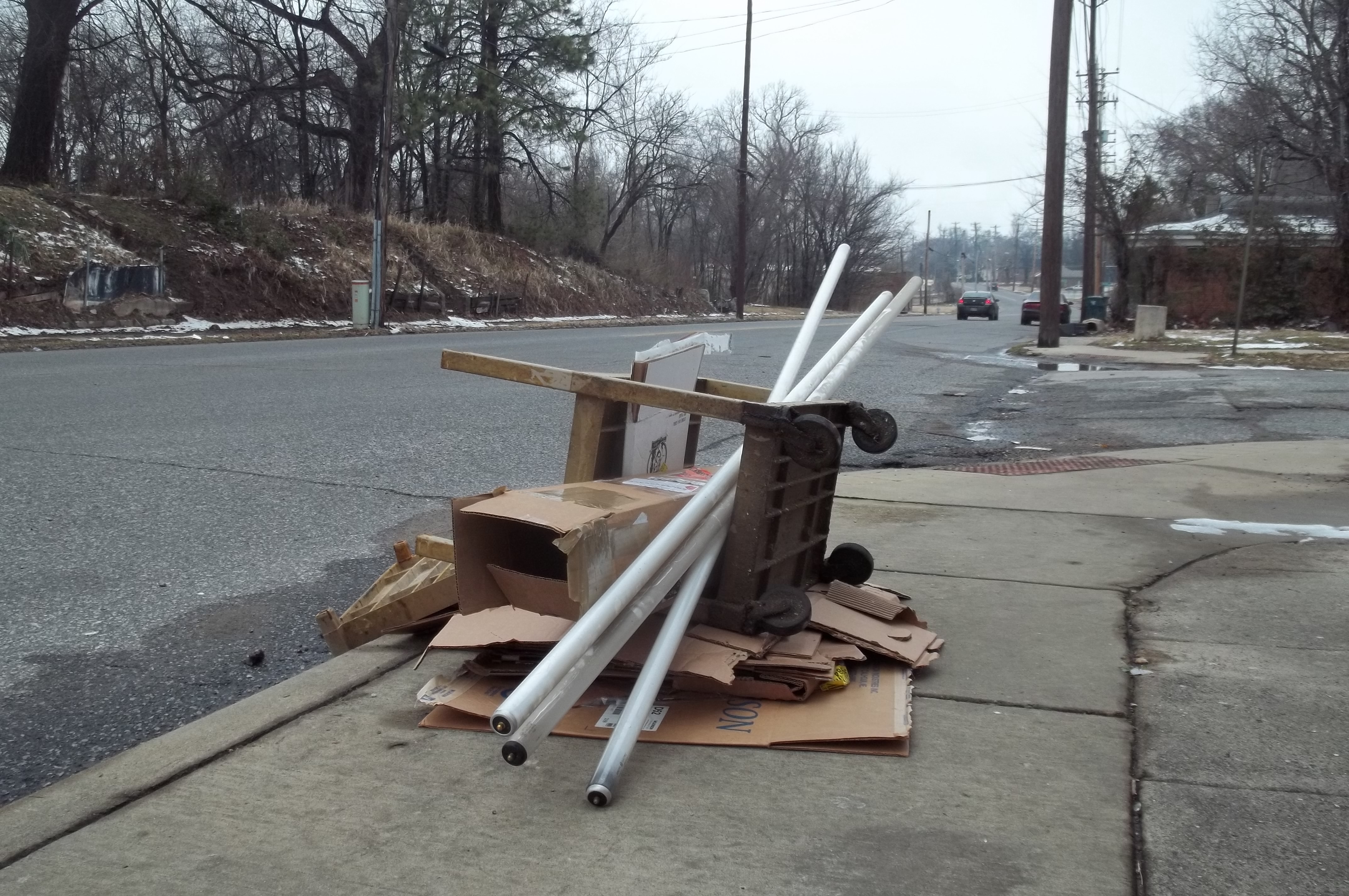
Improper disposal of universal waste lamps

What’s Wrong With This Picture? Errors Made by Generators of Universal Waste

The universal waste regulations of the USEPA provide an option for generators of certain hazardous waste to manage them according to a lower regulatory standard:  The Universal Waste Regulations.  To take advantage of this “de-regulation” of a hazardous waste, generators need only comply with some basic regulations pertaining to its onsite management and off-site disposal.  You can learn more about the management of Universal Waste from my article:  The Universal Waste Option for the Management of Hazardous Waste.

The USEPA hazardous waste currently eligible for the Universal Waste option are:

  • Lamps
  • Batteries
  • Mercury-Containing Devices
  • Recalled or Canceled Pesticides

While states may differ in what they identify as a Universal Waste and in some of the on-site management requirements, they all agree that Universal Waste must be sent for disposal or recycling to a Universal Waste Destination Facility.  A business can not simply throw Universal Waste in the trash with its regular garbage.

Improper disposal of universal waste lamps
Does this look like proper management of a Universal Waste?


**NOTE:  It may be possible for a Conditionally Exempt Small Quantity Generator of hazardous waste or a homeowner to send its Universal Waste to a Municipal Solid Waste Landfill for disposal with its regular trash or garbage.  However, this is not recommended and some states out-right ban the landfill disposal of fluorescent lamps.

Not sure of your hazardous waste generator status?

Take this short survey

Whatever your hazardous waste generator status or your status as a handler of universal waste, you and your employees will benefit from some form of my training services.  Please contact me to discuss the best training option for you:

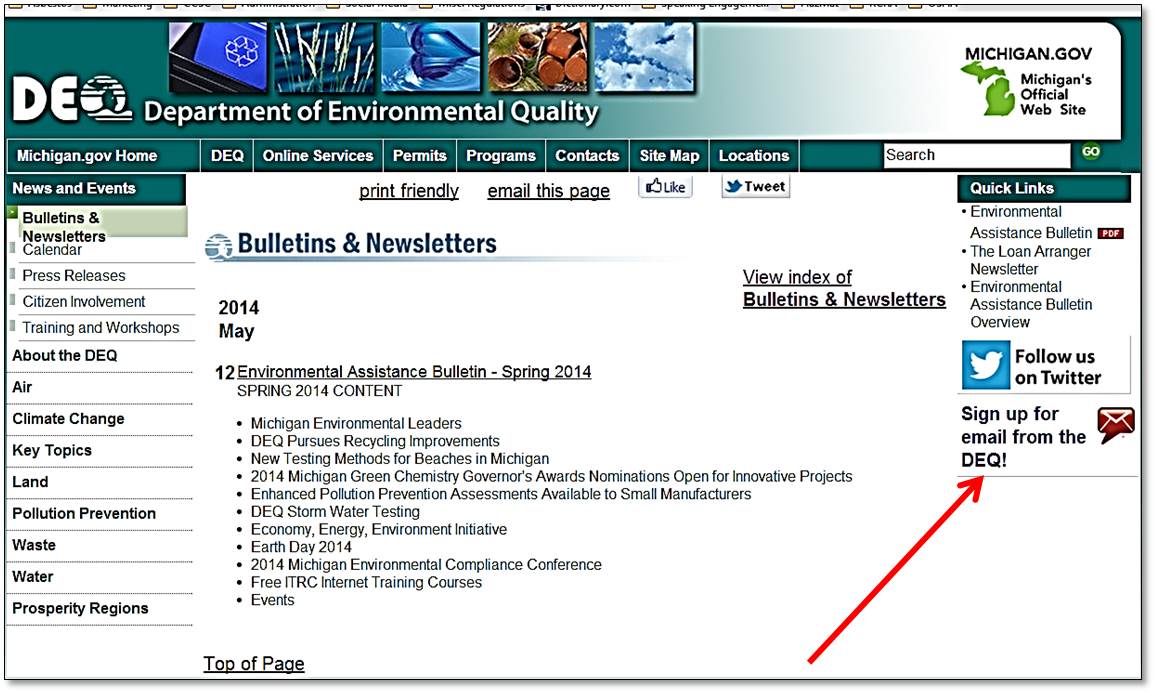
MDEQ Quarterly Environmental Assistance Bulletin

Subscribe to the Michigan DEQ Environmental Assistance Bulletin

Daniels Training Services addresses the regulations of the MDEQ
Have your employees received annual training on the regulations of the MDEQ for the management of hazardous waste?

A generator of hazardous waste in Michigan  – or any industrial or commercial entity within the Wolverine State – will benefit from subscribing to the quarterly Environmental Assistance Bulletin provided by the Michigan Department of Environmental Quality (MDEQ).  The Bulletin contains topics of interest for any Michigan business; for example, the Spring 2014 Bulletin contains articles on the following:

  • Michigan Environmental Leaders
  • DEQ Pursues Recycling Improvements
  • New Testing Methods for Beaches in Michigan
  • 2014 Michigan Green Chemistry Governor’s Awards Nominations Open for Innovative Projects
  • Enhanced Pollution Prevention Assessments Available to Small Manufacturers
  • DEQ Storm Water Testing
  • Economy, Energy, Environment Initiative
  • Earth Day 2014
  • 2014 Michigan Environmental Compliance Conference
  • Free ITRC Internet Training Courses
  • Events

If interested you may subscribe to the Bulletin and a host of other email notification at the MDEQ website:  Subscribe to Michigan DEQ Bulletins and Newsletters

MDEQ Quarterly Environmental Assistance Bulletin
A quarterly bulletin from the MDEQ available to the regulated industry within Michigan.


Daniels Training Services

815.821.1550

Info@DanielsTraining.com

https://danielstraining.com/

A business in Michigan must be familiar with the MDEQ’s unique approach to the management of waste, particularly Liquid Industrial Waste.  My Onsite Training is a great way for you to comply with the annual training requirement for generators of hazardous waste and to teach your employees what they need to know to comply with MDEQ regulations.  Please contact me for a free training consultation.


Search Website