PO Box 1232 Freeport, IL 61032

A Different Kind Of Training

A Different Kind Of Training

A Different Kind Of Training

June 2014 – Rules & Regulations, Proposed Rules, and Notices Regarding the Management of Hazardous Waste and the Transportation of Hazardous Materials

June 2014 – Rules & Regulations, Proposed Rules, and Notices Regarding the Management of Hazardous Waste and the Transportation of Hazardous Materials

On its website the US Government Printing Office makes a wealth of Federal publications available for review and download; one of these is the Federal Register.

Published by the Office of the Federal Register, National Archives and Records Administration (NARA), the Federal Register is the official daily publication for rules, proposed rules, and notices of Federal agencies and organizations, as well as executive orders and other presidential documents.

See below for a brief summary of announcements in the Federal Register by the US EPA on the subject of Hazardous Waste and the Pipeline & Hazardous Materials Safety Administration (PHMSA), Federal Railroad Administration (FRA), and the Federal Aviation Administration (FAA) of the US DOT on the subject of Transportation of Hazardous Materials.

The Federal Register is a great way to look down the road and see potential changes to the regulations long before they are put into effect (sometimes The Rulemaking Process takes years before a final rule is issued, if ever).  Knowledge of these potential changes provides you with several advantages:

  • Additional time to modify your business operations to comply.
  • Awareness of on what topics the regulatory agencies intend to focus their efforts.
  • The ability to register your concerns, complaints, suggestions, etc. in order to modify the proposed rule before a final rule is issued.  It can be done, really!
  • Make changes to your training program to account for changes that become effective before the next training cycle.
  • Alert you to the need to re-train your employees prior to their next scheduled training cycle, if necessary.
  • Keep you abreast of changes to the regulations that affect your business and/or your industry group.

Please note that this is my best effort to identify the relevant announcements in the Federal Register that may be of interest to generators of hazardous waste and shippers of hazardous materials.  I encourage you to review the list of Federal Register publications yourself to ensure regulatory compliance.

May 30, 2014 through June 30, 2014

EPA – Environmental Protection Agency:

Rules and Regulations:

Identification and Listing of Hazardous Waste

Pages 35290 – 35290 [FR DOC # 2014-14607]

PDF | Text | More

Revisions to the Export Provisions of the Cathode Ray Tube (CRT) Rule

Pages 36220 – 36231 [FR DOC # 2014-14996]

PDF | Text | More

Proposed Rules:

Spring 2014 Regulatory Agenda

Pages 34115 – 34123 [FR DOC # 2014-13130]

PDF | Text | More

Definition of “Waters of the United States” Under the Clean Water Act; Extension of Comment Period

Pages 35712 – 35713 [FR DOC # 2014-14674]

PDF | Text | More

Notices:

None

FAA – Federal Aviation Administration:

Rules and Regulations:

None

Proposed Rules:

None

Notices:

None

FMCSA – Federal Motor Carrier Safety Administration:

Rules and Regulations:

None

Proposed Rules:

None

Notices:

Qualification of Drivers; Exemption Applications; Epilepsy and Seizure Disorders

Pages 32014 – 32016 [FR DOC # 2014-12790]

PDF | Text | More

Hours of Service of Drivers: Application of Illumination Fireworks, LLC and ACE Pyro LLC, for Exemption From the 14-Hour Rule During Independence Day Celebrations

Pages 36579 – 36581 [FR DOC # 2014-15043]

PDF | Text | More
FRA – Federal Railroad Administration:

Rules and Regulations:

None

Proposed Rules:

None

Notices:

None

PHMSA – Pipeline and Hazardous Materials Safety Administration:

Rules and Regulations:

None

Proposed Rules:

None

Notices:

Office of Hazardous Materials Safety

Pages 31178 – 31179 [FR DOC # 2014-12438]

PDF | Text | More

Office of Hazardous Materials Safety; Notice of Application for Special Permits

Pages 31179 – 31180 [FR DOC # 2014-12437]

PDF | Text | More

Office of Hazardous Materials Safety; List of Applications Delayed More Than 180 Days

Pages 31405 – 31406 [FR DOC # 2014-12439]

PDF | Text | More

Office of Hazardous Materials Safety; Notice of Applications for Modification of Special Permit

Pages 31406 – 31406 [FR DOC # 2014-12436]

PDF | Text | More

Hazardous Materials: Notice of Availability of Draft Environmental Assessment and Request for Public Comment for a Special Permit Relating to the Transport of Precursor Chemicals From Syria in Port Arthur, Texas

Pages 33802 – 33803 [FR DOC # 2014-13685]

PDF | Text | More

Office of Hazardous Materials Safety; Notice of Applications for Modification of Special Permit

Pages 35406 – 35407 [FR DOC # 2014-14182]

PDF | Text | More

Office of Hazardous Materials Safety; Notice of Application for Special Permits

Pages 35407 – 35408 [FR DOC # 2014-14181]

PDF | Text | More

Office of Hazardous Materials Safety

Pages 35408 – 35410 [FR DOC # 2014-14129]

PDF | Text | More

Office Of Hazardous Materials Safety; List of Applications

Pages 35410 – 35411 [FR DOC # 2014-14183]

PDF | Text | More

More Information can be helpful but it’s useless if you are not able to make sense of it.  You must be able to determine how any changes to the rules and regulations (final or proposed) will affect your operations, and communicate the necessary information to your personnel.  I can help you to do that.

Daniels Training Services

815.821.1550

Info@DanielsTraining.com

https://danielstraining.com/

Please contact for a free training consultation to determine your regulatory requirements and how training can help you to attain and maintain compliance with the regulations of the USEPA (and your state) and the PHMSA/USDOT.

Notify the National Response Center

The Requirements of 40 CFR 265.56 Emergency Procedures for Large Quantity Generator of Hazardous Waste

This is the eighth – and last – in a series that takes a close look at the requirements of 40 CFR 265, Subpart D – Contingency Plan and Emergency Procedures.  This Subpart, along with the remainder for Part 265 is applicable to permitted hazardous waste treatment, storage, and disposal facilities (TSDFs) and to large quantity generators of hazardous waste (LQGs).  A Contingency Plan and the emergency procedures outlined in Subpart D are critical for the safe operation of a hazardous waste facility and to ensure compliance with state and Federal regulations.

The purpose of this article is to read, review, and explain the requirements of 40 CFR 265.56 Emergency Procedures.

Hold on a minute!  These regulations were revised and moved to a new location within Title 40 of the CFR by the Generator Improvements Rule.  If your state has not yet adopted the Generator Improvements Rule, then this article is still applicable to you (but it won’t be for much longer).  If your state has adopted and been authorized to enforce the Generator Improvements Rule, then these regulations no longer apply to you.  Read: What is the status of the Generator Improvements Rule in my state?

To see an explanation of these regulations as revised by the Generator Improvements Rule you must refer to the following:

Not sure if your an LQG?

Take this short survey

Read the previous article in this series:  40 CFR 265.55 Emergency Coordinator or read on to learn about 40 CFR 265.56 Emergency Procedures.

To see an explanation of the regulations prior to the revisions of the Generator Improvements Rule, please continue reading this article.
(more…)

Delaware DNREC website list of publications

Subscribe to the Delaware Department of Natural Resources and Environmental Control DAWM Newsletter

If you do business in Delaware, then staying tuned-in to the activities of the Department of Natural Resources and Environmental Control is a must.  Thankfully, the DNREC assists the regulated community in this by publishing a biweekly update of what its up to in the form of an electronic newsletter:  Division of Air & Waste Management Newsletter (DAWM Newsletter).  It features current information on the Divisions of Air Quality, Waste and Hazardous Substances, and Water regarding public meetings, workshops, hearings, and regulatory documents available for public comment, as well as general news updates.

The subscription is free.

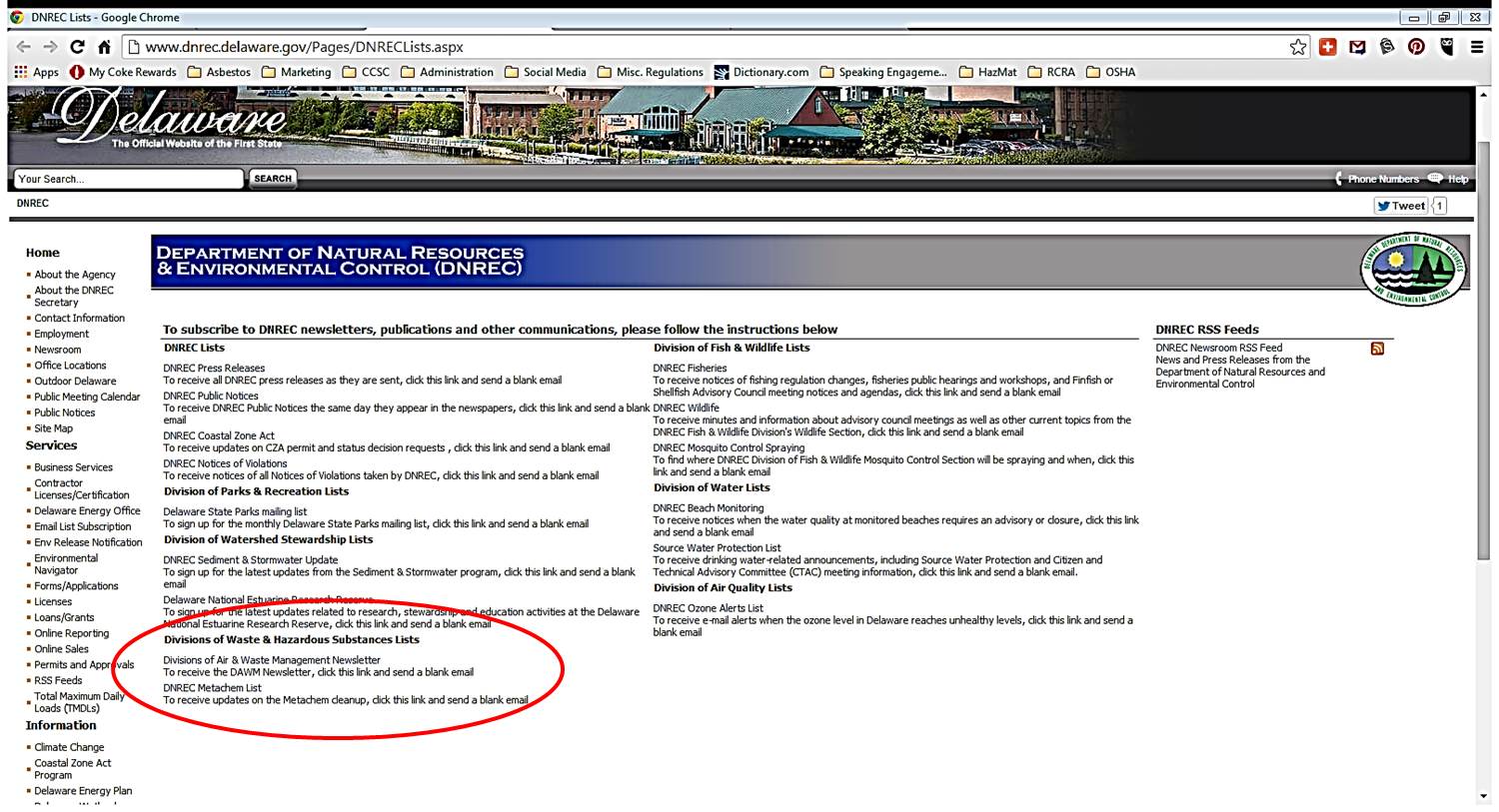
To subscribe, follow this link to the DNREC list of its newsletters, publications, and other communications:  http://www.dnrec.delaware.gov/Pages/DNRECLists.aspx

It looks like this:

Delaware DNREC website list of publications

There are many lists and publications to choose from, consider them all; but the purpose of this article is to direct you to the Divisions of Waste and Hazardous Substances List in the bottom left-hand corner (circled in red).  Just click on the link and it will open your default email software.  Send a blank email and your done.

If you have any questions you may call Stacy Jones  at 302-739-9400, or send an email to Stacy.Jones@state.de.us

Visit the Delaware DNREC website at: www.awm.delaware.gov

My Onsite Training is a great way to train all of your Hazardous Waste Personnel on the DNREC regulations regarding the management of hazardous waste.  Training that covers just what you need to know!  Contact me for a free training consultation.

Daniels Training Services

815.821.1550

Info@DanielsTraining.com

https://danielstraining.com/

Hazardous Waste Penalty Policy for the Colorado Department of Public Health and the Environment

The Colorado Department of Public Health and Environment enforces the Colorado state regulations under the authority of the Federal Resource Conservation and Recovery Act (RCRA).  RCRA provides for authorization of a state hazardous waste program as long as its regulations are at least as strict and as broad as those of the USEPA.  State regulations that are more strict and more broad are allowed as well.  If you do business in Colorado you should be aware of how the CO DPHE determines the monetary penalty for violations of its regulations.  A full description of this policy can be found on the CO DPHE website:  State of Colorado Hazardous Waste Penalty Policy.  See below for a description of the possible penalties and the factors considered by the Department when determining monetary penalties. (more…)

Pennsylvania Company Guilty Plea and $1.2 Million Fine for Improper Storage of Explosive Hazardous Waste

The Bullet:

The generator of a hazardous waste violated basic requirements of the hazardous waste regulations.  And, as a consequence, also violated the Hazardous Material Regulations of the PHMSA/USDOT.  These avoidable violations have resulted in significant criminal violations for this company and its officers.

Who:

Action Manufacturing Company in Atglen, PA.

The initial inspection was conducted by the USEPA’s Land and Chemical Division and the Pennsylvania Department of Environmental Protection (PA DEP).

The case was investigated by the EPA’s Criminal Investigation Division and the U.S. Department of Transportation Office of Inspector General. It is being prosecuted by Assistant U. S. Attorney Elizabeth Abrams.

What:

Action Manufacturing Company’s production process generates an explosive hazardous waste.  State and Federal regulations codified under the Resource Conservation and Recovery Act (RCRA) require hazardous wastes to be managed according to the applicable generator regulations while accumulated on-site and sent off-site for disposal only to permitted hazardous waste Treatment, Storage, & Disposal Facilities (TSDFs).  Instead of complying with these regulations, the company stockpiled hazardous wastes on-site for – in some cases – several years in gross violation of the generator on-site accumulation time limits.

Not sure of your hazardous waste generator status?

Take this short survey

Where:

Action Manufacturing Company is headquartered in Bristol, Bucks County, PA.

The hazardous waste in question was stored at its facility in Atglen, Chester County, PA

When:

Initial inspection was completed by the USEPA’s Land and Chemical Division and the Pennsylvania Department of Environmental Protection (PA DEP) in November 2011.

Action Manufacturing entered the guilty plea on May 21, 2014.

A sentencing hearing is scheduled for August 27, 2014.

Why:

Federal and state hazardous waste regulations require a generator of hazardous waste to comply with applicable regulations in lieu of obtaining a permit for the storage of a hazardous waste.  Indefinite, long-term storage of this type without a permit is not allowed.  Further, evidence of a knowing violation of the regulations can lead to criminal prosecution, as in this case.  Also, as is often the case, violations of the USEPA hazardous waste regulations results in violations of the PHMSA/USDOT regulations for the transportation of a hazardous material (in this case a hazardous waste).

How:

Both Federal and state regulations allow authorities of the USEPA or your state, if it has an authorized hazardous waste program, to enter the property of a hazardous waste generator at any reasonable time and go anyplace hazardous waste are or have been.

Conclusion:

I don’t pretend to know all the facts of this case.  I am relying solely on the news release of the USEPA:  Pennsylvania Company Pleads Guilty to Improper Storage of Explosive Hazardous Waste and Agrees to $1.2 Million Fine.  However, it appears to me that compliance with the regulations of the USEPA and the PA DEP would not have been that difficult and certainly are preferable over this outcome.

Don’t wait!  Contact me for a free consultation regarding your compliance with the regulations of the USEPA, your state, and the PHMSA/USDOT.

Daniels Training Services

815.821.1550

Info@DanielsTraining.com

https://danielstraining.com/


TCEQ Webpage: Air Monitoring Data for Eagle Ford Shale Geological Area

The Bullet:

The Texas Commission on Environmental Quality (TCEQ) has created a new website to provide data to interested parties on the air emissions at the Eagle Ford Shale Geological Area in southeast Texas.

Who:

The Texas Railroad Commission or Railroad Commission of Texas (RRC) and the Texas Commission one Environmental Quality (TCEQ).

What:

The Eagle Ford Shale is a hydrocarbon-producing geological formation extending over 26 Texas counties.

The TCEQ webpage contains near real-time air monitoring data from the agency’s Auto GC monitor, sampling results and health effects evaluations by county and links to the Texas Air Monitoring System (TAMIS).  More information about the monitoring method can be found on the webpage.

Where:

The Eagle Ford Shale Geological Area stretches from the Mexican border between Laredo and Eagle Pass up through counties east of Temple and Waco.

When:

The TCEQ webpage was launched June 6, 2014.

How:

The Texas Railroad Commission has primary responsibility for rail and gas facilities in Texas.  The role of the TCEQ is limited to regulating air emissions and ensuring air quality.

Conclusion:

Refer to the TCEQ webpage: Eagle Ford Shale Geological Area for more information.

Due to the unique arrangement of the TCEQ and the RRC in Texas, the generation of waste during the exploration and production of oil and natural gas is subject to RRC regulations and not those of the TCEQ.  However, this authority changes for wastes that are generated “above the hole” during the transportation and processing of oil and natural gas.  Contact me with any questions you may have about the generation of waste within Texas and the applicability of the regulations of the TCEQ or the RRC to your operations.

Daniels Training Services

815.821.1550

Info@DanielsTraining.com

https://danielstraining.com/


The Government Employee Exemption to the USDOT Hazardous Materials Regulations

At its beginning (49 CFR 171.1) the Hazardous Materials Regulations (HMR) of the USDOT/PHMSA limits its applicability to the following:

  • Persons who transport hazardous materials in commerce.
  • Persons who cause hazardous materials to be transported in commerce.
  • Persons who manufacture or maintain a packaging to be used for the transportation of a HazMat in commerce.
  • Anyone who indicates by marking or other means that a HazMat is present in a packaging or conveyance being transported in commerce when it is not.
  • Anyone who tampers with a package or transport conveyance of a HazMat in transportation or the markings, labels, placards, or shipping description of a hazardous material being transported in commerce.

In sum, the HMR applies to any activity a person may engage in that involves the transportation in commerce of a hazardous material.

However, 49 CFR 171.1(d) identifies, “Functions not subject to the requirements of the HMR.”  The subject of this article is to look at one of the seven exempt functions:  The Government Employee Transportation Exemption of 49 CFR 171.1(d)(5). (more…)

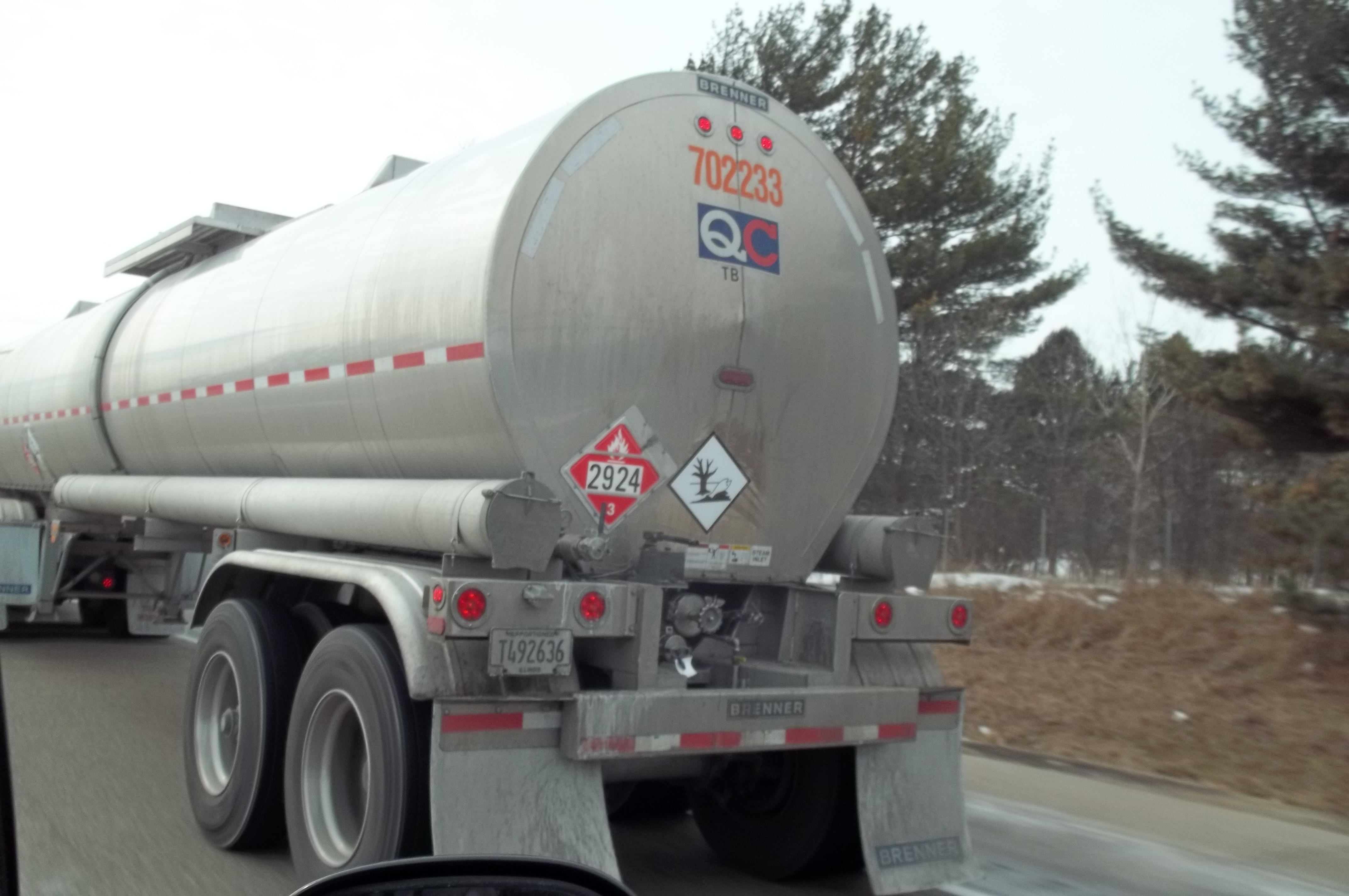
HazMat Placards visible on a tanker truck

Got a Question? Dear Mr. Daniels…The Empty Packaging Exception and the HazMat Endorsement on the CDL

One of the things I love about my business is being able to answer someone’s question about the transportation of hazardous materials or the management of hazardous waste.  Some questions have an easy answer, but a complicated explanation, and those are the ones I decided to address in this format:  An advice column.

Why “Mr. Daniels”?  Because many people mistakenly assume it to be my surname after visiting my website.

(more…)

Accumulation Time Limits for Hazardous Waste Generators in California

As a state with an authorized hazardous waste program under the Resource Conservation and Recovery Act (RCRA) Cal EPA can enact regulations for the management of hazardous waste that are more broad and more strict than those of the USEPA.  If you’ve done business in California you know that its regulations pertaining to waste management (not just hazardous waste, but also used oil, universal waste, and non-RCRA hazardous waste) are much more strict than those of the USEPA – or any other state.  You’ll also know that the Department of Toxic Substances Control (DTSC), one of six boards/departments within Cal EPA, is responsible for managing the hazardous waste program in California and that CUPAs (Certified Unified The purpose of this article is to focus on just one aspect of California’s hazardous waste regulations:  The On-Site Accumulation Time Limit for Generators of Hazardous Waste.

California EPA Department of Toxic Substances Control Regulations
The hazardous waste regulations in California are more strict & more broad than those of the USEPA.

(more…)

What Information Must be on the Commercial Driver’s License (CDL)?

One of the questions I ask attendees of my training – yeah, even though I’m the trainer I still sometimes ask the questions – is this:  “Do you examine a driver’s Commercial Driver’s License (CDL) before he/she leaves your site with a shipment of your HazMat?”  I’m no longer surprised by the blank stares I receive as a form of reply.  The answer, overwhelmingly, is “no”.  Most companies I have had the privilege to provide with HazMat Employee Training do not take what I consider to be a basic step to ensure the safe and secure transportation of their hazardous material once it leaves their property.  That is, to determine if the person operating the motor vehicle transporting their HazMat (including a hazardous waste) has a valid CDL with the necessary endorsements (more on that below).  But before you inspect a CDL, you must know what information is required to be on it.  That is the purpose of this article. (more…)

Search Website