PO Box 1232 Freeport, IL 61032

A Different Kind Of Training

A Different Kind Of Training

A Different Kind Of Training

Q&A: The Display of “HOT” or the Identification Number Marking on Packages of Elevated Temperature Materials

This question came through my website May 2, 2016 from someone I’ve never done business with prior to – or since – this contact:

To Whom It May Concern,

I saw a recent post you made on your web site regarding elevated temperature materials, a requirements for labeling requirements.

Can you answer the following question for me?

Does the transportation of liquid asphalt, if shipped above 212 degrees F, as an elevated temperature material, require the use of 4-digit identification number on shipping documents, placards, or panels as named in part 11 Section 172.101, Publication BOE 6000?

Any advice or guidance would be greatly appreciated.

My reply on May 2nd, to buy myself some time:

I will research the information and get back to you with an answer this week.

And then, on May 7, 2016:

I will attempt to answer your question below.

An elevated temperature material is defined at 49 CFR 171.8, as a material in a bulk packaging that…
  • Is in a liquid phase and at a temperature at or above 100 °C (212 °F);
  • Is in a liquid phase with a flash point at or above 38 °C (100 °F) that is intentionally heated and offered for transportation or transported at or above its flash point;or,
  • Is in a solid phase and at a temperature at or above 240 °C (464 °F).

What you describe appears to be an Elevated Temperature Material.  If that is the case, then it must be shipped as a fully regulated hazardous material which includes but is not limited to:

  • Shipping papers, including the additional description (see below).
  • Placards will not be required if the HazMat is solely a Class 9 Miscellaneous.  Why not?  Class 9 Placards are not required within the U.S.
  • Labels are not required on a bulk packaging.
  • The following package markings:
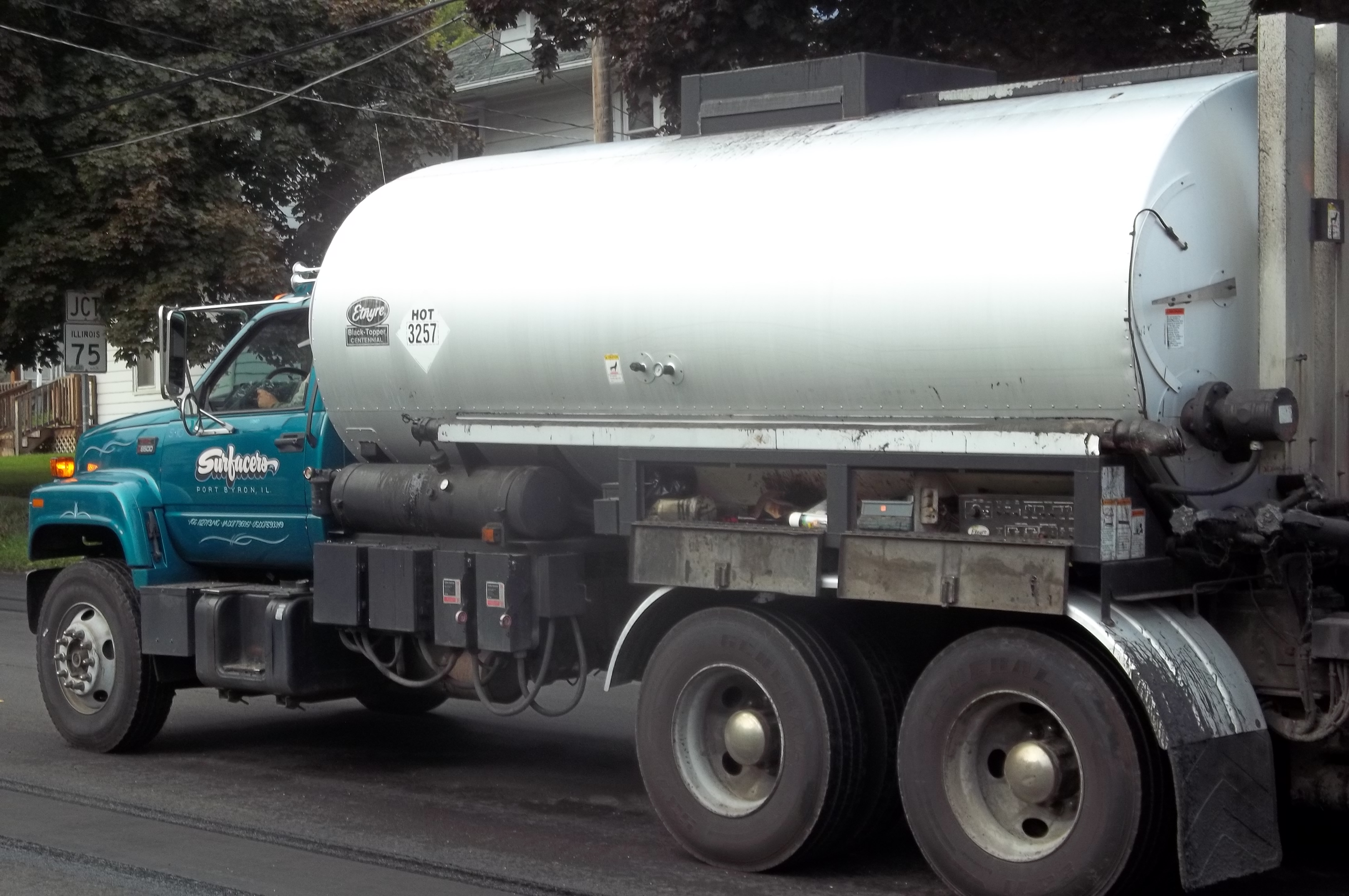
    • The HazMat’s 4-digit identification number (UN3257) on two opposing sides of a bulk packaging with a capacity of <1,000 gallons or on all four sides of a bulk packaging with a capacity of ≥1,000 gallons.  The identification number must be displayed on all four sides of a cargo tank or tank car.
    • “HOT” must be displayed on two opposing sides of any bulk packaging.
More information:
Please don’t hesitate to contact me if you have any questions.
cargo tank motor vehicle of UN3257I thought that might be it, but a few days later (5.09.16) he replied with more questions:
Thank you for taking a look at this issue.  I am very appreciative, and I hope you don’t find my follow up question unnecessarily argumentative.
However, I am just 100% not sure I agree with your conclusion.
I do agree that the product is an elevated temperature material.    However, I am not convinced the four digit identifier is required to be on the car or paperwork, as opposed to just using the word “HOT” on two placards placed on the rail car and on the  BOL.
Per CFR 172.325(a)  – “bulk packaging containing elevated temperature material must be marked on two opposing sides with the word ‘HOT’”.  There is no mention of the requirement to use the four digit Identifier, only the word “HOT”.  In fact, under  CFR 172.325(c) it states, “If identification number is displayed…” .  Hence the CFR’s use of the word “IF” certainly makes it sound like the four digit identifier is optional.
As you correctly point out in your email, “
According to 49 CFR 172.504(f)- (9), “For Class 9, a CLASS 9 placard is not required for domestic transportation, including that portion of international transportation, defined in § 171.8 of this subchapter, which occurs within the United States. However, a bulk packaging must be marked with the appropriate identification number on a CLASS 9 placard, an orange panel, or a white square-on-point display configuration as required by subpart D of this part.”
The language is pretty clear that while “a bulk packaging must be marked with the appropriate identification number on class 9 placard”  it continues on further to say “OR a white square-on-point display” indicating that either can be used, and if a white square-on-point display is used then there is no 4 digit identifier is required.
I would greatly appreciate your further thoughts based on these arguments.
Full text here and below…
§ 172.325 Elevated temperature materials.
(a) Except as provided in paragraph (b) of this section, a bulk packaging containing an elevated temperature material must be marked on two opposing sides with the word “HOT” in black or white Gothic lettering on a contrasting background. The marking must be displayed on the packaging itself or in black lettering on a plain white square-on-point configuration having the same outside dimensions as a placard. (See § 172.302(b) for size of markings on bulk packagings.)
(b) Bulk packagings containing molten aluminum or molten sulfur must be marked “MOLTEN ALUMINUM” or “MOLTEN SULFUR”, respectively, in the same manner as prescribed in paragraph (a) of this section.
(c) If the identification number is displayed on a white-square-on-point display configuration, as prescribed in § 172.336(b), the word “HOT” may be displayed in the upper corner of the same white-square-on-point display configuration. The word “HOT” must be in black letters having a height of at least 50 mm (2.0 inches). Except for size, these markings shall be as illustrated for an Elevated temperature material, liquid, n.o.s.:

Like this article?

Subscribe to my Monthly Newsletter

No marketing emails!

I didn’t mind his challenge.  It caused me to think deeper about the regulations before I replied that same day:

I agree with the regulatory citation you indicated but not the conclusion you draw.  In your previous email you state:

The language is pretty clear that while “a bulk packaging must be marked with the appropriate identification number on class 9 placard”  it continues on further to say “OR a white square-on-point display” indicating that either can be used, and if a white square-on-point display is used then there is no 4 digit identifier is required.

My interpretation of the Hazardous Material Regulations  you reference is this:

  • The regulations require a bulk package of a HazMat to be marked with the identification number.  Indeed, all HazMat packages must be marked with the identification number unless an exception to the Hazardous Material Regulations applies.
  • The identification number may be displayed on a placard, or an orange panel, or a white square-on-point.
  • If the white square-on-point is used the word “HOT” may be included in the upper corner if the HazMat is also an Elevated Temperature Material.
  • It does not say that the display of the identification number on the white square-on-point is a replacement for the “HOT” marking or vice versa.

The “HOT” marking is required on a cargo tank of an Elevated Temperature Material in addition to the identification number, not as a replacement for it.
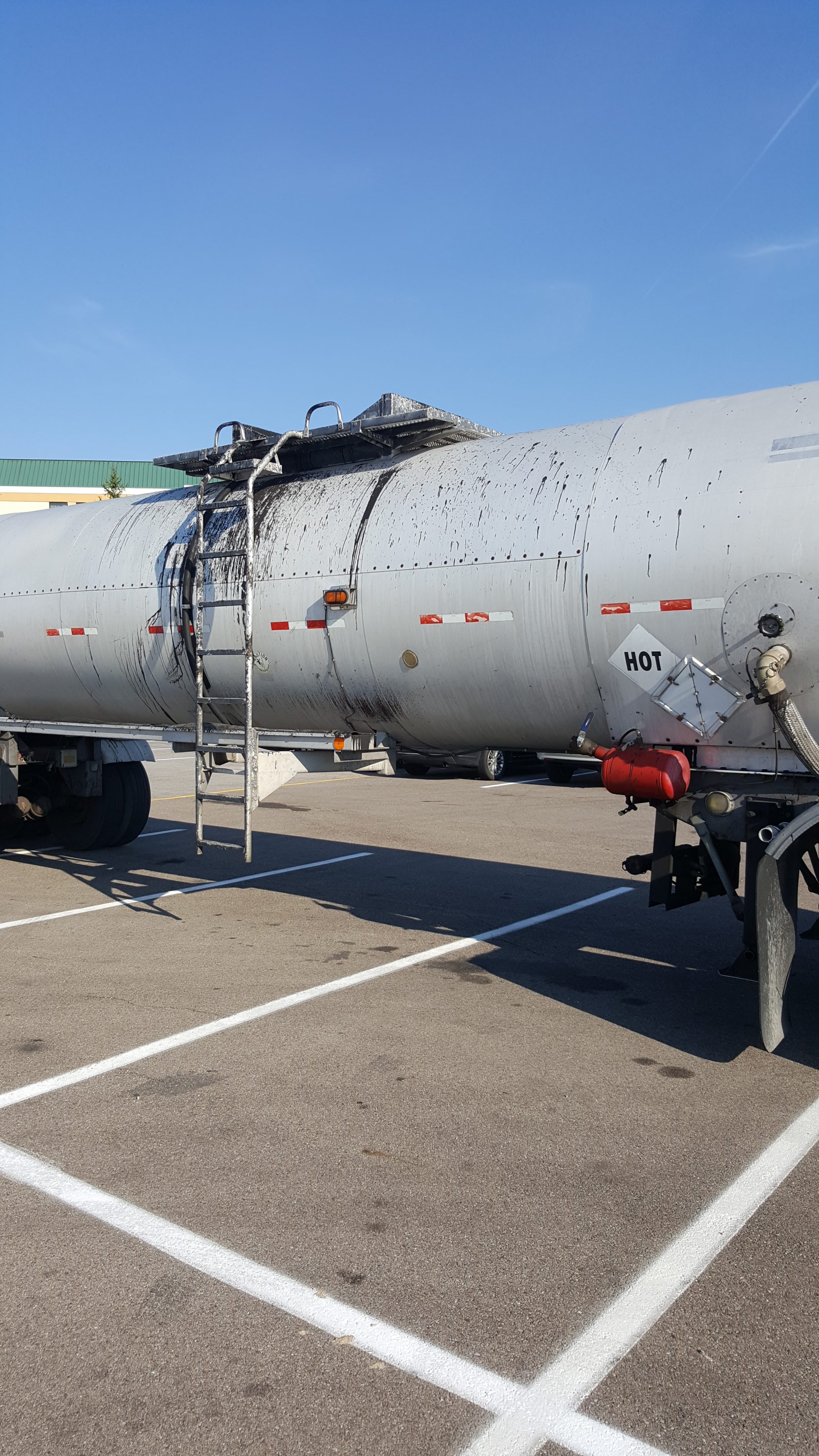
cargo tank truck with elevated temperature material
This cargo tank is missing its identification number
I’m happy to continue this discussion with you.
Clearly this issue was important to him and he had given it a lot of thought (5.09.16):

Dan,

Hope you don’t mind the back and forth on this.
You state, “The regulations require a bulk packaging to be marked with the identification number.”  However, per CFR 172.504(f) -9 it states, “However, a bulk packaging must be marked with the appropriate identification number on a CLASS 9 placard, an orange panel, OR a white square-on-point display configuration as required by subpart D of this part.”
Does the “or” not mean or?
Our exchanges got shorter as we refined our arguments (5.10.16):

You are correct.  The “or”, however, pertains to the options for how to display the identification number not if you display the identification number.  Display of the ID # is not optional.

Please let me know your opinion on this.

May 10, 2016, Finally my answer satisfied him!

Thanks for clarifying!   That helps.

Contact me with any questions you may have about the transportation of hazardous materials by air, highway, vessel, or rail

International and Domestic

Daniels Training Services

815.821.1550

Info@DanielsTraining.com

https://danielstraining.com/

I was glad to help and couldn’t resist a shameless plug:

No problem. Glad I could help. Please let me know if I can answer any other questions you may have.

Or if you require any training.

Will you give me a Positive Review on Google?

First…
Go to Google.com on your phone or PC and say or enter:  Daniels Training Services
 capture-dts-in-search-window
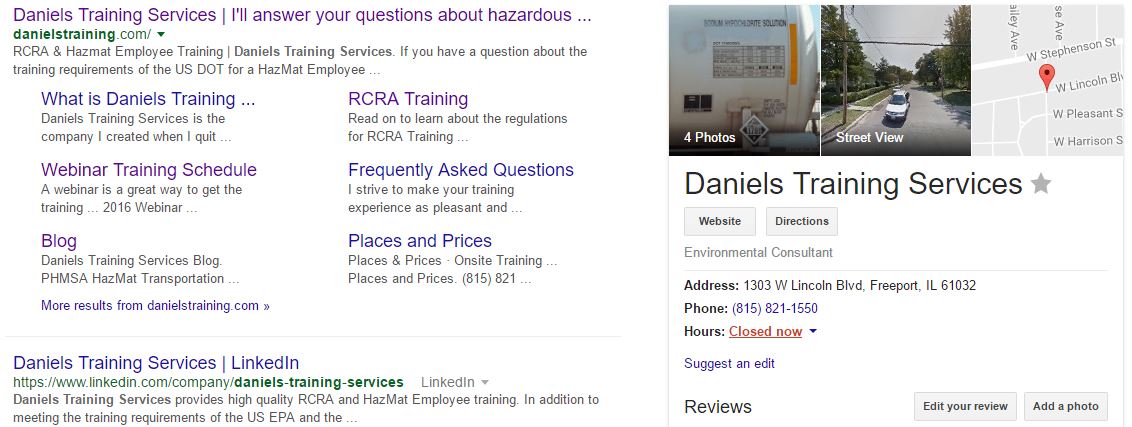
You’ll see my Google My Business page which will look something like this:
capture-dts-google-listing
Second…
Click the “Write a review” button:
capture-dts-write-a-review

On a mobile device you may not see the “Write a review button until you click on a blue circle with the down arrow in it to expand the section.  Scroll down to “Rate and review”.

Third…
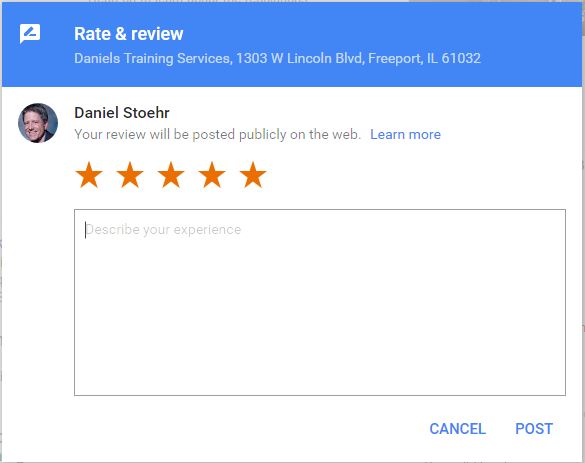
Click on the number of stars you rate the training (all five I hope!)
Write a review of your experience in my training.  Did you learn anything?  Did I seem knowledgeable?  Did I answer your questions?  Was my training a good value?  Would you recommend it to others?  Do you like me?  Do you really like me?!?  Sorry.  Too far.
 capture-dts-rate-review

You may be asked to sign in to your Google account if you are not already.  Google doesn’t allow anonymous reviews.  If you don’t have a Google account, see the next step.

capture-dts-google-sign-in
Fourth…
As stated previously, Google does not allow anonymous reviews so you must sign in to your Google account first or create one.  Creating a new Google account only takes 2-3 minutes and “c’mon, seriously?  You don’t have a Google account yet?”
 And that’s it!  Really simple, right?

I appreciate you doing this for me.  This kind of effort on your part helps me to be found when people are searching for the type of training services that I provide.

The Difference Between a Salvage Drum and an Overpack for the Transportation of a Hazardous Material

The requirements for use of a salvage drum are explained in the USDOT/PHMSA Hazardous Material Regulations at 49 CFR 173.3(c).  Those for the overpack are explained at §173.25(a).  Both salvage drum and overpack are defined at §171.8.  These are two distinct regulatory terms and yet there is a lot of confusion about which is which and when one is chosen and the other is required.  To answer these questions I refer you to an article I wrote for New Pig:

Salvage Packaging vs. Overpacks:  What’s the difference?

It has the advantage of containing links to more information about each of these packagings from New Pig’s catalog.

Contact me with any questions you may have about the transportation of hazardous materials by air, highway, vessel, or rail

International and Domestic

Daniels Training Services

815.821.1550

Info@DanielsTraining.com

https://danielstraining.com/


Q&A: Determination of Hazardous Waste Generation for the Characteristic of Toxicity

Contact me with any questions you may have about the generation, identification, management, and disposal of hazardous waste

Daniels Training Services

815.821.1550

Info@DanielsTraining.com

https://danielstraining.com/

A question to my website on April 29, 2016:

My question is: If your waste is considered a haz waste due to one chemical determined by the TCLP process. Do we count the weight of the chemical in the waste or the total weight of the waste that determines how much you generate. Thanks.

My reply later that same day:

If a representative sample of a waste is analyzed by TCLP and determined to have a leachable toxin above the regulatory threshold, then the entire waste from which the representative sample was derived is assigned the applicable hazardous waste code.  Therefore, the entire weight of the waste – not just the weight of the toxin in the waste – is used for the purpose of determining hazardous waste generation and the hazardous waste generator status.

I hope this helps.
Please don’t hesitate to contact me with any other questions.
20171227

Training Requirements for Persons Involved in the Transportation of Lithium Batteries

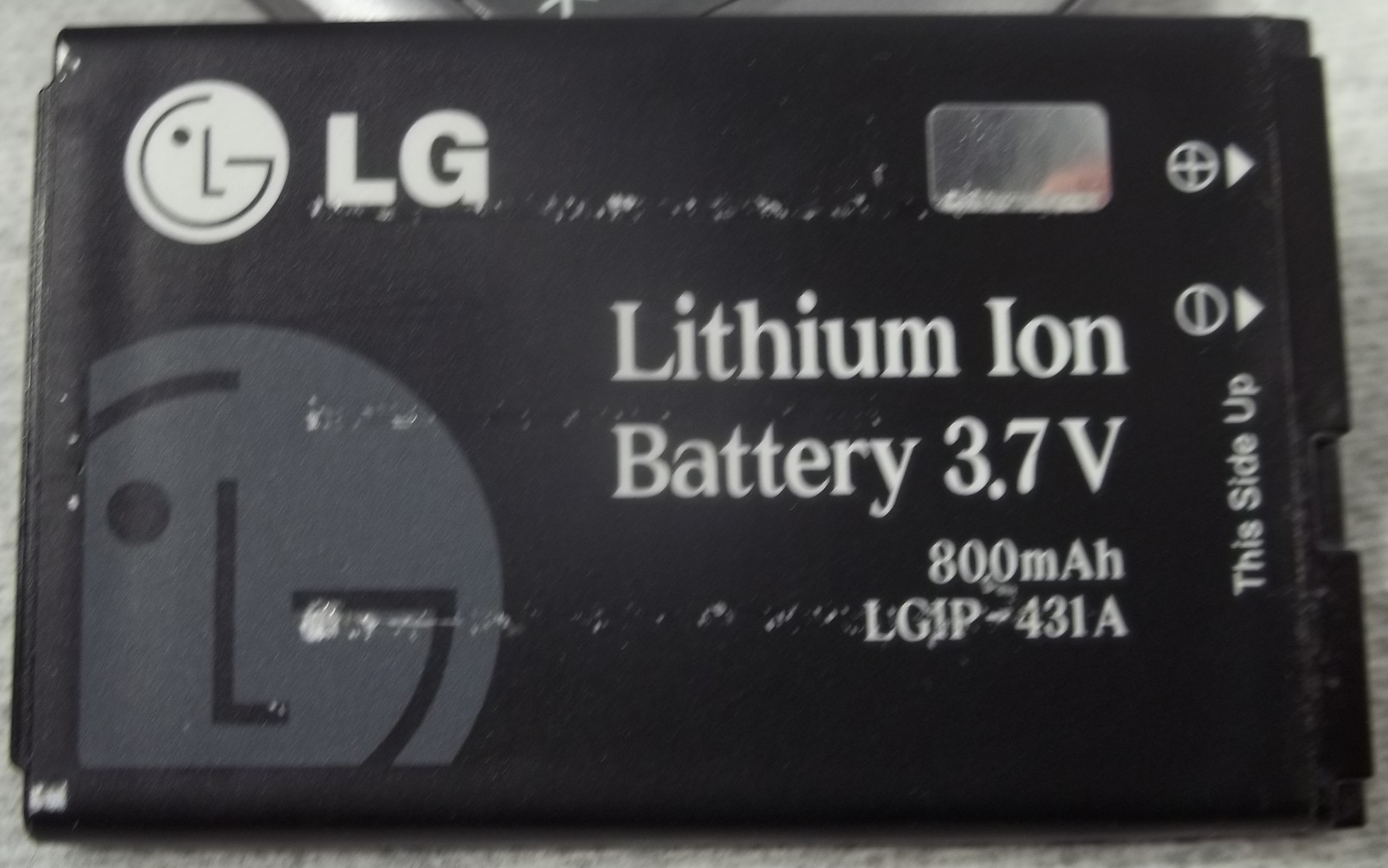
Lithium ion battery for cell phoneIn case you haven’t heard, the transportation in commerce of lithium batteries of all types – and of almost all sizes – is subject to the regulations of several regulatory agencies depending on how it is to be transported.

  • Transportation to, from, or through the U.S. (including its overseas territories and states) is subject to the Hazardous Material Regulations (HMR) of the Pipeline and Hazardous Materials Safety Administration (PHMSA) within the U.S. Department of Transportation (USDOT).
  • Transportation by air anywhere in the world (including to, from, or through the U.S.) will likely be subject to the Dangerous Goods Regulations of the International Air Transport Association (IATA).
  • Transportation by vessel in international waters (which may include U.S. territorial waters if so chosen by the shipper) will be subject to the International Maritime Dangerous Goods Code (IMDG Code) of the International Maritime Organization (IMO).
  • Even the United States Postal Service (USPS) has regulations for the transportation of lithium batteries.

There is not enough space here to document all of the requirements of all of these regulations for all of the possible modes of transportation.  In an earlier article I provided information to assist you with the process of the classification of a lithium battery for transportation; the information in that article pertained to all modes of transportation.  In this article I will explain just one small – though critical – requirement of the regulations for the transportation in commerce of lithium batteries by air:  The responsibility of the employer to provide training for persons involved in the transportation of lithium batteries.

(more…)

The Use of the Uniform Hazardous Waste Manifest for Shipments of PCB Waste

The use, storage, and disposal of equipment containing PCBs (Polychlorinated biphenyls) is subject to USEPA regulations in Part 761 of Title 40 of the Code of Federal Regulations (40 CFR 761); regulations promulgated under the Toxic Substance Control Act (TSCA).  Despite a persistent belief to the contrary:  PCBs are not regulated under RCRA and are not a hazardous waste though they may be regulated as a hazardous waste by state regulations (be sure to check with your state).

Since February 5, 1990 the TSCA regulations of 40 CFR 761 has required generators of PCB waste to use a uniform hazardous waste manifest for its off-site transportation.  The use of the uniform hazardous waste manifest for shipments of PCB waste requires the generator/offeror of the waste to complete it differently than they would for a hazardous waste regulated under RCRA.

The purpose of this article is to identify and explain the requirements of 40 CFR 761.207 for the use of the uniform hazardous waste manifest for the off-site transportation of PCB waste. (more…)

Q&A: Using the Uniform Hazardous Waste Manifest for Shipments of Special Waste in Illinois

A question from a past Onsite Training attendee on April 26, 2016:

Does the generator need to provide a manifest for non hazardous industrial waste? What elements are required in the manifest? Can a bill of lading be sufficient?

A good question and one I replied to that day:

Good question. The Illinois EPA requires the use of the uniform hazardous waste manifest for almost all shipments of special waste in Illinois.

Special waste includes hazardous waste, potentially infectious medical waste (PIMW), industrial process waste, and pollution control waste.

  • Hazardous waste is either listed by USEPA or displays a characteristic defined by USEPA.
  • See the end of this article for more information on PIMW.

A pollution control waste is generated directly or indirectly when businesses remove contaminants from air, soil, or water. Examples include baghouse dust, landfill waste, scrubber sludge, and chemical spill cleaning material.

That leaves one more type of Special Waste:

An industrial process waste is any liquid, solid, semisolid, or gaseous waste generated when manufacturing a product or performing a service. Examples include cutting oils, paint sludges, equipment cleanings, metallic dust sweepings, used solvents from parts cleaners, and off-specification, contaminated, or recalled wholesale or retail products.

The following wastes are not industrial process wastes:

  • Uncontaminated packaging materials

  • Uncontaminated machinery components

  • General household waste

  • Landscape waste

  • Construction or demolition debris

So, the above are not a special waste.  What is?

If your industrial process waste or pollution control waste is any one of the following, it is a special waste:

  • A liquid waste

  • An asbestos waste regulated under the Clean Air Act

  • A regulated polychlorinated biphenyl (PCB) waste

  • A delisted hazardous waste

  • A characteristic hazardous waste treated or stabilized to be nonhazardous

  • A waste material generated by shredding recyclable metals

If your waste is a special waste the Illinois EPA requires the use of the Uniform Hazardous Waste Manifest for its off-site shipment.  A bill of lading will not be sufficient for a shipment of a non hazardous Industrial Waste in Illinois. With some exceptions.

Exceptions?

Any industrial process wastes and pollution control wastes that are not hazardous and not liquid may be certified as nonspecial waste in Illinois and may be disposed of with your general refuse.

Notice this option to certify as nonspecial does not apply to hazardous waste and PIMW.

If using the uniform hazardous waste manifest you must provide the information as required in each section per the federal regulations at 40 CFR 262, subpart B.

Contact me with any questions you may have about the generation, identification, management, and disposal of hazardous waste

Daniels Training Services

815.821.1550

Info@DanielsTraining.com

https://danielstraining.com/

I hope this helps.

Please don’t hesitate to contact me with any other questions.

More information:

Additional Specification Packaging Markings on Intermediate Bulk Containers of Hazardous Materials

In an earlier article I identified and explained the requirements of 49 CFR 178.703(a) that mandate the manufacturer of an Intermediate Bulk Container (IBC) mark it with certain letters, numerals, and symbols to indicate that it is specification packaging designed, manufactured and tested to meet a UN standard.  But the markings required by paragraph (a) of §178.703 may not always be enough.  In paragraph (b) of §178.703 markings are identified that are to be displayed on an IBC, “in addition to markings required in paragraph (a) of this section”.

The purpose of this article is to identify and explain the requirements of 49 CFR 178.703(b) for additional specification packaging markings to be used on intermediate bulk containers.
(more…)

Specification packaging marking on IBC

Specification Packaging Markings on Intermediate Bulk Containers of Hazardous Materials

Like all packagings used for the transportation in commerce of a hazardous material an Intermediate Bulk Container (IBC) must be authorized for the HazMat it is intended to contain. It must also, unless an exception is used, be designed, manufactured, and tested to meet a specification in the form of the UN standards (UN for United Nations) and be marked to demonstrate this.

Note:  Specification packaging for an IBC – like all other non-bulk packagings but unlike most bulk packagings – means the UN standard and not the DOT specification.

In an earlier article I identified and explained the general requirements for all specification packaging markings at 49 CFR 178.3.  This article will expand on those general requirements and look just at those that apply to an Intermediate Bulk Container at §178.703. (more…)

Q&A: Markings on a Bulk Packaging (Roll-off)

Another question through the Contact Me page of my website on April 3, 2016:

Dear Daniel,
A bulk container (rolloff box) requires to display the UN number in the sides?
Best Regards

My reply the next day (4.4.16):

Yes.  Pursuant to 49 CFR 172.302(a), a bulk packaging must display the identification number on all four sides if it has a capacity of 1,000 gallons or more and on two opposing sides if it has a capacity of less than 1,000 gallons.

Pursuant to 49 CFR 172.302(b), markings on a roll-off must have a width of at least 0.24 inch and a height of at least 2 inches.
I hope this helps.
Please don’t hesitate to contact me with any other questions.
Here’s some more information on this topic:

Contact me with any questions you may have about the transportation of hazardous materials by air, highway, vessel, or rail

International and Domestic

Daniels Training Services

815.821.1550

Info@DanielsTraining.com

https://danielstraining.com/

Search Website