PO Box 1232 Freeport, IL 61032

A Different Kind Of Training

A Different Kind Of Training

A Different Kind Of Training

US EPA Regulations for the Management of Used Oil

The prospect of burning used oil on-site for energy recovery may seem daunting.  You may think that the regulatory burden and related costs would far outstrip any savings on fuel consumption.  I think you may be pleasantly surprised to learn how accommodating the US EPA regulations can be.  In certain conditions, you can even burn used oil you collect from outside parties.  Keep in mind that this information is based on the Federal regulations of the US EPA your state may have more strict requirements and additional limitations. Also keep in mind that if you intend to accumulate used oil on-site you may become subject to the Spill Prevention Control and Countermeasure requirements found at 40 CFR 112.

First of all, used oil is defined at 40 CFR 279.1 as,  “any oil that has been refined from crude oil, or any synthetic oil, that has been used and as a result of such use is contaminated by physical or chemical impurities.”  It can include:

  • Motor oil
  • Hydraulic fluid
  • Electrical insulating oils
  • Transmission fluid
  • Compressor oils

The advantages to burning used oil on-site for energy recovery as opposed to shipping it off-site for disposal include the following:

Better for the environment given the reduced resource consumption in collecting, transporting, and processing the oil at an off-site location.

Reduced disposal costs since you will be burning the waste on-site and no longer require a transporter and disposal facility to perform this role.

Reduced heating costs as you replace the fuels you typically purchase for consumption with Used Oil.


First you must determine if the used oil you generate and/or collect for energy recovery is Specification Used Oil orOff-Specification Used Oil.  If the concentration of constituents in your used oil is below the allowable levels identified in Table 1 of 40 CFR 279.11 and you comply with the requirements of 49 CFR 279.72, 279.73, and 279.74(b), see here for these requirements, then you have a Specification Used Oil that is not subject to the requirements of 40 CFR 279.  That means the oil can be burned for energy recovery in any device without US EPA restrictions.  See here for more information from US EPA about the determination and regulation of Specification Used Oil for energy recovery.   Note that mixtures of used oil and hazardous waste per 40 CFR 279.10(b) cannot be considered a Specification Used Oil.

If you generate an Off-Specification Used Oil, there are still options available to you for on-site energy recovery.  Pursuant to 40 CFR 279.12(c) Off-Specification Used Oil may be burned for energy recovery in only one of the following devices:

So, just what are the requirements of 40 CFR 279.23 that will allow you to burn Off-Specification Used Oil for energy recovery in a space heater at your facility?  First, the used oil must either be generated by the owner of the space heater – this includes off-site locations aggregated to one location – or be received directly from a Household “do-it-yourselfer” as defined at 40 CFR 279.1.  Secondly, the heater must have a design capacity not to exceed 0.5mmBtu/hr and the combustion emissions must be vented to the ambient air.  Burning of any used oil with PCB’s is subject to the requirements of 40 CFR 761.20(e).

Now let’s return to management of Specification Used Oil.  Remember that determining the constituent levels to be below the allowable levels of Table 1 of 40 CFR 279.11 is just the first part.  You must also comply with 40 CFR 279.72, 279.73, & 279.74(b).

  • 40 CFR 279.72 – You must maintain – for 3 years – records of analysis or other determination that the oil meets the requirements of 40 CFR 279.11.
  • 40 CFR 279.73 – If you don’t already have one, a US EPA identification number may be required for your site.
  • 40 CFR 279.74(b) – If the used oil is to be shipped off-site, you must maintain records of its shipment.  Note this does not require the use of a Uniform Hazardous Waste Manifest or Shipping Paper.  Carefully check your state regulators as I know there are some who disagree with the US EPA on this point.

Speaking of off-site transportation, you must ensure compliance with both US EPA and US DOT regulations for this activity.  Per 40 CFR 279.24 if using a common-carrier for off-site shipment, you must ensure the transporter has a US EPA identification number.  A generator may self-transport – without a US EPA identification number – used oil it’s generated to either an approved oil collection center or to an aggregation point it owns if it transports no more than 55 gallons at a time and uses a company or employee owned vehicle.

40 CFR 279.24 also includes relaxed requirements for “Tolling Arrangements” where used oil is shipped off-site for reclamation and returned to the generator.  Again, check closely with your states on this one.

It is unlikely, though possible, that an Off-Specification Used Oil – let alone a Specification Used Oil – will meet the US DOT definition of a hazardous material found at 49 CFR 171.8.  However, circumstances may vary and it is important for you to carefully review your used oil and the Hazardous Material Regulations (HMR) to determine the applicable US DOT requirements for transportation.

Used oil may represent a potential fuel combustion source you can use to heat your facility throughout the winter months.  Or, you may continue to ship used oil off-site for final disposal.  Please use the above information as a one component in determining what option works best for your facility.  Please feel free to contact me if you wish to share your experience with the combustion of used oil for energy recovery at your company.
Hospitals and Hazardous Waste Violations

Most of the attendees at my training events – check my Schedule of Events to see when I’ll be in your area – come from the manufacturing industry.  There are many other commercial activities that are subject to the US DOT regulations governing the transportation of hazardous materials and the US EPA regulations governing the generation, handling, and disposal of hazardous waste; one of these is hospitals (SIC’s 8062 & 8069).  As a matter of fact, a hospital administrator recently pled guilty to criminal charges of willfully or knowingly disposing of hazardous waste (STERIS 20 in this case) in an improper manner (click here for the Agency press release).

In the eyes of the US EPA, a hospital is no different than any other industrial facility subject to its hazardous waste regulations found in 40 CFR 260-265.  Before you can comply with the regulations however, and avoid the violations listed below, you must be aware of the potential violations.

Below is a list of the 15 Most common Hazardous Waste Violations and Problems Found at Hospitals according to US EPA Region 2.  I included my own comments where I think they may be helpful.  You can see the original listhere.

1.  Improper or lack of hazardous waste labeling.To label a container is so easy, and so easily overlooked.
2.  No or infrequent weekly inspections of hazardous waste storage areas.For both Large Quantity Generators of hazardous waste andSmall Quantity Generators, “weekly” means “every 7 days”.
3.  Open containers of hazardous waste.Containers of hazardous waste must be kept closed at all times except when adding or removing waste.  See here for more information.
4.  Improper disposal of chemotherapy drugs.Like any waste, they are subject to the hazardous waste determination process.  See #5.
5.  Failure to perform or improper hazardous waste determinations.This is a critical fiirst step in the process of determining what regulations apply to you as a generator of hazardous waste.
6.  No or inadequate hazardous waste manifests.The Uniform Hazardous Waste Manifest must be used for all shipments of hazardous waste, unless you are a Conditionally Exempt Small Quantity Generator of hazardous waste.
7.  Throwing hazardous waste down the drain.A tempting, but illegal option.  See the news release referred to above.
8.  Improper management of mercury-containing wastes, including but not limited to:  fluroescent light bulbs, mercury vapor lights, thermometers, sphygmomanometer, gastric tubes, thermostats, etc.All of these items could be handeld as universal waste at a greatly reduced regulatory burden.
9.  Improper management of expired pharmaceuticals, paints, etc.Like any waste, they are subject to the hazardous waste determination process.  See #5.
10.  Lack of a contingency plan.Large Quantity Generators of hazardous waste must have a contingency plan.
11.  Lack of or inadequate training of employees in hazardous waste management.This is where it all starts!  Not only is a lack of training a violation in itself, but without training you miss an opportunity to teach your employees about the regulations and proper waste handling.  Note that “inadequate training” is also a violation.
12.  Failure to ensure that hazardous waste meets the Land Disposal Restrictions.Usually, your hazardous waste disposal vendor will help you with the completion of the LDR.  However, it is your responsibility as the generator to ensure compliance.
13.  Failure to upgrade/close underground storage tanks (UST’s).
14.  Malfunctioning leak detection systems.
15.  Improper consolidation of wastes from nearby facilities.Use caution when consolidating waste from another facility with your own.

All of the above violations, except for numbers 13 & 14 are covered extensively at my training events.  For as low as $475 you can attend an entire day of training that meets not only the US EPA hazardous waste regulations, but the US Department of Transportation regulations for the transportation of hazardous materials (HazMat).  Don’t forget that the off-site transportation of hazardous waste is regulated by the US DOT as is the receipt of the hazardous materials as product.

Please don’t hesitate to contact me with questions about my training services and how they might apply to your operations.  I can tailor the training to your needs, including conducting on-site training for all of you applicable employees in one day.

US EPA and US DOT Regulations for the Handling and Transportation of Samples of Hazardous Materials and Hazardous Waste

Q:  I need to ship a small amount of our product (let’s say <1 gallon of a flammable solvent blend) from our distribution facility in Des Moines, IA to our QC lab in Akron, OH.  Our salespeople travel this route regularly by company car, can I have one of them transport this hazardous material?  What US DOT regulations must I comply with?

A:  Transportation of product of this quantity by motor vehicle over public roadways is acceptable under the Materials of Trade Exception to the Hazardous Materials Regulations (HMR).  You need only comply with the relatively simple requirements of 49 CFR 173.6.

Q:  OK, what about the same material shipped by a common carrier or UPS or the US Postal Service?

A:  You must follow all the requirements of the HMR for shipping papers, placards, labels, and markings.  The Materials of Trade Exception only applies if you are transporting your HazMat in your motor vehicle.  The Carrier or their industry group (the International Air Transport Association or IATA is a creation of the airline industry) may have additional requirements.

Q:  What if I need to ship the sample in order to determine its hazards, how do I select a proper shipping name, identification number, hazard class, packing group, etc?

A:  49 CFR 172.101(c)(11) states that except for certain materials, you as a Shipper may assign a tentative shipping name, hazard class, and ID # to a hazardous material (including a hazardous waste) based on your knowledge of its characteristics, the hazard precedence found in 49 CFR 173.2(a), and the hazard classes as defined in the HMR.  Some additional – relatively simple – compliance requirements are found at 172.101(c)(11)(iv), research these if you wish to use this exemption.

Q:  What if the material I want to ship for analysis is a waste and has the potential to be a hazardous waste?  What then?

A:  As noted above, 49 CFR 172.101(c)(11) includes hazardous waste.

Daniels Training Services, Inc.

815.821.1550

Info@DanielsTraining.com

https://danielstraining.com/

Q:  Yeah, but what about the US EPA regulations for hazardous waste?  Have you forgotten about them?

A:  There are two US EPA exclusions from the full regulation of the Resource Conservation and Recovery Act (RCRA) for this type of material.  The first, found at 40 CFR 261.4(d) is for small (US EPA says <1 gallon) waste characterization samples collected and shipped solely to determine the hazardous waste characteristics or composition.  The exclusion applies to any stage of the process of sample collection, temporary storage, shipment, and analysis.  As long as you meet the requirements of the exclusion, the sample is not subject to the RCRA regulations for labeling, inspections, personnel training, on-site accumulation time limits, generator status determination, etc.  When shipping the sample you must either comply with the requirements of the US DOT or US Post Office (see above) or if there are none, the requirements of 40 CFR 261.4(d)(2)(ii).

The second exclusion, found at 40 CFR 261.4(e) is for treatability study samples as defined at 40 CFR 260.10.  Somewhat similar to the waste characterization sample exclusion already discussed, this exclusion is more narrow in its allowances and more strict in it requirements.  I suggest a close reading of this regulation if you wish to use this exclusion.  Like the waste characterization sample exclusion, the US EPA requires compliance with applicable US DOT and/or US Postal Service regulations, or compliance with the requirements of 40 CFR 261.4(e)(2)(iii)(B)(1-5) when it comes time for off-site shipment of the sample.  Anything else?

The Universal Waste Option for the Management of Hazardous Waste

Recently, Waste Management LampTracker, Inc. was fined $118,800 for violations at its Kaiser, MO facility where it collects and recycles universal waste lamps, mercury-containing equipment, and batteries (US EPA news release).  Its violations include:

  • Failure to maintain adequate aisle space in storage areas.
  • Failure to close and label hazardous waste containers.
  • Failure to conduct RCRA Training for its hazardous waste personnel.
  • Failure to close universal waste containers (emphasis mine).

It is the last of these that jumped out at me.  How is it that a company that specializes in the handling of universal waste could make such a fundamental oversight in its handling?  Perhaps you should take a close look at the way you handle universal waste at your facility to ensure fines such as these don’t happen to you.

The universal waste regulations, found at 40 CFR 273 and summarized well on this US EPA website, were created in 1995 to reduce the regulatory burden for commercial facilities that might otherwise be generators  of hazardous waste and to reduce landfill disposal and increase recycling of certain kinds of hazardous waste.  Since the wastes originally considered for this regulation are generated in a multitude of commercial activities, they were designated as universal waste.  Any industrial, municipal, or commercial facility may take advantage of the universal waste regulations if it generates the type of hazardous waste specified.  The four types of hazardous waste identified by the US EPA that may be handled as universal waste are:

  • Lamps or bulbs.
  • Batteries.
  • Mercury-containing equipment (formerly:  mercury thermostats only).
  • Pesticides.

I will only address the first three of the above in this article.  More information about recalled or cancelled pesticides can be found here:  What is a Universal Waste Pesticide?

In order to avoid the kinds of fines faced by WM LampTracker you must ensure your universal waste is handled properly.  First of all, the universal waste must be labeled; any of the following is acceptable:

  • Universal Waste – Battery/Lamp/Mercury-Containing Equipment”
  • Waste – Battery/Lamp/Mercury-Containing Equipment”
  • Used – Battery/Lamp/Mercury-Containing Equipment”

If you don’t have a container to label, you can place a sign over a designated storage area or use your imagination to ensure a label is visible and legible.

Speaking of containers, the requirements for universal waste vary based on the type.  Only lamps are required to be in closed containers from the moment of generation.  Batteries and mercury-containing equipment need only be placed in containers if they show signs of leaking or damage.  In any case where a container is required, it must remain closed at all times unless adding or removing waste.

The biggest regulatory relief afforded by the universal waste regulations is the allowance of up to one year for on-site accumulation.  You may accumulate universal waste even longer if the sole purpose is to have enough to justify an off-site shipment.  In other words, hold on to that half-full 5-gallon bucket of batteries until it is full; no matter how long it takes.  Keep in mind that you must be able to justify your decision to retain the waste beyond one year.  In any case, you must be able to identify the date of accumulation through labels, signage, or an inventory system.

Refer to 40 CFR 273 for a full list of on-site waste management practices you are allowed and the regulatory requirements.  Keep in mind that any of the below may result in the generation of a solid waste and possibly a hazardous waste.

  • Sorting of batteries by type or combining in one container.
  • Discharging residual charge in batteries or regenerating them.
  • Disassembling batteries or battery packs.
  • Removing batteries from consumer products.
  • Removing electrolytes from batteries.
  • Remove mercury ampules from equipment.

Notice that there are no waste management methods mentioned for lamps in 40 CFR 273, so where does this leave bulb crushers?  It does say that a handler “must immediately clean up and place in a container any lamp that is broken…” without indicating if the breakage is accidental or a deliberate form of on-site management.  I advise that bulb crushers be considered carefully before use.  Many states require a permit, quarterly reports, and/or air monitoring to ensure limits on airborne mercury concentrations are not exceeded when bulb crushers are used.  The burden of compliance with these state regulations may outweigh any benefits to crushing your bulbs.  Also, the crushed bulbs may no longer be accepted as universal waste and may need to be handled as hazardous waste.  Some states, such as Indiana, forbid the crushing of lamps if you intend to manage them as universal waste (more).

Spills of universal waste should be immediately cleaned-up and placed in a container to minimize any further release.  Incidental breakage of a universal waste such as broken bulbs, leaking batteries, cracked thermometers, etc. does not preclude their handling as universal waste as long as they have been placed in a container to minimize any further release.

And finally, off-site shipments of universal waste must be transported by a Universal Waste Transporter and are prohibited from being transported to anything other than another Universal Waste Handler, a destination facility (defined at 40 CFR 273.9), or a foreign destination.

After this point, your regulatory requirements depends on how much universal waste you accumulate (not generate) on-site.  If you accumulate <5,000 kg of universal waste you are a Small Quantity Handler.  In addition to the above handling requirements, you must inform applicable personnel of proper handling and emergency procedures for your universal waste.  This may be in the form of classroom training, on-the job instruction, signs, labels, etc.  If you accumulate >5,000 kg of universal waste, you are a Large Quantity Handler and are required to obtain an EPA ID# unless you already have one, and to ensure that all employees are thoroughly familiar with proper waste handling and emergency procedures.  This language is deliberately similar to that in 40 CFR 262.34(d)(5)(iii) for Small Quantity Generators of hazardous waste.  Other than the need for an EPA ID# and the level of employee awareness, there is little difference between a LQH and SQH of universal waste.

All of the above are Federal requirements.  You must carefully research your state requirements as well to ensure full compliance.  Many states have added to the list of materials managed as universal waste or have not fully adopted all of the original 1995 regulation or subsequent amendments.  A US EPA directory of state-specific requirements can be found here.

As always, proper training is important to achieve a full understanding of not only the universal waste regulations, but of all hazardous waste regulations under RCRA.  My one-day training events meet the US EPA requirements for RCRA Training and the US DOT requirements for HazMat Certification.  I can also conduct on-site training for all of your applicable employees in one day.

The Materials of Trade Exception for the Transportation of Hazardous Materials

As a shipper of hazardous materials, you are likely comfortable with routine HazMat shipments:

  1. Offer a hazardous material for transportation to a carrier.
  2. Carrier transports HazMat to destination.
  3. HazMat received at destination.

Sometimes, however, you’re faced with a non-routine situation:  you or an employee must transport a hazardous material by motor vehicle over a public roadway.  The need is not limited to, but may include, any one of the following:

  • A ‘sister’ facility requires a small amount of product or raw material from your location.
  • You are required to transport a sample of some material to an off-site location for analysis.
  • You must deliver a product to a customer.
  • A hazardous material is necessary to provide a service to a customer at their location.
  • A hazardous material is necessary to conduct a maintenance service activity at an off-site location.

In any of these situations your concern may be that as a shipper of hazardous materials (one who offers hazardous materials for transportation) you are not allowed to perform the role of a carrier (one who transports hazardous materials in commerce).  You may not be aware that the Hazardous Materials Regulations contain an option for shippers of HazMat in this situation.  Known as the Materials of Trade Exception and codified at 49 CFR 173.6, it was created to simplify the transportation of…

  • Certain hazardous materials…
  • In small quantities…
  • By motor vehicle over a public roadway.
Continue reading to see if the Materials of Trade Exception may be of use to you. (more…)

Use of the Technical Name with the Proper Shipping Name When Shipping HazMat

When determining a proper shipping name for your hazardous materials shipment it is important to select from the Hazardous Materials Table at 49 CFR 172.101 the most specific name that best describes the hazardous material to be shipped.  Proper shipping names should be selected in the following order:

  1. The chemical identity of the hazardous material:  its technical name.
  2. The name of a category or group of chemicals, e.g. “Alcohols, n.o.s.”
  3. The intended use of the material, e.g. “Resin Solution”.
  4. It describes the hazard(s) of the material, e.g. “Flammable Liquid, n.o.s.”

It is when the fourth option of the above is chosen that you must pay special attention to column 1 of the Hazardous Materials Table and see if the letter ‘G’ appears there.  The ‘G’ stands for Generic and means that the proper shipping name selected does not go far enough to describe the hazards of the material it represents.  It is necessary therefore to include the technical name of the hazardous material on the shipping paper.  Technical Name is defined at 49 CFR 171.8 and means a recognized chemical name used by science.  It does not allow for the use of trade names.

The regulations at 49 CFR 172.203(k) indicate the correct use of the technical name on the shipping paper; please continue for a summary of this information.

If the material is not a mixture or solution, than you need use only one technical name.  It must appear in parenthesis and be associated with the basic description.  It may appear thus:

“Corrosive liquid, n.o.s., (Octanoyl chloride), 8, UN 1760, II”, or

“Corrosive liquid, n.o.s., 8, UN 1760, II (contains Octanoyl chloride)”

Note that the use of the word “contains” is allowed, but not required.

If the hazardous material is a mixture or solution of two or more hazardous materials, then the technical names ofat least two hazardous components that contribute the most to the hazards of the material must be listed on the shipping paper as indicated above.  Note that you are required to list “at least two” of the most dangerous constituents, but no upper limit is set.  You may therefore list as many hazardous ingredients as you wish as long as the first two listed are the major contributors to the hazards of the material.  Also note that you are only required to list the hazardous constituents.  If you have a mixture of a hazardous material and non-HazMat, you are not required to list the non-HazMat.

Many people equate the presence of the “n.o.s.” (“not otherwise specified”) at the end of the proper shipping name to be synonymous in meaning with a ‘G’ in column 1, but this is not so.  There are several proper shipping names with “n.o.s.” – such as “Alcohols, n.o.s.” that lack a ‘G’ in column 1.  The regulations at 49 CFR 172.203(k) are clear that the technical name is required on a shipping paper only when a ‘G’ is found in column 1.

For organic peroxides which may qualify for more than one generic listing depending on concentration, the technical name must include the actual concentration being shipped or the concentration range for the appropriate generic listing.

Shipping descriptions for toxic materials that meet the criteria of Division 6.1, PG I or II (Poisonous Material) or Division 2.3 (Poisonous Gas) and are identified by the letter “G” in column 1 of the §172.101 Table, must have the technical name of the toxic constituent entered in parentheses in association with the basic description.

There are some situations where the use of a technical name is not required even if a “G” appears in column 1 of the Hazardous Materials Table.  If a material is a hazardous waste and is described using the proper shipping name of Hazardous waste, solid, n.o.s. or Hazardous waste, liquid, n.o.s. (class 9) it need not include the technical name provided the US EPA hazardous waste code is included near the basic description the same as the requirement for the technical name.  Or, if the material is a reportable quantity of a hazardous substance, you may describe it as required in 49 CFR 172.203(c) instead.

A technical name is also not required if you are shipping a sample of a material for analysis and the hazard class is not known.  Read my article about the US EPA and US DOT requirements for managing samples of hazardous materials.

49 CFR 172.203(k)(2)(iii-iv) allow for a relaxation of the requirement for a technical name in certain rare situations where the proper shipping name – though containing “n.o.s.” – is descriptive enough of the hazards of the material.  I suggest you read these two specific regulations to see if they apply to your operations.

Another exception for the use of the technical name can be found at 49 CFR 173.12 and applies solely to shipments of hazardous waste in lab packs.  I don’t have time to explain lab packs here, but suffice to say that as long as your lab pack shipment of hazardous waste meets the requirements of 49 CFR 173.12(b), then pursuant to 49 CFR 173.12(d) you need not include the technical name on the shipping paper or as a marking on the package.

All of the above is required to appear on the shipping papers, what about on the packaging as a marking?  49 CFR 172.301(b) specifies the requirements for including the technical name on a non-bulk packaging (<119 gallons) as the same as those required on a shipping paper.  Therefore the appearance of the technical name on the shipping paper should match its appearance on the packaging as a marking for non-bulk packages.

49 CFR 172.302 – General Marking Requirements for Bulk Packagings does not include a requirement for the proper shipping name on a bulk packaging unless it is a portable tank or a railroad tank car.  Therefore, the technical name is not required for bulk packagings except in the case of a portable tank or a railroad tank car.

Questions like these come up frequently at the HazMat Courses I hold nationwide and year-round.  My training events meet the regulatory requirements of the US EPA for RCRA training and those of the US DOT for HazMat Employees.  Both together in one day of training.  Please refer to my Schedule of Events to find a training event date and location convenient to you.  Or, contact me directly to schedule on-site training for all of your Hazardous Waste Personnel and HazMat Employees in one day of training for only $1,749.

Selecting a Carrier for Your Shipment of Hazardous Materials

I have the opportunity during my weekly nationwide training events to meet with a variety of HazMat Employers  who usually are also Shippers, since they “offer for shipment” a hazardous material to a Carrier who then transports it in commerce.  For most persons, their experience as a Shipper of hazardous materials is limited to their routine shipments of hazardous waste.  For this purpose they commonly rely on the hazardous waste disposal firm or TSDF to provide for off-site transportation of the waste.

Sometimes however, a person is faced with the responsibility of arranging for a non-typical HazMat shipment.  In this situation you will need to select a Carrier that can transport the hazardous material to its destination.  It is important to select a Carrier who meets the requirements of both the Pipeline and Hazardous Materials Safety Administration (PHMSA) and the Federal Motor Carrier Safety Administration (FMCSA).  Both of these are administrations within the US Department of Transportation and require a brief explanation.

PHMSA was created in 2005 to replace the Research and Special Provisions Administration (RSPA).  It is used by US DOT to develop and enforce regulations to ensure the safe transportation of hazardous materials (HazMat) in commerce by air, water, highway, rail, and all transportation by pipeline.

FMCSA was formed January 1, 2000 to regulate the trucking industry in the US.  Its regulations apply to employees and employers who transport HazMat – and non-HazMat – in commerce on public highways.

Whether it is a routine shipment of your hazardous waste that you have shipped a thousand times before, or a one-time or first-time shipment, you as the Shipper must ensure the Carrier you select is in compliance with all applicable regulations of the PHMSA and FMCSA.  Before you offer a hazardous material for shipment, confirm the following with your Carrier:

  1. Has the driver received training as a HazMat Employee per the requirements of 49 CFR 172, Subpart H within the last three years?  All HazMat Employees must receive the following training:
    1. General Awareness/Familiarization
    2. Function Specific
    3. Safety Procedures/Emergency Response
    4. Security Awareness
    5. In-Depth Security (if applicable, see here for more information)

In addition to the above, a person who transports hazardous materials over a public roadway must receive Driver Training.

  1. If the shipment is required to be placarded per the requirements of 49 CFR 172, Subpart F or otherwise meets the applicability requirements of 49 CFR 107.601; is the Carrier registered as a transporter of hazardous materials per the requirements of 49 CFR 107.608?  Click here for a short survey to determine the registration requirements.
  2. If the shipment meets the applicability requirements of 49 CFR 172.800(b) – Revised effective October 1, 2010 – does the Carrier have a DOT Security Plan and conduct In-Depth Security Training for its HazMat Employees per 49 CFR 172, subpart H?
  3. If the shipment is  required to be placarded per the requirements of 49 CFR 172, Subpart F; does the driver have the hazardous materials endorsement on their Commercial Driver’s License (CDL) per their respective state to the minimum standards mandated in 49 CFR 383, Subparts G & H?
  4. If the shipment meets the applicability requirements of 49 CFR 385.403; does the Carrier have a Hazardous Materials Safety Permit (HMSP)? A Carrier may take the following survey to determine if it is required to obtain an HMSP.  A Shipper may find this survey useful as well.

The selection of your Carrier is only the first of many of your responsibilities as a Shipper of hazardous materials.  You’re responsibilities include:

  • Determining the Proper Shipping Name, Hazard Class and/or Division, Identification Number, and packing group.
  • Select the proper packaging.
  • Affix the proper hazard class labels and markings.
  • Properly complete the shipping paper, including the…
    • Emergency response information
    • Emergency response phone number
    • Certification statement and signature
    • Provide correct placards to the driver.
    • Completion of a DOT Security Plan.  Take this simple survey to see if the DOT Security Regulations apply to you.
    • TRAINING FOR ALL OF YOUR HAZMAT EMPLOYEES.

Everything you need to know as a Shipper is covered in the afternoon session of my one-day, nationwide training events.  It also fulfills the US DOT triennial training requirements for HazMat Employees.  The remaining 4-hours cover the Hazardous Waste Personnel training requirements of the US EPA and provides a wealth of information for generators of hazardous waste.

When Must an Identification Number Not be Included on a Hazardous Material Placard?

An identification number, though usually displayed on or in association with a placard on a vehicle or bulk container, must be in compliance with the Marking requirements of 49 CFR 172, Subpart D and not the Placarding requirements of Subpart F.  And it is in 49 CFR 172.334(d) that a little known prohibition on the use of the identification number on placarded vehicles can be found.   Simply stated, the regulation prohibits the use of an identification number on a placard unless the identification number is applicable to all of the hazardous materials of the same hazard class in the vehicle.

Consider:  A truck is to be loaded with the following hazardous materials…

  • UN 3264, Waste Corrosive Liquid, Acidic, Inorganic, n.o.s  (Hydrochloric Acid, Hydrogen Peroxide), 8, II – 6 x 55 gallon drums @ 600 lb/drum = 3,600 lbs
  • UN1760, Waste Corrosive Liquid, n.o.s. (Nitric Acid, Hydrofluoric Acid), 8, II – 1 x 350 gallon bulk packaging = 350 lbs

Per the US Department of Transportation (US DOT) regulations at 49 CFR 172.504(c), a CORROSIVE placard is required on all four sides of the vehicle for two reasons:

  1. The gross weight of the hazardous material shipment is >1,001 lbs; and,
  2. A bulk packaging of a hazardous material is part of the shipment.

Further, 49 CFR 172.331(c)mandates the use of the identification number on all four sides of the vehicle since the identification number on the bulk packaging (UN1760) is not visible inside the closed transport vehicle.

The usual response to this situation is to placard the vehicle CORROSIVE on all four sides with the identification number (UN1760) for the bulk packaging on the placard.  All is well, right?  Not so fast there Shipper!  49 CFR 172.334(d) seems to prohibit the display of the identification number on the placard in this case.  Why?  Because the identification number may only be displayed if it represents all the hazardous materials in that hazard class loaded on the vehicle.  Since the six drums of Waste Corrosive Liquid, Acidic, Inorganic, n.o.s. has an identification number of UN3264, the identification number of UN1760 cannot be displayed solely on the CORROSIVE placard.  But, 49 CFR 172.331(c) requires the display of the identification number on all four sides of the vehicle.  Pretty confusing huh?

The solution is to display each applicable identification number in one of the following manners:

  • On an orange panel near the placard.  You can use as many orange panels as necessary.
  • On a white square-on-point near the placard.  You can use as many white square-on-points as necessary.
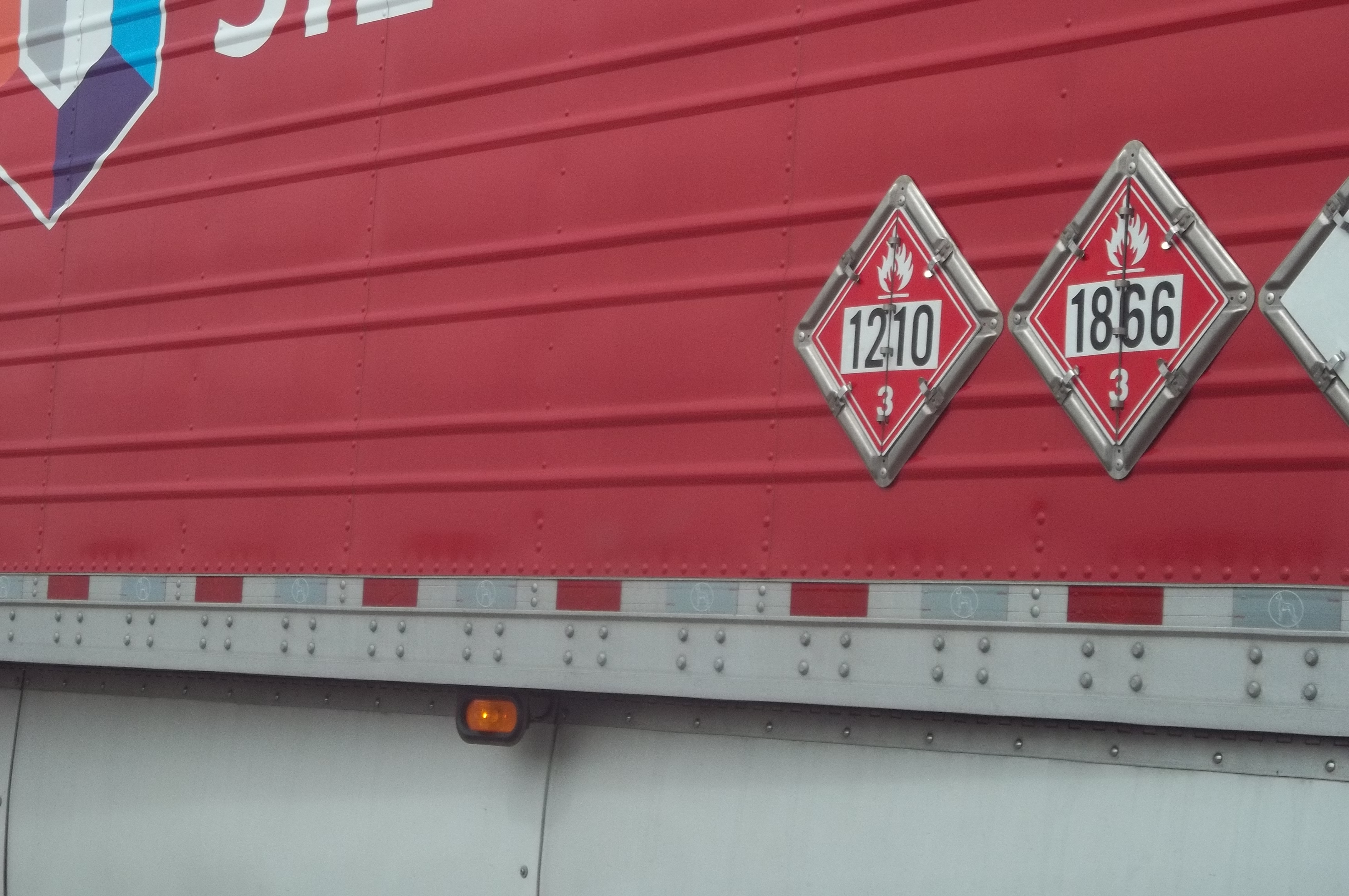
  • On separate placards of the same hazard class.  As demonstrated by the photo below:
Class 3 Flammable Liquid Placards
Class 3 placard with identification number for Printing Ink or Printing Ink Related Material (UN1210) and Resin Solution (UN1866)

And what does it matter to you anyway? You’re a shipper of hazardous materials, not a carrier.  Placarding is the responsibility of the carrier, right?  Wrong.   49 CFR 172.506(a) reads:  “Each person offering a motor carrier a hazardous material for transportation by highway shall provide to the motor carrier the required placards for the material being offered prior to or at the same time the material is offered for transportation, unless the carrier’s motor vehicle is already placarded for the material as required by this subpart.”  And 49 CFR 172.300(a) reads:  “Each person who offers a hazardous material for transportation shall mark each package, freight container, and transport vehicle containing the hazardous material in the manner required by this subpart.”  Since you are offering the hazardous material (which includes hazardous waste shipped on a Uniform Hazardous Waste Manifest) to a motor carrier for transportation it is your responsibility to ensure the bulk packaging and vehicle are properly placarded and marked.

Contact me with any questions you may have about the transportation of hazardous materials by air, highway, vessel, or rail

International and Domestic

Daniels Training Services

815.821.1550

Info@DanielsTraining.com

https://danielstraining.com/

There are many aspects of DOT’s Hazardous Material Regulations (The HMR) that place the burden of responsibility on the person who offers hazardous materials for transportation in commerce (i.e. the Shipper).  As a shipper of hazardous materials – including hazardous waste – it is important for you to be familiar with all of your regulatory requirements.


The USEPA Regulations for “Closed Containers” of Hazardous Waste

Generators of hazardous waste should be aware of the packaging requirements of the U.S. Department of Transportation (USDOT) when shipping their hazardous waste off-site for final treatment and disposal:  the packaging must be in good condition, approved by the USDOT for the use of hazardous materials, it must be labeled per DOT requirements, and it must be closed and sealed to prevent a release during transportation.

What aren’t as clear are the U.S. Environmental Protection Agency (USEPA) requirements for a “closed container” while the waste is accumulated on-site.  In order to answer this question – which has come up many times during my training events – I relied heavily on a USEPA memorandum: Guidance on 40 CFR 264.173(a) and 265.173(a):  Closed Containers. (more…)

An Extension to the Hazardous Waste On-Site Accumulation Limits for Large Quantity Generators of Hazardous Waste that Generate F006 Wastewater Treatement Sludge from Electroplating Operations

As a Large Quantity Generator (LQG) of hazardous waste, you are aware that hazardous waste may not accumulate at your site for longer than 90 days unless it is managed in a satellite accumulation area pursuant to 40 CFR 262.34(c)(1).  However, did you know that an extension of the on-site accumulation time limit from ≤90 days to≤180 days exists for a specific type of hazardous waste?   F006 electroplating wastewater treatment sludge destined for recycling may be accumulated on-site for up to 180 days without a permit or interim status pursuant to 40 CFR 262.34(g-I).  This extension is not granted to any other hazardous waste the facility may generate.  Nor is the extension allowed if the F006 waste is destined for any disposal option other than “legitimately recycled through metals recovery” per 40 CFR 262.34(g)(2).

The one great restriction on the use of this extension is the requirement that the F006 hazardous waste be “legitimately recycled through metals recovery”.  If the wastewater treatment sludge from your electroplating operations is destined for landfill or other treatment instead of metals recovery recycling, you will not be able to take advantage of this extension.  The limiting factors in recycling this type of waste are the value of the metals to be recovered and their concentration in the sludge.  Sludge with low-value metals such as zinc or tin will have a harder time finding recycling options than a sludge containing higher concentrations of copper, nickel, or chrome.  This is something every generator must determine for itself.

If you are able to take advantage of the extension, the requirements of the US EPA are relatively simple; they include:

  1. Implement pollution prevention practices to reduce the hazards of the F006 waste [40 CFR 262.34(g)(1)].
  2. Ensure the F006 waste is legitimately recycled through metals recovery [40 CFR 262.34(g)(2)].
  3. Accumulate no more than 20,000 kg of F006 waste on-site at any one time [40 CFR 262.34(g)(3)].
  4. Comply with the regulations applicable to LQG’s who manage hazardous waste in containers, tanks, or containment buildings [40 CFR 262.34(g)(4)(i-v)].

If the recycling facility to which you ship the F006 waste is at a distance of ≥200 miles, then you may accumulate the waste on-site for up to 270 days without a permit and without special permission from US EPA [40 CFR 262.34(h)].

Unless an extension to the 180/270 day time limit or an exception to the 20,000 kg on-site accumulation limit has been granted by the Regional Administrator of the US EPA, an exceedence of either of these limits subjects the facility to the US EPA regulations of a storage facility and the requirements of 40 CFR 264,265, and 267 and the permit requirements of 40 CFR 270.

Unless you generate an F006 listed hazardous waste from the on-site treatment of electroplating wastewaters, this extension in on-site accumulation times will not be of any benefit to you.  Further, if you generate this type of waste but do not have a recycling disposal option available, you will not be able to avail yourself of the increased on-site accumulation time limits.  However, if you meet the required criteria, it may be of great benefit to you to take advantage of this limited extension of the on-site accumulation limits.

Search Website