PO Box 1232 Freeport, IL 61032

A Different Kind Of Training

A Different Kind Of Training

A Different Kind Of Training

Use of the Emergency Response Telephone Number for Shipments of Hazardous Materials and Hazardous Waste

If you offer for transportation a hazardous material (HazMat) on a shipping paper such as a bill of lading or a hazardous waste on the Uniform Hazardous Waste Manifest (required for both large and small quantity generators of hazardous waste) you must provide an emergency response telephone number for use in the event of an emergency.  I have found many shippers to be unaware of their responsibility regarding this matter as they rely on the carrier and/or designated facility to provide the information required by 49 CFR 172.604.

This article was updated November 01, 2019 to reflect changes made to the regulations since its first publication on March 27, 2012.

The purpose of the emergency response telephone number is that it be a source of helpful information for emergency responders in the event of a HazMat Incident, therefore the number must be:

  • Monitored at all times the hazardous material is in transportation until it reaches its designated facility and is removed from transportation.

And…

  • The number of a person who is knowledgeable of the HazMat being shipped and has comprehensive emergency response information and incident mitigation information for that material.

Or…

  • Has immediate access to a person who has such knowledge and information.  Telephone numbers that require a call back such as an answering service, beeper, or answering machine will not suffice (LOI 01-0176).

This knowledgeable person monitoring the telephone 24/7 (if necessary) is known as the Emergency Response Information Provider or the ERI Provider.

It is important that the emergency response telephone number is clearly visible in the event of an emergency, therefore the number must be written on the shipping paper:

  • Immediately following the description of the hazardous material (this would be Section 9b of the Uniform Hazardous Waste Manifest).
  • Entered once on the shipping paper in a “prominent, readily identifiable, and clearly visible manner…”  This can be done by using a larger or differently colored font, highlighting, or otherwise setting the number apart.  It must also be indicated on the shipping paper that the number is for emergency response information (e.g., “EMERGENCY CONTACT ###”).  This option can only be used if the number applies to each hazardous material on the shipping paper.  Section 3 of the Uniform Hazardous Waste Manifest may be used to fulfill this requirement.

Unfortunately some shippers and carriers were using the phone numbers of ERI Providers that they had not registered with to provide such service and in an emergency first responders were not able to obtain the necessary information from the ERI Provider.  For this reason, effective October 1, 2010, some form of identification of the person who has registered with the ERI Provider must be included on the shipping paper.  Note that the name of the ERI Provider is not required to appear on the shipping paper, merely their phone number (LOI 11-0152, LOI 10-0262).  However the name of the person that has contracted or registered with the ERI Provider to perform this service must be identified on the shipping paper.  Identification can be by name, contract number, or other unique identifier of the ERI Provider for the registrant and it must be near the emergency response telephone number unless it appears elsewhere on the shipping paper in a prominent, readily identifiable, and clearly visible manner.

So, if the person offering the hazardous material for shipment is also the ERI Provider, their name or some other acceptable means of identification must appear prominently and clearly on the shipping paper.  For the Uniform Hazardous Waste Manifest this is accomplished by proper completion of Section 5.  If a 3rd party is contracted to be the ERI Provider then some identification linking them to the registrant (name, contract number or other unique identified of the ERI Provider) must be clearly visible on the shipping paper (LOI 10-0146).  This information could be recorded in Section 14 of the Uniform Hazardous Waste Manifest.

If using a 3rd party, it is the responsibility of the person registered with the ERI Provider to ensure they have the current information on the material before it is offered for shipment.  This is especially important for hazardous waste shipments as the wastes may be different for each pickup.

49 CFR 172.604(b) can be difficult to read and understand (It was much more challenging for me than I thought it would be) but the intent is clear:  some information linking the ERI Provider to the person offering the hazardous material for shipment must be clearly visible on the shipping paper for emergency responders to find.  As of June 2011, the Agency was aware of the confusing text of this regulation and will be taking steps to clarify it (11-0008).

For telephone numbers outside the US, the international access code or the “+” sign, country code, and city code as appropriate must be included.

If preparing shipping papers for the continued transportation of a hazardous material, it is the responsibility of the subsequent offeror to ensure if the original or previous emergency response telephone number is authorized for that shipment.  In such a situation, the subsequent offeror may choose to use their own ERI Provider (11-0005).

The requirement to include an emergency response telephone number do not apply to:

  1. Limited Quantities offered for transportation pursuant to 49 CFR 173.150-156 & 173.306.
  2. Transportation vehicles or freight containers with lading that has been fumigated and displays the FUMIGANT marking, as long as no other hazardous materials are present.
  3. Materials properly described under the following shipping names:
  • Battery powered equipment.
  • Battery powered vehicle.
  • Carbon dioxide, solid.
  • Castor bean, castor flake, castor meal, or castor pomace.
  • Consumer commodity.
  • Dry ice.
  • Engines, internal combustion.
  • Fish meal, stabilized or fish scrap, stabilized.
  • Refrigerating machine.
  • Vehicle, flammable gas powered.
  • Vehicle, flammable liquid powered.
  • Wheelchair, electric.

Prior to your next shipment, ensure that you are in compliance with these important regulations.  Significant penalties will be assessed if the emergency response telephone number for a shipment of your hazardous waste or hazardous material is discovered to be incorrect or incomplete during a hazardous material incident or emergency.  You must also ensure proper training of your HazMat Employees and the employees of a Large Quantity Generator of hazardous waste who handle the waste, including preparing it for shipment or signing the Uniform Hazardous Waste Manifest.  Please contact me to schedule on-site training.
Weekly Inspections of Hazardous Waste Containers in Satellite Accumulation Areas

Both Large and Small Quantity Generators of hazardous waste (LQG & SQG respectively) are required to conduct weekly inspections of their hazardous waste accumulation areas; typically referred to as Central Accumulation Areas (CAA’s) or 90 (for LQG’s) or 180 (for SQG’s) day accumulation areas.  I was recently at an LQG and was told by the EHS Coordinator that the weekly inspection took her almost 5 hours to complete.  The reason?  The inspection included more than 50 Satellite Accumulation Areas (SAA’s) distributed throughout the sprawling facility.  My observation that weekly inspections are not required for SAA’s caught her by surprise.  “Are you sure?” she asked.

Yes I am.

The Federal regulations for managing hazardous waste in an SAA can be found at 40 CFR 262.34(c).  The baseline requirements are known to most:

  • No more than 55 gallons of hazardous waste or 1 quart of acute hazardous waste in a single SAA.
  • In a container at or near the point of generation where the waste initially accumulates.
  • Under the control of the operator of the process generating the waste.

While waste accumulates in the SAA, the generator must comply with other routine container requirements:

  • 40 CFR 265.171:  Containers in good condition.
  • 40 CFR 265.172:  Container compatible with waste.
  • 40 CFR 265.173(a):  Container kept closed except when adding or removing waste.
  • Mark container with the words “Hazardous Waste” or other words that describe the contents (check with your State on this point specifically since some require additional information to be included).

While the waste is maintained in the SAA in compliance with the above, it is not subject to the requirements of 40 CFR 262.34(a) 0r (d); these are the regulations that refer to the weekly inspection requirements of  40 CFR 265.174.  Therefore, proper maintenance of hazardous waste in an SAA precludes the requirement for weekly inspections.

Additional requirements kick-in when the SAA volume thresholds of 55 gallons for hazardous waste or 1 quart for acute hazardous waste are reached; at that point the generator must…

  • Date the container.
  • Move it to the CAA within 3 calendar days.  Note:  not 72 hours or 3 business days.
  • Once moved to the CAA, the generator may re-date the container and then begin the 90 or 180 day accumulation time period.
  • Once moved to the CAA, the container becomes subject to all the standard hazardous waste generator requirements of 40 CFR 262.34(a).

Weekly inspections of waste containers (both hazardous waste and acute hazardous waste) are an option, not a requirement.  Decide for yourself if the benefit from inspections is worth your time and effort.  For more information about SAA’s, review this US EPA FAQ’s on the subject.

I pride myself in providing a training service that not only complies with the regulations (training is required for LQG’s at 40 CFR 265.16) but also gives you information you can use (see above) to make your job of environmental compliance easier.  Please review my schedule of open enrollment training events or contact me to schedule on-site training.

Texting and Cell Phone Ban for Drivers of Commercial Motor Vehicles

Effective January 3, 2012 (Volume 76 75470-75488 of the Federal Register) drivers of Commercial Motor Vehicles (CMV) are prohibited from texting or using a hand-held mobile telephone while driving.  The change affects the regulations of both the Federal Motor Carrier Safety Administration (FMCSA), which apply solely to interstate transportation (between two or more states), and those of the Pipeline and Hazardous Materials Safety Administration (PHMSA), which apply to both interstate and intrastate transportation of placarded loads of hazardous materials.

For the purposes of the FMCSA regulations at 49 CFR 392.80 & 392.82 the ban applies to the following engaged in interstate commerce:

  •  A gross vehicle weight rating or gross combination weight rating, or gross vehicle weight or gross combination weight, of 4,536 kg (10,001 pounds) or more, whichever is greater; or
  • A vehicle designed or used to transport more than 8 passengers (including the driver) for compensation; or
  • A vehicle designed or used to transport more than 15 passengers, including the driver, and is not used to transport passengers for compensation; or
  • A shipment of hazardous materials that requires placarding pursuant to 49 CFR 172, Subpart F.

For the purposes of the PHMSA regulations at 49 CFR 177.804, which refer you to the FMCSA regulations, the ban applies to the following engaged in interstate and intrastate commerce:

  • A shipment of hazardous materials that requires placarding pursuant to 49 CFR 172, Subpart F or any quantity of a material listed as a select agent or toxin by the Department of Health and Human Services at 42 CFR part 73.

Both agencies define prohibited activities as follows:

  • Driver of the vehicle may not use a hand-held mobile phone or text while driving, nor may the employer allow such activity.
  • “Driving” includes temporary stops for traffic jams, at a traffic light or sign, or if you are not pulled off the highway and halted in a safe manner.
  • Prohibited texting includes but is not limited to:  Short Message Service (SMS), Instant Messaging (IM), e-Mailing, accessing the internet, any other form of electronic text retrieval.
  • Prohibited use of a hand-held mobile telephone includes:
  1. Holding a mobile telephone while communicating by voice.
  2. Dialing by pressing more than one button.
  3. Reaching for a mobile phone in an unsafe or unacceptable manner (see 49 CFR 393.93).

But you need to communicate, right?  So what’s a driver to do?  Here are some options to remain compliant and in-touch:

  • Texting & use of hand-held telephone while driving is OK when necessary to communicate with law enforcement or emergency services.
  • Texting & use of hand-held telephone is OK in a vehicle with or without the motor running when on the side of, or off, the highway and halted in a location where the vehicle can safely remain stationary.
  • Use an acceptable hands-free telephone that the driver can access safely and operate solely by pushing one button.

In addition to the above Federal regulations, the use of mobile communication devices are regulated, and in many cases banned, by State laws and local ordinances.

If you transport any quantity of a hazardous material in commerce, no matter whether it is required to be placarded or not, you are a HazMat Employee and require triennial training pursuant to 49 CFR 172, Subpart H.

Contact me to schedule the required training for all of your HazMat Employes.

HMR exception saves hazardous waste generator money

Significant Hazardous Waste Penalties and Fines for Another Company

PHILADELPHIA (March 8, 2012) — Ellwood Quality Steels Company has agreed to pay a $150,000 penalty to settle alleged violations of hazardous waste regulations at its manufacturing facility in New Castle, Pa., the U.S. Environmental Protection Agency announced today.”  Based on the information contained in the full US EPA news release, let’s determine the cost for Ellwood Quality Steels Company to comply with the regulations and avoid this fine.


  1. 1.       “…a variety of hazardous waste including electric and ladle arc furnace dust, which was contained in two tractor trailers without being marked as hazardous waste;” – Since no mention is made to the contrary, I’ll assume the two tractor trailers meet the US EPA definition of a container found at 40 CFR 260.10Container means any portable device in which a material is stored, transported, treated, disposed of, or otherwise handled.  A roll of 500 labels bearing the words “Hazardous Waste” = $65.  Add the date of accumulation, ie. the date hazardous waste first was placed in the container, and your back in compliance.
  2. 2.       “…improperly disposing of mercury-containing universal waste lamps in its arc furnace without a hazardous waste permit.” – Cost for disposing of 500 x 4’ fluorescent lamps with Lamptracker = $450.
  3. 3.       “… stored hazardous waste for more than 90 days without a storage permit;” – This one’s a wash since it doesn’t cost anything extra to ship hazardous waste off-site prior to 90 days.  There are some instances when a Large Quantity Generator of hazardous waste may legally exceed the 90 day on-site accumulation limit without a permit, read more about it here.  Compliance with the regulations, in this case however, is free.
  4. 4.       “failed to keep hazardous waste containers closed;”  – Hazardous waste containers must be kept closed except when adding or removing waste, read more hereNew Pig Latching Drum Lid = $275.
  5. 5.       “failed to minimize the possibility of releases of hazardous wastes;” – I’m unsure what is meant by this, but since Pennsylvania is one of the few States that requires a containment system for the storage area of a hazardous waste generator [the others are: AL, CA, CT, MA, MN, SC (if LQG), WA, & MO (if >1,000 kg)], I’ll assume they didn’t provide proper containment.  I’m no contractor, so let’s assume the total cost to construct a storage area with containment = $25,000.
  6. 6.       “failed to conduct weekly inspections;” – Large and Small Quantity Generators of hazardous waste must weekly inspect their hazardous waste accumulation and storage areas, read more here.  The inspections can be completed by any employee trained sufficiently to perform their duties in compliance with the regulations.  Cost in lost time spent performing the inspection = $50/week = $2,600/year.
  7. 7.       “failed to provide hazardous waste training;” – I provide on-site training that meets the requirements of the US EPA for Hazardous Waste Personnel and the US DOT for HazMat Employees for $1,749.
  8. 8.       “failed to prepare and maintain hazardous training records;” – I provide these records as part of my on-site training; cost = $0.
  9. 9.       “failed to properly fill out hazardous waste manifests;” – I address the proper completion of the Uniform Hazardous Waste Manifest at my on-site training and at my open-enrollment training at no additional cost.
  10. 10.   “and failed to comply with universal waste labeling/marking requirements.” – Though provided relief from full regulation under RCRA, universal waste still has specific labeling and marking requirements.  Learn how to comply with the regulations at one of my training events.  Purchase 100 universal waste labels from Labelmaster for $44.

Total cost to comply with regulations = $27,583 + $2,600/year for inspections.  Consider that the cost of the fines doesn’t begin to cover the total costs to the company in lost time, headaches, lawyer and consultant fees, etc.  No matter what math you use, it’s always less expensive to comply with the regulations than it is to pay the fines.

Please contact me for a free consultation; I can help you decide if you’d be better attending one of my open enrollment training events or having me conduct on-site training at your facility.

HazMat Employee Training for Drivers

49 CFR 172, Subpart H requires a HazMat Employer to train all of their HazMat Employees every three years on the following topics:

  • General Awareness/Familiarization
  • Function Specific Responsibilities
  • Safety/Emergency Response
  • Security General Awareness
  • In-Depth Security (if applicable)

49 CFR 171.8’s definition of a HazMat Employee includes, “Operates a vehicle used to transport hazardous materials.”  Thus, a driver of a motor vehicle transporting any quantity of a hazardous material in commerce over a public roadway is a Hazmat Employee and must receive full training triennially.  There is some confusion on this point as some motor carriers incorrectly believe that the HazMat Employee training requirements apply only if they transport an amount of HazMat that mandates placarding of the vehicle.  The transportation in commerce of any hazardous material, unless excluded by regulation, such as Materials of Trade and some Combustible Liquids, is subject to the HazMat Employee training requirements.

Road sign warningIn addition, 49 CFR 177.816 requires HazMat Employees who will operate a motor vehicle to be trained in the applicable requirements of 49 CFR parts 390 – 397 and safe operating procedures for that motor vehicle.  Training must include:

  • Use of vehicle controls and equipment, including operation of emergency equipment.
  • The basic and advance methods for safe operation of the vehicle in any situation or environment the driver may find themselves.
  • Procedures for maneuvering tunnels, bridges, and railroad crossings.
  • Vehicle attendance requirements and incident reporting.
  • Loading and unloading of materials, including –
    • Hazardous material compatibility and segregation requirements.
    • Handling of packages.
    • Securing packages on the vehicle.

Like this article?

Subscribe to my Monthly Newsletter

No marketing emails!

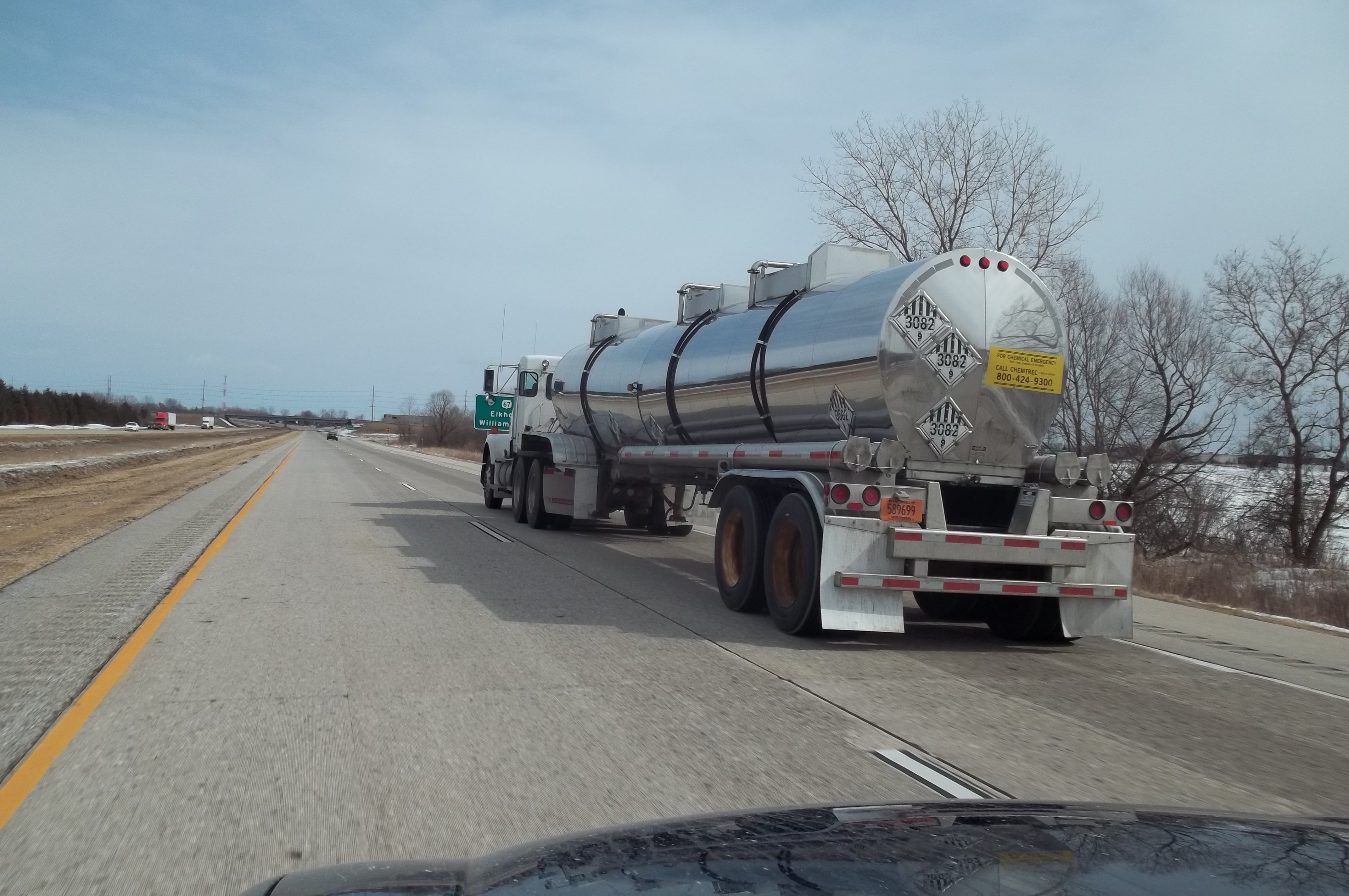
In addition to the above “General Awareness Driver Training”, specialized training is required for drivers of cargo tanks or vehicles with portable tanks of >1,000 gallons, they must also have a state-issued commercial driver’s license (CDL) required by 49 CFR 383.  Specialized training shall include the following:Class 9 placards on cargo tank truck

  • Operation of emergency control features of the vehicle.
  • Special vehicle handling characteristics.
  • Loading and unloading procedures.
  • Properties of the hazardous material being transported.
  • Retest and inspection requirements for cargo tanks.

49 CFR 177.816(c) provides relief from this additional training requirement for drivers of vehicles transporting HazMat.  The requirements for both the General Awareness Driver Training and the Specialized Driver Training may be satisfied by the maintenance of a CDL with a Tank Vehicle or HazMat endorsement.

Note the “may be…”, as the Hazmat Employer the determination if the training and testing received by your HazMat Employees is adequate is your responsibility.  In other words, you are the one who must decide if the maintenance of the CDL with applicable endorsements is enough to meet the training requirements of 49 CFR 177.816(a) & (b).  I suggest you document this determination and maintain with your training records.

49 CFR 177.816(d) requires that the Specialized Driver Training must conform to the frequency of training requirements (within 90 days of employment and triennially thereafter) and recordkeeping requirements of 49 CFR 172.704 which applies to all HazMat Employees.  Again, it is up to you as the HazMat Employer to ensure compliance with this requirement, document your decision.

Contact me with any questions you may have about the transportation of hazardous materials by air, highway, vessel, or rail

International and Domestic

Daniels Training Services

815.821.1550

Info@DanielsTraining.com

https://danielstraining.com/

I provide HazMat Employee training for anyone involved in the transportation of hazardous materials – including hazardous waste – in a variety of formats.  Contact me for a free consultation so you can decide what training is required and what is best for you – and your drivers.

Notification of Regulated Waste Activity Form for Hazardous Waste Generators

The US EPA requires you to submit a Notification of Regulated Waste Activity (8700-12) Form for certain activities involving wastes subject to the regulations of the Resource Conservation and Recovery Act (RCRA).  A Notification is required if you handle a regulated waste or hazardous secondary material and may be required under the following circumstances:

  • You are a Large Quantity Generator (LQG) or Small Quantity Generator (SQG) of hazardous waste.  A Conditionally Exempt Small Quantity Generator of hazardous waste (CESQG) is not required to notify.
  • You are a Large Quantity Handler of universal waste (accumulate >5,000 Kg of universal waste).
  • You recycle hazardous waste.
  • You transport, process, or re-refine used oil; burn off-spec used oil for energy recovery; or market used oil.  The generation, storage, and off-site transportation of used oil is not subject to notification.
  • You are an eligible academic entity opting into 40 CFR 262, Subpart K.
  • You are managing a hazardous secondary material.

Upon receipt of an initial notification form, your site will be issued a unique EPA ID number by the US EPA.  This number is specific to the geographic location of your site and does not change if you sell the property or expire if you go out of business.

If you already have an EPA ID number, you must submit a subsequent notification for changes in any of the following:

The Notification of Regulated Waste Activity Form is the method the US EPA or your state environmental agency (see below) relies on to track your regulated waste activities.  It is your responsibility to ensure the information they have is up-to-date, accurate, and complete. The US EPA recently updated its Notification of Regulated Waste Activity Instructions and Form Booklet in December 2011 and it contains very helpful information.

Many states with authorized hazardous waste programs have their own procedures and requirements for submittal of the initial and subsequent notification forms.  State-specific regulations may include:

  • A state-specific notification form in lieu of the federal form.
  • Time lines for submittal of the initial and subsequent notifications.
  • If using the US EPA form, a state mailing address for submittal.
  • Fees to accompany the notification.

It is very important that you check with your state to ensure your submittal meets their requirements.  

My training services cover the hazardous waste regulations of the US EPA and the HazMat Employee regulations of the US DOT.  I provide open enrollment training events nationwide and year round (my schedule) and on-site training to meet your exact needs.  Please contact me to arrange for the exact training services you require.

Calendar

When Does the Date of Accumulation Begin for Waste Submitted for Analysis?

It’s not too hard to imagine a situation where a container of an unknown material for disposal is brought to your attention during a facility clean-out.  In this situation, disposal as a waste is certain, what isn’t certain are the presence, and type, of hazards in the unknown waste.  If a sample is collected and submitted for analysis, how must you manage the unknown waste while you await results?

The answer is simple and answered directly in this US EPA interpretation (RO11424):  any unknown waste must be managed as a hazardous waste until such time as generator knowledge or analysis proves it is not a hazardous waste.

The moment a decision is made to discard a material, it becomes a waste.  This is its “Point of Generation (POG).  At the POG you are required per 40 CFR 262.11 to determine if the waste is exempt from regulation (40 CFR 261.4 or other), is a de-regulated hazardous waste (Used Oil, Universal Waste), or is a listed or characteristic hazardous waste.  Any delay in conducting the hazardous waste determination – say, waiting for lab results – does not exempt the waste from regulation.  The requirements for hazardous waste generators (labeling, on-site accumulation time limit, inspections, training, etc.) apply at the POG or when the waste is removed from a Satellite Accumulation Area (SAA)

Suggested handling for unknown waste during a hazardous waste determination:

  1. Store in your Central Accumulation Area (CAA) or SAA.
  2. Label:  “Hazardous Waste – Pending Analysis”  <<DATE OF ACCUMULATION>>.
  3. Manage the same as all other non-exempt (ie. CESQG) hazardous waste.
  4. Request the lab to “Rush” results.  Note, your lab may charge an additional fee for rush service.
  5. Immediately upon receipt of results, compare them to hazardous waste characteristics (40 CFR 261, Subpart C).  Determination of listed hazardous waste (40 CFR 261, Subpart D) does not require analysis as it relies upon your knowledge of the source of the waste.
  6. If waste is hazardous, remove “Pending Analysis” from the label and continue on-site management as hazardous waste.  Arrange for off-site disposal.
  7. If waste is non-hazardous, remove hazardous identification and manage as non-hazardous waste.

Read this blog post for more information about exceptions to the US EPA and US DOT regulations for the storage and transportation of waste determination samples.

Being a generator of hazardous waste is not easy.  Frequently what seems like common-sense (waiting for a lab report before handling a waste as hazardous) is actually a serious violation of the RCRA regulations.  Attendance at one of my open enrollment training events is a good way to ensure you are prepared for situations like these when the arise.

export of hazardous waste recordkeeping

The Rulemaking Process

The Code of Federal Regulations or CFR contains all of the rules and regulations of Federal Agencies, a description of the structure of the CFR can be found here.  Equally important to understanding the regulations is awareness of the rulemaking process where a determination is made that a new or revised regulation is necessary and steps taken to create that regulation.  A graphic illustration or “Reg Map” of the process can be found here.

Before the rulemaking process becomes public, a Federal agency must take the initiative to create a new rule or revise an existing one to meet some need.  The agency will determine if a new or revised rule is needed based on a variety of factors that may include public health and safety concerns, new scientific data or technology, political pressure, and more.  The agency will then prepare a Notice of Proposed Rulemaking (NPRM) and make it available for review by the Office of Management and Budget (OMB).

Executive Order 12866, signed by President Clinton in 1993, created guidelines for OMB to follow during its review.  It will not allow the NPRM to be published if, among other things, it is not consistent with the issuing agencies authority and philosophy, contradicts or conflicts with existing rules, or if it determines the issuing agency has not considered alternatives to issuing the rule.  The OMB will only review those rulemaking actions it determines to be “significant”.

If the NPRM passes the OMB review, it is ready to be published in the Federal Register.  The Federal Register is the official daily publication for rules, proposed rules, and notices of Federal agencies and organizations, as well as executive orders and other presidential documents.  The purpose of the NPRM is to make publicly known the proposed new rule or revision.  The agency will include with the NPRM its reasons for the rule and supporting information.  The public is then to comment on the NPRM.

Comments on the NPRM by the public may be made through a variety of methods:  US Mail, hand delivery, fax, email, or web portal (www.regulations.gov).  Comments must reference the Docket Number and Regulation Identifier Number (RIN) assigned to the NPRM.  Choose your words carefully, all comments are made publicly available along with the NPRM.

The Comment Period will last for a period of time established by the agency in the NPRM (60 days is standard); the holding of a public hearing during this time is at the discretion of the agency unless required by statute or its policy.  At the close of the Comment Period the agency will conduct research taking into consideration any new information contained in comments received.  Consideration is given to the proposed rule’s economic costs and benefits, possible environmental impact, and overall burden on the regulated parties.  After it has completed the research to its satisfaction the agency will draft the final rule, interim final rule, or direct final rule.

  • A final rule adds, changes, deletes, or affirms regulatory text.
  • An interim final rule adds, changes, or deletes regulatory text and contains a request for comments. The subsequent final rule may make changes to the text of the interim final rule.
  • A direct final rule adds, changes, or deletes regulatory text at a specified future time, with a duty to withdraw the rule if the agency receives adverse comments within the period specified by the agency.

The OMB then has ninety days to again review the rule prior to its publication.  OMB may either approve the rule for publication or send it back to the issuing agency for additional research.

Publication of the rule may take the form of each or all of the following:

  • Submittal to both houses of Congress and the General Accounting Office for review and possible impact on the rule.
  • Publication in the Federal Register.
  • Publication in the Code of Federal Regulations

The Federal Register entry contains valuable information in the form of the preamble where the agency will address comments received, provide support information for the appearance of the rule as published, indicate the purpose of the rule, and include its opinion of what the rule means.

The agency may make minor changes to the rule upon publication, such as correcting typos, without informing the public or creating a comment period.

Why is it so important to be aware of this process?  Every step of the above that takes place in the public realm is made available on the internet (www.regulations.gov).  Given the widespread availability of the internet, the government assumes that this information will be known by all affected persons.  In short, if you are in non-compliance with a regulation because you were unaware of its existence, the agency (US EPA, OSHA, US DOT) will point to its publication in the Federal Register and say, “you should have known”.

I have had the opportunity to conduct training for a variety of companies over the years.  It is not uncommon that they first learn of the existence of a regulation from me.  Often they are surprised to learn that they are not in compliance with a regulation that has been in effect for years; their comment:  “No one told us about that.”  The regulatory agencies such as the US EPA or the US DOT won’t tell you about a new or revised regulation until they find you to be in violation and it’s too late.  Attending high-quality training like mine is one way to learn about new and revised regulations that affect you and meet the training requirements of the US EPA and the US DOT.

My one day training events will meet the regulatory requirements of the US EPA for hazardous waste personnel and the US DOT for HazMat Employees.  Check out my training schedule to find a date and location convenient for you or contact me (Info@DanielsTraining.com) to arrange for on-site training.

What is a HazMat Employee?

A HazMat Employee is a term used by the Pipeline and Hazardous Materials Safety Administration (PHMSA), one of several Administrations and Bureaus within the US Department of Transportation, to refer to any person involved in the transportation of hazardous materials in commerce.  A complete understanding of this term is necessary in order to comply with the PHMSA mandate to train all HazMat Employees.  The purpose of this article is to assist you in properly identifying your HazMat Employees so you can take the next step and ensure the required training is completed.

Before we begin to identify a HazMat Employee, I must differentiate this term from a similar sounding one used by the Occupational Safety and Health Administration (OSHA).  OSHA has its Hazardous Waste Operations – or HAZWOPER – regulations at 29 CFR 1910.120.  HAZWOPER addresses clean-up and corrective actions at uncontrolled hazardous waste sites or hazardous waste operations at Treatment Storage and Disposal facilities.  Training required by HAZWOPER regulations is sometimes referred to as:  HazMat Awareness, Hazardous Material Training, etc.  This is separate and distinct from the hazardous material transportation regulations of the PHMSA/DOT.

It is also necessary to understand two other terms from the regulations before we can understand the definition of a HazMat Employee.  Defined at 49 CFR 171.8, these two are:

“A HazMat Employer is someone who employs at least one HazMat Employee and transports or offers for transport a hazardous material in commerce.”

“A Hazardous Material is anything the DOT has determined may pose an unreasonable risk to health, safety, and property when transported in commerce.”  It includes many common materials, such as:  solvents, paints, cleaners, degreasers, resins, corrosive acids and bases, and more.

A full definition of a HazMat Employee can also be found at 49 CFR 171.8.  It includes the self-employed and those employed by others as full-time, part time, or temporary workers; anyone who in the course of doing their job directly affects hazardous materials transportation safety.  It also includes persons who:

  • “Load, unload, or handle hazardous materials” – anyone involved in the transfer of a hazardous material from or to its means of transportation.  The transportation could be by air, vessel, rail, or highway.
  • “Designs, manufactures, fabricates, inspects, marks, maintains, reconditions, repairs, or tests a package, container or packaging component that is represented, marked, certified, or sold as qualified for use in transporting hazardous material in commerce.” – This includes the reconditioning of containers for reuse as hazardous material packaging.
  • “Prepares hazardous materials for transportation.” – A wide range of pre-transportation activities may be completed by HazMat Employees long before a hazardous material begins transportation.  This might include selecting hazardous materials packaging and inspecting, labeling, or marking the packaging.  It also includes persons who prepares, reviews and/or signs a shipping paper like the Uniform Hazardous Waste Manifest.
  • “Is responsible for safety of transporting hazardous materials.” – EHS Managers, Shipping and Receiving Supervisors, Dispatchers, Route Coordinators, persons who may never see a hazardous material, but are responsible for persons who do are HazMat Employees as well.
  • “Operates a vehicle used to transport hazardous materials.” – Operators of a vehicle over a public roadway transporting hazardous materials (unless excepted from regulation) are HazMat Employees.  This does not include the transfer of a hazardous material across a public roadway if the road divides a single property.
Additional guidance on identifying your HazMat Employees can be found in a PHMSA document:  What you Should Know: A Guide to Developing a Hazardous Materials Training Program.
It has been my experience that many HazMat Employers are not aware of the complete definition of a HazMat Employee and thus fail to identify the entirety of their requirements under the Hazardous Material Regulations.  One of these requirements is to train your HazMat Employees with 90 day of hire and triennially (every three years) thereafter per 49 CFR 172.704(c).  I provide  HazMat Employee training and am willing to discuss your training needs with you at any time.


DOT Chart 14 Now Available in Spanish

For those of you not familiar with the DOT Chart 14, it is a fantastic guidance document produced and distributed by the Pipeline and Hazardous Materials Safety Administration (PHMSA) within the US DOT.  It contains helpful information on three of the four hazardous material communication methods required by the Hazardous Material Regulations (HMR):

  • Markings,
  • Warning Labels, and;
  • Placards.

The missing HazMat communication method is:  Shipping Papers.

At just four pages, the DOT Chart 14 is not a comprehensive source of information, nor is it intended to be a substitute for the regulations; as it reads on the cover, “NOTE:  This document is for general guidance only and should not be used to determine compliance with 49 CFR, Parts 100-185.”  And don’t be misled by the translation to Spanish; the HMR requires all HazMat shipping papers, markings, warning labels, and placards to be in English.  The intent, I imagine, of this translated version is to assist you as the HazMat Employer to fulfill the requirement to provide full training to your Spanish speaking HazMat Employees every three years (49 CFR 172, Subpart H).

The DOT Chart 14, both English and Spanish, is available from the following sources:

  • Download and print a color copy from the PHMSA website for free (English or Spanish),
  • Purchase a copy from a commercial supplier, or;
  • Purchase a copy directly from the PHMSA for much less than you’ll spend at a commercial supplier.

I have used the DOT Chart 14 as a part of my HazMat Employee training for years, going back to when it used to be known as the DOT Chart 12 and was produced by the Research and Special Programs Administration (RSPA), precursor to the PHMSA.  I strongly recommend its use to assist you in complying with the Hazardous Material Regulations at your facility.

Search Website