Summary of Changes from the 2008 Emergency Response Guidebook to the 2012 ERG
The Emergency Response Guidebook, updated for 2012, was recently released for publication and is now widely available. If you rely on the ERG as a source of information in an emergency or use it as a training tool as I do, you should be aware of the differences in the 2012 version from the 2008. These are summarized below.
The cover has been updated but retains its distinctive orange color.
Several sections of general information (the white pages) have been moved from the front to the back.
Sections have been expanded and/or revised, including:
Shipping Documents (Papers).
How to Use this Guidebook during an Incident.
User’s Guide.
Isolation and Evacuation Distances.
Who to Call for Assistance.
Table of Placards and Initial Response Guide to Use On-Scene.
Rail Car Identification Chart.
Road Trailer Identification Chart.
Fire and Spill Control.
Pipeline Safety Information.
Criminal/Terrorist Use of Chemical/Biological/Radiological Agents.
Glossary.
Publication Data (and related information).
Emergency Response Telephone Numbers.
New Dangerous Goods/Hazardous Materials have been added to the YELLOW bordered pages (Dangerous Goods/Hazardous Materials listed by Identification Number) and BLUE bordered pages (Dangerous Goods/Hazardous Materials listed by Proper Shipping Name).
Emergency response information for some dangerous goods/hazardous materials in the ORANGE bordered pages have been revised.
The following changes to the Table of Initial Isolation and Protective Action Distances and the Table of Water-Reactive Materials Which Produce Toxic Gases (the Green-bordered pages):
Added Table 3 for six gases which are toxic by inhalation.
Revised some of the Initial Isolation and Protective Action Distances.
Added a Boiling Liquid Expanding Vapor Explosion (BLEVE) Chart to Fire and Spill Control Section.
Added an Improvised Explosive Device (IED) Safe Standoff distances Chart to Criminal Terrorist Section.
Check out the PHMSA website for more information about the 2012 ERG.
Training Requirements for Handlers of Universal Waste
You may already be aware of the requirement for large quantity generators of hazardous waste to train their facility personnel annually. And you may be aware of the responsibility of small quantity generators of hazardous waste to ensure that all employees are thoroughly familiar with proper waste handling and emergency procedures [40 CFR 262.34(d)(5)(iii)]. You may not know that if you generate a universal waste, you have an additional responsibility to train/inform your employees depending on your handler status.
Universal wastes are hazardous wastes that have the option to be managed under the less restrictive universal waste regulations of 40 CFR 273. Federal universal wastes include those listed below. Check with your state to determine if they have added any state-specific universal wastes to this list.
Batteries
Mercury-containing devices
Lamps
Recalled or canceled pesticides
There are two levels of universal waste handler status determined by the amount of universal waste accumulated at any one time in the calendar year, they are:
Small Quantity Handler accumulates <5,000 kg of universal waste.
Large Quantity Handler accumulates ≥5,000 kg of universal waste.
Note that your universal waste handler status is distinct and separate from your hazardous waste generator status. Also, the employee training requirements for universal waste are separate and distinct from those for hazardous waste.
Pursuant to 40 CFR 273.16 a small quantity handler of universal waste must inform all employees who handle or have responsibility for managing universal waste. The information must describe proper handling and emergency procedures appropriate to the type(s) of universal waste handled at the facility. Though entitled”Employee Training” the regulation only requires you to “inform” applicable employees, this could be done through instructions, signs, etc. You may not, however, assume they have the necessary knowledge due to experience since the regulations requires you to actively “inform” them of what they need to know.
Pursuant to 40 CFR 273.36 a large quantity handler of universal waste must ensure that all employees are thoroughly familiar with proper waste handling and emergency procedures, relative to their responsibilities during normal facility operations and emergencies. Note the – deliberate – similarity between the training requirements for a large quantity handler of universal waste and a small quantity generator of hazardous waste. They both must ensure their employees are thoroughly familiar with their job duties and know what to do in an emergency, but they have no direction on how this is to be done or are required to document the process or maintain records. How you comply with this regulation is up to you, it could be signs, labels, on-the-job training, or other.
The regulations of the USEPA (and authorized states) are deliberately vague on the subject of training for employees who work with universal waste. It is the responsibility of the handler to determine if its training is adequate. However, I have been advised of a good way to ensure compliance. I was told by an authority of a state environmental regulatory agency that compliance with OSHA’s regulations at 29 CFR Part 1910 for worker protection will ensure compliance with the universal waste training requirements. Indeed, such an achievement was referred to as the “Gold Standard” for compliance.
The training requirements for handlers of universal waste must be completed in addition to the required training for generators of hazardous waste. My training, either at public workshops or at your facility, addresses the both of these regulations and much more.
What is the Paint Filter Test?
Likely you’ve heard mention of a hazardous waste sample “passing/failing paint filter”, but what exactly is paint filter and what role does it play in a hazardous waste determination? Paint filter is the US EPA approved test method (EPA 9095B) to determine the presence of free liquids in a representative sample of waste. It is referenced in the regulations pertaining to hazardous waste landfills (40 CFR 264.314 & 40 CFR 265.314) since free liquids are forbidden from landfill disposal, unless exempted. The paint filter test method is also used to identify the presence of free liquids in the determination of the hazardous characteristics of Ignitability (D001) and Corrosivity (D002).
How the method works is pretty simple: A pre-determined amount of material is placed in a paint filter. If any portion of the sample passes through and drops from the filter in a five (5) minute period, then the material is deemed to contain free liquids. That’s it. No fancy lab equipment is required, the paint filter is a standard conical paint filter [60 +/- 5% (fine meshed size)] available at local paint stores like Sherwin-Williams or Glidden.
Simple, and yet very important. The presence of free liquids indicated by the paint filter test may affect your hazardous waste generator status and whether or not your hazardous waste can go to landfill for disposal. If misunderstood, it could lead to violations and fines. If understood and used properly it is a useful tool to assist you in maintaining your compliance with the regulations. My training is a way for you to expand your understanding and knowledge of the regulations that affect your business.
On-Site Training by Daniels Training Services
The last few weeks have been busy, and the next few look to be busy as well (no complaints). Besides my Public Training Workshops held weekly throughout the year, I have had to provide on-site training, sometimes on short notice. What is on-site training? And why does it consume so much of my time? The answer to the first question is simple: For one low flat fee, I will bring my high-quality training (DOT HazMat Employee and EPA Hazardous Waste Personnel) to your company or to another location if more convenient for you. The answer to the second question is due to the extra work that goes into creating on-site training for a facility. My list of On-Site Training Benefits below will make this clear.
On-Site Training Benefits:
Eliminate time lost traveling to distant training. No matter the length of off-site training, you have to assume you will lose an entire day’s productivity if employees must travel. There is no loss of time when I bring the training to you.
Save money on travel, food, and lodging costs. By having the training at your site, using your existing resources, your ancillary costs are virtually nil. Having some sandwiches delivered would be nice, though.
Flexibility in scheduling. Need the training to start at 5am and go until 7pm in order to catch all the shifts? No problem. Need training on a Saturday? No problem. Need more than one day of training? Again, no problem. I’ve conducted training in all sorts of circumstances and times. I understand the needs of production and the difficulty in taking people away from work to attend training. Let me work with you to ensure you get the training you need without sacrificing production.
Site specific training. I will work with you to construct a training presentation that focuses on the regulations that affect your facility (Federal, State, and local) and ignores those that don’t. If possible, I tour the site with you the day before the training taking pictures (if allowed) that I incorporate into the training. The training will inform your employees of the regulations and then reveal how they are (or are not) in practice at your facility. Both HazMat Employee training and Hazardous Waste Personnel training requires site-specific information in order to be complete, a general overview of the regulations will not do.
Employee interaction. One thing I enjoy about on-site training is when an issue I have brought up spurs discussion among trainees. If the right mix of managers and shop-floor employees are present a resolution of an issue may result. Those times I like to stand back and let the discussion proceed, providing direction from the regulations if necessary, the training can wait.
Coordination of information. Nothing is more frustrating than arguments over the regulations due to different trainers providing different opinions. With on-site training everyone hears the same information from the same source.
Answers to your questions. I won’t pretend I know the answer if I don’t. Instead I’ll write your question down and get you an answer at a later date.
The Downside to On-Site Training:
Well, you don’t have that nice long drive through traffic. And no overnight stay in a luxury hotel…
So, with all those benefits and no discernible downside, why not consider on-site training? Cost for on-site training is low and when you figure in the benefits listed above, you’ll come out way ahead. Contact me for a free consultation to determine your training needs.
Who or What is a “Person” in the Eyes of the US DOT and the US EPA?
It might seem simple, but then again, nothing is simple with the Feds (US EPA and US DOT). Consequently their definition – yes, it’s defined in the regulations – of a “person” doesn’t align with the standard English definition. It’s important to know the regulatory definition, however, since it’s used to determine responsibility for compliance with the respective regulations.
The US Department of Transportation definition at at 49 CFR 171.8:
Person means an individual, corporation, company, association, firm, partnership, society, joint stock company; or a government, Indian Tribe, or authority of a government or Tribe, that offers a hazardous material for transportation in commerce, transports a hazardous material to support a commercial enterprise, or designs, manufactures, fabricates, inspects, marks, maintains, reconditions, repairs, or tests a package, container, or packaging component that is represented, marked, certified, or sold as qualified for use in transporting hazardous material in commerce. This term does not include the United States Postal Service or, for purposes of 49 U.S.C. 5123 and 5124, a Department, agency, or instrumentality of the government.
The US Environmental Protection Agency definition at 40 CFR 260.10:
Person means an individual, trust, firm, joint stock company, Federal Agency, corporation (including a government corporation), partnership, association, State, municipality, commission, political subdivision of a State, or any interstate body.
In both cases the word may refer to an individual or to a business or government entity that person represents. Unless you’re the United States Postal Service and engaged in the transportation of hazardous materials the definition of a “person” according to the US DOT or the US EPA will apply to you.
So, you and the company/government that employs you are a “person”. Your next step is to determine your regulatory responsibility: Are you a HazMat Employer? Do you generate a hazardous waste? What is your hazardous waste generator status? Have you trained your HazMat Employees and your Facility Personnel? I can assist you with the training which in turn will help all the rest to become clear. Please contact me for a free training consultation.
The Honorable Judge Kenneth F. Reilly – A Remembrance
I first met the Judge when I attended one of his live training seminars in Chicago, IL in August of 2009. It was well attended and the Judge went through his prepared material like the professional that he was. As I left with my two training completion certificates – one for the four hours of RCRA training and another for the four hours of HazMat Employee training – and a head full of information, I couldn’t help but think that I could conduct a training session like his. Unlike the Judge, I didn’t intend to go it alone; instead I thought of it as a project for me with my employer at that time, Fehr-Graham and Associates. Looking back, it was the Judge’s confidence and knowledgeable presentation of the material that made it look so easy, like it was something I could do.
I later had the privilege to have a short conversation with the Judge prior to his preparation for the next day’s training. During our short time together he was polite, open, and engaging. Keep in mind that he knew he was speaking with someone that wanted to enter the same market as his and could become a competitor. The fact that he shared anything with me at all speaks to his generosity and kindness. The conversation further reinforced my belief that a training service was something that Fehr-Graham could accomplish, with me as the training provider. To this day, I still use some of the tips and techniques I learned from the Judge during our meeting.
Fast forward a few months to November 2010, and my plans had changed; I intended to leave Fehr-Graham and start my own training business: Daniels Training Services. Once again, the Judge was my inspiration. I don’t know how he ran his business, but it appeared to be largely a one-man operation; which is what I intended for myself. The fact that he had gone up against some of the big corporations that provide training and had carved out a niche resonated with me; I thought with hard work and time I could do the same. I had – and have – however the advantage of the internet with all its free or inexpensive resources to assist a regulatory compliance business like mine. It is notable that none of these things were available when the Judge started in the late 1980’s.
In the one and a half years since I started this business, the Judge has been the yardstick to which I measure my success and my guide to how I operate. “Is my website ranked as high as his?” “What cities is he scheduled to visit? And when?” “What would the Judge do?”
Like anyone who ever strove to accomplish something, I’m sure the Judge had his critics – I was one of them at times – but those criticisms, and any remaining critics, fade to irrelevance when compared to his creation of a business that was recognized nation wide.
I had hoped to meet the Judge again and, if possible, have another conversation. My questions would have been different, reflecting my hard-won experience over the intervening years, but I suspect he would have been the same: polite, affable, professional. The truest statement I can make and, I think, the best compliment I can give to his memory is that I wish I could talk to Judge Ken Reilly just one more time.
Generator Requirements After an Off-Site Shipment of Hazardous Waste
If you are a large quantity generator of hazardous waste (generate ≥1,000 kg of hazardous waste/calendar month) or a small quantity generator of hazardous waste (generate >100 kg but <1,000 kg of hazardous waste/calendar month) your off-site shipments of hazardous waste must be documented on a Uniform Hazardous Waste Manifest. The regulatory responsibilities of a generator don’t end with the shipment, as a matter of fact some of them are just beginning when you print and sign your name and date the manifest in Section 15.
After signing, the driver will give you page 6 and retain pages 1-5. You are required to retain this copy for three years from the date signed by the initial transporter or until you receive the signed page 3 back from the designated facility (more on that later).
Your State may require you to submit to them a copy of the manifest. Or, the designated facility’s State (if shipped out-of-state) may require a copy of the manifest. The time-frame for submittal varies (some States allow as little as 48 hours from the date of shipment) so check with the applicable State Environmental Agency to confirm your responsibilities. If either requires a copy, be sure to make it a photocopy of page 1 of the manifest since this is likely to be the most legible. Please note that the driver will take page 1 with them when they leave your site. It is important that you make a copy of page 1 prior to the driver leaving your site.
You’re still not done. You must also ensure you receive a signed copy of the manifest from the designated facility within a certain time-frame. Your responsibilities will depend on your hazardous waste generator status.
If an LQG you must:
Contact the primary transporter or the designated facility if you have not received a copy of the manifest signed by the owner or operator of the designated facility within35 days of the date accepted by the initial transporter.
Submit an Exception Report to your State or the USEPA regional office if you have not received a copy of the manifest with the handwritten signature of the owner or operator of the designated facility within 45 days of the date accepted by the initial transporter.
The Exception Report for an LQG must include:
A legible copy of the manifest for which the generator does not have confirmation of delivery, and;
A cover letter signed by the generator or his authorized representative explaining the efforts taken to locate the hazardous waste and the results of those efforts.
If an SQG you must:
Submit an Exception Report to your Regional Office of the US EPA or your State if you have not received a signed page 3 of the manifest from the designated facility within 60 days of the shipment (some States set this limit at 45 days).
The Exception Report for an SQG must include:
A legible copy of the manifest with some indication that the generator has not received confirmation of delivery.
Note the following regarding the Exception Report for both an LQG or SQG:
The regulations do not specify which copy of the manifest is to be returned to the generator by the designated facility. However, page 3 of the manifest is intended for this purpose.
The date of initiation (ie. the date the clock starts) is the date the manifest is signed by the initial transporter and not the date the waste is certified as acceptable for shipment by the Generator/Offeror.
The Exception Report is submitted to the state if that state has an authorized hazardous waste program. It must be submitted to the Regional USEPA office in states without an authorized hazardous waste program: Iowa, Alaska, & Puerto Rico.
The signature of the owner or operator of the designated facility must be handwritten, though a copy of the manifest (not the original) is acceptable.
The submission to USEPA or state for an SQG need only be a handwritten or typed note on the manifest itself, or on an attached sheet of paper, stating that the return copy was not received.
Your State may also require you to ensure that an out-of-state designated facility sends a signed copy (page 2 is intended) of the manifest back to the agency of your State. Check with your State Environmental Agency.
Finally, a generator must retain a copy signed page 3 of the manifest, signed by the designated facility, for three years from the date of initial acceptance by the transporter.
The generator requirements for uniform hazardous waste manifests are a mixture of State and Federal regulations that remain unknown to many generators. Training on the hazardous waste regulations of RCRA is required for LQG’s and a good idea for anyone who wishes their facility to remain in compliance and away from violations and fines. Contact me to determine what form of training (public workshop or on-site) will work best for you.
Recordkeeping Requirements of the US DOT for HazMat Employee Training
If you train your HazMat Employees triennially as required by US DOT regulations at 49 CFR 172, Subpart H; you are no doubt aware that in addition to training, §172.702(d) requires you to test them on the training requirements found in §172.704(a), these are:
General Awareness/Familiarization
Function Specific
Safety/Emergency Response
Security General Awareness
In-Depth Security (if applicable)
§172.704(d) indicates the records that must be retained to document the successfully completed training:
The hazmat employee’s name;
The most recent training completion date of the hazmat employee’s training;
A description, copy, or the location of the training materials used to meet the requirements in paragraph (a) of this section;
The name and address of the person providing the training; and
Certification that the hazmat employee has been trained and tested, as required by this subpart.
Notice, there is no mention of the test itself; and indeed, it is not necessary to retain a copy of the test as a record of HazMat Employee training (10-0122).
But what could it hurt? Why not retain the test with the remainder of the training documentation? One word: LITIGATION. I’m no lawyer, but I’ve been told that if your training is the subject of a legal proceeding, the presence of even a single wrong answer on the test could be used to demonstrate your HazMat Employees were not properly trained. So, what to do?
Train and test your HazMat Employees triennially.
Retain the records required by §172.704(d) and no more. Be prepared to provide them if requested by the US DOT.
Ensure that your HazMat Employees get the best training possible.
I can help with all of the above. Attend one of my training workshops or contact me to provide on-site training for all of your HazMat Employees. Either way you will receive high quality training at a good price. And you can decide for yourself what to do with the test.
The Annual Review of RCRA Training for Hazardous Waste Personnel
Pursuant to 40 CFR 262.34(a)(4) a large quantity generator (LQG) of hazardous waste must have a training program for its facility personnel that is the same as that required for a hazardous waste Treatment Storage and Disposal Facility; the regulations for this training can be found at 40 CFR 265.16 and include the following:
Training program must be “designed to ensure that facility personnel are able to respond effectively to emergencies by familiarizing them with emergency procedures, emergency equipment, and emergency systems…”
Facility personnel must be trained within 6 months of new hire or new job assignment and must be supervised by a trained and knowledgeable employee in that time.
Facility personnel must take part in an annual review of the initial training.
Note:
As of the effective date of the Generator Improvements Rule on May 30, 2017 the Federal regulations referenced in this article have changed.
The training requirements for a large quantity generator of hazardous waste are now found at 40 CFR 262.17(a)(7).
The regulations of your state may still refer to the original location of the Federal regulations.
The purpose of the annual review is to “ensure that facility personnel maintain expertise in the areas to which they are assigned thereby reducing the potential for mistakes that might threaten human health or the environment.” In other words, so they don’t get rusty, forget to follow the regulations, and a spill or accident involving hazardous waste occurs. But what is meant by “annual”? Once per calendar year? Once every 12 months? Every 365 days on the exact anniversary of the initial training?
Your best practice is to ensure that facility personnel are trained each year, no later than, and ideally before, the anniversary date of their initial training. However, US EPA is aware that “it may be infeasible for companies with many employees to train each employee exactly one year after the last training…” so it has allowed for annual training to be completed within 90 days after the anniversary date (RO14286). Note however in this case that the extended period was not due to a busy schedule or error on the part of the generator but instead was the result of a training policy that allowed, in some cases, for up to 15 months to pass between refresher training. Also please note that US EPA “does expect companies to attempt to provide training so that personnel are trained every year.”
State regulations for annual training may be more stringent than the Federal requirements, check with your state agency for a more site-specific determination.
If in doubt about your training, default back to the third paragraph of this article, “The purpose of the annual review is to ‘ensure that facility personnel maintain expertise in the areas to which the are assigned thereby reducing the potential for mistakes that might threaten human health or the environment’.”
Contact me with any questions you may have about the generation, identification, management, and disposal of hazardous waste
Initial and recurrent training of your facility personnel is not only a regulatory requirement, it is a good idea as well. Properly trained and informed employees will perform their jobs more safely and ensure your compliance with the regulations. Contact me about the RCRA training I provide for facility personnel or for a free consultation.
The Management of Used Oil
If you generate a waste oil as a by-product of your operations (i.e., a generator of Used Oil) you may be able to take advantage of the relaxed regulatory requirements of the U.S. Environmental Protection Agency (USEPA) and those of your state for the management of this waste as a Used Oil. In addition to less restrictions for on-site handling the used oil regulations of the US EPA at 40 CFR 279 provide used oil generators with additional options for transportation and recycling.
A used oil is defined by regulation as, “Any oil that has been refined from crude oil, or any synthetic oil, that has been used and as a result of such use is contaminated by physical or chemical impurities.” It is worth some repetition in order to emphasize the most important conditions of this definition, a used oil must be…
Refined from crude oil or any synthetic oil; it cannot be a vegetable or animal oil/grease,
Used or unused; and;
Contaminated as a result of its use by physical or chemical impurities (i.e., is too spent or too dirty for continued use).
Refer to Table 1 for further description of what can and cannot be regulated as a used oil.
Table 1:
A Used Oil may be…
A Used Oil Cannot be…
Motor oils
Fuel product storage tank bottoms
Greases
Fuel product spill cleanup material
Emulsions
Unused or virgin oil
Coolants
Animal and vegetable oils and grease
Heating media
Antifreeze
Brake fluids
Materials used as cleaning agents
Transmission fluids
Materials used only for their solvent properties
Other hydraulic fluids
An oil containing >1,000 ppm total halogens
Electrical insulating oils
Metalworking fluids
Refrigeration oils
If your used oil meets the above definition, then it may be managed per the used oil regulations even if it meets the definition of a characteristic hazardous waste. You may not, however, use the used oil option if it contains a listed hazardous waste. Table 2 contains a summary of characteristic and listed hazardous waste.
Table 2:
Characteristic Hazardous Waste
Listed Hazardous Waste
Description
Waste Codes
Description
Waste Codes
Ignitable
D001
Non-Specific Sources
F001 – F039
Corrosive
D002
Specific Sources
K001 – K181
Reactive
D003
Discarded commercial chemical products, off-specification species, container residues, and spill residues thereof (Acute).
P001 – P205
Toxic
D004 – D043
Discarded commercial chemical products, off-specification species, container residues, and spill residues thereof (Toxic).
U001 – U411
Applicability of Used Oil Regulations:
Proper identification on a used oil container.
Even if the above definition is met, there are some instances where you may not be able to take advantage of the used oil option. The used oil regulations are designed to encourage recycling but also protect the environment; this requires the exclusion of some waste from management as a used oil.
First, it is assumed that all used oil generated will be recycled instead of disposed as a waste. This allows you as the generator to comply with the used oil regulations regardless if a transporter, processor, or other handler down the line decides to dispose of it as a waste instead of recycle. In that case the burden of complying with the applicable hazardous waste regulations lies with the handler who chooses disposal over recycling and does not impact your handling of it as a used oil.
One way your oil may be ineligible for management as a used oil is because of something known as the “Rebuttable Presumption”. It works like this: at some point prior to recycling your used oil must be sampled and analyzed to determine its total halogen content (fluorine, chlorine, bromine, iodine, or astatine) by the transporter, processor, re-refiner,transfer facility, or other handler – a generator may perform the analysis but it is not required. If the results of this test indicate the total halogen content is >1,000 ppm, then the used oil is presumed to contain a spent chlorinated solvent and to be a listed hazardous waste from a non-specific source with the waste codes of either F001 or F002 (see Table 2). This presumption, known as the “Rebuttable Presumption”, precludes the waste’s management as a used oil unless you as the generator are able to do one of the following:
Find an exemption/exclusion from the “Rebuttable Presumption”.
Rebut the presumption by demonstrating the oil does not contain a listed hazardous waste.
A second way your oil may be ineligible for the used oil option is if it has been mixed with a characteristic hazardous waste and the resulting mixture exhibits any of the characteristics of a hazardous waste; an exception to this exists for a waste that is hazardous solely for the characteristic of ignitability. If an ignitable hazardous waste is mixed with a used oil the resulting mixture may be managed as a used oil as long as it doesn’t display the characteristic of ignitability.
And, of course, the mixture of an oil with any listed hazardous waste precludes its management as a used oil.
See Table 2 for a summary of characteristic and listed hazardous waste.
Contact me with any questions you may have about the generation, identification, management, and disposal of hazardous waste
The used oil regulations contain specific requirements for generators, they include:
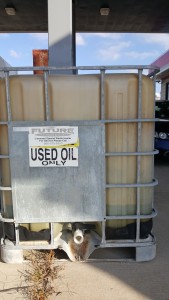
Label containers, above-ground tanks, and underground tank fill pipes as “Used Oil”. This is very important, labeling as “Waste Oil”, “Bad Oil”, “Oil for Recycling”, etc. is frequently cited as a violation by the US EPA. Pennsylvania is the only State that identifies this waste as “Waste Oil”.
Maintain used oil containers and tanks in good condition with no leaking.
If a leak or spill occurs, promptly clean it up with dry methods and dispose of any waste properly.
Also, you should…
Comply with your State’s applicable requirements for the storage of flammable, combustible, and hazardous materials.
Comply with the US EPA Spill Prevention, Control and Countermeasure (SPCC) regulations of the Clean Water Act if your on-site storage of all oil is above threshold amounts.
Transportation of Used Oil:
The used oil transporter you select must comply with the following:
Have a US EPA identification number. It may also require a State solid waste transportation license, check with your State.
Meet all applicable regulations of the US DOT for the transportation of hazardous materials.
Comply with the used oil regulations (Federal and State) applicable to used oil transporters.
There is a special arrangement you may be able to make with your transporter known as the tolling arrangement that removes the requirement for the transporter to have a US EPA identification number. To be eligible for the tolling arrangement the used oil must be reclaimed under a contractual agreement where the reclaimed oil is returned by the processor or re-refiner to the generator for use as a lubricant, cutting oil or coolant.
Management Options for Used Oil:
A used oil generator also has some options available that make the management and disposal of used oil even easier and possibly a net benefit:
You may self-transport up to 55 gallons of your own used oil to a registered used oil collection center or between your facilities to a central aggregation point. You may also transport used oil collected from household do-it-yourselfers or small farmers (those who generate an average of <25 gal/month of used oil in a calendar year) to your facility or an aggregation point. In either case, the transportation must be in a company or employee-owned vehicle.
You may filter, clean, or otherwise recondition used oil for reuse on-site.
You may burn used oil on-site in a space heater if all of the following conditions are met:
Maximum design capacity of the heater is ≤500,000 BTU”s/hour.
Combustion gases are vented to the outside.
Sources of used oil are limited to: on-site generation or other locations owned by the company (you can use self-transportation to aggregate volumes) or receive directly (without a middle-man or used oil marketer) from household do-it-yourselfers or small farmers.
Managed in surface impoundments or waste piles unless permitted.
Used as a dust suppressant.
Burned in a non-exempt boiler or space heater (see above).
Conclusion:
Used oil is a type of waste the USEPA believes can be managed in a way that protects human health and the environment without resorting to full regulation as a hazardous waste under the Resource Conservation and Recovery Act (RCRA). For this reason the used oil regulations were created. Make certain that you comply with the relaxed regulatory requirements and take advantage of the options available to you as a generator of used oil.